English
  简体中文
简体中文  Deutsch
  Español
  Français
  Italiano
  日本語
日本語  한국어
한국어  Polski
  Português
  Русский
  Türkçe
  Nederlands
  Tiếng Việt
  ไทย
ไทย 
What Is Curved Linear Lighting?
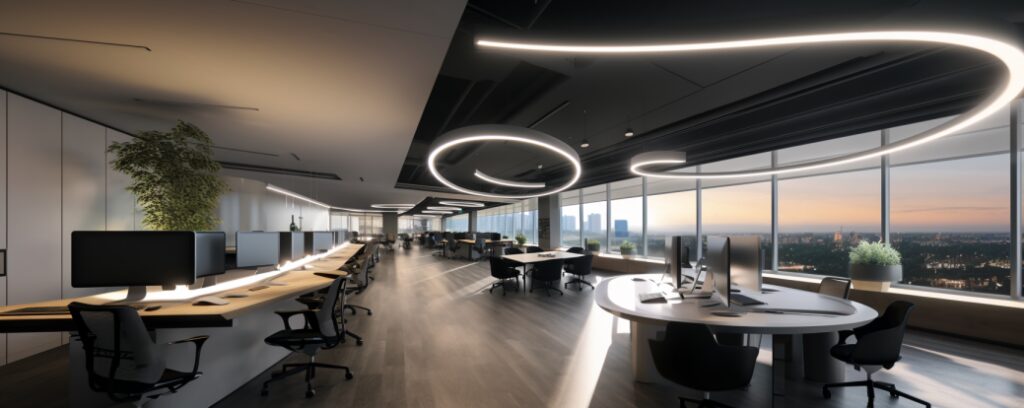
Curved linear lighting refers to LED linear fixtures designed to follow curved or irregular architectural lines while maintaining continuous and uniform illumination.
Unlike traditional straight lighting systems, curved linear lighting integrates directly into architectural forms, allowing lighting to become part of the design rather than an added element.
Typical systems include:
- Flexible LED strips
- Bendable aluminum profiles
- Customized diffusers
These solutions enable designers to create:
- Circular ceiling lighting
- Wave-shaped lighting layouts
- Curved corridor lighting
- Artistic office lighting features
In modern architecture, curved linear lighting is increasingly used to achieve both functional illumination and visual impact.
Why Curved Lighting Is Popular in Modern Office Design
Modern office environments are shifting from rigid layouts to more fluid and human-centric designs. Curved lighting plays a key role in this transformation.
1. Visual Identity
Curved lighting creates distinctive ceiling patterns that enhance brand recognition.
2. Spatial Flow
Lighting lines guide movement and improve spatial navigation.
3. Architectural Integration
Lighting becomes part of the structure, not an afterthought.
4. Visual Comfort
Continuous diffused lighting reduces glare compared to point sources.
As a result, curved linear lighting is now a preferred solution for contemporary office environments.
Types of Bendable Linear Lighting Solutions
Curved lighting can be achieved using several technical approaches depending on project requirements.
1. Flexible LED Strip + Silicone Diffuser
Best for:
- Decorative lighting
- Small-radius curves
- Indirect lighting
Advantages:
- High flexibility
- Seamless lighting effect
2. Bendable Aluminum Linear Profiles
Best for:
- Architectural lighting
- Office ceiling integration
- Suspended linear systems
Advantages:
- Strong structural stability
- Professional appearance
- Better heat dissipation
3. Custom Curved Linear Fixtures
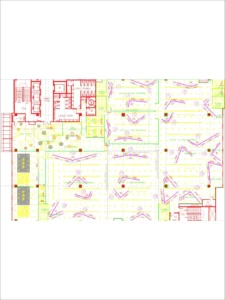
For complex projects, manufacturers can produce pre-engineered curved fixtures based on CAD drawings.
Advantages:
- Precise radius control
- Consistent light output
- Simplified installation
Choosing the right solution depends on the balance between flexibility, performance, and installation requirements.
Key Design Considerations for Curved Linear Lighting
Designing curved linear lighting requires careful attention to both optical and structural factors.
Bending Radius
Every lighting system has a minimum bending radius.
If exceeded, it may cause:
- LED damage
- Diffuser deformation
- Uneven lighting
Selecting the correct radius is critical for both performance and durability.
Light Uniformity
To achieve seamless lighting:
- Use high-density LED strips or COB technology
- Avoid visible LED dots
- Ensure proper diffuser design
Uniformity is the key factor that defines lighting quality in curved applications.
Glare Control
For office environments:
- Maintain UGR < 19
- Use diffused optical covers
Driver Placement
Curved systems often require:
- Remote drivers
- Accessible maintenance points
Proper electrical planning improves long-term reliability.
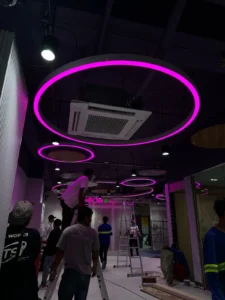
Office Project Case Study: Curved Lighting in a Modern Workspace
Project Overview
Project Type: Modern office
Location: Southeast Asia
Application: Functional lighting + ambient lighting
Lighting System: Bendable aluminum profile + linear module
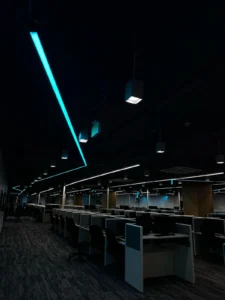
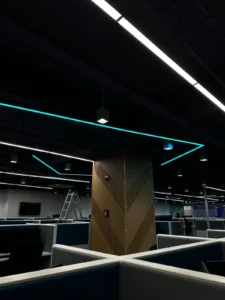
The design required large-scale curved lighting elements combined with geometric patterns to enhance the office atmosphere.
Project Challenges
The client initially faced several practical and technical challenges:
1. Transportation Constraints
Large circular fixtures (up to 5 meters in diameter) were difficult to transport as complete units.
2. Tight Delivery Schedule
The project required fast production and efficient installation.
3. Limited Supplier Flexibility
Previous suppliers offered:
High pricing
No customization options
4. Complex Geometry Requirements
Circular lighting (2m and 5m diameter)
Zigzag linear lighting layouts
These challenges required a solution that balanced customization, efficiency, and cost control.
Engineering Solution
A fully customized bendable linear lighting system was developed.
Structural Solution
- Aluminum profiles redesigned into modular segments
- Connected using mechanical connectors
- Enabled on-site assembly
This modular approach solved transportation issues while maintaining structural precision.
Electrical Solution
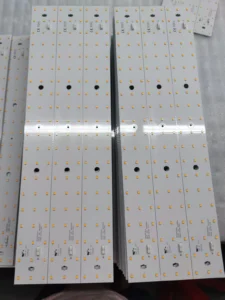
- Customized LED linear module with integrated WAGO connectors
- Plug-and-play wiring system
This significantly reduced installation time and minimized wiring errors.
Technical Specifications
- Power: 10W/m
- Efficiency: 130 lm/W
- CRI: Ra90
- Colors: 6000K + pink + violet + ice blue
- Connection angles: 120° / 150° (customized)
- Dimming system: 0–10V
Customization Details
- Circular diameters: 1.2m,2m and 5m
- Shapes: circular and zigzag
- LED modules tailored to each radius and length
Customized design ensured both geometric accuracy and consistent lighting output.
Installation & Execution
The system was designed for efficient on-site installation:
- Assemble aluminum profiles using connectors
- Connect LED modules via WAGO terminals
- Install onto ceiling structure
No complex pre-shaping or specialized tools were required.
Final Results
The project delivered strong performance outcomes:
- Seamless lighting: No visible joints
- Uniform illumination: No dark areas
- Faster installation: Simplified assembly process
- Optimized segmentation: Reduced joints while maintaining transport efficiency
Client Feedback:
“Installation was much easier than expected. Everything connected smoothly on site, and the lighting looks clean and continuous. It really helped us complete the project faster.”
Advantages of Curved Linear Lighting Systems
Compared with traditional straight lighting, curved systems offer clear benefits:
- Architectural Freedom: Adapt to complex geometries
- Seamless Visual Effect: Continuous light lines
- Flexible Customization: Tailored shapes and sizes
- Enhanced Design Value: Lighting becomes a key visual element
These advantages make curved linear lighting a core solution in modern architectural design.
Future Trends in Architectural Linear Lighting
Lighting design is evolving toward:
- Continuous linear lighting systems
- Integrated architectural lighting
- Flexible and adaptive lighting shapes
- Smart lighting control systems
Curved linear lighting aligns perfectly with these trends and will continue to grow in commercial applications.
FAQ
What is curved linear lighting?
Curved linear lighting is a system where LED fixtures follow curved architectural shapes instead of straight lines, creating continuous and integrated lighting designs.
Can LED linear lights be bent?
Yes. Many systems use flexible LED strips or specially designed bendable aluminum profiles to achieve curved shapes.
What is the minimum bending radius for curved linear lighting?
The bending radius depends on the product design. In architectural applications, larger radii such as 2m or 5m diameter are commonly used to maintain lighting uniformity.
Where is curved linear lighting commonly used?
It is widely used in offices, hotels, shopping malls, and architectural ceiling designs.
Conclusion
Curved linear lighting transforms lighting from a functional necessity into a core architectural element. By combining bendable LED technology, modular aluminum profiles, and proper lighting design, it is possible to achieve both visual impact and high-performance illumination.
For modern office projects, bendable linear lighting is not just an option—it is the optimal solution for achieving seamless curved lighting design.
Need custom curved linear lighting for your project?
Send us your CAD drawings and we will propose a bending solution within 48 hours.
Related Posts