English
  简体中文
简体中文  Deutsch
  Español
  Français
  Italiano
  日本語
日本語  한국어
한국어  Polski
  Português
  Русский
  Türkçe
  Nederlands
  Tiếng Việt
  ไทย
ไทย 
The best LED tape lights for dimming and color accuracy are those that maintain electrical stability, spectral consistency, and perceptual smoothness from full output down to near-zero light levels without visible flicker or color shift.
In professional lighting terms, “best” does not mean brightest, cheapest, or most feature-rich. It means the LED system continues to behave predictably as current is reduced, which is the most demanding operating condition for any white-light LED source. White-light dimming exposes weaknesses in phosphor formulation, driver interaction, voltage architecture, and thermal balance. High-quality LED tape lights are engineered to remain stable across all of these variables simultaneously.
This article will explain how LED tape lights achieve smooth low-level dimming, stable color accuracy, and consistent white-light performance under real-world conditions. For a deeper technical explanation of COB architecture and its role in dimming behavior, see our detailed guide on About Dimmable COB LED Strip Lights.
Quick technical summary
High-quality LED tape lights for dimming maintain a stable white spectrum, flicker-free output, and smooth fade-to-black from full brightness to near zero. This performance depends on strong low-current regulation, minimal spectral shift, tight SDCM binning, appropriate PWM control, and system voltage stability, with 24V designs offering superior low-level dimming behavior compared to 12V systems.
Why white-light dimming exposes LED strip quality more than full output operation
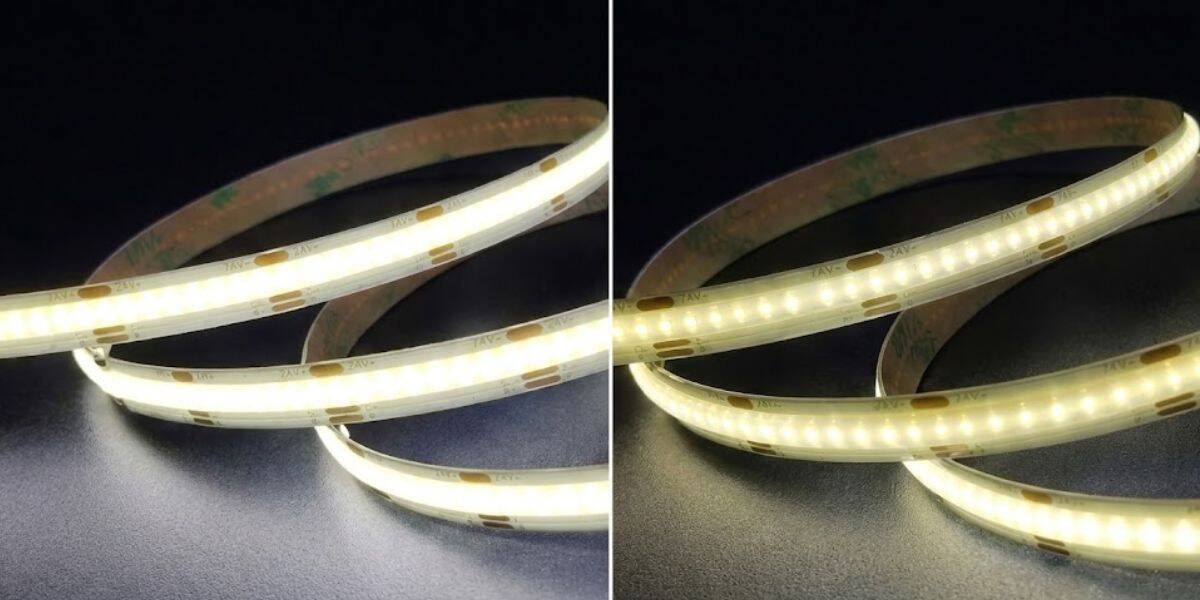
White-light dimming forces the LED system to operate far below its nominal current range. At high output, most LED tape lights appear acceptable because current regulation is easier and phosphor excitation is strong. As current drops, electrical and optical weaknesses become visually obvious.
Human vision is particularly sensitive at low luminance levels, where small spectral or temporal variations are perceived as color changes rather than simple brightness changes. This is why dimming performance is the fastest way to separate professional-grade LED tape lights from entry-level products.
What smooth fade-to-black means in LED tape lighting
Smooth fade-to-black means continuous brightness reduction to below approximately 5 percent output without visible stepping, flicker, or sudden cutoff.
Achieving this requires stable current regulation at very low drive levels and phosphor behavior that remains linear as excitation energy decreases. Most low-cost LED tape lights fail here, shutting off abruptly or flickering before reaching darkness.
What flicker-free dimming means in practical terms
Flicker-free dimming means the LED produces no visible or camera-detectable light modulation across the dimming range under normal viewing conditions.
Technically, this requires either sufficiently high PWM frequencies or current-reduction methods that remain stable at low output levels. Flicker is most noticeable during deep dimming, which is why dimming quality cannot be evaluated at full brightness.
What color shift during dimming actually refers to
Color shift during dimming refers to changes in spectral balance or correlated color temperature as LED output is reduced.
This occurs when phosphor efficiency, blue pump behavior, or current density changes alter the emitted spectrum. High-quality LED tape lights minimize this shift so white light remains perceptually consistent from bright to dim.
Why CRI and R9 are not interchangeable metrics
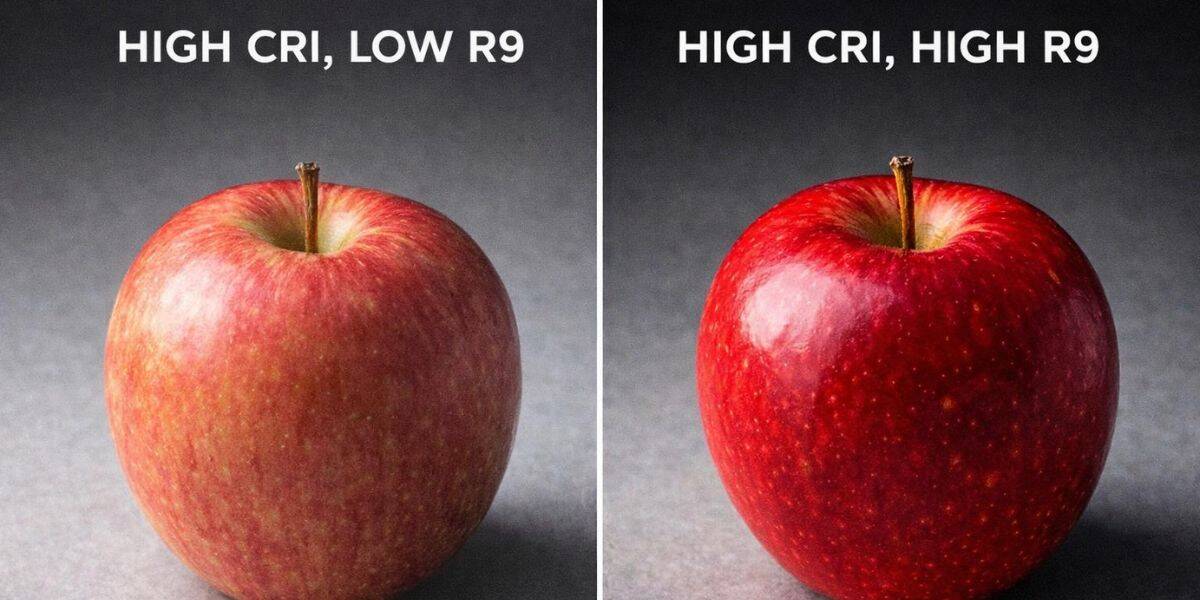
CRI measures how accurately a light source renders a set of reference colors, while R9 specifically evaluates saturated red rendering.
A high CRI value without strong R9 performance often results in visually clean but lifeless whites when dimmed. For white-light dimming, R9 stability is critical because red wavelengths are typically the first to degrade as current drops.
While CRI and R9 are often discussed as technical metrics, their growing importance is also reflected in broader market demand and manufacturing priorities. For additional context on how high-CRI and high-R9 COB LED strips are influencing product development and supply chain trends, see High CRI & High Efficacy COB LED Strips: Market Demand and Supply Chain Trends.
What SDCM means and why it matters during dimming
SDCM (Standard Deviation of Color Matching) describes how closely multiple LEDs match each other in color.
Lower SDCM values indicate tighter binning. During dimming, poor binning becomes obvious because small spectral differences are amplified at low light levels, leading to patchy or uneven white appearance along the strip.
What PWM frequency controls in LED dimming systems
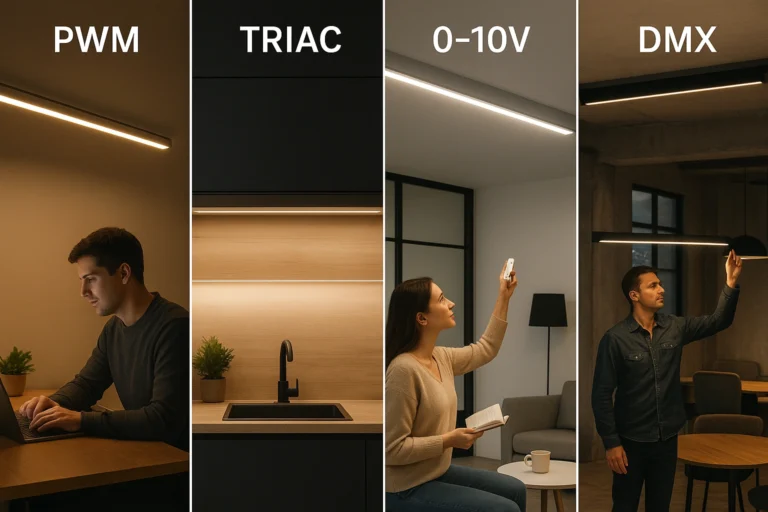
PWM frequency defines how fast the LED is switched on and off to control brightness.
Low PWM frequencies can cause visible flicker and stepping during dimming. High-frequency PWM, typically several kilohertz or higher, reduces perceptible flicker and improves smoothness, especially near the bottom of the dimming curve.
What electrical stability at low current really means
Electrical stability at low current is the ability of the LED and driver system to regulate current accurately when output demand is only a small fraction of nominal load.
Instability at this stage causes flicker, dropout, or color shift and is one of the most difficult engineering challenges in high-quality dimmable LED tape lights.
Why many LED tape lights fail during dimming
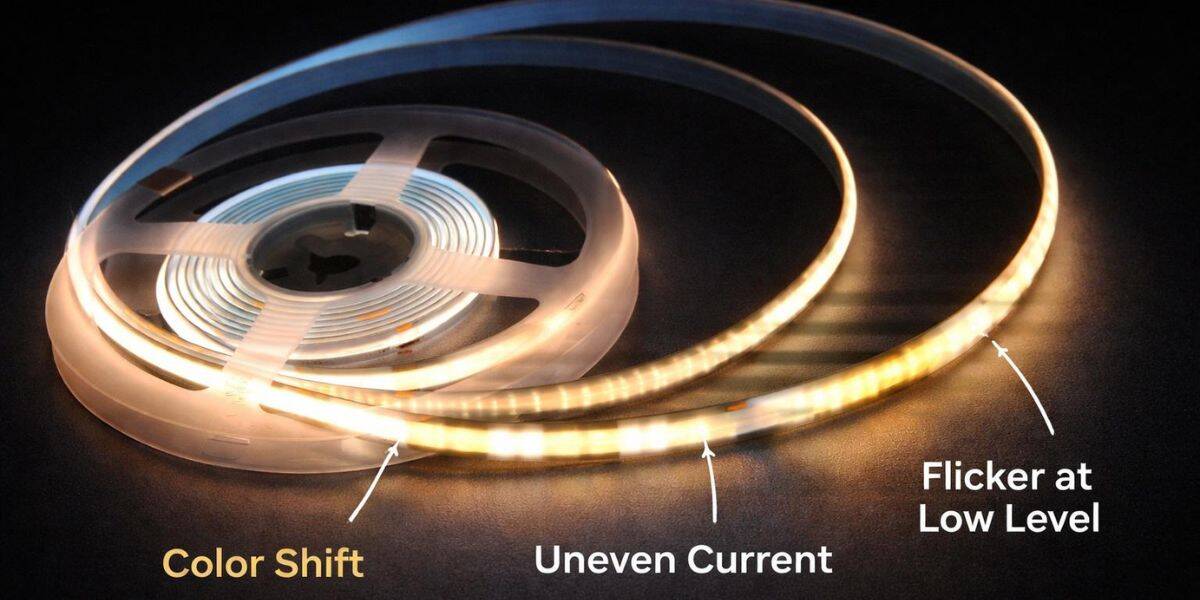
Most LED tape lights fail during dimming because they are optimized for brightness efficiency, not low-current control.
The most common engineering failure modes include:
- Voltage instability along the strip as current drops
- Non-linear phosphor response at low excitation energy
- Low PWM frequency causing visible flicker
- Poor current regulation at low load
- Thermal imbalance affecting LED junction behavior
These issues are typically invisible at full brightness.
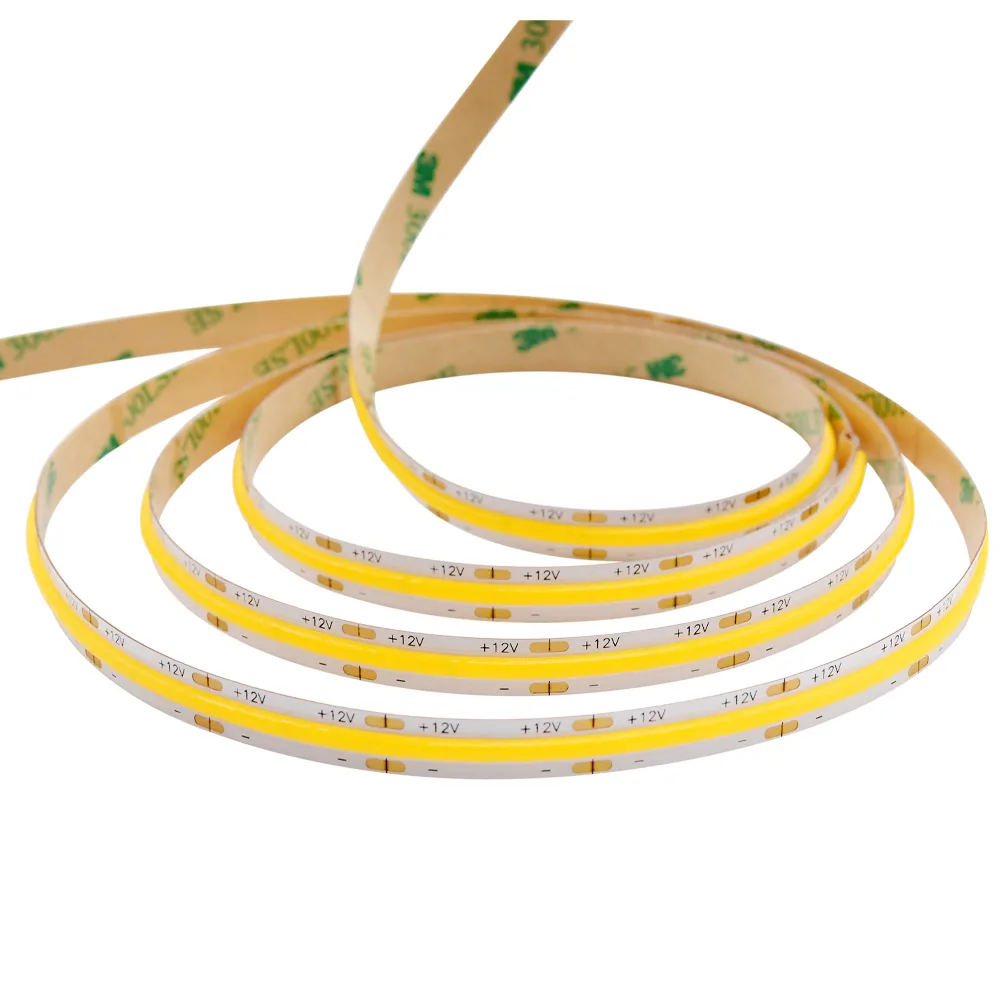
Single Color COB LED Strip Light
- Main Model: FYX08T480C
- LED Chip QTY per Meter: 320/384/480/528chips (Sanan)
- CRI: >90CRI: >90
- PCB Width: 8mm/10mm
- Color Temperature: 2700K/3000K/4000K/6500K
- Input Voltage: DC12V/DC24V
- Power per Meter: 8W/10W/11W/14W
- Efficiency: 130-150lm/W
- IP Grade: IP20/IP54/IP65/IP67/IP68
- Warranty: 3 years
How professionals technically evaluate LED tape lights for dimming and color accuracy
Professionals evaluate LED tape lights using measurable, repeatable parameters rather than visual impressions.
Key evaluation parameters include:
- CRI with emphasis on R9 performance
- SDCM binning consistency across the strip
- PWM frequency and modulation depth
- Current stability at low dimming levels
- Spectral shift across the dimming curve
- Voltage drop behavior under reduced load
Each parameter addresses a specific failure mode visible only during dimming.
Why entry-level LED tape lights behave differently from professional-grade products
Entry-level LED tape lights are optimized for cost and luminous output per dollar. Professional-grade products are optimized for stability, consistency, and control.
The difference becomes obvious at the bottom end of the dimming curve, where professional products maintain output integrity and entry-level products do not.
Technical comparison of entry-level vs professional-grade LED tape lights
| Parameter | Entry-level LED tape | Professional-grade LED tape |
| Low-level dimming | Abrupt cutoff or stepping | Smooth fade-to-black |
| Color stability | Noticeable shift | Stable white point |
| CRI / R9 | Nominal CRI, weak R9 | High CRI with strong R9 |
| PWM behavior | Low or undefined | High-frequency, controlled |
| Electrical tolerance | Minimal margin | Designed for low-current stability |
Why system voltage affects dimming stability more than most users realize
System voltage determines how sensitive an LED tape light is to voltage drop and current variation during dimming.
At lower voltages, small changes in resistance or connector quality have a proportionally larger effect on delivered current, directly impacting dimming smoothness and color consistency.
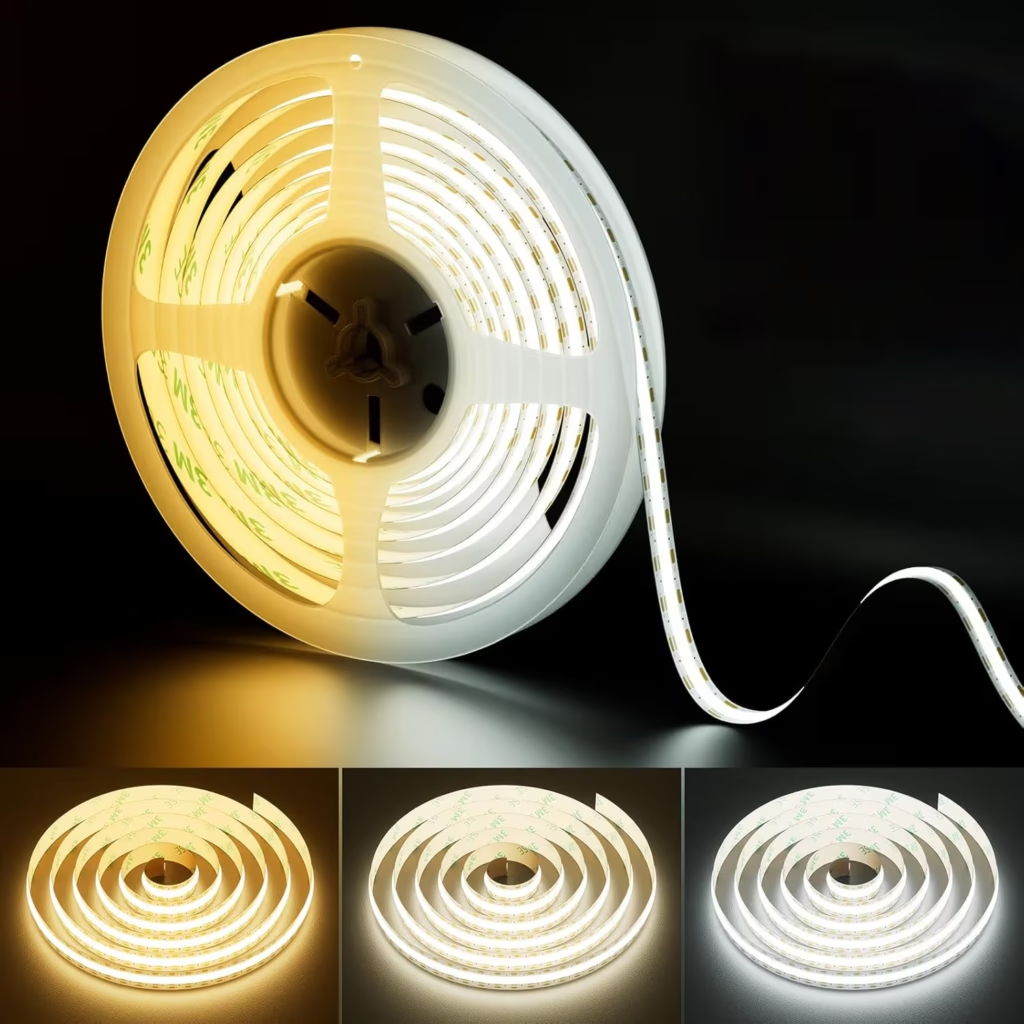
Dual Color Tunable White COB LED Strip Light
- Main Model: FYT10T608C
- LED QTY per Meter Option: 608/640chips (Sanan)
- PCB Width Option: 10mm
- Color Option: 2700K – 6500K tunable
- CRI:>90
- Input Voltage: DC12V/DC24V
- Power per Meter: 14W/16W
- Efficiency: 90-110 lumen/watt
- IP Grade Option: IP20/IP54/IP65/IP67/IP68
- Warranty: 3years
Why 24V LED tape lights outperform 12V systems in low-level dimming
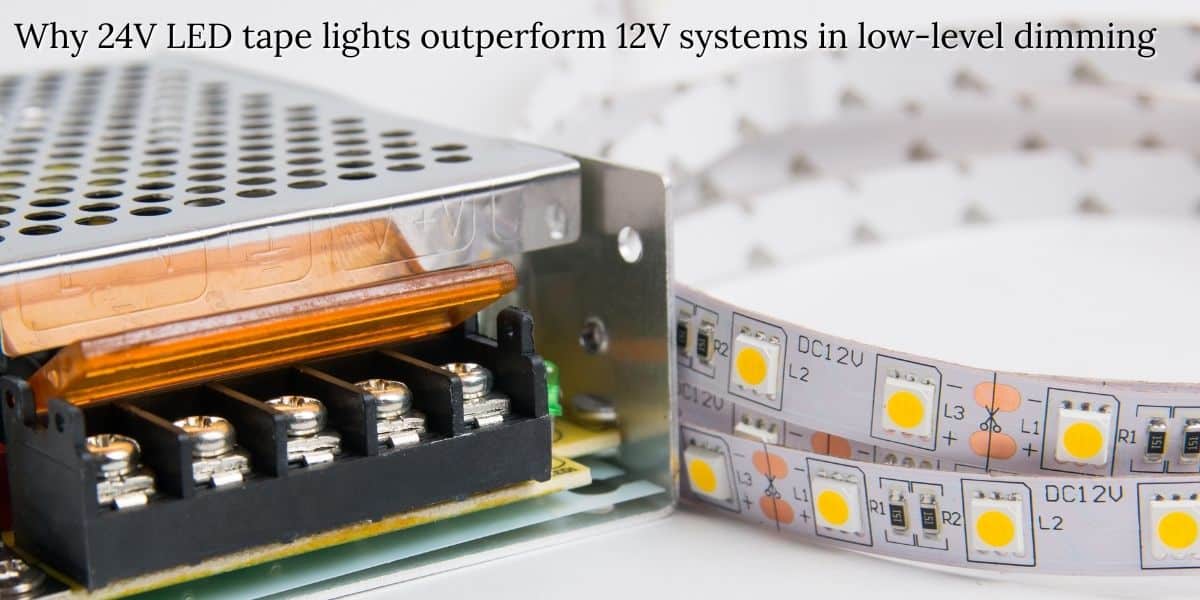
24V LED tape lights reduce current for the same power level, minimizing voltage drop and improving current regulation accuracy.
Technical comparison of 12V vs 24V LED tape systems
| Aspect | 12V system | 24V system |
| Current for same power | Higher | Lower |
| Voltage drop impact | Significant | Reduced |
| Low-level dimming | Less stable | More stable |
| Color consistency | More variation | Better uniformity |
| Maximum practical run length | Shorter | Longer |
Why COB architecture changes perceived dimming behavior
COB LED tape lights distribute light more uniformly using many small dies under a continuous phosphor layer.
This uniform emission masks minor electrical variations, resulting in smoother perceived dimming compared to discrete SMD designs.
Technical comparison of COB vs traditional SMD LED tape construction
| Feature | COB LED tape | Traditional SMD LED tape |
| Light emission | Continuous | Point-based |
| Perceived dimming | Smoother | More segmented |
| Visual uniformity | High | Moderate |
| Sensitivity to binning | Lower | Higher |
Why COB does not automatically guarantee good dimming performance
COB architecture improves visual smoothness but does not correct poor electrical design.
If current regulation, PWM implementation, or phosphor formulation is weak, COB strips will still flicker or shift color when dimmed.
Why RGB LED strips are unsuitable for white-light dimming
RGB LED strips create white light by mixing colored emitters rather than producing true white light.
Because each channel responds differently to reduced current, RGB systems exhibit severe color shift and unstable whites during dimming and are unsuitable for precision white-light applications.
When RGBW LED tape lights can be acceptable for white-light dimming
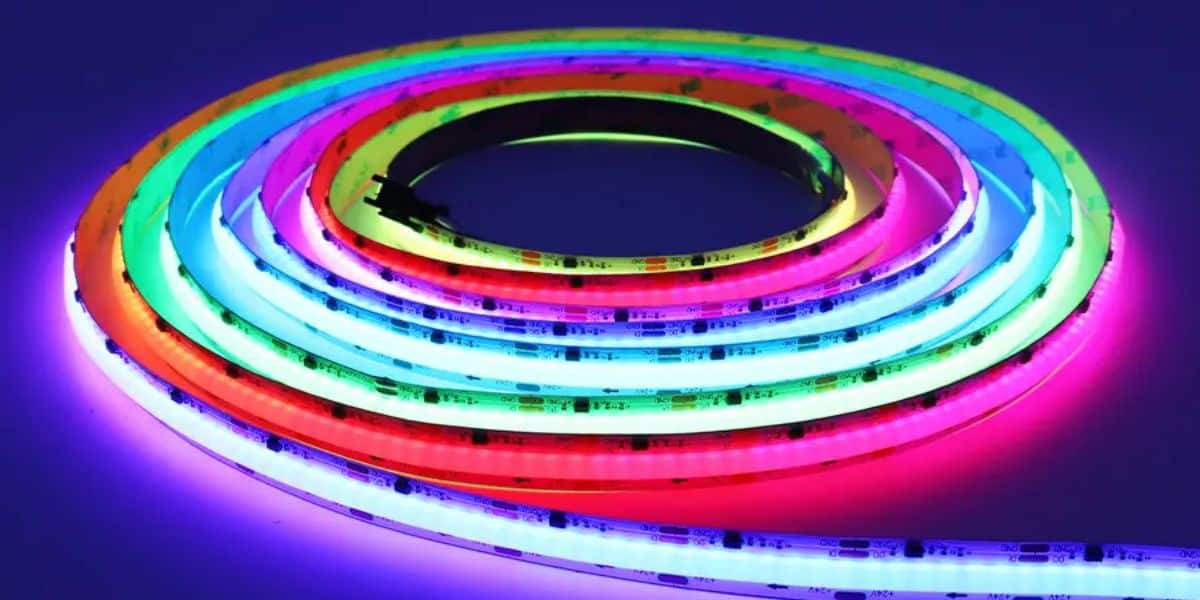
RGBW LED tape lights are acceptable only when the white channel is electrically independent and solely responsible for white-light output.
A COB RGBW LED strip light 24V can perform well if the white LEDs meet the same electrical and spectral criteria as dedicated white-only strips. RGB channels must remain inactive during white-light dimming.
Why driver compatibility matters as much as the LED tape itself
The LED driver determines how current is reduced during dimming.
Even a high-quality LED tape light will perform poorly if paired with a driver that cannot regulate current accurately at low load or uses low-frequency PWM.
The electrical behavior discussed here is directly influenced by the dimming method and control strategy used in the system. For a detailed explanation of LED strip dimming methods, driver types, and compatibility considerations, see How to Dim LED Strip Lights.
What actually defines the best LED tape lights for dimming and color accuracy
The best LED tape lights are defined by engineering performance, not marketing claims.
Core defining criteria include:
- Stable white spectrum from full output to near-zero light
- Smooth fade-to-black without stepping or dropout
- Flicker-free operation at low dimming levels
- High CRI with strong, stable R9 values
- Tight SDCM binning across the strip
- Electrical design optimized for low-current stability
Conclusion
The best LED tape lights for dimming and color accuracy are those that remain electrically and spectrally stable as brightness is reduced.
Smooth fade-to-black, flicker-free operation, and minimal color shift at low light levels depend on stable low-current regulation, proper PWM implementation, tight SDCM binning, and strong R9 performance. From an engineering standpoint, 24V systems provide superior dimming stability compared to 12V, COB construction improves perceived smoothness, and RGB mixing is unsuitable for accurate white-light dimming.
In technical terms, “best” means predictable, repeatable behavior across the entire dimming range, not maximum brightness or marketing specifications.
FAQ’s
Related Posts