English
  简体中文
简体中文  Deutsch
  Español
  Français
  Italiano
  日本語
日本語  한국어
한국어  Polski
  Português
  Русский
  Türkçe
  Nederlands
  Tiếng Việt
  ไทย
ไทย 
With the widespread adoption of LED technology in commercial lighting, architectural lighting, and linear lighting applications, lighting products are no longer solely judged by “whether they are bright enough.” The quality of light, its safety, and the long-term impact on human eye health are increasingly becoming key criteria for clients in project selection and brand evaluation. Among these, “blue light hazard” and its corresponding international standard, IEC 62471, are drawing growing attention from lighting contractors, designers, and end-users.
So, what exactly is the IEC 62471 blue light hazard? Are LED strips truly safe for human eyes in practical applications?
The IEC 62471 blue light hazard standard is an international benchmark for assessing the photobiological safety of all non-coherent light sources (including LEDs). It categorizes light sources into risk groups based on their potential hazards to the eyes and skin—particularly concerning the high-energy blue spectrum range of 400-500 nanometers.
When used correctly in conventional lighting applications, LED strips are generally safe for the eyes. This is because most consumer LED products fall under the standard’s exempt or low-risk (Class 1) categories.
This article provides a systematic analysis from multiple perspectives: the principles of blue light hazard, standard interpretation, risk classification, and safe design of LED strips.
What is blue light? Why is blue light hazard a major concern?
Blue light typically refers to visible light with wavelengths between approximately 400 and 500 nm, with the 415–455 nm range possessing higher light energy. As an efficient light source, LEDs’ emission mechanism can result in relatively concentrated energy peaks within this band, particularly noticeable in high-brightness, cool-color-temperature products.
In commercial lighting, office environments, retail spaces, and industrial settings, LED strips are frequently used for prolonged, close-range illumination. Without proper blue light control, sustained exposure can cause visual fatigue and potentially pose risks to the retina. Furthermore, viewing these light sources poses significant retinal hazards. Prolonged exposure to blue light can cause cumulative damage to the eyes over time. Consequently, blue light concerns have evolved beyond discussions about consumer products, increasingly becoming a matter of “compliance and safety” in lighting projects.
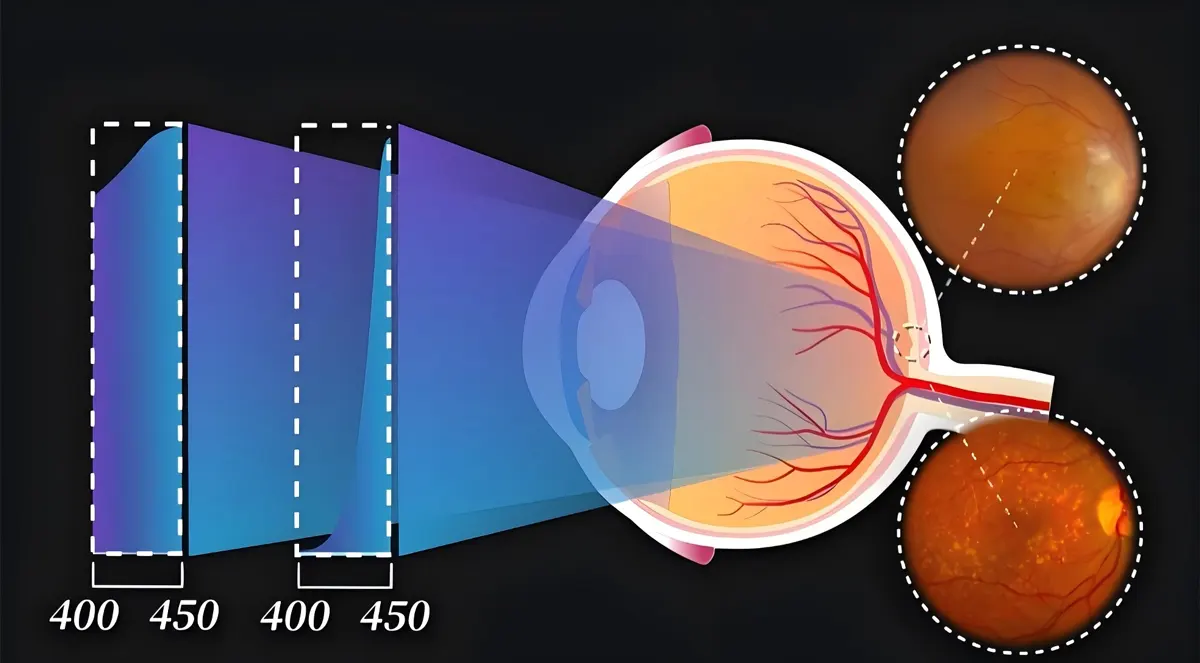
Potential Hazards of Blue Light to the Human Eye
Blue light hazards fundamentally fall under the category of photobiological safety concerns. Prolonged exposure of the human eye to high-energy short-wavelength blue light may trigger photochemical reactions at the retinal level, leading to cumulative damage. This is the core reason behind the international introduction of the concept of blue light hazard.
It is crucial to emphasize that blue light hazard does not cause “immediate blindness.” Instead, it represents a risk closely tied to brightness levels, exposure duration, and viewing distance. In prolonged usage environments such as office spaces and commercial settings, the blue light safety rating of lighting fixtures becomes particularly significant. Blue light is not inherently “harmful light,” but excessive or prolonged exposure may pose the following risks:
- Retinal Blue Light Hazard: High-energy blue light may cause cumulative damage to the retina’s photochemical structures.
- Visual Fatigue: Leading to dry eyes, eye discomfort, and blurred vision.
- Glare Discomfort: Particularly noticeable with excessive brightness or direct light source exposure.
- Circadian Disruption: High blue light exposure at night may affect melatonin secretion and sleep rhythms.
Therefore, the critical factors are not merely “the presence of blue light,” but rather its intensity, exposure duration, and viewing distance.
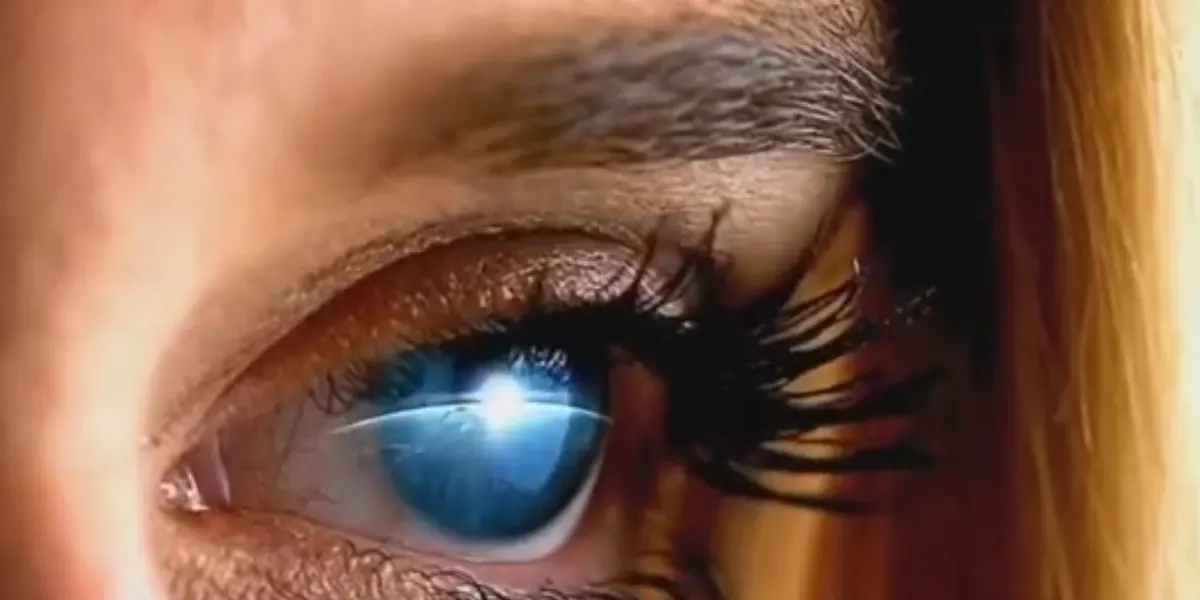
Why are blue light safety standards necessary?
With the global adoption of LED lighting, countries increasingly recognize that traditional electrical safety or EMC standards alone cannot comprehensively evaluate light sources’ effects on human health. Consequently, the International Electrotechnical Commission (IEC) developed IEC 62471, “Photobiological Safety of Lamps and Lamp Systems,” addressing the impact of light radiation on eyes and skin.
The necessity of blue light safety standards manifests in multiple aspects:
First, it regulates product design by limiting blue light radiation to low-risk levels (e.g., Class 0 or Class 1 in international standards), reducing cumulative harm from prolonged exposure.
Second, the standard empowers consumers by providing selection criteria—such as identifying certified products through safety labels—helping the public mitigate risks in daily use. Safety standards also drive technological advancements, like optimizing blue light output in LED lighting and electronic devices to balance illumination efficiency with health requirements.
For end-users, compliance with IEC 62471 not only impacts health but directly affects:
- Project bidding and acceptance
- Product export and regulatory compliance
- Brand professionalism and long-term credibility
What is the IEC 62471 standard?
IEC 62471 is a series of standards developed by the International Electrotechnical Commission (IEC) concerning the photobiological safety of lamps and lighting systems. It aims to evaluate the hazards of light radiation from light sources to the eyes and skin. The standard covers wavelengths from 200 nm to 3000 nm, encompassing ultraviolet, visible, and infrared radiation. It classifies hazards into four levels: exempt, low hazard, medium hazard, and high hazard.
IEC 62471 is currently the globally adopted standard for photobiological safety assessment, applicable to various light sources, including LED luminaires, light strips, modules, and system lighting products. This standard does not evaluate “illuminance performance” but focuses on assessing potential risks from light radiation, covering:
- Blue light hazard
- Ultraviolet radiation
- Infrared radiation
- Thermal radiation, etc.
| Hazard | LED Type | RGO Exempt TLV>10,000 s | RG1 Low Risk TLV 100- 10,000 s | RG2 Moderate Risk TLV 0.25-100 s | RG3 High Risk TLV<0.25 s |
| Actinic UV Hazard Skin and Eye(ES) (200-400 nm) | UVC, UVB, UVA | Not Required | Minimize exposure to eyes or skin. Use appropriate shielding | Eye and skin irritation may result from exposure. Use appropriate shielding | Avoid eye and skin exposure to unshielded product |
| Retinal Blue Light Hazard (LB and EB) (300-400 nm) | UVB, UVA, Blue, White | Not Required | Not Required | Do not stare at operating lamp. May be harmful to eyes | Do not look at operating lamp. Eye injury may result |
| Retinal Blue or Retinal Thermal Hazard (LB EB LR) (400-700 nm) | Blue, White, Green, Red | Not Required | Not Required | Do not stare at operating lamp. May be harmful to eyes | Do not look at operating lamp. Eye injury may result |
| Cornea/Lens Infrared Hazard (EIR) (780-3000 nm) | IR | Not Required | Use appropriate shielding or eye protection | Avoid eye exposure. Use appropriate shielding or eye protection | Avoid eye exposure.Use appropriate shielding or eye protection |
| Retinal Thermal Hazard,Weak Visual Stimulus (LIR) (780-1400 nm) | IR | Not Required | Do not stare at operating lamp | Do not stare at operating lamp | Do not stare at operating lamp |
Among these, the blue light hazard rating is the most frequently discussed and often misunderstood aspect of LED lighting products. Blue light hazard refers to photochemical effects caused by radiation in the 400-500 nm wavelength range, which may lead to retinal damage. This standard applies to all non-coherent broadband light sources (e.g., LEDs, fluorescent lamps), excluding lasers.
Measurement and Evaluation:
- Specifies maximum radiation intensity limits.
- Defines measurement methods (e.g., spectral distribution, BLHI calculation).
- Evaluation distance for general lighting luminaires is typically 500 lx illuminance level, not less than 200 mm.
- Labeling Requirements: Exempted products require no warning labels; low-risk and higher categories must display corresponding warning labels.
- Related Standards: Technical Report IEC/TR 62778 specifically addresses the retinal blue light hazard provisions in IEC 62471, recommending hazard group boundaries be determined under measurement conditions of 200 mm and 0.011 rad.
Testing Principle for Blue Light Hazard in IEC 62471
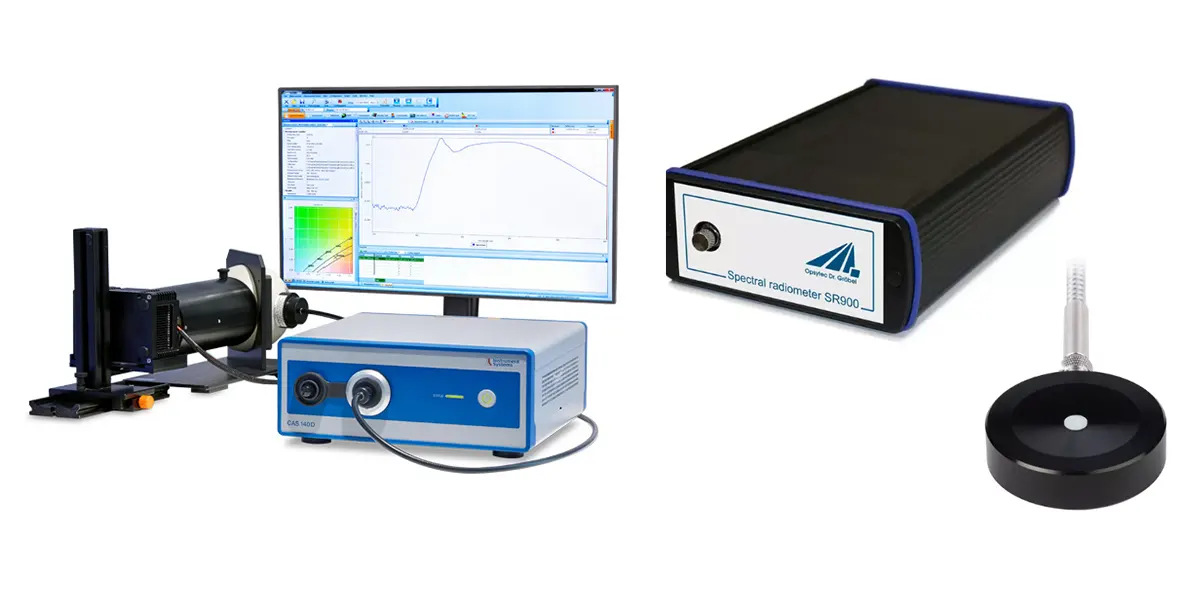
IEC 62471 evaluates blue light risk through spectral radiance measurement:
1) Measure the light source’s radiant energy between 400 and 500 nm using a radiometer.
2) Perform weighted calculations using the blue light hazard weighting function B(λ).
3) Derive the blue light hazard value based on exposure time, viewing angle, and irradiance.
4) Compare results against limits to determine risk level.
IEC 62471 evaluates light sources by measuring blue light weighted luminance (LB), combined with specified viewing distances and exposure times. Testing typically occurs under standard conditions, simulating human eye exposure in typical usage scenarios.
For continuous linear light sources like LED strips, testing focuses on luminance distribution in actual installation conditions; it evaluates the blue light attenuation effect of optical diffusion structures and assesses whether localized bright spots pose increased risk.

IEC 62471 Blue Light Safety Classification
IEC 62471 primarily evaluates the potential hazards of light sources to the human eye and skin, with a particular focus on “blue light hazard”; blue light can cause chemical damage to the human retina. The international standard IEC 62471 establishes guidelines for assessing the photobiological safety of luminaires. It imposes stringent requirements on measurement equipment and procedures to ensure reliable evaluation of photobiological hazards and accurate classification of light sources into BLH risk groups. Based on weighted luminous intensity and exposure time, IEC 62471 categorizes light sources into four risk groups ranging from 0 (exempt) to 3 (high risk).
Additionally, Technical Report IEC-TR 62778 explains how to use IEC 62471 for simplified blue light hazard assessments of luminaires emitting visible radiation. Efforts are currently underway worldwide to develop this technical report into a new standard.
1. Blue Light Safety Risk Group Classification
As shown in the table below, IEC 62471 categorizes blue light hazards into 4 risk groups (RG).
| Risk Group | Name | Description | Exposure Characteristics |
| RG0 | Exempt Group | No blue light hazard | Safe under all reasonably foreseeable conditions |
| RG1 | Low Risk | Low hazard level | No risk under normal use |
| RG2 | Moderate Risk | Moderate hazard | Safe for short-term viewing; prolonged staring may be hazardous |
| RG3 | High Risk | High hazard | Short exposure can cause injury |
2. Blue Light Safety Level Ladder Diagram
| RG3 | ██████████ | High Risk, Do Not Stare Directly < 0.25 S Immediately Hazardous |
| RG2 | ███████ | Moderate Risk, Safe for Short Exposure ≤ 100 S Safe |
| RG1 | ████ | Low Risk, Safe for normal use ≤ 10000 S Safe |
| RG0 | ██ | No Risk, Safe for prolonged exposure ≥10000S |
3. Blue Light Rating Standards for Different Luminaires
IEC 62471 classifies light sources into four risk groups (RG0 to RG3) based on the potential hazard of blue light to the human retina. RG0 and RG1 are safe for normal use, while RG2 and RG3 require risk mitigation through usage restrictions or warning measures.
Based on retinal blue light hazard severity, the standard defines blue light hazard levels. According to test results, IEC 62471 classifies light sources into four risk groups:
- RG0 (Exempt): No blue light hazard risk under reasonable use conditions, suitable for long-duration lighting environments. Applicable to fixtures like interior decorative lights, neon strips, and flexible light strips.
- RG1 (Exempt): Safe under normal use with no strict restrictions on direct viewing time. Also suitable for fixtures like interior decorative lights, neon strips, and flexible light strips. In commercial and office lighting, RG0 or RG1 are widely accepted and recommended blue light safety levels.
- RG2 (Moderate Risk): Prolonged direct viewing may pose risks, typically requiring restrictions through design or usage instructions. Applicable to high-brightness industrial lamps/spotlights/specialized lighting fixtures.
- RG3 (High Risk): Presents significant blue light hazards, generally unsuitable for ordinary lighting scenarios, and typically prohibited as consumer lighting products.
Does the blue light emitted by LED strips affect human eyes?
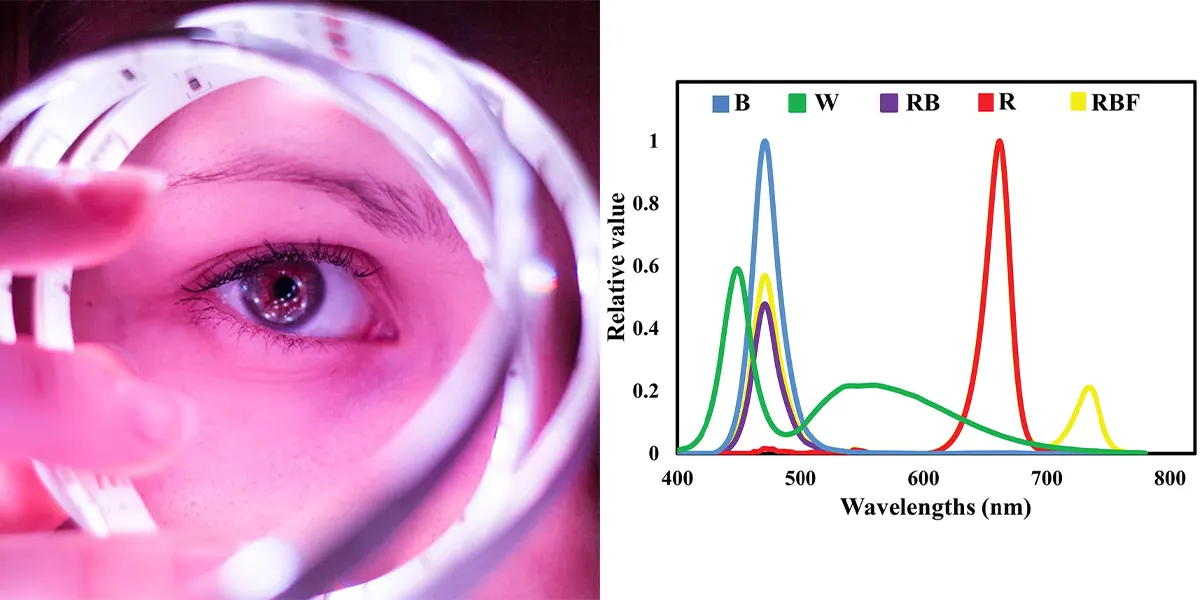
Under normal installation and usage conditions, LED strips are safe for human eyes because:
- LED strips are primarily used for indirect or decorative lighting.
- Users rarely stare directly at the light source for extended periods.
- Proper light diffusion and brightness control significantly reduce glare and blue light exposure.
Only extremely high brightness, non-diffused light viewed at close range may cause discomfort. However, high brightness does not necessarily equate to high blue light risk. Sound optical design can maintain adequate brightness while keeping blue light hazards within safe levels.
Why choose LED strips compliant with IEC 62471?
As the lighting industry advances toward higher quality and standardization, blue light safety should transcend marketing claims to become a verifiable, quantifiable technical metric.
Selecting LED light strips compliant with IEC 62471 blue light safety standards not only reduces potential risks but also demonstrates commitment to end-user health, project compliance, and long-term brand value. SignliteLED will continue investing in R&D for photobiological safety and high-quality linear lighting, delivering safer, more reliable LED strip solutions to global customers.
Choosing IEC 62471-compliant LED light strips means:
- Enhanced eye safety and a more comfortable visual experience;
- Compliance with international standards and diverse project requirements;
- Reduced long-term eye health risks from prolonged use;
- More reliable performance assurance for residential and commercial applications.
Blue light itself is not inherently dangerous—what is dangerous is uncontrolled blue light. LED light strips compliant with IEC 62471 are not only bright and efficient but also safer and more reliable, ensuring long-term peace of mind.
SignliteLED Blue Light Safety Design Advantages for LED Strip Lights
Throughout the development of SignliteLED’s LED strip lights, photobiological safety has been a core design objective. By collaborating with chip manufacturers to optimize chip selection, spectral matching, and optical structures, we produce strip lights that meet safety standards.
As illustrated below, our LED chips undergo specialized optimization to eliminate all ultraviolet spectra. The blue light output is significantly reduced compared to standard white LEDs, achieved by decreasing blue light content between 400-425 nm and 460-525 nm. This approach substantially minimizes blue light exposure while maintaining sufficient red, green, and blue wavelengths to produce high-quality white light.
SignliteLED’s multi-series LED strip products meet IEC 62471 RG0 or RG1 blue light safety requirements. Most products achieve RG0-level standards. These products effectively control blue light risks while maintaining high luminous efficacy and consistency. Multiple products have passed authoritative laboratory testing and obtained IEC 62471 photobiological safety test reports.
Product applications include commercial spaces, office lighting, retail and display lighting, hotels, and public buildings—all scenarios involving long-term use. For customers prioritizing quality and safety, this “performance-meets-health” design philosophy is particularly crucial.
Conclusion
Blue light is a natural component of LED lighting, but excessive exposure without proper control may cause eye discomfort. IEC 62471 provides a scientifically sound and internationally recognized standard for assessing blue light safety and ensuring photobiological protection.
At SignliteLED, our LED strip lights feature an optimized spectrum design that strictly complies with IEC 62471 standards, achieving a balance between brightness, comfort, and eye safety. Choosing IEC 62471-compliant LED strips ensures safer lighting, higher quality, and greater confidence for long-term use.
Related Posts