Français
  English
  简体中文
简体中文  Deutsch
  Español
  Italiano
  日本語
日本語  한국어
한국어  Polski
  Português
  Русский
  Türkçe
  Nederlands
  Tiếng Việt
  ไทย
ไทย 
réponse rapide
Lors de l'évaluation des bandes LED COB remplaceront le LED Neon Flex à l'extérieur, la réponse dépend entièrement de l'environnement d'installation et du niveau d'exposition.
Oui, les bandes LED COB de type IP67 peuvent remplacer les LED Neon Flex à l'extérieur dans des applications encastrées, abritées ou protégées mécaniquement telles que l'éclairage de l'âne, l'éclairage de paysage, l'éclairage sous le banc et les accents de façade cachés. Dans ces conditions, la structure environnante offre une protection contre l'exposition aux UV, la pluie et les impacts physiques, permettant aux bandes d'épis d'atteindre des performances visuelles similaires à un coût de matériau inférieur.
Cependant, pour les installations extérieures entièrement exposées, telles que l'éclairage de la ligne de toit, les contours des bâtiments, les espaces publics à fort trafic et l'éclairage de façade permanent, le LED Neon Flex reste la solution à long terme la plus fiable. Sa structure entièrement encapsulée offre une résistance supérieure à la dégradation des UV, à la pénétration d'humidité et aux chocs accidentels, ce qui réduit les besoins d'entretien au fil du temps.
En résumé, la décision n'est pas déterminée par la seule cote d'étanchéité, mais par le niveau d'exposition global, y compris le rayonnement UV, le stress mécanique et l'usure environnementale à long terme. Les bandes LED COB sont les meilleures pour les environnements protégés, tandis que LED Neon Flex est conçue pour une autoprotection dans des conditions extérieures exposées.
Pourquoi COB LED est-il remplacé par Neon Flex dans certains projets en plein air ?
Jusqu'à il y a quelques années, le choix entre COB LED Strip et LED Neon Flex pour des projets en plein air était rarement remis en question. Neon Flex était l'option par défaut pour l'éclairage extérieur linéaire continu, tandis que le tore est généralement réservé aux environnements intérieurs ou aux installations architecturales hautement protégées.
Cette hypothèse est en train de changer. Depuis 2020, le coût de la bande LED COB évaluée par IP67 a considérablement diminué, rendant les produits COB à haute protection accessibles à un éventail de projets beaucoup plus large. Dans le même temps, les progrès de la technologie d'emballage COB ont considérablement amélioré la qualité de la lumière. Le résultat sans point, visuellement uniforme, qui distingué au néon flex est désormais réalisable avec de nombreuses bandes d'épis modernes.
Alors que les budgets se resserrent et que les propriétaires de projets recherchent une plus grande rentabilité, les acheteurs qui ont déjà fait défaut à Neon Flex réévaluent de plus en plus de savoir si la protection et la durabilité supplémentaires sont nécessaires pour chaque application extérieure. Le résultat est une véritable décision d'approvisionnement plutôt qu'une simple comparaison de produits.
Comme de plus en plus de spécificateurs évaluent les performances de COB vs Neon Flex Outdoor, la question clé n'est plus de savoir si les deux produits peuvent fonctionner à l'extérieur, mais si l'un peut remplacer de manière réaliste l'autre sans compromettre la fiabilité, les exigences de maintenance ou la durée de vie du projet.
Chez Signiteled, nous avons fourni à la fois des bandes LED COB et des produits LED Neon Flex pour des projets d'éclairage architectural et commercial depuis plus de 15 ans. Ces dernières années, l'une des questions les plus courantes des prescripteurs, des entrepreneurs et des acheteurs OEM est de savoir si les bandes de traction IP67 modernes peuvent remplacer Neon Flex à l'extérieur tout en maintenant des performances à long terme.
Pour répondre à cette question, il est nécessaire de regarder au-delà de la luminosité et de l'apparence et de se concentrer sur les caractéristiques structurelles qui déterminent la durabilité à l'extérieur.
Comment les bandes LED COB se comparent-elles à LED Neon Flex à l'extérieur ?
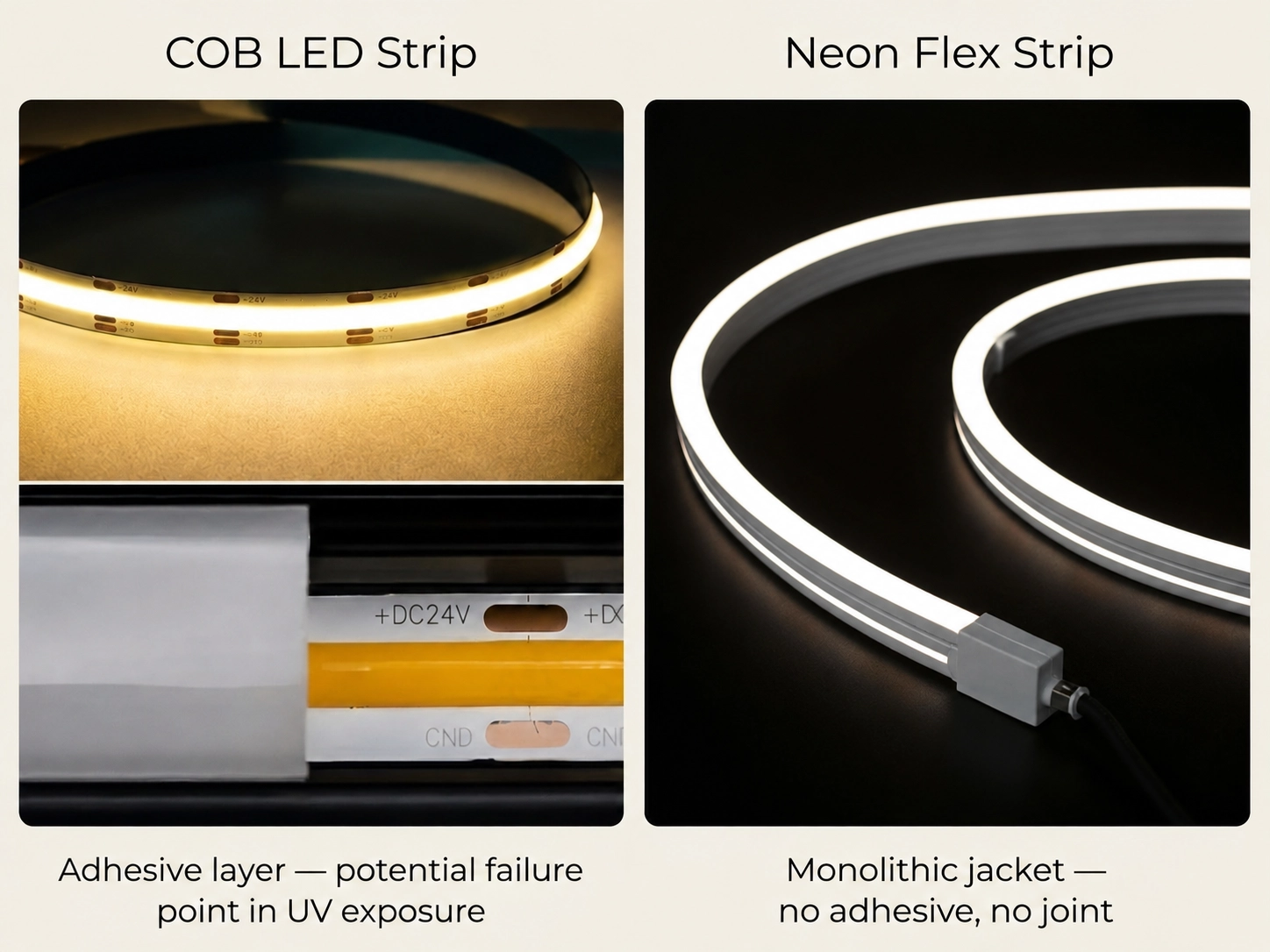
le plus grand Différence entre la bande LED COB et le LED Neon Flex L'extérieur n'est pas la luminosité, la température de couleur ou l'efficacité. C'est ainsi que chaque produit est protégé contre les intempéries, l'exposition aux UV, les impacts physiques et l'usure environnementale à long terme.
A Bande LED COB Place sa couche électroluminescente directement sur un circuit imprimé flexible. Les versions à l'extérieur offrent une protection grâce à des revêtements en silicone ou des manchons en silicone, fournissant généralement une protection IP65, IP67 ou IP68. Comme la source de lumière reste relativement proche de la surface, de nombreuses installations extérieures utilisent des canaux en aluminium pour améliorer la protection mécanique et la gestion thermique. Cependant, les chaînes ne sont pas obligatoires. Selon l'application, des bandes d'épis pour les épis de l'extérieur peuvent également être installées à l'aide de ruban adhésif 3M VHB à haute liaison, de clips de montage, de collage de silicone ou d'autres méthodes de fixation mécaniques.
LED Néon Flex Utilise une approche différente. Les LED sont entièrement encapsulées à l'intérieur d'une veste continue en PVC ou en silicone qui fonctionne comme un diffuseur, une barrière imperméable, un écran UV et un boîtier de protection. Cette construction intégrée signifie que le produit offre une grande partie de sa propre protection sans nécessiter de canaux ou de boîtiers supplémentaires. Cette construction à base de silicone est également ce qui permet au néon flex d'être façonné autour des courbes et des coins architecturaux. Consultez notre aperçu de LED Neon Flex pour un éclairage architectural pour en savoir plus sur la façon dont cette flexibilité est utilisée dans la conception de la façade.
En conséquence, les différences de performances en extérieur entre les deux produits sont largement dues à leur conception structurelle.
Comparaison des performances en extérieur : bande LED COB VS LED NEON FLEX
| Facteur | Bande LED COB | LED Néon Flex | Pourquoi c'est important à l'extérieur |
| Méthode de protection | Revêtement ou manchon en silicone | Encapsulation complète | Détermine la résistance aux intempéries et aux dommages physiques |
| Protection mécanique | Peut nécessiter une protection supplémentaire selon l'application | Protection intégrée | Important dans les environnements publics et exposés |
| Meilleure cote IP disponible | IP68 | IP68 | Convient aux conditions météorologiques difficiles |
| Résistance aux UV | Bon | Excellent | Affecte la durabilité des matériaux à long terme |
| Résistance aux chocs | kermesse | Excellent | Important en cas de contact accidentel |
| Uniformité visuelle | Excellent | Excellent | Les deux peuvent obtenir un éclairage sans points |
| Complexité de l' | Modéré (la méthode d'installation varie) | Plus bas | COB nécessite souvent des composants de montage supplémentaires |
| Coût matériel | Plus bas | Plus élevé | Comparaison initiale des coûts d'achat |
| Attente de maintenance sur 5 ans | Modéré | Faible | Influence le coût total de possession |
| Durée de vie prévue dans les environnements exposés | 30 000 à 40 000 h | 50 000 h+ | Détermine la valeur à long terme |
Plusieurs modèles importants ressortent de cette comparaison :
- Les deux produits peuvent obtenir une protection imperméable à l'extérieur.
- Les deux produits peuvent produire un éclairage lisse, continu et sans point.
- La bande LED COB offre un coût initial inférieur.
- Led Neon Flex offre une protection renforcée contre l'exposition aux UV, les impacts et l'usure environnementale.
- L'écart de performance devient plus important à mesure que l'exposition à l'installation augmente.
Pour les applications extérieures protégées, la différence pratique entre les deux produits peut être relativement faible. Pour les lignes de toit, les façades, les espaces publics et les projets architecturaux à long terme, la structure de protection intégrée de LED Neon Flex entraîne souvent des exigences de maintenance réduites et une durée de vie plus longue.
En termes simples, la bande LED COB est plus performante lorsque l'environnement d'installation offre une protection, tandis que le LED Neon Flex est le meilleur lorsque le produit lui-même doit résister à une exposition directe à l'extérieur.
Quand la bande LED COB peut-elle remplacer le LED Neon Flex à l'extérieur ?
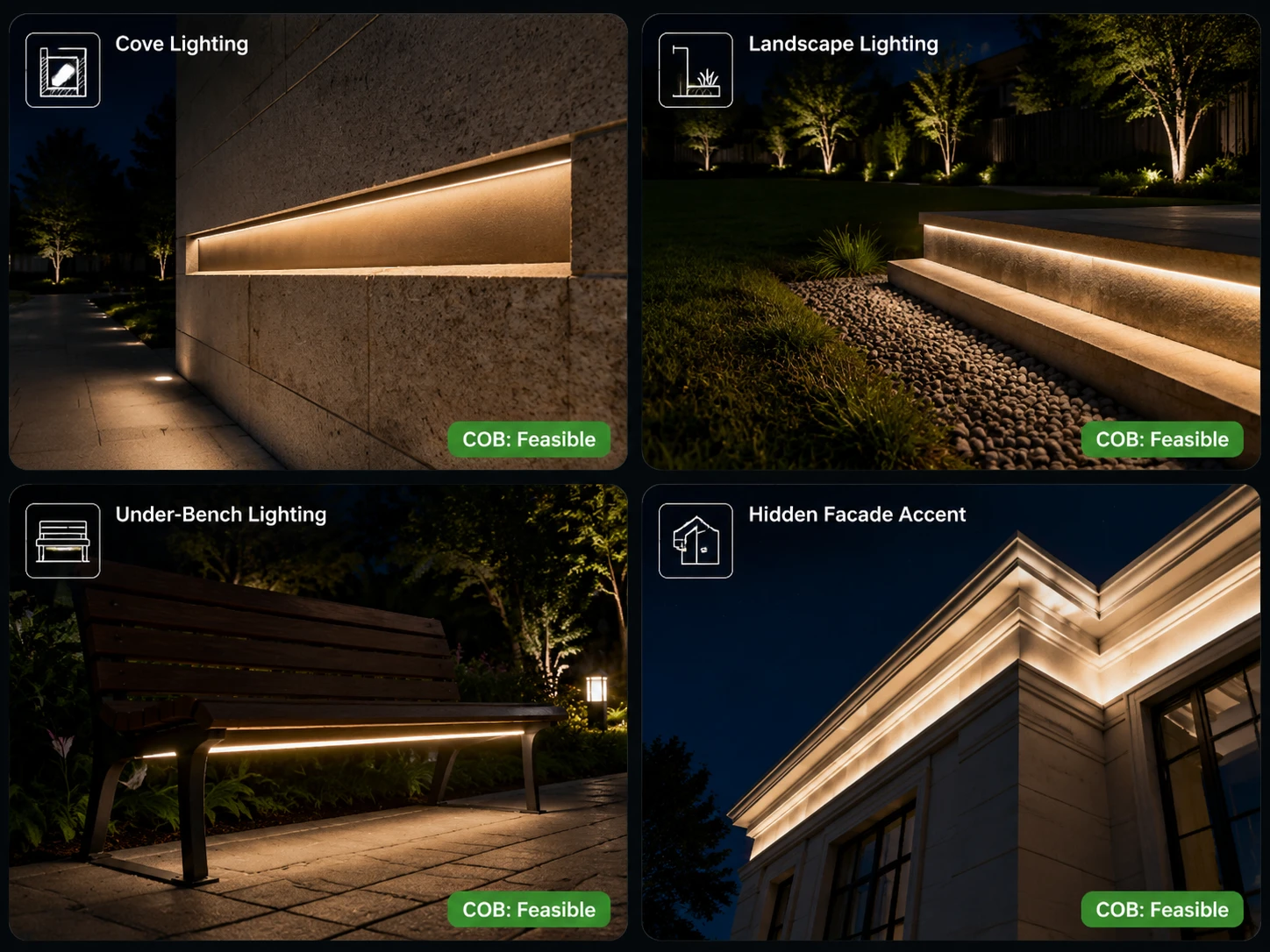
Il existe plusieurs applications extérieures où une bande LED COB classée IP67 peut remplacer la viabilité de LED Neon Flex. Dans ces scénarios, l'environnement d'installation fournit une grande partie de la protection que Neon Flex intègre normalement dans sa structure. Lorsque l'impact mécanique, l'exposition directe aux UV et l'eau stagnante sont limités, COB peut offrir des performances d'éclairage comparables à un coût de matériau inférieur.
Crique et éclairage architectural encastré
L'éclairage de l'âne et les détails architecturaux encastrés représentent le boîtier de remplacement le plus solide pour la bande de cuisson. Lorsque la source de lumière est installée à l'intérieur d'une auge, d'une fente, d'un évidement de parapet ou d'une cavité architecturale, la structure environnante la protège des impacts accidentels et réduit l'exposition directe aux intempéries. Étant donné que les canaux en aluminium sont généralement incorporés dans ces installations dans le cadre du détail de la conception, la gestion thermique est déjà abordée. Du point de vue du spectateur, la différence visuelle entre COB Strip et Neon Flex est souvent négligeable.
Paysage et éclairage de jardin
Les applications paysagères telles que les puits d'arbres, les bordures de plantation, les contremarches d'escalier, les mains courantes et les bords des allées sont un autre domaine où COB fonctionne de manière fiable à l'extérieur. Ces installations connaissent généralement des contacts physiques limités et une exposition indirecte à l'environnement. Pour les acheteurs, demandant si les clapets LED peuvent être utilisés à l'extérieur, l'éclairage de paysage protégé est l'un des exemples les plus clairs où la réponse est oui.
Dans de nombreux projets, COB strip est sélectionné comme alternative à la corde de néon à LED, car elle fournit une ligne continue de lumière tout en réduisant les coûts des matériaux. Lorsqu'il est installé à l'aide d'une méthode de montage appropriée et spécifié avec une norme IP67 ou supérieure, il offre des performances fiables dans des environnements extérieurs à faible impact. Neon Flex reste également un choix courant pour l'éclairage de paysage - voir notre Guide de LED Neon Flex pour l'éclairage architectural Pour des conseils d'installation si cela convient le mieux à votre projet.
Éclairage sous le banc et le pont
Un éclairage sous banc et pont abrité est également bien adapté à la technologie COB. La source de lumière est généralement placée sous des structures d'assise ou des matériaux de terrasse, où la lumière directe du soleil, l'exposition à la pluie et le contact accidentel sont minimes. Dans ces conditions, Cob Strip peut atteindre les mêmes résultats visuels et les mêmes attentes de durée de vie que Neon Flex tout en offrant un coût matériel initial inférieur.
Éclairage d'accentuation de
L'éclairage d'accentuation de façade cachée se concentre sur l'éclairage des surfaces architecturales plutôt que sur l'exposition du luminaire lui-même. Les installations typiques comprennent le montage derrière les détails de l'armature, sous les avant-toits ou à l'intérieur des ailettes architecturales. Lorsque la bande d'épi est associée à un canal en aluminium opaque et à un diffuseur dépoli, le luminaire reste caché tout en produisant un lavage de lumière lisse et continu. Dans ces positions protégées, l'encapsulation supplémentaire fournie par Neon Flex offre souvent peu d'avantages pratiques.
| Application | COB faisable ? | notes |
| Éclairage architectural encastré et encastré | Oui | meilleur scénario |
| Paysage et éclairage de jardin | Oui | Utilisez IP67+ |
| Éclairage sous le banc et le pont | Oui | Poste protégé |
| Éclairage d'accentuation de | Oui | Canal en aluminium requis |
Pour les quatre applications, le facteur commun est la protection. Lorsque l'installation elle-même protège le système d'éclairage des contraintes environnementales et mécaniques, la bande LED COB peut souvent remplacer le LED Neon Flex sans sacrifier les performances.
Quand choisir le LED Neon Flex pour l'éclairage extérieur ?
Le but de ce guide n'est pas de dire que la bande de LED COB est toujours la meilleure option. En fait, il existe plusieurs applications extérieures où LED Neon Flex reste la solution la plus pratique, durable et rentable au cours de la durée de vie de l'installation.
La caractéristique commune de ces projets est que le système d'éclairage est entièrement exposé et doit résister aux contraintes environnementales sans se fier à la structure environnante pour se protéger.
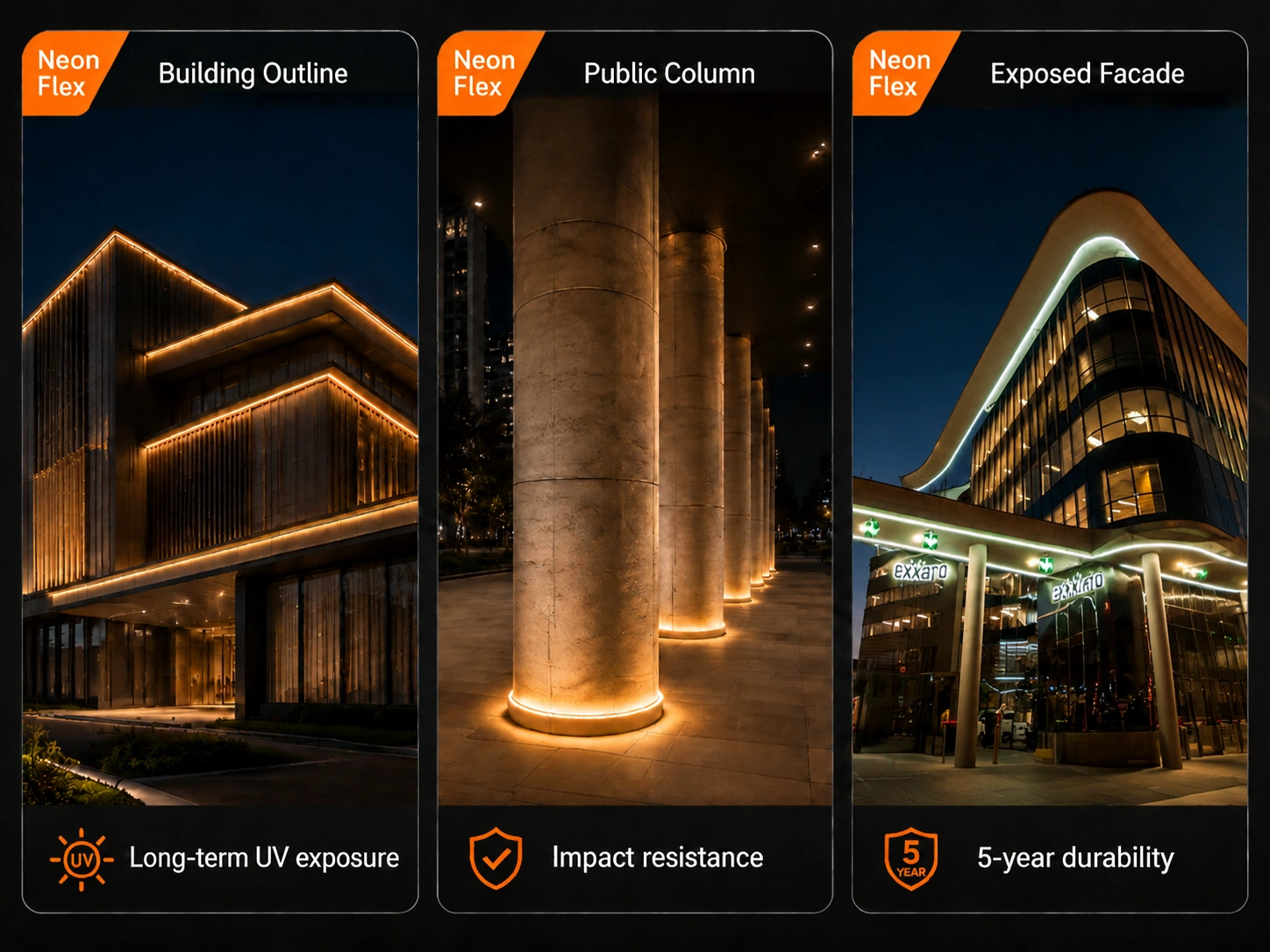
Contour du bâtiment et éclairage de la ligne de toit
Projets de contour de toit et de construction Placez l'éclairage linéaire continu directement dans le trajet du rayonnement UV, de la pluie, des fluctuations de température et des débris atmosphériques. Les installations dépassent souvent 50 à 200 mètres et devraient fonctionner pendant de nombreuses années avec un minimum d'entretien.

Les bandes de cuisson installées dans des canaux en aluminium peuvent techniquement être utilisées dans ces applications, mais des points de défaillance supplémentaires sont introduits :
- Les joints d'extrémité en silicone peuvent se détériorer avec le temps.
- Une pénétration d'eau peut se produire lors de connexions mal scellées.
- L'exposition aux UV accélère le vieillissement des adhésifs et des composants auxiliaires.
- L'humidité peut être emprisonnée à l'intérieur des systèmes de canaux mal drainés.
Led Neon Flex élimine bon nombre de ces risques grâce à sa structure encapsulée monolithique. La gaine de protection étant intégrée au produit, aucune couche adhésive n'est exposée à une dégradation à long terme des UV et à moins de points de vulnérabilité liés à l'installation. Un montage approprié joue également un rôle dans la fiabilité à long terme sur les courses de toit en continu. Solutions de montage FLEX NEON LED pour architectes et installateurs Pour obtenir des conseils sur la sélection des canaux en aluminium par rapport aux clips de montage.
Espaces publics à fort trafic
Dans les environnements publics, l'imperméabilisation n'est souvent pas la principale préoccupation. L'impact physique est.
Des applications telles que :
- Colonnes architecturales
- Bancs publics
- Éclairage décoratif au niveau du sol
- Extérieurs d'accueil
- Passerelles commerciales extérieures
sont régulièrement exposés au contact accidentel des piétons, des équipements de nettoyage, des outils d'entretien, des chariots à bagages et des meubles mobiles.
Une bande d'épis montée dans un canal en aluminium peut être endommagée par un impact suffisamment fort. En comparaison, la veste flexible en silicone ou en PVC de Neon Flex absorbe les chocs et retrouve sa forme sans compromettre le système d'éclairage.
Pour les acheteurs qui se demandent s'il est sûr de laisser une bande LED allumée en permanence, les deux produits sont conçus pour un fonctionnement continu. Cependant, Neon Flex gère généralement de manière plus fiable le fonctionnement à long terme dans les environnements exposés, car sa structure combine une protection thermique, mécanique et environnementale dans un seul système.
Éclairage de façade exposé permanent
L'éclairage de façade permanent présente les conditions extérieures les plus exigeantes. Les hôtels, les bâtiments commerciaux, les propriétés côtières et les projets d'architecture publique nécessitent souvent des systèmes d'éclairage capables de fonctionner pendant cinq ans ou plus sans intervention significative.
Dans ces installations, plusieurs facteurs favorisent le néon flex :
- Résistance aux UV supérieure
- Meilleure stabilité des couleurs à long terme
- Une résistance plus élevée à l'exposition à l'air salin
- Réduction du risque de défaillances d'imperméab
- Fréquence de maintenance inférieure
Pour un examen plus attentif de la raison pour laquelle le Neon Flex, classé IP67, fonctionne de manière fiable dans ces conditions, consultez notre guide sur Pourquoi IP67 étanche LED Neon Flex est le meilleur choix pour l'éclairage de façade extérieur.
Du point de vue du support d'un fabricant, les pannes prématurées dans les installations d'extérieur sont rarement causées par les puces LED elles-mêmes. Plus souvent, les défaillances proviennent de la dégradation des joints, de la conception de drainage inadéquate, des pratiques d'installation inappropriées ou de l'exposition à long terme aux UV affectant les composants de soutien. Ces risques sont considérablement réduits dans les systèmes de qualité néon flex.
| Application | Neon Flex préféré ? | raison principale |
| Contour du bâtiment / Éclairage de toit | Oui | Exposition environnementale à long terme |
| Espaces publics à fort trafic | Oui | Résistance aux chocs |
| Éclairage de façade exposé permanent | Oui | Résistance aux UV et durabilité à long terme |
Lorsqu'une installation devrait rester complètement exposée pendant des années, le LED Neon Flex offre généralement le plus faible fardeau de maintenance et les performances à long terme les plus prévisibles.
Un montage approprié joue également un rôle dans la fiabilité à long terme, en particulier pour les lignes de toit et de façade continues.
La bande LED COB est-elle moins chère que le LED Neon Flex pour les projets en plein air ?
La principale raison pour laquelle les acheteurs envisagent de remplacer le LED Neon Flex par une bande LED COB est le coût. À première vue, COB semble offrir un avantage financier évident, car la bande elle-même est généralement moins chère au mètre.
Cependant, les projets extérieurs doivent être évalués en fonction du coût total de possession (TCO) plutôt que du seul coût matériel.
Le coût final du projet est influencé par quatre facteurs majeurs :
- Coût matériel — Le toreal est généralement moins cher au mètre.
- Exigences relatives aux canaux en — La plupart des installations d'extérieur en épis nécessitent des canaux, des diffuseurs, des embouts et des accessoires de montage.
- Travail d'installation — Neon Flex est généralement plus rapide à installer car aucun assemblage de canal n'est requis.
- Entretien à long terme — Les installations exposées nécessitent souvent moins de réparations et de remplacements lorsque Neon Flex est utilisé.
L'impact de ces catégories de coûts devient plus évident à mesure que la taille du projet augmente.
Comparaison totale du coût de possession (100 m de toit extérieur exposé)
| Élément de coût | Approche LED COB | Approche LED Néon Flex |
| Matériau de bande / flex (au mètre, IP67+) | $2 – $4/M → $200 – $400 | $3 – $6/M → $300 – $600 |
| Canal en aluminium + accessoires (au mètre) | $1.5 – $3/M → $150 – $300 | Non requis → $0 |
| Travail d'installation | Ajoute env. 15–25% en plus du coût du matériau + du canal en raison de l'assemblage et de l'étanchéité du canal | Ajoute env. 8–151TP3 t En plus du coût des matériaux, une installation plus rapide à exécution continue |
| Entretien prévu pour 5 ans (environnement exposé) | Estimation de 10 à 201 tp3 t du coût initial des matériaux dans les réparations/remplacements sur 5 ans | Estimation de 3 à 81 tp3 t du coût initial des matériaux sur 5 ans |
| Coût total estimé (matériel + canal + travail) | $420 – $875 | $324 – $690 |
| Coût total estimé à 5 ans (incl. maintenance) | $460 – $1 050 | $334 – $745 |
Les chiffres sont des estimations illustratives basées sur des fourchettes de prix de gros typiques pour les produits classés IP67+ (tarification FOB) et ne représentent pas un devis formel. Les coûts réels du projet varient selon les spécifications, le volume de commandes et la région d'installation.
Pour les installations cachées telles que les criques encastrées, les terrasses abritées et les éléments de paysage protégés, le coût matériel moindre de COB se traduit souvent par un véritable projet d'économie car les attentes en matière de maintenance restent similaires.
Pour les applications exposées telles que :
- Éclairage de toit
- Construire des contours
- Eclairage de façade côt
- Installations architecturales publiques
Le calcul change considérablement. Un matériel d'installation supplémentaire, un temps d'installation plus long et une probabilité plus élevée d'intervention de maintenance peuvent réduire ou éliminer l'avantage initial de coût de matériaux.
Les spécificateurs d'éclairage expérimentés évaluent de plus en plus le coût d'installation sur la durée de vie prévue plutôt que sur le prix du produit au mètre. Cette approche fournit une image plus réaliste de la valeur du projet.
Le coût matériel inférieur de la bande de cuisson est réel, mais pour les applications extérieures exposées, le coût total de possession sur cinq ans est souvent favorisé par Neon Flex.
Quel est le meilleur pour différents projets d'éclairage extérieur : bande LED COB ou FLEX LED NEON ?
La façon la plus simple de prendre la décision est d'évaluer la protection de l'environnement d'installation.
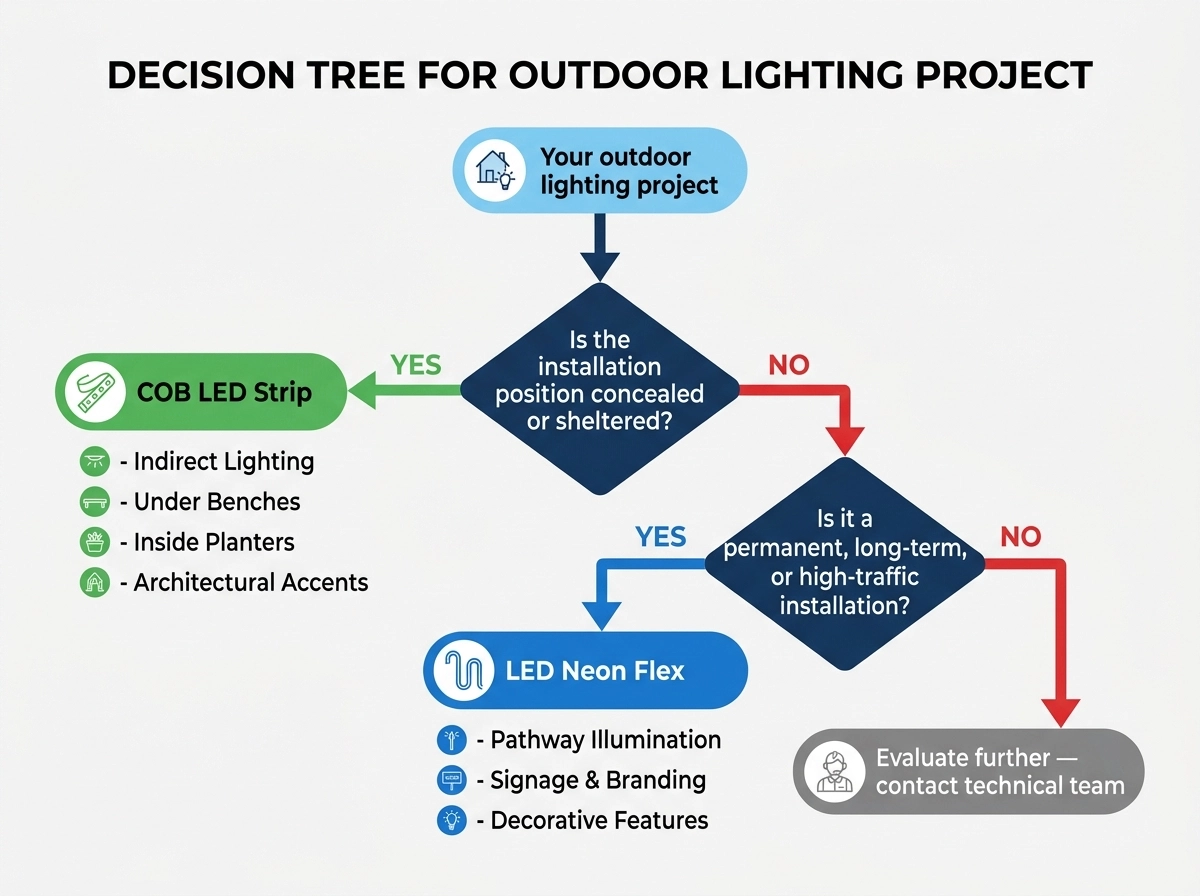
Si l'environnement protège le système d'éclairage, la bande LED COB est souvent suffisante.
Si le système d'éclairage doit se protéger contre les intempéries, l'exposition aux UV et les contacts physiques, le LED Neon Flex est généralement le choix à long terme le plus sûr.
Considérez les types de projets suivants :
- Éclairage de sentiers de jardin de l'hôtel caché sous la bordure de pierre — Choisissez la bande de LED COB
L'éclairage est encastré et protégé par des éléments de paysage dur environnants. L'exposition aux UV est limitée, l'impact physique est peu probable et le résultat visible est simplement une ligne continue de lumière le long de la voie. Dans cet environnement, COB offre une excellente valeur. - Éclairage de la ligne de toit côtière de 200 mètres avec une exigence de durée de vie de cinq ans - Choisissez le LED Neon Flex
L'exposition continue à l'air salin, au rayonnement UV, à la pluie et au vent exerce une pression importante sur le système d'éclairage. La structure encapsulée de Neon Flex réduit les besoins en maintenance et améliore la fiabilité à long terme. - Éclairage sous le banc de terrasse du restaurant couvert — Choisissez le bandeau LED COB
L'installation bénéficie d'un abri aérien, d'une exposition météorologique limitée et d'un risque de contact accidentel. Le coût matériel moindre de COB crée un avantage budgétaire significatif sans compromettre les performances. - Éclairage de colonne au niveau du sol dans une place publique — Choisissez LED Neon Flex
Les environnements publics connaissent fréquemment des contacts fortuits de la part des piétons, du matériel de nettoyage et des activités d'entretien. Neon Flex offre une résistance supérieure aux chocs et un risque d'entretien réduit. - Éclairage de façade résidentielle installé derrière les avant-toits — Choisissez COB LED Strip
Parce que le détail architectural offre déjà une protection contre les intempéries et une dissimulation, l'encapsulation supplémentaire de Neon Flex offre un avantage pratique limité. COB fournit un résultat visuel comparable à un coût d'installation inférieur.
Ces exemples démontrent que la décision est généralement motivée par le niveau d'exposition plutôt que par la qualité de l'éclairage. Dans de nombreuses applications extérieures protégées, COB peut remplacer Neon Flex avec succès. Dans les environnements fortement exposés, les avantages de la durabilité de Neon Flex justifient souvent son coût initial plus élevé.
Conclusion
Les bandes LED COB peuvent-elles remplacer les LED Neon Flex à l'extérieur ?
La réponse est oui, mais uniquement dans le bon environnement.
Pour l'éclairage architectural encastré, les installations paysagères abritées, l'éclairage sous le banc et les accents de façade cachés, la bande LED COB évaluée par IP67 peut souvent produire le même résultat visuel que le LED Flex à un coût de matériau inférieur. Lorsque l'installation elle-même offre une protection, COB est souvent le choix le plus économique.
Cependant, pour les lignes de toit exposées, les espaces publics, les projets côtiers et l'éclairage permanent de la façade, le LED Neon Flex reste l'investissement à long terme plus sûr. Sa structure encapsulée offre une protection supérieure contre l'exposition aux UV, les impacts, l'humidité et l'usure de l'environnement, ce qui réduit les exigences d'entretien pendant la durée du projet.
En fin de compte, la décision devrait être basée sur le niveau d'exposition plutôt que sur le prix du produit. Si l'environnement protège le système d'éclairage, choisissez COB. Si le système d'éclairage doit se protéger, choisissez le LED Neon Flex.
De quelles informations avez-vous besoin avant de demander une bande LED COB ou un devis Flex Néon LED ?
Une fois la demande identifiée, fournir les informations techniques correctes au stade de la demande permet de réduire les révisions de devis, les incompatibilités de spécifications et les retards de projet.
Pour les demandes de bandes LED COB
Veuillez fournir :
- Indice IP requis (IP65, IP67 ou IP68)
- puissance par mètre
- tension de service
- Température de couleur (CCT)
- Exigence de l'IRC (le cas échéant)
- Exigence de cohérence du CCT (étapes de Macadam)
- Durée totale de la course
- Longueur maximale d'un seul passage
- Intervalle de coupe requis
- Si un profilé en aluminium sera fourni par le client ou provenant de la bande
- Environnement d'installation (encastré, paysage, sous-banc, accent de façade, etc.)

Pour les demandes de renseignements sur le flex au néon
Veuillez fournir :
- Indice IP requis (IP67 ou IP68)
- Type de couleur (couleur unique, blanc accordable, RGB ou RGBW)
- tension de service
- Direction de pliage (courbure supérieure ou coude latérale)
- Exigence minimale du rayon de courbure
- Durée totale du projet
- Méthode de montage
- Intervalle de coupe requis
- Que des sections de découpe personnalisées au néon FLEX LED soient requises
- Tolérance de longueur de coupe personnalisée acceptable
- Environnement d'installation (toiture, façade, espace public, projet côtier, etc.)
Plus les informations du projet sont complètes, plus il devient facile de déterminer si une bande LED COB ou une solution LED Neon Flex offriront le meilleur équilibre entre les performances, l'efficacité de l'installation et la valeur à long terme.
Comment savez-vous si COB LED Strip ou LED Neon Flex est le bon pour votre projet ?
Avant de demander un devis, il est utile de préparer les informations suivantes :
- Emplacement d'installation
- Niveau d'exposition (abri ou entièrement exposé)
- Indice IP requis
- Durée de vie prévue
- longueur d'exécution
- Exigences en matière
- Exigences de couleur
- Priorités budgétaires (coût initial le plus bas vs coût de maintenance à long terme le plus bas)
La fourniture de ces détails permet à l'équipe d'ingénieurs de recommander la solution la plus appropriée et d'éviter de sur-spécifier ou sous-spécifier le système d'éclairage.
FAQ
Articles Similaires