English
  简体中文
简体中文  Deutsch
  Español
  Français
  Italiano
  日本語
日本語  한국어
한국어  Polski
  Português
  Русский
  Türkçe
  Nederlands
  Tiếng Việt
  ไทย
ไทย 
Quick Answer
When evaluating Can COB LED Strips Replace LED Neon Flex Outdoors, the answer depends entirely on the installation environment and exposure level.
Yes — IP67-rated COB LED strips can replace LED Neon Flex outdoors in recessed, sheltered, or mechanically protected applications such as cove lighting, landscape lighting, under-bench lighting, and hidden facade accents. In these conditions, the surrounding structure provides protection against UV exposure, rain, and physical impact, allowing COB strips to achieve similar visual performance at a lower material cost.
However, for fully exposed outdoor installations, such as roofline lighting, building outlines, high-traffic public spaces, and permanent facade lighting, LED Neon Flex remains the more reliable long-term solution. Its fully encapsulated structure provides superior resistance to UV degradation, moisture ingress, and accidental impact, resulting in lower maintenance requirements over time.
In summary, the decision is not determined by waterproof rating alone, but by overall exposure level, including UV radiation, mechanical stress, and long-term environmental wear. COB LED strips are best for protected environments, while LED Neon Flex is designed for self-protection in exposed outdoor conditions.
Why Is COB LED Strip Replacing Neon Flex in Some Outdoor Projects?
Until a few years ago, the choice between COB LED strip and LED Neon Flex for outdoor projects was rarely questioned. Neon Flex was the default option for continuous linear outdoor lighting, while COB strip was typically reserved for indoor environments or highly protected architectural installations.
That assumption is changing. Since 2020, the cost of IP67-rated COB LED strip has fallen significantly, making high-protection COB products accessible to a much wider range of projects. At the same time, advances in COB packaging technology have dramatically improved light quality. The dot-free, visually uniform output that once distinguished Neon Flex is now achievable with many modern COB strips.
As budgets tighten and project owners seek greater cost efficiency, buyers who previously defaulted to Neon Flex are increasingly reassessing whether the additional protection and durability are necessary for every outdoor application. The result is a genuine procurement decision rather than a simple product comparison.
As more specifiers evaluate COB vs Neon Flex outdoor performance, the key question is no longer whether both products can work outdoors, but whether one can realistically replace the other without compromising reliability, maintenance requirements, or project lifespan.
At SignliteLED, we have supplied both COB LED strips and LED Neon Flex products for architectural and commercial lighting projects for more than 15 years. In recent years, one of the most common questions from specifiers, contractors, and OEM buyers has been whether modern IP67-rated COB strip can replace Neon Flex outdoors while maintaining long-term performance.
To answer that question, it is necessary to look beyond brightness and appearance and focus on the structural characteristics that determine outdoor durability.
How Do COB LED Strips Compare to LED Neon Flex Outdoors?
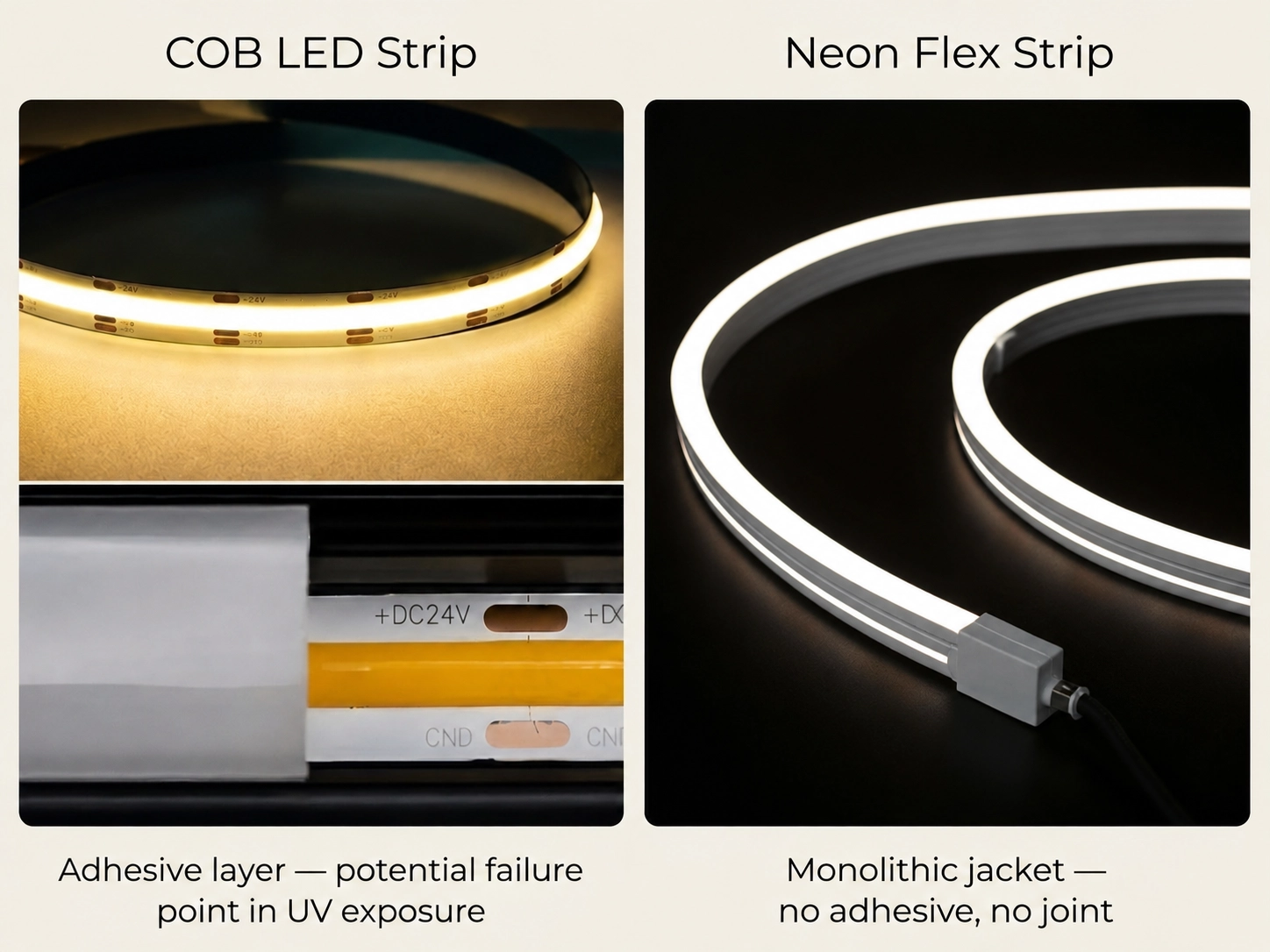
The biggest difference between COB LED Strip and LED Neon Flex outdoors is not brightness, color temperature, or efficiency. It is how each product achieves protection against weather, UV exposure, physical impact, and long-term environmental wear.
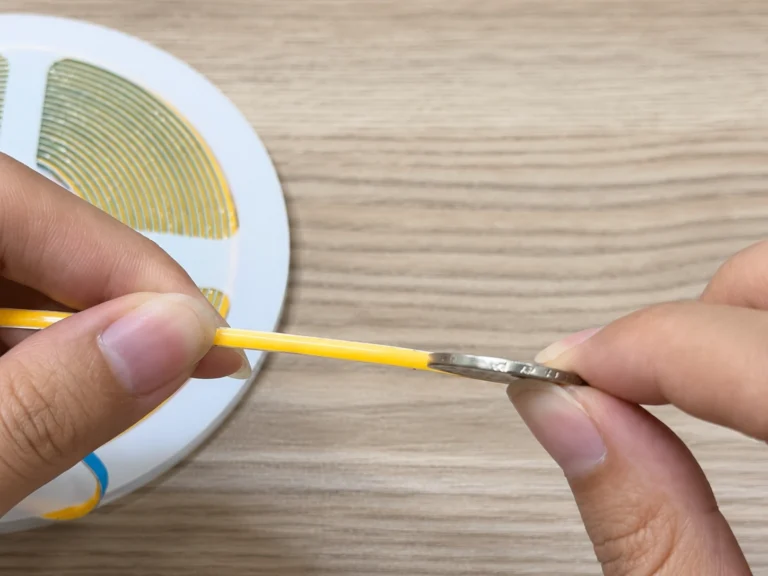
A COB LED Strip places its light-emitting layer directly on a flexible PCB. Outdoor-rated versions achieve protection through silicone coatings or silicone sleeves, typically providing IP65, IP67, or IP68 protection. Because the light source remains relatively close to the surface, many outdoor installations use aluminum channels to improve mechanical protection and thermal management. However, channels are not mandatory. Depending on the application, outdoor COB strips may also be installed using high-bond 3M VHB adhesive tape, mounting clips, silicone bonding, or other mechanical fastening methods.
LED Neon Flex uses a different approach. The LEDs are fully encapsulated inside a continuous PVC or silicone jacket that functions as a diffuser, waterproof barrier, UV shield, and protective housing. This integrated construction means the product provides much of its own protection without requiring additional channels or housings. This silicone-based construction is also what allows Neon Flex to be shaped around architectural curves and corners — see our overview of LED Neon Flex for architectural lighting for more on how this flexibility is used in facade design.
As a result, the outdoor performance differences between the two products are driven largely by their structural design.
Outdoor Performance Comparison: COB LED Strip vs LED Neon Flex
| Factor | COB LED Strip | LED Neon Flex | Why It Matters Outdoors |
| Protection method | Silicone coating or sleeve | Full encapsulation | Determines resistance to weather and physical damage |
| Mechanical protection | May require additional protection depending on application | Built-in protection | Important in public and exposed environments |
| Best available IP rating | IP68 | IP68 | Suitable for harsh weather conditions |
| UV resistance | Good | Excellent | Affects long-term material durability |
| Impact resistance | Fair | Excellent | Important where accidental contact may occur |
| Visual uniformity | Excellent | Excellent | Both can achieve dot-free lighting |
| Installation complexity | Moderate (installation method varies) | Lower | COB often requires additional mounting components |
| Material cost | Lower | Higher | Initial purchase cost comparison |
| 5-year maintenance expectation | Moderate | Low | Influences total ownership cost |
| Expected lifespan in exposed environments | 30,000–40,000 h | 50,000 h+ | Determines long-term value |
Several important patterns emerge from this comparison:
- Both products can achieve outdoor-rated waterproof protection.
- Both products can produce smooth, continuous, dot-free illumination.
- COB LED Strip offers a lower initial material cost.
- LED Neon Flex provides stronger protection against UV exposure, impact, and environmental wear.
- The performance gap becomes more significant as installation exposure increases.
For protected outdoor applications, the practical difference between the two products may be relatively small. For fully exposed rooflines, facades, public spaces, and long-term architectural projects, the integrated protective structure of LED Neon Flex often results in lower maintenance requirements and longer service life.
In simple terms, COB LED Strip performs best when the installation environment provides protection, while LED Neon Flex performs best when the product itself must withstand direct outdoor exposure.
When Can COB LED Strip Replace LED Neon Flex Outdoors?
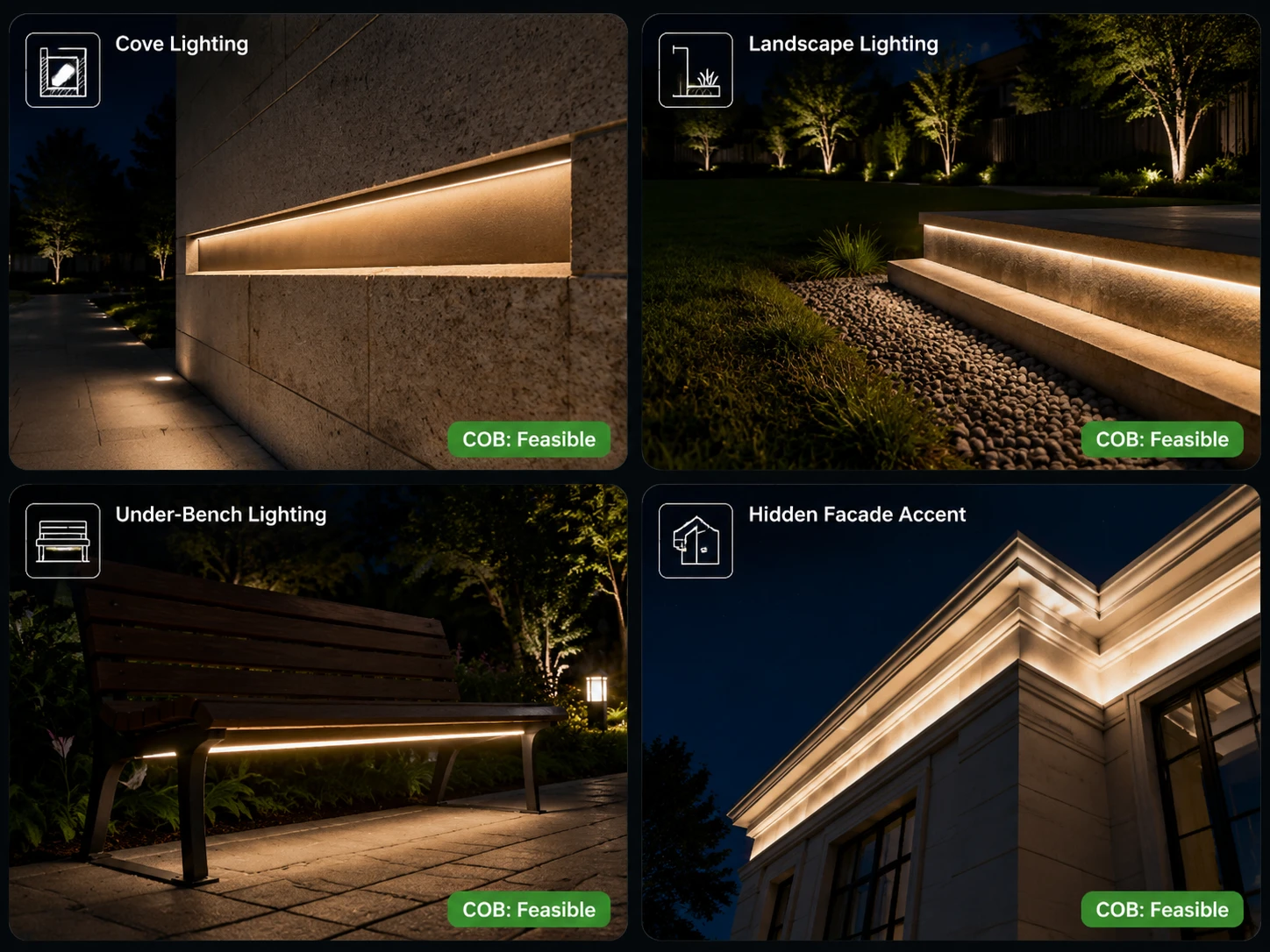
There are several outdoor applications where an IP67-rated COB LED strip can serve as a fully viable replacement for LED Neon Flex. In these scenarios, the installation environment provides much of the protection that Neon Flex normally builds into its structure. When mechanical impact, direct UV exposure, and standing water are limited, COB can deliver comparable lighting performance at a lower material cost.
Cove and Recessed Architectural Lighting
Cove lighting and recessed architectural details represent the strongest replacement case for COB strip. When the light source is installed inside a trough, slot, parapet recess, or architectural cavity, the surrounding structure shields it from accidental impact and reduces direct exposure to weather. Because aluminum channels are typically incorporated into these installations as part of the design detail, thermal management is already addressed. From the viewer’s perspective, the visual difference between COB strip and Neon Flex is often negligible.
Landscape and Garden Lighting
Landscape applications such as tree wells, planting borders, stairway risers, handrails, and pathway edges are another area where COB performs reliably outdoors. These installations generally experience limited physical contact and indirect environmental exposure. For buyers asking whether LED strip lights can be used outdoors, protected landscape lighting is one of the clearest examples where the answer is yes.
In many projects, COB strip is selected as an outdoor LED neon rope light alternative because it delivers a continuous line of light while reducing material costs. When installed using an appropriate mounting method and specified with an IP67 or higher rating, it provides dependable performance in low-impact outdoor environments. Neon Flex remains a common choice for landscape lighting as well — see our guide to LED Neon Flex for architectural lighting for installation tips if that’s the better fit for your project.
Under-Bench and Deck Lighting
Sheltered under-bench and deck lighting is also well suited to COB technology. The light source is typically positioned beneath seating structures or decking materials, where direct sunlight, rain exposure, and accidental contact are minimal. In these conditions, COB strip can achieve the same visual result and service life expectations as Neon Flex while offering a lower upfront material cost.
Hidden Facade Accent Lighting
Hidden facade accent lighting focuses on illuminating architectural surfaces rather than exposing the lighting fixture itself. Typical installations include mounting behind coping details, beneath eaves, or inside architectural fins. When COB strip is paired with an opaque aluminum channel and frosted diffuser, the fixture remains concealed while producing a smooth, continuous wash of light. In these protected positions, the additional encapsulation provided by Neon Flex often offers little practical advantage.
| Application | COB Feasible? | Notes |
| Cove / recessed architectural lighting | Yes | Best-case scenario |
| Landscape & garden lighting | Yes | Use IP67+ |
| Under-bench & deck lighting | Yes | Protected position |
| Hidden facade accent lighting | Yes | Aluminum channel required |
For all four applications, the common factor is protection. When the installation itself shields the lighting system from environmental and mechanical stress, COB LED strip can often replace LED Neon Flex without sacrificing performance.
When Should You Choose LED Neon Flex for Outdoor Lighting?
The goal of this guide is not to argue that COB LED strip is always the better option. In fact, there are several outdoor applications where LED Neon Flex remains the more practical, durable, and cost-effective solution over the lifespan of the installation.
The common characteristic of these projects is that the lighting system is fully exposed and must withstand environmental stress without relying on the surrounding structure for protection.
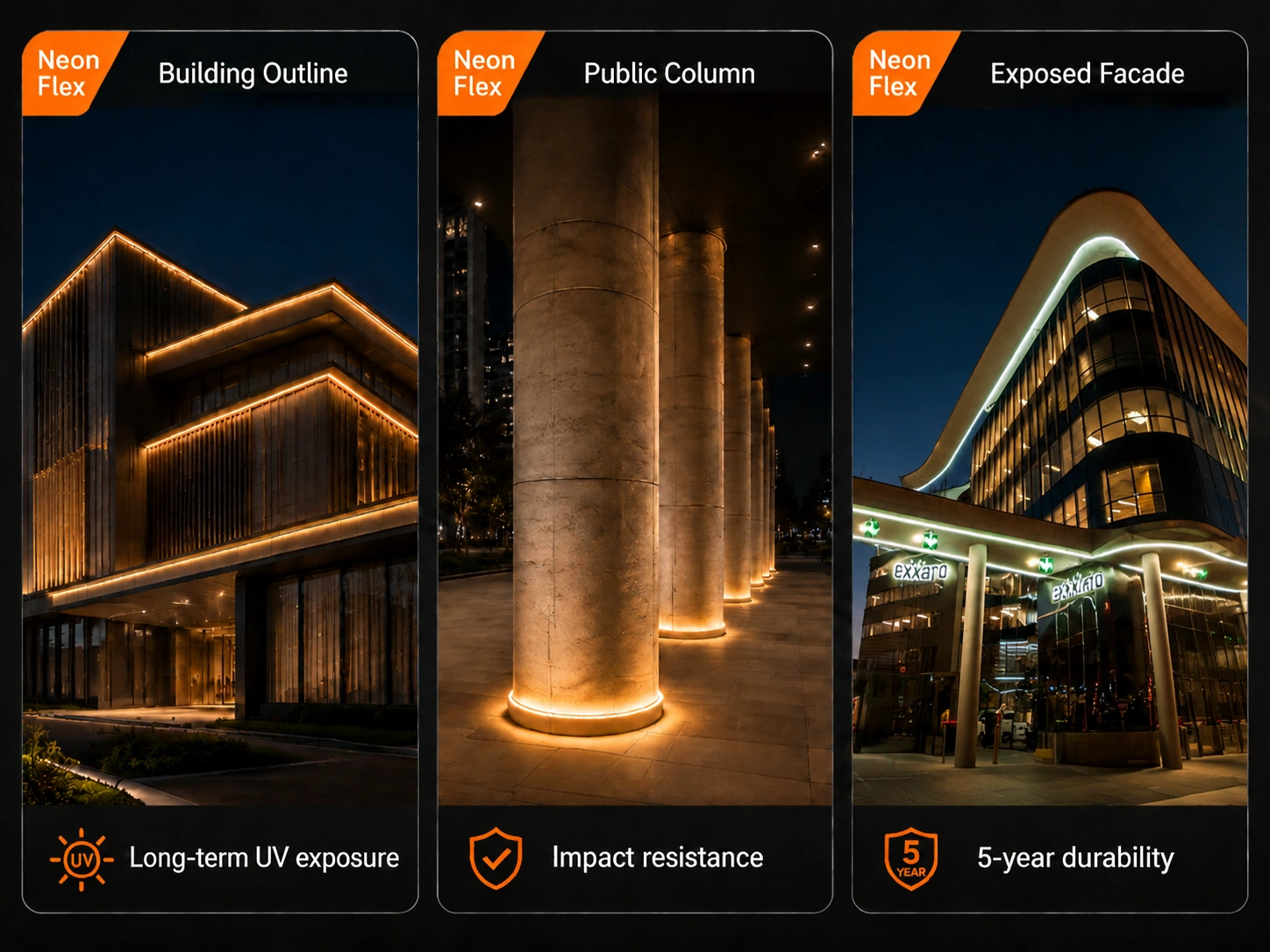
Building Outline and Roofline Lighting
Roofline and building outline projects place continuous linear lighting directly in the path of UV radiation, wind-driven rain, temperature fluctuations, and airborne debris. Installations often exceed 50–200 metres and are expected to operate for many years with minimal maintenance.

COB strip installed in aluminum channels can technically be used in these applications, but additional failure points are introduced:
- Silicone end-cap seals can deteriorate over time.
- Water ingress may occur at poorly sealed connections.
- UV exposure accelerates aging of adhesives and auxiliary components.
- Moisture can become trapped inside poorly drained channel systems.
LED Neon Flex eliminates many of these risks through its monolithic encapsulated structure. Because the protective jacket is integrated into the product, there is no adhesive layer exposed to long-term UV degradation and fewer installation-related vulnerability points. Proper mounting also plays a role in long-term reliability on continuous roofline runs — see our breakdown of outdoor LED Neon Flex mounting solutions for architects and installers for guidance on selecting aluminum channels versus mounting clips.
High-Traffic Public Areas
In public environments, waterproofing is often not the primary concern. Physical impact is.
Applications such as:
- Architectural columns
- Public benches
- Ground-level decorative lighting
- Hospitality exteriors
- Outdoor commercial walkways
are regularly exposed to incidental contact from pedestrians, cleaning equipment, maintenance tools, luggage carts, and movable furniture.
A COB strip mounted in an aluminum channel can be damaged by a sufficiently strong impact. By comparison, the flexible silicone or PVC jacket of Neon Flex absorbs shock and returns to shape without compromising the lighting system.
For buyers wondering whether it is safe to leave an LED strip on constantly, both products are designed for continuous operation. However, Neon Flex generally handles long-term operation in exposed environments more reliably because its structure combines thermal, mechanical, and environmental protection in a single system.
Permanent Exposed Facade Lighting
Permanent facade lighting presents the most demanding outdoor conditions. Hotels, commercial buildings, coastal properties, and public architectural projects often require lighting systems capable of operating for five years or longer without significant intervention.
In these installations, several factors favor Neon Flex:
- Superior UV resistance
- Better long-term color stability
- Higher resistance to salt air exposure
- Reduced risk of waterproofing failures
- Lower maintenance frequency
For a closer look at why IP67-rated neon flex performs reliably in these conditions, see our guide on why IP67 waterproof LED neon flex is the best choice for outdoor facade lighting.
From a manufacturer’s support perspective, premature failures in outdoor COB installations are rarely caused by LED chips themselves. More commonly, failures originate from seal degradation, inadequate drainage design, improper installation practices, or long-term UV exposure affecting supporting components. These risks are substantially reduced in quality Neon Flex systems.
| Application | Neon Flex Preferred? | Primary Reason |
| Building outline / roofline lighting | Yes | Long-term environmental exposure |
| High-traffic public spaces | Yes | Impact resistance |
| Permanent exposed facade lighting | Yes | UV resistance and long-term durability |
When an installation is expected to remain fully exposed for years, LED Neon Flex typically provides the lowest maintenance burden and the most predictable long-term performance.
Proper mounting also plays a role in long-term reliability, particularly for continuous roofline and facade runs.
Is COB LED Strip Cheaper Than LED Neon Flex for Outdoor Projects?
The primary reason buyers consider replacing LED Neon Flex with COB LED strip is cost. At first glance, COB appears to offer a clear financial advantage because the strip itself is typically less expensive per metre.
However, outdoor projects should be evaluated based on total cost of ownership (TCO) rather than material cost alone.
The final project cost is influenced by four major factors:
- Material cost — COB strip is usually cheaper per metre.
- Aluminum channel requirements — Most outdoor COB installations require channels, diffusers, end caps, and mounting accessories.
- Installation labour — Neon Flex is generally faster to install because no channel assembly is required.
- Long-term maintenance — Exposed installations often require fewer repairs and replacements when Neon Flex is used.
The impact of these cost categories becomes more apparent as project size increases.
Total cost of ownership comparison (100 m exposed outdoor roofline)
| Cost Component | COB LED Strip Approach | LED Neon Flex Approach |
| Strip / flex material (per metre, IP67+) | $2 – $4/m → $200 – $400 total | $3 – $6/m → $300 – $600 total |
| Aluminum channel + accessories (per metre) | $1.5 – $3/m → $150 – $300 total | Not required → $0 |
| Installation labour | Adds approx. 15–25% on top of material + channel cost due to channel assembly and sealing | Adds approx. 8–15% on top of material cost; faster continuous-run installation |
| Expected 5-year maintenance (exposed environment) | Estimated 10–20% of initial material cost in repairs/replacements over 5 years | Estimated 3–8% of initial material cost over 5 years |
| Total estimated cost (material + channel + labour) | $420 – $875 | $324 – $690 |
| Total estimated 5-year cost (incl. maintenance) | $460 – $1,050 | $334 – $745 |
Figures are illustrative estimates based on typical wholesale price ranges for IP67+ outdoor-rated products (FOB pricing) and do not represent a formal quotation. Actual project costs vary by specification, order volume, and installation region.
For concealed installations such as recessed coves, sheltered terraces, and protected landscape features, the lower material cost of COB often translates into a genuine project saving because maintenance expectations remain similar.
For exposed applications such as:
- Roofline lighting
- Building outlines
- Coastal facade lighting
- Public architectural installations
the calculation changes significantly. Additional installation hardware, longer installation time, and a higher probability of maintenance intervention can reduce or eliminate the initial material-cost advantage.
Experienced lighting specifiers increasingly evaluate installed cost over the expected service life rather than product price per metre. This approach provides a more realistic picture of project value.
The lower material cost of COB strip is real — but for exposed outdoor applications, the total cost of ownership over five years often favours Neon Flex.
Which Is Better for Different Outdoor Lighting Projects: COB LED Strip or LED Neon Flex?
The easiest way to make the decision is to evaluate how much protection the installation environment already provides.
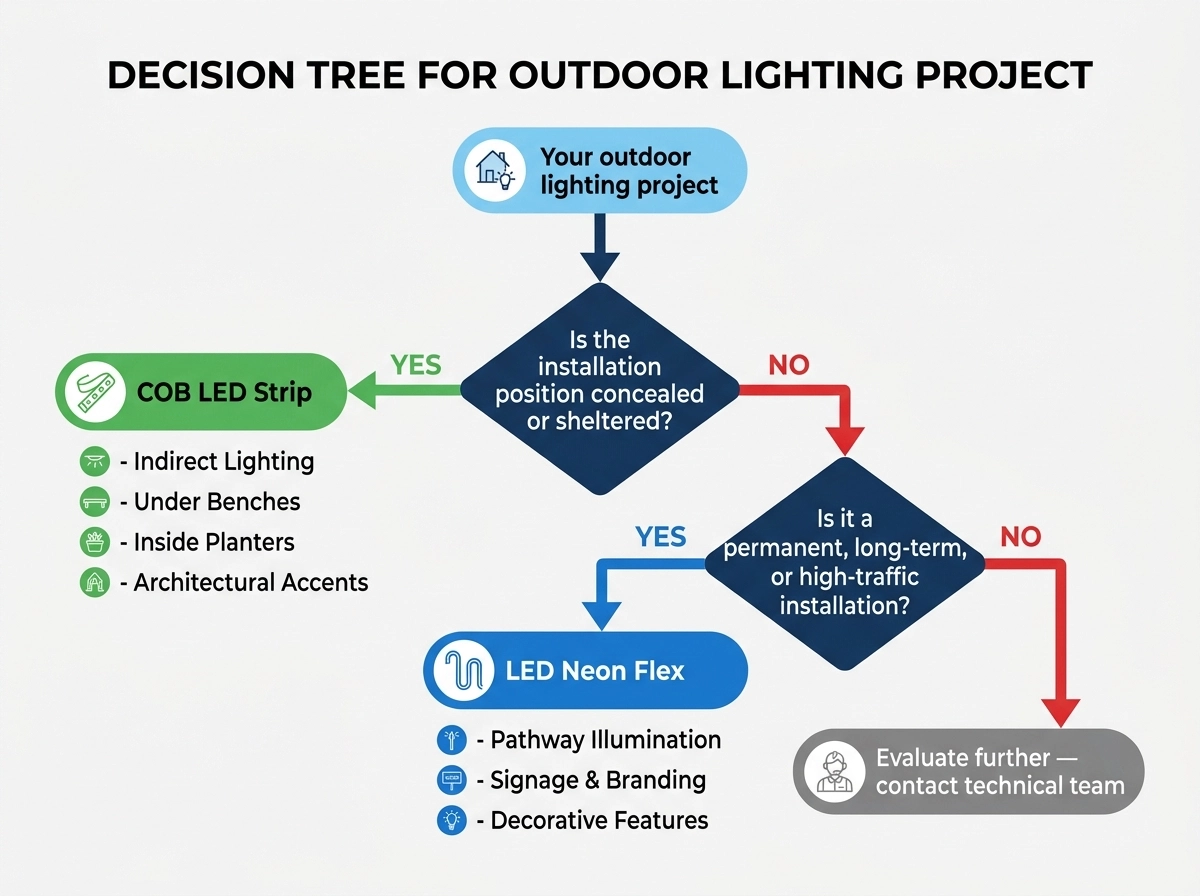
If the environment protects the lighting system, COB LED strip is often sufficient.
If the lighting system must protect itself against weather, UV exposure, and physical contact, LED Neon Flex is usually the safer long-term choice.
Consider the following project types:
- Hotel garden pathway lighting hidden beneath stone edging — Choose COB LED Strip
The lighting is recessed and protected by surrounding hardscape elements. UV exposure is limited, physical impact is unlikely, and the visible result is simply a continuous line of light along the pathway. In this environment, COB provides excellent value. - 200-metre coastal roofline lighting with a five-year service-life requirement — Choose LED Neon Flex
Continuous exposure to salt air, UV radiation, rain, and wind places significant stress on the lighting system. The encapsulated structure of Neon Flex reduces maintenance requirements and improves long-term reliability. - Covered restaurant terrace under-bench lighting — Choose COB LED Strip
The installation benefits from overhead shelter, limited weather exposure, and minimal risk of accidental contact. The lower material cost of COB creates a meaningful budget advantage without compromising performance. - Ground-level column lighting in a public plaza — Choose LED Neon Flex
Public environments experience frequent incidental contact from pedestrians, cleaning equipment, and maintenance activities. Neon Flex provides superior impact resistance and lower maintenance risk. - Residential facade cove lighting installed behind eaves — Choose COB LED Strip
Because the architectural detail already provides weather protection and concealment, the additional encapsulation of Neon Flex offers limited practical benefit. COB delivers a comparable visual result at a lower installed cost.
These examples demonstrate that the decision is usually driven by exposure level rather than lighting quality. In many protected outdoor applications, COB can replace Neon Flex successfully. In heavily exposed environments, the durability advantages of Neon Flex often justify its higher initial cost.
Conclusion
Can COB LED strips replace LED Neon Flex outdoors?
The answer is yes—but only in the right environment.
For recessed architectural lighting, sheltered landscape installations, under-bench lighting, and concealed facade accents, IP67-rated COB LED strip can often deliver the same visual result as LED Neon Flex at a lower material cost. When the installation itself provides protection, COB is frequently the more economical choice.
However, for exposed rooflines, public spaces, coastal projects, and permanent facade lighting, LED Neon Flex remains the safer long-term investment. Its encapsulated structure provides superior protection against UV exposure, impact, moisture ingress, and environmental wear, resulting in lower maintenance requirements over the life of the project.
Ultimately, the decision should be based on exposure level rather than product price alone. If the environment protects the lighting system, choose COB. If the lighting system must protect itself, choose LED Neon Flex.
What Information Do You Need Before Requesting a COB LED Strip or LED Neon Flex Quote?
Once the application has been identified, providing the correct technical information at the inquiry stage helps reduce quotation revisions, specification mismatches, and project delays.
For COB LED Strip Enquiries
Please provide:
- Required IP rating (IP65, IP67, or IP68)
- Wattage per metre
- Operating voltage
- Colour temperature (CCT)
- CRI requirement (if applicable)
- CCT consistency requirement (MacAdam steps)
- Total run length
- Maximum single-run length
- Required cut interval
- Whether an aluminum profile will be supplied by the client or sourced with the strip
- Installation environment (recessed, landscape, under-bench, facade accent, etc.)

For LED Neon Flex Enquiries
Please provide:
- Required IP rating (IP67 or IP68)
- Colour type (single colour, tunable white, RGB, or RGBW)
- Operating voltage
- Bending direction (top bend or side bend)
- Minimum bend radius requirement
- Total project length
- Mounting method
- Required cut interval
- Whether LED Neon Flex Custom Cut sections are required
- Acceptable custom-cut length tolerance
- Installation environment (roofline, facade, public space, coastal project, etc.)
The more complete the project information, the easier it becomes to determine whether a COB LED Strip or LED Neon Flex solution will provide the best balance of performance, installation efficiency, and long-term value.
How Do You Know Whether COB LED Strip or LED Neon Flex Is Right for Your Project?
Before requesting a quotation, it is helpful to prepare the following information:
- Installation location
- Exposure level (sheltered or fully exposed)
- Required IP rating
- Expected service life
- Run length
- Power requirements
- Colour requirements
- Budget priorities (lowest upfront cost vs lowest long-term maintenance cost)
Providing these details allows the engineering team to recommend the most suitable solution and avoid over-specifying or under-specifying the lighting system.
FAQ
Related Posts