Français
  English
  简体中文
简体中文  Deutsch
  Español
  Italiano
  日本語
日本語  한국어
한국어  Polski
  Português
  Русский
  Türkçe
  Nederlands
  Tiếng Việt
  ไทย
ไทย 
En septembre 2025, nous avons reçu une enquête WhatsApp avec une ligne finale qui aurait découragé la plupart des fournisseurs. Le client était un entrepreneur spécialisé en Serbie avec sa propre usine et ses chaînes de montage. Il fabrique des luminaires linéaires pour des projets d'installation locaux en Serbie. Il fabrique lui-même les luminaires et ne s'approvisionne que sur les Modules LED des fournisseurs.
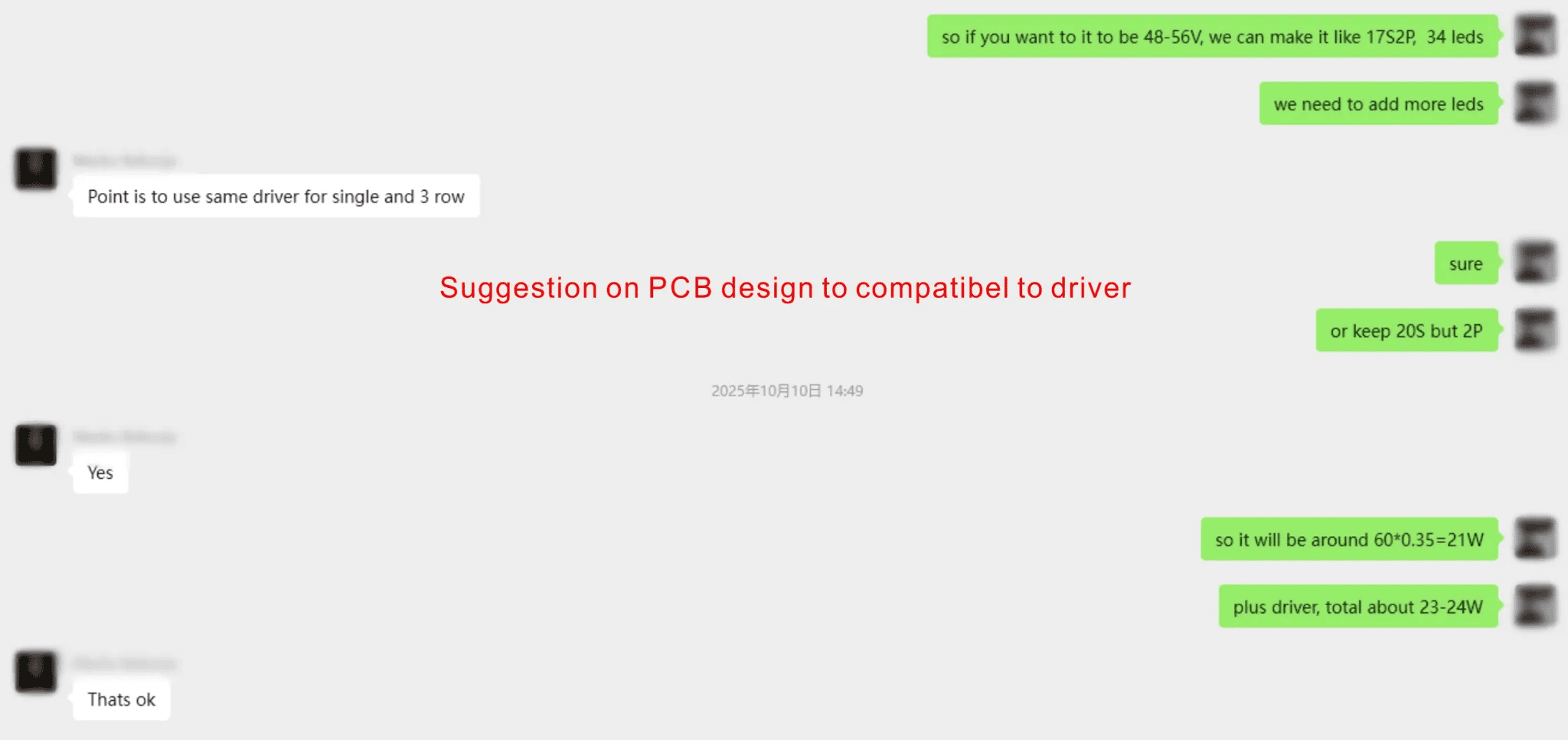
La principale exigence était simple : les modules devaient fonctionner avec les pilotes déjà utilisés dans son usine. Il ne voulait pas remplacer les pilotes ni modifier la configuration de production existante dans son usine.
J'ai tout de suite compris le défi derrière la demande.
Il avait déjà un stock en stock. Changer les drivers signifiait modifier les calculs de coûts sur sa chaîne de production.
La fiche technique qu'il a envoyée et la seule ligne qui a tout changé
Cet entrepreneur fabriquait déjà ses propres luminaires linéaires en Serbie avant de nous contacter. Il n'avait pas besoin de recommandations de produits. Il avait besoin d'un fournisseur capable de construire des modules autour des pilotes et des dimensions déjà utilisées dans sa chaîne de production.
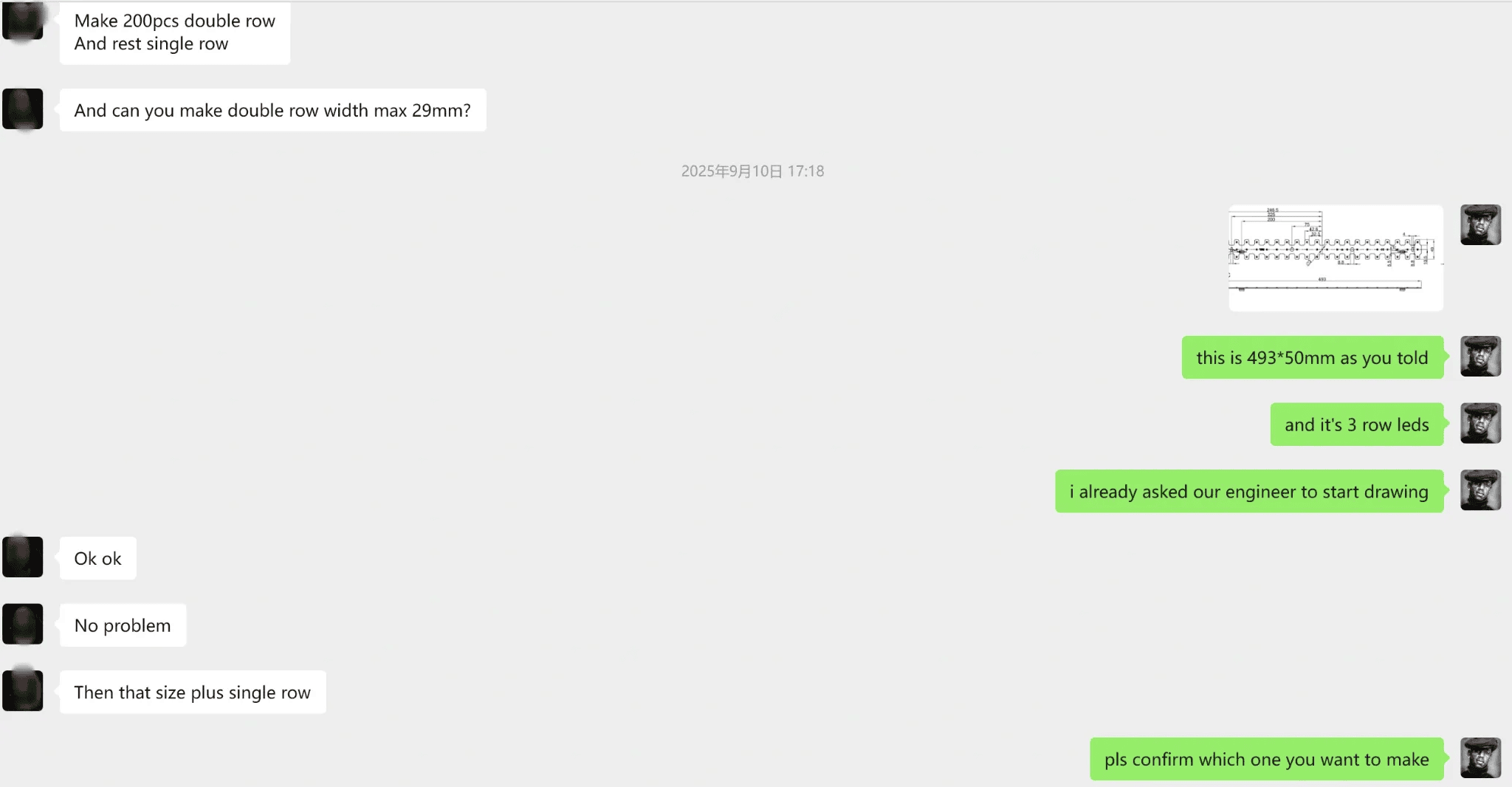
Les spécifications elles-mêmes étaient gérables. Le vrai problème était la condition du conducteur : tout devait fonctionner avec les chauffeurs existants déjà assis dans son usine.
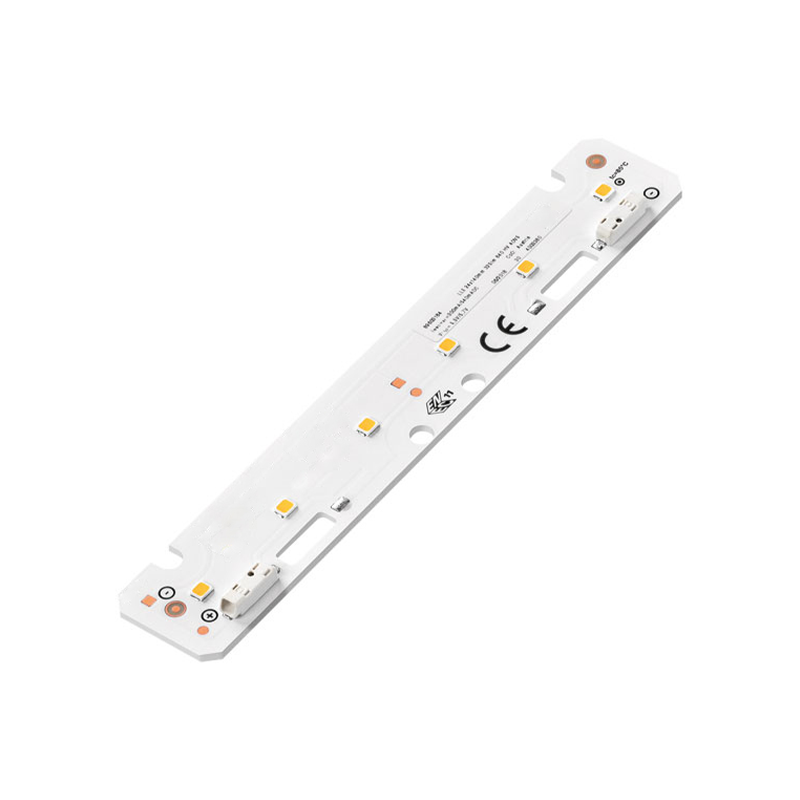
Module d'éclairage LED modulaire de 140x24mm 550lm
- Modèle: ROX24T012E-140MM/RQX24T012E-140MM
- Tension d'entrée : 10.4-11.4VDC
- Courant d'entrée : 275mA
- Watt d'entrée : 3W
- lumens : 549-621 LM
- Efficacité lumineuse : 183-205 lm/w
- Types de LED : SMD3030/SMD2835
- Puce LED : Samsung/Osram/Lumileds/Bridgelux/Séoul
- LED QTÉ : 12 pièces
- Température de couleur : 2700K/3000K/4000K/5000K/6500K
- IRC : 80/90
- Dimension : 139×23,6×1,6mm
- Matériau de circuit imprimé : Aluminium/FR-4
- Certification : CE, RoHS
- Garantie: 5 ans
Pourquoi la condition du conducteur était le vrai problème et pourquoi je ne suis pas parti
Un pilote de courant constant produit un courant fixe. Son pilote existant fonctionnait à 350 mA. Le module à une rangée tire 120 mA. Le module à trois rangées consomme 360 mA. J'avais déjà vu des conflits de pilotes similaires, et la plupart d'entre eux se sont terminés avec le fournisseur recommandant un matériel entièrement nouveau. Les spécifications de tension étaient faciles à adapter. Le véritable défi consistait à faire fonctionner les deux configurations de modules avec le même pilote.
La réponse la plus simple était de lui dire d'acheter un deuxième pilote. Je ne lui ai pas donné de réponse facile.
Avant de discuter des solutions avec l'ingénierie, j'ai parcouru les spécifications d'origine qu'il avait envoyées sur WhatsApp.
C'était la configuration que nous essayions de faire fonctionner avec le même pilote existant :
| Paramètres | Module à une seule rangée | Module triple rangée |
| Taille du circuit imprimé | 493 x 25 mm | 493 x 50mm |
| Configuration LED | 20 séries, 1 parallèle | 20 séries, 3 parallèles |
| Total des LED | 20 | 60 |
| tension de service | 50 à 60V | 50 à 60V |
| Température de couleur | Blanc chaud | Blanc chaud |
| Puissance estimée | Environ 7W | Module 21W, 23 à 24W au total avec pilote |
| Matériau du circuit imprimé | Aluminium | Aluminium |
| Certification | CE ROHS | CE ROHS |
| chauffeur | Stock existant — Pas de nouveau pilote | Même pilote existant |
Avant de répondre, j'ai discuté des exigences du conducteur directement avec notre équipe d'ingénieurs. Parce que je savais que le projet allait avancer ou s'effondrer en fonction de ce seul problème. Le client attendait une réponse avant de poursuivre la planification de la production. À ce stade, le projet ne pouvait avancer que si la configuration du pilote fonctionnait correctement. Je ne savais pas encore ce que ça allait être.
La solution qui a gardé son chauffeur existant et son budget intact
Trois modules à une seule rangée connectés en parallèle dessinent 120 mA.
Combinés, les trois modules fonctionnent dans la plage de travail de sa configuration de pilote 350mA existante.
Cela signifiait :
Pas de nouveau pilote. Pas de matériel supplémentaire. Aucun coût supplémentaire dans sa chaîne de production.
Les modules à une rangée et à trois rangées deviennent interchangeables du point de vue du conducteur, tant que les modules à une rangée sont câblés en groupes parallèles de trois.
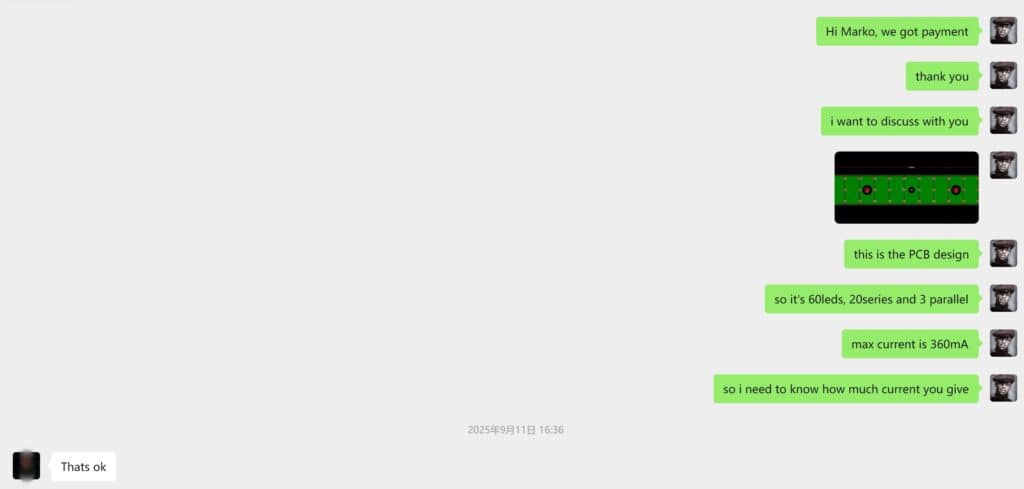
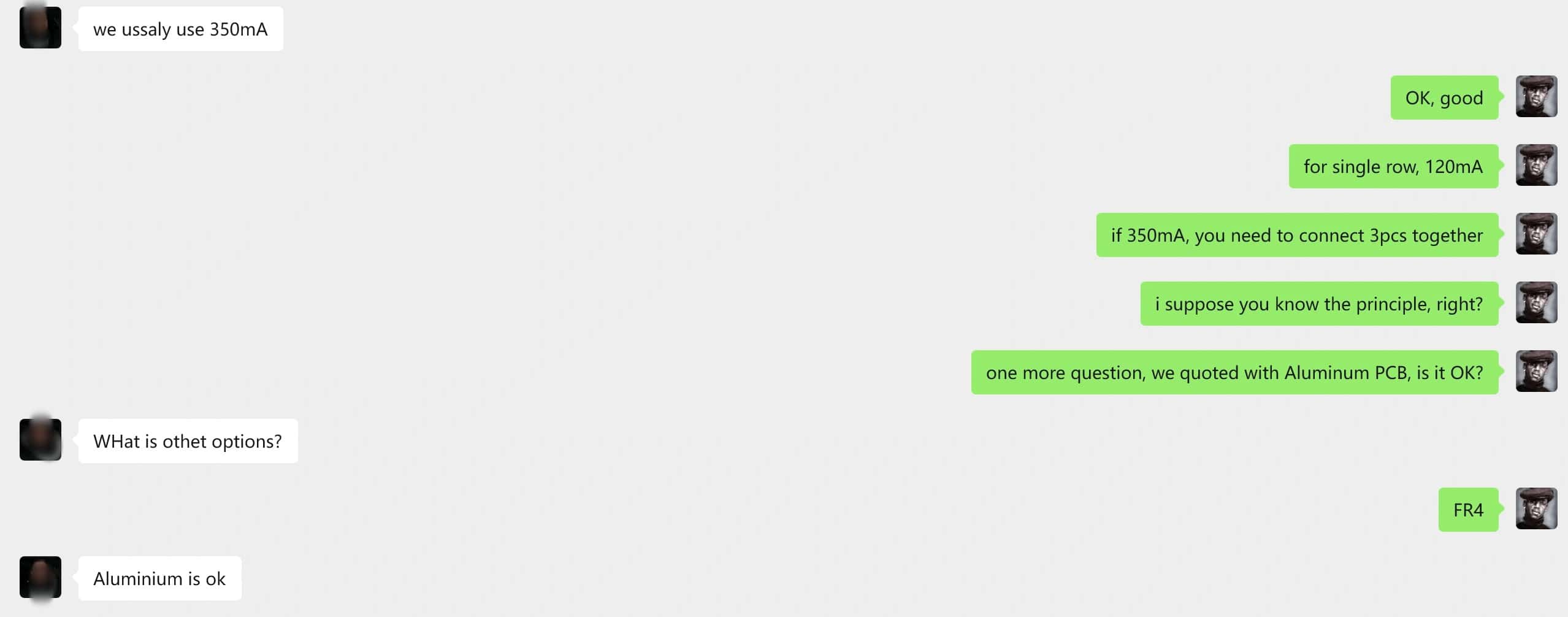
Comment la connexion parallèle a résolu le problème du pilote :
| configuration | Courant par unité | contact | Courant total | Changement de pilote |
| 1x rangée unique | 120mA | diriger | 120mA | Oui - un pilote différent nécessaire |
| 1x rangées triples | 360mA | diriger | 360mA | Non — Correspond à l'existant |
| 3x rangs parallèles à une seule rangée | 120 mA chacun | parallèle | 360 mA au total | Non — Correspond à l'existant |
Après avoir examiné les calculs et la configuration de câblage en cours, sa réponse est revenue en deux mots :
"C'est bon."
Le client avait soigneusement examiné tous les détails techniques tout au long de la discussion, qui était en fait son approbation pour aller de l'avant.
Il n'a pas demandé d'échantillon. Cela vous dit tout.
La plupart des acheteurs dans cette situation demandent d'abord un prototype. C'est le processus normal lorsque vous commandez des modules LED personnalisés à partir d'une usine que vous n'avez jamais visitée.
Il n'en a jamais demandé.
- Aucun échantillon de test.
- Pas de visite d'usine.
- Pas d'inspection par un tiers.
Il a passé la commande de production entièrement basée sur notre discussion WhatsApp, la solution d'ingénierie et le dessin sur PCB que nous avons confirmés ensemble.
Ce niveau de confiance est établi grâce à une communication technique et à un suivi cohérent avant le début de la production.
Du paiement confirmé au tirage au sort avant le lendemain matin
Une fois les spécifications finalisées, le client a confirmé la commande et nous avons immédiatement déplacé le dessin de PCB dans la revue de production. J'ai contacté Engineering le même après-midi et je l'ai signalé comme prioritaire.
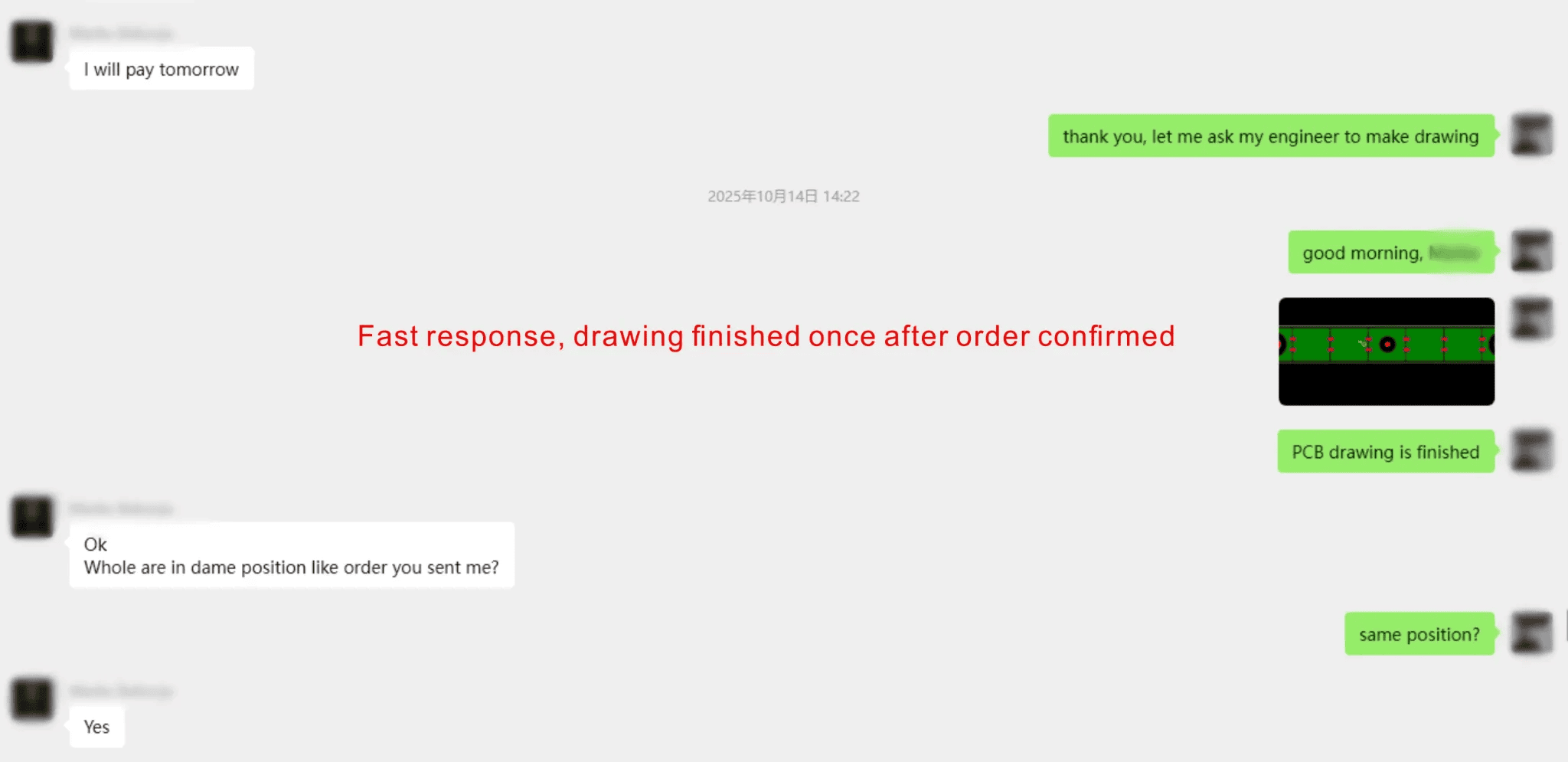
Après une journée de discussion technique, le dessin du PCB a été complété le lendemain et envoyé pour confirmation. Cette vitesse importait parce que sa propre planification de production attendait déjà la confirmation.
Les positions des trous, la disposition des LED et les emplacements des connecteurs ont toutes été finalisées dans un seul échange de messages.
Il a examiné la mise en page, confirmé les positions des trous et approuvé le dessin pour la production.


Spécifications finales verrouillées pour la production :
| Paramètres | une seule rangée | Triple rangée |
| Taille du circuit imprimé | 493 x 25 mm | 493 x 50mm |
| Nombre de LED | 20 | 60 |
| configuration | 20 s 1 p | 20s 3p |
| courant de fonctionnement | 120 mA par module | 360 mA au total |
| Chauffeur utilisé | 350mA existant | 350mA existant |
| puissance totale | Environ 7W | Environ 23 à 24 W |
| substrat | Aluminium | Aluminium |
| Certification | CE ROHS | CE ROHS |
Pourquoi l'aluminium et non le FR4
Il a posé des questions sur FR4 lors de la discussion sur les spécifications. J'ai recommandé l'aluminium immédiatement car j'ai vu des modules FR4 haute densité échouer tôt à cause de l'accumulation de chaleur dans les applications commerciales.
Si vous comparez le coût des matériaux, la dissipation de chaleur et les compromis de fabrication, cela aide également à comprendre Comment les entreprises évaluent la fabrication et l'assemblage de PCB valeur dans différentes applications.
Le circuit imprimé en aluminium réduit la température de jonction LED de 15 à 20 degrés Celsius par rapport à FR4, ce qui prolonge directement la durée de vie des modules et améliore la stabilité à long terme.
Pour un entrepreneur qui installe ces luminaires dans des espaces commerciaux sous son propre nom d'entreprise, la fiabilité importait bien plus que la petite différence de coût des matériaux.
Une fois les spécifications et le dessin sur PCB confirmés, la production pouvait commencer.
Ce qui est sorti de la chaîne de production
Voici à quoi ressemblait le premier lot avant d'être expédié en Serbie.
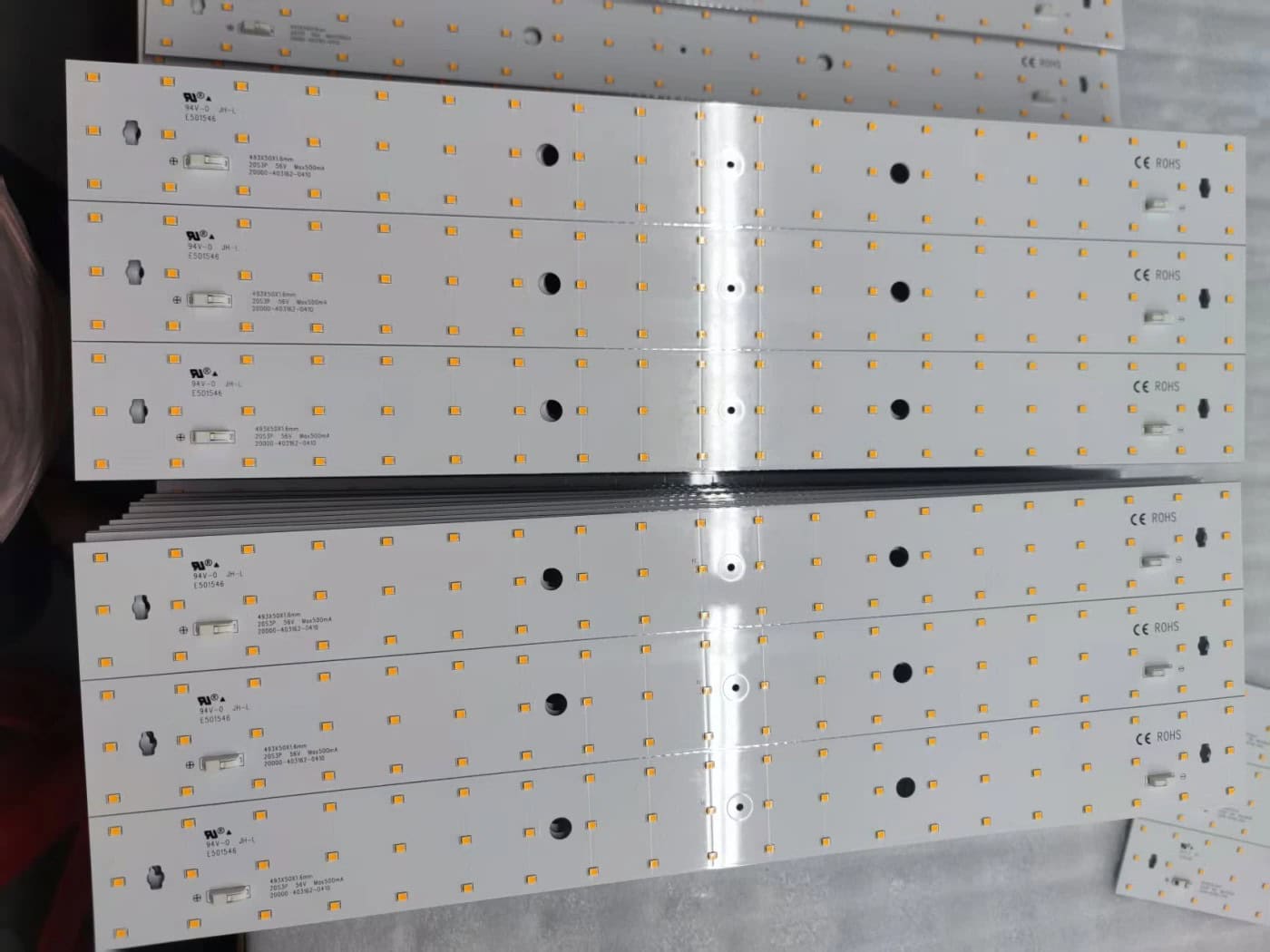
Il n'a jamais visité l'usine. Je n'ai jamais vu ces produits être faits. Il faisait confiance à une conversation et à un dessin. chaque module Dans ce lot, il fallait exactement ce que la fiche technique décrite, car il n'y avait aucune seconde chance de faire une première impression.
La boutique en Serbie à quoi ressemblaient les modules
Après l'arrivée des modules, il les installa. Il a envoyé des photos.
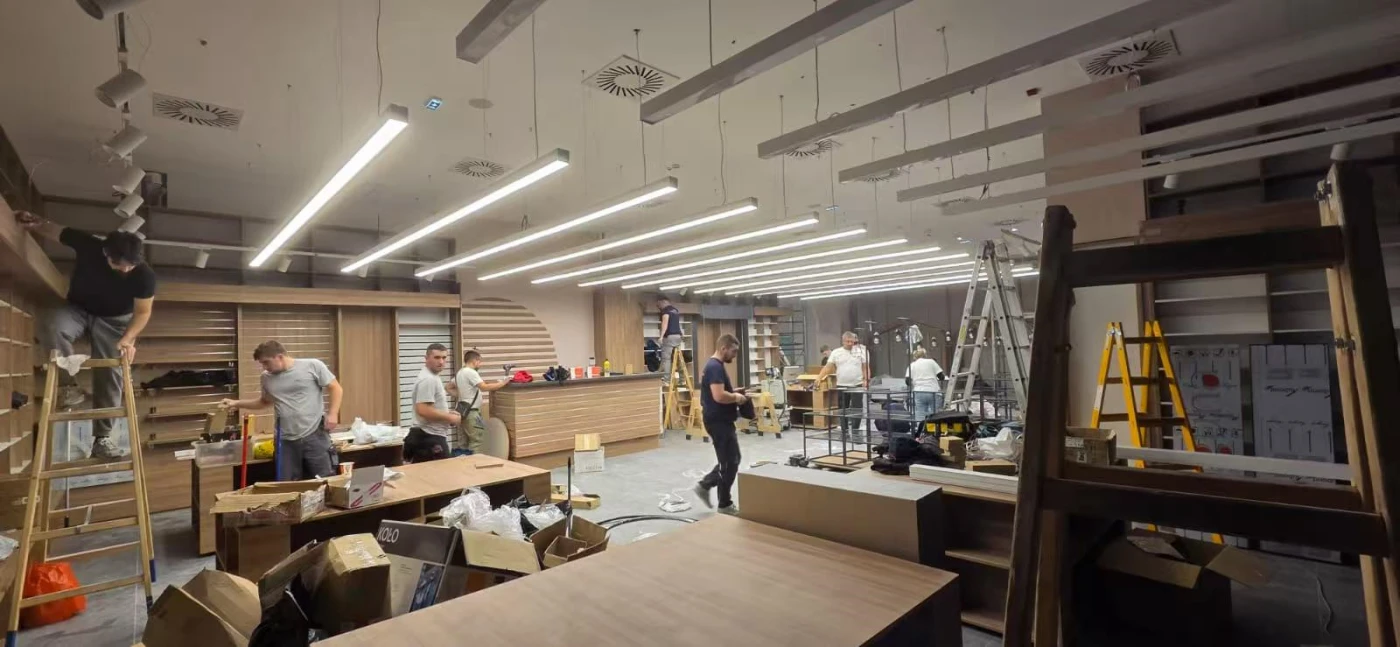
L'installation terminée correspondait aux spécifications d'origine que nous avons discutées au cours du projet.
La séquence vidéo provient d'un projet séparé, une installation de bureau moderne que l'entrepreneur a réalisée à l'aide des mêmes modules. Il l'a partagé avec les photos de la boutique.
Cinq minutes après l'arrivée du premier lot
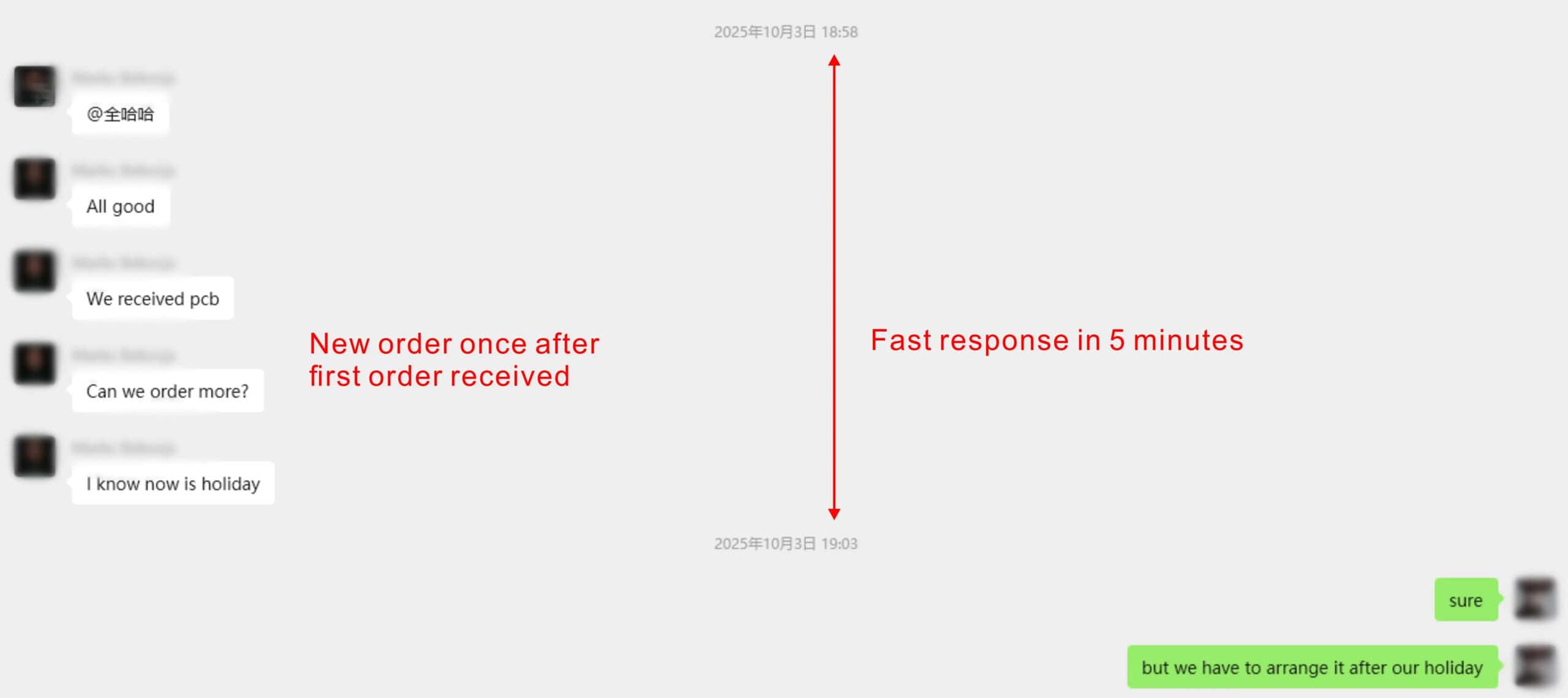
Cet entrepreneur assemble lui-même des luminaires. Il sait immédiatement si un module fonctionne en dimensions, en sortie, en compatibilité avec les pilotes. Lorsqu'il dit "tout va bien" et demande plus d'informations dans les cinq minutes suivant la livraison, pour un entrepreneur qui assemble lui-même les luminaires, cette réponse a suffi à confirmer que les modules répondaient à ses exigences.
Ma réponse : "Bien sûr. Mais nous devons organiser cela après nos vacances.
C'était la deuxième commande. Le module à double rangée qu'il a ajouté dans cette commande 493x50 mm était une nouvelle configuration qu'il souhaitait pour un projet différent. Même attente de qualité. même niveau de confiance.
Quatre commandes plus tard, ce que ce partenariat signifie réellement
Cette deuxième commande n'était pas la dernière.
Chronologie complète du projet :
| dater | Ce qui s'est | se produire |
| Septembre 2025 | WhatsApp Interrogation — Fiche technique, référence de site Web | Démarré du projet — aucun échantillon demandé |
| Septembre 2025 | Un jour de discussion — Spécifications confirmées | Spécifications à trois lignes et à une seule ligne verrouillées |
| Septembre 2025 | La conception du PCB est confirmée le lendemain | Signature d'ingénierie terminée |
| Septembre 2025 | Commande confirmée et dessin de PCB terminé | L'examen de la production a commencé |
| Octobre 2025 | Premier lot reçu en Serbie | "Tout va bien" - zéro problème |
| Octobre 2025 — 5 minutes plus tard | "Pouvons-nous en commander plus?" | Deuxième ordre — Double ligne ajoutée |
| Fin 2025 | Troisième et quatrième commandes passées | Partenariat actif continu |
Ce qui a fait la différence :
| la situation | Ce que Signiteled a fait | Ce qu'il a produit |
| Aucun échantillon — Spécifications uniquement | Conçu à partir de la conversation WhatsApp et de la fiche technique | Spécifications correspondantes de production exactement |
| Conflit de compatibilité avec | Solution de connexion parallèle — pas de nouveau pilote | Aucun frais supplémentaire pour l'entrepreneur |
| Deux types de modules nécessaires | Les deux conçus en une seule session | Gamme complète d'un fournisseur |
| Délai d'exécution rapide nécessaire | Dessin de circuit imprimé prêt avant le lendemain matin | Aucun retard de production |
| Première commande sans échantillon | CE RoHS certifié ROHS PCB livré | « Tout va bien » à l'arrivée |
| Quatre commandes au fil du temps | Spécifications et qualité cohérentes pour chaque lot | Statut du fournisseur du module principal |
Il est venu avec une condition que la plupart des fournisseurs utilisent comme sortie. Nous l'avons utilisé comme point de départ. C'est la raison pour laquelle il y a eu quatre commandes.
Si vous fabriquez vos propres luminaires
Si vous fabriquez vos propres luminaires et que vous avez déjà des limitations de conducteur ou des normes de production existantes, envoyez les spécifications avant le début de la planification de la production.
La plupart des problèmes dans les projets de modules LED personnalisés commencent lorsque ces détails sont discutés trop tard.
Au SignliteLED, nous préférons confirmer la compatibilité avant le début de la production plutôt que de corriger les problèmes après l'installation.
- Auteur : Steven Quan
- Directeur des ventes
- Courriel : sales@signlite.com.cn
- Mobile / WhatsApp : +86 15814478470

FAQ
Articles Similaires