Français
  English
  简体中文
简体中文  Deutsch
  Español
  Italiano
  日本語
日本語  한국어
한국어  Polski
  Português
  Русский
  Türkçe
  Nederlands
  Tiếng Việt
  ไทย
ไทย 
Les bandes de lumière LED à spectre complet sont conçues pour produire un spectre équilibré de lumière visible qui ressemble étroitement à la lumière naturelle du jour. Contrairement aux bandes de LED conventionnelles qui ne mettent l'accent que sur certaines longueurs d'onde, les LED à spectre complet offrent une distribution spectrale plus complète et une précision des couleurs plus élevée, ce qui les rend idéales pour les applications où la reproduction fidèle des couleurs et le confort visuel sont essentiels.
Alors que la technologie d'éclairage continue d'évoluer, les architectes, les concepteurs d'éclairage, les distributeurs et les acheteurs commerciaux mettent davantage l'accent sur la qualité de la lumière plutôt que sur la luminosité seule. Qu'elles soient utilisées dans des présentoirs, des musées, des studios de photographie, des environnements de santé ou des projets résidentiels de qualité supérieure, les bandes de bande LED à spectre complet aident à révéler les couleurs plus naturellement et à créer une expérience d'éclairage plus confortable.
Cependant, tous les produits étiquetés « Full Spectrum » ne offrent pas les mêmes performances. Des facteurs tels que la distribution spectrale, l'indice de rendu des couleurs (IRC), la température de couleur (CCT), la qualité de la puce LED et la cohérence de la fabrication influencent tous l'effet d'éclairage final et la fiabilité à long terme.
Dans ce guide, vous apprendrez ce que sont les feux de bande à LED à spectre complet, comment ils fonctionnent, leurs principaux avantages, les applications courantes et les spécifications les plus importantes à prendre en compte avant de choisir un produit ou un fabricant.
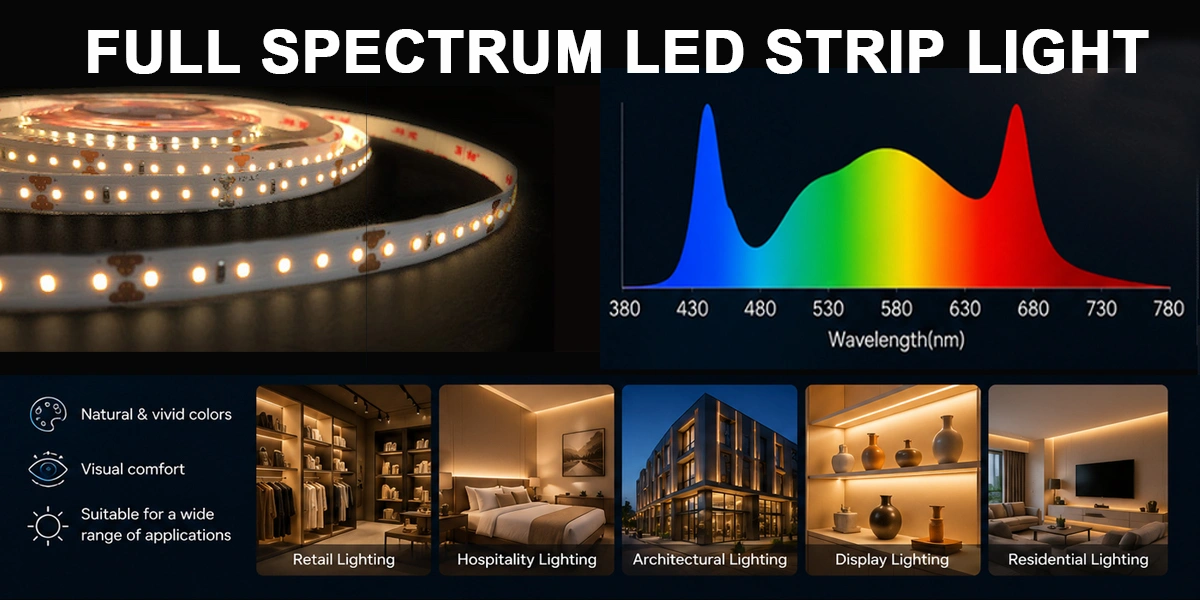
Que sont les bandes de lumière à LED à spectre complet ?
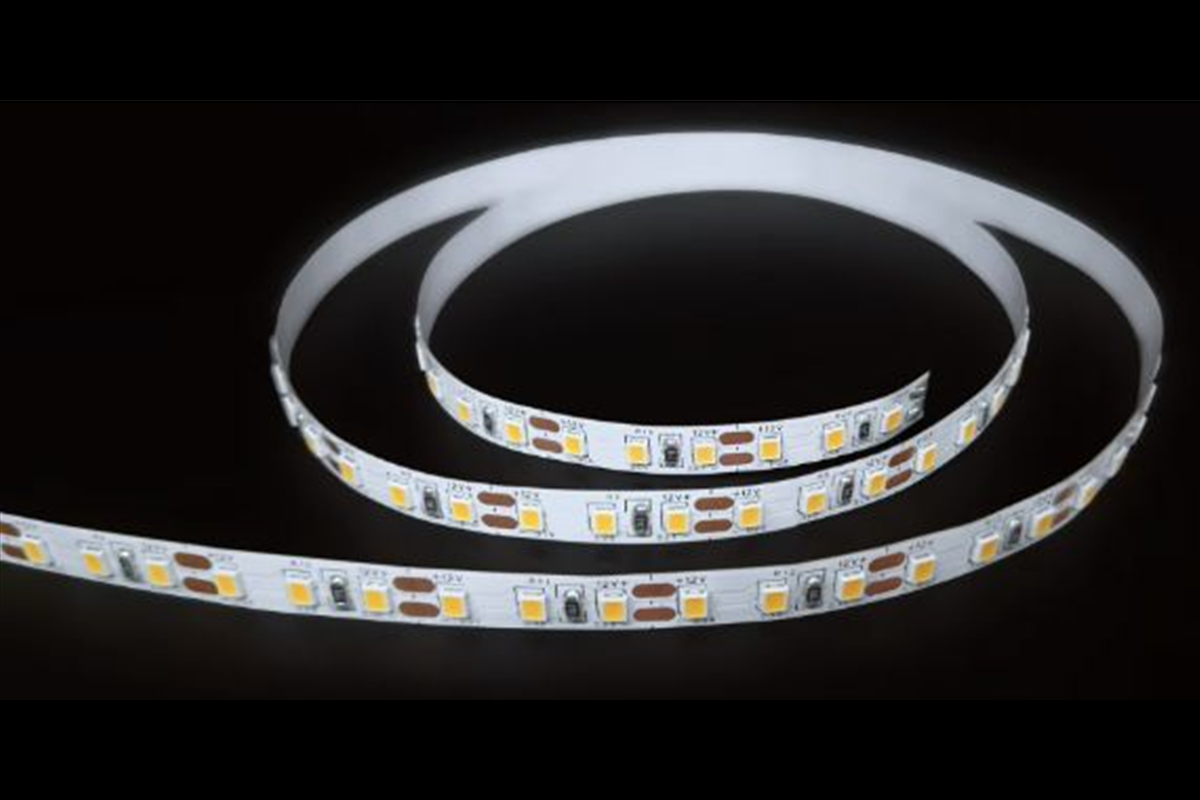
Les bandes de lumière à LED à spectre complet sont des produits d'éclairage linéaire flexibles conçus pour émettre une large gamme équilibrée de longueurs d'onde visibles. Leur production spectrale est destinée à ressembler de plus en plus à la lumière naturelle du jour que celle des bandes LED conventionnelles, permettant aux objets et environnements lumineux d'apparaître plus naturels. Cette production spectrale symétrique contribue également à Amélioration du rendu des couleurs, aidant les objets à apparaître plus près de leurs vraies couleurs sous un éclairage artificiel.
Le terme « spectre complet » décrit la distribution globale de la lumière dans le spectre visible plutôt qu'une température de couleur spécifique, un boîtier LED ou une technologie de fabrication. Cependant, il n'existe pas de norme universellement acceptée qui définit exactement la couverture spectrale qu'un produit doit fournir pour être qualifiée de spectre complet. En conséquence, les performances spectrales des bandes LED commercialisées sous ce terme peuvent varier selon les fabricants et les modèles de produits.
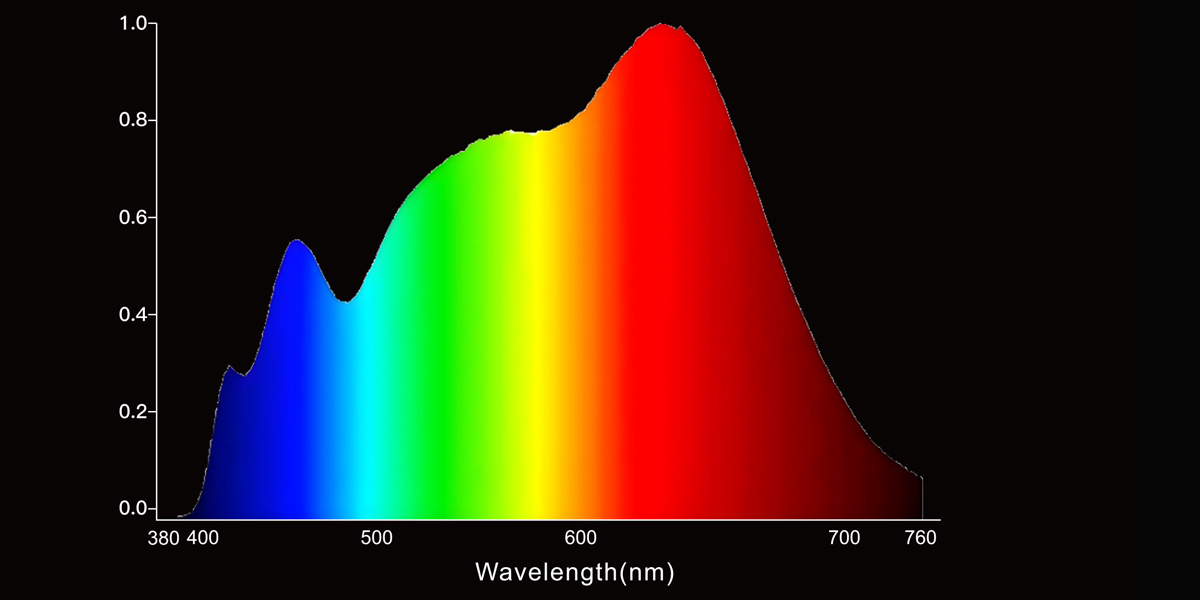
Légende de la figure : distribution spectrale typique d'une source de lumière LED à spectre complet sur la plage de longueurs d'onde visible.
Comment est réalisé l'éclairage LED à spectre complet ?
L'éclairage LED à spectre complet nécessite un contrôle attentif de la conception de la source de lumière, notamment la sélection de puces LED, la technologie du phosphore et le réglage spectral. Contrairement aux bandes LED classiques, principalement optimisées pour la luminosité et l'efficacité, les bandes LED à spectre complet sont conçues pour créer une distribution plus large et plus équilibrée des longueurs d'onde visibles.
Une approche courante consiste à utiliser des puces LED spécialement conçues, des formulations de phosphores avancées ou des combinaisons de différentes technologies LED pour améliorer la couverture spectrale. Grâce à une conception optique précise et à une sélection de matériaux, les fabricants peuvent ajuster la sortie lumineuse émise pour obtenir un spectre qui ressemble davantage à la lumière naturelle du jour.
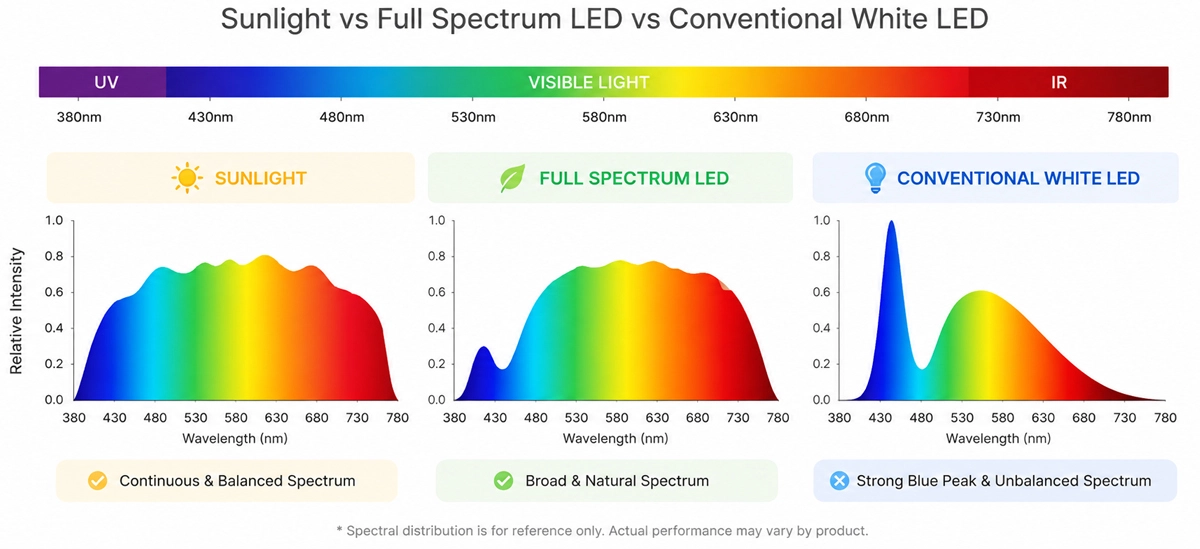
Figure : Comparaison des distributions spectrales typiques de la lumière du soleil, de l'éclairage LED à spectre complet et de l'éclairage LED blanc conventionnel.
La comparaison de la distribution spectrale ci-dessus illustre la différence entre un large spectre de lumière équilibré et la sortie de longueur d'onde limitée que l'on trouve couramment dans les LED blanches conventionnelles. En améliorant l'équilibre des longueurs d'onde et en réduisant les écarts dans le spectre visible, la technologie LED à spectre complet peut offrir une expérience d'éclairage plus naturelle et confortable.
Cependant, obtenir des performances de spectre complète cohérentes dépend de plus que de simples composants LED. Des facteurs tels que la qualité de la puce LED, la cohérence du phosphore, la structure optique, la gestion thermique et le contrôle de la fabrication peuvent tous influencer la sortie spectrale finale. C'est pourquoi les bandes LED à spectre complet de différents fabricants peuvent produire des résultats d'éclairage différents, même lorsque des descriptions de produits similaires sont utilisées.
La compréhension de l'obtention de l'éclairage à spectre complet constitue la base pour évaluer les facteurs de performance clés, notamment la distribution spectrale, le rendu des couleurs et la température de couleur, qui seront discutées dans les sections suivantes.
Full Spectrum vs. High CRI vs Standard LED Lights : quelle est la différence ?
spectre complet, Lampes de bande LED hautement CRI et standard sont des termes liés mais non interchangeables. Ils décrivent différents aspects des performances et de la conception de l'éclairage LED. Le spectre complet se concentre principalement sur la distribution et l'équilibre des longueurs d'onde produites par la source lumineuse, tandis que le CRI (indice de rendu des couleurs) évalue la précision avec laquelle les couleurs sont reproduites. Les éclairages à bande LED standard se réfèrent plus largement aux produits LED conventionnels conçus pour un éclairage général, où les priorités peuvent inclure la luminosité, l'efficacité, la température de couleur et le coût.
Lumières de bandes LED à spectre complet ou à bandes LED élevées : comprendre la différence
Le spectre complet et le CRI élevé décrivent différents aspects des performances des lumières LED, mais les deux jouent un rôle important dans Qualité des couleurs dans l'éclairage LED. Le spectre complet fait principalement référence à l'étendue et à la distribution des longueurs d'onde produites par une source de lumière, tandis que le CRI (indice de rendu des couleurs) mesure la précision avec laquelle la source lumineuse révèle des couleurs par rapport à une source de lumière de référence.
Solutions de bandes LED de haute qualité est conçu pour reproduire les couleurs avec plus de précision, généralement avec un IRC de 90 ou plus pour les applications où une bonne qualité de couleur est importante. Cependant, une cote IRC élevée ne décrit pas la distribution spectrale complète de la LED. Deux bandes LED peuvent avoir des cotes de CRI similaires tout en produisant des profils spectraux sensiblement différents.
Une bande LED à spectre complet, quant à elle, se concentre plus largement sur la distribution des longueurs d'onde visibles. Lorsque le spectre est bien équilibré et relativement continu, la lumière peut fournir un éclairage naturel et un rendu de couleur fort. Pour cette raison, de nombreuses bandes LED à spectre complet de haute qualité sont également conçues avec un CRI élevé et une performance R9 solide.
Comparaison rapide : spectre complet vs. CRI élevé
| Fonctionnalité | FBande de LED de spectre ULL | Bande LED CRI élevée |
| Orientation principale | Distribution spectrale | Précision du rendu des couleurs |
| Mesure principale | spd | CRI / RA |
| Couverture de longueur d'onde visible | large et équilibré | Pas forcément large |
| CRI | Peut être élevé | Généralement élevé |
| Performances R9 | Peut être optimisé | Dépend de la conception LED |
| Continuité du spectre | Facteur important | Non défini par CRI seul |
| parenté | Peut aussi être élevé CRI | Peut également être à spectre complet |
Les deux concepts ne sont donc pas mutuellement exclusifs. Une bande LED à spectre complet peut également être une bande LED CRI élevée, et cette combinaison peut être particulièrement utile pour les applications où la qualité spectrale et la reproduction précise des couleurs sont importantes.
L'IRC ne doit donc pas être considéré isolément lors de l'évaluation de l'éclairage LED à spectre complet. En examinant la distribution de puissance spectrale, le CRI, R9, le CCT, l'efficacité lumineuse et la cohérence des couleurs fournissent une image plus complète des performances de la source lumineuse.
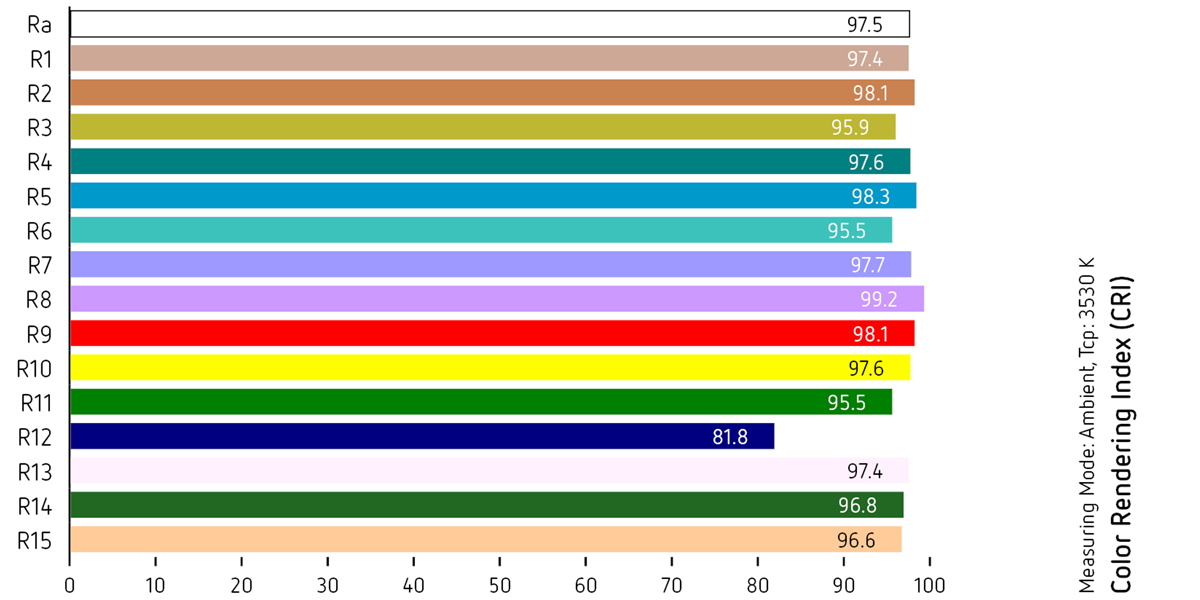
Exemple de la distribution spectrale et des caractéristiques de rendu des couleurs d'une bande LED CRI élevée.
Pour une meilleure compréhension du rendu des couleurs et du CRI, la vidéo ci-dessous explique comment le CRI est mesuré et pourquoi cela est important lors de l'évaluation de la qualité de l'éclairage des LED.

Lampes de bande LED à spectre complet ou à bandes LED standard : comprendre la différence
Les éclairages à bande LED standard sont généralement conçus autour d'exigences d'éclairage pratiques telles que la luminosité, l'efficacité énergétique, la température de couleur, le coût du produit et l'éclairage général. Leurs caractéristiques spectrales peuvent varier considérablement en fonction de la puce LED, de la formulation de phosphore et de la conception globale du produit.
Les bandes de lumière à spectre complet à spectre LED mettent davantage l'accent sur la qualité spectrale et la distribution de la longueur d'onde. Leur conception spectrale vise à fournir une couverture plus large et plus équilibrée dans la gamme visible, ce qui peut contribuer à une apparence de couleur plus naturelle et à une perception visuelle cohérente.
Cela ne signifie pas que les bandes LED standard fournissent une lumière de mauvaise qualité. De nombreuses bandes de lumière LED conventionnelles peuvent offrir une excellente efficacité, des performances fiables et un bon rendu des couleurs. La principale différence est la priorité de conception : une bande LED standard peut être optimisée principalement pour l'éclairage général, l'efficacité ou le coût, tandis qu'une bande de LED à spectre complet met davantage l'accent sur la qualité et la distribution du spectre émis.
Comparaison rapide : full spectrum vs. Lights de bande LED standard
| Fonctionnalité | Bande LED à spectre complet | Bande LED standard |
| Priorité de conception | Qualité spectrale et répartition de la longueur d'onde | Éclairage général |
| Distribution spectrale | large et équilibré | Dépend de la conception LED |
| CRI | Souvent disponible en versions CRI élevées | Varie selon le produit |
| Aspect couleur | Conçu pour un éclairage naturel | Dépend de la conception LED et phosphore |
| Efficacité | Peut être élevé | Souvent une considération de conception majeure |
| Coût | peut être plus élevé | Une fourchette de prix plus large |
| Applications typiques | Éclairage couleur sensible et haut de gamme | Éclairage commercial et résidentiel général |
Aucun des deux types n'est universellement meilleur. Les bandes de LED à spectre complet méritent d'être prises en compte lorsque la qualité spectrale, l'apparence des couleurs et la cohérence visuelle sont importantes, tandis que les bandes LED standard peuvent être un choix pratique lorsque l'éclairage, l'efficacité et le coût sont les principales priorités.
En fin de compte, la bonne bande LED dépend des exigences d'éclairage spécifiques de chaque projet plutôt que de l'étiquette du produit. Pour les applications où la précision des couleurs, la qualité visuelle et les performances spectrales sont essentielles, la révision de données techniques telles que SPD, CRI, R9, CCT, l'efficacité lumineuse et la cohérence des couleurs fournit une base plus fiable pour la sélection des produits.
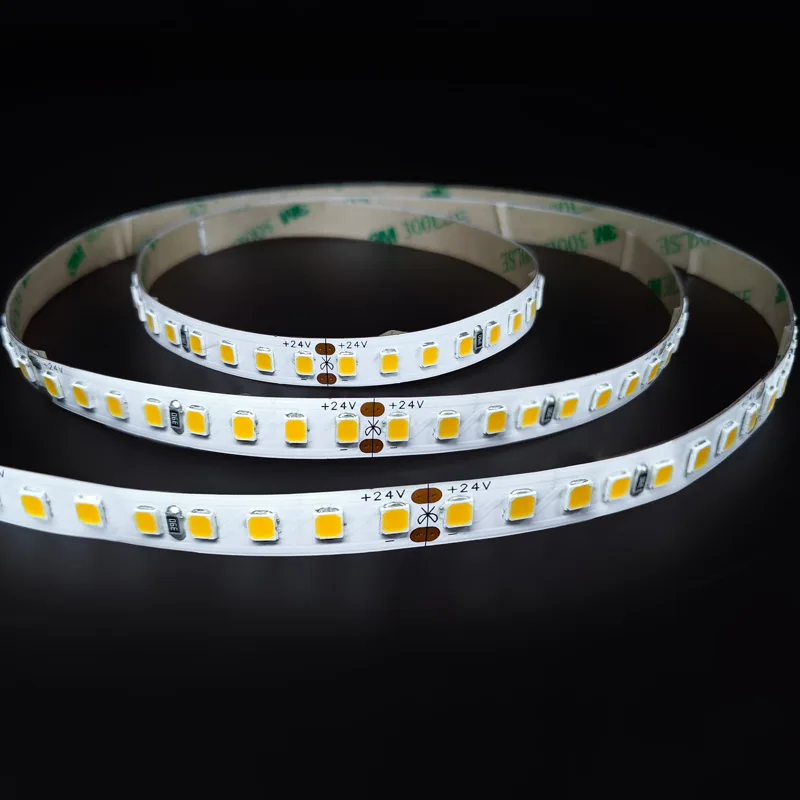
- 128 LED SMD2835 par mètre
- Largeur de la carte de 10 mm
- CRI 80/ 90/ 98
- Efficacité élevée jusqu'à 200 lm/W
- Entièrement gradable
- Ruban adhésif double face 3M très résistant
- Températures de couleur 3000K, 4000K et 6500K en option
- BIN unicolore, DDCM en 3 étapes disponible
- Peut être OEM/ODM et personnalisable
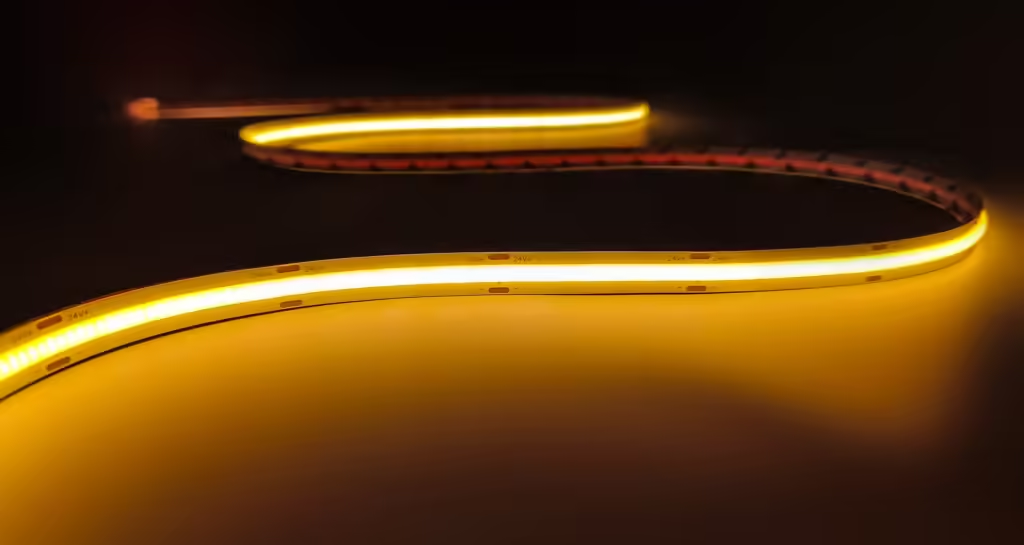
Bande lumineuse de 480 LED COB pour l'éclairage décoratif
- 480chips/m, 100lm/W, sans points
- Température de couleur disponible de 2700K à 6500K
- Dimmable
- Angle de rayonnement de 180 degrés
- CRI 80/ 90/ 98
- Technologie sans soudure, de bobine à bobine
Principales spécifications des bandes de lumière LED à spectre complet
Lors de la sélection de la bande de lumière LED à spectre complet, les acheteurs doivent regarder au-delà de l'étiquette « spectre complet » et évaluer les spécifications techniques qui déterminent la qualité de la lumière, la fiabilité et la pertinence pour différentes applications.
1. Distribution de puissance spectrale (SPD)
Une bande LED à spectre complet bien conçue devrait fournir une couverture large et relativement équilibrée sur la plage de longueurs d'onde visible. La courbe de distribution de puissance spectrale (SPD) fournit une représentation visuelle de la façon dont l'énergie lumineuse est répartie sur différentes longueurs d'onde et est l'une des références les plus utiles pour évaluer la qualité du spectre. En analysant la courbe SPD, les acheteurs peuvent mieux comprendre si une bande LED fournit une production spectrale équilibrée plutôt que de se fier uniquement à des termes marketing tels que « spectre complet » ou « type de soleil ».
2. CRI (index de rendu des couleurs) et R9
CRI indique la précision avec laquelle les couleurs sont rendues, tandis que R9 fournit des informations supplémentaires sur le rendu rouge saturé. Pour les applications commerciales et sensibles aux couleurs, le CRI 90+ est généralement un point de départ pratique, avec des performances CRI et R9 fortes préférées pour les applications nécessitant une plus grande précision des couleurs.

La vidéo fournit une explication simple de l'IRC, y compris en quoi elle diffère du CCT et comment le CRI affecte la qualité de couleur perçue.
3. CCT (température de couleur corrélée)
CCT détermine si la lumière semble chaude, neutre ou froide. Les bandes LED à spectre complet peuvent être produites dans différentes options de température de couleur, notamment le blanc chaud, le blanc neutre et le blanc de la lumière du jour. Différentes applications peuvent nécessiter des sélections CCT différentes en fonction de l'atmosphère visuelle et des exigences d'éclairage souhaitées. En savoir plus sur le choix du bon Température de couleur pour éclairage LED.
4. Densité et uniformité des LED
La densité des LED affecte l'uniformité de l'éclairage et l'apparition de taches sombres. Les bandes LED à plus forte densité peuvent fournir une lumière plus lisse, en particulier dans les profils peu profonds, les armoires d'affichage et les applications où la bande est installée près de la surface éclairée.
5. Consommation d'énergie et efficacité lumineuse
La consommation d'énergie est généralement spécifiée en watts par mètre (W/m) et doit être envisagée avec une sortie de lumière et une efficacité lumineuse. Le niveau de puissance approprié dépend de la luminosité requise, de la consommation d'énergie, des conditions thermiques et des exigences d'application.
6. tension
Les bandes de bandes LED à spectre complet sont généralement disponibles dans 12V et 24V configurations. Pour les longs exercices, 24 V est souvent préféré car il peut aider à réduire les chutes de tension et à maintenir un éclairage plus cohérent le long de la bande.
7. Indice IP
La cote IP appropriée dépend de l'environnement d'installation. IP20 convient généralement aux applications intérieures sèches, tandis que IP65, IP67 ou IP68 peut être nécessaire pour les applications exposées à l'humidité, à la poussière ou aux conditions extérieures.
| spécification | Que considérer |
| Distribution spectrale | Recherchez une couverture large et équilibrée dans le spectre visible. |
| CRI & R9 | CRI 90+ est généralement préféré pour un éclairage de qualité ; un R9 plus élevé peut améliorer le rendu des couleurs rouges. |
| TDC | Sélectionnez la température de couleur en fonction de l'application, comme le blanc chaud, le blanc neutre ou la lumière du jour. |
| Densité des LED | Une densité de LED plus élevée peut fournir un éclairage plus uniforme et réduire les points chauds visibles. |
| Pouvoir et efficacité | Équilibrez la luminosité, la consommation d'énergie et les performances thermiques. |
| Tension | Les configurations 12V et 24V sont généralement disponibles; 24V est souvent préféré pour les longs exercices. |
| Indice de protection IP | Choisissez le niveau de protection approprié pour les environnements intérieurs, humides ou extérieurs. |
Pour les projets avec des exigences spécifiques en matière de sécurité photobiologique, les acheteurs doivent également tenir compte CEI 62471 Conformité et classification des risques de lumière bleue Lors de l'évaluation de l'éclairage de la bande LED.
Pour les projets commerciaux et OEM, d'autres spécifications telles que la largeur du circuit imprimé, la longueur de coupe, la méthode de gradation, le type de connecteur et la longueur de bobine peuvent également être adaptées aux besoins d'installation.
Applications de feux de bande à LED à spectre complet
L'éclairage à bande LED à spectre complet est particulièrement adapté aux applications où la qualité des couleurs, la cohérence visuelle et la perception visuelle précise sont importantes. Contrairement aux solutions d'éclairage à usage général, qui se concentrent principalement sur la luminosité et l'efficacité, les bandes LED à spectre complet sont souvent sélectionnées lorsque la qualité des objets et des environnements éclairés est une considération clé.
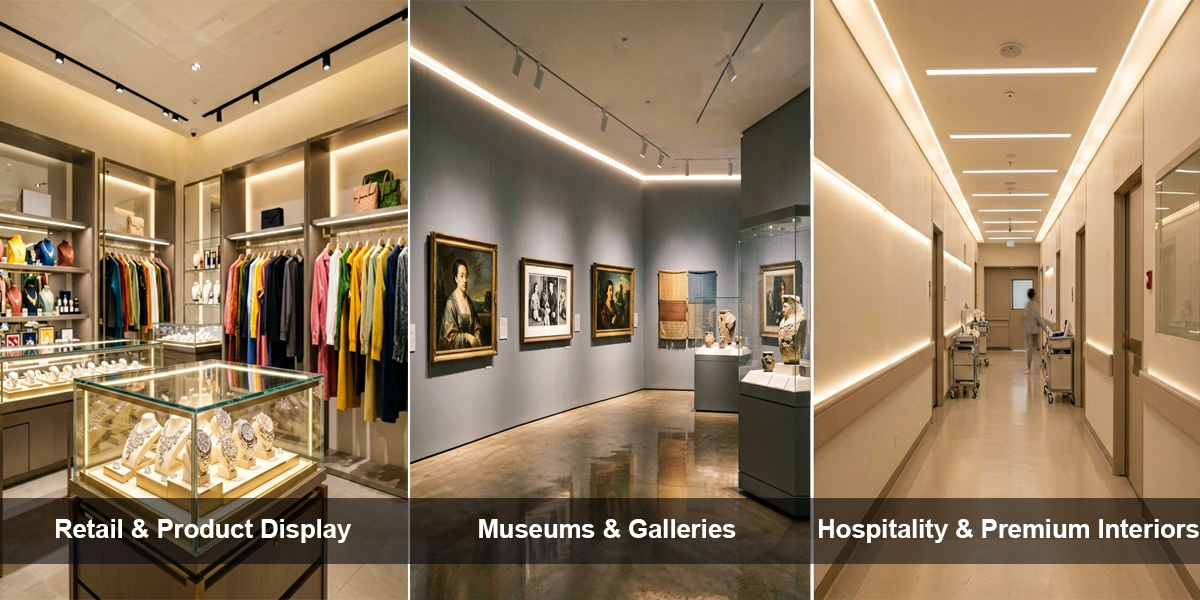
1. Éclairage de vente au détail et d'affichage
Les slips LED à spectre complet sont largement utilisés dans les magasins de détail, les vitrines, les étagères et les vitrines de produits où l'éclairage influence directement la façon dont la marchandise est perçue. En fournissant un éclairage plus naturel et en soutenant une apparence de couleur précise, ils peuvent aider à mettre en évidence les détails et les couleurs des produits tels que les vêtements, les cosmétiques, les bijoux, la nourriture et les produits de luxe.
Pour les applications de vente au détail, la qualité spectrale doit être prise en compte ainsi que la luminosité, l'efficacité énergétique et les exigences d'installation pour atteindre l'expérience client souhaitée.
2 Exposition de musées, galeries et œuvres d'art
Les musées, les galeries et les expositions d'œuvres d'art nécessitent un contrôle attentif de l'éclairage, car les peintures, les photographies, les textiles et les objets historiques contiennent souvent des couleurs subtiles et des détails de surface. L'éclairage à bande LED à spectre complet peut aider à créer une expérience de vision plus naturelle, mais les décisions d'éclairage doivent également tenir compte de facteurs tels que le niveau d'éclairement, le rayonnement UV/IR, la production de chaleur et les exigences de conservation.
3. L'accueil et l'éclairage intérieur haut de gamme
Les hôtels, restaurants, salles d'exposition et les intérieurs résidentiels haut de gamme peuvent utiliser des bandes LED à spectre complet pour des applications telles que l'éclairage de l'anse, l'éclairage des armoires, les étagères, les détails muraux et l'éclairage indirect.
Lorsqu'il est combiné avec des performances de rendu des couleurs et des CCT appropriés, l'éclairage LED à spectre complet peut améliorer l'apparence des meubles, des tissus, du bois, de la pierre et d'autres matériaux d'intérieur tout en conservant une atmosphère visuelle cohérente.
Choisir la bonne application
Les bandes de socle LED à spectre complet ne sont pas nécessairement le meilleur choix pour chaque projet. Ils offrent la plus grande valeur dans les applications où la précision des couleurs, la qualité visuelle et les performances spectrales sont des facteurs importants.
Pour les projets où la luminosité, l'efficacité, les exigences d'installation et le coût sont les principales priorités, les bandes LED conventionnelles ou les bandes LED à haut CRI peuvent fournir une solution plus pratique.
Combien coûtent les bandes de lumière à LED à spectre complet ?
Les bandes de lumière à spectre complet vont généralement d'environ $3 à $12 par mètre pour la plupart des applications commerciales et OEM, en fonction de la technologie LED, des performances spectrales, des exigences CRI/R9, de la puissance de sortie, de la personnalisation et de la quantité de commandes.
Le prix réel varie en fonction de facteurs tels que le package LED, la conception spectrale, la qualité des composants, la densité des LED, les certifications et le volume de production. Étant donné que les produits commercialisés comme « spectre complet » peuvent avoir des spécifications et des niveaux de performances différents, les acheteurs doivent évaluer les prix avec des exigences techniques plutôt que le prix seul.
Cependant, il n'y a pas de prix standard unique pour les socles LED à spectre complet, car les produits commercialisés dans cette catégorie peuvent avoir des spécifications spectrales et électriques très différentes.
| Catégorie de produits | Gamme de prix typique* | Applications courantes |
| Bande LED à spectre complet / haute CRI standard | $3–$6/M | Éclairage commercial général |
| Bande LED CRI 90+ élevée | $5–$8/M | Commerce de détail, hôtellerie, éclairage architectur |
| Bande LED CRI 95+ ultra-élevée | $8–$12/M | Affichage, œuvres d'art, intérieurs haut de gamme |
| Solutions de spectre / OEM personnalisées | $10–$15+/M | Applications critiques en couleur et projets spéciaux |
*Gamilles de marché indicatives à titre de référence uniquement. Le prix réel dépend des spécifications, de la quantité, des certifications, de la personnalisation et des capacités des fournisseurs.
Qu'est-ce qui détermine le prix ?
Les principales différences de prix proviennent du package LED, de la conception spectrale, de la qualité des composants, des exigences de production et du niveau de personnalisation.
Une bande LED à spectre complet conçue pour des performances CRI élevées et fortes R9 peut nécessiter des composants LED plus spécialisés et un contrôle de production plus strict qu'une bande LED standard. Densité de LED plus élevée, puissance de sortie supérieure, PCB LED personnalisé, certificat, et des tests supplémentaires peuvent encore augmenter le coût.
La quantité de commande a également un impact significatif sur la tarification unitaire. Les commandes de petits échantillons ont généralement un coût par mètre plus élevé, car la configuration de fabrication, les tests, l'emballage et les coûts de logistique sont répartis sur moins d'unités.
Tarif de bande LED à spectre complet personnalisé
Pour les projets OEM et ODM, les acheteurs peuvent demander une bande de LED à spectre complet personnalisée au lieu de sélectionner un produit standard. Les exigences personnalisées telles que les performances spectrales, le CCT, la cible CRI/R9, la largeur du PCB, la densité de LED, la tension, la longueur de coupe, la cote IP, les connecteurs et l'emballage peuvent toutes affecter la devis finale.
Pour cette raison, les acheteurs doivent comparer les produits basés sur les mêmes spécifications et quantités plutôt que sur le prix du mètre comme seul critère d'achat.
Un fabricant peut offrir un prix unitaire inférieur pour un projet à volume élevé, tandis qu'une petite commande personnalisée peut avoir un coût initial plus élevé, mais fournir la configuration spectrale et mécanique exacte requise par l'application.
FAQ sur les feux de bandes LED à spectre complet
Conclusion
Les bandes de lumière LED à spectre complet sont une solution adaptée aux projets qui nécessitent plus qu'un éclairage de base, en particulier lorsque la qualité des couleurs, la lumière naturelle et des performances visuelles cohérentes sont importantes. Le choix du produit approprié nécessite cependant de faire correspondre ses spécifications et sa configuration à l'application spécifique plutôt que de se fier uniquement à l'étiquette « spectre complet ».
Pour les acheteurs à la recherche d'un fabricant de bandes LED à spectre complet en Chine, travailler directement avec une usine peut offrir une plus grande flexibilité dans la personnalisation, la planification de la production, le contrôle de la qualité et le support OEM. Cela peut être particulièrement utile pour les projets d'éclairage commercial, les présentoirs de vente au détail, les applications architecturales et d'autres projets avec des exigences spécifiques de produits.
SignliteLED est un fabricant de bandes LED basé en Chine qui fournit des solutions d'éclairage LED personnalisées pour les clients mondiaux B2B. Nous prenons en charge les bandes LED à spectre complet, les bandes LED à haut CRI, la production d'OEM et d'ODM et des solutions personnalisées pour différentes exigences de projet, aidant les clients à passer du développement et de l'échantillonnage de produits à la production et à la livraison de masse.
Vous recherchez un fabricant de bandes LED à spectre complet fiable en Chine ? Contactez Signiteled pour discuter des exigences de votre application, des spécifications techniques, de la quantité et des besoins OEM/ODM.
Écrit par : Elaine Zhu, directrice générale chez SignliteLED
Revue technique : Jason Chen, chef de la R&D chez Signiteled
Courriel : info@signliteled.com
Articles Similaires