English
  简体中文
简体中文  Deutsch
  Español
  Français
  Italiano
  日本語
日本語  한국어
한국어  Polski
  Português
  Русский
  Türkçe
  Nederlands
  Tiếng Việt
  ไทย
ไทย 
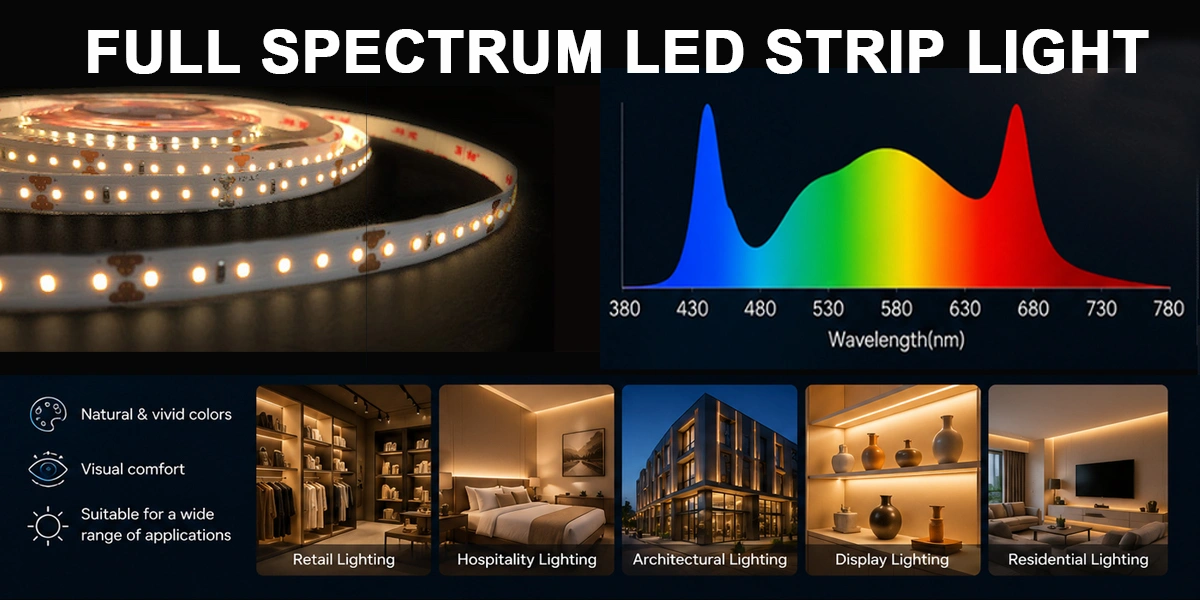
Full spectrum LED strip lights are designed to produce a balanced spectrum of visible light that closely resembles natural daylight. Unlike conventional LED strips that emphasize only certain wavelengths, full spectrum LEDs provide more complete spectral distribution and higher color accuracy, making them ideal for applications where faithful color reproduction and visual comfort are essential.
As lighting technology continues to evolve, architects, lighting designers, distributors, and commercial buyers are placing greater emphasis on light quality rather than brightness alone. Whether used in retail displays, museums, photography studios, healthcare environments, or premium residential projects, full spectrum LED strip lights help reveal colors more naturally and create a more comfortable lighting experience.
However, not all products labeled “full spectrum” deliver the same performance. Factors such as spectral distribution, color rendering index (CRI), color temperature (CCT), LED chip quality, and manufacturing consistency all influence the final lighting effect and long-term reliability.
In this guide, you’ll learn what full spectrum LED strip lights are, how they work, their key advantages, common applications, and the most important specifications to consider before choosing a product or manufacturer.
What Are Full Spectrum LED Strip Lights?
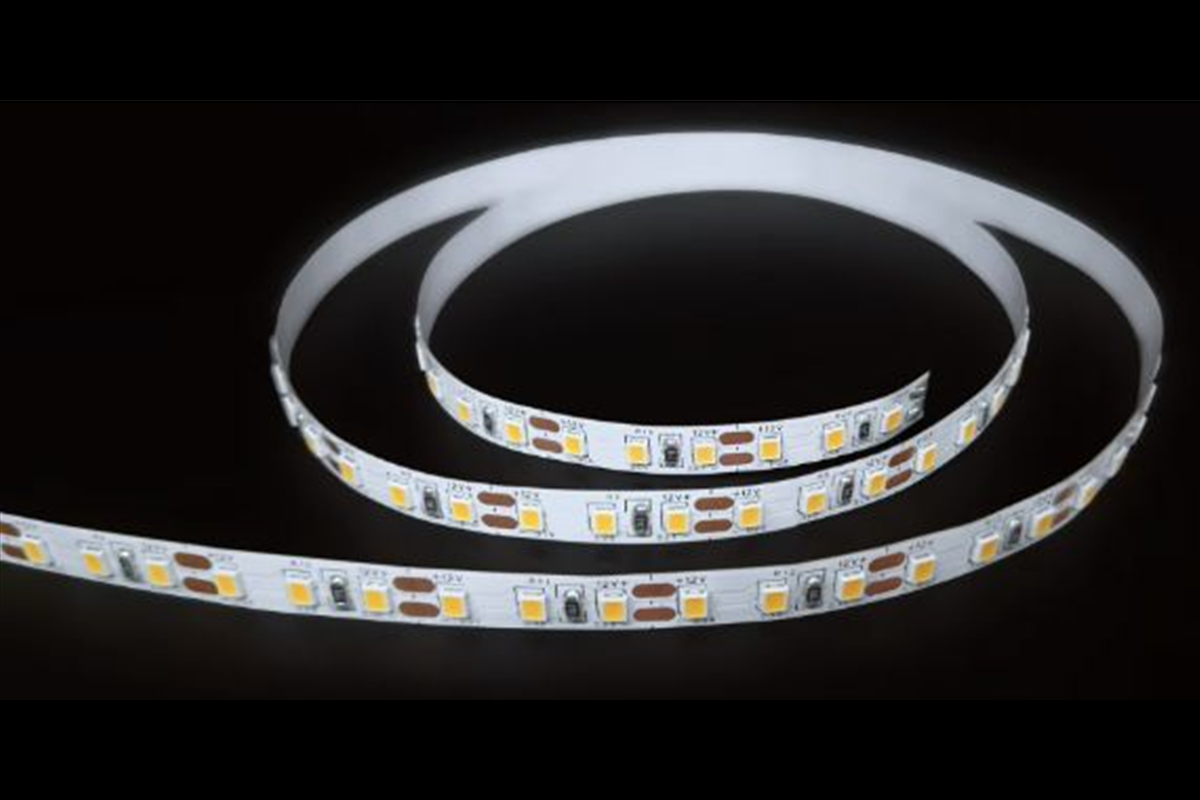
Full spectrum LED strip lights are flexible linear lighting products designed to emit a broad and balanced range of visible wavelengths. Their spectral output is intended to resemble natural daylight more closely than that of conventional LED strips, allowing illuminated objects and environments to appear more natural. This balanced spectral output also contributes to improved color rendering, helping objects appear closer to their true colors under artificial lighting.
The term “full spectrum” describes the overall distribution of light across the visible spectrum rather than a specific color temperature, LED package, or manufacturing technology. However, there is no universally accepted standard that defines exactly how much spectral coverage a product must provide to qualify as full spectrum. As a result, the spectral performance of LED strips marketed under this term can vary between manufacturers and product models.
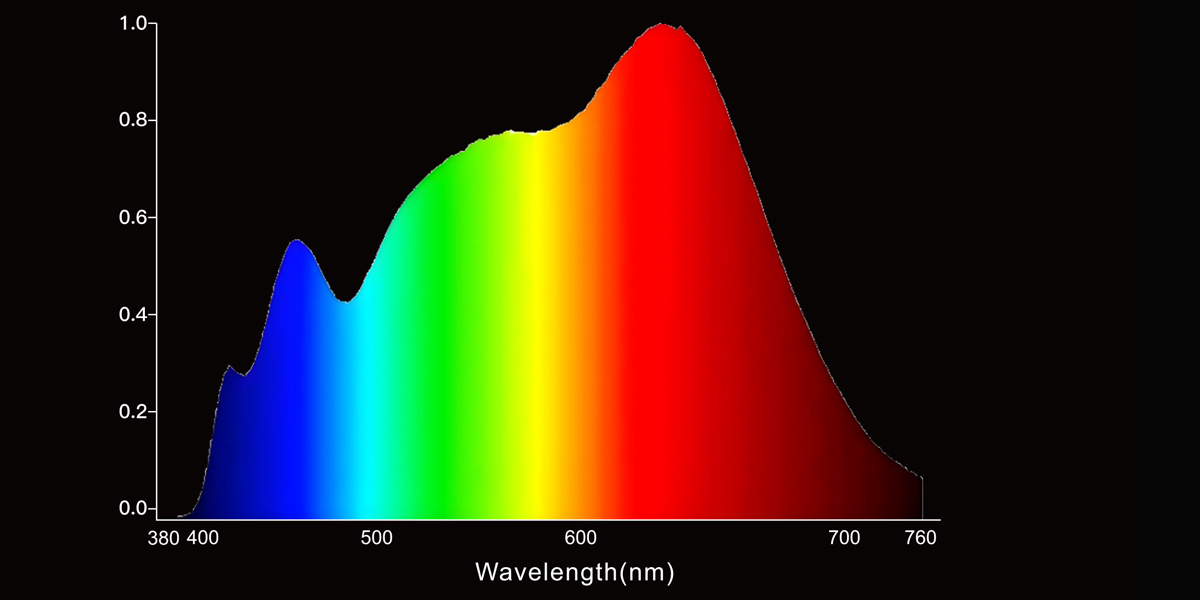
Figure caption: Typical spectral distribution of a full spectrum LED light source across the visible wavelength range.
How Is Full Spectrum LED Lighting Achieved?
Achieving full spectrum LED lighting requires careful control of light source design, including LED chip selection, phosphor technology, and spectral tuning. Unlike conventional LED strips that are mainly optimized for brightness and efficiency, full spectrum LED strips are engineered to create a broader and more balanced distribution of visible wavelengths.
One common approach is to use specially designed LED chips, advanced phosphor formulations, or combinations of different LED technologies to improve spectral coverage. Through precise optical design and material selection, manufacturers can adjust the emitted light output to achieve a spectrum that more closely resembles natural daylight.
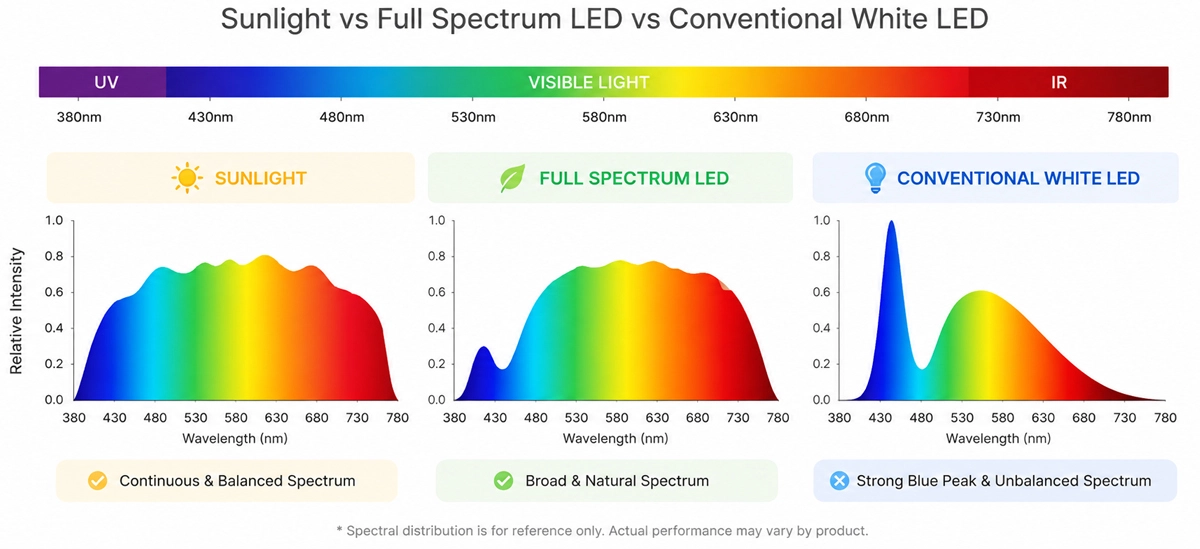
Figure: Comparison of typical spectral distributions of sunlight, full spectrum LED lighting, and conventional white LED lighting.
The spectral distribution comparison above illustrates the difference between a broad, balanced light spectrum and the limited wavelength output commonly found in conventional white LEDs. By improving wavelength balance and reducing gaps within the visible spectrum, full spectrum LED technology can provide a more natural and comfortable lighting experience.
However, achieving consistent full spectrum performance depends on more than just LED components. Factors such as LED chip quality, phosphor consistency, optical structure, thermal management, and manufacturing control can all influence the final spectral output. This is why full spectrum LED strips from different manufacturers may deliver different lighting results, even when similar product descriptions are used.
Understanding how full spectrum lighting is achieved provides the foundation for evaluating key performance factors, including spectral distribution, color rendering, and color temperature, which will be discussed in the following sections.
Full Spectrum vs. High CRI vs. Standard LED Strip Lights: What’s the Difference?
Full spectrum, high CRI, and standard LED strip lights are related but not interchangeable terms. They describe different aspects of LED lighting performance and design. Full spectrum primarily focuses on the distribution and balance of wavelengths produced by the light source, while CRI (Color Rendering Index) evaluates how accurately colors are reproduced. Standard LED strip lights refer more broadly to conventional LED products designed for general illumination, where priorities may include brightness, efficiency, color temperature, and cost.
Full Spectrum vs. High CRI LED Strip Lights: Understanding the Difference
Full spectrum and high CRI describe different aspects of LED light performance, but both play an important role in color quality in LED lighting. Full spectrum primarily refers to the breadth and distribution of wavelengths produced by a light source, while CRI (Color Rendering Index) measures how accurately the light source reveals colors compared with a reference light source.
high-quality LED strip solutions is designed to reproduce colors more accurately, typically with a CRI of 90 or higher for applications where good color quality is important. However, a high CRI rating alone does not describe the complete spectral distribution of the LED. Two LED strips can have similar CRI ratings while producing noticeably different spectral profiles.
A full spectrum LED strip, on the other hand, focuses more broadly on the distribution of visible wavelengths. When the spectrum is well balanced and relatively continuous, the light can provide natural-looking illumination and strong color rendering. For this reason, many high-quality full spectrum LED strips are also designed with high CRI and strong R9 performance.
Quick Comparison: Full Spectrum vs. High CRI
| Feature | Full Spectrum LED Strip | High CRI LED Strip |
| Primary focus | Spectral distribution | Color rendering accuracy |
| Main measurement | SPD | CRI / Ra |
| Visible wavelength coverage | Broad and balanced | Not necessarily broad |
| CRI | Can be high | Usually high |
| R9 performance | Can be optimized | Depends on LED design |
| Spectrum continuity | Important factor | Not defined by CRI alone |
| Relationship | Can also be high CRI | Can also be full spectrum |
The two concepts are therefore not mutually exclusive. A full spectrum LED strip can also be a high CRI LED strip, and this combination can be particularly valuable for applications where both spectral quality and accurate color reproduction are important.
CRI should therefore not be considered in isolation when evaluating full spectrum LED lighting. Looking at the spectral power distribution together with CRI, R9, CCT, luminous efficacy, and color consistency provides a more complete picture of the light source’s performance.
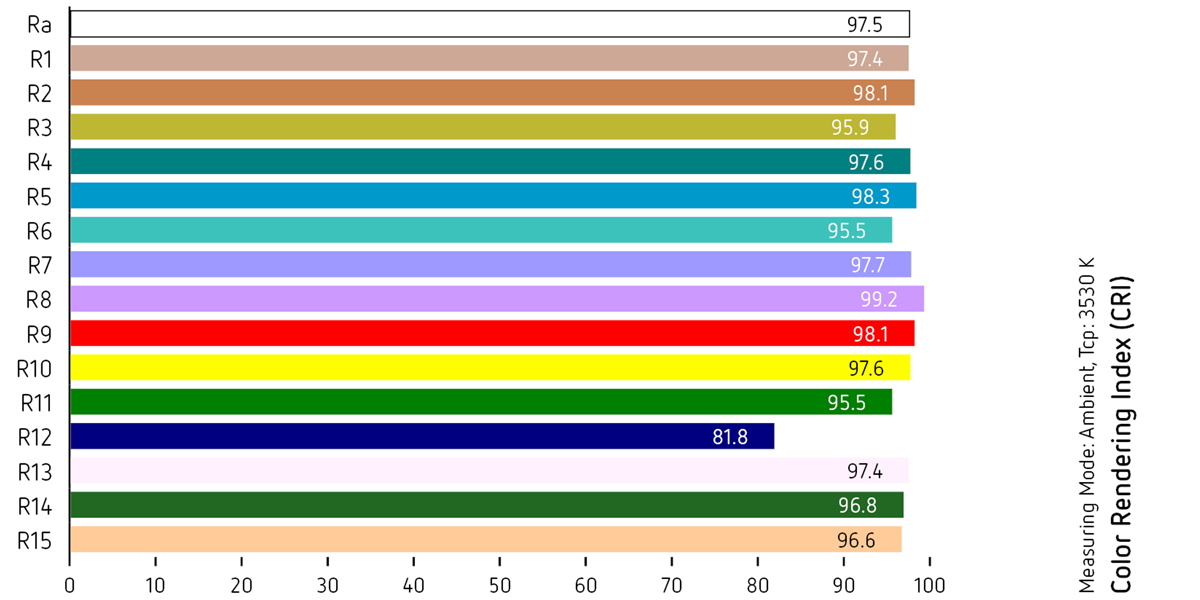
Example of the spectral distribution and color rendering characteristics of a high CRI LED strip.
For a better understanding of color rendering and CRI, the video below explains how CRI is measured and why it matters when evaluating LED lighting quality.

Full Spectrum vs. Standard LED Strip Lights: Understanding the Difference
Standard LED strip lights are generally designed around practical lighting requirements such as brightness, energy efficiency, color temperature, product cost, and general illumination. Their spectral characteristics can vary significantly depending on the LED chip, phosphor formulation, and overall product design.
Full spectrum LED strip lights place greater emphasis on spectral quality and wavelength distribution. Their spectral design aims to provide broader and more balanced coverage across the visible range, which can contribute to more natural-looking color appearance and consistent visual perception.
This does not mean that standard LED strips provide poor-quality light. Many conventional LED strip lights can offer excellent efficiency, reliable performance, and good color rendering. The main difference is the design priority: a standard LED strip may be optimized primarily for general illumination, efficiency, or cost, while a full spectrum LED strip places greater emphasis on the quality and distribution of the emitted spectrum.
Quick Comparison: Full Spectrum vs. Standard LED Strip Lights
| Feature | Full Spectrum LED Strip | Standard LED Strip |
| Design priority | Spectral quality and wavelength distribution | General illumination |
| Spectral distribution | Broad and balanced | Depends on LED design |
| CRI | Often available in high CRI versions | Varies by product |
| Color appearance | Designed for natural-looking illumination | Depends on LED and phosphor design |
| Efficiency | Can be high | Often a major design consideration |
| Cost | May be higher | Wider price range |
| Typical applications | Color-sensitive and premium lighting | General commercial and residential lighting |
Neither type is universally better. Full spectrum LED strip lights are worth considering when spectral quality, color appearance, and visual consistency are important, while standard LED strips can be a practical choice when general illumination, efficiency, and cost are the primary priorities.
Ultimately, the right LED strip depends on the specific lighting requirements of each project rather than the product label alone. For applications where color accuracy, visual quality, and spectral performance are critical, reviewing technical data such as SPD, CRI, R9, CCT, luminous efficacy, and color consistency provides a more reliable basis for product selection.
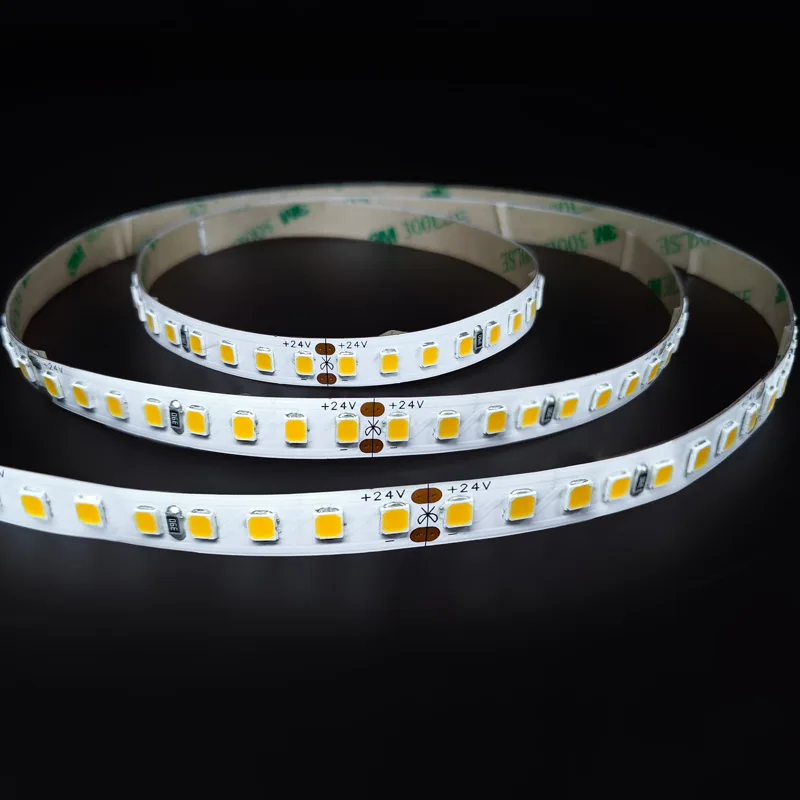
- 128 SMD2835 LEDs per meter
- 10mm PCB width
- CRI 80/ 90/ 98
- Up to 200lm/W high efficiency
- Fully Dimmable
- Strong double sided 3M adhesive tape
- 3000K, 4000K and 6500K color temperatures optional
- Single one color BIN, 3 steps SDCM available
- Can be OEM/ODM and customizable
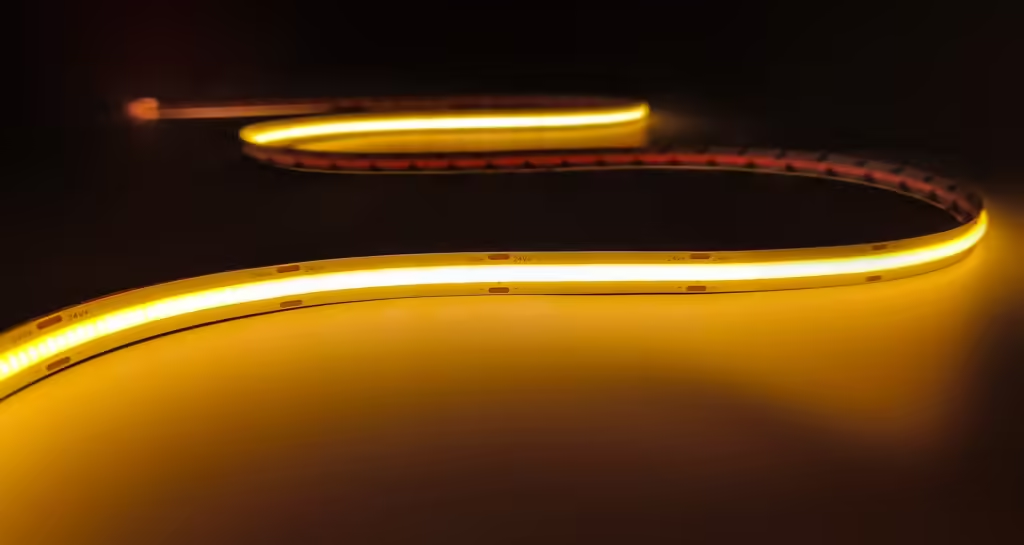
480Chips LED COB Strip Light for Decorative Lighting
- 480chips/m, 100lm/W, dot-free
- Available in color temperature 2700K to 6500K
- Dimmable
- 180 degree beam angle
- CRI 80/ 90/ 98
- Solderless, reel to reel technology
Key Specifications of Full Spectrum LED Strip Lights
When selecting full spectrum LED strip lights, buyers should look beyond the “full spectrum” label and evaluate the technical specifications that determine light quality, reliability, and suitability for different applications.
1. Spectral Power Distribution (SPD)
A well-designed full spectrum LED strip should provide broad and relatively balanced coverage across the visible wavelength range. The Spectral Power Distribution (SPD) curve provides a visual representation of how light energy is distributed across different wavelengths and is one of the most useful references for evaluating spectrum quality. By analyzing the SPD curve, buyers can better understand whether an LED strip provides balanced spectral output rather than relying only on marketing terms such as “full spectrum” or “sunlight-like.”
2. CRI (Color Rendering Index) and R9
CRI indicates how accurately colors are rendered, while R9 provides additional information about saturated red rendering. For commercial and color-sensitive applications, CRI 90+ is generally a practical starting point, with higher CRI and strong R9 performance preferred for applications requiring greater color accuracy.

The video provides a simple explanation of CRI, including how it differs from CCT and how CRI affects perceived color quality.
3. CCT (Correlated Color Temperature)
CCT determines whether the light appears warm, neutral, or cool. Full spectrum LED strips can be produced in different color temperature options, including warm white, neutral white, and daylight white. Different applications may require different CCT selections depending on the desired visual atmosphere and lighting requirements. Learn more about choosing the right color temperature for LED lighting.
4. LED Density and Uniformity
LED density affects illumination uniformity and the appearance of dark spots. Higher-density LED strips can provide smoother light, particularly in shallow profiles, display cabinets, and applications where the strip is installed close to the illuminated surface.
5. Power Consumption and Luminous Efficacy
Power consumption is typically specified in watts per meter (W/m) and should be considered together with light output and luminous efficacy. The appropriate power level depends on the required brightness, energy consumption, thermal conditions, and application requirements.
6. Voltage
Full spectrum LED strip lights are commonly available in 12V and 24V configurations. For longer runs, 24V is often preferred because it can help reduce voltage drop and maintain more consistent illumination along the strip.
7. IP Rating
The appropriate IP rating depends on the installation environment. IP20 is generally suitable for dry indoor applications, while IP65, IP67, or IP68 may be required for applications exposed to moisture, dust, or outdoor conditions.
| Specification | What to Consider |
| Spectral Distribution | Look for broad and balanced coverage across the visible spectrum. |
| CRI & R9 | CRI 90+ is commonly preferred for quality lighting; higher R9 can improve red color rendering. |
| CCT | Select the color temperature according to the application, such as warm white, neutral white, or daylight. |
| LED Density | Higher LED density can provide more uniform illumination and reduce visible hotspots. |
| Power & Efficacy | Balance brightness, energy consumption, and thermal performance. |
| Voltage | 12V and 24V configurations are commonly available; 24V is often preferred for longer runs. |
| IP Rating | Choose the appropriate protection level for indoor, damp, or outdoor environments. |
For projects with specific photobiological safety requirements, buyers should also consider IEC 62471 compliance and blue light hazard classification when evaluating LED strip lighting.
For commercial and OEM projects, other specifications such as PCB width, cut length, dimming method, connector type, and reel length may also need to be customized according to the installation requirements.
Applications of Full Spectrum LED Strip Lights
Full spectrum LED strip lighting is particularly suitable for applications where color quality, visual consistency, and accurate visual perception are important. Unlike general-purpose lighting solutions that focus mainly on brightness and efficiency, full spectrum LED strips are often selected when the quality of illuminated objects and environments is a key consideration.
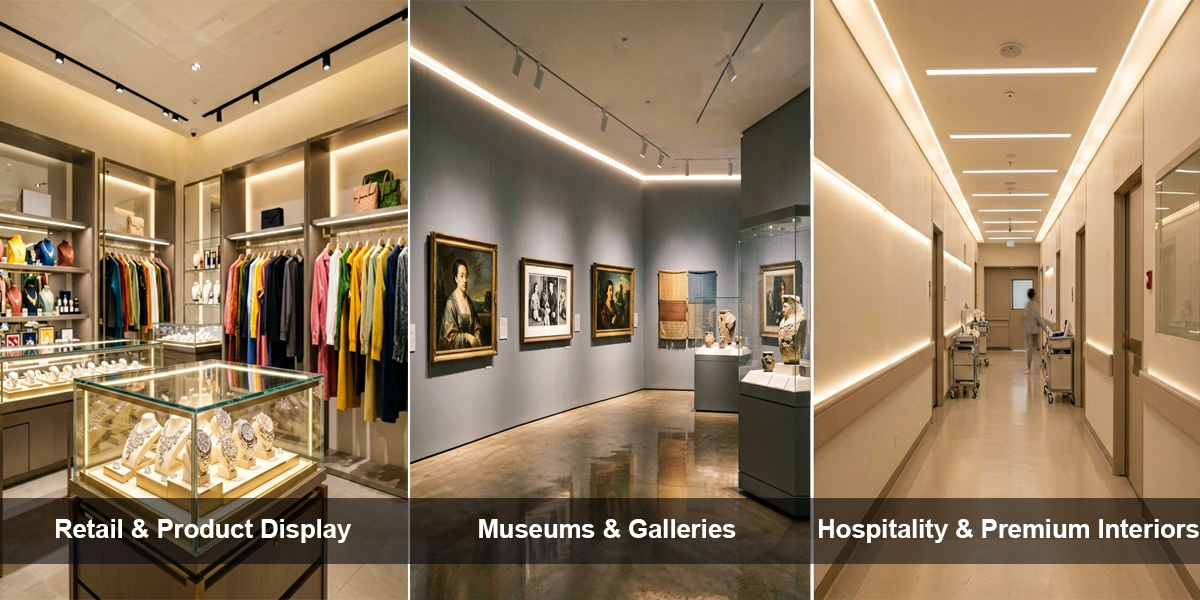
1. Retail and Product Display Lighting
Full spectrum LED strip lights are widely used in retail stores, display cabinets, shelving, and product showcases where lighting directly influences how merchandise is perceived. By providing more natural-looking illumination and supporting accurate color appearance, they can help highlight details and colors in products such as clothing, cosmetics, jewelry, food, and luxury goods.
For retail applications, spectral quality should be considered together with brightness, energy efficiency, and installation requirements to achieve the desired customer experience.
2. Museums, Galleries, and Artwork Display
Museums, galleries, and artwork displays require careful lighting control because paintings, photographs, textiles, and historical objects often contain subtle colors and surface details. Full spectrum LED strip lighting can help create a more natural viewing experience, but lighting decisions should also consider factors such as illuminance level, UV/IR radiation, heat generation, and conservation requirements.
3. Hospitality and Premium Interior Lighting
Hotels, restaurants, showrooms, and premium residential interiors can use full spectrum LED strips for applications such as cove lighting, cabinet lighting, shelving, wall details, and indirect illumination.
When combined with suitable CCT and color rendering performance, full spectrum LED lighting can enhance the appearance of furniture, fabrics, wood, stone, and other interior materials while maintaining a consistent visual atmosphere.
Choosing the Right Application
Full spectrum LED strip lights are not necessarily the best choice for every project. They provide the greatest value in applications where color accuracy, visual quality, and spectral performance are important factors.
For projects where brightness, efficiency, installation requirements, and cost are the primary priorities, conventional LED strips or high-CRI LED strips may provide a more practical solution.
How Much Do Full Spectrum LED Strip Lights Cost?
Full spectrum LED strip lights typically range from around $3 to $12 per meter for most commercial and OEM applications, depending on LED technology, spectral performance, CRI/R9 requirements, power output, customization, and order quantity.
The actual price varies based on factors such as LED package, spectral design, component quality, LED density, certifications, and production volume. Since products marketed as “full spectrum” can have different specifications and performance levels, buyers should evaluate pricing together with technical requirements rather than price alone.
However, there is no single standard price for full spectrum LED strip lights because products marketed under this category can have significantly different spectral and electrical specifications.
| Product Category | Typical Price Range* | Common Applications |
| Standard full spectrum / high CRI LED strip | $3–$6/m | General commercial lighting |
| High CRI 90+ LED strip | $5–$8/m | Retail, hospitality, architectural lighting |
| Ultra-high CRI 95+ LED strip | $8–$12/m | Display, artwork, premium interiors |
| Custom spectrum / OEM solutions | $10–$15+/m | Color-critical applications and special projects |
*Indicative market ranges for reference only. Actual pricing depends on specifications, quantity, certifications, customization, and supplier capabilities.
What Determines the Price?
The main price differences come from the LED package, spectral design, component quality, production requirements, and customization level.
A full spectrum LED strip designed for high CRI and strong R9 performance may require more specialized LED components and tighter production control than a standard LED strip. Higher LED density, greater power output, custom LED PCB, certificates, and additional testing can further increase the cost.
Order quantity also has a significant impact on unit pricing. Small sample orders usually have a higher cost per meter because manufacturing setup, testing, packaging, and logistics costs are spread across fewer units.
Custom Full Spectrum LED Strip Pricing
For OEM and ODM projects, buyers may request a custom full spectrum LED strip instead of selecting an off-the-shelf product.. Custom requirements such as spectral performance, CCT, CRI/R9 target, PCB width, LED density, voltage, cut length, IP rating, connectors, and packaging can all affect the final quotation.
For this reason, buyers should compare products based on the same specifications and quantity rather than using price per meter as the only purchasing criterion.
A manufacturer may offer a lower unit price for a high-volume project, while a small custom order may have a higher initial cost but provide the exact spectral and mechanical configuration required by the application.
Full Spectrum LED Strip Lights FAQ
Conclusion
Full spectrum LED strip lights are a suitable solution for projects that require more than basic illumination, particularly where color quality, natural-looking light, and consistent visual performance are important. Choosing the right product, however, requires matching its specifications and configuration to the specific application rather than relying on the “full spectrum” label alone.
For buyers looking for a full spectrum LED strip manufacturer in China, working directly with a factory can provide greater flexibility in customization, production planning, quality control, and OEM support. This can be especially valuable for commercial lighting projects, retail displays, architectural applications, and other projects with specific product requirements.
SignliteLED is a China-based LED strip manufacturer providing customized LED strip lighting solutions for global B2B customers. We support full spectrum LED strips, high-CRI LED strips, OEM and ODM production, and customized solutions for different project requirements, helping customers move from product development and sampling to mass production and delivery.
Looking for a reliable full spectrum LED strip manufacturer in China? Contact SignliteLED to discuss your application requirements, technical specifications, quantity, and OEM/ODM needs.
Written by: Elaine Zhu, General Manager at SignliteLED
Technical Review: Jason Chen, R&D Leader at SignliteLED
Email: info@signliteled.com
Related Posts