Français
  English
  简体中文
简体中文  Deutsch
  Español
  Italiano
  日本語
日本語  한국어
한국어  Polski
  Português
  Русский
  Türkçe
  Nederlands
  Tiếng Việt
  ไทย
ไทย 
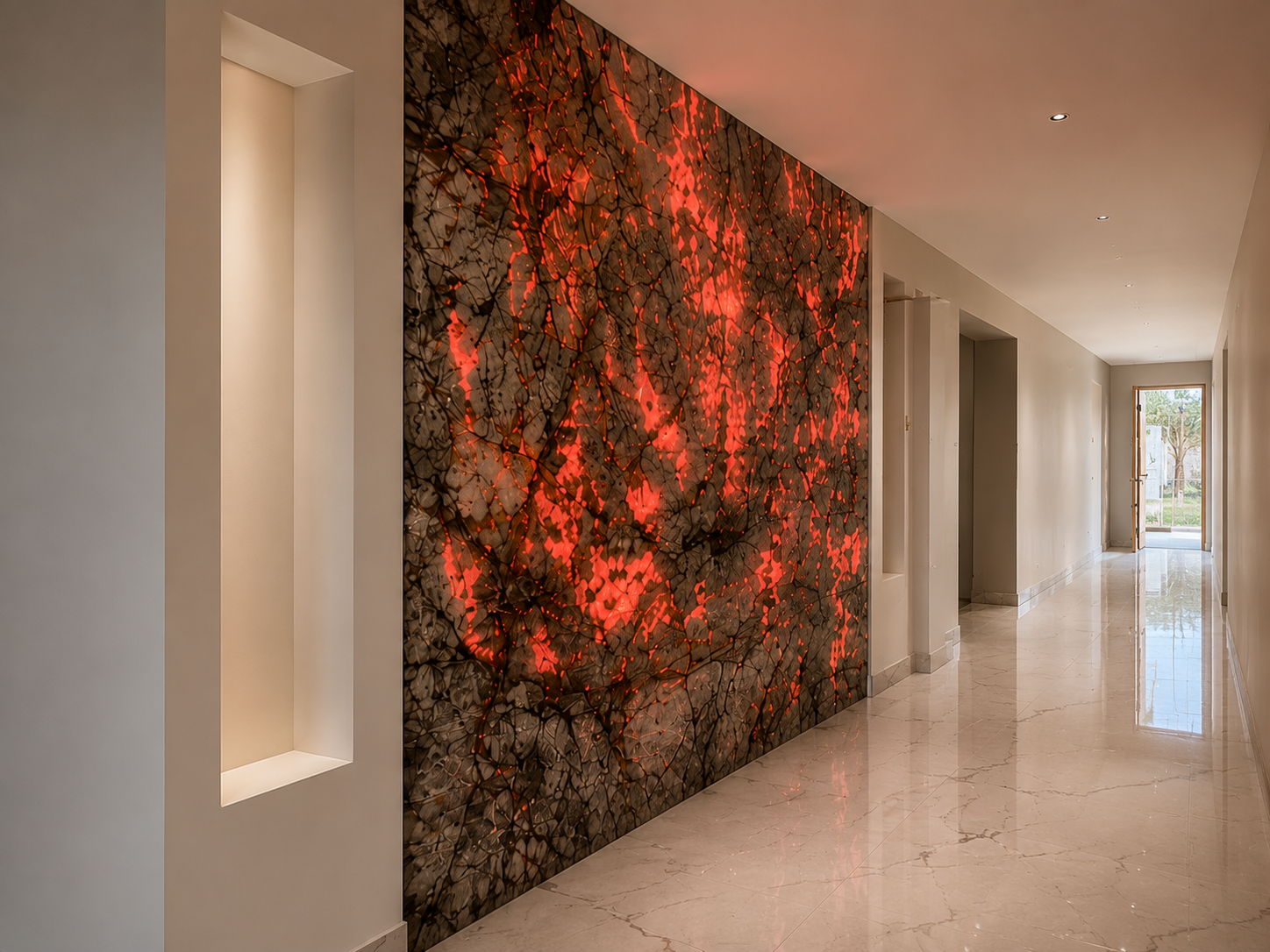
- Les feuilles LED offrent un rétroéclairage uniforme et sans points derrière la pierre translucide, plus fine et plus uniforme que les bandes ou les panneaux.
- Gardez un espace de 20 à 50 mm entre la feuille LED et la surface de la pierre pour une diffusion en douceur.
- Choisissez RGBW (et pas seulement RGB) si vous avez besoin d'une véritable lumière blanche lorsque les effets de couleur sont éteints.
- Associez le contrôleur au projet : RF Remote for Homes, Wall Panel for Hotels, DMX512 pour les grandes installations.
- Dimensionnez l'alimentation à 120% de puissance totale et utilisez un fil de 18 à 20 AWG pour éviter les chutes de tension.
- Testez la luminosité, la couleur et le câblage avant le montage final. La pierre est déjà installée, il n'y a donc pas de place pour les travaux.
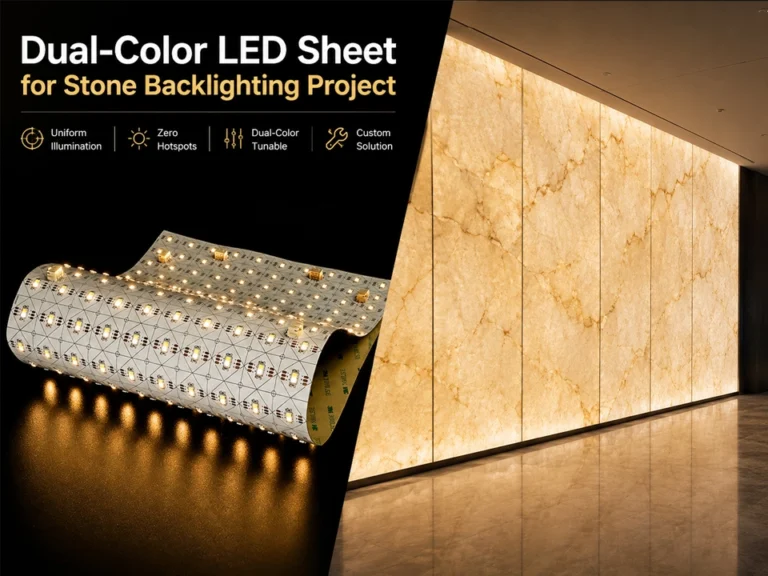
Un véritable projet de pierre rétro-éclairé
Un entrepreneur en éclairage architectural nous est venu avec un bref aperçu commun dans l'hospitalité et dans les aménagements commerciaux : installez un mur de caractéristiques en pierre translucide - un mélange d'onyx et de marbre fin, déjà équipé - et le fait briller avec une couleur qui change à la demande. La cavité derrière la pierre ne faisait que 35 mm de profondeur et le client voulait le système complètement invisible : pas de luminaires, pas de câblage, pas de boîtiers de commande. Les boîtes fluorescentes étaient trop volumineuses, les modules LED créaient des points chauds et des bandes nécessitaient des jours de câblage pour dissimuler. Les feuilles de LED étaient la seule technologie qui cochait chaque case.
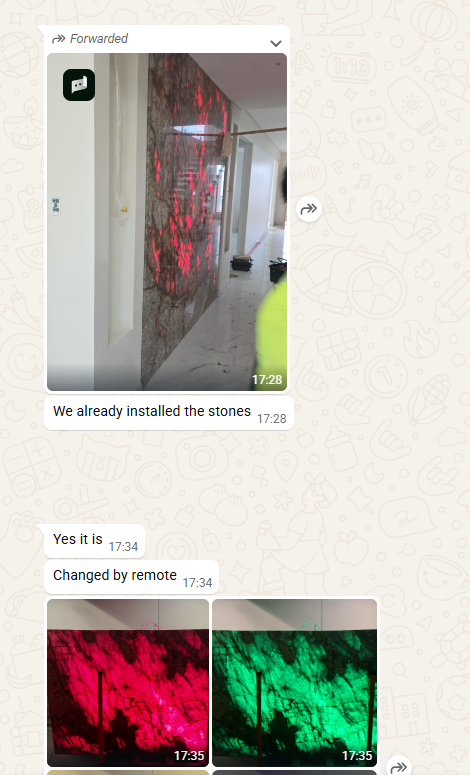
L'installation a pris une seule journée : des feuilles coupées à la taille, montées à 30 mm derrière la pierre avec un adhésif 3 M intégré, câblé à un pilote 24 V et associé à une télécommande RF portable. Une pression sur un bouton fait passer le mur du rouge chaud au vert froid.
"Nous avons déjà installé les pierres."
"Oui, ça l'est. changé par la télécommande.
Cet échange capture ce qu'est l'éclairage architectural moderne : matériel invisible, impact visible, contrôle sans effort.
Fichier de projet : en un coup d'œil
| champ de courses | détail |
|---|---|
| Type de projet | Rétroéclairage mural en pierre translucide |
| Statut de la pierre | Déjà installé — Feuilles LED montées par derrière |
| Profondeur de la cavité | 35 mm |
| Méthode de contrôle | Télécommande portable (RF 2.4G) — La couleur a été modifiée instantanément |
| Effets de couleur | Commutation dynamique : rouge chaud, vert froid et au-delà |
| Produit recommandé | Feuille LED RGB/RGBW (5050 SMD, DC 24V) |
Qu'est-ce qu'une feuille de lumière LED ?
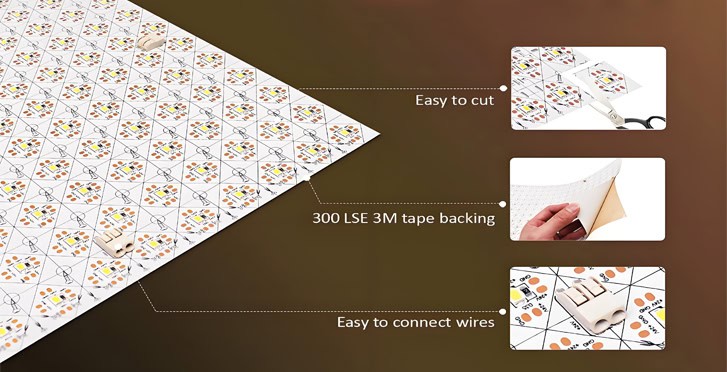
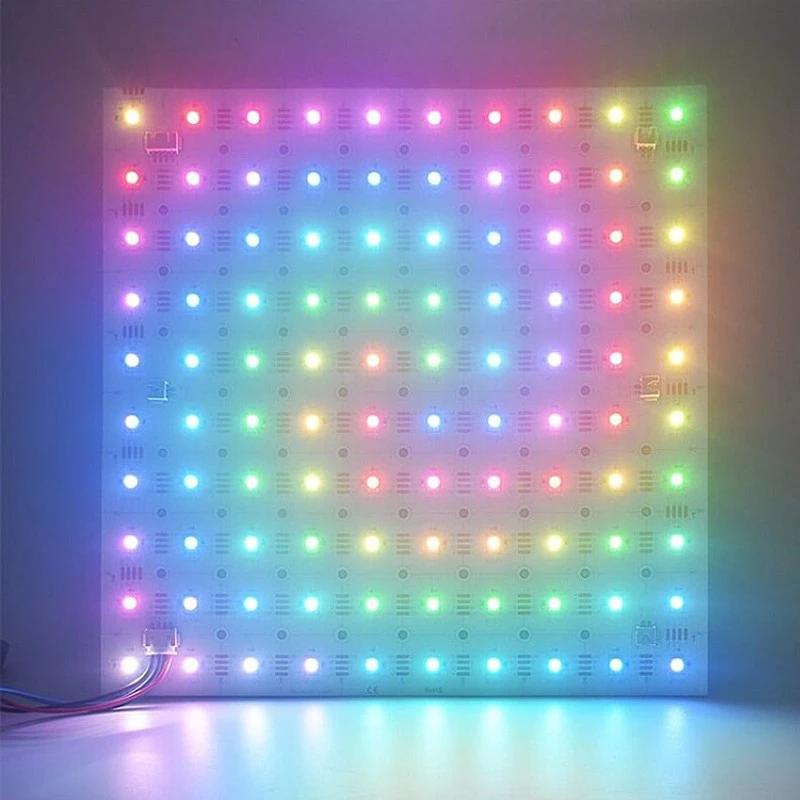
Une lampe de feuille de LED est un panneau de circuit imprimé flexible avec une gamme de LED denses et uniformément réparties. Lorsqu'une bande produit une ligne de lumière et un module un point de lumière, une feuille produit une lumière de zone continue et uniforme. Le PCB a généralement une épaisseur de 0,3 à 0,5 mm, suffisamment mince pour une cavité de pierre étroite et exempt de la baisse de tension qui pèle.
Les feuilles fonctionnent sur 12 V ou 24 V DC, dans des tailles standard de 250 × 250 mm à 500 × 250 mm, coupables tous les 20 à 50 mm le long des lignes marquées. La densité des LED détermine l'uniformité : une feuille haute densité (128 LED par panneau de 490 × 245 mm) élimine les points visibles même derrière la pierre fine ; les densités plus faibles montrent des « points chauds ».
Comment les feuilles de LED se comparent aux alternatives
| critère | Feuille LED | Bande LED | Module LED | Panneau LED |
|---|---|---|---|---|
| Puissance lumineuse | Lumière de zone uniforme | Lumière linéaire | éclairage brisé | Lumière de zone uniforme |
| épaisseur | Ultra-mince (~0,5 mm) | Ultra fin (~3mm avec du ruban) | Moyen (10–20mm) | Épais (rigide, 8–25 mm) |
| Découpable | Oui (20 à 50 mm) | Oui (25–50 mm) | Non | Non |
| Flexible | Oui — Conforme aux courbes | Oui | limité | Non — Cadre rigide |
| Efficacité de la couverture | Élevé — Une feuille couvre une zone de mur | Faible - De nombreux passages parallèles sont nécessaires | Faible — Diffuseur requis | Moyen |
| Meilleur pour | Rétroéclairage de pierre, murs caractéristiques, panneaux rétroéclairés | Accents linéaires, éclairage de l'anse | Lettres de canaux, petits signes | Panneaux de plafond, Troffers |
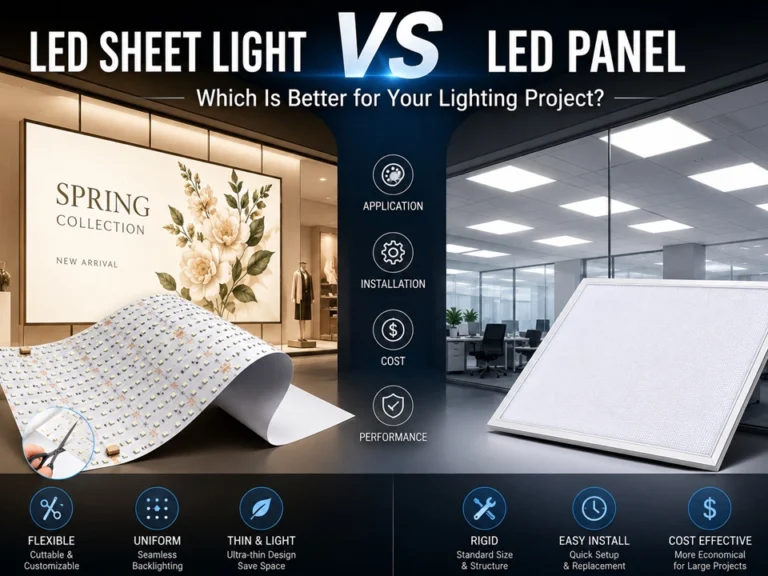
En pratique : les bandes nécessitent de nombreuses exécutions parallèles avec une injection de puissance séparée ; les modules ont besoin de diffuseurs qui cachent les points chauds – inacceptables derrière la pierre translucide ; les panneaux sont rigides et ne peuvent pas être coupés. Les feuilles offrent une lumière uniforme sans points, sans ombre ni gradation lointaine. Voir nos comparaisons de Feuille LED vs panneau LED et Feuille LED vs bande LED.
Pourquoi les feuilles de LED sont la norme pour le rétroéclairage de la pierre
Les méthodes traditionnelles sont insuffisantes : les boîtes fluorescentes ont une profondeur de 50 à 100 mm, génèrent de la chaleur et n'offrent aucun contrôle de couleur; les modules LED ont besoin de diffuseurs épais et présentent toujours des motifs irréguliers à travers la pierre. Les feuilles de LED résolvent tout cela - le circuit imprimé fin pour les cavités de 20 mm, les réseaux denses créent une véritable lumière de zone sans diffuseur, et le courant continu à l'état solide signifie qu'aucun scintillement, bourdonnement ou n'est dommageable.
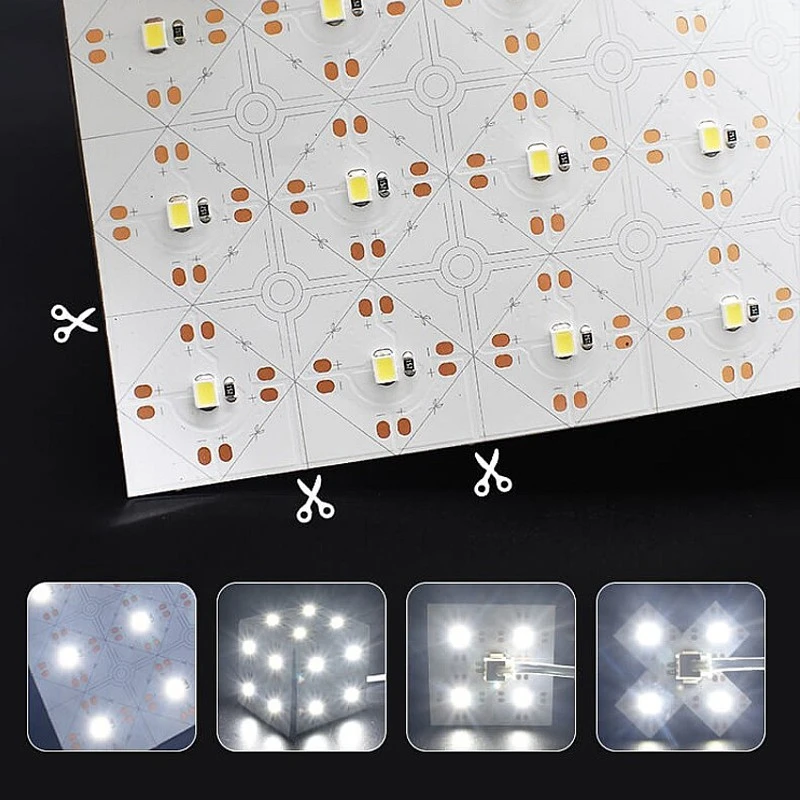
- Glow de surface uniforme — 128 LED par panneau créent une luminance sans couture même derrière 3–5 mm Onyx ; aucun diffuseur n'est nécessaire.
- Profil ultra-fin - ~0,5 mm pour les cavités étroites de 20 à 50 mm, essentielles pour les rénovations où la profondeur est fixe.
- Découpe à toute géométrie - rectangles, cercles ou formes irrégulières, garnies sur place avec des ciseaux; unités aussi petites que 20,4 × 122,5 mm.
- Options de couleur dynamique — Blanc statique, blanc accordable (2700–6500K), RGB, RGBW, RGB+CCT ou effets adressables en pixels.
- Plusieurs chemins de contrôle - RF Remote, panneau mural, DMX512, DALI, Triac, 0-10V ou PWM.
- Montage simple — Support adhésif 3M ou trous de vis pré-percés, sans supports, rails ou extrusions de canaux.
Spécifications du produit : quelle feuille de LED alimente ce look
Pour un mur de pierre à changement de couleur comme le nôtre, vous avez besoin d'une feuille LED RGB ou RGBW avec télécommande - le choix détermine si le mur est un éclairage blanc ou uniquement une couleur décorative.
RVB vs RGBW : Lequel avez-vous besoin ?
RGB mélange les canaux rouges, verts et bleus pour se rapprocher du blanc, mais le résultat est visiblement « boueux » – le CRI tombe en dessous de 60. RGBW ajoute une puce blanche dédiée qui produit un vrai blanc indépendamment : CRI au-dessus de 90, température de couleur naturelle et éclairage quotidien lorsque les effets de couleur ne sont pas nécessaires.
Feuille de LED RVB (5050 SMD, 24V)
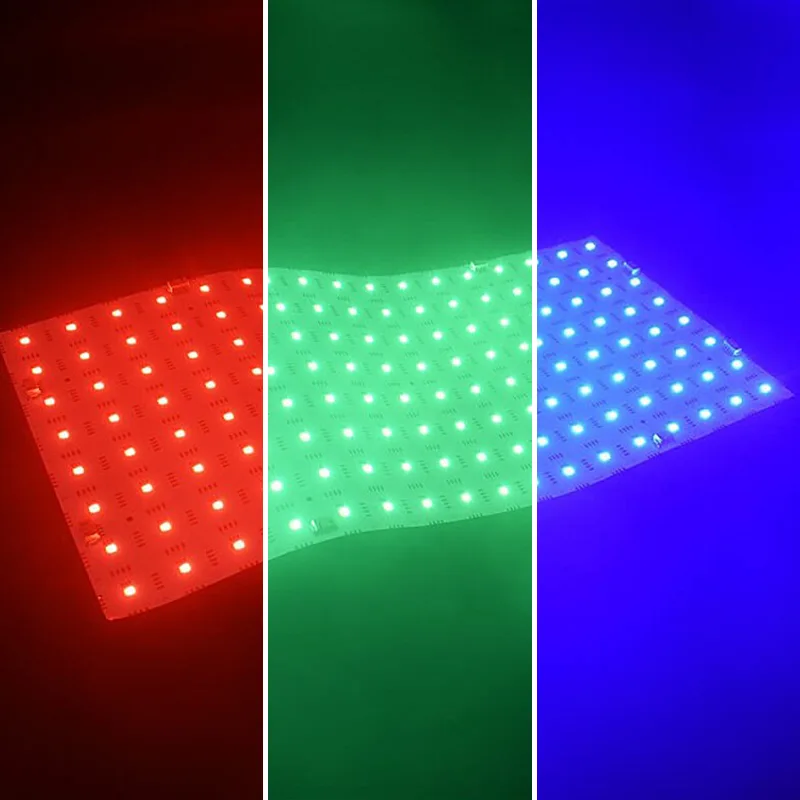
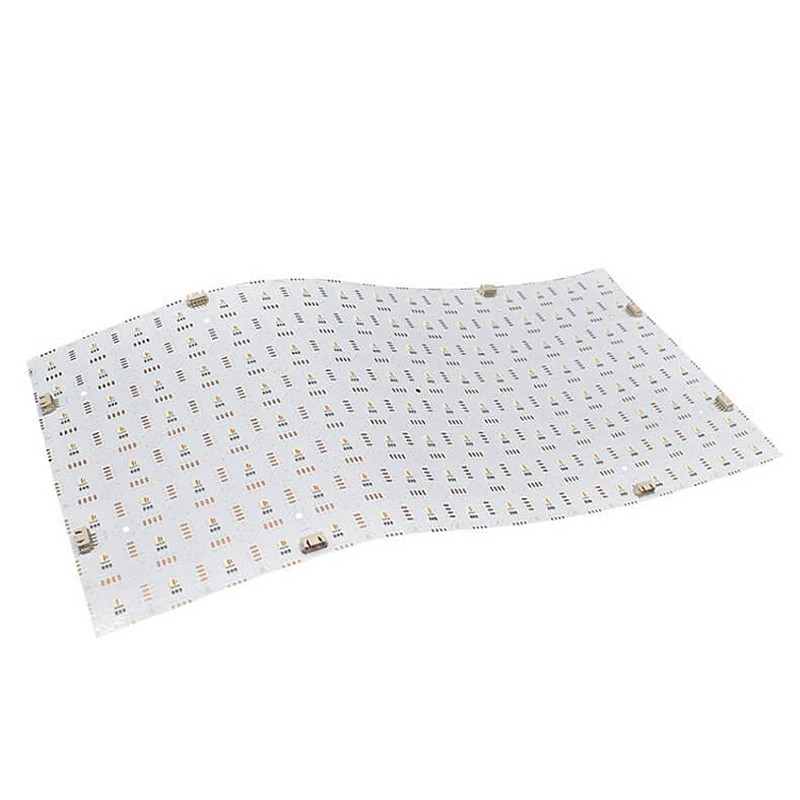
| spécification | évaluer |
|---|---|
| Taille | 490 × 245 mm (tailles personnalisées disponibles) |
| Type de LED | 5050 SMD |
| Nombre de LED | 128 par feuille |
| tension de service | DC 24V |
| Puissance | 45w |
| Unité de coupe minimale | 39,6 mm |
| Durée de vie nominale | > 35 000 heures |
Feuille de LED RGBW (5 050 RGBW 4 en 1, 24 V) — Recommandé pour la plupart des projets
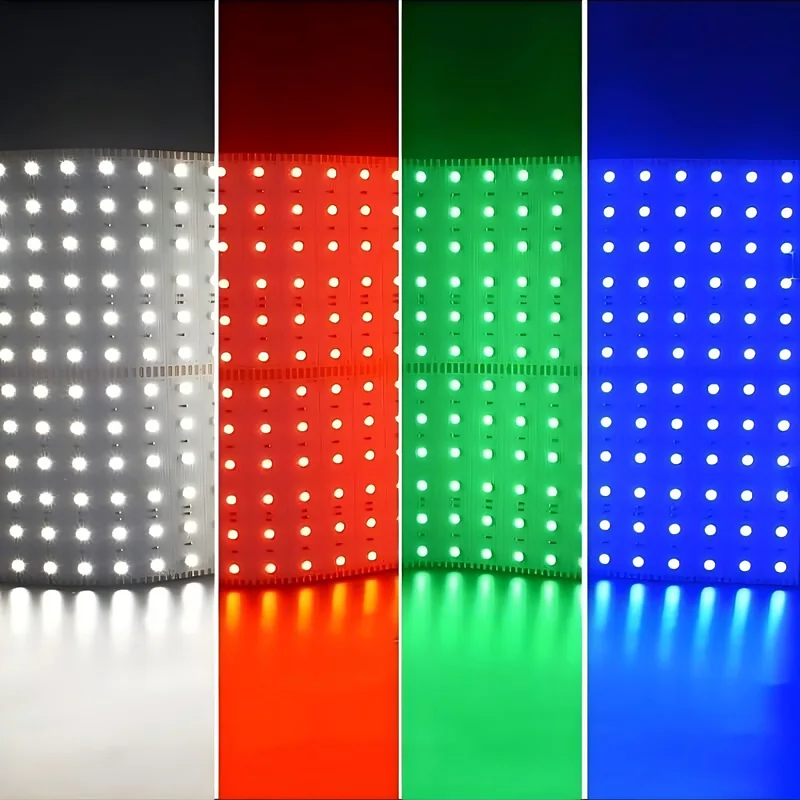
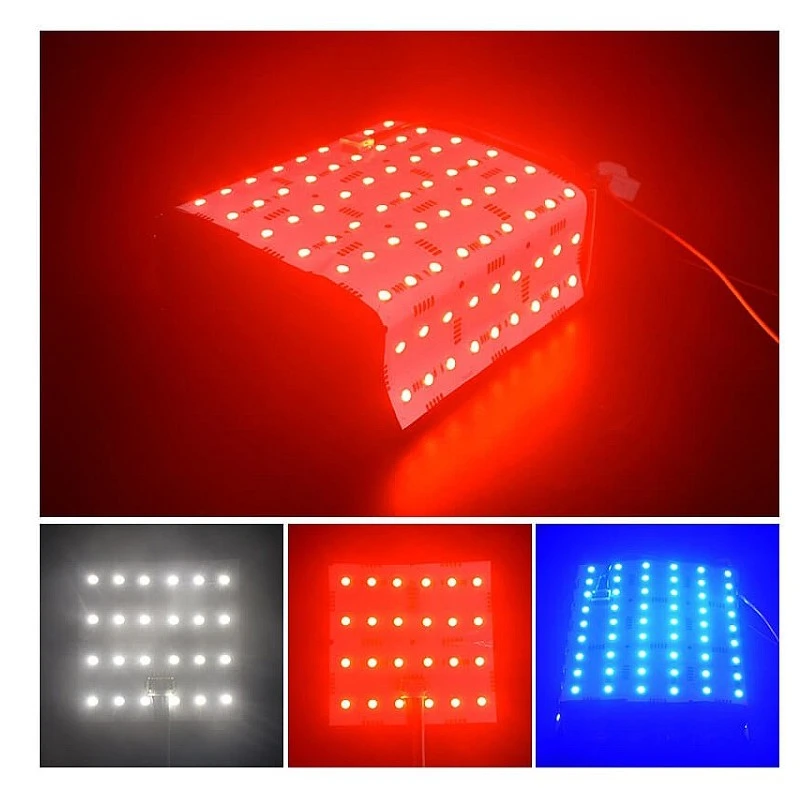
| spécification | évaluer |
|---|---|
| Taille | 250 × 250 mm / 490 × 250 mm |
| Type de LED | 5050 RGBW 4-en-1 SMD |
| Couleurs | RVB + 3000K / 4000K / 6500K BLANC |
| Puissance | 24W / 48W |
| Efficacité lumineuse | 90 lm/w |
| Unité de coupe minimale | 50 × 50 mm / 20,4 × 122,5 mm |
Exemple de calcul de puissance
Pour un mur de 2,4 m × 1,5 m (3,6 m²) de 490 × 245 mm RGBW à 48 W chacune : environ 6 à 7 feuilles ; tirage total de 7 × 48 W = 336 W. Les tableaux de taille des pilotes sont livrés avec chaque commande, et les schémas de câblage sont gratuits pour les mises en page complexes.
Comment installer des feuilles de LED derrière la pierre : 6 étapes
La pierre est coûteuse et difficile à enlever une fois installée, donc la commande est importante ; sauter le pré-test est la cause de défaillance la plus fréquente.
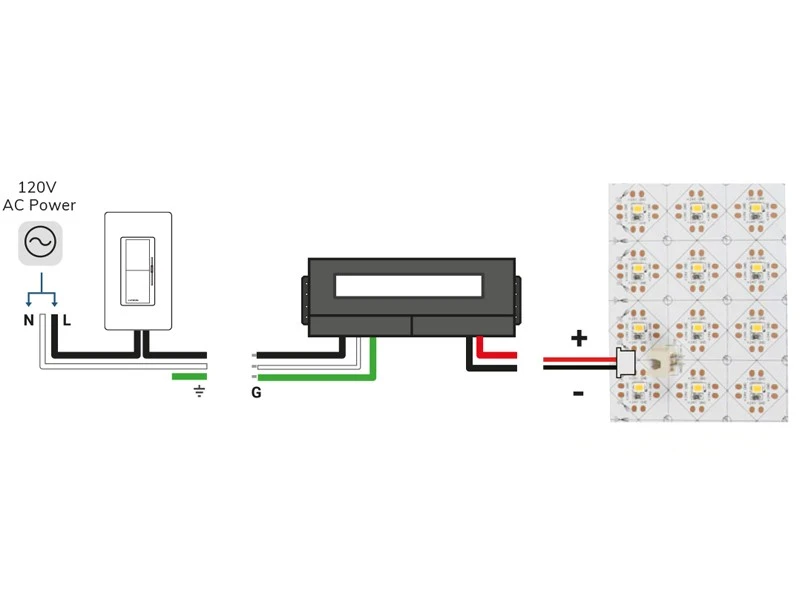
Étape 1 : Testez tout d'abord
Connectez l'alimentation et le contrôleur sur un établi ; cyclez toutes les couleurs et tous les niveaux de luminosité et confirmez que chaque segment répond avant Montage. Un segment mort, généralement une trace interrompue, se trouve ici, et non après que la pierre est en place.
Étape 2 : Préparez la surface
Enlever la poussière, l'huile et l'humidité; essuyer les surfaces avec de l'alcool isopropylique. Sur du béton irrégulier, ajoutez du ruban aluminium ou une plaque de support plate pour que l'adhésif 3M soit entièrement en contact - les espaces affaiblissent l'adhésion et créent des poches d'air.
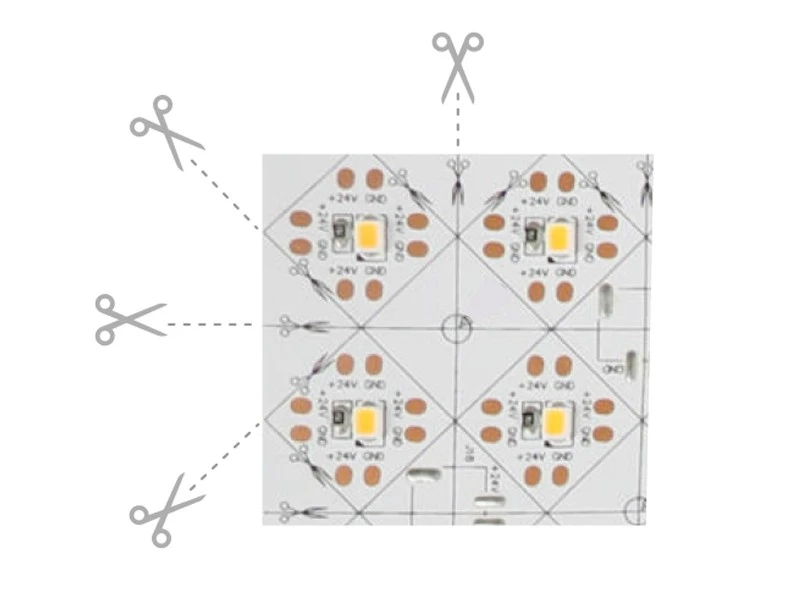
Étape 3 : Coupez à la taille
Coupez avec des ciseaux pointus uniquement le long des lignes marquées – coupant contre eux des traces de cuivre et crée des zones mortes. Pour les grands murs, les feuilles de crosse bordent de 2 à 3 mm d'espace, la diffusion de la pierre cache de petits espaces.
Étape 4 : Montez les feuilles
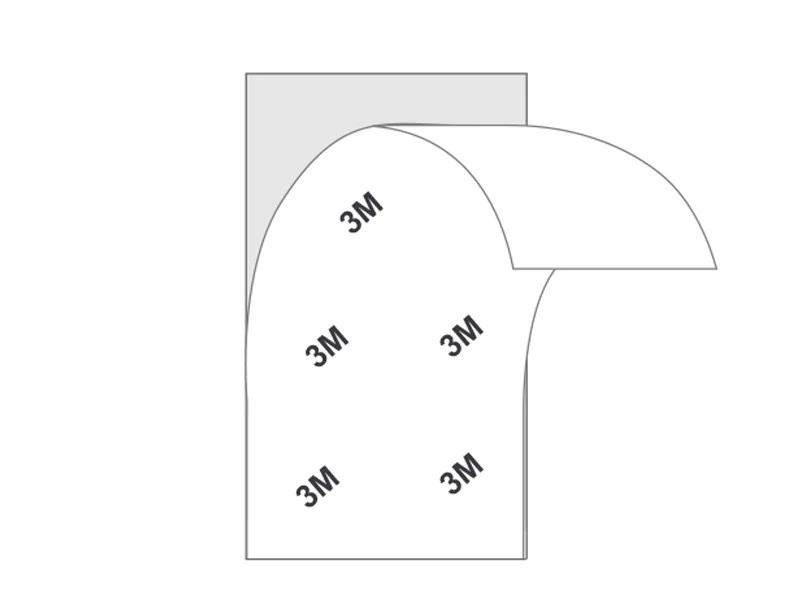
Décollez le support de 3 m et appuyez sur la feuille à 20 à 50 mm derrière la pierre, en travaillant d'un coin vers l'extérieur pour éliminer les bulles d'air. Pour des constructions permanentes, ajoutez des vis à travers les trous pré-percés - les têtes sont à ras du cou et ne projetez aucune ombre.
Étape 5 : Connectez l'alimentation et le contrôle
Utilisez du fil 20AWG pour une seule feuille, 18AWG pour plusieurs. La plupart des contrôleurs RF gèrent jusqu'à 10 A. Au-delà, ajoutez un amplificateur de signaux toutes les 5 à 10 feuilles. Connecteurs correspondants : RGB à 4 broches, RGBW à 5 broches, XLR/DMX pour DMX512. Étiquetez chaque fil.
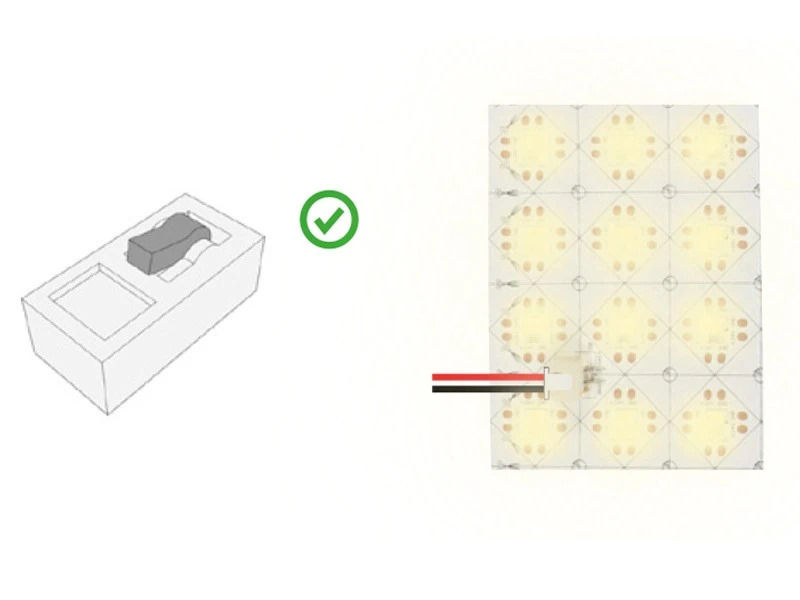
Étape 6 : Mise sous tension et réglage fin
Rétablir l'alimentation, cycler les couleurs et verrouiller les scènes prédéfinies. Marchez sur le mur à la recherche de points inégaux : les points chauds signifient augmenter l'écart ou ajouter un film de diffuseur; les couleurs délavées signifient généralement que le profil du contrôleur est erroné.
Liste de contrôle des outils
- Ciseaux pointus
- 18–20AWG fil + dénuders
- Alimentation électrique — 12V/24V DC, dimensionné en watts + 20%
- Contrôleur/télécommande (RF 2.4G, panneau mural, DMX512 ou DALI)
- Lingettes d'alcool isopropylique
- Multimètre pour la vérification de la tension avant la mise sous tension finale
Pour les schémas de câblage multi-feuilles et le placement de l'amplificateur, voir Comment couper, installer et configurer des éclairages à LED.

Vidéo : Lampe de feuille de LED monochrome pour la pierre rétro-éclairée — flexible et transparente (Signliteled YouTube).
Systèmes de contrôle comparés
Le bon contrôleur dépend de qui utilise les lumières et de la fréquence des changements de réglages : une télécommande portable convient à un mur changé quelques fois par semaine ; le DMX512 convient à un hall d'hôtel avec dix scènes programmées.
| Contrôleur | Meilleur pour | Principales caractéristiques |
|---|---|---|
| Télécommande RF 2.4G | Petits-Mid Projects | Touch roue de couleur, scènes prédéfinies, contrôle de la luminosité/vitesse |
| Panneau tactile mural | Installations permanentes | Variation RGBW, contrôle de zone, esthétique propre |
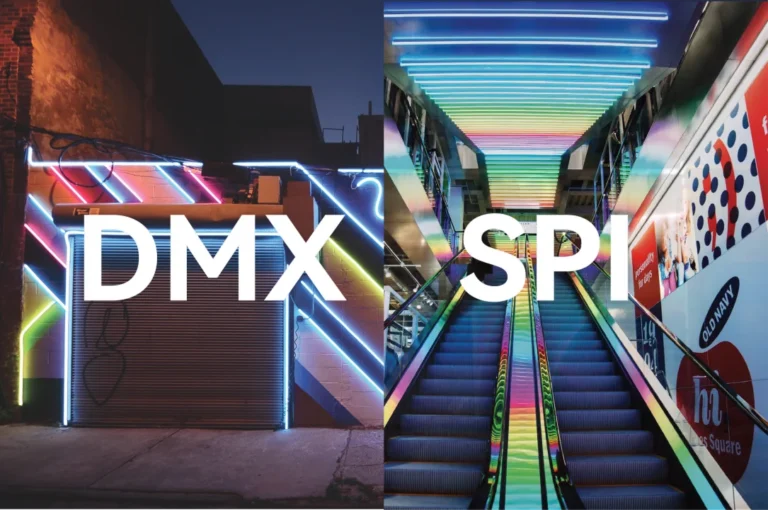
| DMX512 | Grands projets architecturaux | Cartographie des pixels, scènes programmées, synchronisation à l'échelle du bâtiment |
| dali | Intégration de bâtiments intelligent | Intégration de la planification blanche et BMS |
| SPI / adressable | Effets dynamiques | Contrôle pixel par pixel, motifs de chasse, synchronisation vidéo |
Télécommande RF 2.4G – le véritable choix du projet
Aucune ligne de vue n'est nécessaire - RF fonctionne sur la pierre et les cloisons sèches - avec une roue chromatique, un curseur de luminosité et des scènes prédéfinies (flash, fondu, stroboscopique, lisse). La portée est de 20 à 30 mètres à l'intérieur, une télécommande peut contrôler plusieurs zones.
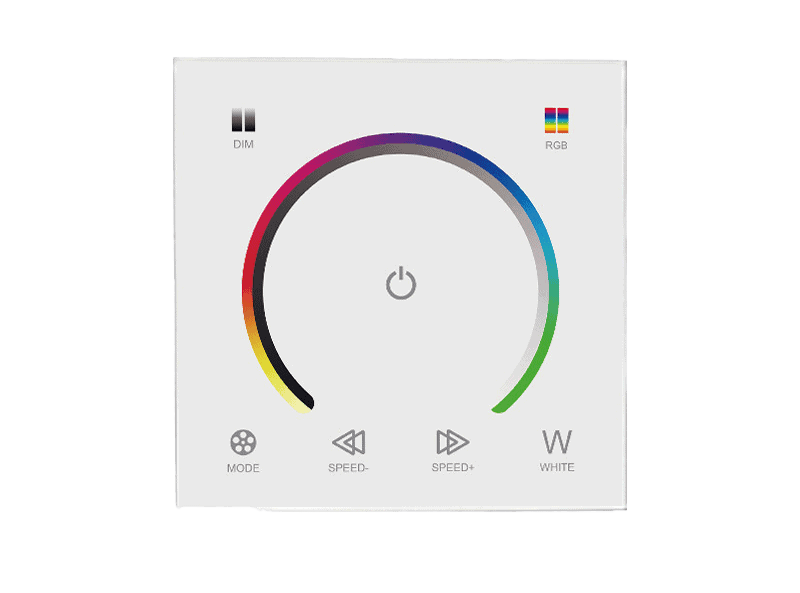
Panneaux tactiles muraux — Standard hôtelier et commercial
Contrôleurs à face en verre avec gradation RGBW, mémoire de scène et sélection de zone - matériel architectural, pas électronique grand public. Disponible en noir, blanc et aluminium brossé.
DMX512 et DALI — Contrôle à l'échelle du bâtiment
Pour plus de 20 feuilles, ou éclairage synchronisé avec HVAC, Stores ou AV : DMX512 propose 512 canaux par univers avec mappage de pixels via MadMapper ou Resolume ; DALI s’intègre dans les systèmes de gestion de la lumière du jour et de la gradation programmée.
SPI adressable — lorsque chaque pixel compte
Les feuilles adressables contrôlent chaque LED individuellement : motifs de chasse, ondes de couleur, cartographie vidéo. Le compromis est la complexité : plus de canaux, une synchronisation correcte du signal et un câblage prudent sur de longues distances.
Notre point de vue : Pour un mur en pierre avec des changements de couleur occasionnels, une télécommande RF ou un panneau mural suffit. Pour les scènes programmées, investissez dans DMX512 ou SPI. Voir notre plongée profonde sur Éclairage pixel adressable avec DMX512 et SPI.

Vidéo : Lampe de feuille LED bicolore — L'effet de changement de couleur exact utilisé dans notre projet de pierre réelle.
Choisir la bonne pierre translucide
Toutes les pierres ne transmettent pas la lumière de la même manière : un panneau de résine de 2 mm passe presque toute la lumière ; une dalle de granit de 20 mm bloque presque tout. Les variables clés sont l'épaisseur, la densité minérale et la finition de surface - les faces polies réfléchissent la lumière avant d'entrer dans la pierre, tandis que les finitions aiguisées donnent une lueur plus chaude et diffuse.
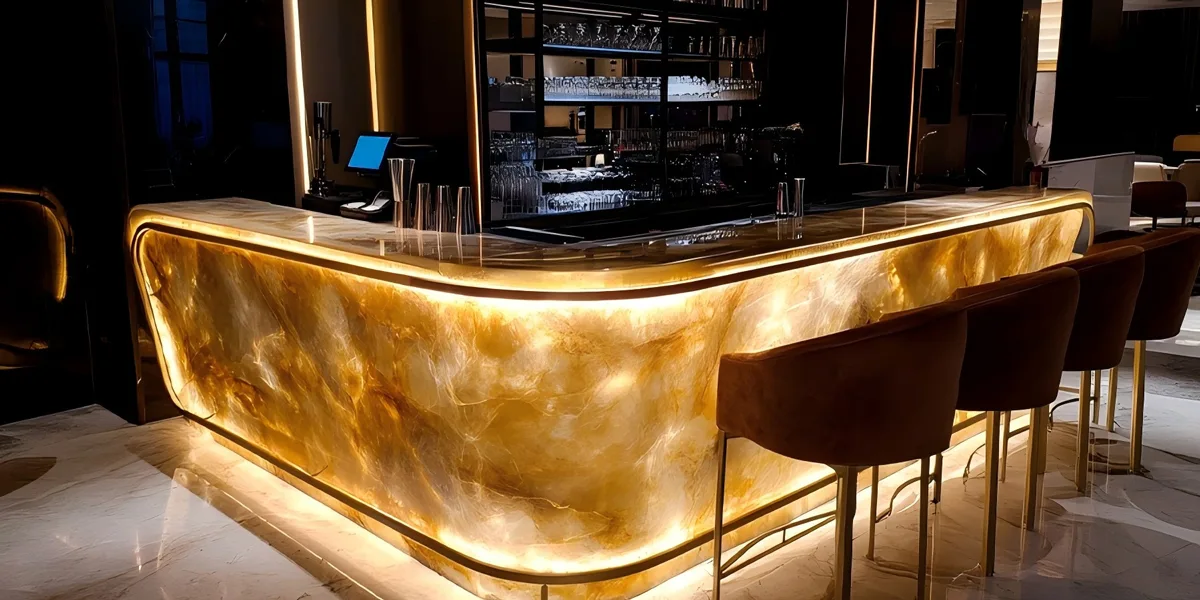
Basé sur les résultats de terrain, y compris les projets de notre Guide de conception de marbre rétroéclairé — Les matériaux se classent comme ceci :
| Matériau | translucidité | Épaisseur typique | Meilleur pour |
|---|---|---|---|
| onyx | Excellent | 6–12 mm | Murs, bars, bureaux de réception |
| albâtre | Excellent | 8 à 15 mm | Lueur chaude et diffuse dans les spas et les centres de bien-être |
| Marbre fin | Bon | 5–10mm | Rétroéclairage élégant et subtil dans les hôtels et les bureaux |
| Panneaux de résine | Excellent | 3–8 mm | Couleur cohérente, look moderne, économique |
| acrylique | très haut | 3–10mm | Économique, diffusion uniforme, facile à fabriquer |
Onyx — l'étalon-or
onyx est une pierre naturelle avec des veines dramatiques et une translucidité élevée. Une dalle de 6 à 8 mm avec une feuille de 30 mm derrière révèle chaque veine - utilisez un écart de 35 à 40 mm pour éviter les points chauds dans les zones minces. coûteux et fragile, mais inégalé.
Albâtre — chaleureux et pardonnant
Translucidité plus douce et plus laiteuse qui diffuse la lumière uniformément - pardonnant sur les distances d'écart et facile à couper sur le terrain. Se marie bien avec 3000K feuilles blanches.
Marbre fin — Élégance subtile
Moins translucide, il a donc besoin d'une feuille plus lumineuse ou d'un espace plus petit. Une dalle de 5 mm avec une feuille RGBW haute densité à 20 mm offre une douce luminance adaptée aux lobbies et aux résidences des entreprises.
Référence de luminosité : Pour la plupart des panneaux Onyx et résine, une feuille à 12–28 W (1200–2800 lm) avec un écart de 30 mm offre une lueur équilibrée. Pour de l'albâtre mince, passez à 20 mm avec un variateur de puissance ; pour le marbre épais, allez 40–50 mm ou ajoutez une deuxième couche.
OEM et personnalisation pour votre projet
Les projets de pierre sont rarement standard : un hall d'entrée d'hôtel a besoin de feuilles coupées à 487 × 243 mm, une barre humide a besoin d'une imperméabilisation IP54, une chaîne de vente au détail a besoin de 5 000 feuilles identiques avec des harnais personnalisés. En tant que fabricant OEM/ODM, Signiteled personnalise à travers six paramètres, voir Options de conception de feuilles de LED personnalisées:
- Taille et forme : rectangles, cercles, arcs et polygones personnalisés à partir d'un dessin CAO ; mise en page en 48 heures.
- Densité LED — 128 LED standard par panneau de 490 × 245 mm, jusqu'à 192 pour le marbre épais, environ +50% de sortie sans épaisseur supplémentaire.
- Tension — Standard 24V (courant inférieur, courses plus longues) ; 12 V pour les installations automobiles, marines ou alimentées par batterie.
- Température de couleur — 2700K–6500K, ou RGB/RGBW complet. 3000K est le plus populaire pour les environnements d'hôtels chaleureux.
- Imperméabilisation — IP54/IP65 Revêtement conforme et connecteurs scellés pour salles de bains, spas et panneaux extérieurs (les feuilles standard sont IP20).
- Connecteurs — soudés pour les harnais uniques, les faisceaux de connexions et de lecture permettent de réduire le temps d'installation jusqu'à 60%.
Workflow de personnalisation
Débit typique : Exigences (dimensions, pierre, luminosité, couleur, contrôle) → Conception de la disposition avec dimensionnement du conducteur et schéma de câblage (2 à 3 jours) → Échantillons de prototypes pour approbation (1 à 2 semaines) → Production avec test de contrôle qualité (2 à 4 semaines) → Support continu pour l'installation et la garantie.
Prêt à demander un devis ? Incluez six détails pour une réponse précise en un tour : ① Dimensions de montage, ② Matériau et épaisseur de la pierre, ③ Luminosité requise (lm/m²), ④ Température de couleur ou RGB/RGBW, ⑤ Variation/méthode de contrôle, ⑥ Quantité cible. Voir aussi le Liste de contrôle technique en 7 points de l'acheteur B2B.

Vidéo : Feuilles de LED rétro-éclairées en pierre de luxe en production à l'usine Signiteled.
FAQ
Qu'est-ce qu'une feuille de lumière LED ?
Un panneau de circuit imprimé fin et flexible avec une gamme dense de LED uniformément réparties. Contrairement aux bandes (linéaires) ou aux modules (point), les feuilles produisent un éclairage de surface uniforme sans points visibles ni points chauds, idéal pour le rétroéclairage de panneaux onyx, marbre, acrylique et résine.
Les feuilles de LED de feuilles de rétro-éclairage peuvent-elles être en mesure de rétro-é
Oui. Montez-les à 20 à 50 mm derrière la pierre avec des adhésifs ou des vis 3M; les baies denses 2835/5050 offrent une lueur uniforme; les versions RGB/RGBW changent de couleur via la télécommande RF, le panneau mural, le DMX512 ou le DALI.
RGB ou RGBW - quel est le meilleur pour le rétroéclairage de la pierre ?
RGBW. La puce blanche dédiée offre CRI > 90 et une température de couleur naturelle ainsi que des effets de couleur. Utilisez uniquement le RGB simple pour les murs purement décoratifs.
À quelle distance les feuilles LED doivent-elles être de la pierre ?
20–50mm. Les matériaux plus minces ou plus translucides nécessitent un écart plus grand; une sortie plus lumineuse permet une plus courte. Toujours tester avec de vrais échantillons de pierre.
Les feuilles de LED peuvent-elles être coupées à la taille ?
Oui — coupez le long des lignes marquées avec des ciseaux pointus dans n'importe quelle forme. Les unités de coupe minimale vont d'une LED à 50 × 50 mm. au sujet de -Testez chaque segment après la coupe.
Combien de temps durent les ampoules LED ?
35 000 à 50 000 heures selon le modèle et les conditions. Monter sur des surfaces métalliques pour une meilleure dissipation thermique. Signiteled couvre les feuilles standard avec une garantie de 3 ans.
Conclusion
Rétroéclairage La pierre translucide ne consiste pas à ajouter de la lumière à un mur - il s'agit de transformer le mur en une surface de vie. Comme le montre le projet réel ci-dessus, la technologie est abordable et simple à installer : les feuilles LED offrent la pierre lueur uniforme et sans points, les contrôleurs RGB/RGBW offrent les exigences de contrôle de la couleur en matière d'architecture moderne ; et l'écart de 20 à 50 mm s'adapte à presque toutes les cavités, y compris les rénovations là où la pierre est déjà en place.
Les installations réussies se résument à trois choses : tester avant le montage, faire correspondre la densité des LED à l'épaisseur de la pierre et dimensionner correctement l'alimentation. Faites-les bien, et le mur passe du rouge chaud au vert froid en appuyant sur un bouton - pas de matériel visible, pas de maux de tête de maintenance pendant des années.
Vous planifiez un projet de rétroéclairage en pierre ? Signiteled peut vous aider à la conception de la mise en page, à la sélection des produits, au dimensionnement des pilotes et à la fabrication sur mesure. Entrez en contact avec vos dimensions, votre type de pierre et vos exigences de couleur pour une proposition complète avec des schémas de câblage et une nomenclature.
Prêt à rétro-éclairer votre prochain projet de pierre ?
Parcourez le Collection de lumières de feuilles LED, ou nous contacter Pour le dimensionnement personnalisé, la conception de la mise en page et la fabrication d'OEM.
Articles Similaires