English
  简体中文
简体中文  Deutsch
  Español
  Français
  Italiano
  日本語
日本語  한국어
한국어  Polski
  Português
  Русский
  Türkçe
  Nederlands
  Tiếng Việt
  ไทย
ไทย 
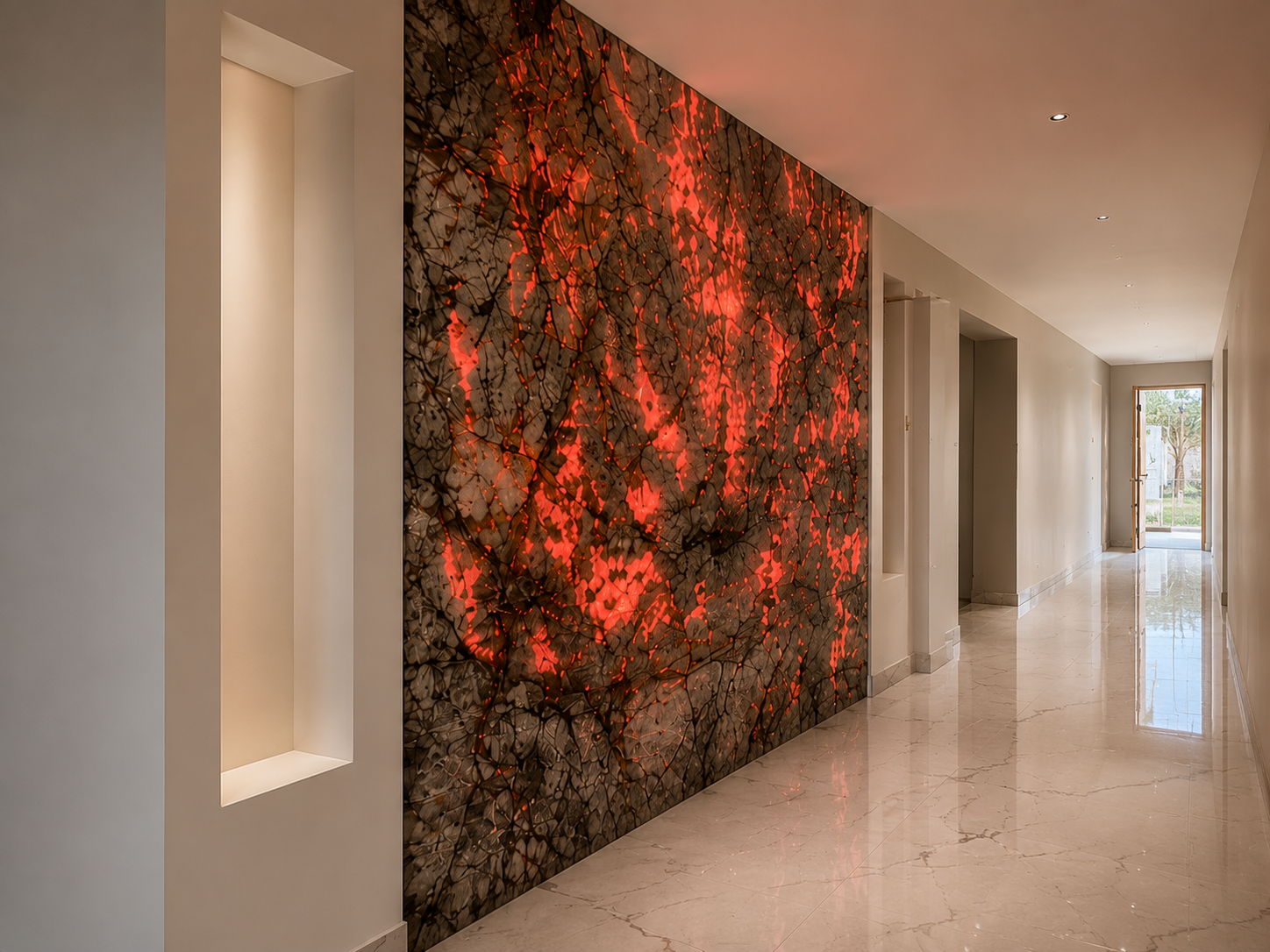
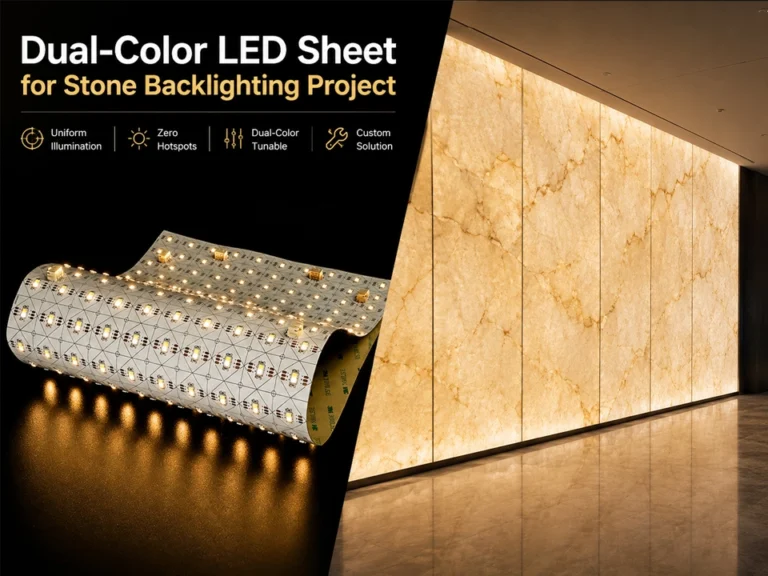
- LED sheets deliver uniform, dot-free backlighting behind translucent stone — thinner and more even than strips or panels.
- Keep a 20–50 mm gap between the LED sheet and the stone surface for smooth diffusion.
- Choose RGBW (not just RGB) if you need true white light when colour effects are off.
- Match the controller to the project: RF remote for homes, wall panel for hotels, DMX512 for large installations.
- Size the power supply at 120% of total wattage and use 18–20 AWG wire to prevent voltage drop.
- Test brightness, colour and wiring before final mounting — stone is already installed, so there is no room for rework.
A real backlit stone project
An architectural lighting contractor came to us with a brief common in hospitality and commercial fit-outs: install a translucent stone feature wall — a mix of onyx and thin marble, already fitted — and make it glow with color that changes on demand. The cavity behind the stone was only 35mm deep, and the client wanted the system completely invisible: no fixtures, no wiring, no control boxes. Fluorescent boxes were too bulky, LED modules created hot spots, and strips needed days of wiring to conceal. LED sheets were the only technology that ticked every box.
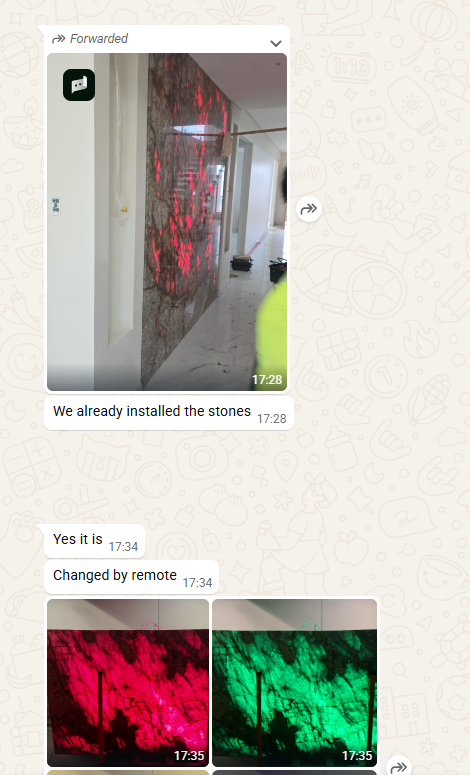
The installation took a single day: sheets cut to size, mounted 30mm behind the stone with built-in 3M adhesive, wired to a 24V driver and paired with a handheld RF remote. One button press shifts the wall from warm red to cool green.
“We already installed the stones.”
“Yes it is. Changed by remote.”
That exchange captures what modern architectural lighting is about: invisible hardware, visible impact, effortless control.
Project file: at a glance
| Field | Detail |
|---|---|
| Project type | Translucent stone wall backlighting |
| Stone status | Already installed — LED sheets mounted from behind |
| Cavity depth | 35mm |
| Control method | Handheld remote (RF 2.4G) — color changed instantly |
| Color effects | Dynamic switching: warm red, cool green and beyond |
| Recommended product | RGB / RGBW LED sheet (5050 SMD, DC 24V) |
What is an LED sheet light?
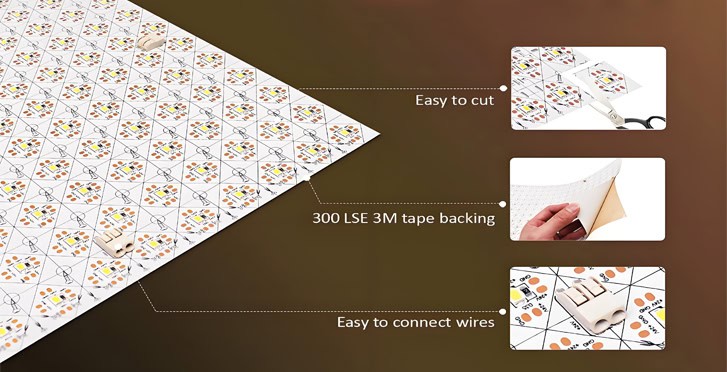
An LED sheet light is a flexible PCB panel with a dense, evenly distributed array of LEDs. Where a strip produces a line of light and a module a point of light, a sheet produces continuous, uniform area light. The PCB is typically 0.3–0.5mm thick — thin enough for a narrow stone cavity and free of the voltage-drop dimming that plagues long strip runs.
Sheets run on 12V or 24V DC, in standard sizes from 250 × 250mm to 500 × 250mm, cuttable every 20–50mm along marked lines. LED density determines uniformity: a high-density sheet (128 LEDs per 490 × 245mm panel) eliminates visible dots even behind thin stone; lower densities show “hot spots.”
How LED sheets compare to alternatives
| Criterion | LED sheet | LED strip | LED module | LED panel |
|---|---|---|---|---|
| Light output | Uniform area light | Linear light | Point light | Uniform area light |
| Thickness | Ultra-thin (~0.5mm) | Ultra-thin (~3mm with tape) | Medium (10–20mm) | Thick (rigid, 8–25mm) |
| Cuttable | Yes (20–50mm units) | Yes (25–50mm) | No | No |
| Flexible | Yes — conforms to curves | Yes | Limited | No — rigid frame |
| Coverage efficiency | High — one sheet covers a wall area | Low — many parallel runs needed | Low — diffuser required | Medium |
| Best for | Stone backlighting, feature walls, backlit signs | Linear accents, cove lighting | Channel letters, small signs | Ceiling panels, troffers |
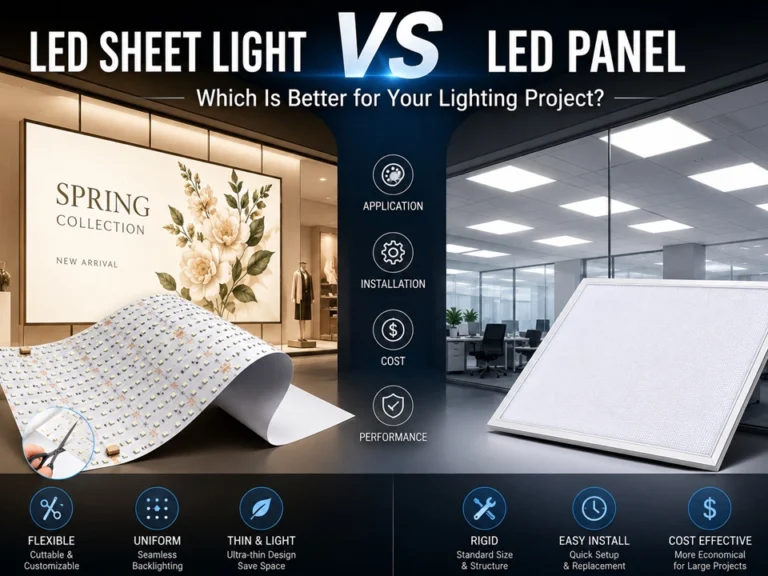
In practice: strips need many parallel runs with separate power injection; modules need diffusers that hide hot spots — unacceptable behind translucent stone; panels are rigid and cannot be cut. Sheets deliver uniform light with no dots, no shadows and no far-end dimming. See our comparisons of LED Sheet vs LED Panel and LED Sheet vs LED Strip.
Why LED sheets are the standard for stone backlighting
Traditional methods fall short: fluorescent boxes are 50–100mm deep, generate heat and offer no color control; LED modules need thick diffusers and still show irregular patterns through stone. LED sheets solve all of it — thin PCB fits 20mm cavities, dense arrays create true area light with no diffuser, and solid-state DC means no flicker, hum or damaging heat.
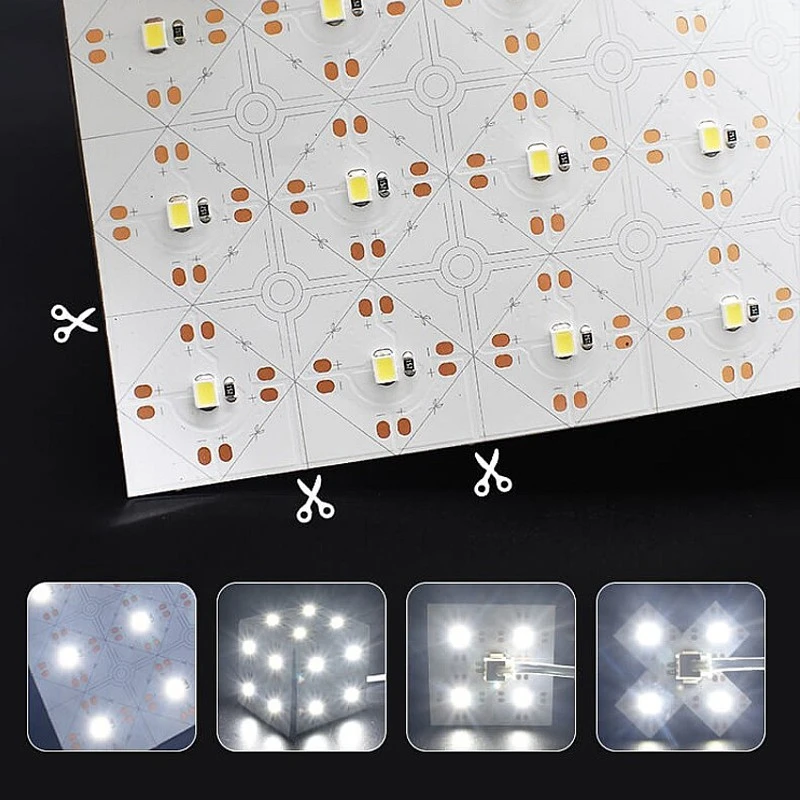
- Uniform surface glow — 128 LEDs per panel create seamless luminance even behind 3–5mm onyx; no diffuser needed.
- Ultra-thin profile — ~0.5mm fits tight 20–50mm cavities, critical for retrofits where depth is fixed.
- Cuttable to any geometry — rectangles, circles or irregular shapes, trimmed on site with scissors; units as small as 20.4 × 122.5mm.
- Dynamic color options — static white, tunable white (2700–6500K), RGB, RGBW, RGB+CCT or pixel-addressable effects.
- Multiple control paths — RF remote, wall panel, DMX512, DALI, TRIAC, 0-10V or PWM.
- Simple mounting — 3M adhesive backing or pre-drilled screw holes; no brackets, rails or channel extrusions.
Product specs: which LED sheet powers this look
For a color-changing stone wall like ours, you need an RGB or RGBW LED sheet with remote control — the choice determines whether the wall doubles as white illumination or only decorative color.
RGB vs RGBW: which one do you need?
RGB mixes red, green and blue channels to approximate white, but the result is visibly “muddy” — CRI drops below 60. RGBW adds a dedicated white chip that produces true white independently: CRI above 90, natural color temperature, and everyday illumination when color effects are not needed.
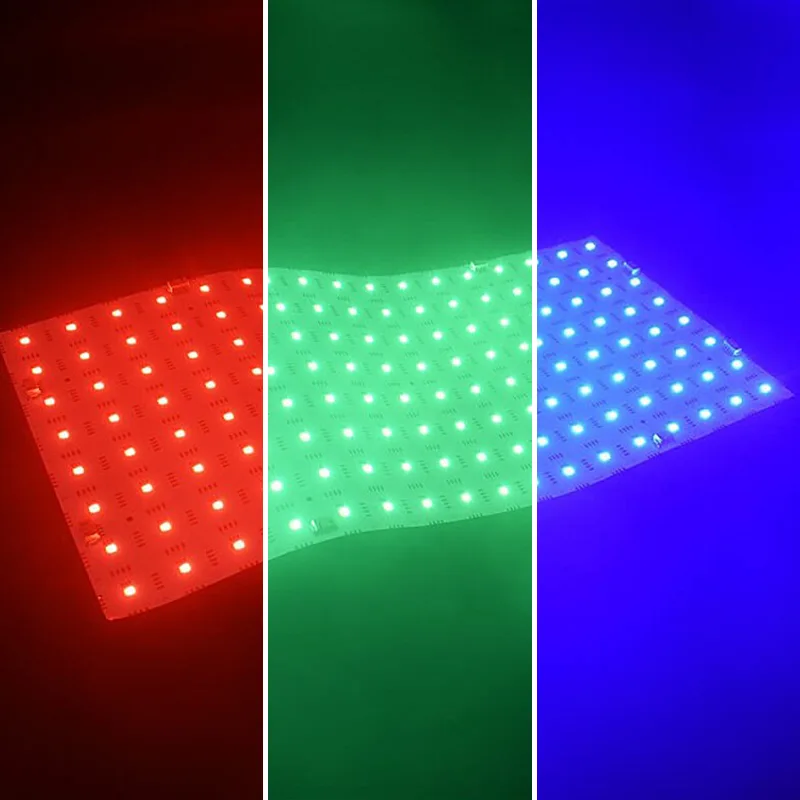
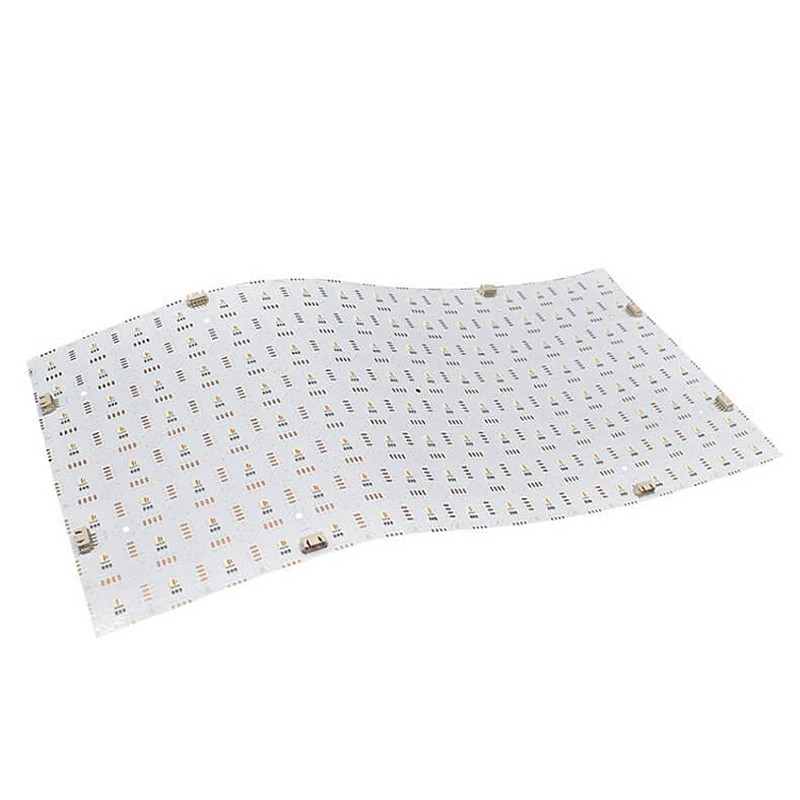
RGB LED sheet (5050 SMD, 24V)
| Specification | Value |
|---|---|
| Size | 490 × 245mm (custom sizes available) |
| LED type | 5050 SMD |
| LED count | 128 per sheet |
| Operating voltage | DC 24V |
| Power | 45W |
| Minimum cut unit | 39.6mm |
| Rated lifespan | > 35,000 hours |
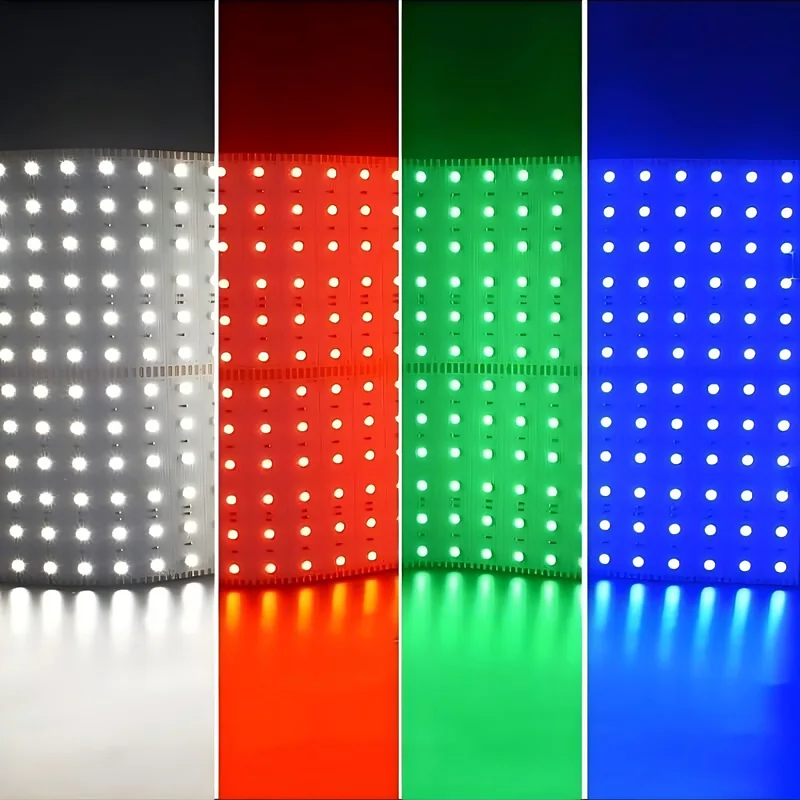
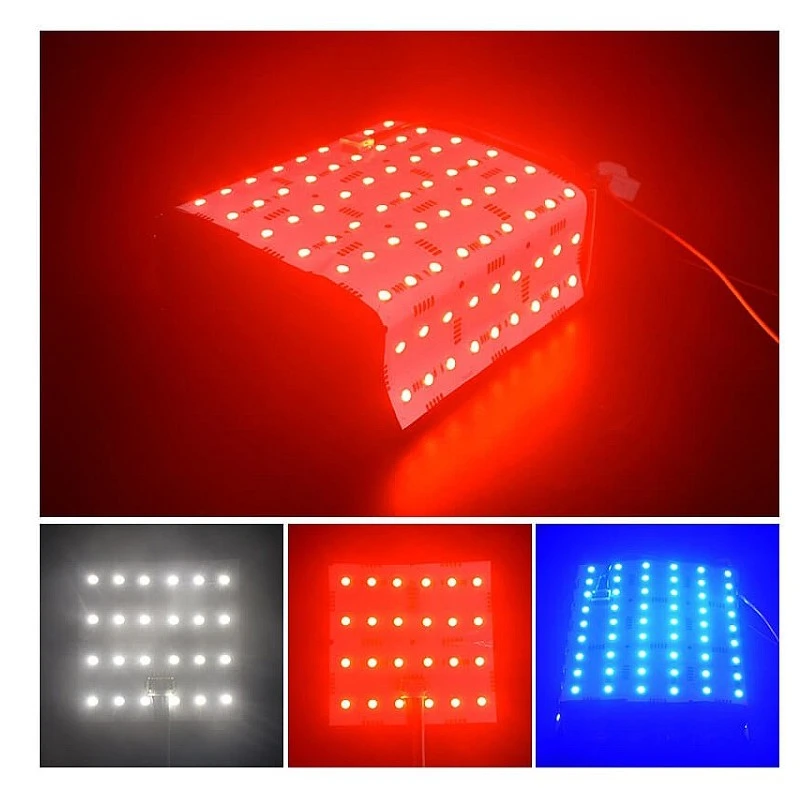
RGBW LED sheet (5050 RGBW 4-in-1, 24V) — recommended for most projects
| Specification | Value |
|---|---|
| Size | 250 × 250mm / 490 × 250mm |
| LED type | 5050 RGBW 4-in-1 SMD |
| Colors | RGB + 3000K / 4000K / 6500K white |
| Power | 24W / 48W |
| Luminous efficacy | 90 LM/W |
| Minimum cut unit | 50 × 50mm / 20.4 × 122.5mm |
Power calculation example
For a 2.4m × 1.5m wall (3.6m²) of 490 × 245mm RGBW sheets at 48W each: about 6–7 sheets; total draw 7 × 48W = 336W; add 20% headroom → 400–450W 24V DC driver. Driver sizing charts come with every order, and wiring diagrams are free for complex layouts.
How to install LED sheets behind stone: 6 steps
Stone is expensive and hard to remove once installed — so order matters; skipping the pre-test is the most common cause of failure.
Step 1: Test everything first
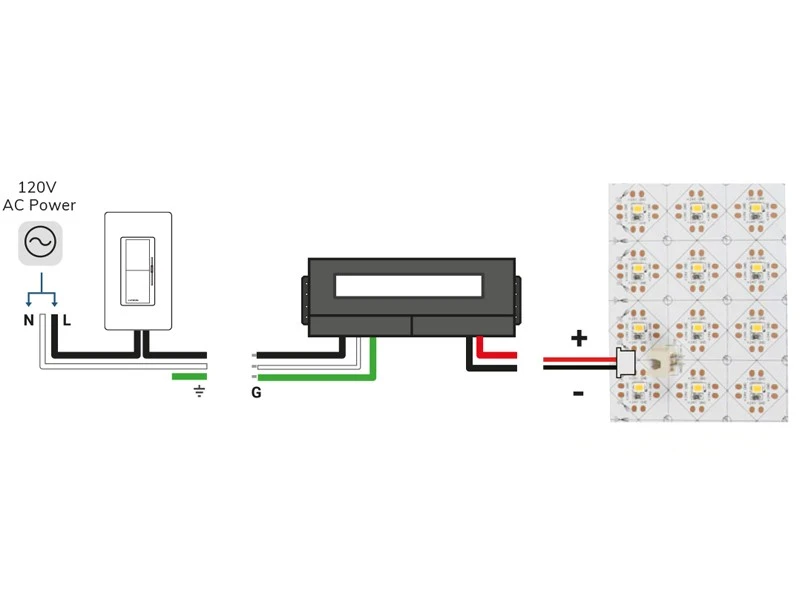
Connect power and controller on a workbench; cycle all colors and brightness levels and confirm every segment responds before mounting. A dead segment — usually an interrupted trace — is found here, not after the stone is in place.
Step 2: Prepare the surface
Remove dust, oil and moisture; wipe surfaces with isopropyl alcohol. On uneven concrete, add aluminium tape or a flat backing board so the 3M adhesive gets full contact — gaps weaken adhesion and create shadow-casting air pockets.
Step 3: Cut to size
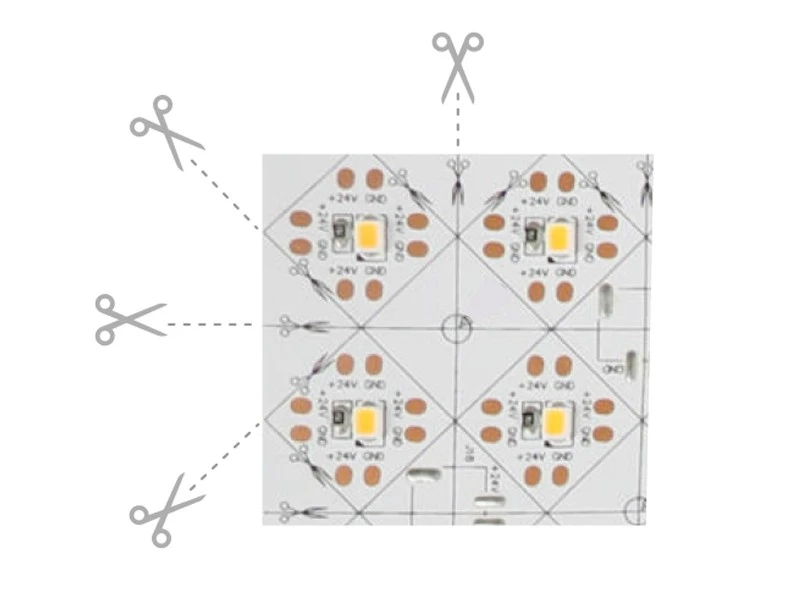
Cut with sharp scissors along the marked lines only — cutting against them severs copper traces and creates dead zones. For large walls, butt sheets edge-to-edge with a 2–3mm gap; the stone’s own diffusion hides small gaps.
Step 4: Mount the sheets
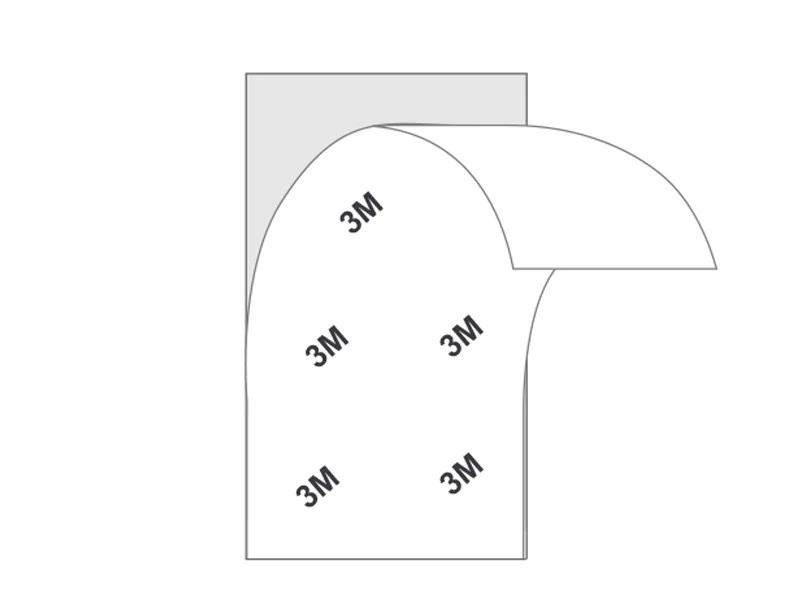
Peel the 3M backing and press the sheet 20–50mm behind the stone, working from one corner outward to eliminate air bubbles. For permanent builds, add screws through the pre-drilled holes — heads sit flush and cast no shadows.
Step 5: Connect power and control
Use 20AWG wire for a single sheet, 18AWG for multiple. Most RF controllers handle up to 10A — beyond that, add a signal amplifier every 5–10 sheets. Match connectors: 4-pin RGB, 5-pin RGBW, XLR/DMX for DMX512. Label every wire.
Step 6: Power on and fine-tune
Restore power, cycle colors and lock in preset scenes. Walk the wall looking for uneven spots: hot spots mean increase the gap or add diffuser film; washed-out colors usually mean the controller profile is wrong.
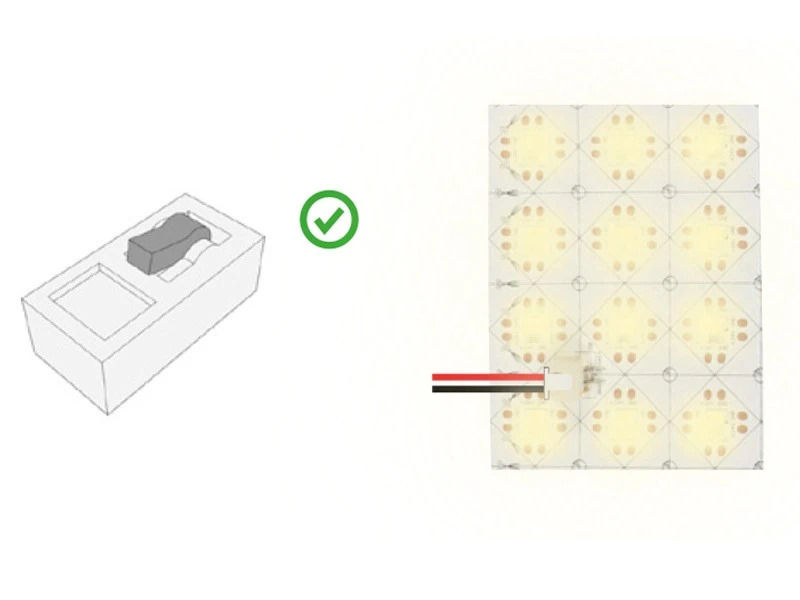
Tools checklist
- Sharp scissors
- 18–20AWG wire + wire strippers
- Power supply — DC 12V/24V, sized to wattage + 20% headroom
- Controller/remote (RF 2.4G, wall panel, DMX512 or DALI)
- Isopropyl alcohol wipes
- Multimeter for voltage verification before final power-on
For multi-sheet wiring diagrams and amplifier placement, see How to Cut, Install, and Set Up LED Sheet Lights.

Video: monochrome LED sheet light for backlit stone — flexible & seamless (SignLiteLED YouTube).
Control systems compared
The right controller depends on who operates the lights and how often settings change: a handheld remote suits a wall changed a few times a week; DMX512 suits a hotel lobby with ten programmed scenes.
| Controller | Best for | Key features |
|---|---|---|
| RF 2.4G remote | Small–mid projects | Touch color wheel, preset scenes, brightness/speed control |
| Wall touch panel | Permanent installations | RGBW dimming, zone control, clean aesthetic |
| DMX512 | Large architectural projects | Pixel mapping, programmed scenes, building-wide sync |
| DALI | Smart building integration | Tunable white, scheduling, BMS integration |
| SPI / addressable | Dynamic effects | Pixel-by-pixel control, chasing patterns, video sync |
RF 2.4G remote — the real project choice
No line-of-sight needed — RF works through stone and drywall — with a color wheel, brightness slider and preset scenes (flash, fade, strobe, smooth). Range is 20–30 metres indoors; one remote can control multiple zones.
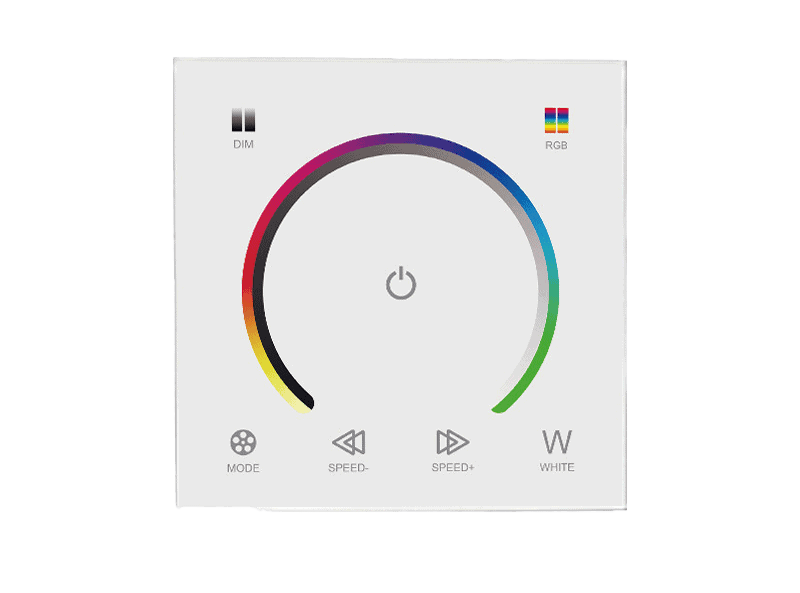
Wall touch panels — hotel and retail standard
Glass-faced controllers with RGBW dimming, scene memory and zone selection — architectural hardware, not consumer electronics. Available in black, white and brushed aluminium.
DMX512 and DALI — building-scale control
For 20+ sheets, or lighting synced with HVAC, blinds or AV: DMX512 offers 512 channels per universe with pixel mapping via MadMapper or Resolume; DALI integrates into building management systems for daylight harvesting and scheduled dimming.
SPI addressable — when every pixel counts
Addressable sheets control every LED individually — chasing patterns, colour waves, video mapping. The trade-off is complexity: more channels, correct signal timing and careful wiring over long distances.
Our view: for a stone feature wall with occasional color changes, an RF remote or wall panel is sufficient. For programmed scenes, invest in DMX512 or SPI. See our deep dive on addressable pixel lighting with DMX512 and SPI.

Video: dual-color LED sheet light — the exact colour-change effect used in our real stone project.
Choosing the right translucent stone
Not all stone transmits light equally: a 2mm resin panel passes nearly all light; a 20mm granite slab blocks almost everything. Key variables are thickness, mineral density and surface finish — polished faces reflect light before it enters the stone, while honed finishes give a warmer, diffused glow.
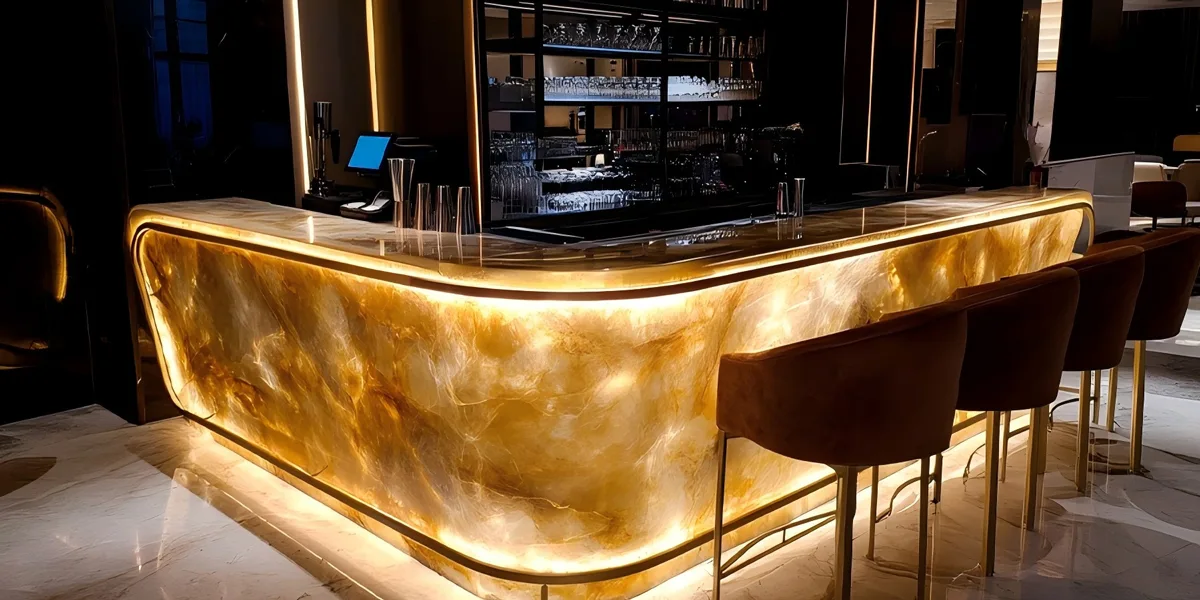
Based on field results — including projects in our Backlit Marble Design Guide — materials rank like this:
| Material | Translucency | Typical thickness | Best for |
|---|---|---|---|
| Onyx | Excellent | 6–12mm | Luxury feature walls, bars, reception desks |
| Alabaster | Excellent | 8–15mm | Warm, diffused glow in spas and wellness centres |
| Thin marble | Good | 5–10mm | Elegant, subtle backlighting in hotels and offices |
| Resin panels | Excellent | 3–8mm | Consistent colour, modern look, budget-friendly |
| Acrylic | Very high | 3–10mm | Budget-friendly, even diffusion, easy to fabricate |
Onyx — the gold standard
Onyx is a natural stone with dramatic veining and high translucency. A 6–8mm slab with a sheet 30mm behind reveals every vein — use a 35–40mm gap to prevent hot spots in thin areas. Costly and fragile, but unmatched.
Alabaster — warm and forgiving
Softer, milkier translucency that diffuses light evenly — forgiving on gap distances and easy to cut in the field. Pairs well with 3000K white sheets.
Thin marble — subtle elegance
Less translucent, so it needs a brighter sheet or a smaller gap. A 5mm slab with a high-density RGBW sheet at 20mm delivers a gentle luminance suited to corporate lobbies and residences.
Brightness reference: for most onyx and resin panels, a sheet at 12–28W (1200–2800 lm) with a 30mm gap delivers balanced glow. For thin alabaster, drop to 20mm with a dimmable driver; for thick marble, go 40–50mm or add a second layer.
OEM & customization for your project
Stone projects are rarely standard: a hotel lobby needs sheets cut to 487 × 243mm, a humid bar needs IP54 waterproofing, a retail chain needs 5,000 identical sheets with custom harnesses. As an OEM/ODM manufacturer, SignLiteLED customizes across six parameters — see custom LED sheet design options:
- Size and shape — custom rectangles, circles, arcs and polygons from a CAD drawing; layout in 48 hours.
- LED density — standard 128 LEDs per 490 × 245mm panel; up to 192 for thick marble, roughly +50% output at no extra thickness.
- Voltage — 24V standard (lower current, longer runs); 12V for automotive, marine or battery-powered installations.
- Color temperature — 2700K–6500K, or full RGB/RGBW. 3000K is most popular for warm hotel environments.
- Waterproofing — IP54/IP65 conformal coating and sealed connectors for bathrooms, spas and outdoor signage (standard sheets are IP20).
- Connectors — soldered for one-offs; plug-and-play harnesses cut installation time by up to 60%.
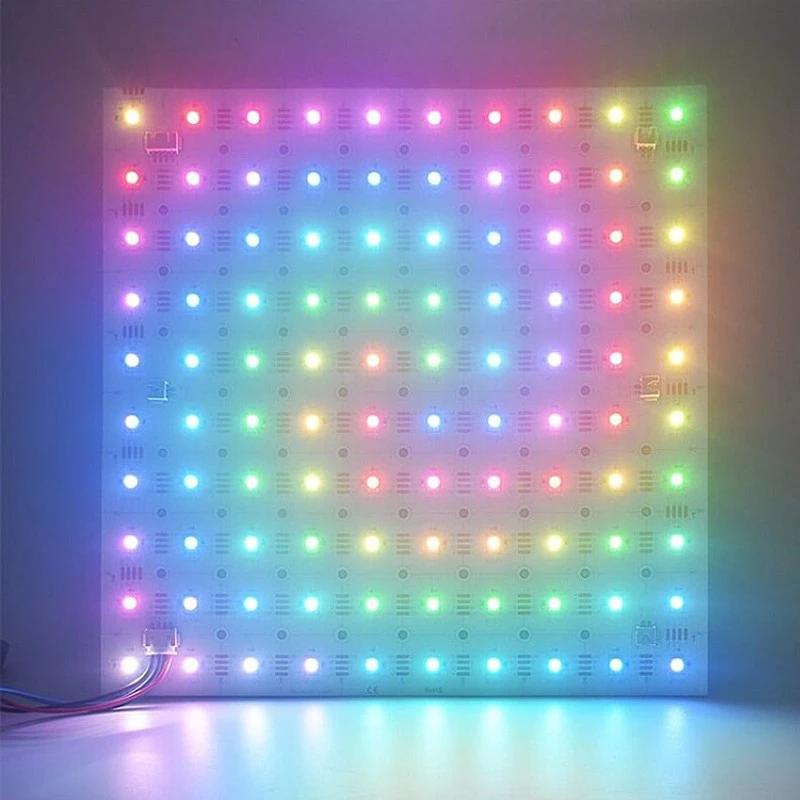
Customisation workflow
Typical flow: requirements (dimensions, stone, brightness, colour, control) → layout design with driver sizing and wiring diagram (2–3 days) → prototype samples for approval (1–2 weeks) → production with QC testing (2–4 weeks) → ongoing support for installation and warranty.
Ready to request a quote? Include six details for an accurate one-round answer: ① mounting dimensions, ② stone material and thickness, ③ required brightness (lm/m²), ④ colour temperature or RGB/RGBW, ⑤ dimming/control method, ⑥ target quantity. See also the B2B buyer’s 7-point technical checklist.

Video: luxury stone backlit LED sheets in production at the SignLiteLED factory.
FAQ
What is an LED sheet light?
A thin, flexible PCB panel with a dense array of evenly distributed LEDs. Unlike strips (linear) or modules (point), sheets produce uniform area lighting with no visible dots or hot spots — ideal for backlighting onyx, marble, acrylic and resin panels.
Can LED sheets backlight stone walls?
Yes. Mount them 20–50mm behind the stone with 3M adhesive or screws; dense 2835/5050 arrays deliver uniform glow; RGB/RGBW versions change colour via RF remote, wall panel, DMX512 or DALI.
RGB or RGBW — which is better for stone backlighting?
RGBW. The dedicated white chip delivers CRI > 90 and natural colour temperature alongside colour effects. Use plain RGB only for purely decorative walls.
How far should LED sheets be from the stone?
20–50mm. Thinner or more translucent materials need a larger gap; brighter output allows a shorter one. Always test with real stone samples first.
Can LED sheets be cut to size?
Yes — cut along the marked lines with sharp scissors into any shape. Minimum cut units range from one LED to 50 × 50mm. Re-test each segment after cutting.
How long do LED sheet lights last?
35,000–50,000+ hours depending on model and conditions. Mount on metal surfaces for better heat dissipation. SignLiteLED covers standard sheets with a 3-year warranty.
Conclusion
Backlighting translucent stone is not about adding light to a wall — it is about turning the wall into a living surface. As the real project above shows, the technology is affordable and simple to install: LED sheets deliver the uniform, dot-free glow stone deserves; RGB/RGBW controllers deliver the colour control modern architecture demands; and the 20–50mm gap fits almost any cavity, including retrofits where the stone is already in place.
Successful installations come down to three things: testing before mounting, matching LED density to stone thickness, and sizing the power supply correctly. Get those right, and the wall shifts from warm red to cool green at the press of a button — no visible hardware, no maintenance headaches for years.
Planning a stone backlighting project? SignLiteLED can help with layout design, product selection, driver sizing and custom manufacturing. Get in touch with your dimensions, stone type and colour requirements for a full proposal with wiring diagrams and bill of materials.
Ready to backlight your next stone project?
Browse the LED Sheet Lights collection, or contact us for custom sizing, layout design and OEM manufacturing.
Related Posts