Español
  English
  简体中文
简体中文  Deutsch
  Français
  Italiano
  日本語
日本語  한국어
한국어  Polski
  Português
  Русский
  Türkçe
  Nederlands
  Tiếng Việt
  ไทย
ไทย 
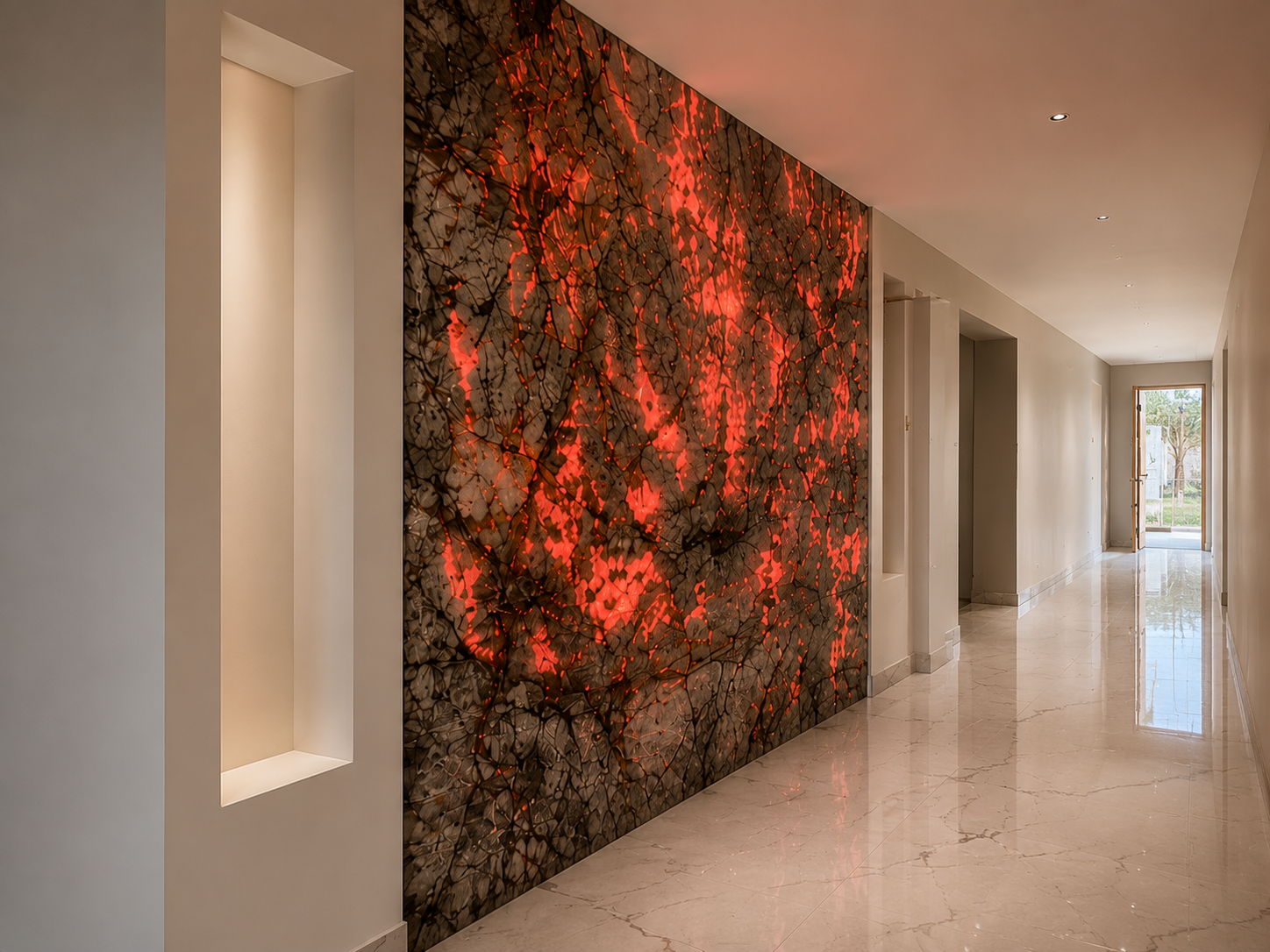
- Las hojas LED brindan retroiluminación uniforme y sin puntos detrás de la piedra translúcida: más delgadas y más incluso que tiras o paneles.
- Mantenga un espacio de 20 a 50 mm entre la hoja LED y la superficie de piedra para una difusión suave.
- Elija RGBW (no solo RGB) si necesita una verdadera luz blanca cuando los efectos de color están apagados.
- Haga coincidir el controlador con el proyecto: RF Remote para hogares, panel de pared para hoteles, DMX512 para instalaciones grandes.
- Dimensionar la fuente de alimentación a 120% de potencia total y utilizar cables de 18–20 AWG para evitar la caída de voltaje.
- Pruebe el brillo, el color y el cableado antes del montaje final: la piedra ya está instalada, por lo que no hay espacio para el retrabajo.
Un verdadero proyecto de piedra retroiluminado
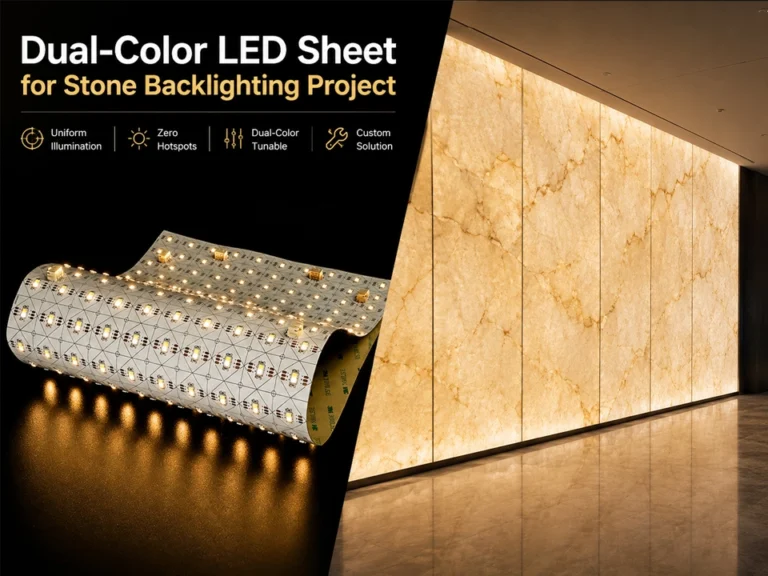
Un contratista de iluminación arquitectónica nos llegó con un breve común en hospitalidad y equipamiento comercial: instale una pared de piedra translúcida, una mezcla de ónix y mármol delgado, ya instalado, y haga que brille con un color que cambia según la demanda. La cavidad detrás de la piedra tenía solo 35 mm de profundidad, y el cliente quería que el sistema fuera completamente invisible: sin accesorios, sin cableado, sin cajas de control. Las cajas fluorescentes eran demasiado voluminosas, los módulos LED creaban puntos calientes y las tiras necesitaban días de cableado para ocultar. Las hojas LED eran la única tecnología que marcaba cada casilla.
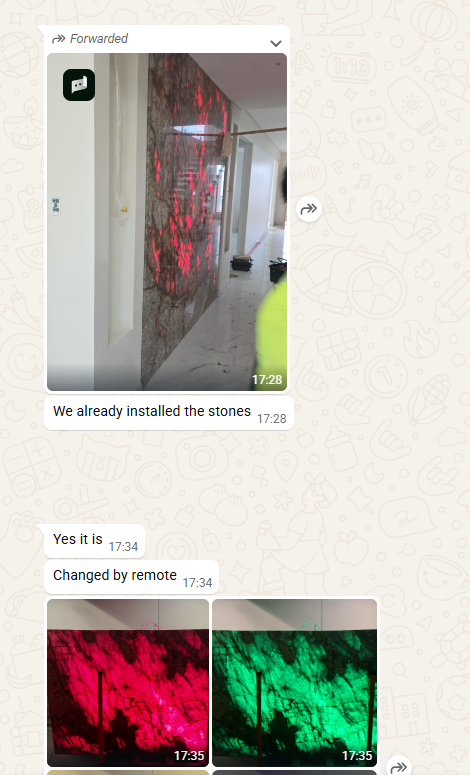
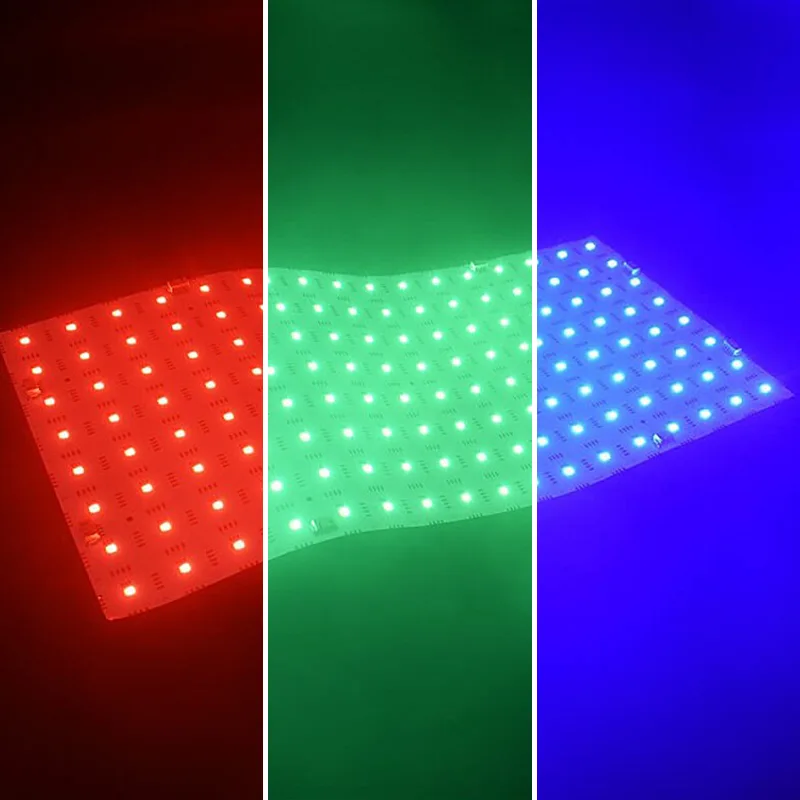
La instalación tomó un solo día: láminas cortadas a medida, montadas 30 mm detrás de la piedra con adhesivo 3M incorporado, cableados a un controlador de 24 V y emparejados con un control remoto RF portátil. Una pulsación de un botón cambia la pared de rojo cálido a verde frío.
“Ya instalamos las piedras”.
“Sí lo es. cambiado por control remoto”.
Ese intercambio captura de qué se trata la iluminación arquitectónica moderna: hardware invisible, impacto visible, control sin esfuerzo.
Archivo del proyecto: de un vistazo
| prado | parte |
|---|---|
| Tipo de proyecto | Retroiluminación de pared de piedra translúcida |
| Estado de piedra | Ya instalado: hojas LED montadas desde atrás |
| profundidad de la cavidad | 35 mm |
| Método de control | Remoto de mano (RF 2.4G) — El color cambió al instante |
| Efectos de color | Cambio dinámico: rojo cálido, verde frío y más allá |
| Producto recomendado | Hoja LED RGB / RGBW (5050 SMD, CC 24V) |
¿Qué es una hoja de luz LED?
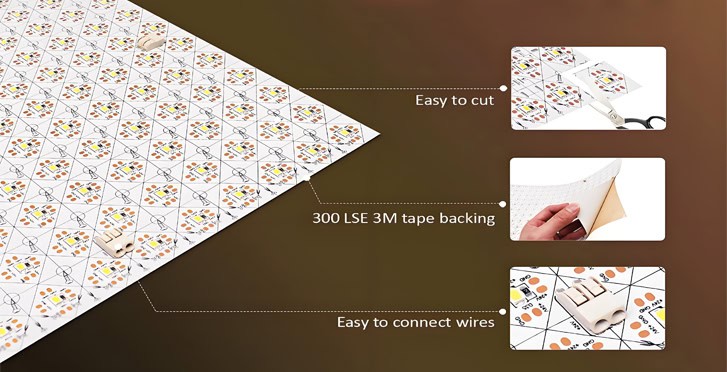
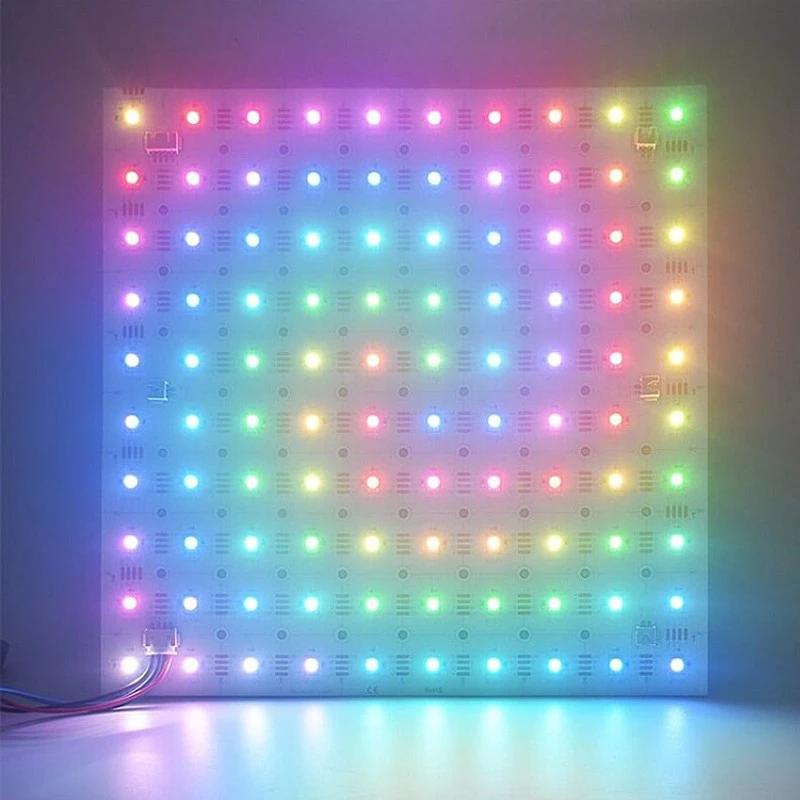
Una hoja de luz LED es un panel de PCB flexible con una densa y uniformemente distribuida de LEDs. Cuando una tira produce una línea de luz y un módulo de luz, una hoja produce luz de área uniforme y continua. La PCB tiene típicamente de 0,3 a 0,5 mm de grosor, lo suficientemente delgada para una cavidad de piedra estrecha y libre de la atenuación de caída de voltaje que afecta a las tiras largas.
Las hojas funcionan en 12V o 24V DC, en tamaños estándar de 250 × 250 mm a 500 × 250 mm, cortable cada 20 a 50 mm a lo largo de líneas marcadas. La densidad del LED determina la uniformidad: una hoja de alta densidad (128 LED por panel de 490 × 245 mm) elimina los puntos visibles incluso detrás de la piedra delgada; las densidades más bajas muestran "puntos calientes".
Cómo se comparan las hojas de LED con las alternativas
| criterio | hoja led | Tira de LED | Módulo LED | Panel LED |
|---|---|---|---|---|
| Potencia luminosa | Luz de área uniforme | luz lineal | Luz de punto | Luz de área uniforme |
| espesor | Ultrafino (~0.5mm) | Ultrafino (~3 mm con cinta) | Medio (10–20 mm) | Grueso (rígido, 8-25 mm) |
| Cortable | Sí (unidades de 20 a 50 mm) | Sí (25-50 mm) | No | No |
| Flexible | Sí — se ajusta a las curvas | Sí | limitado | No — Marco rígido |
| Eficiencia de cobertura | Alto: una hoja cubre un área de pared | Bajo: se necesitan muchas carreras paralelas | Bajo — Se requiere difusor | Medio |
| Lo mejor para | Retroiluminación de piedra, paredes decorativas, letreros retroiluminados | Acentos lineales, iluminación de cala | Letras de canal, pequeñas señales | Paneles de techo, trofeos |
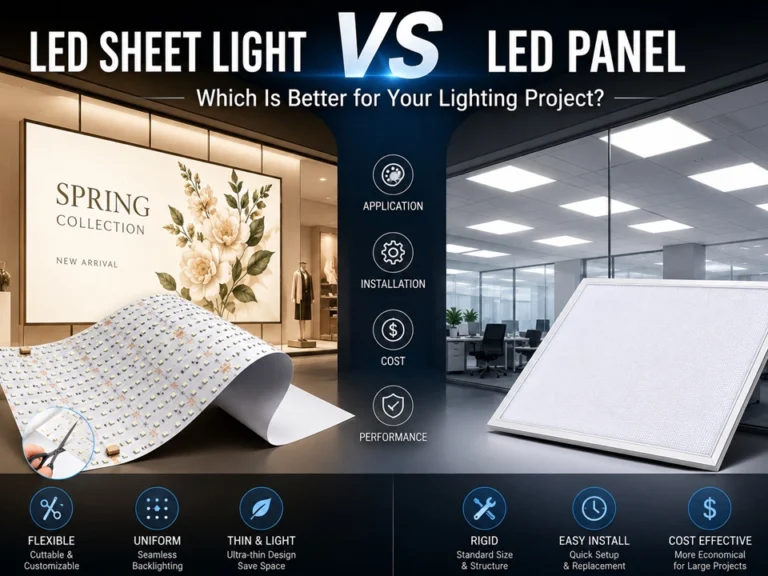
En la práctica: las tiras necesitan muchas tiradas paralelas con inyección de energía separada; los módulos necesitan difusores que oculten puntos calientes, inaceptables detrás de piedra translúcida; los paneles son rígidos y no se pueden cortar. Las sábanas brindan luz uniforme sin puntos, sin sombras y sin atenuación de extremo lejano. Vea nuestras comparaciones de Hoja LED vs Panel LED y Hoja LED vs tira de LED.
Por qué las hojas LED son el estándar para la retroiluminación de piedra
Los métodos tradicionales se quedan cortos: las cajas fluorescentes tienen entre 50 y 100 mm de profundidad, generan calor y no ofrecen control de color; los módulos LED necesitan difusores gruesos y aún muestran patrones irregulares a través de la piedra. Las hojas de LED lo resuelven todo: el PCB delgado se adapta a las cavidades de 20 mm, las matrices densas crean una verdadera luz de área sin difusor y DC de estado sólido significa que no hay parpadeo, zumbido o calor dañino.
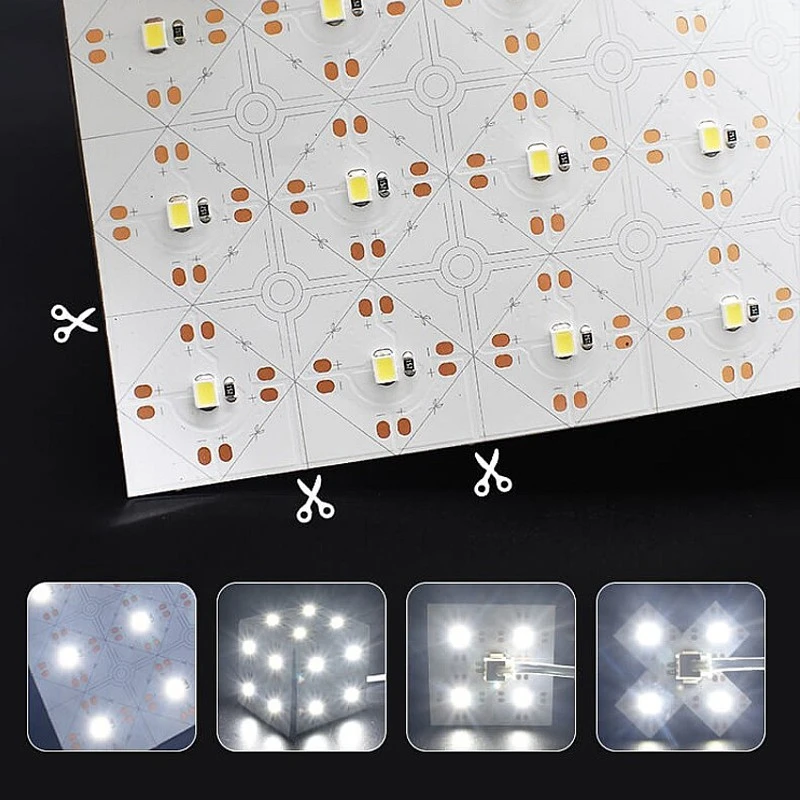
- Resplandor de superficie uniforme: 128 LEDs por panel crean una luminancia sin problemas incluso detrás de 3 a 5 mm de ónix; no se necesita difusor.
- Perfil ultrafino: ~0,5 mm se ajusta a cavidades apretadas de 20 a 50 mm, críticas para reajustes donde la profundidad es fija.
- Cortable a cualquier geometría: rectángulos, círculos o formas irregulares, recortados en el sitio con tijeras; unidades de hasta 20,4 × 122,5 mm.
- Opciones de color dinámico: blanco estático, blanco sintonizable (2700–6500K), RGB, RGBW, RGB+CCT o efectos direccionables por píxeles.
- Múltiples rutas de control: control remoto RF, panel de pared, DMX512, DALI, TRIC, 0-10 V o PWM.
- Montaje sencillo — Respaldo adhesivo 3M o orificios de tornillo preperforados; sin soportes, rieles ni extrusiones de canal.
Especificaciones del producto: ¿Qué hoja de LED alimenta este aspecto?
Para una pared de piedra que cambia de color como la nuestra, necesita una hoja LED RGB o RGBW con control remoto: la opción determina si la pared funciona como iluminación blanca o solo color decorativo.
RGB vs RGBW: ¿Cuál necesitas?
RGB mezcla canales rojo, verde y azul para aproximar el blanco, pero el resultado es visiblemente "mudo": el CRI cae por debajo de 60. RGBW agrega un chip blanco dedicado que produce un verdadero blanco de forma independiente: CRI superior a 90, temperatura de color natural e iluminación diaria cuando no se necesitan efectos de color.
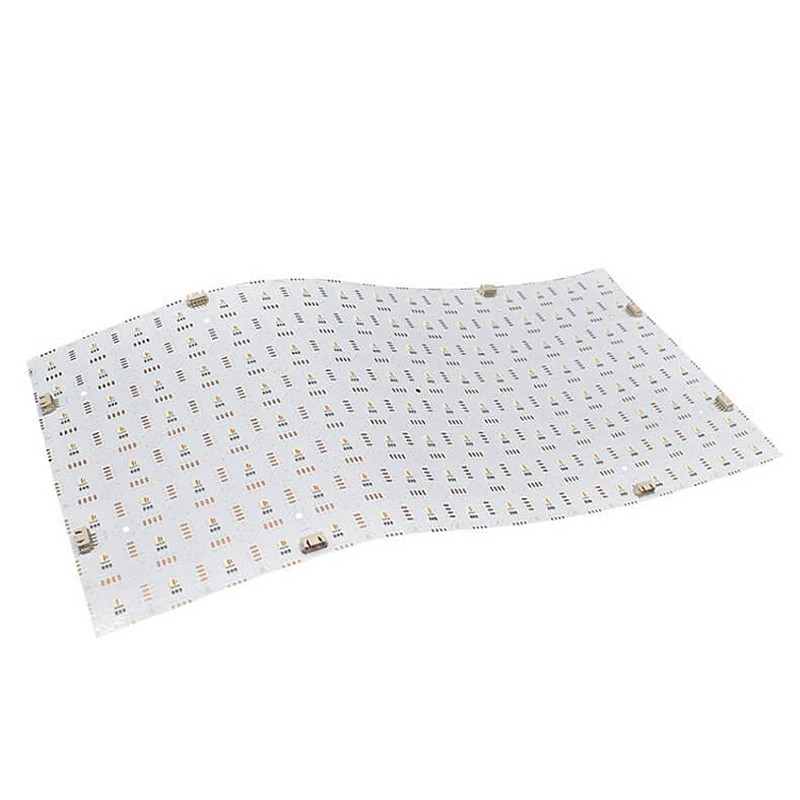
Hoja LED RGB (5050 SMD, 24 V)
| presupuesto | preciar |
|---|---|
| Talla | 490 × 245 mm (disponibles tamaños personalizados) |
| Tipo de LED | 5050 SMD |
| Recuento de LED | 128 por hoja |
| Tensión de funcionamiento | 24 V CC |
| Potencia | 45W |
| Unidad de corte mínimo | 39,6 mm |
| Vida útil nominal | > 35.000 horas |
Hoja LED RGBW (5050 RGBW 4 en 1, 24V) — Recomendado para la mayoría de los proyectos
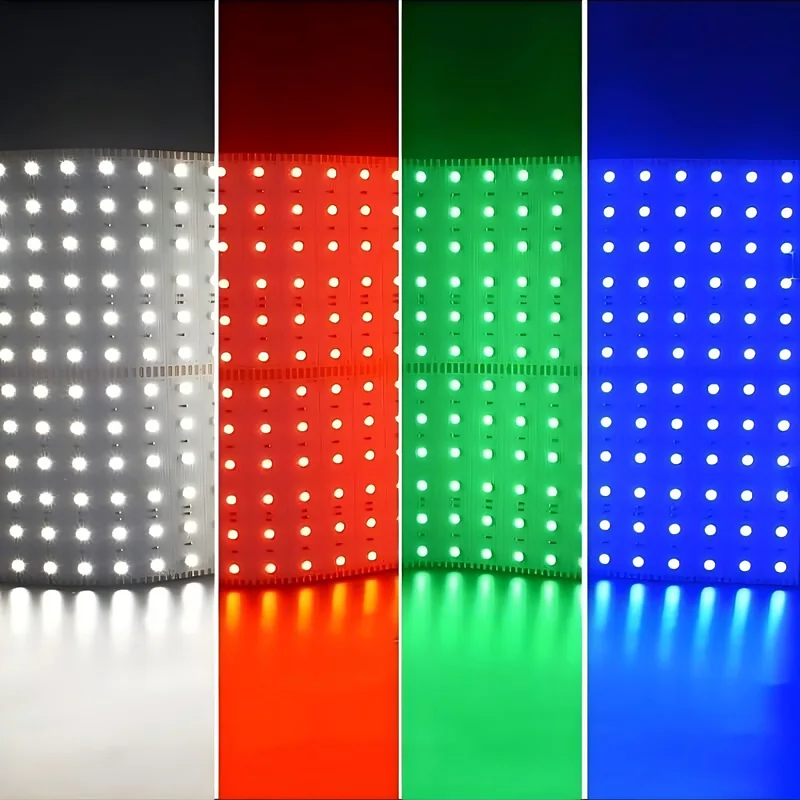
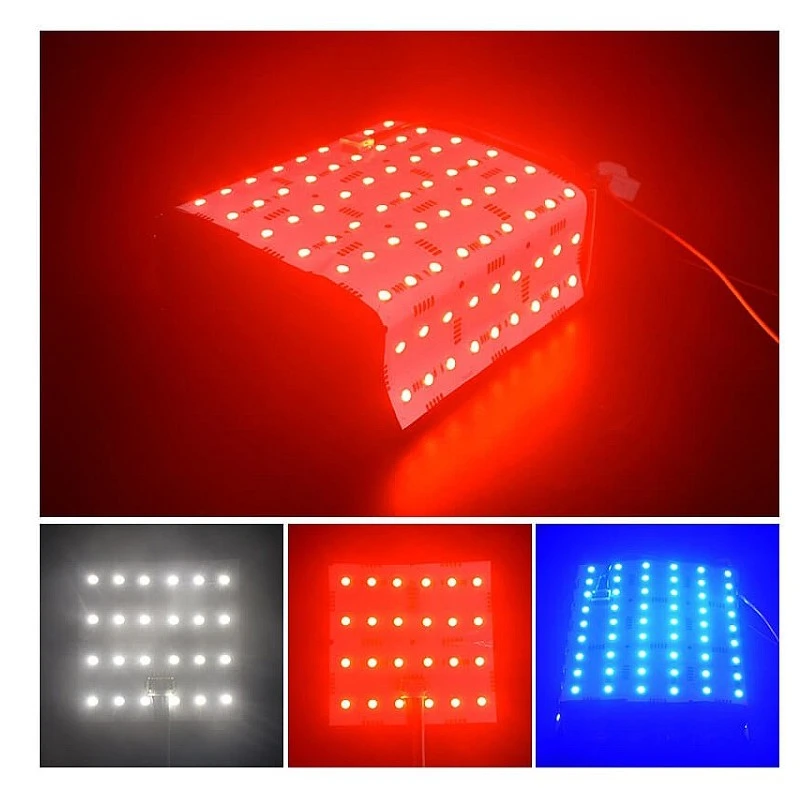
| presupuesto | preciar |
|---|---|
| Talla | 250 × 250 mm / 490 × 250 mm |
| Tipo de LED | 5050 RGBW 4 en 1 SMD |
| Colores | RGB + 3000K / 4000K / 6500K Blanco |
| Potencia | 24W / 48W |
| Eficacia luminosa | 90 lm/a |
| Unidad de corte mínimo | 50 × 50 mm / 20,4 × 122,5 mm |
Ejemplo de cálculo de potencia
Para una pared de 2,4 m × 1,5 m (3,6 m²) de 490 hojas RGBW de 490 × 245 mm cada una: aproximadamente 6 a 7 hojas; sorteo total 7 × 48W = 336W; agregue 20% Headroom → 400–450W 24V DC Driver. Los gráficos de tamaño del controlador vienen con cada pedido, y los diagramas de cableado son gratuitos para diseños complejos.
Cómo instalar hojas de LED detrás de piedra: 6 pasos
La piedra es costosa y difícil de eliminar una vez instalada, por lo que el orden importa; saltarse la prueba previa es la causa más común de falla.
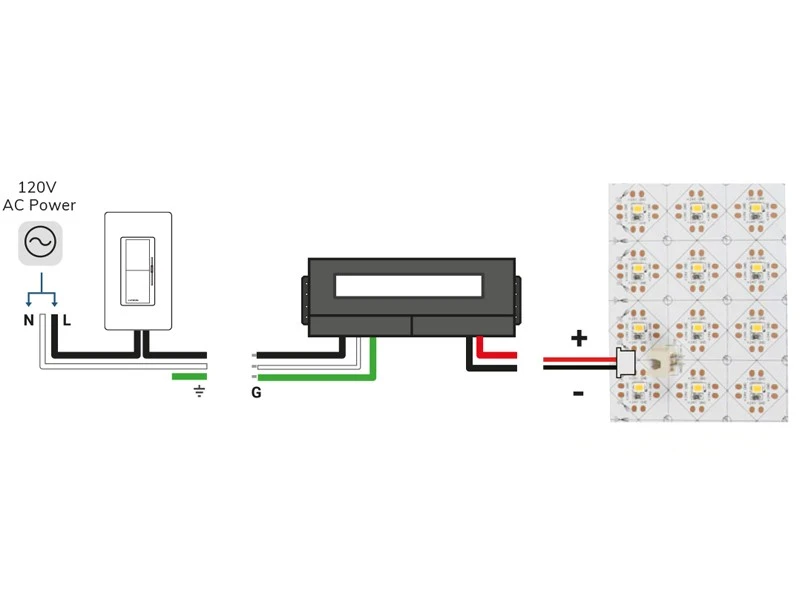
Paso 1: Prueba todo primero
Conecte la energía y el controlador en un banco de trabajo; apague todos los colores y niveles de brillo y confirme que cada segmento responde antes de que Montaje. Aquí se encuentra un segmento muerto, generalmente un rastro interrumpido, no después de que la piedra esté en su lugar.
Paso 2: Prepara la superficie
Eliminar el polvo, el aceite y la humedad; limpiar las superficies con alcohol isopropílico. En concreto desigual, agregue cinta de aluminio o una placa de respaldo plana para que el adhesivo 3M tenga pleno contacto: los espacios debilitan la adhesión y crean bolsas de aire de fundición de sombras.
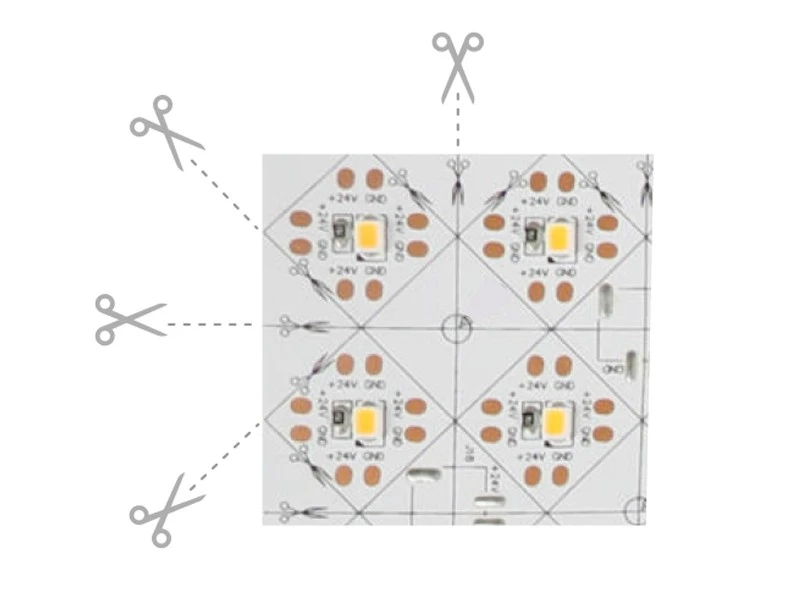
Paso 3: cortar a medida
Corta con tijeras afiladas a lo largo de las líneas marcadas. Cortando contra ellos corta las huellas de cobre y crea zonas muertas. Para paredes grandes, las láminas de tope de borde a borde con un espacio de 2 a 3 mm; la propia difusión de la piedra esconde pequeños espacios.
Paso 4: Montar las hojas
Pele el respaldo de 3 m y presione la hoja 20–50 mm detrás de la piedra, trabajando desde una esquina hacia afuera para eliminar las burbujas de aire. Para las construcciones permanentes, agregue tornillos a través de los orificios pretaladrados: las cabezas se sientan al ras y no proyectan sombras.
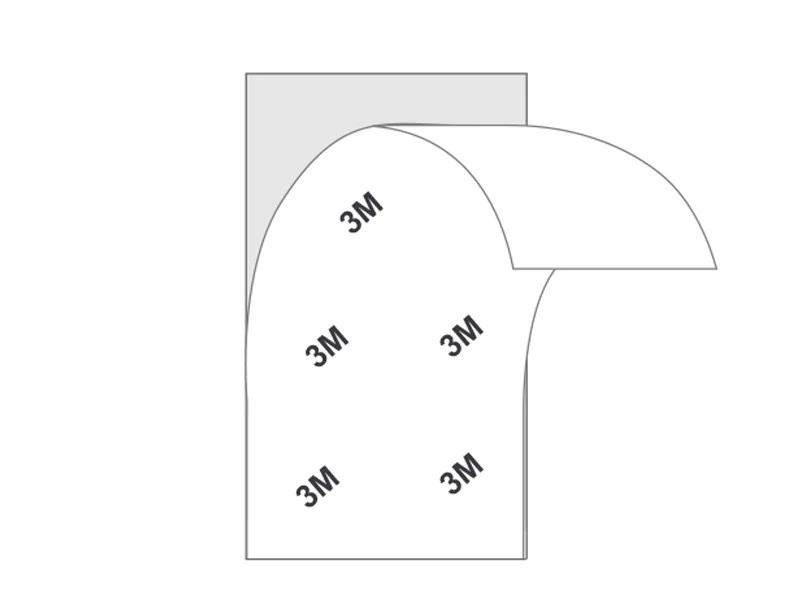
Paso 5: Conecte la energía y el control
Use cable de 20 AWG para una sola hoja, 18 AWG para múltiples. La mayoría de los controladores de RF manejan hasta 10 A; más allá de eso, agregue un amplificador de señal cada 5 a 10 hojas. Conectores de coincidencia: RGB de 4 pines, RGBW de 5 pines, XLR/DMX para DMX512. Etiqueta cada cable.
Paso 6: Encender y afinar
Restaura la potencia, los colores del ciclo y el bloqueo en escenas preestablecidas. Camina por la pared Buscando puntos desiguales: los puntos calientes significan aumentar el espacio o agregar una película difusora; los colores descoloridos generalmente significan que el perfil del controlador es incorrecto.
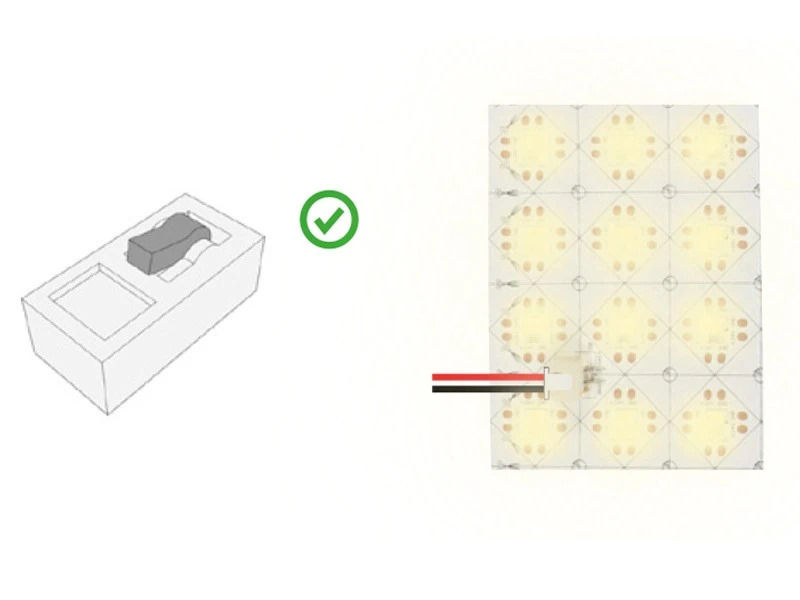
Lista de verificación de herramientas
- tijeras afiladas
- Cable de 18 a 20 AWG + pelacables
- Fuente de alimentación: CC 12 V/24 V, tamaño a potencia + 20% Headroom
- Controlador/Remoto (RF 2.4G, Panel de Pared, DMX512 o DALI)
- Toallitas de alcohol isopropílico
- Multímetro para verificación de voltaje antes de la puesta en marcha final
Para diagramas de cableado de varias hojas y colocación de amplificador, consulte Cómo cortar, instalar y configurar luces de hoja LED.

Vídeo: luz de hoja LED monocromática para piedra retroiluminada — Flexible y sin costuras (Signliteleteleted YouTube).
Sistemas de control comparados
El controlador correcto depende de quién opera las luces y con qué frecuencia cambian los ajustes: un control remoto de mano se adapta a una pared que se cambia unas pocas veces a la semana; DMX512 se adapta a un vestíbulo del hotel con diez escenas programadas.
| Controlador | Lo mejor para | Características clave |
|---|---|---|
| Remoto RF 2.4G | Proyectos pequeños-mediados | Rueda de color táctil, escenas preestablecidas, control de brillo/velocidad |
| Panel táctil de pared | Instalaciones permanentes | Atenuación RGBW, control de zona, estética limpia |
| DMX512 | Grandes proyectos arquitectón | Mapeo de píxeles, escenas programadas, sincronización en todo el edificio |
| dalí | Integración de edificios inteligentes | Blanco sintonizable, programación, integración de BMS |
| SPI / direccionable | Efectos dinámicos | Control de píxeles por píxeles, patrones de persecución, sincronización de video |
Remoto RF 2.4G: la verdadera elección del proyecto
No se necesita línea de visión: RF funciona a través de piedra y paneles de yeso, con una rueda de color, control deslizante de brillo y escenas preestablecidas (flash, desvanecimiento, estroboscópico, suave). El alcance es de 20 a 30 metros en interiores; un control remoto puede controlar varias zonas.
Paneles táctiles de pared: estándar de hotel y comercio
Controladores con cara de vidrio con atenuación RGBW, memoria de escena y selección de zona: hardware arquitectónico, no electrónica de consumo. Disponible en aluminio negro, blanco y cepillado.
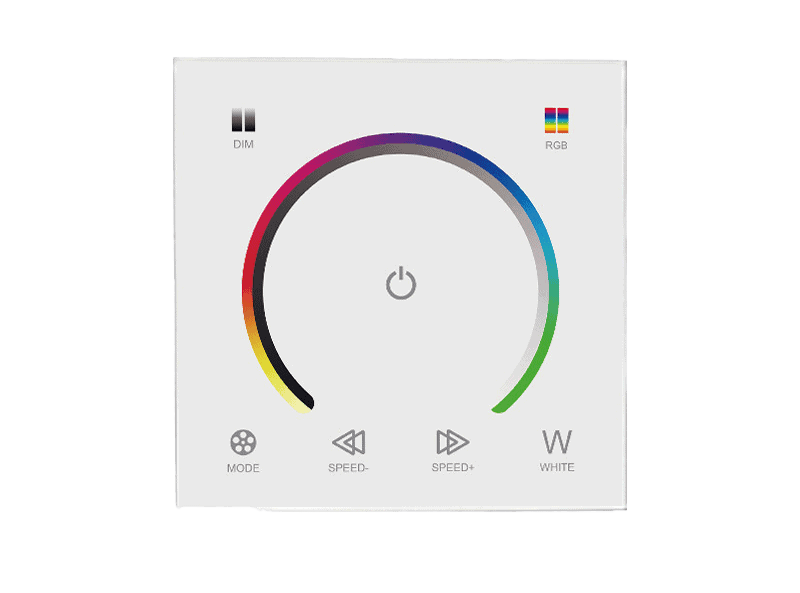
DMX512 y DALI — Control de escala de construcción
Para más de 20 hojas, o iluminación sincronizada con HVAC, persianas o AV: DMX512 ofrece 512 canales por universo con mapeo de píxeles a través de MadMapper o Resolume; DALI se integra en los sistemas de gestión de edificios para la recolección de luz diurna y la atenuación programada.
SPI direccionable: cuando cada píxel cuenta
Las hojas direccionables controlan cada LED individualmente: patrones de persecución, ondas de color, mapeo de video. La compensación es complejidad: más canales, sincronización correcta de la señal y cableado cuidadoso en largas distancias.
Nuestra vista: Para una pared de piedra con cambios de color ocasionales, es suficiente un panel de pared o control remoto de RF. Para escenas programadas, invierta en DMX512 o SPI. Vea nuestra inmersión profunda en Iluminación de píxeles direccionable con DMX512 y SPI.

Vídeo: Hoja de luz LED de dos colores: el efecto de cambio de color exacto utilizado en nuestro proyecto de piedra real.
Elegir la piedra translúcida correcta
No toda la piedra transmite la luz por igual: un panel de resina de 2 mm pasa casi toda la luz; una losa de granito de 20 mm bloquea casi todo. Las variables clave son el grosor, la densidad mineral y el acabado superficial: las caras pulidas reflejan la luz antes de entrar en la piedra, mientras que los acabados pulido dan un brillo más cálido y difuso.
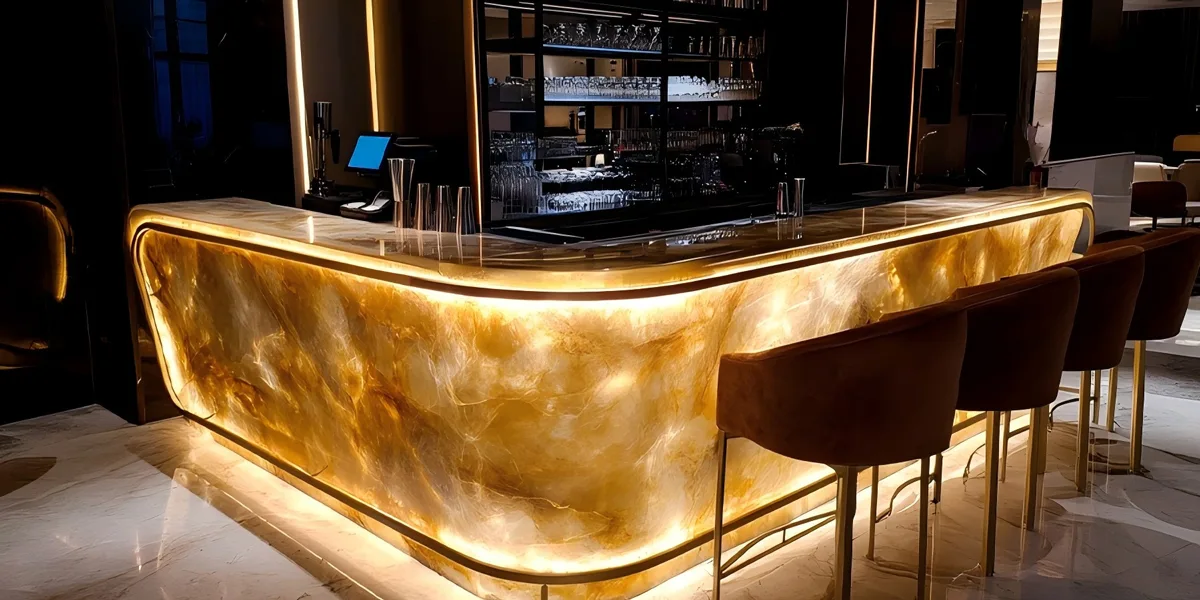
Basado en los resultados de campo, incluidos los proyectos en nuestro Guía de diseño de mármol retroiluminado — Los materiales se clasifican como este:
| Material | translucidez | Espesor típico | Lo mejor para |
|---|---|---|---|
| ónix | Excelente | 6-12mm | Paredes de lujo, bares, mostradores de recepción |
| alabastro | Excelente | 8-15mm | Resplandor cálido y difuso en spas y centros de bienestar |
| mármol delgado | Bien | 5-10mm | Retroiluminación elegante y sutil en hoteles y oficinas |
| Paneles de resina | Excelente | 3-8mm | Color consistente, aspecto moderno, económico |
| acrílico | muy alto | 3-10mm | Económico, incluso difusión, fácil de fabricar |
Onyx — el estándar de oro
ónix Es una piedra natural con veteado dramático y alta translucidez. Una losa de 6 a 8 mm con una hoja de 30 mm detrás revela cada vena: use un espacio de 35 a 40 mm para evitar puntos calientes en áreas delgadas. Costoso y frágil, pero inigualable.
Alabastro - cálido y perdonador
Translucidez más suave y lechosa que difunde la luz de manera uniforme, perdonando las distancias de brecha y fácil de cortar en el campo. Combina bien con sábanas blancas de 3000K.
Mármol delgado — Elegancia sutil
Menos translúcido, por lo que necesita una hoja más brillante o un espacio más pequeño. Una losa de 5 mm con una hoja RGBW de alta densidad de 20 mm ofrece una luminancia suave adecuada para vestíbulos y residencias corporativos.
Referencia de brillo: para la mayoría de los paneles de ónix y resina, una hoja de 12 a 28 W (1200 a 2800 lm) con un espacio de 30 mm ofrece un brillo equilibrado. Para alabastro delgado, baje a 20 mm con un controlador regulable; para mármol grueso, vaya de 40 a 50 mm o agregue una segunda capa.
OEM y personalización para su proyecto
Los proyectos de piedra rara vez son estándar: el vestíbulo de un hotel necesita sábanas cortadas a 487 × 243 mm, una barra húmeda necesita impermeabilización IP54, una cadena minorista necesita 5.000 hojas idénticas con arneses personalizados. Como fabricante de OEM/ODM, SignLiteled se personaliza en seis parámetros. Opciones de diseño de hoja LED personalizada:
- Tamaño y forma: rectángulos personalizados, círculos, arcos y polígonos de un dibujo CAD; diseño en 48 horas.
- Densidad LED — 128 LED estándar por panel de 490 × 245 mm; hasta 192 para mármol grueso, aproximadamente +50% de salida sin espesor adicional.
- Voltaje — Estándar de 24 V (corriente más baja, carreras más largas); 12 V para instalaciones automotrices, marinas o con batería.
- Temperatura de color: 2700K–6500K, o RGB/RGBW completo. 3000K es más popular para ambientes hoteleros cálidos.
- Impermeabilización — Revestimiento de conformación IP54/IP65 y conectores sellados para baños, spas y señalización exterior (las láminas estándar son IP20).
- Conectores: soldados para uni-offs; los arneses plug-and-play reducen el tiempo de instalación hasta en 60%.
Flujo de trabajo de personalización
Flujo típico: Requisitos (dimensiones, piedra, brillo, color, control) → Diseño de diseño con diagrama de dimensionamiento y cableado del controlador (2 a 3 días) → Muestras de prototipo para aprobación (1 a 2 semanas) → Producción con pruebas de control de calidad (2 a 4 semanas) → Soporte continuo para la instalación y garantía.
¿Listo para solicitar una cotización? Incluya seis detalles para obtener una respuesta precisa de una ronda: ① Dimensiones de montaje, ② Material y espesor de piedra, ③ Brillo requerido (lm/m²), ④ Temperatura de color o RGB/RGBW, ⑤ Método de regulación/dimming, ⑥ Cantidad objetivo. Véase también el Lista de verificación técnica de 7 puntos del comprador B2B.

Vídeo: Hojas de LED retroiluminadas de piedra de lujo en producción en la fábrica de Signliteled.
PREGUNTAS FRECUENTES
¿Qué es una hoja de luz LED?
Un panel de PCB delgado y flexible con una densa variedad de LEDs distribuidos uniformemente. A diferencia de las tiras (lineal) o de los módulos (punto), las láminas producen una iluminación de área uniforme sin puntos visibles ni puntos calientes, ideales para la retroiluminación de paneles de ónix, mármol, acrílico y resina.
¿Pueden las hojas LED las paredes de piedra de la luz de fondo?
Sí. Los márgenes de 20 a 50 mm detrás de la piedra con adhesivo o tornillos 3M; las matrices 2835/5050 densas ofrecen brillo uniforme; las versiones RGB/RGBW cambian de color a través de RF Remote, panel de pared, DMX512 o DALI.
RGB o RGBW: ¿cuál es mejor para la retroiluminación de piedra?
RGB. El chip blanco dedicado ofrece CRI > 90 y temperatura de color natural junto con los efectos de color. Use RGB solo para paredes puramente decorativas.
¿Qué tan lejos deben estar las láminas LED de la piedra?
20-50mm. Los materiales más delgados o translúcidos necesitan una brecha más grande; una salida más brillante permite una más corta. Siempre pruebe con muestras de piedra real primero.
¿Se pueden cortar las hojas LED a medida?
Sí: cortar a lo largo de las líneas marcadas con unas tijeras afiladas en cualquier forma. Las unidades de corte mínimo varían de un LED a 50 × 50 mm. con respecto a -Prueba cada segmento después del corte.
¿Cuánto tiempo duran las luces de sábanas LED?
35.000 a 50.000 horas, dependiendo del modelo y las condiciones. Montar sobre superficies metálicas para una mejor disipación del calor. SignLiteled cubre las hojas estándar con una garantía de 3 años.
Conclusión
Retroiluminación de piedra translúcida no se trata de agregar luz a una pared, se trata de convertir la pared en una superficie viva. Como muestra el proyecto real anterior, la tecnología es asequible y fácil de instalar: las hojas LED ofrecen el uniforme, sin puntos, Glow Stone merece; los controladores RGB/RGBW ofrecen las demandas de arquitectura moderna de control de color; y el espacio de 20 a 50 mm se adapta a casi cualquier cavidad, incluidas las remodelaciones donde la piedra ya está en su lugar.
Las instalaciones exitosas se reducen a tres cosas: probar antes del montaje, hacer coincidir la densidad del LED con el grosor de la piedra y dimensionar correctamente la fuente de alimentación. Haz las cosas bien, y la pared cambia de rojo cálido a verde frío con solo pulsar un botón: no hay hardware visible, sin dolores de cabeza de mantenimiento durante años.
¿Planeando un proyecto de retroiluminación de piedra? SignLiteled puede ayudar con el diseño de diseño, la selección de productos, el dimensionamiento del controlador y la fabricación personalizada. Póngase en contacto con sus dimensiones, tipo de piedra y requisitos de color para una propuesta completa con diagramas de cableado y lista de materiales.
¿Listo para retroiluminar tu próximo proyecto de piedra?
Navega por el Colección de luces de hoja LEDo Contacto Para dimensionamiento personalizado, diseño de diseño y fabricación OEM.
Publicaciones relacionadas