English
  简体中文
简体中文  Deutsch
  Español
  Français
  Italiano
  日本語
日本語  한국어
한국어  Polski
  Português
  Русский
  Türkçe
  Nederlands
  Tiếng Việt
  ไทย
ไทย 
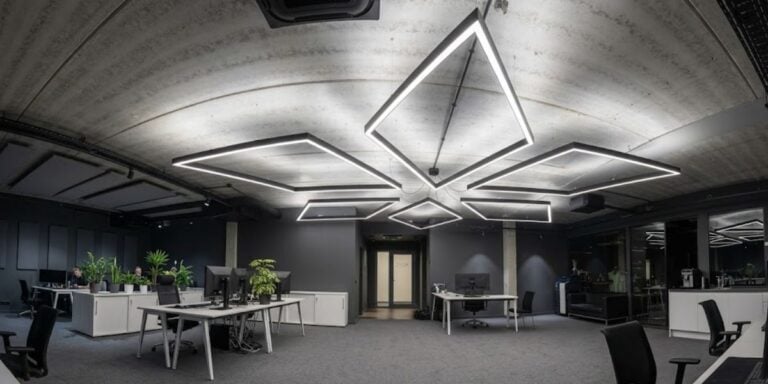
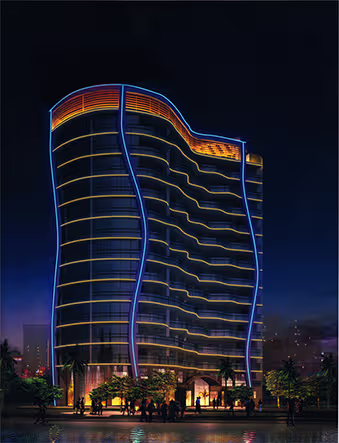
Picture walking past a sleek office lobby, a lively commercial plaza, or a building façade that seems to glow from top to bottom — that’s the power of a well-designed wall wash. LED wall washer lights — from rigid and flexible strips to chain-modular and pixel-addressable systems — turn ordinary walls into dynamic canvases. Unlike conventional panels that often produce hot spots or struggle on curved surfaces, purpose-built wall washers deliver smooth, even illumination and integrate with control systems such as DMX512, SPI, and RGB drivers.
Recessed wall washers offer a clean, concealed look indoors; RGB and pixelated variants give designers full color control for immersive effects. Flexible and chain-modular solutions follow curves and corners with minimal seam visibility, eliminating dark bands on complex façades. From interior accent walls to large commercial plazas and urban landmarks, the right LED wall washer brings texture, depth, and visual identity to every surface.
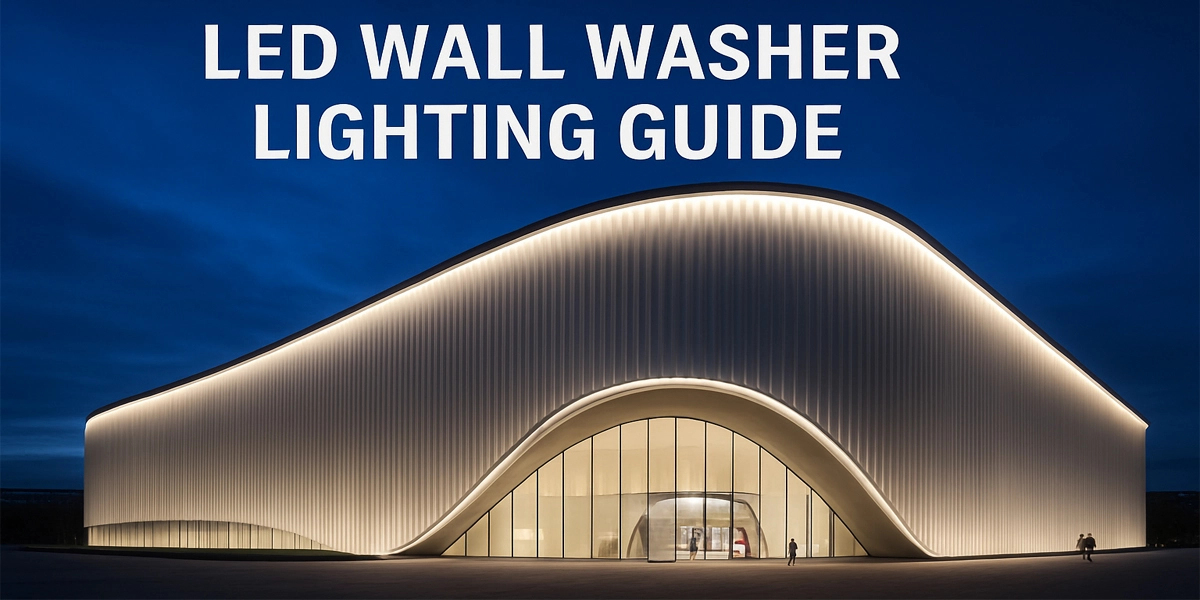
The Main Types of LED Wall washers
LED wall washers are essential tools for architects, lighting designers, and commercial space planners who aim to enhance building façades, interior accent walls, or public spaces with uniform, vibrant illumination. The main types include Rigid Wall washers, Flexible Wall washers, Chain Modular Wall washers, and Pixel/RGB Wall washers, each suited to specific architectural needs
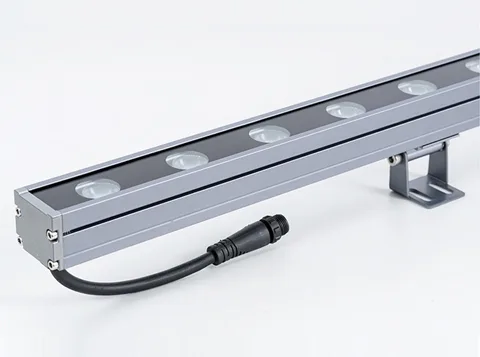
Rigid LED Wall washers
Rigid LED wall washer lights are designed for professional façade lighting that demands precision and long-range projection. These fixtures deliver high lumen output with uniform coverage, making them ideal for hotels, corporate buildings, and large-scale landmarks. Available in single color, RGB, and RGBW options, rigid wall washers easily integrate into DMX512 wall washer systems for synchronized lighting control.
Key Features
- Uniform vertical illumination
- High thermal management for continuous operation
- Compatible with DMX, SPI, and other control protocols
Flexible LED Wall Washer
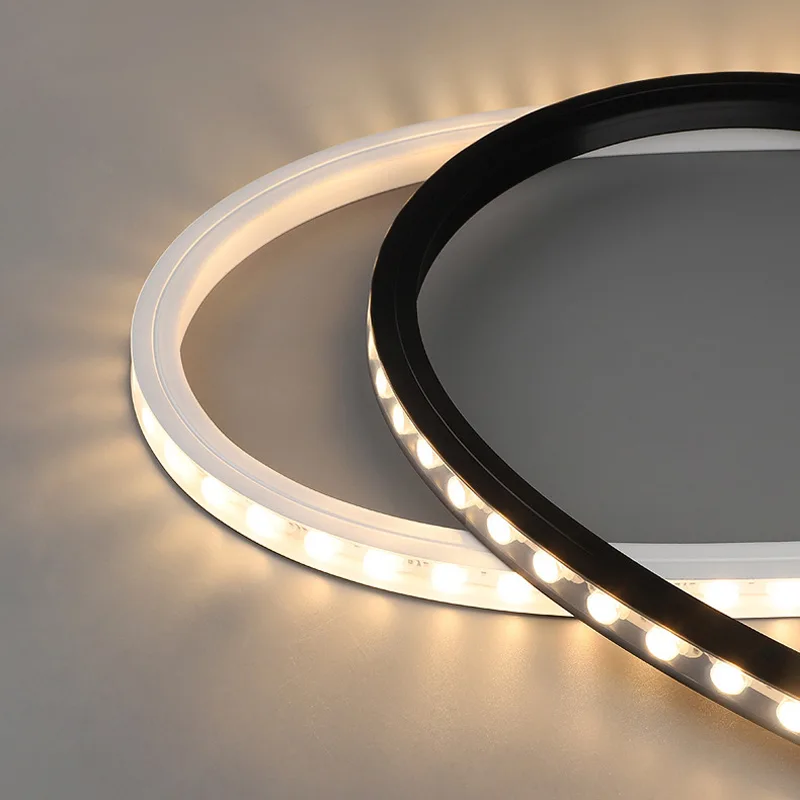
Flexible wall washer lighting is made for curved or irregular surfaces that rigid fixtures cannot fit. Featuring bendable silicone extrusion and continuous light emission, these lights ensure perfect alignment on wavy façades or interior contours. They are widely used in shopping malls, creative architecture, and commercial interiors where both flexibility and smooth lighting performance are required.
Key Features
- Horizontal flexibility for curved surfaces
- Seamless illumination with no dark spots
- Easy installation for interior and exterior projects
- Supports DMX and RGB control for color effects
Chain-Modular LED Wall Washer
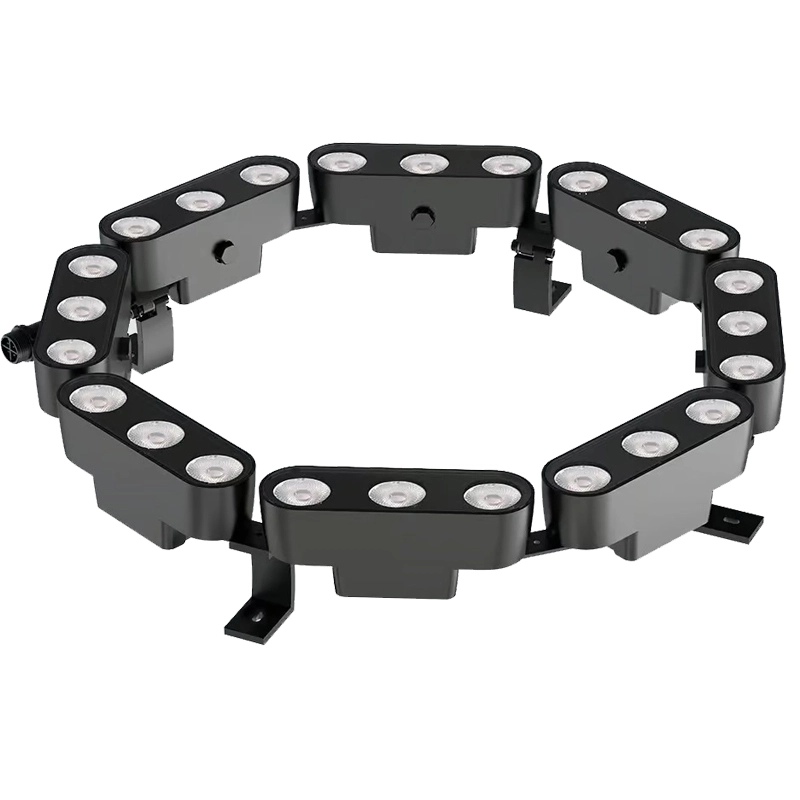
Chain-modular LED wall washer lights are built for façades with irregular geometry—folded, segmented, or curved surfaces. Each modular segment can be linked, rotated, or extended to match the structure’s contour, simplifying installation while maintaining optical consistency. With DMX512 or SPI control compatibility, these modular systems offer scalability and independent channel addressing for creative façade lighting.
Key Features
- Modular design allows adjustable length
- High uniformity and no dark spots
- Compatible with DMX, SPI, and RGB control for dynamic effects
Pixel & RGB LED Wall Washer
Pixel and RGB LED wall washers enable dynamic color transitions and programmable effects through DMX512 or SPI systems. Each pixel or segment can be individually controlled, allowing designers to create gradients, animations, or interactive visual effects. They are perfect for media façades, stadiums, theme parks, and branding projects that require high visual impact.
Key Features
- Pixel-level control for dynamic effects
- Supports RGB or RGBW color modes
- Ideal for programmable façade lighting
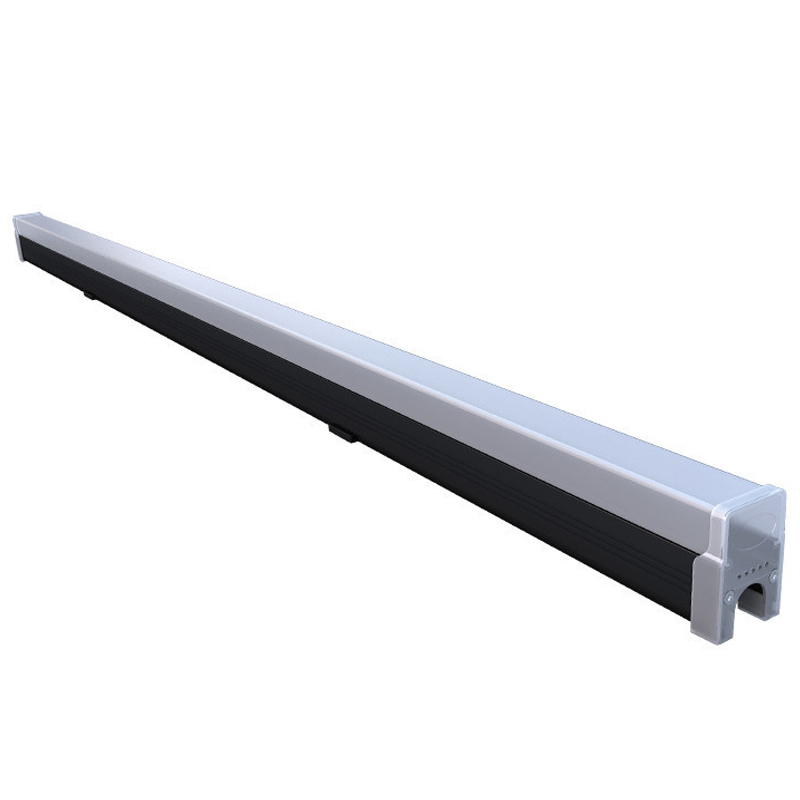
Selecting the Appropriate LED Wall washer
Choosing the right LED wall washer involves more than wattage or color temperature. It requires a balanced evaluation of architectural structure, optical design, control protocol, environmental factors, and overall project budget. Each product type carries distinct advantages and limitations that lighting designers must consider during façade lighting planning.
Architectural and Surface Considerations
Rigid Wall Washers: Rigid wall washers are designed for stable installation on flat façades and long projection distances. They offer high luminous efficacy and narrow beam precision, making them ideal for large exterior walls or high-rise buildings. With beam options from 10° to 45°, they provide uniform vertical illumination even across tall structures.
Flexible Wall Washers: Flexible wall washers solve the challenge of curved or irregular façades. Their bendable bodies conform to contours without gaps or shadows, maintaining consistent luminance along arcs and transitions. Light distribution depends on lumen density per meter and the optical film used to diffuse the beam evenly.
Chain Modular Wall Washers: Chain modular systems consist of short, connectable units that can be freely combined for complex geometries—such as curved façades, wave shapes, or segmented panels. Designers can calculate spacing, optical overlap, and module quantity to achieve uniform brightness.
Pixel / RGB Wall Washers: When visual motion and programmable color effects are required, pixel and RGB wall washers are the preferred choice. Each node can be addressed individually through DMX512 or SPI control, enabling gradients, animations, and synchronized patterns across façades.
Environmental and Installation Requirements
Protection and Durability: Outdoor wall washers must withstand rain, dust, and temperature shifts. Products rated IP65–IP67 with UV-resistant coatings and corrosion-proof housings are essential for long-term stability. For coastal or humid regions, anodized aluminum or stainless steel is recommended.
Thermal Management: Heat directly affects LED lifespan and lumen maintenance. Efficient aluminum heat sinks and ventilation designs are crucial for continuous operation. A well-engineered fixture maintains over 90% luminous flux after 10,000 hours of use.
Mounting Methods: Choose installation hardware based on wall height, curvature, and load-bearing structure. Bracket mounts suit flat walls; suspension systems are better for irregular façades. When planning maintenance, leave sufficient access for replacement and aiming adjustment.
Optical and Control Considerations
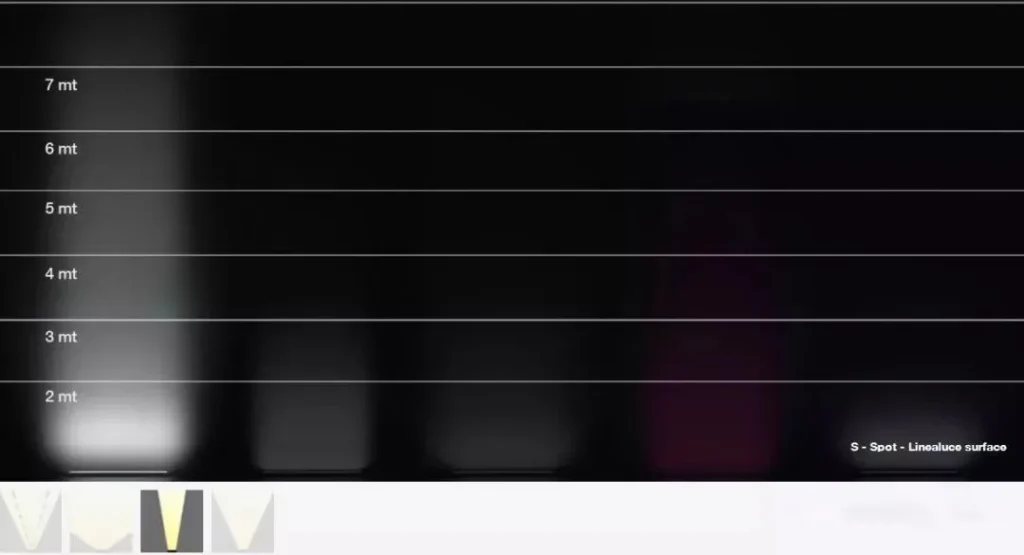
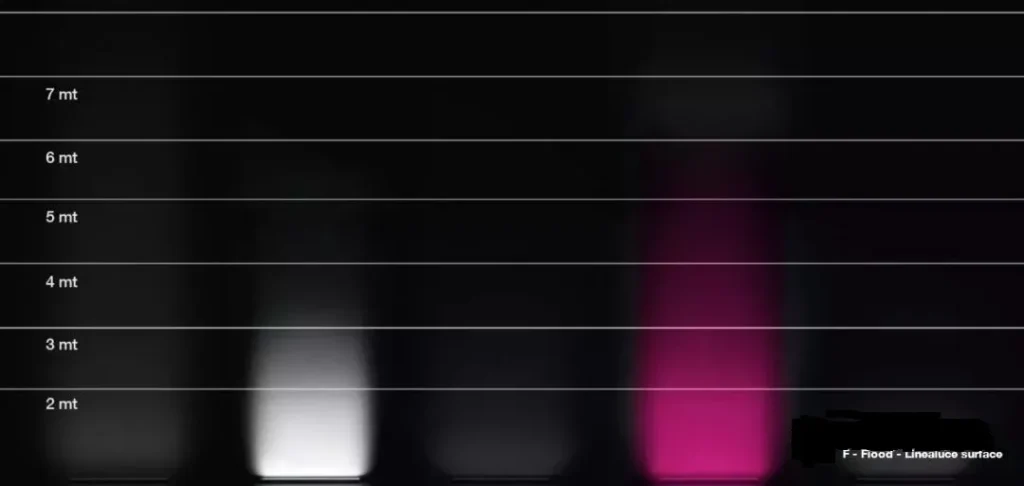
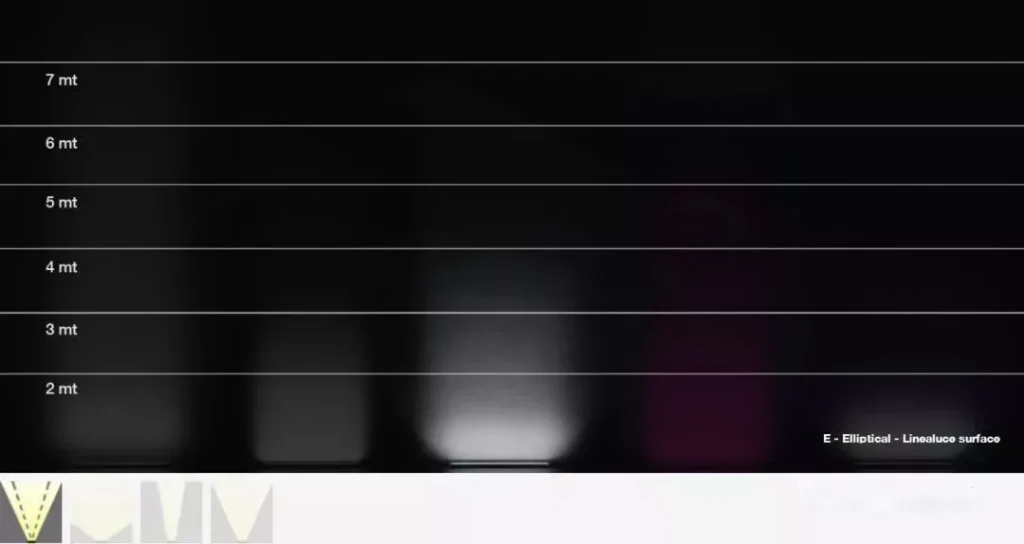
Beam Angle and Optical System
Beam angle defines the spread and uniformity of light across the surface.
Narrow beams (10°–15°) create concentrated vertical highlights, ideal for tall façades or columns.
Medium beams (24°–40°) offer balanced wall coverage, while wide or asymmetric beams (10×60°, 15×30°) form elliptical light spots suitable for decorative façades.
High-quality wall washers use custom-designed lenses instead of generic optics, achieving smoother transitions and consistent illumination.
DMX512 & SPI Control
DMX512 is the standard protocol for large-scale façade projects, allowing long-distance signal transmission and synchronized lighting control.
SPI, with faster data speed, is often used in short-distance, pixel-based systems.
In complex installations, proper addressing, isolation, and signal shielding are critical to avoid interference and ensure smooth data flow.
Color Rendering and Uniformity
For architectural lighting, color consistency is critical.
Use LEDs with CRI ≥ 80 or 90 and SDCM ≤ 3 to achieve natural material color and prevent visual patchiness.
Even light distribution and proper lumen density eliminate visible LED points, producing a smooth, continuous wash across surfaces.
Indicative Pricing (Per Fixture)
| Product Type | Typical Length per Fixture | Approx. Price per Fixture (USD) | Notes |
| Rigid Wall washer | 1 meter (3.28 ft) | $55 – $85 / piece | Price varies by wattage, beam angle, housing finish, IP rating. |
| Flexible Wall washer | 1 meter (3.28 ft) | $48 – $75 / piece | Depends on bending structure, silicone extrusion quality, RGB/DMX options. |
| Chain Modular Wall washer | 0.5 meter (1.64 ft) per module | $30 – $55 / module | Final cost depends on number of modules needed for each run. |
| Pixel / RGB Wall washer | 1 meter (3.28 ft) | $65 – $110 / piece | Depends on pixel density, DMX/SPI protocol version, RGB/RGBW options. |
For project-based pricing and detailed quotations, please contact our sales team
Wall washer Spacing & Quantity Estimation
Achieving a clean and uniform wall-wash effect depends heavily on correct fixture spacing. The required quantity of LED wall washers is influenced by wall height, optical distribution, beam angle, fixture output, and the geometry of the façade. The following guidelines offer practical reference values commonly used by lighting designers, façade engineers, and project planners during the early design stage.
Rigid Wall Washers – Spacing Rules for High-Output Linear Fixtures
Rigid wall washers provide strong lumen output and long throw distances, making them suitable for straight, flat architectural façades and mid-to-high-rise structures.
- Recommended spacing:0.8 – 1.2 m
- Vertical coverage: 6 – 12 m
- Quantity estimation:Fixtures ≈ Wall length ÷ 1.0 m spacing
- Example:40 m façade typically requires 38–40 fixtures.
Flexible Wall Washers – Spacing Guidelines for Curved & Contour Surfaces
Flexible wall washers conform to curved or irregular façades where rigid fixtures cannot maintain consistent alignment. They produce seamless illumination with no visible light gaps.
- Recommended spacing:0.5 – 1.0 m
- Coverage characteristics:Continuous installation with seamless illumination, ensuring no visible light gaps.
- Quantity estimation:Fixtures ≈ Curved façade length ÷ 1.0 m
- Example:28 m curved façade requires ≈ 28 fixtures.
Chain Modular Wall Washers – Module-Based Layout Planning
Chain modular wall washers use short segments (typically 0.5 m per module) and are ideal for façades with folds, corners, recesses, or wave-shaped geometry. Modules are installed in a continuous sequence to maintain uniform optical overlap.
- Module length: 0.5 m/ module
- Recommended layout:Install modules continuously along the façade path to maintain seamless optical overlap.
- Quantity estimation:Modules ≈ Wall path length ÷ 0.5 m
- Example:24 m irregular façade requires ≈ 48 modules.
Pixel & RGB Wall Washers – Spacing for DMX/SPI Dynamic Effects
Pixel-addressable wall washers (DMX512 / SPI) require spacing based on pixel pitch, intended animation detail, and data transmission constraints. Projects featuring color-changing or dynamic media-facade effects often require tighter spacing to maintain visual continuity.
- Recommended spacing:1.0 – 1.2 m
- Control considerations:Pixel pitch, controller type (DMX512 or SPI), and maximum data-transmission distance will influence fixture spacing, especially for projects requiring detailed animations.
- Quantity estimation:Fixtures ≈ Wall length ÷ 1.1 m spacing
- Example:30 m RGB façade requires ≈ 26–30 fixtures.
Summary Table
| Type | Typical Spacing | Coverage | Estimation |
| Rigid Wallwasher | 0.8–1.2 m | Long throw | Length ÷ 1 m |
| Flexible Wallwasher | 0.5–1.0 m | Continuous line | Length ÷ 1 m |
| Chain Modular Wallwasher | 0.5 m per module | Follows curves | Length ÷ 0.5 m |
| Pixel / RGB Wallwasher | 1.0–1.2 m | DMX/SPI dynamic effects | Len |
Application Scenarios
LED wall washers are widely used across architectural, commercial, and public-space lighting projects. Each type of wall washer—rigid, flexible, chain modular, and pixel-addressable—supports different façade geometries and lighting objectives, from uniform wall wash lighting to large-scale dynamic displays.
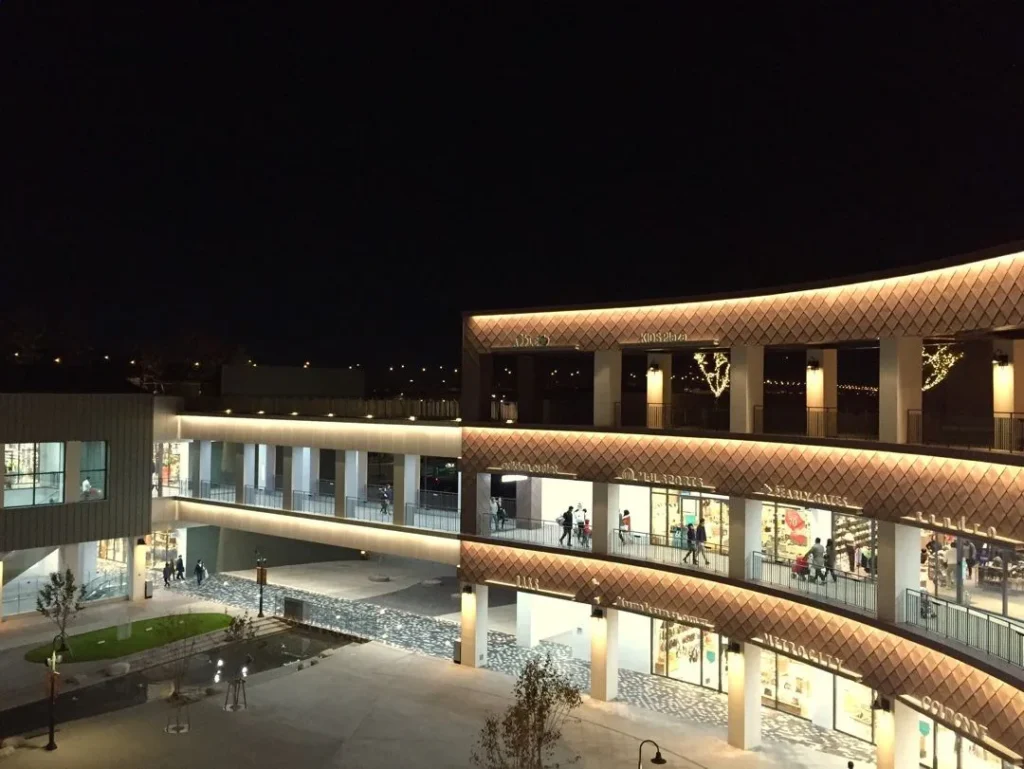
1. Architectural Facade Lighting
Rigid wall washers are commonly used for office towers, hotels, cultural buildings, and commercial plazas where vertical surfaces require uniform and long-throw illumination. The precise beam control creates clear wall wash lighting without hotspotting, making them suitable for high façades and large exterior elevations
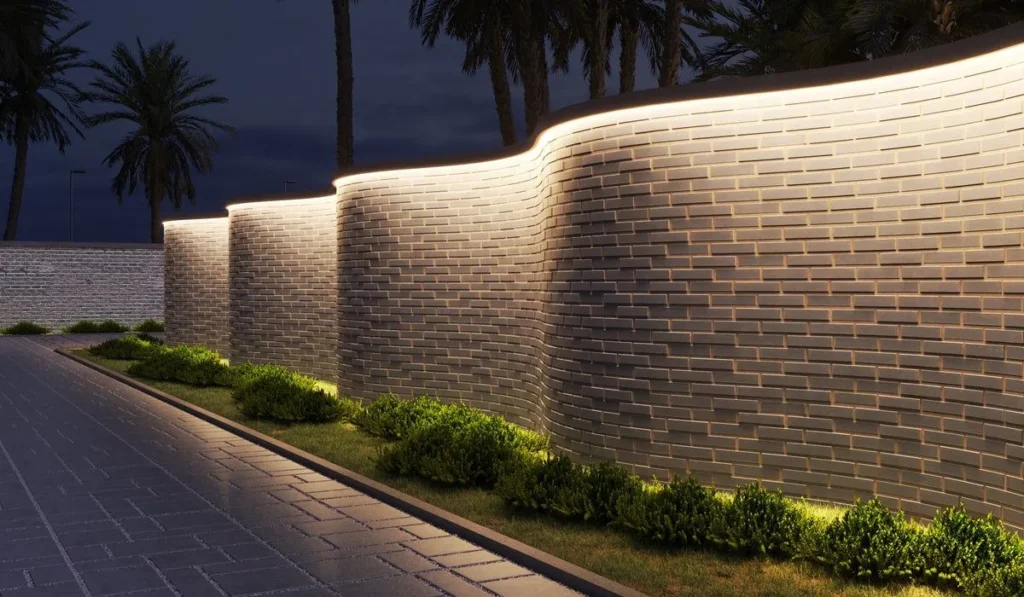
2. Curved, Folded, and Irregular Facades
Flexible wall washers and chain modular wall washers excel on curved or non-linear building surfaces. Flexible units follow continuous arcs and decorative contours, while chain modular systems offer the optical uniformity of rigid fixtures with the dimensional adaptability needed for folded surfaces, corners, wave shapes, and architectural transitions.
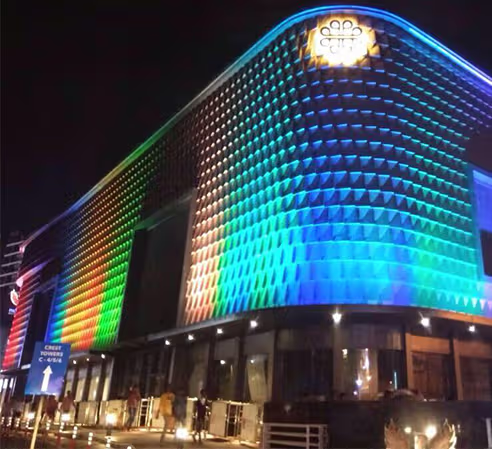
3. RGB Dynamic Facade Effects
Pixel and RGB wall washers are used in projects requiring dynamic lighting, such as shopping malls, stadiums, cultural complexes, and digital façades. With DMX512 or SPI control, each pixel or segment can be individually programmed to create color-changing effects, gradients, chases, and media-facade visual animations.
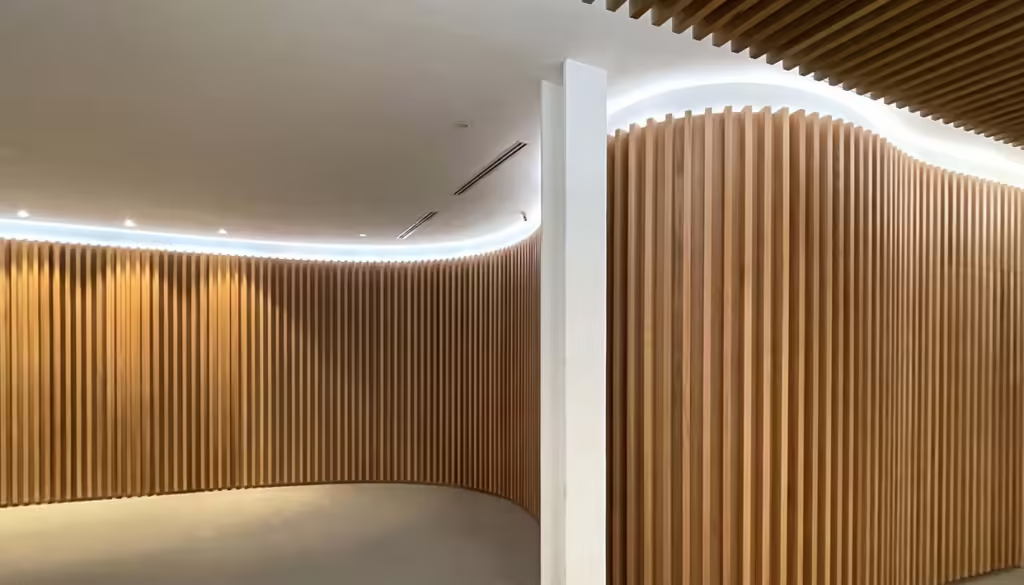
4. Interior Accent Walls and Decorative Features
In interior spaces such as hotel lobbies, galleries, retail environments, and corporate offices, wall wash lighting highlights textures, materials, and architectural details. Flexible wall washers are often used for curved interior walls, while rigid units are selected for precise grazing and controlled beam distributions.
5. Public Spaces and Infrastructure
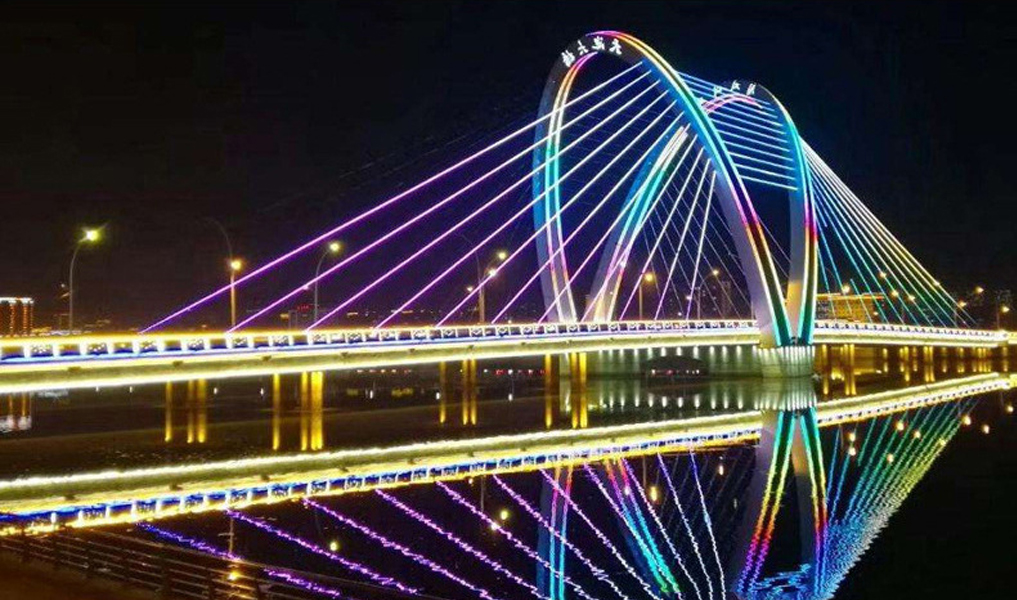
LED wall washers are widely used in bridges, tunnels, waterfront structures, transit hubs, and civic buildings. Projects requiring durability, high visibility, and large-scale façade illumination often rely on rigid or pixel-controlled systems, depending on whether the lighting is static or dynamic.

LED Wall washer Installation Guide
Proper installation of LED wall washer lights is critical for achieving even illumination and long-term reliability. The fixture surface should be flush with the mounting edge to avoid top shadows and ensure a seamless wash effect. Maintain installation tolerances within ±2 mm to guarantee smooth lighting distribution.
When connecting DMX512 or SPI wall washer systems, plan the data lines and power supplies carefully. For long runs, consider using power injection to avoid voltage drop and ensure stable signal transmission.
Light‑Emitting Surface Flush
- Position the light-emitting surface flush with the edge of the channel, ceiling recess, or bulkhead.
- Proper alignment ensures uniform light distribution, avoids top dark bands, and creates a continuous “light curtain.”
- Overly deep or shallow installation may reduce efficiency, cause shadowing, or create visible scalloping on the wall.
Tip: Use a laser level to check flush alignment before fixing the fixture.
Installation Precision & Tolerances
- Maintain construction tolerances within ±2 mm for channel width, depth, and alignment.
- Use measuring tools (laser levels, rulers) and photometric meters to verify uniform illuminance post-installation.
- Small deviations can create noticeable visual effects, particularly with long façades or pixel-addressable models.
Modular Maintenance & Upgrade Strategy
- Opt for chain-modular or replaceable-module wall washers (engine, driver, lens) for easier future maintenance and lower replacement costs.
- Schedule regular photometric checks every 12–18 months to track lumen maintenance and color stability.
- Design the installation layout with accessibility in mind, allowing for easy removal or adjustment of modules.
Installation Methods Overview
- Surface-Mounted: Simple and flexible; suitable for most commercial and indoor projects.
- Recessed: Provides clean lines; hides the fixture while maintaining uniform light output.
- Chain-Modular: Perfect for irregular façades; modules can be extended or rearranged easily.
- Adjustable Angle: Optimize beam direction to highlight architectural features.
Wiring & Control Notes
- Plan wiring carefully for DMX512 or SPI pixel-addressable wall washers.
- Group modules by power zones to prevent voltage drop and simplify troubleshooting.
- Consider future upgrades and expansions in wiring layout.
Environmental & Project Considerations
- Outdoor projects: consider rain, wind, temperature, and UV exposure.
- Spacing and density should match façade height, width, and desired light effect.
- Modular design improves long-term flexibility for future façade changes.
LED Wall washer Market Insights
LED wall washers have quietly transformed the way buildings and spaces are illuminated. From sleek office lobbies to lively retail façades, designers are looking for solutions that combine flexibility, brightness, and control. Over the past few years, the market for wall wash lighting—rigid, flexible, chain-modular, and pixel-addressable—has been steadily expanding.
Global Market Overview
The global LED wall washer light market continues to expand steadily, supported by façade renovation projects, urban beautification, and the adoption of smart DMX512 lighting systems. North America and Europe remain the largest markets, while Asia-Pacific shows the fastest growth rate driven by infrastructure development.
- Growth is consistent across commercial, hospitality, and public infrastructure projects.
- Dynamic control systems like DMX512 and SPI are increasingly integrated into new installations.
Regional Trends
North America
North America remains one of the largest markets. Designers and contractors are particularly interested in chain-modular and pixel-addressable wall washers, which allow for creative façade designs and dynamic lighting effects.
- Hotels, retail spaces, and sports venues drive much of the demand.
- Flexible solutions are increasingly used for curved façades and decorative walls.
Europe
Europe shows steady adoption of high-efficiency wall washers, encouraged by energy regulations and complex architectural designs.
- Flexible and chain-modular models are preferred for intricate façades.
- RGB and pixel-controlled lights are increasingly popular in entertainment and retail projects.
Asia-Pacific
Asia-Pacific is growing fastest, with rising infrastructure and commercial projects. Pixel-addressable wall washers are particularly favored for large-scale media façades and cultural landmarks.
- Chain-modular solutions gain traction for irregular façades.
- Dynamic RGB lighting is a key trend in high-profile developments.
Product-Level Insights
Rigid Wall washers: Stable and reliable, suitable for tall buildings and long-throw illumination.
Flexible Wall washers: Flexible strips fit curved or decorative façades, making them ideal for creative architectural applications.
Chain-Modular Wall washers: Fastest-growing segment, designed for irregular or folded façades.
- Easy to extend or reconfigure for different projects.
- Increasingly adopted by design studios in North America and Europe.
Pixel/RGB Wall washers: Perfect for media façades, retail branding, and entertainment complexes.
- DMX512 and SPI controls allow dynamic color effects and animation.
Future Outlook
Pixel-addressable lighting — demand expected to outpace average market growth.
Modular and curved solutions — chain-modular wall washers becoming standard for complex façades.
Energy-efficient products — designers and project owners increasingly prioritize high-efficiency lighting.
Smart DMX/SPI systems — networked control and intelligent programming becoming common.
Retrofit and renovation markets — older façades being upgraded with brighter, thinner, and more flexible wall washers.
Looking for a reliable OEM LED wall washer manufacturer?
SignliteLED provides a full range of architectural wall wash lights—from rigid and flexible models to chain-modular and pixel-controlled systems—tailored for your façade lighting projects. Contact us today to discuss custom DMX512 and SPI solutions for your next commercial or architectural installation.

Related Posts