English
  简体中文
简体中文  Deutsch
  Español
  Français
  Italiano
  日本語
日本語  한국어
한국어  Polski
  Português
  Русский
  Türkçe
  Nederlands
  Tiếng Việt
  ไทย
ไทย 
In modern lighting design, LED strip lights—also known as LED tape lights or LED tape strip lights—have become a go-to choice for both decorative and functional illumination. Yet, behind their clean lines and flexible form lies one key decision that often determines the success of a project: choosing between 12V and 24V LED tape lights. While both options look similar on the surface, their performance, installation requirements, and ideal applications differ significantly. Understanding these differences is essential for achieving consistent brightness, maximizing efficiency, and selecting the right solution for your project.
Performance Comparison: Brightness, Efficiency, and Voltage Drop
When comparing 12V and 24V LED tape strip lights, three performance factors matter most: brightness, efficiency, and voltage drop.
Brightness
In terms of brightness, both 12V and 24V LED tape lights can achieve the same lumen output as long as they use the same LED type and density. However, the difference lies in how consistently they maintain that brightness along the run. Because 24V delivers lower current for the same power, it places less stress on the circuit, allowing the LED tape lights to maintain more uniform illumination across longer lengths. In contrast, 12V LED tape strip lights may show slight dimming toward the end of the strip, especially in installations longer than 5 meters. Therefore, for long continuous runs where brightness uniformity is critical—such as commercial coves, linear architectural lighting, or retail display shelves—24V generally performs better.
Efficiency
Today’s LEDs commonly have a forward voltage of about 3V. This creates a structural difference inside the circuit design:
12V LED tape lights typically use 3 LEDs per series group.
24V LED tape lights can use 6 LEDs, 7 LEDs, or even 8 LEDs per series group.
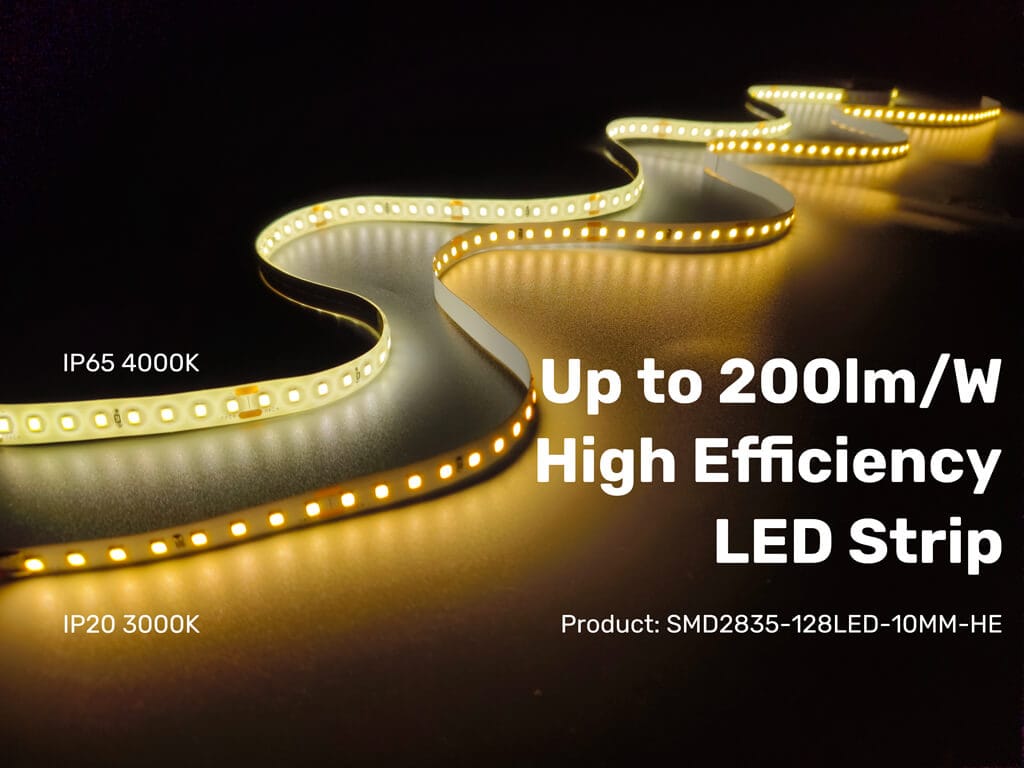
When more LEDs share the same current in a series circuit, less energy is wasted on resistors. This results in lower heat generation and higher luminous efficiency. Because 24V strips use fewer resistors relative to the number of LEDs, they naturally achieve better system efficiency. High-quality 24V LED tape lights can even reach up to 200 lm/W, making them an excellent choice for energy-sensitive projects or commercial installations with long operation hours.
Voltage Drop
Voltage drop occurs as electrical current travels through the copper traces on an LED strip—resistance causes the voltage to decrease over distance. Because 12V systems require higher current to deliver the same power, they experience greater voltage drop. This means 12V LED tape strip lights are more likely to show brightness loss at the far end of longer runs. On the other hand, 24V LED tape lights operate at lower current, significantly reducing the voltage drop and maintaining better brightness consistency.
To learn more about how voltage drop works and how to calculate it, read article “Voltage Drop on LED Strips: Causes and Solutions”.
Installation and Power Supply Considerations
Installation
When it comes to installation, the difference between 12V and 24V LED tape strip lights becomes even more obvious. Because 12V systems draw higher current, they often require thicker wires, shorter connection lengths, and more frequent power feed points to maintain stable performance. This increases wiring complexity and labor time, especially in projects that involve long continuous runs or multiple lighting zones. For small DIY projects, 12V LED tape lights are still easy enough to install, but for professional applications—such as office ceilings, hotel coves, or retail shelves—the number of extra connection points can significantly slow down installation.
In contrast, 24V LED tape lights support longer maximum run lengths, often 10 meters or more from a single power feed. The lower current reduces heat buildup and voltage drop, allowing installers to complete large linear lighting runs with fewer breaks, fewer parallel connections, and cleaner wiring layouts. This not only improves reliability but also makes long-distance installations noticeably easier and more efficient. For contractors, fewer connection points mean fewer potential failure points and lower maintenance needs in the long run.
Moreover, 12V LED tape lights offer shorter cutting intervals, which makes them more suitable for small or highly customized projects. The ability to cut the strip more precisely allows installers or DIY users to achieve exact lengths without leaving dark gaps or excess unused strip. This is especially valuable in applications like display cases, model lighting, furniture accents, or compact under-cabinet spaces where every centimeter matters. For hobbyists and DIY users, the finer cut points of 12V strips provide greater flexibility and cleaner results, making them a more convenient choice for detail-oriented or small-scale installations.

Power Supply Considerations
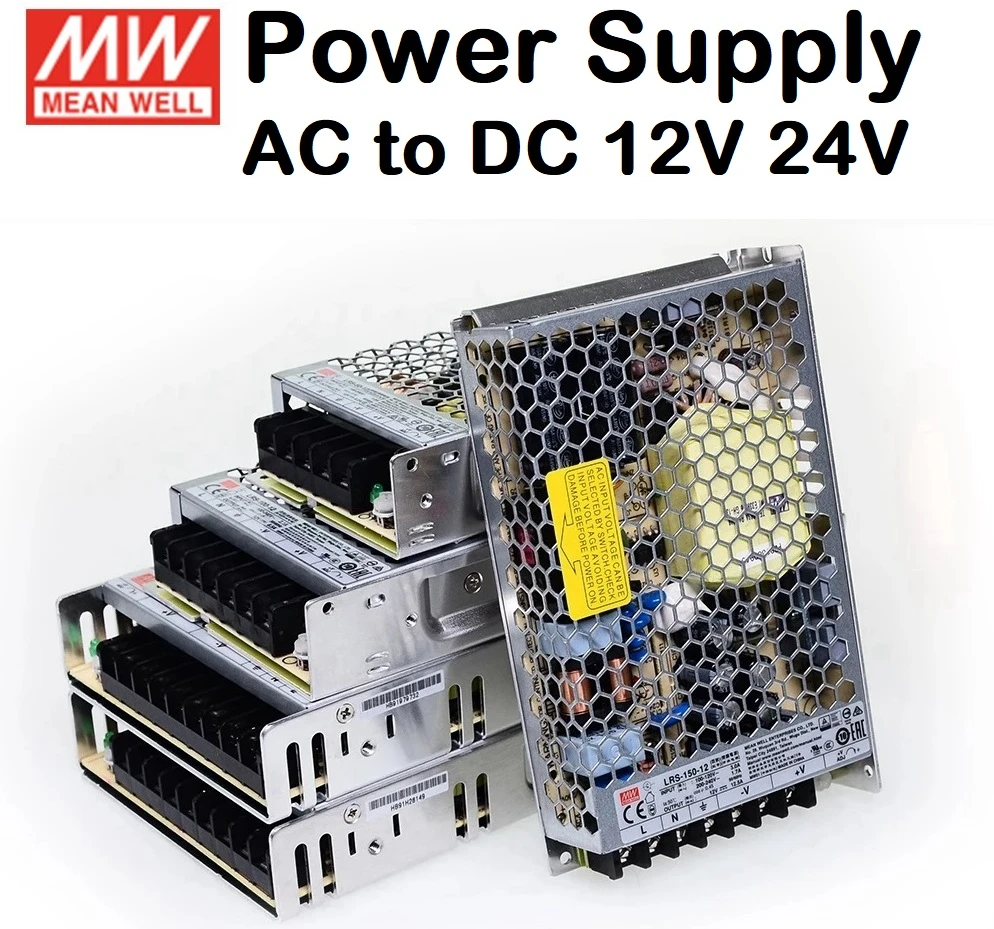
Power supply selection is another area where 12V and 24V differ substantially in both cost and practicality. A 12V LED strip system usually requires more power supplies to cover the same total length because each power supply can only handle shorter runs before voltage drop becomes unacceptable. On the other hand, usually 12V drivers is more expensive, so the total system cost is higher due to needing multiple units, higher price, additional wiring, and more installation time.
With 24V LED tape lights, the situation improves significantly. Because each run can be much longer, you typically need fewer power supplies to support the same project size. This reduces not only hardware costs but also labor expenses and installation complexity. Additionally, 24V drivers tend to operate more efficiently under load, offering better long-term stability and longer lifespan. In commercial or industrial applications where dozens or even hundreds of meters of LED strip lights are installed, the cost difference can become substantial.
Overall, 24V LED tape strip lights offer clear advantages in large-scale or professional installations, whereas 12V may still be suitable for small, localized, or vehicle-based lighting projects.
Best Applications for 12V vs 24V LED Strip Lights
12V LED Strip Lights
12V LED tape lights are best suited for short-distance, low-power applications where flexibility and easy wiring matter more than long-run performance. They work especially well in compact spaces and projects that require frequent cutting or precise lengths. Common uses include cabinet lighting, under-shelf illumination, automotive lighting, display cases, and small residential accent lighting. For example, in a kitchen under-cabinet project with runs under 2 meters, 12V strips provide excellent brightness without requiring complex wiring or large power supplies.
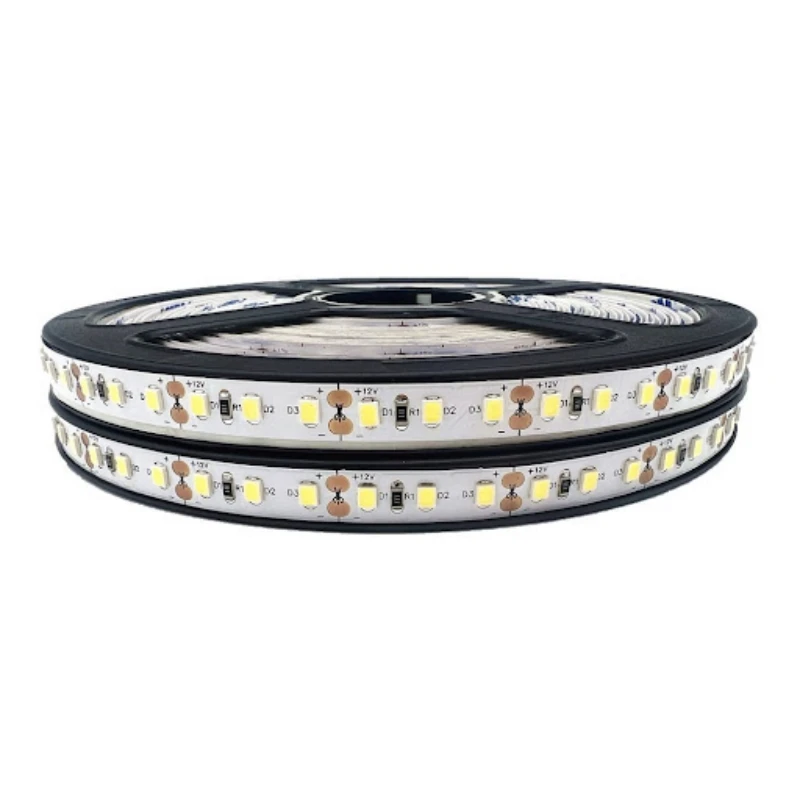
DC12V 120LEDs/m LED Strip Light
Model No.: FQX10T120A
Input Voltage: DC12V
Power: 12W/m
LED QTY: 120LEDs/m
CCT: 2700K, 3000K, 4000K, 6500K
CRI: >80
Efficiency: 110lm/W
Beam Angle: 120°
Cut Section: 25mm
IP Rating: IP20/IP65/IP67/IP68
Warranty: 3years
24V LED Strip Lights
24V LED tape strip lights excel in professional, commercial, and large-scale installations where long continuous runs and consistent brightness are critical. Their lower current and reduced voltage drop make them ideal for hotel coves, office linear lighting, retail shelving, exhibition booths, and architectural features. For instance, a 25-meter ceiling cove in a retail store can be powered efficiently with fewer feed points using 24V strips, ensuring uniform illumination throughout the entire space.
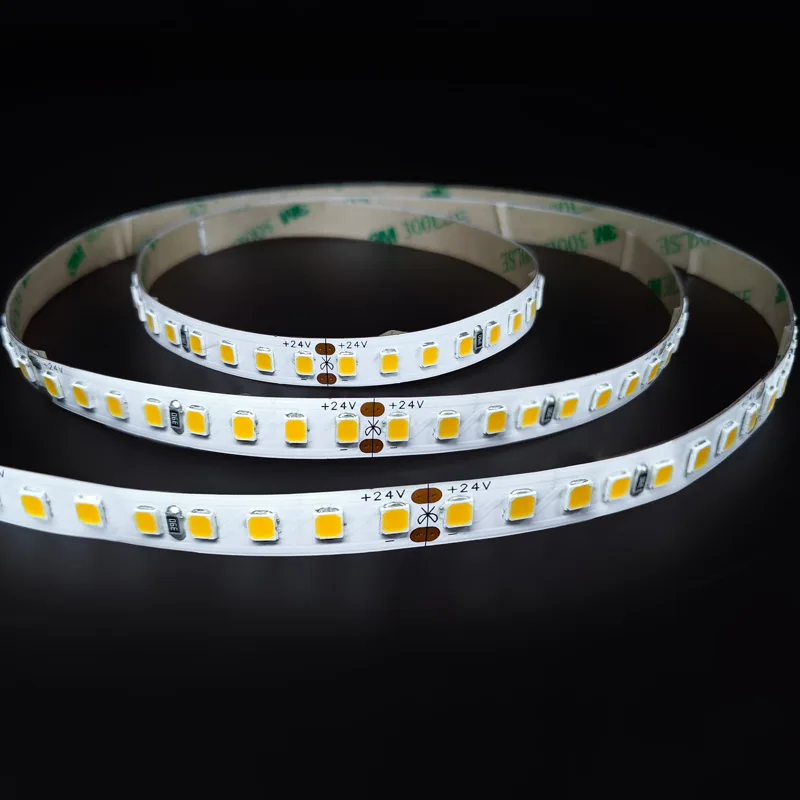
DC24V 128LEDs/m 170lm/W High Efficiency LED Strip light
Model No.: FQX10T128C
Input Voltage: DC24V
Power: 14W/m
LED QTY: 128LEDs/m
CCT: 2700K, 3000K, 4000K, 6500K
CRI: >80
Efficiency: 170lm/W
Beam Angle: 120°
Cut Section: 62.5mm
IP Rating: IP20/IP65/IP67/IP68
Warranty: 3years
Choosing between 12V and 24V LED tape strip lights ultimately depends on the scale and requirements of your project. For short runs and compact spaces, 12V strips offer flexibility and simplicity. For long-distance, commercial, or professional installations, 24V LED strip lights deliver better efficiency, fewer power supplies, and more consistent brightness. Evaluating your installation environment, run length, and performance needs will help you make the right decision.
At SignliteLED, we manufacture high-quality 12V and 24V LED strip lights designed for engineering projects, commercial lighting, and large-scale installations. We support customization, bulk orders, and fast delivery. Contact us today to get a quote or request samples!
Related Posts