English
  简体中文
简体中文  Deutsch
  Español
  Français
  Italiano
  日本語
日本語  한국어
한국어  Polski
  Português
  Русский
  Türkçe
  Nederlands
  Tiếng Việt
  ไทย
ไทย 
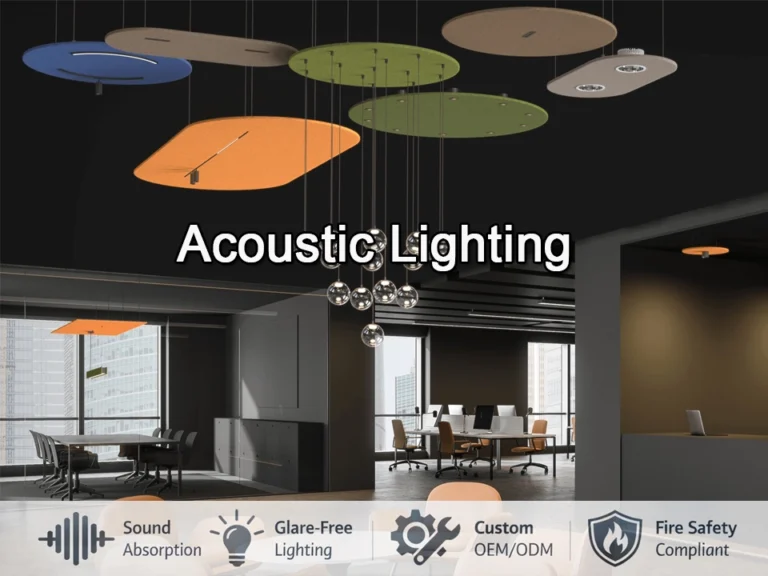
The best acoustic lighting fixtures for sound absorption are hybrid systems that seamlessly integrate high-performance, micro-perforated sound-absorbing materials (typically Class A absorption) with high-quality, low-glare LED lighting, engineered to simultaneously solve noise control and visual comfort in modern spaces.
Modern interiors look clean and impressive, but they come with a real problem. Open-plan offices, hard ceilings, glass walls, polished concrete, and minimal soft furnishings create spaces where sound reflects endlessly. The result is echo, speech overlap, and constant background noise. At the same time, poor lighting design introduces glare, harsh contrast, and eye strain. Together, these issues reduce concentration, increase fatigue, and negatively impact well-being in offices, schools, restaurants, and healthcare environments.
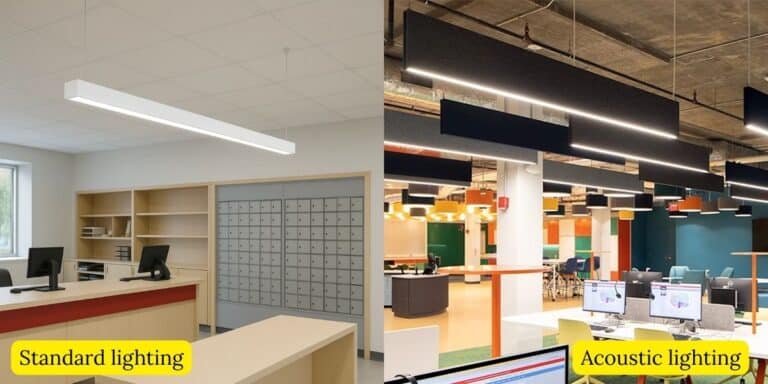
Acoustic lighting addresses both problems at once. Instead of treating sound and light as separate disciplines, it integrates them into a single engineered element. This guide defines what truly makes acoustic lighting “the best.” It explains the core performance metrics, breaks down the anatomy of a high-performance fixture, provides a clear selection framework for different spaces, and shows why engineered acoustic lighting solutions outperform improvised or decorative approaches.
The Dual Performance Metrics of Acoustic Lighting

Quality acoustic lighting is measured on two equally important axes: sound absorption and light quality. Excelling at only one is not enough. A fixture that absorbs sound but creates glare fails just as much as a visually pleasing light that does nothing for acoustics.
The Sound Metric: Understanding NRC (Noise Reduction Coefficient)
NRC, or Noise Reduction Coefficient, is the standard metric used to describe how much sound a material absorbs. It is expressed on a scale from 0.0 to 1.0.
0.0 means the material absorbs no sound and reflects it all.
1.0 means the material absorbs 100 percent of incident sound energy.
In practice, NRC is an average measured across multiple speech-relevant frequencies. It is the most widely used and trusted benchmark for acoustic ceiling lighting and other absorptive systems.
NRC Performance Guide
| NRC Rating | Absorption Performance | Typical Use Case |
| 0.0 – 0.5 | Low to Moderate | Decorative elements with minimal acoustic impact |
| 0.5 – 0.7 | Good | General offices, classrooms, cafes |
| 0.7 – 0.85+ | Very Good to Excellent | Open-plan offices, call centers, auditoriums, busy restaurants |
The best acoustic ceiling lighting fixtures consistently target an NRC of 0.70 or higher. Below this level, the acoustic effect is often noticeable only in laboratory conditions, not in real spaces.
The Light Metric: Controlling Glare with UGR (Unified Glare Rating)
UGR, or Unified Glare Rating, measures visual discomfort caused by excessive brightness contrast within the field of view. It is especially critical in workspaces where people spend long hours looking at screens.
Lower UGR means less glare and greater visual comfort.
Higher UGR means more discomfort, eye strain, and fatigue.
UGR Acceptance Guide
| UGR Rating | Glare Level | Recommended For |
| < 16 | Imperceptible | Precision tasks, long-duration computer work |
| 16 – 19 | Acceptable | General offices, libraries, schools |
| > 19 | Unacceptable | Should be avoided in work environments |
The best acoustic lighting fixtures achieve a UGR below 19, and often below 16 for demanding environments. This is typically achieved through deep light cavities, micro-louvres, indirect emission, or high-quality opal diffusers.
The Anatomy of a High-Performance Acoustic Lighting Fixture

A true acoustic lighting fixture is not a light with padding added later. It is a layered system where every component is designed to work together.
The Sound-Absorbing Core
The acoustic core is the heart of the fixture. Its material choice and construction determine real-world sound performance.
Common high-performance materials include micro-perforated wood wool panels, PET felt panels made from recycled fibers, and high-density mineral fiber used in commercial ceilings.
How it works:
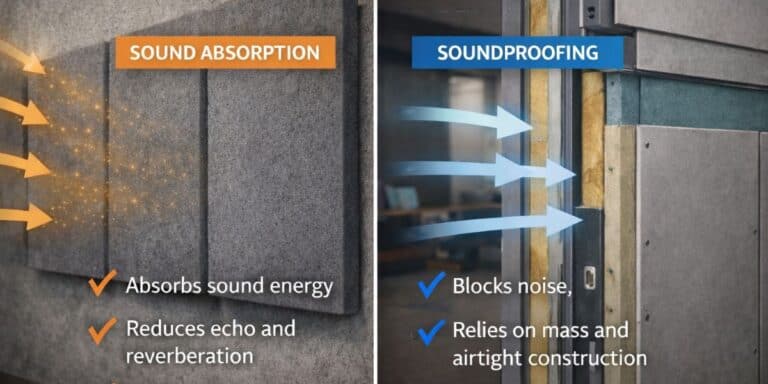
Sound waves enter the micro-perforations or fibrous structure. Inside the material, friction converts sound energy into heat. The thicker and more open the structure, the more effective it is across speech frequencies.
Material trade-offs:
Wood wool offers excellent absorption and a strong architectural presence but is heavier. PET felt is lightweight and design-flexible. Mineral fiber delivers predictable performance with a more utilitarian appearance.
The Integrated Lighting Engine
The lighting system must complement, not compromise, the acoustic material.
LED technology considerations include high-efficacy LEDs for reduced heat, stable drivers to avoid flicker, and low thermal output to protect acoustic materials over time.
Optical control strategies involve deep-recessed LED placement, edge-lit or indirect emission, and precision optics to maintain low UGR without sacrificing brightness.
Color quality matters as well. A CRI above 80 is the baseline for professional spaces, while CRI above 90 is preferred for hospitality, healthcare, and design-focused environments.
Mounting and Form Factor
How a fixture is installed has a direct impact on acoustic performance.
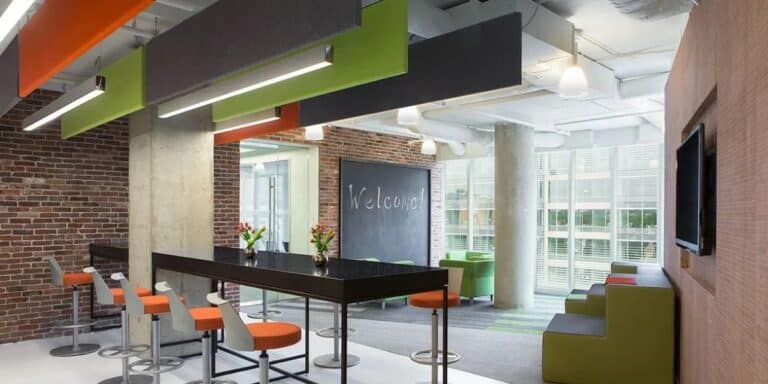
Common configurations include suspended clouds or baffles, surface-mounted canopies, and grid-integrated modules that replace standard ceiling panels.
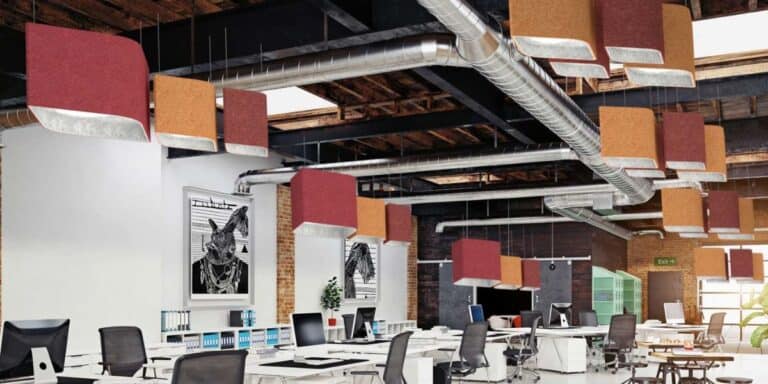
Suspended acoustic lighting is often the most effective because it allows sound absorption on the top, sides, and bottom surfaces, increasing the total active area.
Selection Guide: Matching Fixtures to Space and Noise Challenge
Different spaces have different acoustic problems. Choosing the right fixture means matching performance targets to real use conditions.
| Space Type | Primary Noise Issue | Recommended Fixture Type | Key Performance Targets | Secondary Benefit |
| Open-plan office | Speech overlap, lack of privacy | Suspended baffles or canopy clouds | NRC > 0.75, UGR < 19 | Zoning and visual structure |
| Classroom or lecture hall | Reverberation, poor speech clarity | Grid-integrated or surface-mounted panels | NRC > 0.80, UGR < 16 | Improved learning outcomes |
| Restaurant or cafe | Clatter, crowd noise | Decorative suspended linear or felt clouds | NRC > 0.65, warm CCT | Enhanced ambiance |
| Hotel lobby | Echo, acoustic harshness | Designer pendants or feature clouds | NRC > 0.60, CRI > 90 | Visual centerpiece |
| Healthcare waiting area | Stress-amplifying noise | Curved or indirect acoustic panels | NRC > 0.70, glare-free light | Calming environment |
Beyond the Fixture: Installation and Layout for Maximum Effect
Even the best acoustic lighting will underperform if installed without a system-level strategy.
The 30–50 percent coverage rule:
For noticeable acoustic improvement, 30 to 50 percent of the ceiling area often needs acoustic treatment. Lighting fixtures are frequently combined with non-illuminated acoustic panels.
Strategic placement for speech control:
Place fixtures above desk clusters and meeting tables, along circulation paths, and combine ceiling treatment with wall panels in high-noise zones.
Avoiding the acoustic short-circuit:
Mounting absorbent fixtures directly against hard ceiling slabs can reduce effectiveness. A small air gap above the fixture often improves low-frequency absorption.
The Engineered Solution: SignliteLED’s Integrated Acoustic Lighting

Where Superior Acoustics Meet Optimized Illumination
SignliteLED’s acoustic lighting solutions are fully co-engineered systems where the LED module, optical control, and acoustic core are designed together to deliver balanced, certified performance.
These systems are built to meet professional specification standards rather than marketing claims.
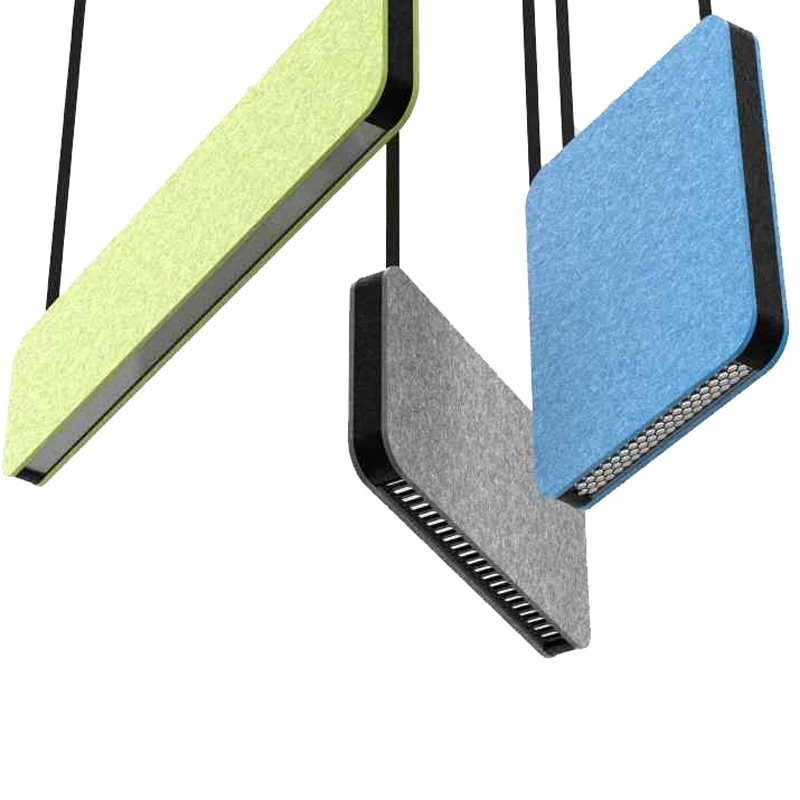
Super Slim Acoustic LED Linear Light
- Input Voltage: AC100-277V / AC220-240V,50-60HZ
- Emitting Direction: Downward
- Size: 1218*36*400mm
- CCT: 3000K / 4000K / 6000K
- Power: 30W
- Luminous Flux: 100-110Lm/W
- CRI: >80Ra
- PF: >0.90
- Fllicker Free: Yes
- Beam Angle: 120°
- IP Grade: IP20
- Warranty: 5 Years
- Felt Acoustic Board Color: Red / Green / Blue / Grey more than 48 colors option
| Engineering Feature | Direct Performance Benefit | Why It Matters |
| Class A sound-absorbing materials (NRC up to 0.9+) | Reduced reverberation time | Clearer communication |
| UGR below 19 optics | Minimal glare | Visual comfort |
| High-efficacy LED modules | Stable output | Long-term reliability |
| Modular OEM/ODM designs | Flexible integration | Architectural freedom |
For projects where acoustic performance is non-negotiable, engineered LED acoustic lighting systems provide specification-ready solutions for architects, designers, and facility managers who require verified acoustic and visual performance.
Conclusion
The best acoustic lighting fixture is not defined by appearance alone. It is defined by verified NRC and UGR ratings appropriate for the space, supported by material science and optical engineering.
In modern architecture, lighting and acoustics must work as one system. Specify with confidence and always request technical datasheets and certified test reports.
FAQs
Related Posts