Nederlands
  English
  简体中文
简体中文  Deutsch
  Español
  Français
  Italiano
  日本語
日本語  한국어
한국어  Polski
  Português
  Русский
  Türkçe
  Tiếng Việt
  ไทย
ไทย 
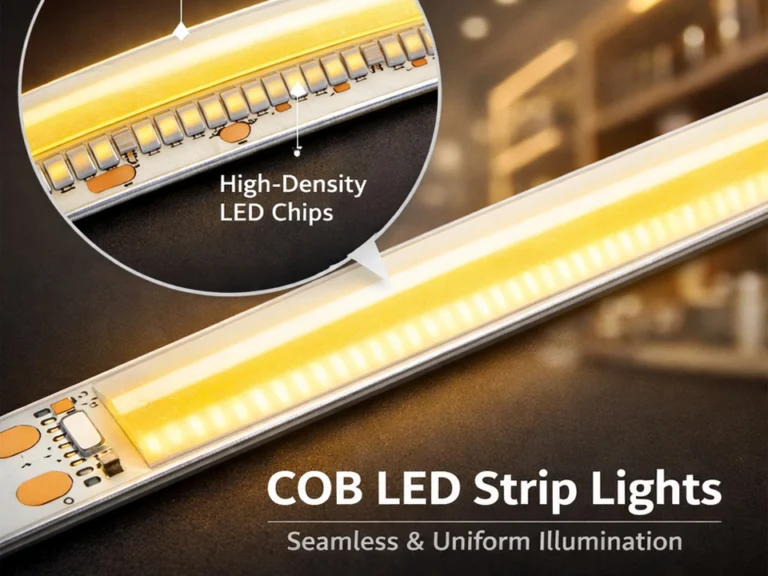
Veel installateurs gaan ervan uit dat een 24v COB LED-strip Kan zo ver lopen als nodig is vanaf een enkele stroomtoevoer. In werkelijkheid heeft elke LED-strip een maximale praktische looplengte die wordt bepaald door PCB-weerstand, koperdikte, vermogensdichtheid en fabricageontwerp.
Voor de meeste standaard 24V COB LED-strips is de aanbevolen maximale continue looplengte van een enkele stroomtoevoer ongeveer 5 meter. Buiten deze afstand kan spanningsval zichtbare helderheidsreductie, verminderde uniformiteit en kleurverschuiving aan het uiteinde van de strip veroorzaken.
Sommige geavanceerde reel-to-reel (R2R) 24V COB LED-strips zijn echter speciaal ontworpen voor langere continue runs. Dankzij het geoptimaliseerde PCB-ontwerp, verbeterde kopergeleidbaarheid en verbeterde productieprocessen, kunnen deze producten maximale continue looplengtes van 10-15 meter bereiken met behoud van een acceptabele helderheidsconsistentie.
Als gevolg hiervan wordt de maximale looplengte van een 24V COB LED-strip niet bepaald door alleen spanning. Productontwerp en productiekwaliteit spelen een even belangrijke rol bij de prestaties op lange afstand.
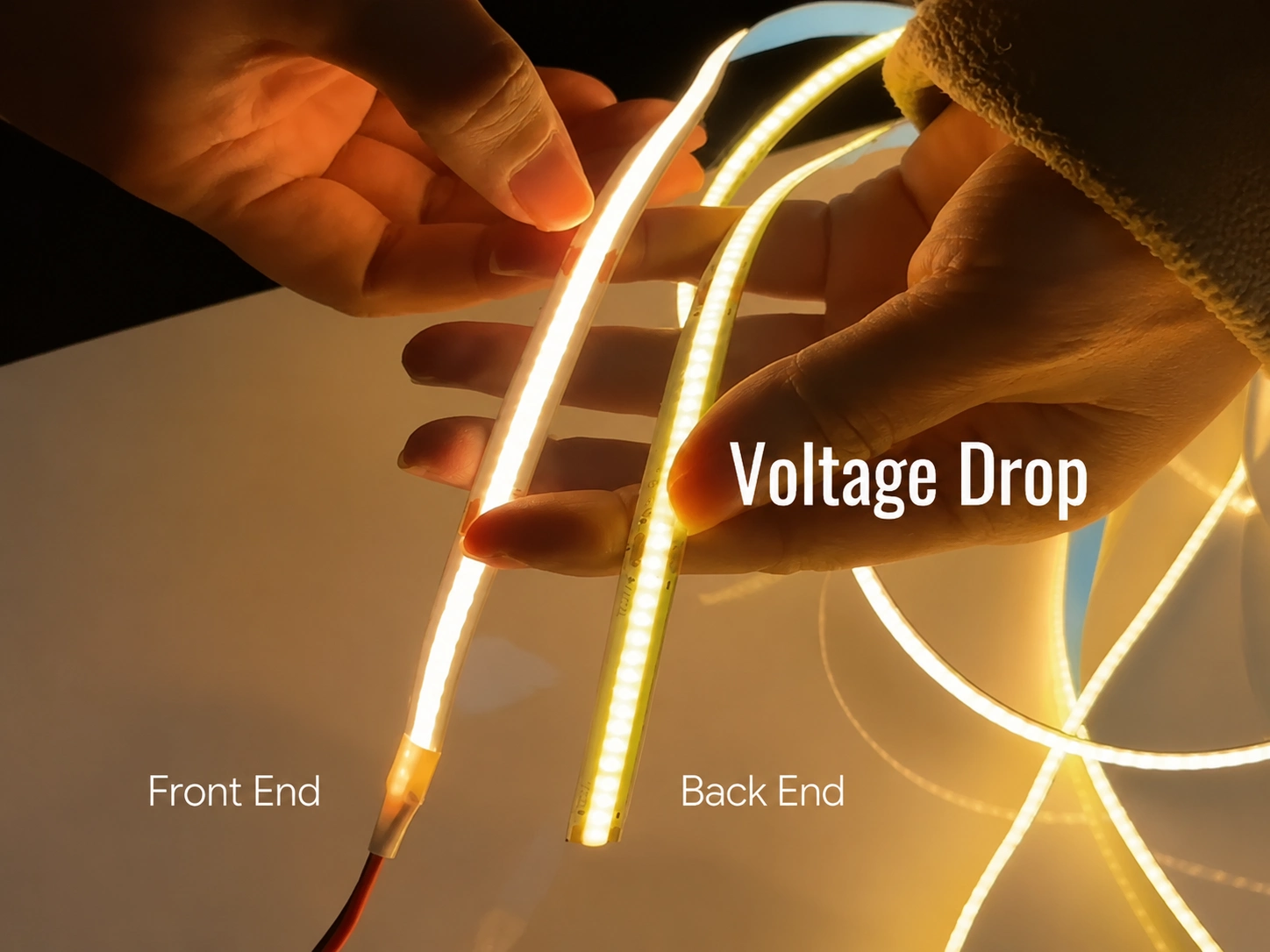
De exacte afstand is afhankelijk van vier belangrijke variabelen:
- Vermogensdichtheid (W/m)
- PCB-breedte
- dikte koper
- Aanvaardbare helderheid uniformiteit
Een 7W/m-strip met een laag vermogen kan werken tot bijna 10 meter vanaf het ene uiteinde, terwijl een 24 W/m-strip met een hoge uitgang mogelijk stroominjectie vereist voordat het 7 meter bereikt.
In commerciële projecten zoals hotelbaaien, winkeldisplays, museumverlichting en architecturale gevels is spanningsval vaak de factor die het bedradingsontwerp bepaalt, stroomvoorziening maatvoering en of extra injectiepunten nodig zijn.
Deze gids biedt praktische aanbevelingen voor runlengte, legt de technische principes achter spanningsval uit, laat zien hoe u de maximaal bruikbare lengte kunt berekenen en bevat echte projectvoorbeelden die door verlichtingsprofessionals worden gebruikt. voor begeleiding bij het selecteren 24V COB LED-strips voor binnen- en buitentoepassingen — inclusief IP-classificaties, montage-opties en milieuvereisten — Raadpleeg onze speciale Indoor vs. Outdoor COB LED Strip Guide.
Snelle ontwerpregels
Voor lezers die direct antwoord nodig hebben:
✔ Voor standaard 24V COB LED-strips, houd enkelvoudige runs binnen 5 m. Voor R2R-geoptimaliseerde COB-strips strekt de limiet zich uit tot 8 m bij 10 W/m met standaard 1oz koper.
✔ Pas een 1,25× voedingsmaatfactor toe op alle installaties.
Overweeg 2oz koperen PCB's wanneer de runlengte de ontwerplimieten benadert.
✔ Voor projecten van meer dan 15 miljoen continue runs, evalueer 48V COB LED-strips in plaats van meerdere injectiepunten toe te voegen.
Deze vier regels alleen al elimineren de meeste spanningsdruppelgerelateerde problemen die zich tegenkomen in commerciële LED-stripinstallaties.
Snel antwoord: maximale runlengte per configuratie
Voor R2R-gefabriceerde 24V COB LED-strips kan een enkele stroomtoevoer runs van 7-10 meter ondersteunen, afhankelijk van de vermogensdichtheid en PCB-specificatie. Voor standaard COB-strips ligt de praktische limiet dichter bij 5 meter. De onderstaande tabel toont technische maxima voor R2R-configuraties op basis van een drempel voor spanningsval van 1,5 V aan de klem.
De onderstaande tabel biedt praktische technische limieten op basis van een maximale klemspanningsdaling van 1,5 V (6,251 TP3T), wat algemeen wordt geaccepteerd als de drempel waar helderheidsverschillen zichtbaar beginnen te worden in architecturale en commerciële verlichtingstoepassingen.
De onderstaande waarden weerspiegelen technische maxima op basis van PCB-weerstandsberekeningen. Standaard COB-ledstrips worden doorgaans aanbevolen voor runs tot 5 m; R2R-gefabriceerde strips met geoptimaliseerd PCB-ontwerp kunnen de langere getoonde afstanden bereiken.
| Vermogensdichtheid | PCB Breedte | dikte koper | Maximale single-end run | Aanbevolen ontwerprun | met centerinjectie | Typische toepassing |
| 7W/m | 8mm | 1oz | 10m | 9m | ~20m | Cove verlichting, vitrines |
| 8W/m | 8mm | 1oz | 10m | 8,5 m | ~20m | Retail schappen, verlichting onder de kast |
| 10W/m | 8mm | 1oz | 9m | 7,5 m | ~18m | Hotel, kantoor, architecturale verlichting |
| 10W/m | 5mm | 1oz | 7m | 6M | ~14m | Smalle profielen bewegwijzering |
| 11W/m | 8mm | 1oz | 8,5 m | 7m | ~17m | Gastvrijheidscorridors |
| 12W/m | 8mm | 1oz | 8M | 7m | ~ 16m | Commerciële verlichting met hoge output |
| 14W/m | 10 mm | 1oz | 8,5 m | 7m | ~17m | Gevelverlichting |
| 24W/m | 12 mm | 1oz | 7m | 6M | ~14m | Ultra-hoge output installaties |
De afstanden die in deze gids worden getoond, zijn gebaseerd op:
- Standaard 24V constante spanningssystemen
- 20°C omgevingstemperatuur
- Industrie-standaard PCB-weerstandswaarden
- 1oz koperfolie, tenzij anders aangegeven
- Installatiepraktijken afgestemd op de principes van IPC-dirigentontwerp
De werkelijke prestaties kunnen variëren afhankelijk van:
- PCB-traceringslay-
- Kwaliteit van de connector
- Soldeer gezamenlijke weerstand
- Tolerantie voor stuurspanning
- Omgevingstemperatuur
Voor kritieke commerciële installaties moeten de berekeningen van de spanningsval altijd worden geverifieerd vóór de definitieve specificatie.
Veel LED-stripgeleiders bieden slechts een enkele afstandsfiguur, wat misleidend kan zijn.
- Maximale looplengte = de afstand waarop de klemspanning de acceptabele technische drempel bereikt.
- Aanbevolen looplengte = een conservatieve ontwerpwaarde die een veiligheidsmarge omvat voor temperatuurstijging, connectorweerstand, stroomtoevoertolerantie en installatievariabelen.
Voor professionele projecten moet de aanbevolen looplengte altijd worden gebruikt tijdens de ontwerp- en offertefasen.
Een van de meest voorkomende vragen die installateurs stellen:
"Hoe moet ik mijn LED-strip bedraden op basis van de totale looplengte?"
Een van de meest voorkomende vragen die installateurs stellen, is hoe te overboeken op basis van de totale runlengte:
- 0–5M: Single-end feed is voldoende voor de meeste standaard COB-strips
- 5–8 m: single-end feed met spanningsvalberekening aanbevolen
- 8-15M: centruminjectie
- 15-25M: meerdere injectiepunten
- 25M+: Overweeg 48V COB LED-strips
Voor standaard COB-ledstrips, behandel 5m als de ontwerplimiet voor één eind. Het bereik van 5-8 m is van toepassing op R2R-strips of configuraties met 2oz-koper.
Wat veroorzaakt spanningsdaling in lange LED-strips?
Spanningsval is de belangrijkste factor die bepaalt hoe ver een COB LED-strip vanaf een enkel voedingspunt kan worden gevoed.
Veel installateurs gaan ervan uit dat de LED's zelf de maximale looplengte bepalen. In werkelijkheid komt de beperking van de koperen geleiders in de PCB. Terwijl de stroom door de kopersporen reist, zet elektrische weerstand een deel van de energie om in warmte. Hoe langer de strip, hoe meer weerstand ophoopt en hoe lager de spanning die beschikbaar is aan het andere uiteinde.
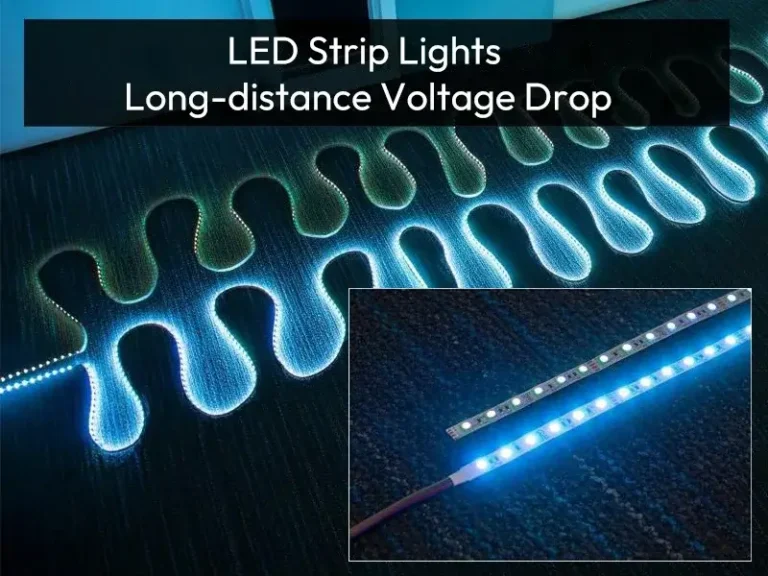
Dit is de reden waarom een strip die perfect helder lijkt op 3 meter, een merkbare vermindering van de helderheid, kleurverschuiving of flikkering kan vertonen als deze tot 10 meter of meer wordt verlengd.
De volgende vier variabelen bepalen hoe snel de spanning tijdens een run daalt:
| veranderlijke groot | Effect op spanningsval |
| Huidig (A) | Hogere stroom verhoogt de spanningsval |
| Runlengte (m) | Langere afstand verhoogt de spanningsval |
| PCB-weerstand (Ω/m) | Hogere weerstand verhoogt de spanningsval |
| dikte koper | Dikker koper vermindert spanningsval |
Omdat deze variabelen met elkaar interageren, neemt de spanningsval veel sneller toe dan de meeste installateurs verwachten.
Voor een uniform geladen COB LED-strip kan de spanningsval worden geschat met behulp van:
waar:
- ΔV = spanningsval aan het uiteinde (V)
- I/M = stroomverbruik per meter (A/M)
- R/M = PCB-lusweerstand per meter (Ω/m)
- L = striplengte (m)
De verdeling door twee verklaart het feit dat LED's continu langs de strip worden verdeeld in plaats van op een enkel punt te worden geconcentreerd.
Deze formule is veel nauwkeuriger voor het ontwerp van LED-strips dan de eenvoudige draadspanningsvergelijkingen die vaak online worden gevonden.
Hoe spanningsval op een 24v COB LED-strip te berekenen
Laten we een gemeenschappelijke commerciële specificatie gebruiken:
- Vermogensdichtheid = 10 W/m
- Spanning = 24V
- PCB-breedte = 8 mm
- Koperdikte = 1oz
Stap 1 — Bereken de stroom per meter
Werkstroom = 10W ÷ 24V = 0,417 A/m
Stap 2 — Bepaal de PCB-weerstand
PCB-lusweerstand voor 8 mm, 1oz = 0,09 Ω/m (zie referentietabel hieronder)
PCB-lusweerstandsreferentietabel
| PCB Breedte | Loopweerstand (1oz) | Loopweerstand (2oz) |
| 5mm | 0,14 / m | 0,07 / m |
| 8mm | 0,09 / m | 0,045 /m |
| 10 mm | 0,072 /m | 0,036 /m |
| 12 mm | 0,060 /m | 0,030 /m |
Stap 3 — Bereken de werkelijke spanningsval
| Lengte | spanningsval | positie |
| 5 m | 0,47v | ✓ Uitstekend |
| 8M | 1.20V | ✓ Aanvaardbaar |
| 9m | 1.52V | drempel |
| 10m | 1.88V | ✗ Zichtbare druppel waarschijnlijk |
| 12m | 2.70V | ✗ Vermogensinjectie vereist |
Dit toont aan waarom een typische COB-strip van 10 W/m zijn praktische limiet bereikt rond 8-9 meter wanneer hij vanaf een enkel uiteinde wordt gevoed.
Een van de grootste misvattingen in het ontwerp van LED-strips is dat de spanningsval lineair toeneemt.
het niet.
Omdat zowel de stroomverdeling als de geleiderweerstand erbij betrokken zijn, versnelt de spanningsval naarmate de lengte toeneemt.
Een handige manier om dit te visualiseren is met een grafiek.
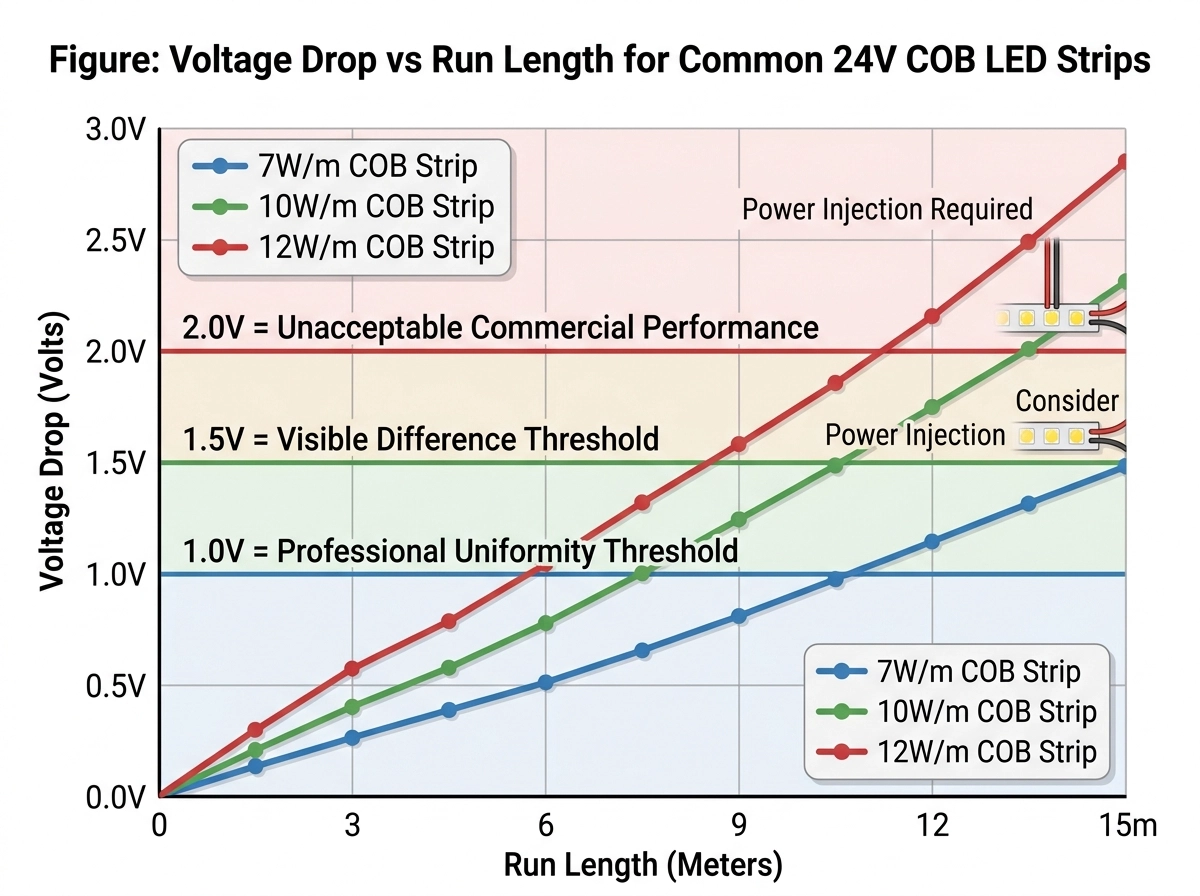
Deze grafiek is zeer effectief omdat lezers direct kunnen identificeren wanneer stroominjectie noodzakelijk wordt zonder berekeningen uit te voeren.
De formule kan ook worden herschikt om de maximaal toegestane lengte direct te berekenen:
Gebruikmakend van:
- Maximaal toegestane daling = 1,5 V
- Stroom = 0,417A/m
- Weerstand = 0,09Ω/m
Het resultaat wordt:
L (max) ≈ 8,9 m
Deze waarde sluit nauw aan bij de veldervaring van commerciële COB LED-stripinstallaties.
Waarom werkt 24V langer dan 12V?
Een van de meest voorkomende vragen die kopers stellen bij het vergelijken van LED-stripsystemen is:
Waarom kan een 24v COB LED-strip veel verder lopen dan een 12V-strip, zelfs als beide hetzelfde wattage hebben?
Het antwoord komt neer op één fundamenteel elektrisch principe:
Hogere spanning betekent lagere stroom. Lagere stroom betekent minder spanningsval.
Aangezien spanningsval de belangrijkste factor is die de lengte van de LED-strips beperkt, verbetert het verhogen van de systeemspanning direct de prestaties op lange afstand.

Voor dezelfde vermogensdichtheid:
- Een 24V COB LED-strip loopt doorgaans 1,8–2 × verder dan een vergelijkbare 12V-strip.
- Een 48v COB LED-strip loopt doorgaans 2 × verder dan een vergelijkbare 24V-strip.
- De spanningsval neemt dramatisch af naarmate de bedrijfsspanning toeneemt.
Dit is waarom:
- 12V domineert korte decoratieve installaties.
- 24V domineert commerciële en architecturale projecten.
- 48V wordt steeds vaker gebruikt voor ultralange continue verlichtingsruns.
Voor een uitgebreide vergelijking van hoe deze spanningsniveaus de looplengte, helderheid en het algehele systeemontwerp beïnvloeden, zie onze volledige gids over 12V versus 24V LED-stripsystemen.
De huidige trekking per meter wordt berekend als:
Bij dezelfde vermogensdichtheid van 10 W/m trekt een strip van 12V 0,833 A/m, een strip van 24 V trekt 0,417 A/m, en een 48V-strip trekt slechts 0,208 A/m. Elke verdubbeling van de spanning verlaagt de stroom in twee - en omdat de spanningsval met stroom door de gedistribueerde belastingsverhouding wordt verminderd, vermindert de spanningsstroom met ongeveer 751 tp3t.
Weer verdubbelen van 24v naar 48v snijdt de stroom weer doormidden.
Omdat geleiderverliezen sterk afhankelijk zijn van de stroom, heeft dit een grote impact op de bruikbare looplengte.
Vergelijking van spanningsval: 12V versus 24V versus 48V
Hetzelfde gebruiken:
- 10 W/m vermogensdichtheid
- 8mm PCB
- 1oz koper
- 8 meter hardlopen
De resultaten zijn dramatisch verschillend.
| specificatie | 12V | 24V | 48V |
| Vermogensdichtheid | 10W/m | 10W/m | 10W/m |
| stroom per meter | 0,833 A/m | 0.417 A/M | 0.208 A/M |
| Spanningsdaling @ 8m | ~4.8V | ~1.2V | ~0.3V |
| Percentage daling | 40% | 5% | <1% |
| Aanbevolen single-end run | ~4M | ~7,5m | ~15-20m |
| Typische toepassing | decoratief | handels- | Architectonisch lang |
Deze tabel illustreert waarom spanningselectie vaak belangrijker is dan de strip zelf bij het ontwerpen van langeafstandsverlichtingssystemen.
Welke COB LED-stripspanning is het beste voor lange runs?
Het antwoord is afhankelijk van de projectvereisten.
- Onder de 5m: 12V is voldoende
- 5–15m: 24V is de standaardkeuze
- 15-25m: 48V wordt praktischer
- Boven 25m: 48V met injectiestrategie
- Premium uniformiteit of grote architectonische: 24V of 48V afhankelijk van de lengte van de run
Als een project helemaal opnieuw wordt ontworpen, vermindert het vroegtijdig selecteren van de juiste spanning vaak de installatiekosten effectiever dan het later oplossen van problemen met de spanningsval.
Voor een gedetailleerde uitsplitsing van de compromissen die betrokken zijn bij Kiezen tussen 12V en 24V LED-stripsystemen, inclusief de beschikbaarheid van bestuurders, compatibiliteit met controllers en kostenoverwegingen, raadpleeg onze volledige selectiegids.
24V versus 48V: wat is beter?
Veel kopers gaan er automatisch van uit dat 48V altijd beter is.
Dat hoeft niet per se waar te zijn.
Voordelen van 24V
- Op grote schaal beschikbare stuurprogramma's
- Lagere systeemkosten
- Brede compatibiliteit van de controller
- Makkelijker inkopen
- Industrie-standaard specificatie
Voordelen van 48V
- Langere continue runs
- Minder injectiepunten
- Betere helderheid consistentie
- Lagere geleiderverliezen
- Schonere installatie-esthetiek
Voor projecten onder de 15 meter is 24V doorgaans de meest voordelige keuze.
Voor projecten boven de 15 meter wordt 48V vaak de efficiëntere engineeringoplossing.
Een eenvoudige regel die door veel lichtingenieurs wordt gebruikt, is:
| Lengte | Voorkeursstrategie |
| onder de 8m | 24V single-end feed |
| 8-15m | 24v centruminjectie |
| 15-20 m | Evalueer 48v |
| 20m+ | 48V aanbevolen |
Deze aanpak minimaliseert de complexiteit van de bedrading terwijl de helderheid van de helderheid tijdens de installatie behouden blijft.
Wat is de langste looplengte voor verschillende 24v COB LED-stripconfiguraties?
Er is geen enkele maximale looplengte die van toepassing is op elke 24V COB LED-strip.
De haalbare afstand is afhankelijk van een combinatie van:
- Vermogensdichtheid (W/m)
- PCB-breedte
- dikte koper
- Vereisten voor uniformiteit van helderheid
- omgevingstemperatuur
- bedradingsmethode
Dit is de reden waarom twee producten die beide het label "24V COB LED Strip" hebben genoemd, heel anders kunnen presteren in real-world installaties.
PCB-breedte heeft direct invloed op de looplengte door zijn impact op sporenweerstand. Ten opzichte van een 5 mm PCB-basislijn, verhoogt een 8 mm PCB de praktische looplengte met ongeveer 251 TP3T, een PCB van 10 mm bij 401 TP3T en een 12 mm PCB met 551 TP3T. Voor projecten waarbij de toegang tot de installatie beperkt is, is het specificeren van een bredere PCB in de sourcing-fase vaak kosteneffectiever dan injectiepunten later achteraf te monteren. Voor een compleet overzicht van LED Strip PCB Breedte Selectie, inclusief profielafmetingen, straalhoek en montageoverwegingen, raadpleeg onze speciale breedteselectiegids.
Voor projecten waar toegang tot installatie moeilijk is, vermindert het selecteren van een bredere PCB vaak de totale projectkosten.
Hoe koperdikte de maximale looplengte beïnvloedt
Koperdikte is een van de meest over het hoofd geziene specificaties in de LED-stripindustrie.
De meeste kopers vergelijken:
- Spanning
- Wattage
- CRI
- CCT
Zeer weinig vergelijken:
- koper gewicht
Toch bepaalt de koperdikte direct de geleiderweerstand.
| specificatie | 1oz koper | 2oz koper |
| dikte koper | 35μm | 70 μm |
| tegenweer | 100% | ~50% |
| spanningsval | 100% | ~50% |
| Maximale looplengte | 100% | ~140% |
| Extra bedrading vereist | Ja (vaak) | Minder vaak |
Deze wijziging van één specificatie elimineert vaak de noodzaak voor centerinjectie in middellange installaties.
Tekenen dat spanningsval een probleem wordt

Spanningsval zorgt er zelden voor dat een LED-strip plotseling uitvalt.
In plaats daarvan verslechtert de prestatie geleidelijk naarmate de spanning die aan het uiteinde beschikbaar is, afneemt. In veel projecten merken installateurs symptomen lang voordat ze zich realiseren dat spanningsval de hoofdoorzaak is.
Door deze waarschuwingssignalen te begrijpen, kunnen problemen worden geïdentificeerd en gecorrigeerd voordat de projectoverdracht wordt uitgevoerd, waardoor dure probleemoplossing en klachten van klanten worden voorkomen.
De volgende symptomen geven aan dat spanningsvallimieten worden benaderd:
✓ Helderheid wordt zwakker tegen het einde van de strip
✓ Kleurtemperatuurveranderingen tijdens de run
✓ Het uiteinde flikkert met tussenpozen
✓ Secties gaan onverwacht uit
✓ Gemeten spanning aan het uiteinde valt onder 22,5 V
In professionele installaties geven deze symptomen bijna altijd aan dat spanningsvallimieten worden benaderd of overschreden.
De volgende tabel verbindt veelvoorkomende veldsymptomen met hun waarschijnlijke oorzaken en aanbevolen oplossingen:
Deze tabel biedt een snelle diagnostische handleiding die door veel installateurs wordt gebruikt tijdens inbedrijfstelling en probleemoplossing.
| teken | meest waarschijnlijke oorzaak | Aanbevolen oplossing |
| Einde van strip lijkt dimmer | Spanningsval overschrijdt ontwerpdrempel | Vermogensinjectie toevoegen |
| Ongelijke helderheid tijdens het rennen | Overmatige weerstand van de geleider | Run verkorten of stroom injecteren |
| Kleur temperatuurverschuiving | Voedingsspanning variatie over strip | Verminder spanningsval |
| Verre einde flikkert | Spanning onder de bedrijfsdrempel | Injectiepunt toevoegen |
| Strip wordt met tussenpozen afgesloten | Onderspanningsbeveiliging van de bestuurder | Controleer de dimensionering van de spanning en voeding |
| Gehele installatie instabiel | Overbelaste stroomvoorziening | Verhoog de PSU-capaciteit |
| Helderheid verandert na opwarming | Temperatuur-geïnduceerde weerstand verhogen | Verbeter het bedradingontwerp |
Dit formaat is handig omdat het zichtbare veldsymptomen rechtstreeks verbindt met technische oplossingen.
Wanneer is stroominjectie nodig?
Vermogensinjectie wordt noodzakelijk wanneer de spanning die beschikbaar is aan het uiteinde van de Constante spanningsstripsystemen Valt onder het niveau dat nodig is om een consistente helderheid en stabiele werking te behouden.
Hoewel veel installateurs vaste afstandsregels gebruiken, zoals "injecteer elke 5 meter" of "injecteer elke 10 meter", zijn deze regels vaak onnauwkeurig omdat ze de werkelijke vermogensdichtheid, PCB-specificatie en uniformiteitsvereisten van de strip negeren.
De juiste technische benadering is om te bepalen of spanningsval de acceptabele drempel van het project overschrijdt.
Voor de meeste professionele 24v COB LED-stripinstallaties:
- Spanningsdaling onder 1,0 V wordt als uitstekend beschouwd.
- Spanningsval tussen 1,0 V en 1,5 V is over het algemeen acceptabel.
- Spanningsdaling boven 1,5 V vereist meestal stroominjectie.
- Spanningsval boven 2.0V vereist corrigerende maatregelen.

Beslissing matrix voor vermogens
De volgende matrix biedt een snelle technische beoordeling van wanneer injectie vereist is:
| rang | Risiconiveau | Injectie aanbeveling |
| ren 5m | Laag | NIET VEREIST |
| 5-8 m rennen | Matig | Controleer spanningsval |
| rennen > 8m | Hoog | Evalueer injectie |
| Vermogensdichtheid >10 W/m | Hoog | Injectie aanbevolen |
| Spanningsdaling >1,5V | bedillerig | Injectie vereist |
| Commerciële uniformiteitsvereiste | Hoog | Injectie aanbevolen |
| Spanningsdaling >2,0V | zeer hoog | Onmiddellijke actie vereist |
Deze matrix stelt ontwerpers in staat om snel beslissingen te nemen zonder gedetailleerde berekeningen uit te voeren tijdens de vroege planningsfase.
Voor de meeste 24V COB-LED-strips mag de injectieafstand nooit de aanbevolen lengte van de strip van de strip overschrijden.
De afstand tussen de injectiepunten mag de aanbevolen single-end run van de strip niet overschrijden: 9-10 m voor strips van 7 W/m, 7-8 m voor 10-11 W/m, 7 m voor 12 W/m en 5-6 m voor 24 W/m ultrahoge outputconfiguraties.
Deze waarden vormen een praktisch uitgangspunt voor ontwerp en offertes.
De uiteindelijke afstand moet altijd worden geverifieerd met behulp van spanningsdruppelberekeningen.
Welke power injectiemethode moet u gebruiken?
Er zijn drie primaire injectiestrategieën die worden gebruikt in professionele installaties.
Methode 1: Dual-end voeding
Aan beide uiteinden van de strip wordt stroom geleverd.
Voordelen:
- Eenvoudige implementatie
- Minimale extra bedrading
- Uitstekend geschikt voor middellange runs
Typische gebruiksgeval:
8-18 miljoen installaties.
Methode 2: Center Injectie
De stroom is in het midden aangesloten.
Voordelen:
- Evenwichtige huidige verdeling
- Verminderde spanningsval
- Kortere effectieve geleiderafstand
Typische gebruiksgeval:
Hotelgangen
Retail perimeterverlichting
Lange baaien

Methode 3: Meerdere injectiepunten
De strook is verdeeld in meerdere elektrisch ondersteunde secties.
Voordelen:
- Ondersteunt zeer lange runs
- Handhaaft uitstekende uniformiteit
- Schaalbaar voor grote projecten
Typische gebruiksgeval:
Architectonische gevel
winkelcentra
luchthavens
Grote hospitality projecten

Selectiegids voor injectiemethode
- Onder de 8m: single-end feed
- 8-15M: centruminjectie
- 15–20 m: dual-end feed of centerinjectie
- 20-30m: meerdere injectiepunten
- 30M+: meerdere injectiepunten of 48V-systeem
Dit kader vereenvoudigt de besluitvorming tijdens de projectplanning.
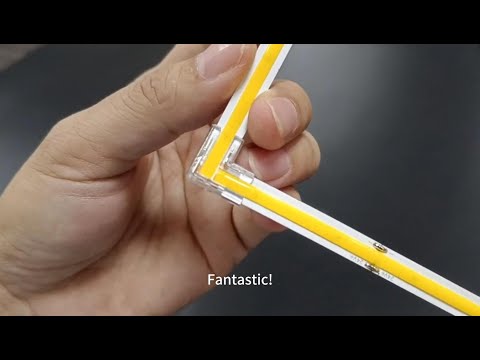
Het juiste selecteren LED-stripconnectoren voor krachtinjectie is de volgende praktische stap zodra de injectiemethode is besloten: het connectortype, het aantal pins en de huidige beoordeling moeten overeenkomen met de stripspecificatie en de bedradingslay-out.
Op een gegeven moment wordt het verminderen van de stroom door een systeem met een hoger spanningssysteem praktischer dan het continu toevoegen van injectiepunten.
Dit geldt met name in projecten waar de toegang voor toekomstig onderhoud beperkt is.
Hoe de looplengte van een 24V COB LED-strip te verlengen
Wanneer een project meer afstand vereist dan een standaard single-end feed kan ondersteunen, zijn er verschillende bewezen technische methoden beschikbaar.
Niet alle oplossingen bieden echter hetzelfde niveau van effectiviteit, kostenefficiëntie of installatiegemak.
Veel installateurs voegen onmiddellijk meer stroomvoorzieningen of grotere stuurprogramma's toe, om te ontdekken dat het onderliggende spanningsverliesprobleem ongewijzigd blijft.
De meest effectieve aanpak is om de juiste strategie te selecteren op basis van:
- Runlengte
- Vermogensdichtheid
- Installatietoegang
- Projectbudget
- Uniformiteitsvereisten
Zes methoden kunnen de bruikbare runlengte overschrijden tot buiten de limiet van één eind:
- Dubbele stroomvoeding
- Centrum vermogensinjectie
- Meerdere injectiepunten
- COB-strips met een lager vermogen
- bredere PCB of dikker koper
- Upgraden naar 48V COB LED-strips
Elke methode verhelpt spanningsval op een andere manier.
Sommigen verminderen de stroom.
Sommigen verminderen de weerstand van de geleider.
Sommige verkorten het effectieve elektrische pad.
Het begrijpen van de voordelen en beperkingen van elke optie is essentieel voor het selecteren van de beste oplossing.
De volgende tabel vat de prestaties van elke benadering samen.
| werkwijze | Verbetering van de runlengte | Complexiteit van installatie | Extra bedrading | het beste voor |
| Dual-end feed | Hoog | Laag | Matig | 8-18 miljoen runs |
| Middeninjectie | Hoog | Laag | Matig | Lange lineaire installaties |
| Meerdere injectiepunten | zeer hoog | Hoog | Hoog | 20 miljoen+ projecten |
| Lagere stroomstrip | Medium | niet een | niet een | Decoratieve verlichting |
| bredere PCB | Medium | niet een | niet een | Nieuwe projecten |
| 2oz koperen PCB | Hoog | niet een | niet een | Professionele installaties |
| 48v COB-strook | zeer hoog | Medium | minimaal | Lange architecturale runs |
Voor de meeste commerciële projecten biedt het verhogen van de geleider of systeemspanning meestal een betere langetermijnoplossing dan het continu toevoegen van injectiepunten.
Voeding size voor lange COB LED-strip loopt
Het selecteren van de juiste stroomvoorziening is net zo belangrijk als het selecteren van de LED-strip zelf.
Veel problemen die installateurs toeschrijven aan spanningsval, worden in feite veroorzaakt door ondermaatse voedingen die in de buurt van of buiten hun nominale capaciteit werken.
Een stroomvoorziening die op papier voldoende lijkt, kan instabiel worden zodra de omgevingstemperatuur stijgt, opstartstroom optreedt of het systeem gedurende langere perioden continu werkt.
Voor een betrouwbare langdurige werking mogen professionele LED-stripinstallaties nooit de stroomvoorziening exact gelijk aan het berekende stripvermogen.
De aanbevolen maatformule is:

waar:
- P(aanbod) = Vereist voedingswattage
- P(Load) = Totaal aangesloten LED-strip wattage
De extra capaciteit van 251 TP3T biedt hoofdruimte voor:
- Opstarten Inschakelstroom
- Derating van de omgevingstemperatuur
- Component veroudering
- Tolerantie voor spanningsregeling
- Toekomstige systeemuitbreiding
Dit is een van de eenvoudigste en meest effectieve methoden om de betrouwbaarheid van het systeem op lange termijn te verbeteren.
Voor verdere begeleiding over De juiste voeding kiezen voor LED-stripinstallaties — inclusief stuurprogrammatypes, bedradingsconfiguraties en Voedingsaansluiting en installatietypes — Raadpleeg onze speciale selectiegidsen voor stroomvoorziening.
Voeding dimensionering rekenmachine tabel
De onderstaande tabel biedt een snelle referentie voor veelvoorkomende installaties.
| Totale LED-belasting | Minimum aanbod (1,25× regel) | Aanbevolen standaardmaat |
| 40W | 50W | 60W |
| 60W | 75W | 80W |
| 80W | 100W | 100W |
| 100W | 125W | 150W |
| 120W | 150W | 150W |
| 160W | 200W | 200W |
| 200W | 250W | 240W-300W |
| 320W | 400W | 480W |
| 400W | 500W | 600 W |

Voor commerciële projecten wordt het kiezen van de volgende beschikbare standaardmaat over het algemeen aanbevolen.
Veelvoorkomende fouten bij het dimensioneren van stroomvoorzieningen
- Passend vermogensvermogen precies aan te laden Oorzaken oververhitting — Pas altijd de 1.25×-regel toe
- Omgevingstemperatuur negeren Leidt tot thermische uitschakeling — gebruik de deratingmarge
- dimensionering alleen het eerste stripsegment Oorzaken overbelasting — Bereken de totale aangesloten belasting
- Ervan uitgaande dat injectie de stroomvraag vermindert Veroorzaakt onjuiste maatvoering — Totaal wattage blijft hetzelfde
- Het kiezen van de laagste kosten Vermindert betrouwbaarheid — Gebruik stuurprogramma's van industriële kwaliteit voor commercieel werk
- Opstartstroom negeren Veroorzaakt onverwachte uitschakeling — inclusief reservecapaciteit
Verandert de size injectie van de stroomvoorziening?
Nee.
Vermogensinjectie verandert:
✔ Huidige distributie
✔ Spanningverdeling
✔ Helderheid Uniformiteit
Maar het verandert niet:
✖ Totaal stroomverbruik
FAQ
De volgende vragen zijn de meest voorkomende zorgen van installateurs, lichtontwerpers, inkoopteams en projectingenieurs bij het plannen van langetermijn COB-ledstripinstallaties.
Conclusie
Voor de meeste standaard 24V COB LED-strips is de aanbevolen limiet voor één eind loop 5 meter. R2R-gefabriceerde strips met geoptimaliseerd PCB-ontwerp breid dit uit tot 10-15 meter, afhankelijk van de vermogensdichtheid en koperspecificatie.
Wanneer de spanningsval de aanvaardbare limieten overschrijdt, moeten vermogensinjectie, dikker koper, bredere PCB's of 48V-systemen worden geëvalueerd.
Een goed ontwerp voor de voedingsvoorziening en het bedrading blijft de basis van betrouwbare LED-stripinstallaties op lange termijn.
Gerelateerde berichten