Nederlands
  English
  简体中文
简体中文  Deutsch
  Español
  Français
  Italiano
  日本語
日本語  한국어
한국어  Polski
  Português
  Русский
  Türkçe
  Tiếng Việt
  ไทย
ไทย 
Bij het inkopen van op maat gemaakte neonborden voor buiten voor een commercieel project - of het nu voor een winkelpui, restaurantpatio of architecturale verlichting is - zullen de materialen die u vandaag kiest, bepalen hoe het bord eruitziet en presteert over twee, vijf of zelfs over tien jaar. Als de verkeerde materialen worden gebruikt, kan een bord dat er geweldig uitziet op de showroomvloer, geel, barsten, flikkeren of volledig falen na slechts één seizoen van buitenblootstelling.
Voor inkoopprofessionals, projectingenieurs en bedrijfseigenaren is de uitdaging niet alleen het vinden van een leverancier die een neonbord er aantrekkelijk uit kan laten zien. Het is het vinden van een leverancier die echt op maat gemaakte outdoor neon begrijpt vanuit het perspectief van materiaaltechnische techniek - iemand die weet waarom siliconen neon beter presteert dan PVC in UV-bestendigheid, begrijpt hoe hij de juiste acrylborden en aluminium profielen moet selecteren, en weet wat echt betrouwbare waterdichte neonmaterialen zijn.
Deze gids analyseert elk belangrijk materiaalcomponent van buiten Aangepaste neonreclames, van de neonbuizen zelf tot de elektrische verbindingen. Na het lezen, heb je een duidelijke checklist voor het evalueren van leveranciers en kun je nauwkeurig de materialen specificeren die nodig zijn voor je project op basis van de unieke milieuvereisten.
Als u een complete stapsgewijze handleiding nodig heeft, van ontwerp tot levering, raadpleeg dan onze uitgebreide gids over het kopen van aangepaste neonreclames.
Siliconen versus PVC: het kiezen van het juiste kernmateriaal
Bij het specificeren van de technische vereisten voor aangepaste buitenneonlichten, is de meest fundamentele materiaalbeslissing de keuze voor neonbuismateriaal. Siliconen en PVC zijn de twee dominante materialen in de markt voor LED-neonverlichting, maar hun prestaties in buitenomgevingen variëren aanzienlijk.
Vergelijking van materiaaleigenschappen
| hoedanigheid | Siliconen LED Neon Flex | PVC LED Neon Flex |
| Materiële samenstelling | Premium siliconen elastomeer | Polyvinylchloride met weekmakers |
| Levensduur (buiten) | 50.000+ uren | 8.000-15.000 uur |
| UV-bestendigheid | Uitstekend - geen vergeling voor 5+ jaar | arm - geel en wordt broos |
| Temperatuurbereik | -50°C tot +150°C | -15°C tot +80°C |
| Flexibiliteit bij lage temperatuur | Blijft zacht en flexibel | wordt hard en broos |
| Waterdichte classificatie | IP67 / IP68 haalbaar | Beperkt, typisch IP65 Max |
| brandwerendheid | Zelfdovend, vlamvertragend | Produceert giftige dampen bij verbranden |
| Warmteafvoer | 27W/MK thermische geleidbaarheid | 0,14 W/mk — Slecht warmtebeheer |
| Kosten | Hogere initiële investering | Hogere initiële investering |
| Beste gebruiksgeval | Buiten, langdurig, complexe ontwerpen | Binnen, tijdelijke, low-budget projecten |
Waarom siliconen de gouden standaard is voor gebruik buitenshuis

Siliconen blinkt uit in elke maatstaf die relevant is voor gebruik buitenshuis. Door de UV-bestendigheid is hij meer dan vijf jaar bestand tegen direct zonlicht zonder geel of broos te worden. Het brede temperatuurbereik (-50°C tot +150°C) maakt het mogelijk om zich aan te passen aan verschillende klimaten, van koude noordelijke winters tot warme woestijnzomers. Bovendien helpt de superieure thermische geleidbaarheid van siliconen (27 W/m·K, vergeleken met PVC's 0,14 W/m·K) de warmte die door LED's wordt gegenereerd effectiever af te voeren, waardoor de levensduur van zowel neonbuizen als LED's wordt verlengd.
Vanuit veiligheidsperspectief is siliconen van nature vlamvertragend. Daarentegen geeft PVC waterstofchloride en andere giftige gassen vrij wanneer ze worden verbrand, wat ernstige veiligheids- en aansprakelijkheidsrisico's met zich meebrengt. Siliconen biedt ook een uitstekende chemische weerstand, waardoor het geschikt is voor kustomgevingen - waar zoutspray inferieure materialen snel kan aantasten.
wanneer IS PVC Sgeldkist Apassend?
PVC is niet geheel zonder verdienste. Voor indoor bewegwijzering, tijdelijke evenementendisplays of projecten met beperkte levensduurvereisten en krappe budgetten, is PVC een kosteneffectieve optie. Voor elke toepassing die wordt blootgesteld aan direct zonlicht, regen of aanzienlijke temperatuurschommelingen buiten, is siliconen echter de enige betrouwbare keuze. Zoals een industriegids opmerkt: "PVC duurt slechts ongeveer 8.000 tot 15.000 uur onder buitenomstandigheden" - wat neerkomt op slechts één tot twee jaar continu gebruik buitenshuis.
Siliconen Neon-oplossingen van Sillitetled
Bij Signlitetled produceren we een volledig assortiment siliconen neonlichten en LED neon strips Ontworpen voor duurzaamheid buitenshuis. Onze productlijn bevat een verscheidenheid aan specificaties voor verschillende toepassingsbehoeften - van de zijverlichte S0612- en S0815-serie voor beletteringsborden, tot de aan de voorkant verlichte T1010- en T1212-serie voor architecturale contouren tot de 360 ° omnidirectionele cirkelvormige neon D15. Al onze siliconen neonproducten ondergaan strenge kwaliteitstests om langdurige buitenprestaties te garanderen.
Soorten acryl backing panelen: de foundation die alles bij elkaar houdt
Het steunpaneel voor op maat gemaakte neonborden wordt vaak over het hoofd gezien, maar het speelt een cruciale rol bij het waarborgen van duurzaamheid buitenshuis. Het steunpaneel moet structurele ondersteuning bieden, weerstaan aan verwering en zijn uiterlijk behouden zonder geel, kromtrekken of delamineren.
Gemeenschappelijke acryl backing opties
| Type | lijvigheid | UV-bestendigheid | Beste toepassing |
| Helder acryl (gegoten) | 3mm-10mm | Goed - UV-gestabiliseerd | Moderne, doorzichtige ontwerpen |
| Wit acryl (gegoten) | 3mm-10mm | Goed - UV-gestabiliseerd | Standaard binnen-/buitenborden |
| Zwart acryl (gegoten) | 3mm-10mm | Goed - UV-gestabiliseerd | Hoogcontrast, premium uiterlijk |
| Geëxtrudeerd acryl | 2mm-5mm | schoon | Binnen of beschermd buitengebruik |
Gegoten acryl vs. geëxtrudeerd acryl

Gegoten acryl wordt geproduceerd door vloeibaar acryl in een mal te gieten, wat een superieure optische helderheid, uniforme dikte en betere UV-bestendigheid biedt. Geëxtrudeerd acryl wordt gevormd door extrusie door rollen; hoewel het minder duur is, het heeft een slechtere stabiliteit in buitenomstandigheden en is meer vatbaar voor kromtrekken, vervorming en geel worden. Voor outdoor op maat gemaakte neonborden, gegoten acryl is de aanbevolen keuze.
Oppervlaktebehandeling en kleur op de achterkant
De oppervlaktebehandeling en kleur van het achterpaneel hebben een aanzienlijke invloed op het visuele effect van het neonteken:
- Transparant achterpaneel: Creëert een "zwevend" effect, waardoor de neon lijkt te zweven in de lucht - vaak gebruikt voor etalages en moderne minimalistische ontwerpen.
- witte backboard: Biedt maximaal contrast voor neonkleuren, waardoor het teken bij daglicht bijzonder levendig en opvallend wordt.
- zwarte backboard: presenteert een verfijnd, verfijnd uiterlijk en verbergt effectief bedrading en bevestigingsmateriaal.
SignLiteled biedt drie kleuren op het bord (transparant/wit/zwart) en kan de snijmaten op aanvraag aanpassen aan elke ontwerpvereiste.

Beschermende coating
Voor buiteninstallaties is extra bescherming essentieel. Achterpanelen moeten in de fabriek worden behandeld met UV-stabilisatie. Voor bewegwijzering in barre omgevingen (zoals kustzoutspray, industriële verontreinigende stoffen of hoge luchtvochtigheid), kan het aanbrengen van een transparante UV-beschermende film op het oppervlak van de achterwand de levensduur aanzienlijk verlengen.
Waterdichte connectoren: het meest over het hoofd geziene punt van storing
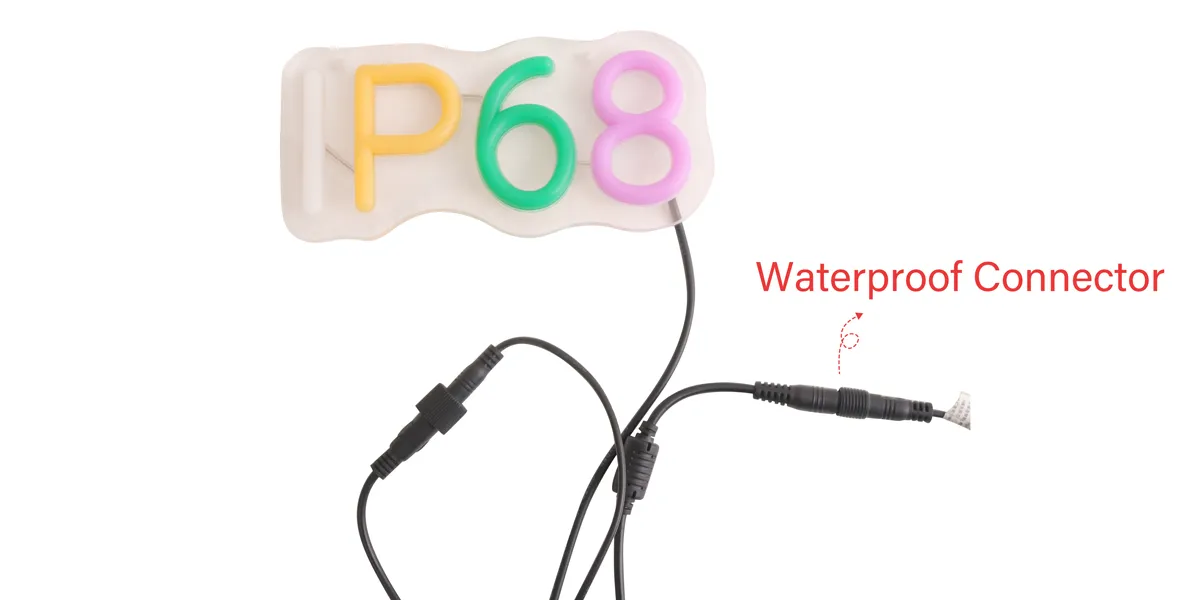
Als er een deel van de aangepaste outdoor neonverlichting is die het meest vatbaar is voor falen, zijn het de connectoren. Veel kopers richten zich uitsluitend op de IP-beoordeling van de neonstrip zelf, waarbij ze de verbindingspunten volledig over het hoofd zien - en zijn dan verbaasd wanneer hun "waterdichte" neonverlichting na de eerste zware regenval niet goed werkt.
IP-beoordelingen uitgelegd
| IP-classificatie | Beschermingsniveau | Geschikt voor |
| IP65 | Beschermd tegen waterstralen | Overdekte patio's, onder dakranden, beschermde buitenruimtes |
| IP67 | Beschermd tegen tijdelijke onderdompeling (1m voor 30 minuten) | Gevels van het bouwen, volledig blootgestelde buitentekens |
| IP68 | Beschermd tegen continue onderdompeling | Zwembaden, fonteinen, onderwatertoepassingen |
Voor de meeste outdoor signage projecten biedt IP67 voldoende bescherming tegen regen en vocht. IP65 is geschikt voor gedeeltelijk beschutte omgevingen, terwijl IP68 doorgaans is gereserveerd voor situaties die continue onderdompeling in water vereisen.
Waar falen de meeste buitenneonlichten buiten?
Volgens de werkelijke faalanalyses begint het probleem meestal wanneer vocht langzaam in slecht afgesloten connectoren sijpelt, zich rond bestuurders ophoopt of wanneer verwering op lange termijn kwetsbare delen van het systeem verzwakt. De LED-strips zelf falen zelden; de echte boosdoener is vaak vochtindringing op verbindingspunten, wat leidt tot corrosie, flikkering en uiteindelijk het volledige falen van het neondisplay.
Hoe een waterdichte verbindingsoplossing correct te specificeren?
Zorg ervoor dat uw leverancier het volgende gebruikt om betrouwbare buitenprestaties te garanderen:
- Spuitgegoten connectoren: Aangepaste overgevormde connectoren die een volledige afdichting bieden bij de draadinvoerpunten.
- siliconen potten: Connectors gevuld met siliconen om vocht binnendringen te voorkomen, zelfs onder druk.
- Kleefstof-onderde dubbelwandige warmtekrimpbuis: Vormt een waterdichte afdichting over gesoldeerde verbindingen.
- Vergulde of corrosiebestendige contacten: Voorkom oxidatie, zelfs bij lichte binnendringing van vocht.
Bij Signlitetled gebruiken alle aangepaste outdoor neonborden waterdichte connectoren met dubbele injectiegegoten einddoppen, waardoor IP67/IP68-beoordelingen als vereist. Ons productieproces legt speciale nadruk op het afdichten van verbindingspunten, omdat we weten dat dit waar de meeste concurrerende producten mislukken.
UV-weerstand: wat zorgt ervoor dat uw neontekens niet geel worden

UV-veroudering is de stille moordenaar van outdoor-signage. Zelfs als een neonteken volledig waterdicht is, zal langdurige blootstelling aan zonlicht de buismaterialen geleidelijk beschadigen, leidt tot geel, vertroebeling, verminderde lichttransmissie en uiteindelijk barsten.
UV-bestendigheid door materiaal
| Materiaal | UV-bestendigheid | Verwachte vergeling begin |
| platina-geharde siliconen | Uitstekend | 5-10+ jaar |
| UV-gestabiliseerd TPU | Goed | 3-5 jaar |
| Standaard siliconen | Goed | 3-5 jaar |
| Hoogwaardige PU met UV-additieven | schoon | 2-3 jaren |
| Standaard PVC | Slecht | 6-12 maanden |
| Laaggradige gerecyclede kunststoffen | erg arm | <6 maanden |
Met platina uitgeharde siliconen: de gouden standaard
Het hoogste niveau van UV-bescherming is afkomstig van siliconen uit platina, die algemeen wordt erkend als het beste materiaal om vergeling te voorkomen. Dit materiaal biedt uitstekende UV-bestendigheid en hittebestendigheid, behoudt flexibiliteit om complexe architecturale ontwerpen te accommoderen en behoudt levendige kleuren gedurende 5 tot 10 jaar of langer.
Hoogwaardige siliconen neonproducten ondergaan strenge versnelde verouderingstests. Bijvoorbeeld, 3.000 uur UV-blootstelling (gelijk aan ongeveer 9 jaar buiten) resulteert in een kleurverschil (E) van minder dan 1,5 - een verandering die vrijwel onmerkbaar is voor het blote oog.
Testen en certificeren
Vraag het volgende aan bij uw leverancier voordat u een bestelling plaatst:
- Versneld UV-verouderingstestrapport (ASTM G154 of gelijkwaardige standaard)
- Gegevens over buitenverwering (real-world exposure resultaten)
- Materiaalcertificeringen (ROHS, REACH, UL)
Waarschuwingssignalen van slechte UV-weerstand
Als een leverancier geen UV-testgegevens kan verstrekken, ga dan voorzichtig te werk. Neonborden gemaakt van PVC of gerecycled plastic van lage kwaliteit kunnen binnen zes maanden na installatie buitenshuis geel beginnen te worden - dit probleem is onomkeerbaar en zal uw merkimago beschadigen.
Bij Signlitetled zijn al onze siliconen neonproducten geformuleerd met UV-stabilisatoren en ondergaan verouderingstests om langdurige kleurstabiliteit te garanderen. Op verzoek kunnen we ook uitgebreide testrapporten verstrekken.
Checklist voor het kopen van materialen
Gebruik deze checklist bij het evalueren van leveranciers voor aangepaste buitenneonborden om ervoor te zorgen dat de producten die u ontvangt echt bestand zijn tegen buitenomstandigheden.
Checklist voor kernmaterialen
- Neon buismateriaal: Siliconen (bij voorkeur platina-uitgehard) — Kies geen PVC voor gebruik buitenshuis
- UV-weerstandsdocumentatie: Versnelde verouderingstestresultaten (bijv. 3.000 uur UV-blootstelling, ΔE < 1,5)
- IP-classificatie: Minimum IP67 voor volledig blootgestelde buitensignalisatie (IP65 acceptabel voor beschutte gebieden)
- Type connector: spuitgegoten, siliconen ingekapselde of dubbelwandige warmtekrimpbuis met lijm
- Eindkappen: Dubbele injectie gegoten, niet alleen gelijmd
- Acryl-achterplaat: Gegoten acryl (niet geëxtrudeerd), met UV-stabilisatiebehandeling
- Bevestigingshardware: roestvrijstalen schroeven
Checklist voor leverancierskwalificaties
- Certificeringen: UL, CE, ROHS — Veiligheid en naleving van commerciële projecten waarborgen
- Beschikbaarheid van verouderde testgegevens: Kan de leverancier daadwerkelijke testgegevens verstrekken in plaats van theoretische claims?
- Aanpassingsmogelijkheden: Kan de leverancier aangepaste vormen, maten, kleuren en buigrichtingen aan?
- Technische ondersteuning: Geeft de leverancier richtlijnen voor de minimale buigradius, installatieaanbevelingen en constructie-instructies?
- Garantie: Minimaal 2-3 jaar garantie voor siliconen neonproducten voor buiten
- Kwaliteitscontrole: Zijn interne test- en inspectieprocedures gedocumenteerd?
Checklist voor milieubeoordeling
Beoordeel voordat u een bestelling plaatst uw installatieplaats:
- blootstelling aan de zon: Aantal uren direct zonlicht per dag — Bepaalt de vereisten voor de UV-bescherming
- regen blootstelling: Volledig blootgesteld of beschermd (bijvoorbeeld onder een luifel of dakrand)
- Temperatuurbereik: verwachte jaarlijkse maximum- en minimumtemperaturen
- nattigheid: Kustgebied (hoge vochtigheid/zoutmist) of droog binnenklimaat
- windbelastingen: Installatiesterkte vereist voor de blootgestelde locatie
- vervuilingsniveau: Industriegebied (chemische blootstelling) of schone omgeving
Conclusie
Het selecteren van de juiste materialen voor op maat gemaakte buitenneonborden is een beslissing die rechtstreeks van invloed is op de levensduur, het uiterlijk en de totale eigendomskosten van het project. De gegevens zijn duidelijk:
- Silicone: beter presteert dan PVC in elke outdoor-gerelateerde metrische - UV-bestendigheid, temperatuurbestendigheid, flexibiliteit, brandveiligheid en levensduur.
- gegoten acryl achterpanelen: Zorg voor structurele integriteit en UV-stabiliteit die geëxtrudeerd acryl niet kan matchen in buitentoepassingen.
- Goed afgedichte connectoren: Of het nu gaat om spuitgegoten, siliconenpotten of beschermd door dubbelwandige hittekrimpbuis - dit bepaalt of uw neonteken jaren meegaat of na een enkel regenseizoen faalt.
- UV-bestendige materialen: met name siliconen met platina-uitgeharde siliconen, die uw neonreclames 5 tot 10 jaar of zelfs langer levendig en geelvrij houden.
- Certificeringen, testrapporten en garanties: Deze zijn de sleutel tot het onderscheiden van betrouwbare leveranciers van degenen die niet-verifieerbare beloften doen.
Wanneer u samenwerkt met Signlitetled, koopt u niet alleen een bord, maar werkt u samen met een fabrikant die materialen, techniek en echte buitenprestaties begrijpt. Onze siliconen neontekens zijn getest, gecertificeerd en ondersteund door deskundige technische ondersteuning. We antwoorden niet alleen: "Hoeveel?" Wij stellen de juiste vragen: Wat is uw installatieomgeving? Wat zijn de dagelijkse zonlichtomstandigheden? Hoe complex is het ontwerp dat je nodig hebt? Welke certificeringen vereist uw project?
Klaar om een echt duurzaam, op maat gemaakt neonbord voor buiten te specificeren? Neem contact op met SignLiteLed voor technisch advies en materiaalaanbevelingen die zijn afgestemd op uw specifieke projectvereisten.
FAQs
Gerelateerde berichten