English
  简体中文
简体中文  Deutsch
  Español
  Français
  Italiano
  日本語
日本語  한국어
한국어  Polski
  Português
  Русский
  Türkçe
  Nederlands
  Tiếng Việt
  ไทย
ไทย 
When sourcing outdoor custom neon signs for a commercial project—whether for a storefront, restaurant patio, or architectural lighting—the materials you choose today will determine how the sign looks and performs two, five, or even ten years from now. If the wrong materials are used, a sign that looks great on the showroom floor may yellow, crack, flicker, or fail entirely after just one season of outdoor exposure.
For procurement professionals, project engineers, and business owners, the challenge isn’t simply finding a supplier who can make a neon sign look appealing. It’s finding a supplier who truly understands outdoor custom neon from a materials engineering perspective—someone who knows why silicone neon outperforms PVC in UV resistance, understands how to select the right acrylic backboards and aluminum profiles, and knows what constitutes genuinely reliable waterproof neon materials.
This guide will analyze every key material component of outdoor custom neon signs, from the neon tubes themselves to the electrical connections. After reading it, you’ll have a clear checklist for evaluating suppliers and will be able to accurately specify the materials needed for your project based on its unique environmental requirements.
If you need a complete step-by-step guide from design to delivery, refer to our comprehensive guide on how to purchase custom neon signs.
Silicone vs. PVC: Choosing the Right Core Material
When specifying the technical requirements for custom outdoor neon lights, the most fundamental material decision is the choice of neon tube material. Silicone and PVC are the two dominant materials in the LED neon lighting market, but their performance in outdoor environments varies significantly.
Material Properties Comparison
| Property | Silicone LED Neon Flex | PVC LED Neon Flex |
| Material composition | Premium silicone elastomer | Polyvinyl chloride with plasticizers |
| Lifespan (outdoor) | 50,000+ hours | 8,000–15,000 hours |
| UV resistance | Excellent — no yellowing for 5+ years | Poor — yellows and becomes brittle |
| Temperature range | -50°C to +150°C | -15°C to +80°C |
| Flexibility at low temp | Remains soft and flexible | Becomes hard and brittle |
| Waterproof rating | IP67 / IP68 achievable | Limited, typically IP65 max |
| Fire resistance | Self-extinguishing, flame-retardant | Produces toxic fumes when burned |
| Heat dissipation | 27W/MK thermal conductivity | 0.14W/MK — poor heat management |
| Cost | Higher initial investmentt | Higher initial investment |
| Best use case | Outdoor, long-term, complex designs | Indoor, temporary, low-budget projects |
Why Silicone Is the Gold Standard for Outdoor Use

Silicone excels in every metric relevant to outdoor use. Its UV resistance allows it to withstand direct sunlight for over five years without yellowing or becoming brittle. Its wide temperature range (-50°C to +150°C) allows it to adapt to various climates, from cold northern winters to hot desert summers. Additionally, silicone’s superior thermal conductivity (27 W/m·K, compared to PVC’s 0.14 W/m·K) helps dissipate heat generated by LEDs more effectively, extending the lifespan of both neon tubes and LEDs.
From a safety perspective, silicone is naturally flame-retardant. In contrast, PVC releases hydrogen chloride and other toxic gases when burned, posing serious safety and liability risks. Silicone also offers excellent chemical resistance, making it suitable for coastal environments—where salt spray can rapidly corrode inferior materials.
When Is PVC Still Appropriate?
PVC is not entirely without merit. For indoor signage, temporary event displays, or projects with limited lifespan requirements and tight budgets, PVC is a cost-effective option. However, for any application exposed to direct sunlight, rain, or significant temperature fluctuations outdoors, silicone is the only reliable choice. As one industry guide notes: “PVC lasts only about 8,000 to 15,000 hours under outdoor conditions”—which equates to just one to two years of continuous outdoor use.
SignliteLED’s Silicone Neon Solutions
At SignliteLED, we manufacture a full range of silicone neon lights and LED neon strips designed for outdoor durability. Our product line includes a variety of specifications to suit different application needs—from the side-lit S0612 and S0815 series for lettering signs, to the front-lit T1010 and T1212 series for architectural outlines, to the 360° omnidirectional circular neon D15. All our silicone neon products undergo rigorous quality testing to ensure long-term outdoor performance.
Types of Acrylic Backing Panels: The Foundation That Holds It All Together
The backing panel for custom neon signs is often overlooked, yet it plays a crucial role in ensuring outdoor durability. The backing panel must provide structural support, withstand weathering, and maintain its appearance without yellowing, warping, or delaminating.
Common Acrylic Backing Options
| Type | Thickness | UV Resistance | Best Application |
| Clear acrylic (cast) | 3mm–10mm | Good — UV-stabilized | Modern, see-through designs |
| White acrylic (cast) | 3mm–10mm | Good — UV-stabilized | Standard indoor/outdoor signs |
| Black acrylic (cast) | 3mm–10mm | Good — UV-stabilized | High-contrast, premium appearance |
| Extruded acrylic | 2mm–5mm | Fair | Indoor or protected outdoor use |
Cast Acrylic vs. Extruded Acrylic

Cast acrylic is produced by pouring liquid acrylic into a mold, offering superior optical clarity, uniform thickness, and better UV resistance. Extruded acrylic is formed by extrusion through rollers; while it is less expensive, it has poorer stability in outdoor conditions and is more prone to warping, deformation, and yellowing. For outdoor custom neon signs, cast acrylic is the recommended choice.
Back Panel Surface Treatment and Color
The surface treatment and color of the back panel significantly impact the visual effect of the neon sign:
- Transparent Back Panel: Creates a “floating” effect, making the neon appear to hover in the air—commonly used for storefront displays and modern minimalist designs.
- White Backboard: Provides maximum contrast for neon colors, making the sign particularly vivid and eye-catching in daylight.
- Black Backboard: Presents a sophisticated, refined appearance and effectively conceals wiring and mounting hardware.
SignliteLED offers three backboard color options (transparent/white/black) and can customize cutting dimensions on demand to match any design requirement.

Protective Coating
For outdoor installations, additional protection is essential. Back panels should be factory-treated with UV stabilization. For signage in harsh environments (such as coastal salt spray, industrial pollutants, or high humidity), applying a transparent UV-protective film to the back panel surface can significantly extend its service life.
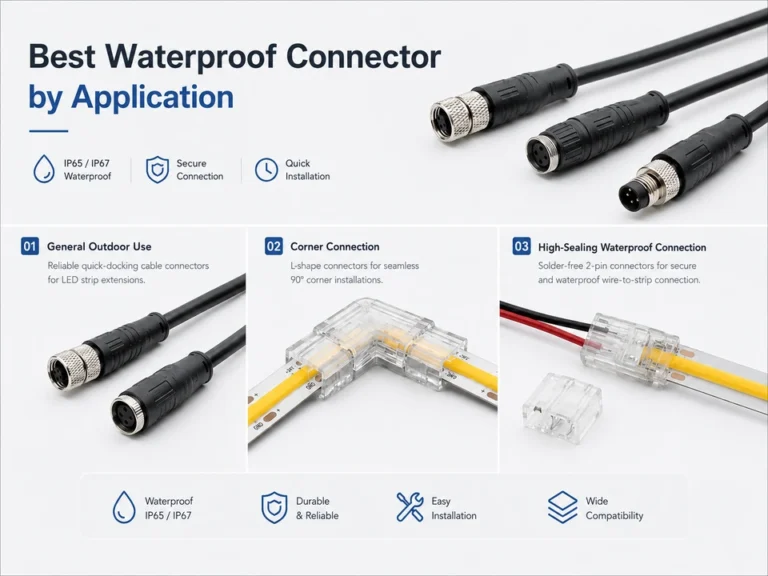
Waterproof Connectors: The Most Overlooked Point of Failure
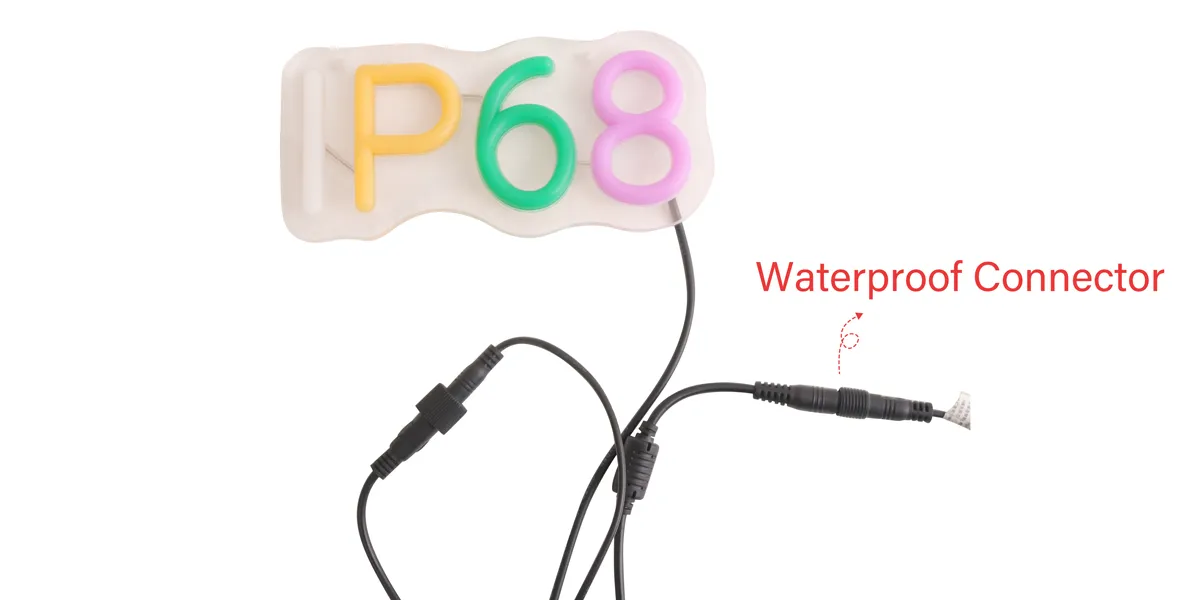
If there’s one part of custom outdoor neon lighting that’s most prone to failure, it’s the connectors. Many buyers focus solely on the IP rating of the neon strip itself, completely overlooking the connection points—and are then puzzled when their “waterproof” neon lighting malfunctions after the first heavy rain.
IP Ratings Explained
| IP Rating | Protection Level | Suitable For |
| IP65 | Protected against water jets | Covered patios, under eaves, protected outdoor areas |
| IP67 | Protected against temporary immersion (1m for 30 min) | Building facades, fully exposed outdoor signs |
| IP68 | Protected against continuous immersion | Pools, fountains, underwater applications |
For most outdoor signage projects, IP67 provides sufficient protection against rain and moisture. IP65 is suitable for partially sheltered environments, while IP68 is typically reserved for situations requiring continuous submersion in water.
Where do most outdoor neon lights fail?
According to actual failure analyses, “the problem usually begins when moisture slowly seeps into poorly sealed connectors, accumulates around drivers, or when long-term weathering weakens vulnerable parts of the system.” The LED strips themselves rarely fail; the real culprit is often moisture intrusion at connection points, leading to corrosion, flickering, and ultimately the complete failure of the neon display.
How to Properly Specify a Waterproof Connection Solution?
To ensure reliable outdoor performance, make sure your supplier uses:
- Injection-molded connectors: Custom overmolded connectors that provide a complete seal at the wire entry points.
- Silicone potting: Connectors filled with silicone to prevent moisture penetration even under pressure.
- Adhesive-backed double-wall heat-shrink tubing: Forms a watertight seal over soldered joints.
- Gold-plated or corrosion-resistant contacts: Prevent oxidation even in the event of minor moisture ingress.
At SignliteLED, all custom outdoor neon signs use industrial-grade waterproof connectors with double-injection-molded end caps, achieving IP67/IP68 ratings as required. Our manufacturing process places special emphasis on sealing connection points, as we know this is where most competing products fail.
UV Resistance: What Keeps Your Neon Signs from Yellowing

UV aging is the silent killer of outdoor signage. Even if a neon sign is completely waterproof, prolonged exposure to sunlight will gradually damage the tube materials, leading to yellowing, clouding, reduced light transmission, and eventually cracking.
UV Resistance by Material
| Material | UV Resistance | Expected Yellowing Onset |
| Platinum-cured silicone | Excellent | 5–10+ years |
| UV-stabilized TPU | Good | 3–5 years |
| Standard silicone | Good | 3–5 years |
| High-grade PU with UV additives | Fair | 2–3 years |
| Standard PVC | Poor | 6–12 months |
| Low-grade recycled plastics | Very poor | <6 months |
Platinum-cured Silicone: The Gold Standard
The highest level of UV protection comes from platinum-cured silicone, widely recognized as the best material for preventing yellowing. This material offers excellent UV resistance and heat resistance, maintains flexibility to accommodate complex architectural designs, and retains vibrant colors for 5 to 10 years or more.
High-quality silicone neon products undergo rigorous accelerated aging tests. For example, 3,000 hours of UV exposure (equivalent to approximately 9 years outdoors) results in a color difference (ΔE) of less than 1.5—a change virtually imperceptible to the naked eye.
Testing and Certification
Before placing an order, request the following from your supplier:
- Accelerated UV aging test report (ASTM G154 or equivalent standard)
- Outdoor weathering test data (real-world exposure results)
- Material certifications (RoHS, REACH, UL)
Warning Signs of Poor UV Resistance
If a supplier cannot provide UV test data, proceed with caution. Neon signs made from low-quality PVC or recycled plastic may begin to yellow within six months of outdoor installation—this issue is irreversible and will damage your brand image.
At SignliteLED, all our silicone neon products are formulated with UV stabilizers and undergo aging tests to ensure long-term color stability. We can also provide comprehensive test reports upon request.
Purchasing Materials Checklist
When evaluating suppliers for custom outdoor neon signs, use this checklist to ensure that the products you receive can truly withstand outdoor conditions.
Core Materials Checklist
- Neon Tube Material: Silicone (preferably platinum-cured) — Do not choose PVC for outdoor use
- UV Resistance Documentation: Accelerated aging test results (e.g., 3,000 hours of UV exposure, ΔE < 1.5)
- IP Rating: Minimum IP67 for fully exposed outdoor signage (IP65 acceptable for sheltered areas)
- Connector Type: Injection-molded, silicone-encapsulated, or double-wall heat-shrink tubing with adhesive
- End Caps: Double-injection molded, not merely glued
- Acrylic Backplate: Cast acrylic (not extruded), with UV stabilization treatment
- Mounting Hardware: Stainless steel screws
Supplier Qualification Checklist
- Certifications: UL, CE, RoHS — Ensuring safety and compliance for commercial projects
- Availability of aging test data: Can the supplier provide actual test data rather than theoretical claims?
- Customization capabilities: Can the supplier accommodate custom shapes, sizes, colors, and bending directions?
- Technical support: Does the supplier provide guidance on minimum bend radius, installation recommendations, and construction instructions?
- Warranty: At least a 2–3-year warranty for outdoor silicone neon products
- Quality Control: Are internal testing and inspection procedures documented?
Environmental Assessment Checklist
Before placing an order, assess your installation site:
- Sun Exposure: Number of hours of direct sunlight per day — determines UV protection requirements
- Rain Exposure: Fully exposed or protected (e.g., under a canopy or eaves)
- Temperature Range: Expected annual maximum and minimum temperatures
- Humidity: Coastal area (high humidity/salt fog) or dry inland climate
- Wind Loads: Installation strength required for the exposed location
- Pollution Level: Industrial area (chemical exposure) or clean environment
Conclusion
Selecting the right materials for custom outdoor neon signs is a decision that directly impacts the project’s lifespan, appearance, and total cost of ownership. The data is clear:
- Silicone: Outperforms PVC in every outdoor-related metric—UV resistance, temperature resistance, flexibility, fire safety, and lifespan.
- Cast acrylic back panels: Provide structural integrity and UV stability that extruded acrylic cannot match in outdoor applications.
- Properly sealed connectors: Whether injection-molded, silicone-potted, or protected by double-wall heat-shrink tubing—this determines whether your neon sign will last for years or fail after a single rainy season.
- UV-resistant materials: Specifically platinum-cured silicone, which keeps your neon signs vibrant and yellow-free for 5 to 10 years or even longer.
- Certifications, test reports, and warranties: These are key to distinguishing reliable suppliers from those making unverifiable promises.
When you partner with SignliteLED, you’re not just buying a sign—you’re working with a manufacturer that understands materials, engineering, and real-world outdoor performance. Our silicone neon signs are tested, certified, and backed by expert technical support. We don’t just answer, “How much?” We ask the right questions: What is your installation environment? What are the daily sunlight conditions? How complex is the design you need? What certifications does your project require?
Ready to specify a truly durable, custom outdoor neon sign? Contact SignliteLED for technical consultation and material recommendations tailored to your specific project requirements.
FAQs
Related Posts