English
  简体中文
简体中文  Deutsch
  Español
  Français
  Italiano
  日本語
日本語  한국어
한국어  Polski
  Português
  Русский
  Türkçe
  Nederlands
  Tiếng Việt
  ไทย
ไทย 
When sourcing outdoor LED neon signs for commercial building facades, restaurant patios, or architectural lighting projects, one technical specification becomes the focal point of every discussion: the Ingress Protection (IP) rating. However, many buyers mistakenly believe that “waterproof neon signs” adhere to a single, universal standard—but this is not the case. Choosing the wrong protection rating can result in anything from a reduced return on investment to a major maintenance disaster within a matter of months.
For the vast majority of commercial outdoor LED neon projects, IP67 solid silicone extruded products are the optimal choice. They offer the same dust protection as IP65 while adding genuine protection against brief immersion. Furthermore, their cost is significantly lower than that of IP68 products, which are often over-specified for non-submersible applications.
This guide provides a comprehensive, engineering-based analysis of what IP65, IP67, and IP68 truly mean for outdoor LED neon lighting, focusing on the core knowledge that commercial buyers and project engineers must understand. We will explore why IP65 frequently fails in real-world outdoor environments; the silicone sealing process that determines a product’s long-term reliability; why the driver is just as critical as the light strip itself; and how to make optimal decisions that balance protection and cost based on project requirements.
After reading this article, you will no longer merely know what the IP numbers represent but will also understand the engineering rationale behind them—enabling you to accurately determine the appropriate protection rating for your next project.
What does the IP rating mean?
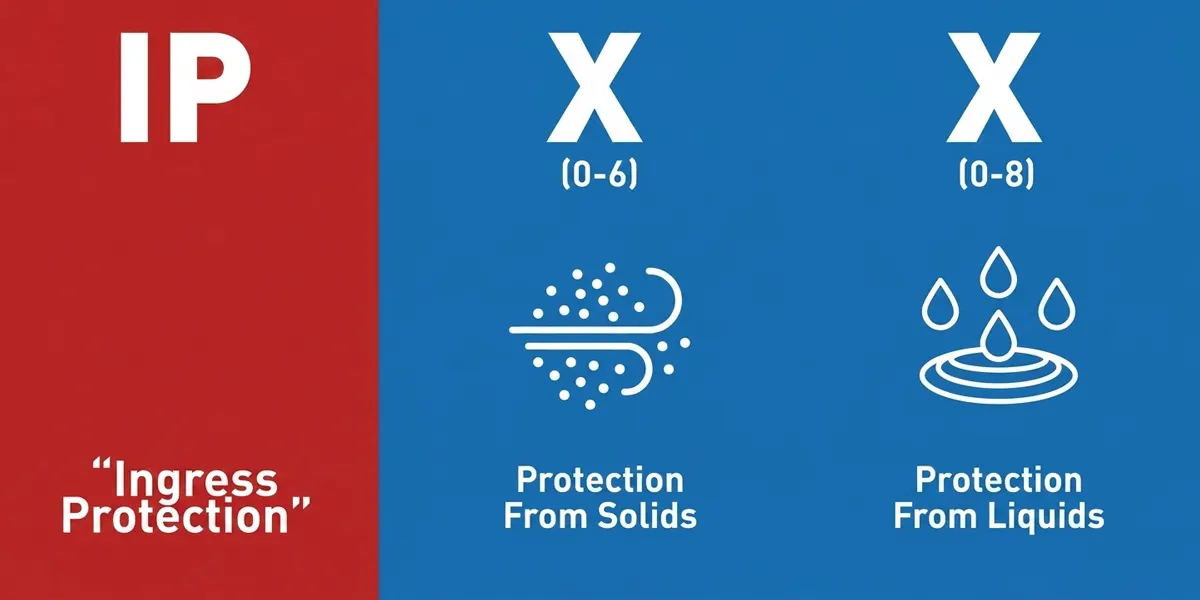
IP stands for Ingress Protection. As defined by the international standard IEC 60529, an IP rating consists of two digits:
- First digit (0–6): Protection against solid objects (dust, debris, accidental contact)
- Second digit (0–9K): Protection against liquids (rain, splashes, jets, immersion)
For outdoor LED neon signs, the first digit is almost always 6—complete dust protection, i.e., the highest level of protection against solids. The real focus of the decision lies in the second digit: the water resistance rating.
Below is a clear technical comparison of the relevant water resistance ratings:
| Second Digit | Definition | Testing Method | Real-World Meaning |
| 5 (IP65) | Water jets | 12.5 L/min from nozzle (6.3 mm), 3 m distance, at least 3 minutes | Resists low-pressure jets, heavy rain |
| 6 (IP66) | Powerful jets | 100 L/min from nozzle (12.5 mm), 3 m distance | Resists powerful water jets, severe rain |
| 7 (IP67) | Temporary immersion | Up to 1 meter depth for 30 minutes | Survives extreme storms, flooding, washing |
| 8 (IP68) | Continuous immersion | Depth and duration set by manufacturer (no single standard) | Long-term underwater use |
Key Note: There is no globally unified testing standard for IP68. Manufacturers and customers must explicitly agree on specific immersion depth and duration conditions. Some IP66 products can also pass basic IP68 tests—therefore, in the absence of explicit specifications, the IP68 rating itself has limited significance.
IP65 vs. IP67 vs. IP68—A Complete Comparison Chart
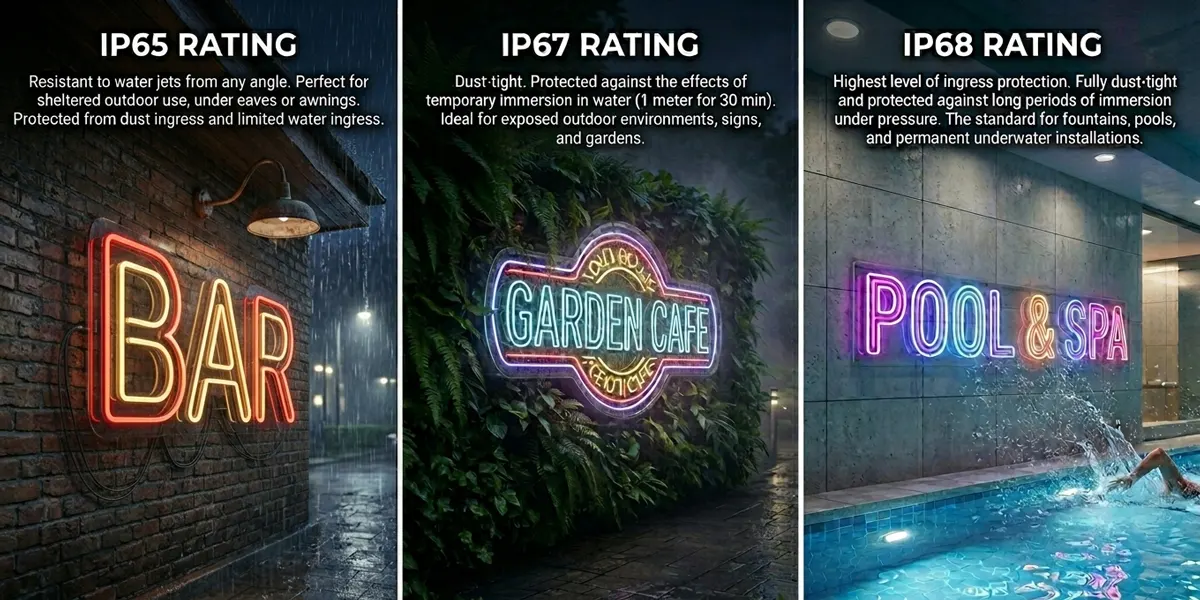
For commercial buyers of outdoor LED neon signs, understanding the differences between these three ratings in terms of construction, durability, and cost is crucial.
| Aspect | IP65 | IP67 | IP68 |
| Dust protection | 6 (dust-tight) | 6 (dust-tight) | 6 (dust-tight) |
| Water protection | Low-pressure jets only | Temporary immersion (1m, 30 min) | Continuous immersion (manufacturer-specified) |
| Construction method | Surface coating or semi-sealed sleeve | Full silicone extrusion / solid potting | High-grade silicone extrusion with reinforced seals |
| Can be submerged? | ❌ No | ✔️ Yes (short term) | ✔️ Yes (continuous) |
| Typical lifespan outdoors | 8,000–15,000 hours (PVC) | 50,000+ hours (silicone) | 50,000+ hours (silicone) |
| Relative cost | Budget | Moderate (15–30% higher than IP65) | Premium |
| Suitable for coastal areas? | Limited (salt-spray corrosion) | Yes (UV-stabilized silicone) | ✔️ Yes |
| Best for | Sheltered outdoor areas, under awnings | Full outdoor exposure, facades, signs, gardens | Fountains, pools, permanent underwater installations |
| Aspect | IP65 | IP67 | IP68 |
| Dust protection | 6 (dust-tight) | 6 (dust-tight) | 6 (dust-tight) |
Key Differences Explained
- IP65 provides complete protection against dust and withstands low-pressure water jets from any direction. However, it offers no protection against immersion—a limitation that has proven fatal in many real-world outdoor installations.
- IP67 builds upon IP65 by adding the ability to withstand brief immersion (1 meter underwater for 30 minutes). This level of protection is achieved through a fully extruded silicone construction: the LED circuitry is completely encapsulated within the silicone, leaving no gaps for moisture to penetrate.
- IP68 extends this capability to continuous submersion; however, due to the lack of a unified standard, IP67 already provides far more protection than is actually required for the vast majority of commercial outdoor signage and facade projects (where light strips are installed vertically or hung on the exterior of buildings).
- According to industry statistics, IP67 represents the optimal balance for approximately 82% of outdoor projects—it withstands seasonal harsh weather without incurring excessive costs.
For most outdoor lighting applications (signage, patios, and gardens), IP67 offers the ideal balance: it provides more reliable protection against rain than IP65 while remaining more cost-effective than IP68.
Why IP65 Fails in Outdoor Settings: The Hidden Risks
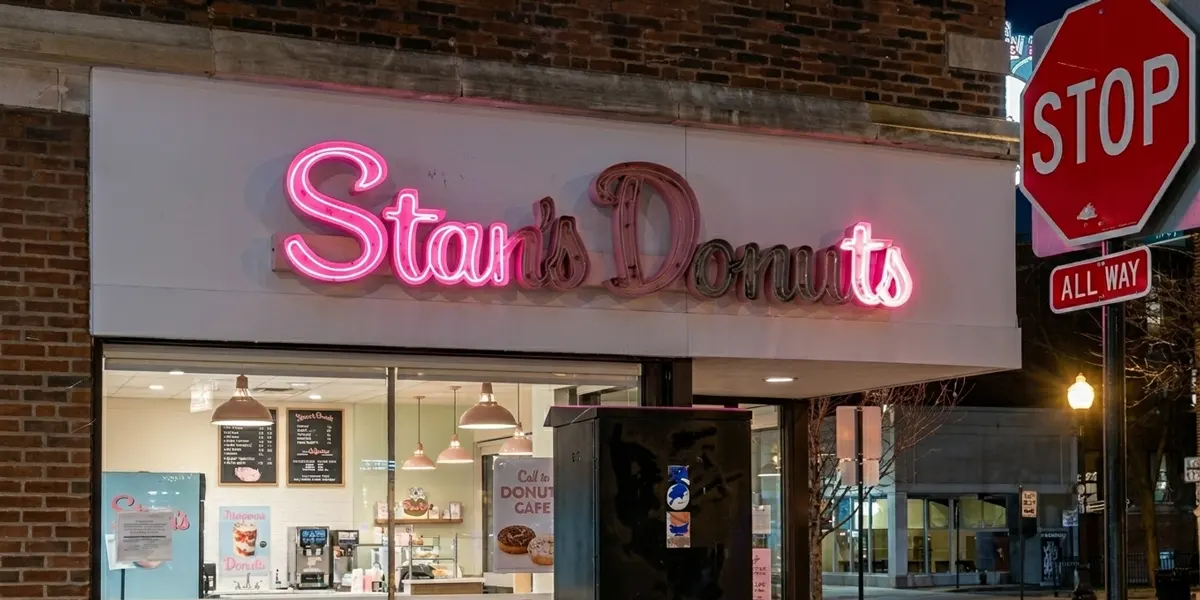
You might be tempted to choose IP65 for outdoor LED neon signs—after all, it’s often referred to as “waterproof.” But the reality is far from that.
A big data analysis of outdoor LED fixture failures (covering 4,200 installation records over three years) revealed that in rainy regions, the annual failure rate for IP65 fixtures reached as high as 14.7%, while IP66 fixtures dropped to 7.9%.
Many buyers assume that IP65 means the product can withstand all water-related hazards. This is incorrect. IP65 only protects against low-pressure water jets. However, during severe typhoons, hurricanes, or blizzards, wind-driven rain can blow horizontally or even upward. For regions prone to extreme weather, only a fully sealed structure that truly meets IP67 standards provides the only reliable engineering guarantee.
Three Major Reasons IP65 Fails in Outdoor Environments
1. Surface-Level Protection Only: Many IP65 LED strips use only a single layer of silicone tubing or a thin surface coating. Water can easily enter through cut ends, connection points, or damaged tubing.
2. Long-Term Moisture Intrusion: Moisture and condensation seep through microscopic gaps that surface treatments cannot seal, eventually causing circuit failure.
3. Zero Immersion Resistance: When exposed to standing water, rainwater backflow, or even high-pressure water jets near signage, IP65 products will short-circuit and fail as soon as water briefly contacts the internal circuitry.
For any truly outdoor-exposed waterproof neon sign—whether on building facades, street-facing storefronts, or garden installations near sprinklers or water features—IP65 is insufficient. The slight cost savings cannot offset the risk of premature failure.
The Silicone Sealing Process That Determines True Protection Capability
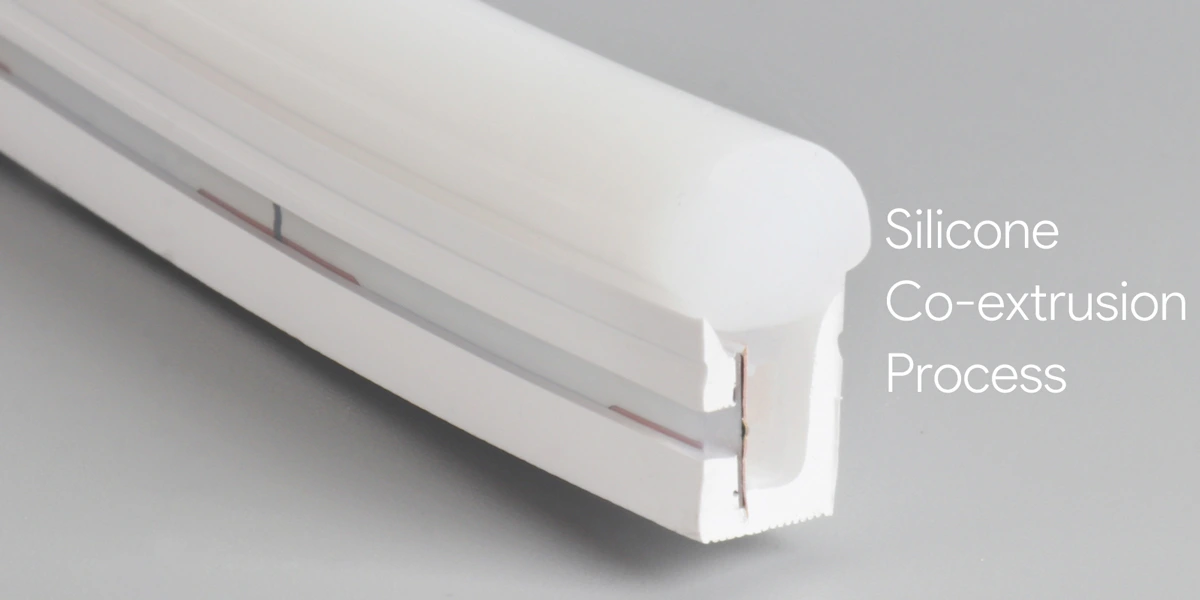
Not all waterproof neon lights are manufactured the same way. The method used to seal the LED circuitry directly determines whether the product can achieve its claimed IP rating.
Common Waterproofing Methods Compared
| Method | IP Achievable | Description | Weakness |
| PVC sleeve + end caps | IP65 | LED strip inserted into hollow PVC tube, caps sealed | Water enters at ends; PVC yellows outdoors |
| Silicone sleeve + end caps | IP65–IP66 | Same design but with silicone sleeve | Still relies on end-cap seals; not fully potted |
| Surface coating (drip-glue) | IP65–IP66 | LED PCB coated on top side only | Back side vulnerable; no full encapsulation |
| Extrusion potting / solid silicone | IP67–IP68 | LED circuit fully encased in solid silicone via extrusion | Higher material cost; premium durability |
Why Silicone Is Critical
Material selection is equally critical. Among the three primary neon tube materials (PVC, PU, silicone), silicone significantly outperforms the others in outdoor performance:
| Property | PVC | PU | Silicone |
| UV resistance | Poor (degrades/yellows) | Moderate | Excellent |
| Temperature range | –20°C to 60°C | –20°C to 80°C | –50°C to 200°C+ |
| Outdoor lifespan | 8,000–15,000 hours | Moderate | 50,000–100,000 hours |
| Flexibility | Moderate | Moderate | Excellent |
Solid silicone and PU can achieve high waterproof ratings (IP67/IP68), whereas hollow PVC has limited water resistance. The service life of silicone neon tubing is typically around 50,000 hours, while PVC products last only about 8,000–15,000 hours under outdoor conditions.
Silicone also offers excellent UV resistance, avoiding the yellowing and cracking issues that PVC products experience under prolonged sun exposure. For commercial buyers, explicitly specifying solid silicone extrusion rather than PVC tubing during the selection process is the most effective step to ensure the long-term reliability of outdoor LED neon tubes.
SignliteLED’s IP67 LED neon flex tubing is manufactured from high-grade silicone that remains flexible even under extreme temperatures; it uses UV-resistant materials that will not crack or yellow after years of exposure; and it fully seals the LED circuitry through an all-silicone extrusion process, preventing moisture intrusion.
Waterproof LED Drivers Are Equally Crucial
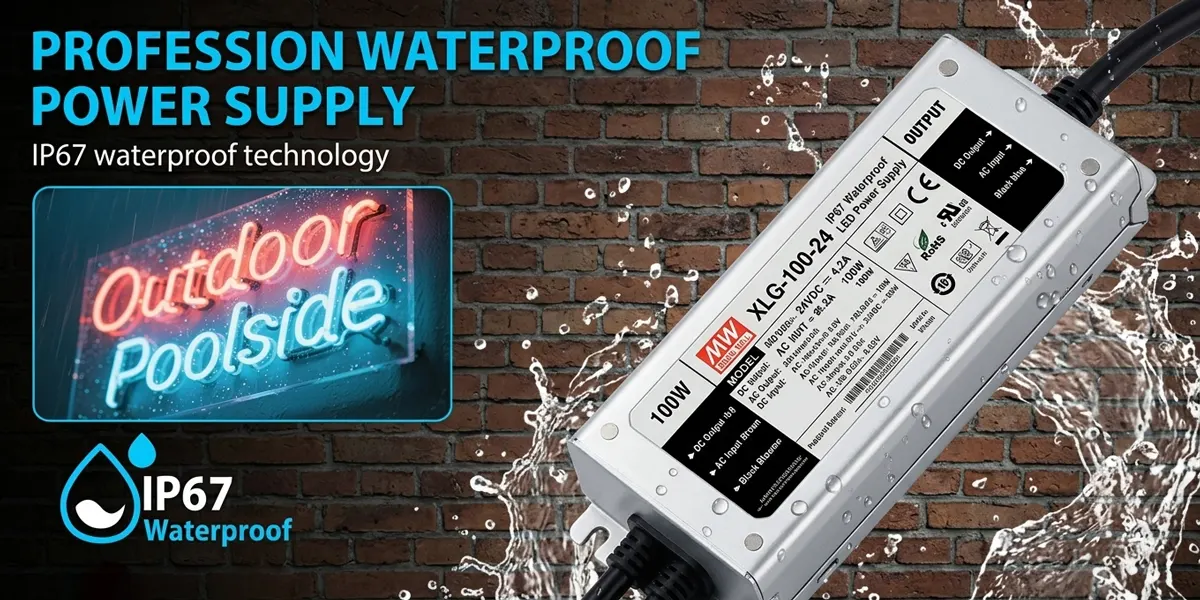
Here’s a truth you won’t find in many product specifications: a waterproof LED strip is worthless if the LED driver fails after six months.
The driver (LED power supply) is responsible for converting mains power into safe, low-voltage DC power (typically 12V or 24V), and it must be just as waterproof as the strip itself. Never use indoor, non-waterproof drivers in outdoor LED neon projects.
Minimum Specifications for Commercial Outdoor Drivers
| Requirement | Why It Matters |
| IP67 rated or higher | Prevents moisture from reaching internal circuitry |
| Constant current design | Maintains consistent LED brightness and prevents premature degradation |
| Over-current / short-circuit protection | Protects against power surges and installation faults |
| UL / CE / EN61347 certified | Ensures compliance with international safety standards |
| 5-year warranty | Indicator of manufacturer confidence in reliability |
According to safety regulations, in North America, only UL 676-certified fixtures are accepted by NEC/NFPA 70 for use in swimming pools or similar environments—this underscores that certification is just as important as the IP rating.
When evaluating suppliers for your IP67 neon lighting project, be sure to request the driver specifications separately. A high-grade IP67 neon strip paired with a low-grade or uncertified LED driver will significantly diminish the overall value of the system.
The Best Choice for Commercial Projects
Decision Matrix by Project Type
| Project / Environment | Recommended IP Rating | Material | Rationale |
| Sheltered awning / covered terrace | IP65 | Silicone sleeve | Occasional rain exposure only |
| Building facade (standard exposure) | IP67 | Solid silicone extrusion | Optimal balance: rain-resistant, dust-tight, cost-effective |
| Street-front retail signage | IP67 | Solid silicone extrusion + UV-stabilized | Constant weather exposure demands full sealing |
| Coastal installation (within 50m of shore) | IP67 or IP68 | Silicone extrusion with anti-corrosion rating | Salt spray rapidly corrodes lower grades |
| Areas with frequent heavy storms / flooding | IP67 | Solid silicone extrusion | Can survive temporary submersion |
| Restaurant terrace / outdoor bar | IP67 | Solid silicone extrusion | Handles spills, cleaning, and rain |
| Fountain edge / near water features | IP67 | Solid silicone extrusion | Splash and brief immersion protection |
| Permanent underwater (pool / fountain) | IP68 | Reinforced silicone extrusion | Continuous immersion requires IP68 |
| Event / temporary outdoor signage | IP65 | Cost-optimized | Short-term exposure may accept lower IP |
| Sheltered awning / covered terrace | IP65 | Silicone sleeve | Occasional rain exposure only |
Engineering Recommendations
For the vast majority of commercial outdoor LED neon projects—building facades, retail signage, restaurant patios, garden lighting, and architectural accent lighting—IP67 solid silicone extruded products are the optimal choice.
Why IP67? It offers the same dust protection as IP65 while adding genuine protection against brief immersion. Its fully filled silicone construction eliminates the risk of water ingress that inevitably occurs in IP65 products after long-term use. Furthermore, its cost is significantly lower than that of IP68 products, which are often over-specified for non-submersible applications.
For most outdoor lighting applications (signage, patios, and gardens), IP67 strikes the ideal balance: it offers more reliable protection against rain than IP65 yet is more cost-effective than IP68.
In-Depth Analysis: Why Does Silicone Excel in Outdoor Applications?
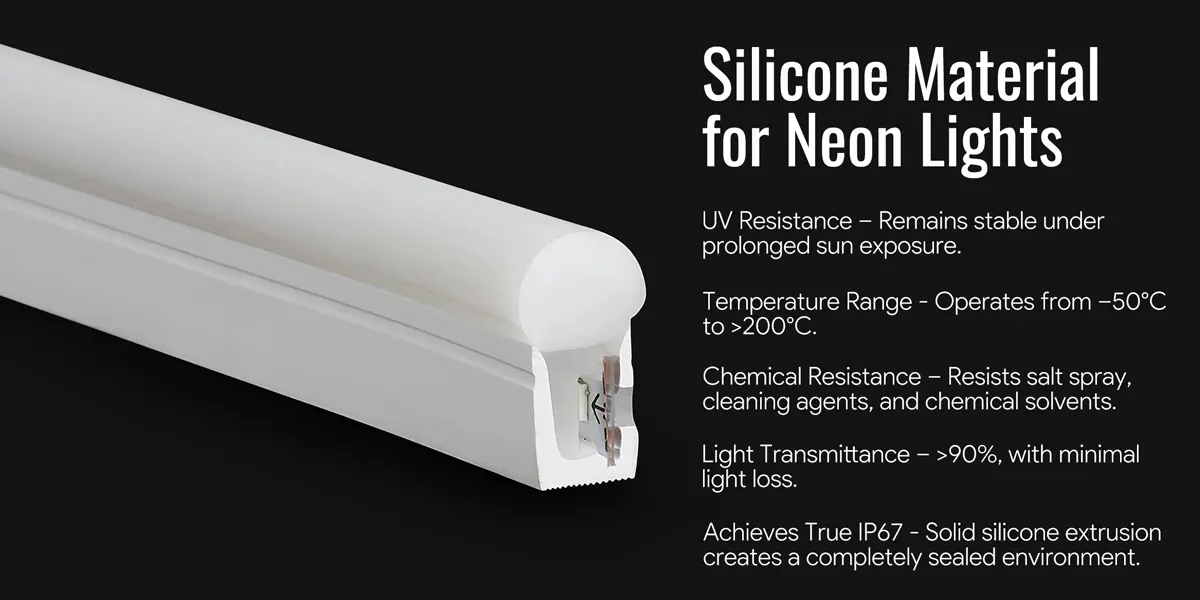
When selecting outdoor LED neon lights, the debate between silicone and PVC is not merely an academic discussion—it directly impacts project lifespan and total cost of ownership.
Comprehensive Material Comparison
| Material | Outdoor Durability | Flexibility | Cost | Best Application |
| PVC | ❌ Poor | Moderate | Low | Indoor / short-term indoor-outdoor |
| PU | Moderate | Moderate | Medium | Damp indoor environments |
| Silicone | ✅ Excellent | Excellent | Higher (2–3× PVC) | Outdoor, extreme weather, high-end applications |
Key reasons why silicone is a worthwhile investment for commercial outdoor applications:
- UV resistance – Remains stable under prolonged sun exposure; PVC yellows and becomes brittle.
- Temperature Range – Operates from –50°C to >200°C; PVC fails in freezing or extreme heat.
- Chemical Resistance – Resists salt spray, cleaning agents, and chemical solvents.
- Light Transmittance – >90%, with minimal light loss.
- Achieves true IP67/IP68 – Solid silicone extrusion creates a completely sealed environment.
For a waterproof neon sign that will operate outdoors for years, silicone is not merely a “premium material” but the most cost-effective engineering choice. The higher initial material cost is offset by significantly reduced replacement, maintenance, and downtime costs over the entire lifecycle.
Best Practices for Maintaining IP Integrity During Installation
Even LED strip lights with the highest IP ratings rely heavily on installation quality for their protective effectiveness. The following practices are essential for maintaining the waterproof integrity of your outdoor LED neon lights:
1. Use a “drip bend” for power cables: When power cables enter a junction box or driver housing, create a downward bend just before the entry point. This prevents rainwater from “siphoning” along the wire into the electronic components.
2. Never rely solely on waterproof tape: Most waterproof tapes lack IP certification and cannot withstand water pressure over the long term. In buried, underwater, or persistently damp environments, tape cannot maintain IP67/IP68 integrity.
3. Use IP67 or higher-rated enclosures for drivers and control boxes: The driver is part of the system and must be treated accordingly. If the driver is placed in a box with a lower protection rating, the entire IP67 system is compromised.
4. Ensure proper end sealing: For connections at cut ends, always use the manufacturer-specified waterproof connectors instead of improvising on-site.
5. Test before installation: Perform a brief power-on test on the light strip before installation. If it fails upon first power-up, this indicates a defect that will worsen further in the field.
Conclusion
When selecting the appropriate IP rating for outdoor LED neon signs, the goal is not to blindly pursue the highest rating—but rather to match the protection level to the actual environmental requirements.
- IP65: Suitable for sheltered or intermittent use only. Not recommended for fully exposed commercial outdoor installations.
- IP67: The ideal choice for most commercial outdoor signage and facade projects: dust-tight, capable of temporary immersion, cost-effective, and reliable for over 50,000 hours when manufactured in solid silicone.
- IP68: Required only for applications involving continuous underwater exposure (fountains, swimming pools, submerged installations). Often over-specified for standard outdoor signage.
For commercial buyers and project engineers, the decision-making framework is straightforward:
- For any outdoor signage, facades, patios, or garden installations that will be exposed to rain, snow, moisture, or cleaning operations, specify IP67 silicone extrusion products.
- Require a solid silicone construction (rather than PVC sleeving) to ensure UV resistance and temperature tolerance.
- Ensure that the driver is also IP67-rated and holds UL/CE/EN61347 certification.
- Ask suppliers for material specifications, not just the IP rating. IP67 achieved through PVC tubing is not the same as IP67 achieved through solid silicone extrusion.
- Ensure that installation best practices are followed—drip loops, sealed connectors, and appropriate enclosures.
- When you choose an IP67 silicone neon tube from a supplier with expertise in both materials engineering and environmental reliability, you’re purchasing more than just a sign. You’re investing in a long-term, reliable lighting asset.
For technical specifications, custom neon sign project quotes, or environmental assessments, contact the SignliteLED engineering team to discuss your specific requirements—including local climate conditions, installation location, and expected service life.
Frequently Asked Questions (FAQ)
Related Posts