诸言
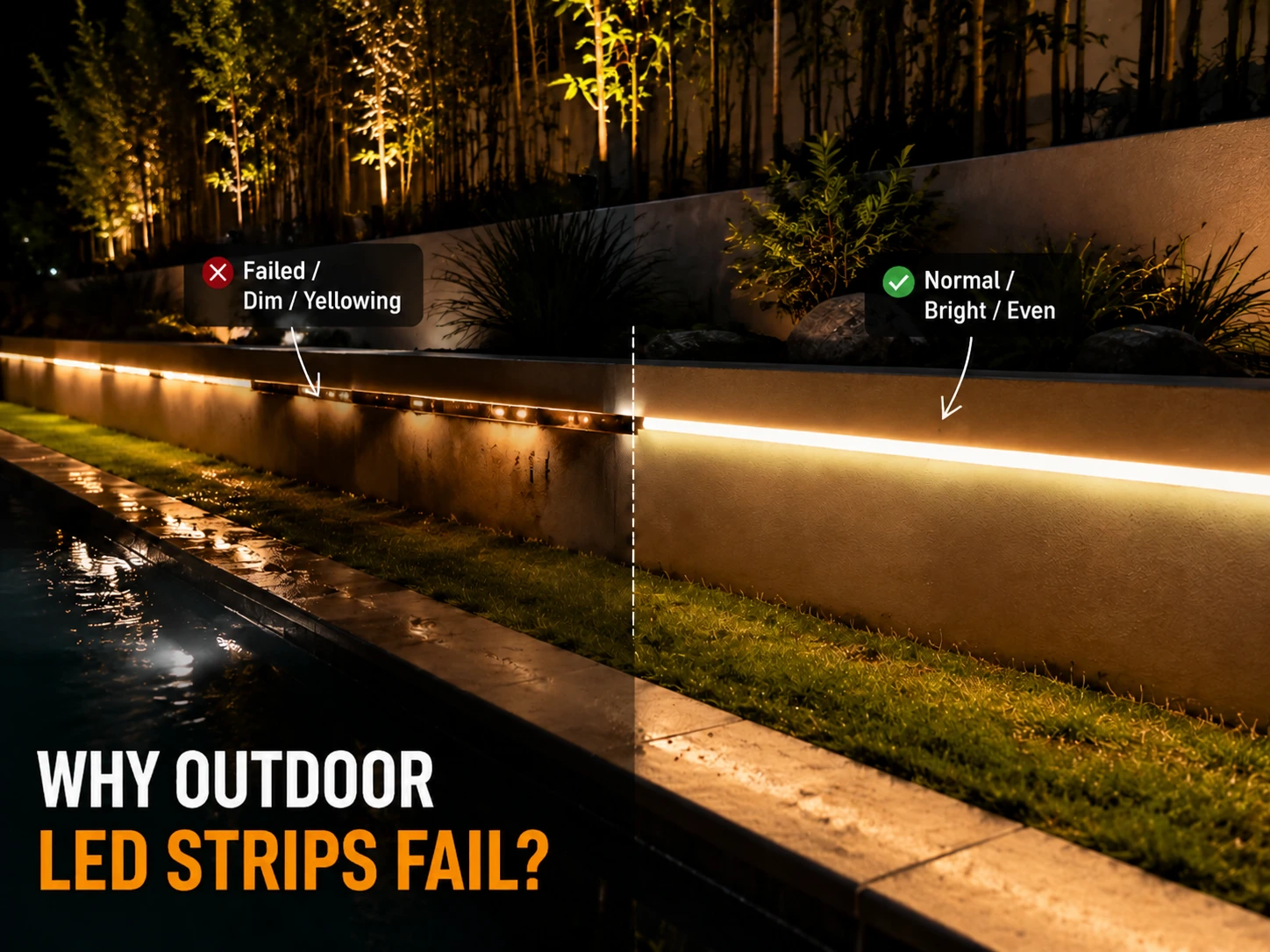
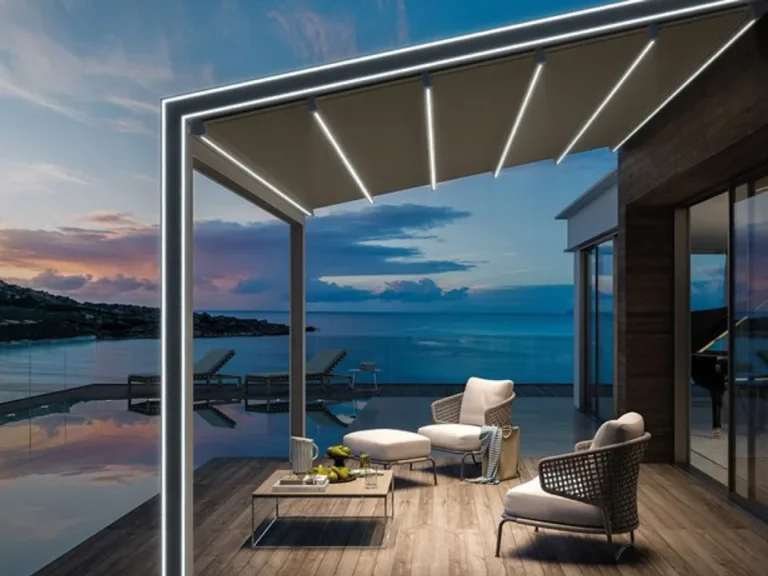
户外 LED 灯条 are flexible lighting systems designed to withstand rain, sunlight, temperature changes, and other outdoor conditions. They are widely used for outdoor strip lighting in patios, gardens, facades, pathways, and pool areas, but their real-world lifespan depends far more on installation quality and environmental protection than on LED chips alone.
If you installed outdoor LED strip lights expecting them to last for years and they failed within twelve months, you’re not alone—and the cause is rarely the LEDs themselves. Most failures result from moisture ingress, UV degradation, poor heat dissipation, low-quality power supplies, or installation mistakes. Many buyers assume waterproof LED strip lights with an IP65 or IP67 rating will survive for years without problems, but IP ratings only reflect performance under controlled laboratory testing—not prolonged exposure to sunlight, rain, thermal cycling, and outdoor weather.
This guide explains the seven most common causes of premature failure, the warning signs to watch for before a strip stops working completely, and the key factors to consider when choosing outdoor LED strip lights that can realistically last five years or longer.
快速回答
Most outdoor LED strip lights do not fail because of defective LED chips. Instead, premature failures are usually caused by water ingress, UV damage, poor heat dissipation, unstable power supplies, weak connectors, or incorrect wiring design. While LED chips are commonly rated for more than 50,000 hours, the surrounding materials, waterproof seals, drivers, and installation methods often determine the actual service life.
For most outdoor installations, choosing high-quality waterproof materials, proper heat management, and suitable installation practices has a much greater impact on longevity than simply selecting a higher IP rating.
| 惹 | Estimated Share of Failures |
| 水进入 | 35% |
| UV degradation | 20% |
| 热积聚 | 15% |
| 电源故障 | 15% |
| Poor connectors | 10% |
| Other factors (wiring, voltage drop, physical damage) | 5% |
Common Symptoms Before Failure
Before a strip fails outright, it usually shows warning signs. Matching the symptom you’re seeing to its likely cause can help you catch the problem early, before it spreads to the rest of the run.
| 症侯 | 最有可能的原因 | Covered In |
| Strip doesn’t light up at all | Power supply failure, damaged connector, or broken circuit | Failure #4, #6 |
| Turns off by itself, then comes back on later | Thermal protection triggering, unstable power supply, loose connection | Failure #3, #4 |
| Hot to the touch, especially near the driver | Inadequate heat dissipation, no aluminum channel, undersized driver | Failure #3 |
| Dimming, yellowing, or color shift over months | UV degradation of the silicone/PVC jacket, LED lumen depreciation | Failure #2 |
| Several strips on the same run fail around the same time | Shared power supply or wiring fault, not a coincidence of LED defects | Failure #4, #7 |
| Visible corrosion, green residue, or discoloration on the PCB | Moisture ingress combined with salt air or high humidity | Failure #5 |
| Flickering, especially at the far end of a long run | Voltage drop or undersized power injection | Failure #7 |
| Section near a connector or end cap fails first | Weak point in the waterproofing, not a strip-wide defect | Failure #1, #6 |
If your symptom isn’t reflected in the LED chips themselves but in the strip going dark in sections, flickering intermittently, or failing near a joint, the chips are very likely fine—the failure point is almost always somewhere in the surrounding system: the seal, the connector, the driver, or the wiring design.
Why Outdoor LED Strip Lights Usually Fail Before Their Rated Lifespan
Manufacturers often advertise outdoor LED strip lights with lifespans of 50,000 hours or more, but this figure represents a theoretical lifespan measured under controlled laboratory conditions. The real-world lifespan of an outdoor lighting system is often much shorter because the entire installation—not just the LED chips—is exposed to sunlight, rain, humidity, temperature changes, and electrical stress every day.
Most lifespan claims are based on LM-80 testing, which measures how well LED chips maintain their brightness over time. The commonly quoted L70 value means the LEDs are expected to retain at least 70% of their original light output after a specified number of operating hours. These standards evaluate LED performance—not the long-term durability of waterproof seals, connectors, drivers, or installation materials.
Theoretical Lifespan vs. Real-World Lifespan
| Theoretical Lifespan | Real-World Lifespan |
| Based on LM-80 and L70 testing | Based on actual outdoor conditions |
| Focuses on LED chip performance | Depends on the entire lighting system |
| Tested under controlled laboratory conditions | Affected by weather, installation, and maintenance |
| Assumes ideal operating conditions | Influenced by UV, heat, moisture, and wiring quality |
This difference explains why two outdoor LED strip lights with similar LED chips can have completely different service lives. In real outdoor environments, several external factors shorten lifespan long before the LEDs wear out.
In other words, when outdoor LED strip lights fail after only one or two years, the LEDs are rarely the primary problem. Most failures originate elsewhere in the lighting system. The following seven failure modes explain where these problems occur and how to prevent them. (For a deeper look at how LED lifespan ratings are calculated and what factors shorten them in real installations, see our guide on how long outdoor LED strip lights actually last.)
Failure #1 — Water Ingress Through Weak Seals
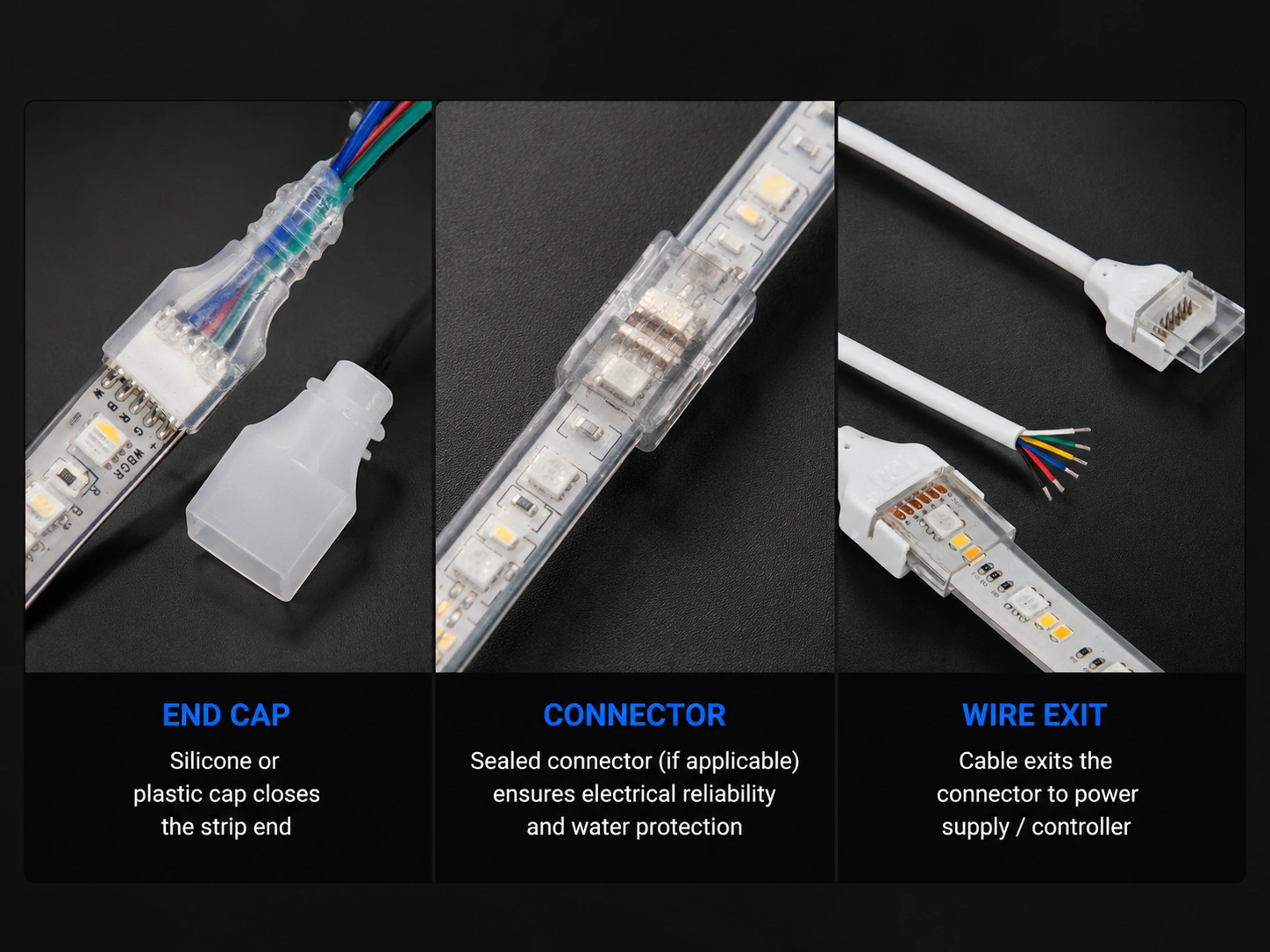
Water ingress is the leading cause of premature outdoor LED strip lights failure. In most cases, water does not pass through the silicone covering itself—it enters through weak sealing points such as end caps, wire exits, and connectors, where repeated expansion, contraction, and weather exposure gradually weaken the original seal.
Why IP Ratings Alone Aren’t Enough
An IP rating measures resistance to water and dust during standardized laboratory testing—it does not guarantee long-term outdoor durability. An IP67 rating, for example, means a product survived temporary submersion in up to one meter of fresh water for thirty minutes under controlled conditions, with no UV exposure, thermal cycling, or mechanical stress.
What happens outdoors is very different. Daily expansion and contraction caused by changing temperatures gradually weaken seals, while prolonged sunlight accelerates material aging. A strip can pass an IP67 test yet still develop leaks within a year because the rating reflects a one-time laboratory test rather than years of outdoor use.
Two outdoor LED strip lights carrying the same IP rating can therefore have very different service lives. In many cases, long-term reliability depends more on sealing quality and manufacturing consistency than on the IP number itself. (For a full breakdown of IP65, IP67, and IP68 ratings and which one fits your installation, see our complete guide to outdoor LED strip waterproof ratings.)
Common Waterproofing Weak Points
Water rarely enters through the silicone jacket itself. Instead, most failures begin at three vulnerable sealing points:
- End caps – The most common failure point. Tiny gaps left by insufficient adhesive or poor sealing allow moisture to enter during repeated heating and cooling cycles.
- Wire exits – Where power cables pass through the silicone jacket, the seal is constantly stressed by movement, UV exposure, and temperature changes, making it prone to cracking over time.
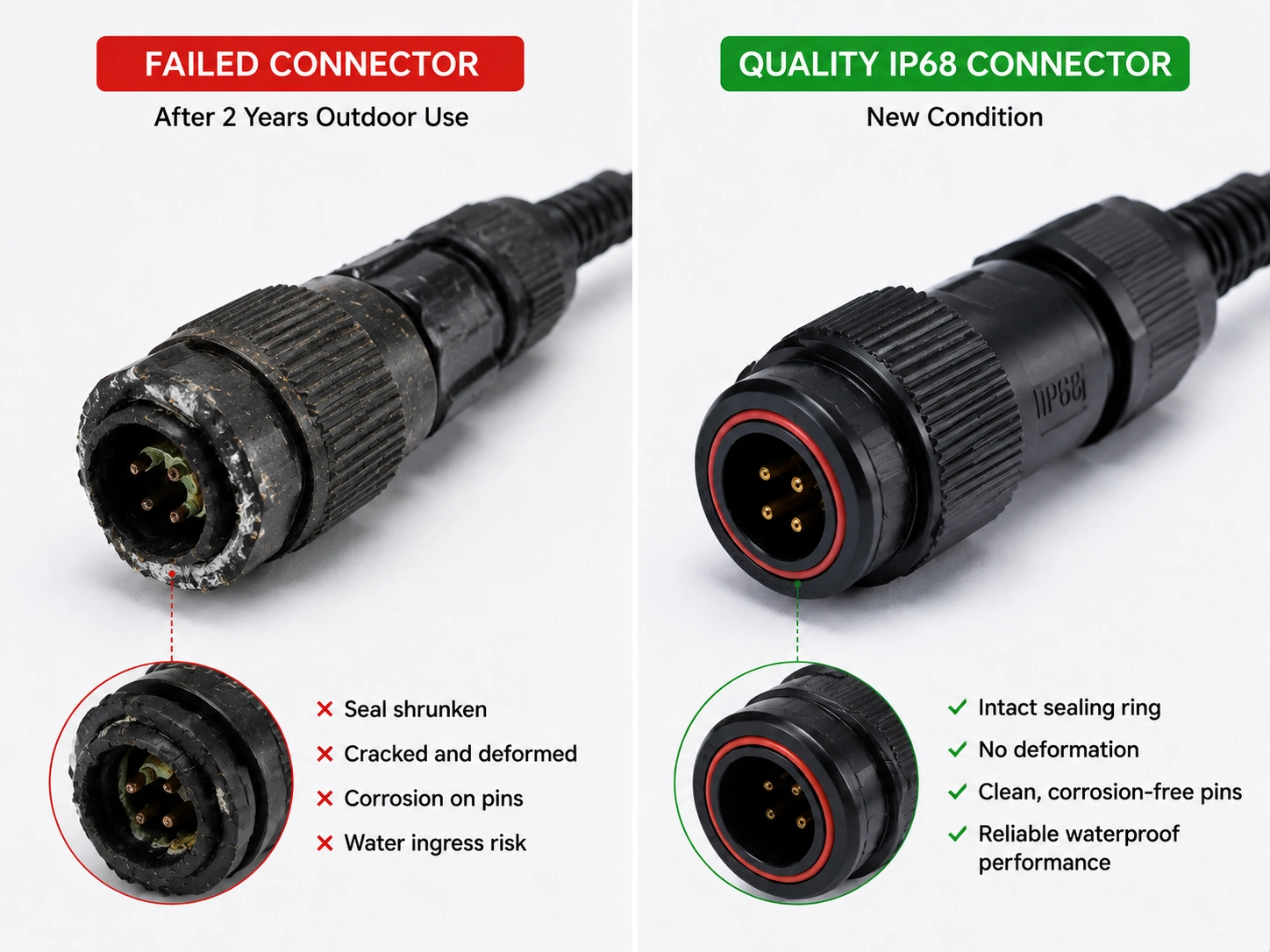
- 连接器 – Indoor quick-connect fittings are often used outdoors for convenience but usually lack the long-term sealing performance needed for continuous exposure to rain and sunlight.
How to Prevent Water Ingress
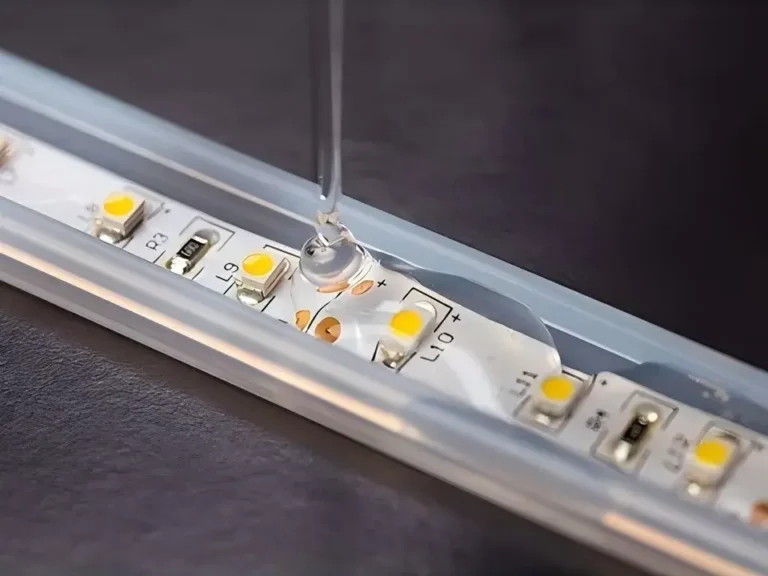
- Choose fully potted outdoor LED strip lights instead of surface-coated designs whenever possible.
- Apply outdoor-rated silicone sealant to end caps and wire exits, even if they are factory sealed.
- Use connectors specifically designed for long-term outdoor use, preferably with IP68 protection where exposure is severe.
- Position connectors and cable joints away from areas where rainwater or standing water can accumulate.
- Inspect seals periodically, especially after long periods of strong sunlight or seasonal temperature changes.
Following these simple installation practices significantly improves long-term waterproof performance without increasing installation complexity. (For a deeper walkthrough of selecting waterproof strips by project type—pools, facades, gardens—see our guide to choosing waterproof LED strip lights for outdoor projects.)

Failure #2 — UV Damage to Silicone and PVC Materials
UV degradation is the gradual breakdown of protective materials caused by long-term exposure to sunlight. For outdoor LED strip lights, UV damage affects the silicone or PVC jacket long before it damages the LEDs themselves. Once these protective materials lose flexibility or develop cracks, moisture can enter the strip and significantly shorten its service life.
How UV Exposure Damages LED Strips
Many outdoor lighting failures begin long before visible damage appears. Ultraviolet radiation gradually breaks down the molecular structure of silicone and PVC, reducing their flexibility and weather resistance over time. By the time yellowing, clouding, or surface cracks become noticeable, the material has often already lost much of its protective performance.
This process is accelerated in regions with intense sunlight, south-facing installations, and locations without shade, making UV exposure one of the most important factors affecting long-term outdoor durability..
PVC vs Silicone: Which Lasts Longer Outdoors?
| 特点 | 聚氯乙烯 | 硅胶 |
| 抗紫外线 | 老实地 | 优秀 |
| 随时间推移的灵活性 | Decreases quickly | Remains stable longer |
| Risk of cracking | 更高 | 较低 |
| Typical outdoor lifespan | 1–2 years in strong sunlight | 3–5+ years under similar conditions |
| Best application | Covered or shaded areas | Direct outdoor exposure |
关键要点: For installations exposed to direct sunlight, silicone provides significantly better long-term durability than PVC, even when both products have similar IP ratings.

Early Signs of UV Damage
Watch for these warning signs before waterproof performance is compromised:
- Yellowing or clouding of the protective jacket
- Reduced flexibility when bending the strip
- Fine surface cracks around bends or end caps
- Visible cracking that exposes internal components
Once cracking appears, the waterproof barrier has already been weakened, making moisture ingress much more likely. Replacing the strip at this stage is usually more cost-effective than waiting for electrical failure.
How to Minimize UV Damage
✓ Choose silicone-encapsulated outdoor LED strip lights for areas with direct sunlight.
✓ Avoid prolonged exposure where partial shading or protective mounting is available.
✓ Inspect jackets periodically for yellowing or surface cracks.
✓ Replace damaged sections before moisture reaches the internal PCB.
关键要点: UV damage usually begins months before it becomes visible. Regular inspection helps prevent small material defects from developing into complete strip failures.
Failure #3 — Heat Build-Up from Poor Installation
Heat buildup occurs when outdoor LED strip lights cannot dissipate heat efficiently. Excessive operating temperatures accelerate the aging of LEDs, drivers, adhesives, and protective materials, reducing the lifespan of the entire lighting system rather than the LEDs alone.
Outdoor installations often experience much harsher thermal conditions than indoor applications. Direct sunlight, dark mounting surfaces, and enclosed spaces can raise operating temperatures well above the surrounding air temperature. Even high-quality outdoor LED strip lights may overheat if the installation prevents heat from escaping efficiently.
When excessive heat builds up, drivers and protective materials usually deteriorate faster than the LED chips themselves, leading to intermittent shutdowns, brightness loss, or premature system failure. (This is also a key reason indoor and outdoor strips aren’t interchangeable—see our breakdown of how COB LED strips differ between indoor and outdoor use for more on how moisture exposure and temperature variation affect long-term performance.)
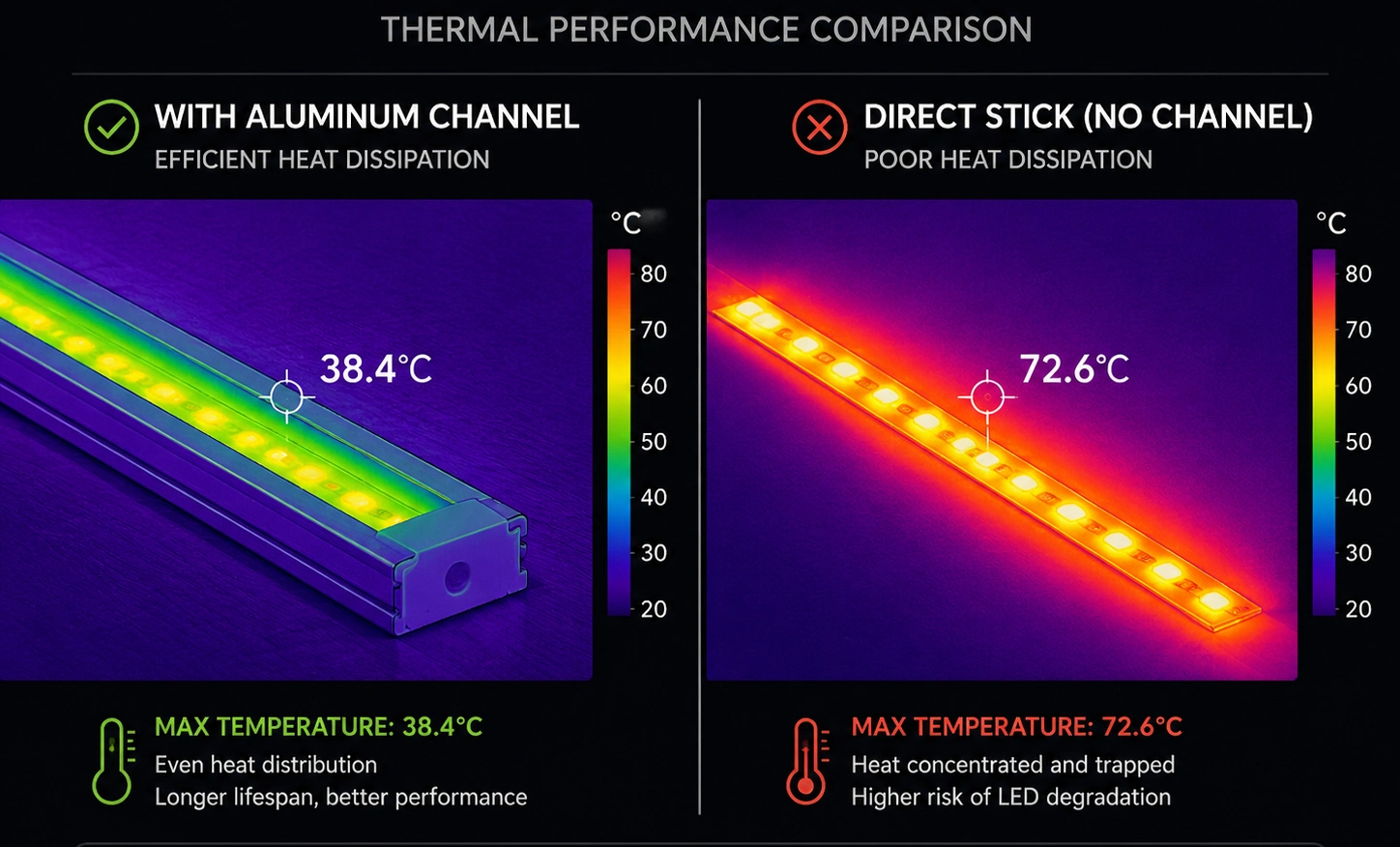
Why Aluminum Profiles Improve Lifespan

An aluminum profile for LED strips acts as a heat sink, drawing heat away from the PCB and LEDs while allowing it to dissipate into the surrounding air. Compared with mounting strips directly onto wood, plastic, or other insulating surfaces, aluminum profiles significantly reduce operating temperature and improve long-term reliability.
Besides improving heat dissipation, aluminum profiles also provide mechanical protection, helping reduce damage caused by accidental impacts and environmental exposure. For most outdoor installations, they are one of the simplest and most cost-effective upgrades for extending service life. (For a closer look at profile selection, see our guide to Aluminum LED Profiles.)
Heat Management Checklist
✓ Install outdoor LED strip lights in aluminum profiles whenever possible.
✓ Leave ventilation space around enclosed channels instead of completely sealing them.
✓ Avoid mounting strips directly onto dark surfaces that absorb and retain heat.
✓ Select a power supply with at least 20% spare capacity instead of operating continuously at full load.
✓ Keep drivers away from enclosed areas where heat can accumulate.
关键要点: Good heat management not only protects LED chips—it also extends the lifespan of drivers, waterproof materials, and electrical connections, reducing the likelihood of premature outdoor failures.
Failure #4 — Low-Quality Power Supplies and Drivers
The power supply is one of the most common failure points in an outdoor LED strip lighting system. While LED chips usually degrade gradually over many years, drivers and power supplies contain electronic components that are much more vulnerable to heat, moisture, and voltage fluctuations. When several outdoor LED strip lights fail at the same time, the shared power supply is often the first component to inspect.
Many users assume a dark LED strip means the LEDs have failed. In reality, power supplies typically wear out much sooner because capacitors and other electronic components are sensitive to high temperatures, humidity, and unstable electrical conditions. Outdoor drivers experience additional stress from weather exposure and daily temperature fluctuations, making proper driver selection just as important as choosing high-quality LED strips.

Common Signs of a Failing Power Supply
If the following symptoms affect multiple strips or appear across an entire installation, the driver is more likely to be the problem than the LEDs.
- Random flickering, especially after the system has been running for some time
- Brightness changes without adjusting the controller or dimmer
- Several strips failing simultaneously on the same power supply
- Only part of a lighting run working while other sections remain dark
- Intermittent shutdowns that recover after cooling
How to Select Outdoor-Rated Drivers
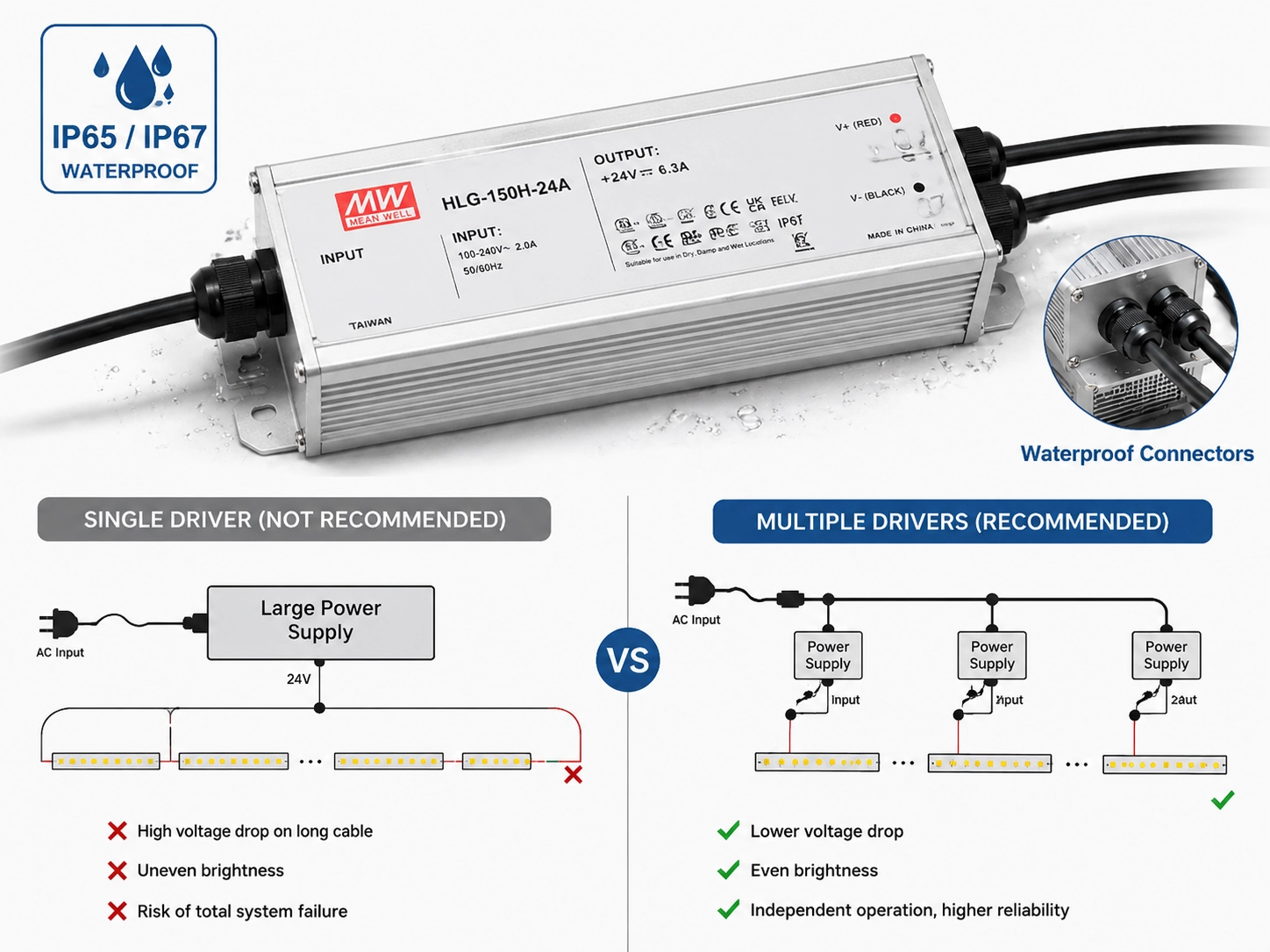
✓ Select drivers specifically designed for outdoor use with IP65 or higher protection.
✓ Leave at least 20% power headroom to reduce long-term thermal stress.
✓ For large projects, divide the load across multiple drivers instead of relying on a single unit.
✓ Install drivers in well-ventilated locations away from standing water and excessive heat.
✓ Match the driver’s voltage and output specifications to the LED strip manufacturer’s recommendations. (If you’re unsure whether your LED strip setup requires a dedicated driver or how to match one correctly, see our guide on when and how to choose the right driver for LED strips.)
关键要点: A high-quality outdoor driver can significantly extend the lifespan of the entire lighting system and reduce the risk of multiple strips failing at once.
Failure #5 — Corrosion of PCB Copper and Solder Joints
Corrosion occurs when moisture and oxygen gradually attack exposed metal components inside an LED strip. In outdoor environments, especially near the coast or in areas with consistently high humidity, corrosion can damage copper traces and solder joints long before the LED chips reach the end of their rated lifespan.

Where Corrosion Happens Most Often
Not all outdoor installations face the same level of corrosion. The following environments require additional protection:
- Coastal locations – Salt carried by sea air accelerates oxidation and increases the likelihood of corrosion at connectors, end caps, and exposed copper traces.
- High-humidity regions – Frequent condensation and prolonged humidity can gradually damage inadequately sealed PCB assemblies.
- Pool and waterfront installations – Moisture combined with chlorine or salt creates a more aggressive environment than ordinary rainfall.
Even when outdoor LED strip lights meet the same IP rating, installations in these environments usually require higher-quality sealing and corrosion-resistant construction.
ASTM B117 Salt Spray Test Results
Salt spray testing provides a more realistic measure of long-term coastal durability than IP ratings alone. Unlike IP tests, which evaluate water ingress under controlled conditions, ASTM B117 simulates prolonged exposure to salt-laden moisture and helps assess corrosion resistance in marine environments.
| ASTM B117 (336 Hours) | Fully Potted Strip | Surface-Coated / Hollow IP67 Strip |
| Visible corrosion | 一个也没有 | Copper oxidation and verdigris observed |
| Electrical failure | 一个也没有 | Localized failure after 48–72 hours |
| PCB protection | No saltwater ingress | Oxidation at solder joints |
These results show why fully potted LED strips generally provide better long-term performance in coastal and high-humidity installations. By encapsulating the PCB in silicone, they reduce the risk of salt-laden moisture reaching the copper circuitry. To see how COB LED strip quality differs between brands under extended stress conditions—including lumen maintenance and thermal stability measured across 2,200 hours of continuous operation—see our 2200-hour COB LED strip durability test report.
Failure #6 — Poor Waterproof Connectors
Waterproof connectors are designed to protect electrical joints from moisture, but not all waterproof connectors provide the same level of long-term outdoor protection. Connector failure is often caused by aging seals, improper installation, or selecting connectors that are not intended for continuous outdoor exposure.
Even a connector that performs well when first installed can become a weak point over time. UV exposure, repeated temperature changes, and moisture gradually harden or shrink rubber seals, allowing water to enter through tiny gaps. In many cases, corrosion begins inside the connector long before any visible damage appears.
Installation location also matters. Connectors placed where rainwater collects are much more likely to fail than those installed in sheltered or well-drained positions.

Common Connector Installation Mistakes
The following installation errors account for most connector-related failures:
- Using indoor quick-connect connectors in outdoor applications.
- Installing connectors at the lowest point of a lighting run where water can collect.
- Relying only on the factory seal without adding additional outdoor-rated sealant.
- Leaving connectors exposed to direct sunlight and continuous weathering.
关键要点: Even high-quality connectors can fail prematurely if they are installed in the wrong location or without adequate sealing.
When to Use IP68 Connectors
Although IP67 connectors are suitable for many outdoor applications, IP68 connectors generally provide better long-term protection in locations exposed to heavy rain, irrigation systems, or standing water. Their sealing design is intended for more demanding environments, making them a better choice for gardens, pool surrounds, and landscape lighting.
Choosing the correct connector rating is only part of the solution—proper installation and additional sealing remain equally important. (For a step-by-step walkthrough of how to wire LED strips and connect them correctly for outdoor use, see our guide on how to wire LED strips with proper connectors.)
Failure #7 — Incorrect Voltage and Wiring Design
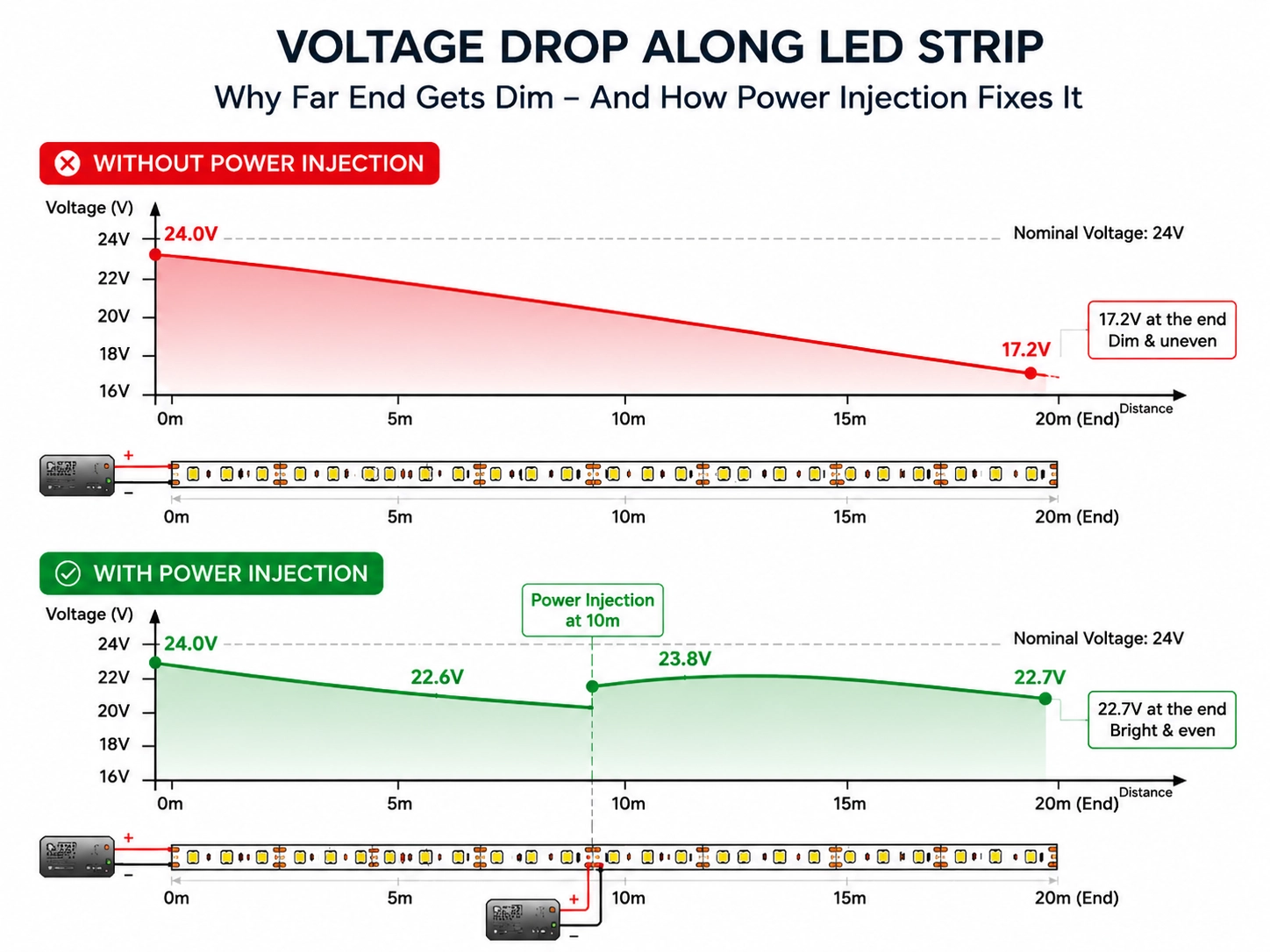
Voltage drop is the gradual loss of electrical voltage as power travels through a long LED strip. When the voltage reaching the far end becomes too low, outdoor LED strip lights may appear dimmer, flicker, or display inconsistent color—even though the LEDs themselves are functioning normally.
Voltage drop is one of the most common electrical issues in outdoor lighting because installations often require much longer cable runs than indoor projects. Fence lighting, building facades, landscape lighting, and perimeter illumination frequently exceed the recommended length for a single power feed.
As electrical resistance increases over distance, the far end of the strip receives less voltage than the section closest to the power source. The result is usually progressive dimming, color shift, or flickering rather than complete strip failure.

Common Symptoms of Voltage Drop
| 症侯 | 最有可能的原因 |
| Far end appears dimmer | 压降 |
| Flickering at the end of the strip | Insufficient power injection |
| 亮度不均 | Run exceeds recommended length |
| Color shift along the strip | Voltage loss over distance |
How to Prevent Voltage Drop
✓ Follow the manufacturer’s maximum recommended run length.
✓ Add power injection for long lighting runs instead of using a single power feed.
✓ Use appropriately sized cables to reduce electrical resistance.
✓ Divide large outdoor installations into multiple shorter circuits when practical.
✓ Verify voltage at the far end during installation before completing the project.
关键要点: Most voltage drop problems can be prevented during the design stage. Proper wiring and power distribution are far more effective than replacing LED strips after brightness problems appear. (For a detailed breakdown of voltage drop calculations and maximum run lengths, see our Voltage Drop in LED Strip Installations guide.)
How to Choose Outdoor LED Strip Lights That Last Longer
Choosing outdoor LED strip lights is about more than selecting the highest IP rating. Long-term reliability depends on the combined performance of waterproof construction, UV resistance, heat dissipation, power supply quality, and proper installation. Before making a purchase, evaluate the entire lighting system rather than focusing on a single specification.
Recommended Protection by Application
| 项目类型 | Minimum Protection | Additional Recommendation |
| Garden & Landscape | IP65 / IP67 | Aluminum profile for better heat dissipation |
| Building Facades | IP67 | Silicone-encapsulated strip with UV-resistant materials |
| Pool Areas | IP68 | Waterproof connectors and sealed cable joints |
| Coastal Installations | Marine-grade construction | Fully potted strip with ASTM B117 salt spray test data |
Outdoor LED Strip Buying Checklist
Before purchasing, check whether the product offers:
✓ Silicone encapsulation instead of basic surface coating
✓ UV-resistant materials for long-term outdoor exposure
✓ Aluminum profile compatibility for improved heat dissipation
✓ Outdoor-rated power supply with sufficient capacity
✓ IP68 connectors where water exposure is expected
✓ Salt spray test data for coastal applications
关键要点: Products that perform well in real outdoor environments combine durable materials, reliable electrical components, and proper installation—not just a high IP rating.
Real-World Installation Examples
Real-world projects often show that premature failures are caused by installation conditions rather than defective LED chips. The following examples illustrate how correcting the underlying issue—not simply replacing the strip—resulted in a more reliable outdoor lighting system.
Case 1: Coastal villa pool deck, installed Year 1, failed Month 14
A coastal pool deck installation using standard IP67 LED strips developed scattered dark sections after about 14 months. Inspection revealed corrosion around end caps and connectors caused by salt air and moisture rather than LED failure.
The system was upgraded with fully potted LED strips, aluminum profiles, and improved sealing at every connector. More than 18 months after the upgrade, no additional corrosion or electrical failures were observed.
Case 2: Rooftop green wall installation, installed Year 1, failed Month 9
A rooftop landscape project experienced intermittent shutdowns and flickering after 9 months of operation. Investigation found excessive heat buildup and voltage drop caused by poor mounting and a single overloaded power supply.
After adding aluminum profiles, introducing power injection, and dividing the load between two drivers, the original LED strips continued operating reliably without further failures.
Lessons Learned
Although the environments were very different, both projects reached the same conclusion:
- The LED chips were not the primary cause of failure.
- Installation quality had a greater impact than the IP rating alone.
- Correcting waterproofing, heat management, and power distribution solved the problem without changing the lighting design.
关键要点: Most outdoor LED strip failures can be prevented by addressing the installation system rather than simply replacing the LED strips.
结论
Most outdoor LED strip lights fail long before their advertised lifespan not because of defective LED chips, but because other components in the lighting system deteriorate first. Weak waterproof seals, prolonged UV exposure, excessive heat, low-quality power supplies, connector failures, corrosion, and poor wiring design all have a much greater impact on real-world reliability than the LEDs themselves.
The good news is that nearly all of these problems can be prevented. Choosing high-quality materials, installing strips in aluminum profiles, using outdoor-rated connectors and drivers, and following proper waterproofing practices can significantly extend the service life of an outdoor lighting system.
Whether you are designing architectural lighting, landscape illumination, or poolside installations, the best long-term results come from evaluating the entire system—not just comparing IP ratings or LED specifications. By focusing on construction quality, installation practices, and environmental protection, outdoor LED strip lights can realistically deliver reliable performance for five years or longer.
常见问题
Common Troubleshooting Questions
A failed power supply, damaged connector, or moisture reaching the PCB is far more likely than a defective LED chip. Before replacing the strip, check the driver, connectors, and wiring to identify the actual point of failure.
Intermittent shutdowns are usually caused by overheating or an unstable power supply. If the lights turn off after running for a period and work again once cooled, excessive heat or driver protection is the most likely cause.
Install the strip in an aluminum profile, provide adequate ventilation, and use a properly sized outdoor-rated power supply with spare capacity. Good heat dissipation protects not only the LEDs but also drivers, adhesives, and waterproof materials.
Quality outdoor LED strip lights are designed for continuous operation when installed correctly. Their lifespan depends more on heat management, waterproofing, and driver quality than on the number of hours they operate each day.
Outdoor LED strips gradually degrade because of UV exposure, heat, moisture, and corrosion rather than LED chip failure. Environmental conditions slowly weaken protective materials and electrical components, shortening the lifespan of the entire lighting system.
When multiple strips stop working simultaneously, the problem is usually a shared driver, power supply, or wiring fault instead of multiple LED failures. Check the power source before replacing individual strips.
This usually indicates voltage drop caused by a long lighting run. Adding power injection or reducing the run length helps maintain consistent brightness across the entire installation.
Buying & Installation Decisions
IP67 indicates protection against temporary water immersion under laboratory conditions, but it does not guarantee long-term outdoor durability. Waterproof performance also depends on sealing quality, connector design, and installation practices.
With quality materials, proper installation, and effective heat management, outdoor LED strip lights can operate reliably for five years or longer. In most cases, surrounding components fail before the LED chips reach their rated lifespan.
For installations exposed to direct sunlight or limited airflow, aluminum profiles significantly improve heat dissipation and extend service life. They also provide additional mechanical protection for the strip.
Yes. Long-term UV exposure gradually weakens silicone and PVC materials, increasing the risk of cracking and moisture ingress. Silicone-encapsulated strips generally provide better UV resistance than PVC designs.
Connectors usually fail because of aging seals, prolonged UV exposure, standing water, or improper installation. Choosing outdoor-rated connectors and sealing vulnerable joints helps improve long-term reliability.
Yes. Salt accelerates corrosion of exposed copper and solder joints, especially in coastal environments. Fully potted constructions and products supported by ASTM B117 salt spray testing generally provide better long-term corrosion resistance.
Look for fully potted construction, UV-resistant silicone encapsulation, IP68 connectors where appropriate, and, if available, ASTM B117 salt spray test data. Proper installation is equally important for maximizing service life.
Rain alone is rarely the problem. Most failures occur when water enters through poorly sealed end caps, connectors, or cable entry points after prolonged outdoor exposure.
Yes. Outdoor LED strip lights are designed for extended operation when paired with a properly sized driver and adequate heat dissipation. Continuous use has less impact on lifespan than poor installation or environmental exposure.