Nederlands
  English
  简体中文
简体中文  Deutsch
  Español
  Français
  Italiano
  日本語
日本語  한국어
한국어  Polski
  Português
  Русский
  Türkçe
  Tiếng Việt
  ไทย
ไทย 
invoering
Buiten LED-stripverlichting zijn flexibele verlichtingssystemen die zijn ontworpen om bestand te zijn tegen regen, zonlicht, temperatuurveranderingen en andere buitenomstandigheden. Ze worden veel gebruikt voor buitenstripverlichting in patio's, tuinen, gevels, paden en zwembadgebieden, maar hun reële levensduur hangt veel meer af van installatiekwaliteit en milieubescherming dan van LED-chips alleen. Voor architecten, aannemers en projecteigenaren gaat het kiezen van betrouwbare LED-striplampen voor buiten niet alleen over helderheid of IP-classificatie, het gaat om het waarborgen van prestaties op lange termijn, het verlagen van de onderhoudskosten en het vermijden van voortijdige vervanging na de installatie.
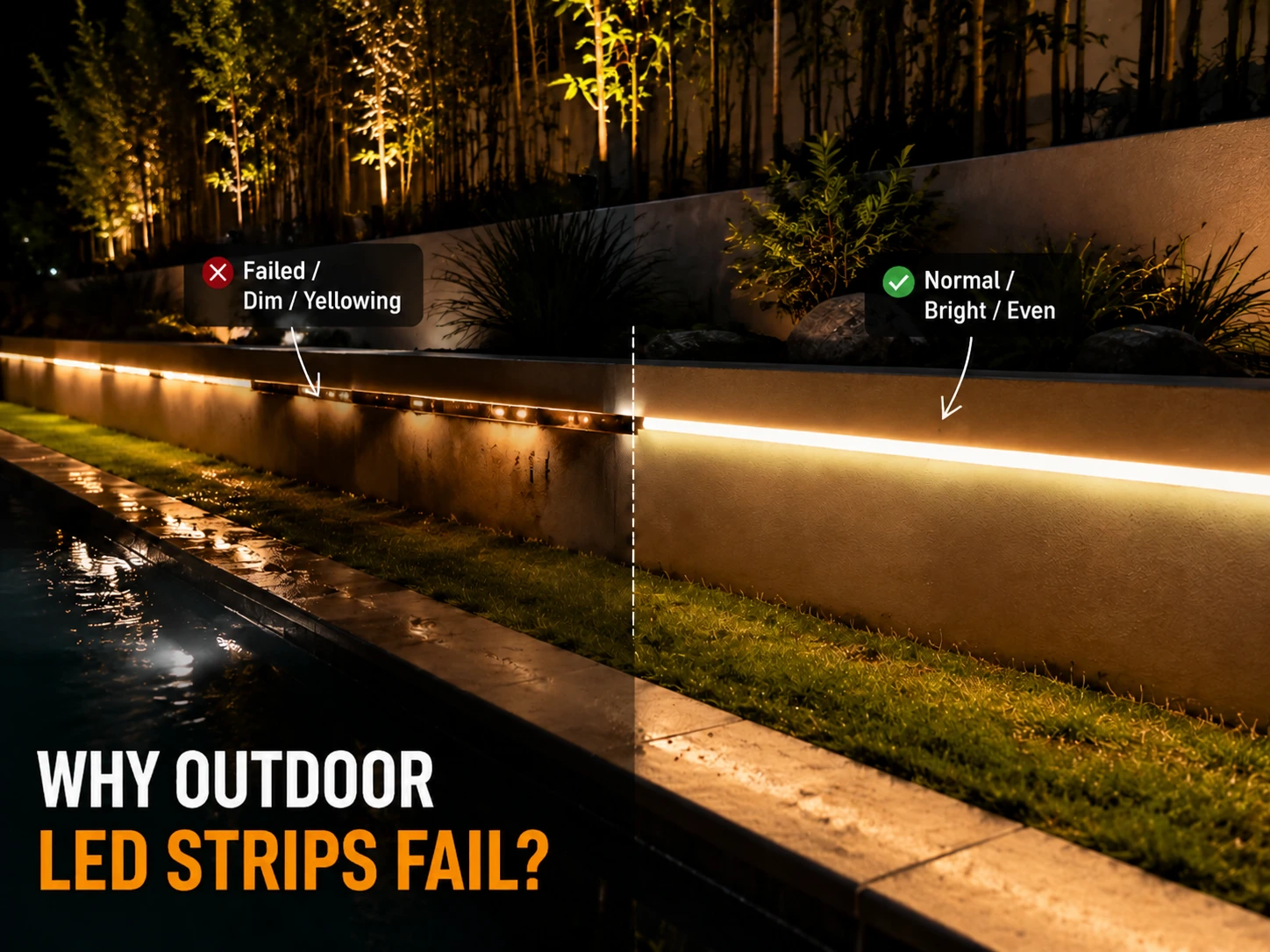
Als je outdoor LED-striplampen installeerde in de verwachting dat ze jaren meegaan en ze faalden binnen twaalf maanden, ben je niet de enige - en de oorzaak is zelden de LED's zelf. De meeste storingen zijn het gevolg van het binnendringen van vocht, UV-degradatie, slechte warmteafvoer, stroomvoorzieningen van lage kwaliteit of installatiefouten. Veel kopers gaan ervan uit: Waterdichte LED-striplichten Met een IP65- of IP67-classificatie zal het jarenlang probleemloos overleven, maar IP-classificaties weerspiegelen alleen de prestaties onder gecontroleerde laboratoriumtests - niet langdurige blootstelling aan zonlicht, regen, thermisch fietsen en buitenweer.
Deze gids legt de zeven meest voorkomende oorzaken van voortijdige storing uit, de waarschuwingssignalen om op te letten voordat een strip niet meer werkt, en de belangrijkste factoren waarmee u rekening moet houden bij het kiezen van buiten-LED-striplampen die realistisch vijf jaar of langer meegaan.
snel antwoord
Buiten LED-striplampen falen meestal vóór hun nominale levensduur vanwege het binnendringen van water, UV-degradatie, slechte warmteafvoer, onstabiele stroomvoorzieningen, connectorstoringen, corrosie en onjuist bedradingsontwerp. De LED-chips zelf zijn zelden het eerste onderdeel dat faalt. In de meeste buiteninstallaties hangt de werkelijke levensduur af van waterdichte constructie, materiaalduurzaamheid, thermisch beheer, elektrisch ontwerp en installatiekwaliteit.
Met de juiste bescherming en installatiepraktijken kunnen hoogwaardige LED-striplampen voor buiten vijf jaar of langer betrouwbare prestaties bieden. Het kiezen van waterdichte strips met siliconen, met behulp van geschikte voedingen, het beheren van warmte met de juiste montagemethoden en het beschermen van kwetsbare verbindingspunten zijn de belangrijkste factoren die voortijdige storingen voorkomen.
Wat bepaalt de levensduur van LED-striplampen voor buiten?
De levensduur van LED-striplampen voor buiten wordt bepaald door de prestaties van het hele verlichtingssysteem in plaats van alleen de LED-chips. Terwijl LED-chips vaak tienduizenden uren worden beoordeeld onder gecontroleerde laboratoriumomstandigheden, stellen echte buitenomgevingen het complete systeem bloot aan vocht, zonlicht, temperatuurveranderingen, elektrische spanning en mechanische slijtage.
In praktische buitentoepassingen bepaalt de zwakste component vaak de levensduur van de gehele installatie. Een hoogwaardige LED-chip kan normaal blijven werken, terwijl omringende componenten zoals waterdichte materialen, connectoren, voedingen of bedradingssystemen veel eerder uitvallen.
De belangrijkste factoren die de levensduur van LED-stripverlichting voor buiten beïnvloeden, zijn onder meer:
| Factor | Impact op prestaties op lange termijn |
| waterdichte constructie | Voorkomt dat vocht de PCB, kopersporen en elektrische componenten bereikt |
| UV-bestendige materialen | Beschermt siliconen of PVC-jacks tegen barsten, vergeling en verlies van bescherming onder zonlicht |
| Ontwerp van warmteafvoer | Vermindert thermische belasting op LED's, drivers, kleefstoffen en beschermende materialen |
| Kwaliteit van de voeding | Voorkomt spanningsinstabiliteit, oververhitting en storing van elektrische componenten |
| Connector en afdichtingskwaliteit | Beschermt kwetsbare aansluitpunten tegen binnendringend water en corrosie |
| Installatie ontwerp | Zorgt voor een goede bedrading, spanningsverdeling en mechanische bescherming |
Onder deze factoren hebben waterdichte bescherming, warmtebeheer en installatiekwaliteit meestal de grootste impact op de real-world betrouwbaarheid. Daarom kunnen twee LED-striplampen voor buiten met vergelijkbare LED-specificaties een volledig verschillende levensduur hebben wanneer ze in verschillende omgevingen worden geïnstalleerd.
Een LED-stripverlichting voor buitenshuis op een op het zuiden gerichte gebouw heeft bijvoorbeeld een veel hogere UV-blootstelling en thermische belasting dan een buitenshuis geïnstalleerd onder een overdekt terras. Evenzo vereisen zwembad- en kusttoepassingen een sterkere bescherming tegen vocht en corrosie in vergelijking met standaard tuinverlichtingsprojecten.
Deze verschillen verklaren waarom de geadverteerde levensduur van LED-striplampen voor buiten niet altijd overeenkomt met de prestaties in de echte wereld. Fabrikanten verwijzen vaak naar een levensduur van de LED's van 50.000 uur of meer, maar deze cijfers zijn meestal gebaseerd op gecontroleerde testomstandigheden in plaats van volledige buiteninstallaties.
De meeste geadverteerde LED-levensduurbeoordelingen zijn gebaseerd op LM-80- en L70-tests, die evalueren hoe goed LED-chips in de loop van de tijd de helderheid behouden. Deze standaarden meten echter voornamelijk LED-prestaties en vertegenwoordigen niet volledig de duurzaamheid van buitencomponenten zoals waterdichte afdichtingen, connectoren, stuurprogramma's of installatiesystemen.
Outdoor LED Strip Lights: theoretische levensduur versus levenslange levensverwachting in de buitenlucht
| Theoretische levensduur | Levensduur in de echte wereld |
| Gebaseerd op LM-80 en L70 testen | Op basis van de werkelijke buitenomstandigheden |
| Richt zich op LED-chipprestaties | Afhankelijk van het gehele verlichtingssysteem |
| Getest onder gecontroleerde laboratoriumomstandigheden | Beïnvloed door weer, installatie en onderhoud |
| gaat uit van ideale bedrijfsomstandigheden | Beïnvloed door UV-blootstelling, warmte, vocht en bedrading kwaliteit |
In echte buitenomgevingen verkorten externe factoren vaak de levensduur lang voordat de LED-chips hun nominale bedrijfsuren bereiken. Wanneer LED-strips buitenshuis na slechts een of twee jaar uitvallen, zijn de LED-chips zelden het belangrijkste probleem. De meeste storingen zijn afkomstig van omringende systemen, waaronder verzwakte waterdichte afdichtingen, beschadigde connectoren, oververhitting, slechte stroomverdeling of corrosie in het milieu.
In de volgende sectie worden de zeven meest voorkomende faalmechanismen uitgelegd die ervoor zorgen dat LED-striplampen voor buitenshuis voortijdig uitvallen en hoe goede ontwerpkeuzes deze problemen kunnen voorkomen. (Voor een diepere blik op hoe de LED-levensduurbeoordelingen worden berekend en welke factoren ze in echte installaties verkorten, zie onze gids over hoe lang buiten ledstriplampen gaan eigenlijk mee.)
Waarom LED-striplampen voor buiten na een jaar uitvallen
Wat zijn de meest voorkomende symptomen voordat LED-striplampen buitenshuis uitvallen?
Voordat een strip niet helemaal uitkomt, vertoont deze meestal waarschuwingssignalen. Door het symptoom dat u ziet aan de waarschijnlijke oorzaak te matchen, kunt u het probleem vroegtijdig opvangen, voordat het zich verspreidt naar de rest van de run.
| teken | meest waarschijnlijke oorzaak | Verwante oorzaak |
| Strip licht helemaal niet op | Stroomvoorzieningsstoring, beschadigde connector of kapot circuit | Storing #4, #6 |
| gaat vanzelf uit en komt later weer aan | Thermische beveiliging triggering, instabiele voeding, losse verbinding | #3, #4 |
| Heet aan de aanraking, vooral in de buurt van de bestuurder | Ontoereikende warmteafvoer, geen aluminium kanaal, ondermaatse driver | #3 |
| Dimmen, vergeling of kleurverschuiving in de loop van de maanden | UV-degradatie van de siliconen/PVC-jas, LED-lumenafschrijving | #2 |
| Verschillende strips op dezelfde run mislukken rond dezelfde tijd | Gedeelde stroomvoorziening of bedradingsfout, geen samenval van LED-defecten | #4, #7 |
| Zichtbare corrosie, groene resten of verkleuring op de PCB | Vochtintred gecombineerd met zoute lucht of hoge luchtvochtigheid | #5 |
| flikkeren, vooral aan het einde van een lange duurloop | Spanningsdaling of ondermaatse vermogensinjectie | #7 |
| sectie bij een connector of einddop mislukt eerst | Zwak punt in de waterdichtheid, geen strookbreed defect | #1, #6 |
Als uw LED-striplichten voor buiten flikkeren, dimmen, onderbroken afsluiten of de buurt van connectoren uitvallen, zijn de LED-chips meestal niet de oorzaak. In de meeste gevallen vindt de storing zich elders in het verlichtingssysteem, zoals de waterdichte afdichtingen, connectoren, stroomvoorziening of ontwerp van de bedrading. Het identificeren van het symptoom eerst maakt het veel gemakkelijker om het werkelijke faalmechanisme te diagnosticeren dat in de volgende secties wordt uitgelegd. (Voor een diepere blik op hoe de LED-levensduurbeoordelingen worden berekend en welke factoren ze in echte installaties verkorten, zie onze gids over hoe lang buiten ledstriplampen gaan eigenlijk mee.)
FAILUE #1 — Hoe zorgt het binnendringen van water ervoor dat LED-striplampen voor buiten falen?
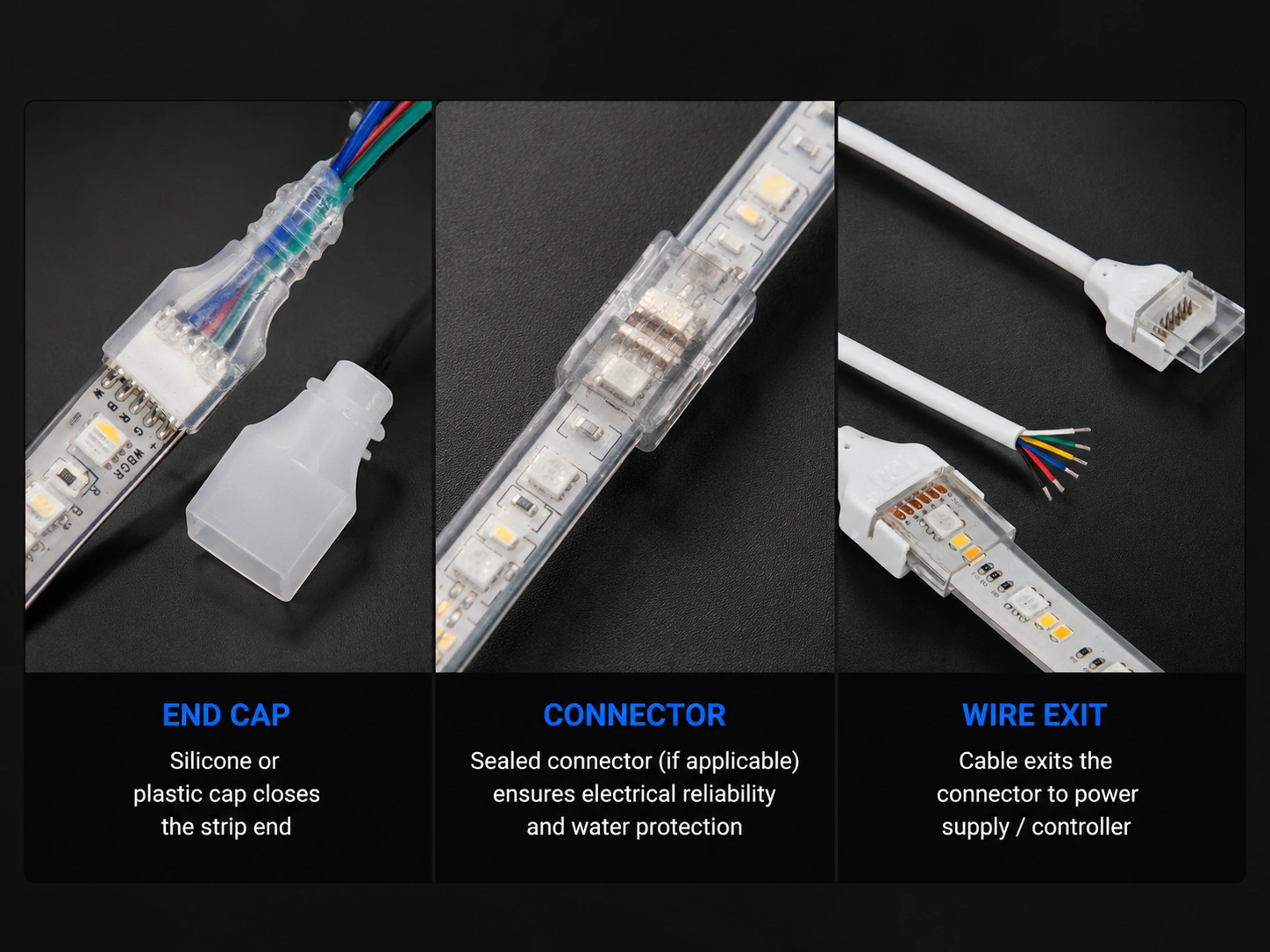
Waterinvoer is de belangrijkste oorzaak van voortijdige storing in de buitenverlichting van LED-striplampen. In de meeste gevallen gaat er geen water door de siliconenbedekking zelf - het komt binnen via zwakke afdichtingspunten zoals einddoppen, draaduitgangen en connectoren, waar herhaalde uitzetting, samentrekking en blootstelling aan weersomstandigheden de oorspronkelijke afdichting geleidelijk verzwakken.
Waarom IP-beoordelingen alleen niet genoeg zijn
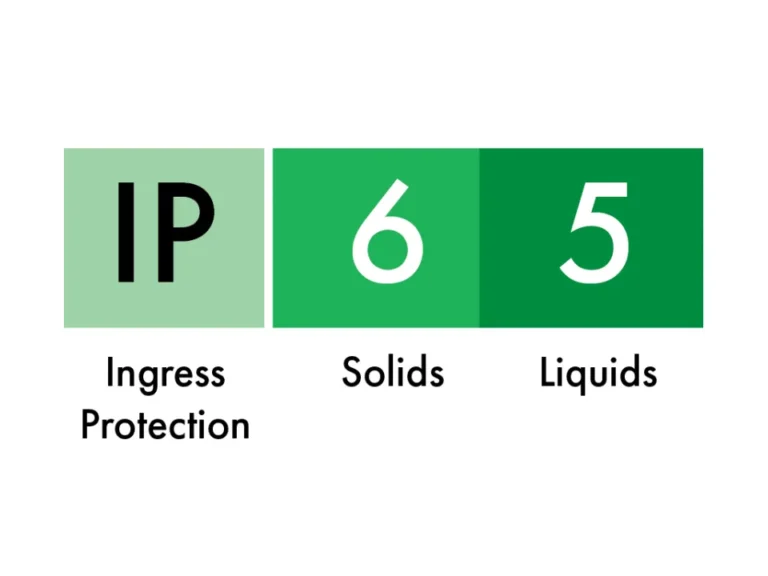
Een IP-classificatie meet weerstand tegen water en stof tijdens gestandaardiseerde laboratoriumtests - het garandeert geen langdurige duurzaamheid buitenshuis. Een IP67-classificatie betekent bijvoorbeeld dat een product tijdelijk ondergedompeld in maximaal een meter zoet water gedurende dertig minuten onder gecontroleerde omstandigheden, zonder blootstelling aan UV, thermische cycli of mechanische belasting, gedurende dertig minuten overleefde.
Wat buiten gebeurt, is heel anders. Dagelijkse uitzetting en samentrekking veroorzaakt door veranderende temperaturen verzwakken de afdichtingen geleidelijk, terwijl langdurig zonlicht de veroudering van het materiaal versnelt. Een strip kan een IP67-test doorstaan, maar toch binnen een jaar lekken ontwikkelen, omdat de beoordeling een eenmalige laboratoriumtest weerspiegelt in plaats van jaren buitengebruik.
Twee buiten LED-striplampen met dezelfde IP-classificatie kunnen daarom zeer verschillende levensduur hebben. In veel gevallen hangt de betrouwbaarheid op lange termijn meer af van de afdichtingskwaliteit en de consistentie van de fabricage dan van het IP-nummer zelf. (Voor een volledige uitsplitsing van IP65-, IP67- en IP68-classificaties en welke past op uw installatie, zie onze Complete gids voor outdoor LED-strip waterdichte beoordelingen.)
Gemeenschappelijke waterdichte zwakke punten
Water komt zelden binnen via de siliconen jas zelf. In plaats daarvan beginnen de meeste storingen op drie kwetsbare afdichtpunten:
- Eindkappen – Het meest voorkomende storingspunt. Kleine openingen die door onvoldoende lijm of slechte afdichting achterblijven, zorgen ervoor dat vocht kan binnendringen tijdens herhaalde verwarmings- en koelcycli.
- Draaduitgangen – Waar stroomkabels door de siliconenmantel gaan, wordt de afdichting constant gestrest door beweging, UV-blootstelling en temperatuurveranderingen, waardoor deze na verloop van tijd gevoelig is voor barsten.
- Connectoren – Indoor Quick-Connect Fittings worden vaak buiten gebruikt voor het gemak, maar missen meestal de langetermijnafdichtingsprestaties die nodig zijn voor continue blootstelling aan regen en zonlicht.
Hoe het binnendringen van water te voorkomen
- Kies waar mogelijk volledig ingemaakte LED-stripverlichting in de buitenlucht in plaats van oppervlaktebekleding.
- Breng siliconenkit aan buiten aan op einddoppen en draaduitgangen, zelfs als ze in de fabriek zijn afgedicht.
- Gebruik connectoren die speciaal zijn ontworpen voor langdurig buitengebruik, bij voorkeur met IP68-bescherming waar de blootstelling ernstig is.
- Plaats connectoren en kabelverbindingen uit de buurt van gebieden waar regenwater of stilstaand water zich kan ophopen.
- Inspecteer afdichtingen periodiek, vooral na lange perioden van sterk zonlicht of seizoensgebonden temperatuurveranderingen.
Het volgen van deze eenvoudige installatiepraktijken verbetert de waterdichte prestaties op lange termijn aanzienlijk zonder de installatiecomplexiteit te vergroten. (Voor een diepere handleiding bij het selecteren van waterdichte strips op projecttype - zwembaden, gevels, tuinen - zie onze Gids voor het kiezen van waterdichte LED-striplampen voor buitenprojecten.)

#2 — Waarom beschadigt UV-blootstellingsschade buiten LED-striplichten?
UV-degradatie is de geleidelijke afbraak van beschermende materialen veroorzaakt door langdurige blootstelling aan zonlicht. Voor LED-stripverlichting buitenshuis treft UV-schade de siliconen of PVC-mantel lang voordat deze de LED's zelf beschadigt. Zodra deze beschermende materialen flexibiliteit verliezen of scheuren ontwikkelen, kan vocht de strip binnendringen en de levensduur aanzienlijk verkorten.
Hoe UV-blootstelling beschermende materialen beschadigt
Veel storingen in de buitenverlichting beginnen lang voordat er zichtbare schade verschijnt. Ultraviolette straling breekt geleidelijk de moleculaire structuur van siliconen en PVC af, waardoor hun flexibiliteit en weersbestendigheid na verloop van tijd worden verminderd. Tegen de tijd dat vergeling, vertroebeling of oppervlaktescheuren merkbaar worden, heeft het materiaal vaak al veel van zijn beschermende prestaties verloren.
Dit proces wordt versneld in regio's met intens zonlicht, installaties op het zuiden en locaties zonder schaduw, waardoor UV-blootstelling een van de belangrijkste factoren is die van invloed zijn op de duurzaamheid van de lange termijn.
Siliconen versus PVC voor buitentoepassingen
| Functie | PVC | Silicone |
| UV-bestendigheid | schoon | Uitstekend |
| Flexibiliteit in de loop | neemt snel af | Blijft langer stabiel |
| Risico op barsten | Hoger | Onder |
| Typische buitenlevensduur | 1-2 jaar in sterk zonlicht | 3-5+ jaar onder vergelijkbare omstandigheden |
| Beste toepassing | overdekte of schaduwrijke gebieden | Directe buitenblootstelling |
Belangrijkste afhaalmaaltijden: Voor installaties die aan direct zonlicht worden blootgesteld, biedt siliconen een aanzienlijk betere duurzaamheid op lange termijn dan PVC, zelfs wanneer beide producten vergelijkbare IP-classificaties hebben.

Vroege tekenen van UV-schade
Let op deze waarschuwingssignalen voordat de waterdichte prestaties in gevaar komen:
- Geel of vertroebeld van de beschermende jas
- Verminderde flexibiliteit bij het buigen van de strip
- Fijne oppervlaktescheuren rond bochten of einddoppen
- Zichtbare scheuren die interne componenten blootleggen
Zodra het kraken verschijnt, is de waterdichte barrière al verzwakt, waardoor het binnendringen van vocht veel waarschijnlijker wordt. Het vervangen van de strip in dit stadium is meestal kosteneffectiever dan wachten op elektrische storingen.
Hoe UV-schade te minimaliseren
✓ Kies voor siliconen ingekapselde LED-stripverlichting voor buiten voor ruimtes met direct zonlicht.
✓ Vermijd langdurige blootstelling waar gedeeltelijke schaduw of beschermende montage beschikbaar is.
✓ Inspecteer de jassen regelmatig op geel of oppervlaktescheuren.
✓ Vervang beschadigde secties voordat het vocht de interne PCB bereikt.
Belangrijkste afhaalmaaltijden: UV-schade begint meestal maanden voordat het zichtbaar wordt. Regelmatige inspectie helpt voorkomen dat kleine materiaaldefecten zich ontwikkelen tot volledige stripstoringen.
Falen #3 — Hoe vermindert slechte warmteafvoer de levensduur van LED-strips buiten?
Warmteopbouw treedt op wanneer LED-stripverlichting buitenshuis de warmte niet efficiënt kan afvoeren. Overmatige bedrijfstemperaturen versnellen de veroudering van LED's, drivers, kleefstoffen en beschermende materialen, waardoor de levensduur van het hele verlichtingssysteem wordt verkort in plaats van alleen de LED's.
Buiteninstallaties ervaren vaak veel hardere thermische omstandigheden dan binnentoepassingen. Direct zonlicht, donkere montagevlakken en afgesloten ruimtes kunnen de bedrijfstemperaturen ver boven de luchttemperatuur van de omringende lucht verhogen. Zelfs hoogwaardige buiten-LED-striplampen kunnen oververhit raken als de installatie voorkomt dat warmte efficiënt ontsnapt.
Wanneer overmatige hitte zich ophoopt, verslechteren drivers en beschermende materialen meestal sneller dan de LED-chips zelf, wat leidt tot intermitterende uitschakelingen, verlies van helderheid of voortijdige systeemstoring. (Dit is ook een belangrijke reden waarom binnen- en buitenstrips niet uitwisselbaar zijn - zie onze afbraak van Hoe COB LED-strips verschillen tussen binnen- en buitengebruik Voor meer informatie over hoe vochtblootstelling en temperatuurvariatie van invloed zijn op de prestaties op lange termijn.)
Waarom aluminium profielen de levensduur verbeteren
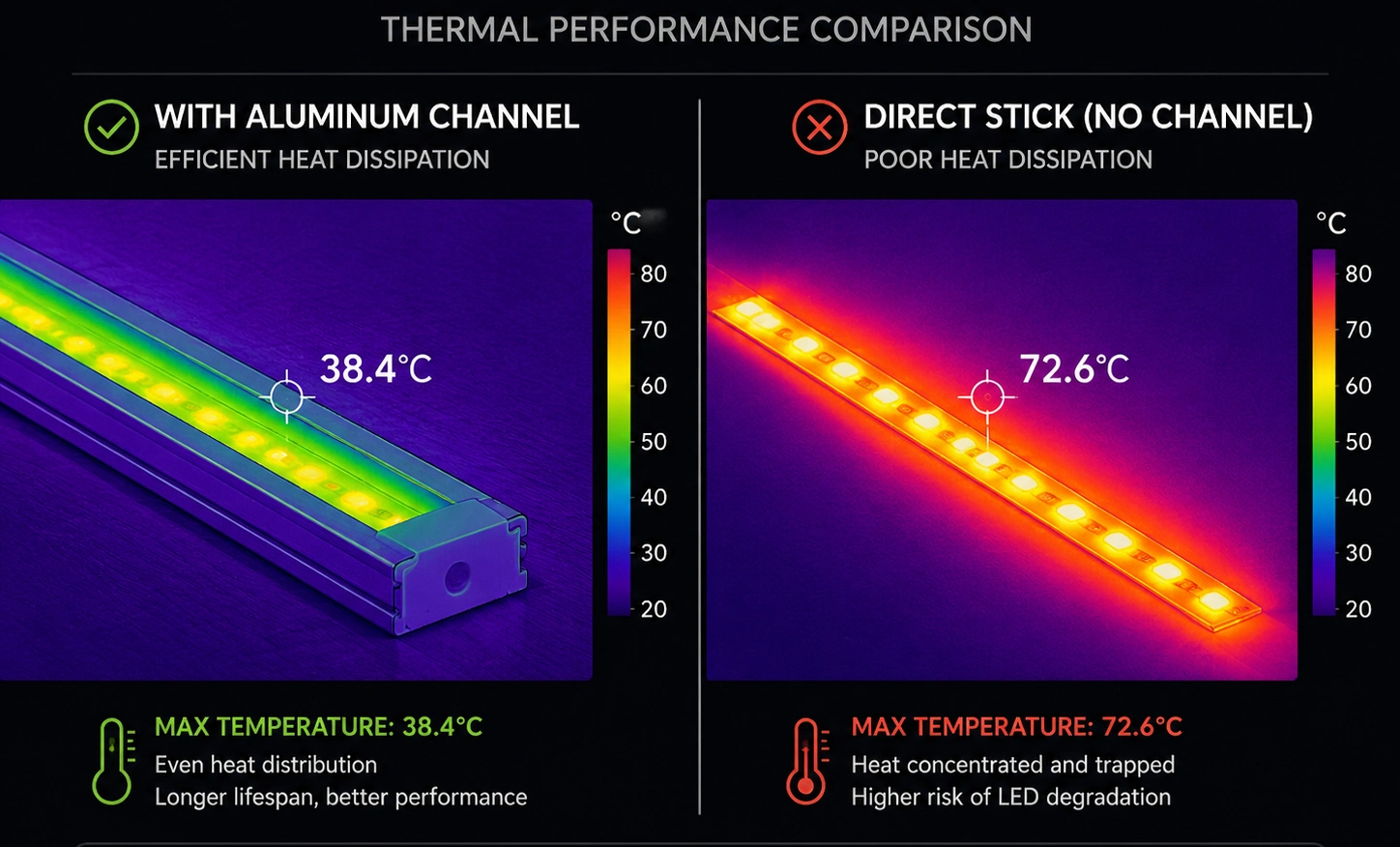
Een aluminium profiel voor LED-strips fungeert als een koellichaam, waardoor warmte van de PCB en LED's wordt weggetrokken terwijl deze in de omringende lucht kan worden gedaald. Vergeleken met montagestrips direct op hout, plastic of andere isolerende oppervlakken, verminderen aluminiumprofielen de bedrijfstemperatuur aanzienlijk en verbeteren ze de betrouwbaarheid op lange termijn.
Naast het verbeteren van de warmteafvoer, bieden aluminium profielen ook mechanische bescherming, waardoor schade wordt verminderd door accidentele effecten en blootstelling aan het milieu. Voor de meeste buiteninstallaties zijn ze een van de eenvoudigste en meest kosteneffectieve upgrades voor het verlengen van de levensduur. (Voor een nadere blik op profielselectie, zie onze gids om Aluminium LED-profielen.)
Checklist voor warmtebeheer
✓ Installeer buiten ledstriplampen waar mogelijk in aluminium profielen.
✓ Laat ventilatieruimte rond gesloten kanalen achter in plaats van ze volledig af te dichten.
✓ Vermijd montagestrips direct op donkere oppervlakken die warmte absorberen en vasthouden.
✓ Selecteer een stroomvoorziening met een reservecapaciteit van ten minste 201 TP3T in plaats van continu te werken bij vollast.
✓ Houd bestuurders uit de buurt van afgesloten ruimtes waar warmte kan oplopen.
Belangrijkste afhaalmaaltijden: Goed warmtebeheer beschermt niet alleen LED-chips - het verlengt ook de levensduur van bestuurders, waterdichte materialen en elektrische verbindingen, waardoor de kans op voortijdige storingen in de buitenlucht wordt verminderd.
#4 — Waarom zorgen voor lage kwaliteit voedingen ervoor zorgen dat LED-strips voor buiten falen?
De stroomvoorziening is een van de meest voorkomende storingspunten in een LED-stripverlichtingssysteem voor buiten. Terwijl LED-chips over vele jaren geleidelijk afnemen, bevatten drivers en stroomvoorzieningen elektronische componenten die veel kwetsbaarder zijn voor warmte-, vocht- en spanningsschommelingen. Wanneer meerdere LED-striplampen buitenshuis tegelijkertijd uitvallen, is de gedeelde stroomvoorziening vaak het eerste onderdeel dat moet worden geïnspecteerd.
Veel gebruikers gaan ervan uit dat een donkere LED-strip betekent dat de LED's zijn uitgevallen. In werkelijkheid slijten stroomvoorzieningen doorgaans veel eerder omdat condensatoren en andere elektronische componenten gevoelig zijn voor hoge temperaturen, vochtigheid en onstabiele elektrische omstandigheden. Buitenbestuurders ervaren extra stress door weersinvloeden en dagelijkse temperatuurschommelingen, waardoor de juiste keuze van de bestuurder net zo belangrijk is als het kiezen van hoogwaardige LED-strips.
Veelvoorkomende tekenen van stroomstoring
Als de volgende symptomen van invloed zijn op meerdere strips of verschijnen in een hele installatie, is de kans groter dat de bestuurder het probleem is dan de LED's.
- Willekeurig flikkeren, vooral nadat het systeem al enige tijd actief is
- Helderheid verandert zonder de controller of dimmer aan te passen
- meerdere strips die tegelijkertijd falen op dezelfde stroomvoorziening
- Slechts een deel van een verlichtingsrun die werkt Terwijl andere secties donker blijven
- Intermitterende sluitingen die herstellen na afkoeling
Hoe te selecteren buitenbestuurders
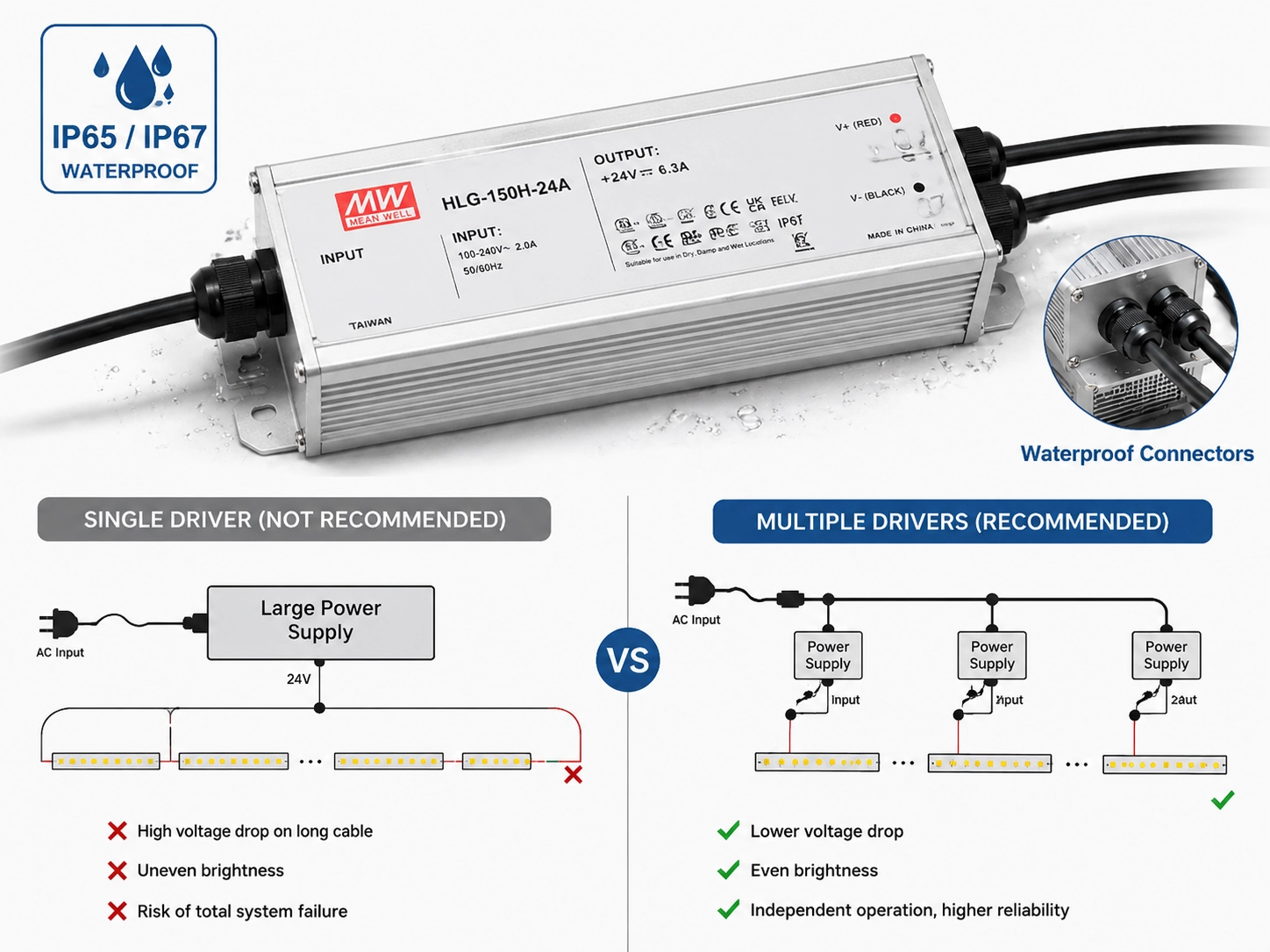
✓ Selecteer stuurprogramma's die speciaal zijn ontworpen voor gebruik buitenshuis met IP65 of hogere bescherming.
✓ Laat ten minste 20% stroomtoevoer naar de hoofdruimte om thermische spanning op lange termijn te verminderen.
✓ Verdeel voor grote projecten de belasting over meerdere stuurprogramma's in plaats van op één eenheid te vertrouwen.
✓ Installeer drivers op goed geventileerde locaties, uit de buurt van stilstaand water en overmatige warmte.
✓ Stem de specificaties van de aandrijving en de uitgang van de bestuurder af op de aanbevelingen van de fabrikant van de LED-strip. (Als u niet zeker weet of uw LED-stripopstelling een speciale driver vereist of hoe u er een correct kunt matchen, raadpleeg dan onze gids over Wanneer en hoe de juiste driver voor LED-strips te kiezen.)
Belangrijkste afhaalmaaltijden: Een hoogwaardige buitenbestuurder kan de levensduur van het gehele verlichtingssysteem aanzienlijk verlengen en het risico dat meerdere strips tegelijk falen, verminderen.
#5 — Hoe beschadigt corrosie de buiten LED-stripverlichting in buitenomgevingen?
Corrosie treedt op wanneer vocht en zuurstof geleidelijk blootgestelde metalen componenten in een LED-strip aantasten. In buitenomgevingen, vooral in de buurt van de kust of in gebieden met een constant hoge vochtigheid, kan corrosie kopersporen en soldeerverbindingen beschadigen lang voordat de LED-chips het einde van hun nominale levensduur bereiken.

Waar corrosie het vaakst voorkomt
Niet alle buiteninstallaties hebben te maken met hetzelfde corrosieniveau. De volgende omgevingen vereisen extra bescherming:
- Kustlocaties – Zout dat door zeelucht wordt gedragen, versnelt de oxidatie en verhoogt de kans op corrosie bij connectoren, einddoppen en blootgestelde kopersporen.
- Hoge bevochtigingsregio's – Frequente condensatie en langdurige vochtigheid kunnen geleidelijk aan onvolkomen afgedichte PCB-assemblages beschadigen.
- Zwembad- en waterfrontinstallaties – Vocht in combinatie met chloor of zout zorgt voor een agressievere omgeving dan gewone regenval.
Zelfs wanneer LED-striplampen voor buitenshuis dezelfde IP-classificatie voldoen, vereisen installaties in deze omgevingen meestal hoogwaardige afdichting en corrosiebestendige constructie.
ASTM B117 Zoutspray testresultaten
Het testen van zoutspray biedt een meer realistische maatstaf voor de langetermijnduurzaamheid aan de kust dan alleen IP-classificaties. In tegenstelling tot IP-tests, die onder gecontroleerde omstandigheden waterinvoer evalueren, simuleert ASTM B117 langdurige blootstelling aan met zout beladen vocht en helpt het de corrosieweerstand in mariene omgevingen te beoordelen.
| ASTM B117 (336 uur) | Volledig ingemaakte strip | Oppervlaktegecoate / holle IP67-strip |
| zichtbare corrosie | niet een | Koperoxidatie en verdigris waargenomen |
| elektrische storing | niet een | Gelokaliseerde storing na 48-72 uur |
| PCB-bescherming | Geen zoutwater binnendringen | Oxidatie bij soldeerverbindingen |
Deze resultaten laten zien waarom volledig gepotte LED-strips over het algemeen betere prestaties op lange termijn bieden in kust- en hoge vochtigheidsinstallaties. Door de PCB in siliconen te omhullen, verminderen ze het risico dat met zout beladen vocht het koperen circuit bereikt. Zie onze om te zien hoe de COB-LED-stripkwaliteit verschilt tussen merken onder langdurige spanningsomstandigheden, waaronder lumenonderhoud en thermische stabiliteit gemeten over 2.200 uur continu gebruik. 2200 uur COB LED Strip Duurzaamheid Testrapport.
#6 — Waarom zijn waterdichte connectoren een veel voorkomend storingspunt voor LED-stripverlichting voor buiten?
Waterdichte connectoren zijn ontworpen om elektrische verbindingen te beschermen tegen vocht, maar niet alle waterdichte connectoren bieden hetzelfde niveau van langdurige buitenbescherming. Connectorstoring wordt vaak veroorzaakt door verouderde afdichtingen, onjuiste installatie of het selecteren van connectoren die niet bedoeld zijn voor continue blootstelling buitenshuis.
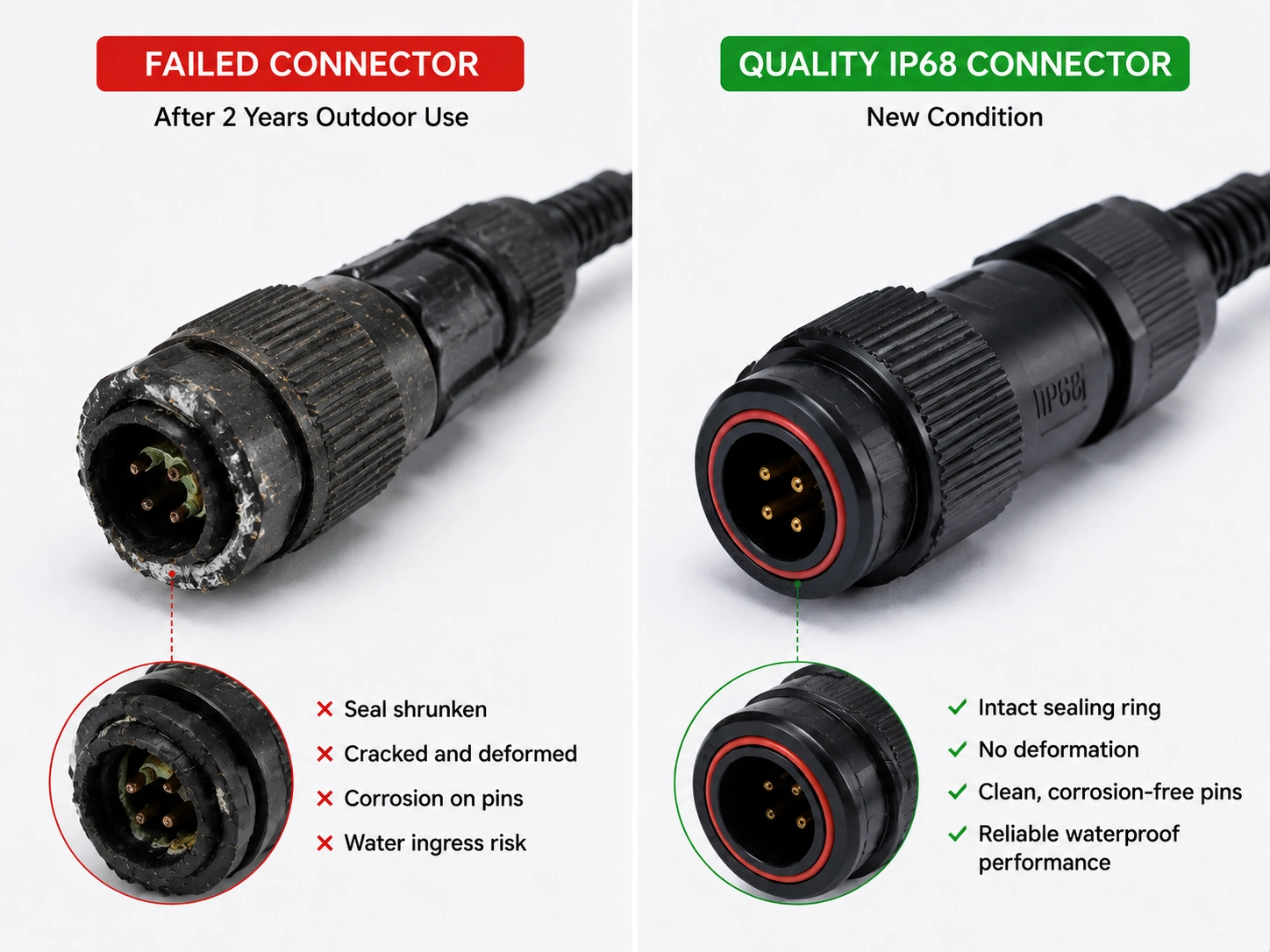
Zelfs een connector die goed presteert wanneer hij voor het eerst wordt geïnstalleerd, kan in de loop van de tijd een zwak punt worden. UV-blootstelling, herhaalde temperatuurveranderingen en vocht verharden of krimpen de rubberen afdichtingen geleidelijk, waardoor water door kleine openingen kan binnendringen. In veel gevallen begint corrosie in de connector lang voordat er zichtbare schade optreedt.
Ook de installatielocatie is van belang. Connectors geplaatst waar regenwater zich verzamelt, hebben veel meer kans om te falen dan die geïnstalleerd in beschutte of goed gedraineerde posities.
Veelvoorkomende fouten bij installatie van connectoren
De volgende installatiefouten zijn verantwoordelijk voor de meeste connectorgerelateerde storingen:
- Gebruik binnenshuis connectoren in buitentoepassingen.
- Installeren van connectoren op het laagste punt van een verlichtingsrun waar water kan worden verzameld.
- Alleen vertrouwend op de fabrieksafdichting zonder extra outdoor-geclassificeerde afdichting toe te voegen.
- waardoor connectoren worden blootgesteld aan direct zonlicht en continue verwering.
Belangrijkste afhaalmaaltijden: Zelfs hoogwaardige connectoren kunnen voortijdig uitvallen als ze op de verkeerde locatie of zonder voldoende afdichting worden geïnstalleerd.
Wanneer moet u IP68-connectoren gebruiken?
Hoewel IP67-connectoren geschikt zijn voor veel buitentoepassingen, bieden IP68-connectoren over het algemeen een betere bescherming op lange termijn op locaties die worden blootgesteld aan zware regen, irrigatiesystemen of stilstaand water. Hun afdichtingsontwerp is bedoeld voor veeleisende omgevingen, waardoor ze een betere keuze zijn voor tuinen, zwembadomlijstingen en landschapsverlichting.
Het kiezen van de juiste connectorclassificatie is slechts een deel van de oplossing: goede installatie en extra afdichting blijven even belangrijk. (Voor een stapsgewijze handleiding over het bedrading van LED-strips en ze correct aan te sluiten voor gebruik buitenshuis, zie onze gids over Hoe LED-strips te bedraden met de juiste connectoren.)
storing #7 — Hoe beïnvloeden onjuiste bedrading en spanningsval invloed op de LED-stripverlichting buitenshuis?
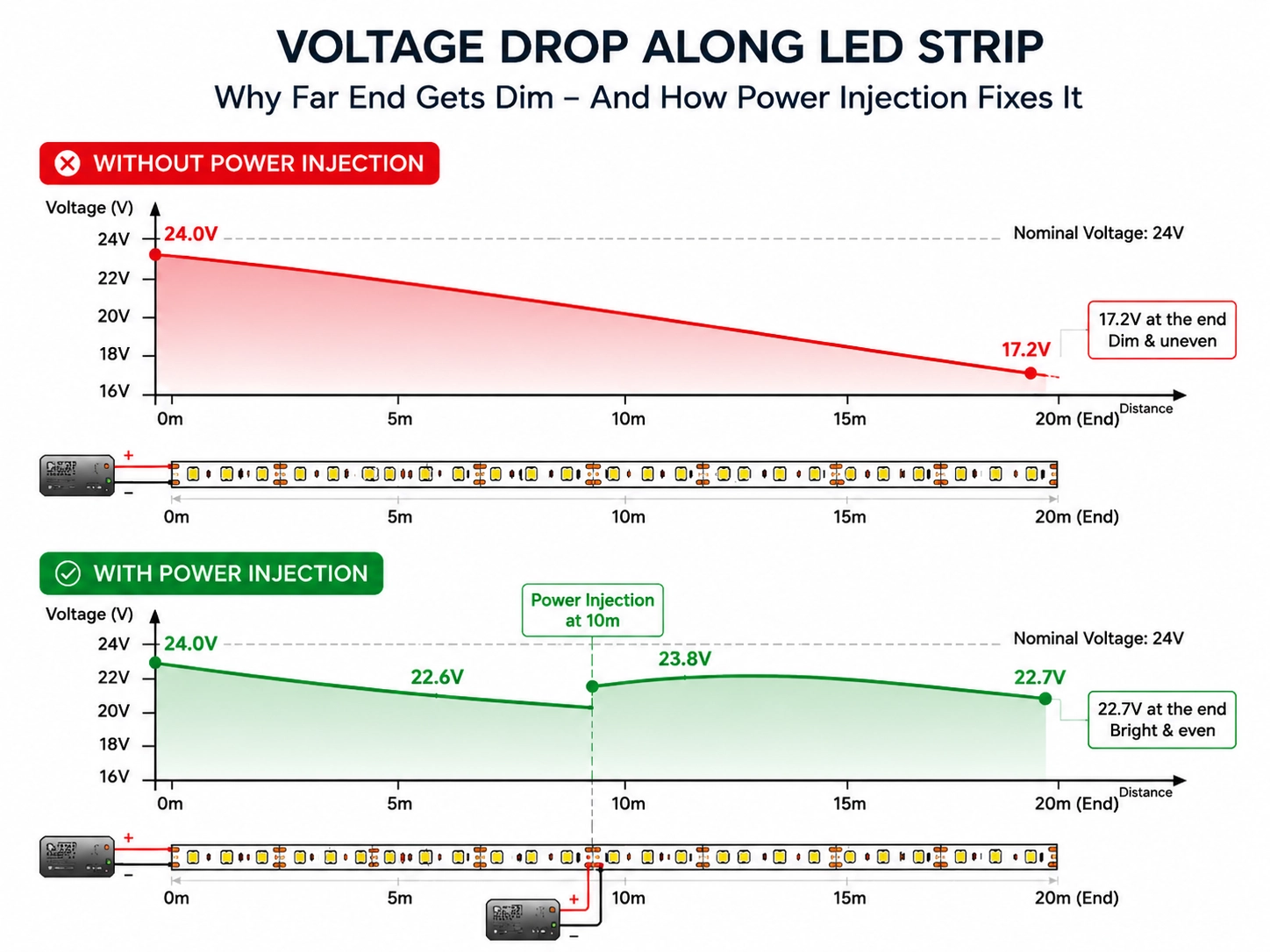
Spanningval is het geleidelijke verlies van elektrische spanning als de stroom door een lange LED-strip gaat. Wanneer de spanning die het verre uiteinde te laag bereikt, kan de LED-stripverlichting buitenshuis dimmer, flikkeren of inconsistente kleuren vertonen, ook al werken de LED's zelf normaal.
Spanningsval is een van de meest voorkomende elektrische problemen bij buitenverlichting, omdat installaties vaak veel langere kabels nodig hebben dan binnenprojecten. Hekverlichting, gevels van gebouwen, landschapsverlichting en perimeterverlichting overschrijden vaak de aanbevolen lengte voor een enkele stroomtoevoer.
Naarmate de elektrische weerstand over de afstand toeneemt, ontvangt het uiteinde van de strip minder spanning dan het gedeelte dat het dichtst bij de stroombron ligt. Het resultaat is meestal progressieve dimmen, kleurverschuiving of flikkering in plaats van volledige stripfalen.
Veelvoorkomende symptomen van spanningsval
| teken | meest waarschijnlijke oorzaak |
| Verre einde lijkt dimmer | spanningsval |
| Flikkeren aan het einde van de strip | Onvoldoende stroominjectie |
| ongelijke helderheid | Run overschrijdt de aanbevolen lengte |
| Kleurverschuiving langs de strip | Spanningsverlies over afstand |
Hoe spanningsval te voorkomen
✓ Volg de maximaal aanbevolen looplengte van de fabrikant.
✓ Voeg stroominjectie toe voor lange lichtruns in plaats van een enkele stroomtoevoer te gebruiken.
✓ Gebruik kabels van de juiste maat om de elektrische weerstand te verminderen.
✓ Verdeel grote buiteninstallaties in meerdere kortere circuits indien praktisch.
✓ Controleer de spanning aan het uiteinde tijdens de installatie voordat u het project afrondt.
Belangrijkste afhaalmaaltijden: De meeste spanningsvalproblemen kunnen tijdens de ontwerpfase worden voorkomen. Een goede bedrading en stroomverdeling zijn veel effectiever dan het vervangen van LED-strips nadat helderheidsproblemen verschijnen. (Voor een gedetailleerde uitsplitsing van spanningsvalberekeningen en maximale looplengtes, zie onze Spanningsdaling in LED-stripinstallaties gids.)
Hoe u outdoor LED-striplampen kiest die langer meegaan
Het kiezen van buiten LED-striplampen gaat over meer dan het selecteren van de hoogste IP-classificatie. De betrouwbaarheid op lange termijn hangt af van de gecombineerde prestaties van waterdichte constructie, UV-bestendigheid, warmteafvoer, kwaliteit van de stroomvoorziening en een goede installatie. Voordat u een aankoop doet, moet u het hele verlichtingssysteem evalueren in plaats van u te concentreren op een enkele specificatie.
Aanbevolen bescherming door toepassing
| Type project | Minimale bescherming | Aanvullende aanbeveling |
| Tuin & Landschap | IP65 / IP67 | Aluminium profiel voor betere warmteafvoer |
| Gevels bouwen | IP67 | Siliconen-gekapselde strip met UV-bestendige materialen |
| Zwembaden | IP68 | Waterdichte connectoren en afgedichte kabelverbindingen |
| Kustinstallaties | Bouw van de zeevaart | Volledig ingemaakte strip met ASTM B117 zoutspray testgegevens |
Outdoor LED Strip kopen checklist
Controleer voor de aankoop of het product:
✓ Siliconen inkapseling in plaats van basiscoating
✓ UV-bestendige materialen voor langdurige blootstelling aan de buitenlucht
✓ Aluminiumprofielcompatibiliteit voor verbeterde warmteafvoer
✓ Buitengewaardeerde voeding met voldoende capaciteit
✓ IP68-connectoren waar blootstelling aan water wordt verwacht
✓ Zoutspray testgegevens voor kusttoepassingen
Belangrijkste afhaalmaaltijden: Producten die goed presteren in echte buitenomgevingen, combineren duurzame materialen, betrouwbare elektrische componenten en een goede installatie - niet alleen een hoge IP-classificatie.
Real-World Outdoor LED Strip Lights Installatievoorbeelden
Real-world projecten laten vaak zien dat voortijdige storingen worden veroorzaakt door installatieomstandigheden in plaats van defecte LED-chips. De volgende voorbeelden illustreren hoe het corrigeren van het onderliggende probleem - niet alleen de strip vervangen - resulteerde in een betrouwbaarder buitenverlichtingssysteem.
Geval 1: Kustvilla Zwembaddeck faalt na 14 maanden
Een installatie aan de kust van het zwembad met standaard IP67-ledstrips ontwikkelde na ongeveer 14 maanden verspreide donkere secties. Inspectie onthulde corrosie rond einddoppen en connectoren veroorzaakt door zoute lucht en vocht in plaats van LED-storing.
Het systeem werd geüpgraded met volledig gepotte LED-strips, aluminium profielen en verbeterde afdichting bij elke connector. Meer dan 18 maanden na de upgrade werden geen extra corrosie of elektrische storingen waargenomen.
Case 2: Rooftop Green Wall Installation Failure na 9 maanden
Een landschapsproject op het daklandschap ondervond intermitterende stilstanden en flikkeringen na 9 maanden gebruik. Onderzoek wees uit dat overmatige warmteopbouw en spanningsval veroorzaakt door slechte montage en een enkele overbelaste stroomvoorziening.
Na het toevoegen van aluminiumprofielen, het introduceren van stroominjectie en het verdelen van de belasting over twee drivers, bleven de originele LED-strips betrouwbaar werken zonder verdere storingen.
Geleerde lessen
Hoewel de omgevingen heel anders waren, kwamen beide projecten tot dezelfde conclusie:
- De LED-chips waren niet de belangrijkste oorzaak van het falen.
- De installatiekwaliteit had een grotere impact dan de IP-classificatie alleen.
- Het corrigeren van waterdichting, warmtebeheer en stroomverdeling loste het probleem op zonder het lichtontwerp te veranderen.
Belangrijkste afhaalmaaltijden: De meeste storingen in de buitenstrips van de buitenkant kunnen worden voorkomen door het installatiesysteem aan te pakken in plaats van alleen de LED-strips te vervangen.
Fabrikant Testing Insight: Wat we leren van LED-striptoepassingen voor buiten
Door middel van LED-striplichten voor buiten en real-world projecttoepassingen hebben we ontdekt dat voortijdige storingen zelden worden veroorzaakt door LED-chips zelf. In de meeste gevallen verschijnt het storingspunt in het omringende systeem, inclusief waterdichte bescherming, thermisch beheer, connectoren, voedingen en installatiemethoden.
Verschillende buitenomgevingen creëren verschillende betrouwbaarheidsuitdagingen. Kustprojecten vereisen bijvoorbeeld een sterkere corrosieweerstand, omdat met zout beladen lucht de oxidatie van kopersporen en soldeerverbindingen kan versnellen. Gevels van gebouwen en dakinstallaties vereisen een betere UV-bestendigheid en warmteafvoer omdat het verlichtingssysteem gedurende langere tijd aan direct zonlicht en temperatuurschommelingen wordt blootgesteld.
Op basis van veldwaarnemingen en duurzaamheidsevaluaties dragen verschillende factoren consequent bij aan een langere levensduur van LED-strips buitenshuis:
- Volledig afgedichte of siliconen ingekapselde constructie Biedt een betere bescherming tegen vocht en blootstelling aan het milieu in vergelijking met basiscoatings van het oppervlak.
- Juiste oplossingen voor warmteafvoer, zoals aluminium profielen, helpen de bedrijfstemperaturen te verminderen en LED's, drivers en omringende materialen te beschermen.
- Betrouwbare voedingen met voldoende capaciteit Verminder elektrische spanning en voorkom onstabiele werking.
- Correcte connectorselectie en afdichtingsmethoden Bescherm kwetsbare aansluitpunten waar veel buitenstoringen beginnen.
- Correct bedrading ontwerp, inclusief spanningsvalregeling en stroominspuiting, indien nodig, zorgt voor een consistente helderheid en stabiele werking bij lange installaties.
Deze bevindingen benadrukken een belangrijk principe voor buitenverlichtingsprojecten: betrouwbaarheid is afhankelijk van het complete verlichtingssysteem, niet alleen de LED-strip zelf.
Voor architecten, aannemers en projecteigenaren moet het selecteren van LED-striplampen voor buitenshuis daarom het samen evalueren van waterdichte constructie, materiaalduurzaamheid, thermische prestaties, elektrisch ontwerp en installatieomstandigheden samenvoegen. Een goed ontworpen systeem kan de onderhoudsvereisten aanzienlijk verminderen en jarenlang betrouwbare buitenprestaties leveren.
Conclusie
Buiten ledstriplampen kunnen jarenlang betrouwbare prestaties leveren in buitenomgevingen wanneer waterdichte constructie, thermisch beheer, kwaliteit van de stroomvoorziening en installatieontwerp naar behoren worden overwogen.
Het goede nieuws is dat bijna al deze problemen kunnen worden voorkomen. Het kiezen van hoogwaardige materialen, het installeren van strips in aluminium profielen, het gebruik van connectoren en chauffeurs buitenshuis, en het volgen van de juiste waterdichtingspraktijken, kan de levensduur van een buitenverlichtingssysteem aanzienlijk verlengen.
Of u nu architecturale verlichting, landschapsverlichting of installaties aan het zwembad ontwerpt, de beste langetermijnresultaten komen van het evalueren van het hele systeem - niet alleen het vergelijken van IP-classificaties of LED-specificaties. Door zich te concentreren op de bouwkwaliteit, installatiepraktijken en milieubescherming, kunnen LED-striplampen voor buitenshuis gedurende vijf jaar of langer realistische betrouwbare prestaties leveren.
FAQ
Veelgestelde vragen over probleemoplossing
Beslissingen over kopen en installeren
Gerelateerde berichten