Français
  English
  简体中文
简体中文  Deutsch
  Español
  Italiano
  日本語
日本語  한국어
한국어  Polski
  Português
  Русский
  Türkçe
  Nederlands
  Tiếng Việt
  ไทย
ไทย 
La plupart des demandes de modules de LED suivent le même chemin : un acheteur envoie des spécifications, les devis du fabricant et, si les chiffres fonctionnent, la production commence. Mais lorsque l'exigence ne tombe pas en dehors du catalogue standard - une tension non standard, un groupement de pixels spécifique ou un protocole de contrôle particulier - le succès du projet dépend souvent de la façon dont ces détails sont clarifiés avant le début de la production.
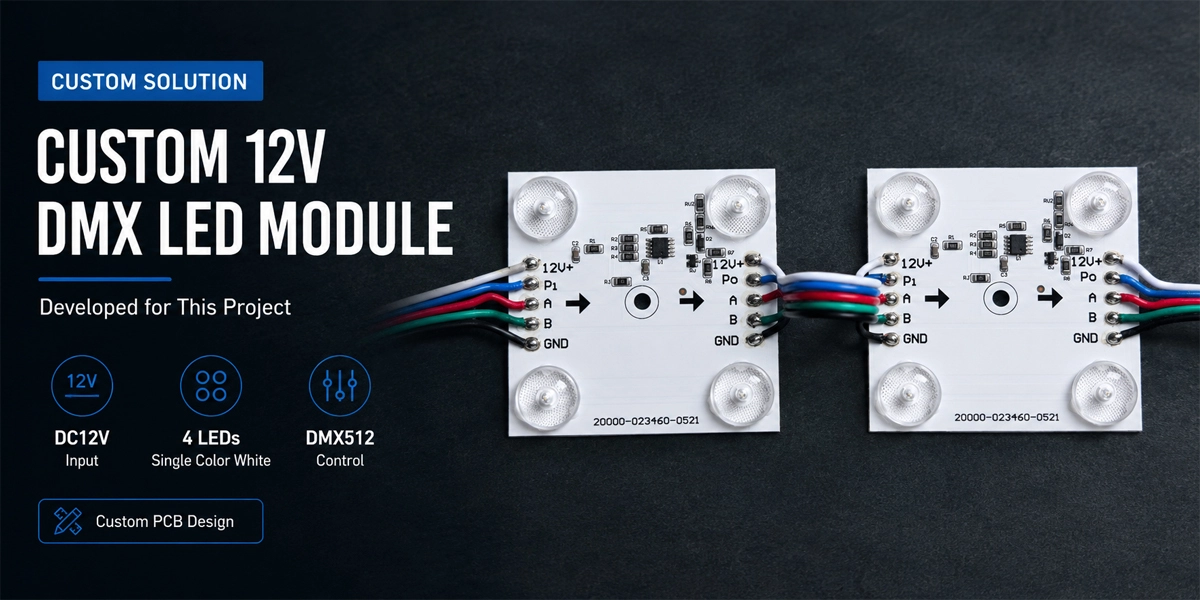
Cette étude de cas fait suite à un véritable projet Signiteled pour une entreprise européenne d'éclairage nécessitant une combinaison non standard : entrée 12 V DC, LED blanches unicolores, contrôle DMX et quatre LED regroupées comme une unité adressable. Les sections suivantes montrent comment la spécification a été clarifiée, le PCB personnalisé a été développé et approuvé, et les modules sont passés à la production et à l'expédition.
réponse rapide
La réponse courte : une entreprise européenne d'éclairage avait besoin de modules LED blancs unicolores 12 V DC sur mesure avec un contrôle DMX, avec les quatre LED sur chaque module fonctionnant comme une unité adressable. Signiteled a repensé le PCB pour une entrée 12V, a confirmé les exigences électriques avant la production et a envoyé le dessin du PCB au client pour approbation avant la fabrication. Le projet est passé de la première demande à l'expédition dans environ six semaines.
L'enquête : modules LED blancs uni avec commande DMX
Fin juillet, un concepteur européen d'éclairage a contacté Signiteled avec une exigence claire mais non standard :
Modules LED blancs unicolores 12V DC avec commande DMX, avec les quatre LED de chaque module fonctionnant comme une unité adressable plutôt que d'être contrôlée individuellement.
Deux choses ont permis à cette enquête de se démarquer :
1. Commande DMX pour un module blanc uni
Les configurations standard de modules LED DMX de Signiteled sont principalement conçues pour le contrôle des couleurs multicanaux, comme RGBW ou RGBCCT. Dans ce projet, cependant, le client n'avait besoin que d'une lumière blanche uni avec un contrôle DMX. Les quatre LED blanches de chaque module fonctionneraient ensemble comme une seule unité contrôlable, permettant à chaque module d'être adressé et grisé à travers le système DMX.
2 Entrée 12 V DC au lieu de la plate-forme standard 24 V
La plate-forme de modules LED standard de Signiteled fonctionne sur DC24V, tandis que l'installation existante du client exigeait un DC12V. Cela signifiait que le circuit imprimé standard ne pouvait pas être utilisé simplement tel quel; une configuration de circuit imprimé 12V dédiée était requise pour correspondre au système électrique du client.
| Type de module DMX | LED par module | Canaux de contrôle | logique de contrôle | Usage typique |
| DMX RGBW standard | 6 | 4 (R, G, B, W) | Contrôle indépendant des canaux de couleurs | Éclairage couleur |
| RGBCCT standard DMX | 6 | 5 (R, G, B, WW, CW) | Couleur indépendante et contrôle du canal blanc | Couleur + blanc accordable |
| Ce projet personnalisé | 4 LED blanches | 1 | Les 4 LED sont contrôlées ensemble comme une seule unité | Rétroéclairage blanc avec gradation par module |
En contrôlant les quatre LED de chaque module ensemble, la conception a réduit le nombre de canaux de commande DMX requis par rapport au contrôle individuel de chaque LED. Cela a simplifié l'architecture de contrôle et correspondait à l'exigence du client pour la variation au niveau du module plutôt que sur le contrôle individuel des LED.
Les questions de spécification : obtenir les détails juste avant de citer
Plutôt que de passer directement à devis, Signiteled a clarifié d'abord deux détails qui affecteraient la configuration finale du module :
Question 1 — Ruban adhésif sur le dos ?
Les modules standard de Signiteled sont fournis sans ruban 3M pré-appliqué. Au cours de la discussion sur les spécifications, le client a confirmé que le ruban adhésif n'était pas nécessaire, de sorte que le projet a conservé la configuration standard sans bande.
Question 2 — Comment les quatre LED doivent-elles être regroupées ?
C'était la décision de conception la plus importante. Une configuration contrôlée individuellement a été envisagée au départ, mais le client a précisé que les quatre LED de chaque module devaient fonctionner ensemble :
Je souhaite contrôler un module avec 4 LED en tant qu'unité unique - donc pas chacune des 4 LED d'un module individuellement.
Cette clarification a directement affecté le PCB et la conception de la commande : les quatre LED de chaque module de 65 × 65 mm nécessaires pour fonctionner ensemble comme une unité contrôlable plutôt que comme quatre LED à commande individuelle.
Pour comparaison, consultez notre Page produit du module LED Pour les configurations de modules standard, ou notre Guide des modules LED RGB DMX Pour plus d'informations sur le contrôle et l'adressage DMX.
Le contrôle de la tension : confirmation de 12 V DC avant la facturation
Étant donné que la plate-forme de modules LED standard de Signiteled fonctionne sur DC24V, l'exigence du DC12V du client devait être confirmée avant que la conception personnalisée ne progresse. L'enquête d'origine et les discussions de spécifications ultérieures ont été examinées pour vérifier que le module serait utilisé avec un système 12V DC.
Une fois l'entrée 12V confirmée, le PCB pourrait être conçu autour de la tension requise, y compris les composants de limitation de courant appropriés et la configuration de série LED parallèle. Cela nécessitait une disposition de circuit imprimé 12V dédiée plutôt que simplement utiliser la conception standard 24V.
Pourquoi cela compte : La tension d'entrée est un paramètre de conception de circuit imprimé de base de circuits imprimés. Un module conçu pour un fonctionnement 24V n'est pas automatiquement compatible avec un système 12V, de sorte que la tension requise doit être confirmée avant que la disposition du PCB et la sélection des composants ne soient finalisées. Dans ce projet, la confirmation de l'exigence de 12 v avant la production a permis d'éviter la refonte et les retouches inutiles.
Pour plus d'informations sur le choix entre les systèmes DC12V et DC24V, consultez notre Guide d'achat de modules LED pour les boîtes lumineuses et les plafonds, y compris la sélection et le dimensionnement de l'alimentation.
Modules LED blancs accordables DMX
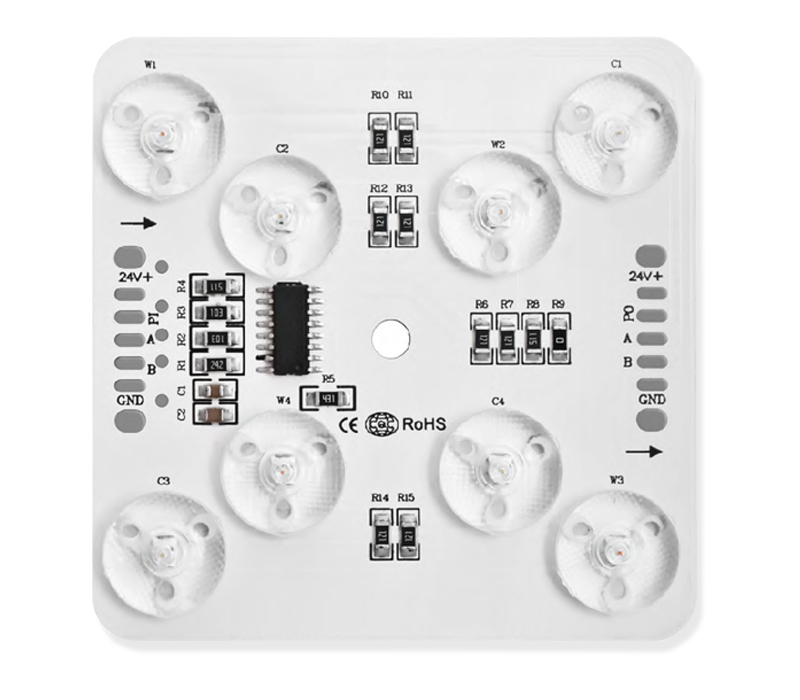
- Type de LED : 2835 SMD
- Qté LED : 2*4 pièces
- Puissance : 2+4W
- Tension : DC24V
- Efficacité : 100 lm/W
- Couleur: CCT 2700-6500K
- CRI : RA90+
- Taille : 68 x 68 x 5,5 mm
- BIN unicolore, DDCM en 3 étapes disponible
De la facture à la production : le point de contrôle du dessin de PCB
Une fois les spécifications confirmées, la facture a été émise et le paiement a été reçu le 7 août. La commande étant confirmée, le projet est passé à la préparation de circuits imprimés et à la planification de la production.
Étape 1 — Dessin d'un PCB en premier, deuxième production
Avant que la production ne progresse, Signiteled a envoyé le dessin de PCB personnalisé au client pour examen et approbation. Cela a permis de vérifier les détails de conception clés, y compris les dimensions des cartes, la tension d'entrée, la disposition des LED et le regroupement, avant la production.
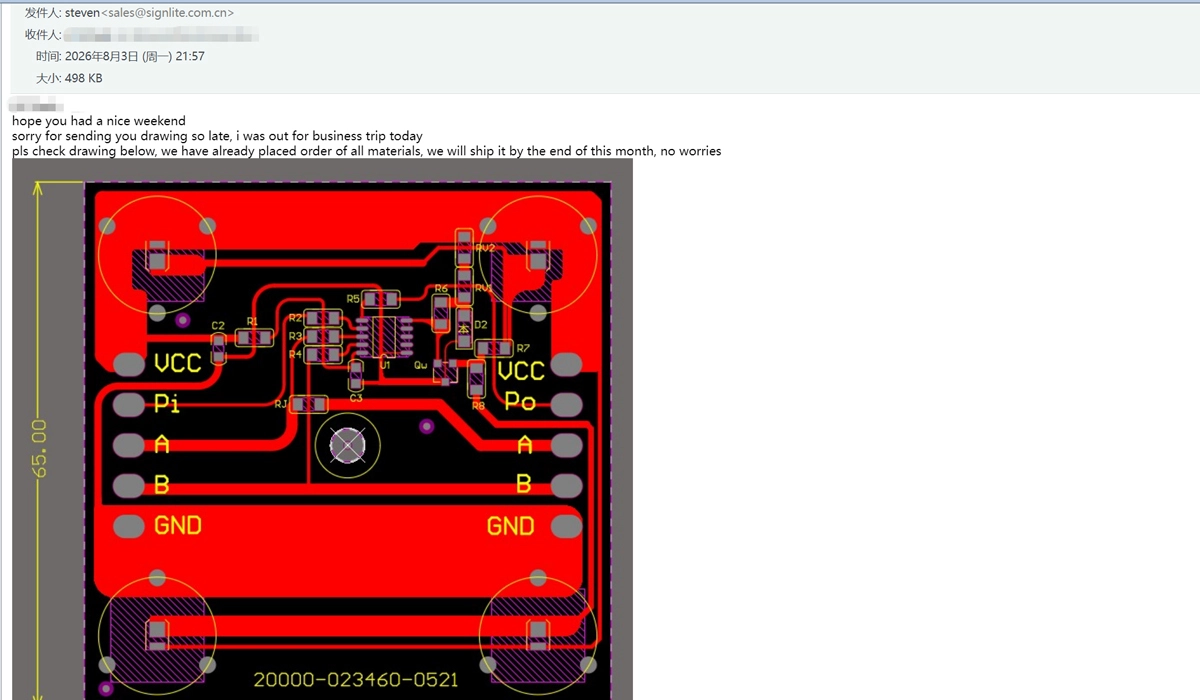
Figure : Dessin de circuits imprimés partagé avec le client lors du projet de module LED 12V DMX pour la confirmation de la conception.
Après avoir examiné le dessin, le client a approuvé le design :
Oui, ça a l'air bien, vous pouvez aller de l'avant avec la production.
Étape 2 : production organisée après confirmation du dessin
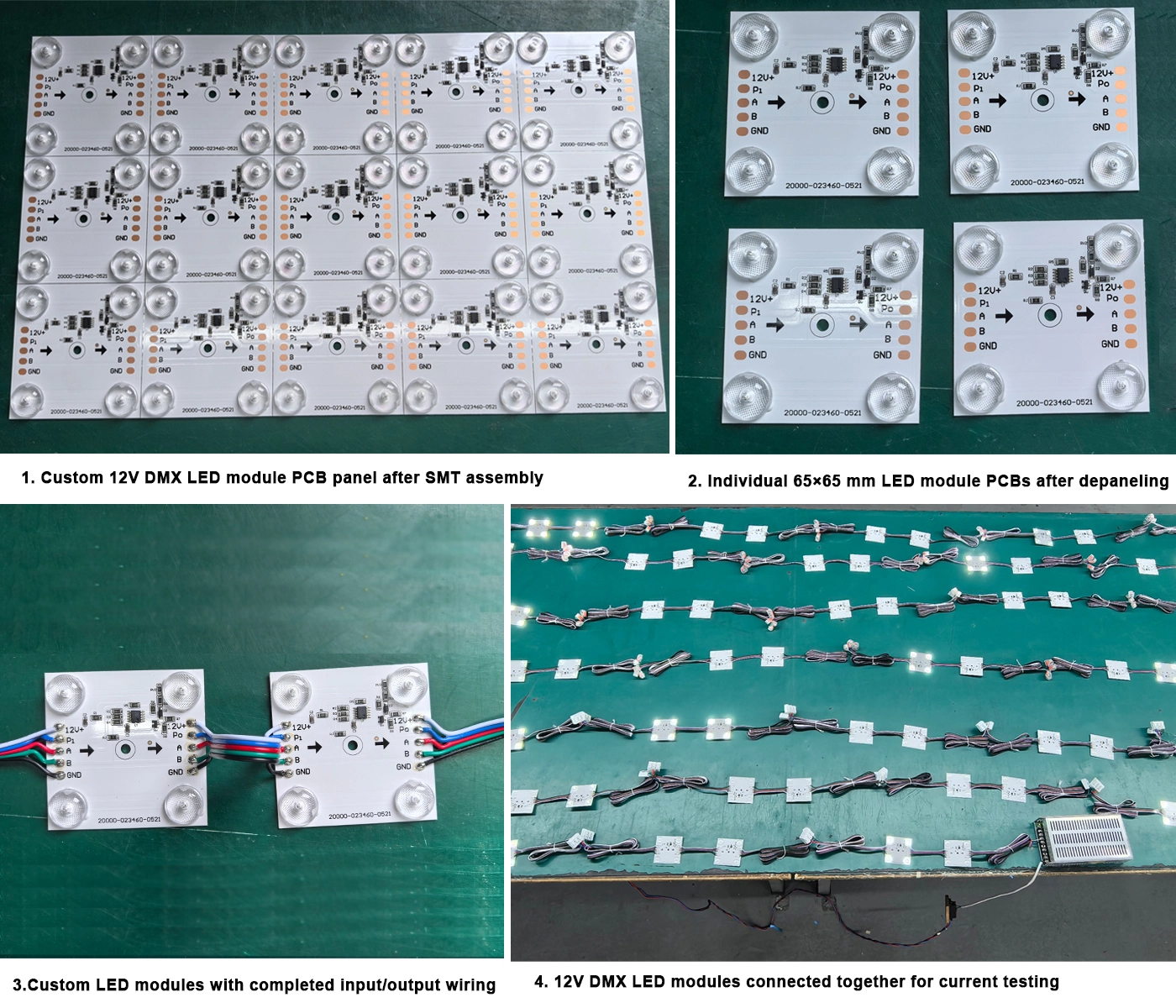
Une fois le dessin du PCB approuvé, les matériaux de PCB personnalisés ont été commandés et le projet est passé en production. Les modules ont ensuite procédé à l'assemblage et aux tests avant expédition.
Étape 3 – Envoi programmé
Après la production et les tests, les modules terminés ont été préparés pour l'expédition selon le calendrier du projet.
Calendrier du projet en un coup d'œil
| dater | Jalon |
| 23 juillet | Demande initiale reçue |
| 24-25 juillet | Spécifications clarifiées : ruban adhésif, groupement LED et entrée 12 V confirmées |
| 26 juillet | Facture émise |
| 7 -Aug | Paiement confirmé |
| 9 août | Dessin de PCB envoyé et approuvé |
| mi-août | Matériaux de circuits imprimés personnalisés commandés et production commencée |
| Fin août | expédition |
De la première demande à l'expédition, le projet complet a duré environ six semaines.
Ce que cette affaire enseigne aux acheteurs commander des modules LED personnalisés
1. Confirmez la tension d'entrée avant de finaliser la conception
La tension d'entrée affecte le circuit de circuit imprimé et la sélection des composants. Si un projet nécessite 12 V au lieu d'une plate-forme standard 24 V du fabricant, la tension doit être confirmée avant la finalisation de la conception du PCB. Dans ce projet, la vérification précoce de l'exigence de 12 v a permis de garantir que le PCB personnalisé a été conçu pour le système électrique existant du client.
2. Définissez la logique de contrôle, pas seulement le protocole de contrôle
La spécification de « DMX Control » seule ne peut pas définir complètement le fonctionnement d'un module LED. Les acheteurs doivent également préciser si les LED sont contrôlées individuellement ou regroupées. Dans ce projet, le client avait spécifiquement besoin des quatre LED blanches de chaque module pour fonctionner comme une seule unité contrôlable, ce qui a affecté directement le circuit imprimé et la conception de contrôle.
3. Utilisez le dessin du PCB comme point de confirmation de conception
Pour un projet de circuit imprimé personnalisé, la révision du dessin donne aux deux côtés la possibilité de vérifier les détails importants tels que les dimensions de la carte, la tension, la disposition des LED et le regroupement avant que la production ne progresse. Dans ce cas, le dessin de PCB a été partagé avec le client et approuvé avant que les modules n'entrent en production.
4. Le développement personnalisé ne nécessite pas toujours un long délai de livraison
Ce projet est passé de l'enquête initiale à l'expédition dans environ six semaines, y compris la clarification des spécifications, la préparation et l'approbation des PCB, la préparation des matériaux, la production et les tests. Le délai réel pour les autres projets personnalisés dépendra du niveau de personnalisation et des exigences de production.
Spécifications du projet en un coup d'œil
Le tableau ci-dessous compare la plate-forme de modules LED standard de Signiteled avec la configuration finale développée pour ce projet. Trois différences étaient particulièrement importantes : le client avait besoin de 12 v DC au lieu de la plate-forme standard DC24V, d'une configuration à quatre LED à faible puissance et d'une seule couleur et les quatre LED de chaque module pour fonctionner ensemble comme une unité DMX contrôlable.
Ces exigences ont affecté la conception du circuit imprimé, la configuration électrique et la logique de contrôle, ce qui rend un module personnalisé nécessaire plutôt qu'un produit standard standard.
| spécification | SigneLiteled Standard | Ce projet personnalisé |
| Type de produit | Module LED RGBW / RGBCCT standard | Module LED DMX monochrome personnalisé |
| Tension d'entrée | DC24V | DC12V |
| LED par module | 6 LED | 4 LED |
| couleur claire | RGBW / RGBCCT | Blanc |
| CCT / CRI | Dépend de la configuration | 6500k / RA80 |
| Puissance | 4–6W | 1,5 W par module |
| Taille du circuit imprimé | Plateforme standard | 65 × 65 mm |
| Protocole de contrôle | DMX512 | DMX512 |
| logique de contrôle | Contrôle des couleurs multicanaux | Les 4 LED sont contrôlées ensemble comme une seule unité |
| adhésif | nul | nul |
| Délai de réalisation du projet | — | Environ 6 semaines entre la demande et l'expédition |
La configuration finale du projet était basée sur les exigences confirmées du client et le dessin sur PCB approuvé, fournissant une référence claire pour la production et l'inspection finale.

FAQ
Conclusion
"Personnalisé" n'est pas simplement une catégorie de produits, c'est un processus. Pour ce projet de module LED 12V DMX, les étapes clés ont été de comprendre les exigences électriques et de contrôle du client, de confirmer les spécifications, de développer le PCB personnalisé, de revoir le dessin de PCB et de mettre la conception approuvée en production.
Le projet montre également pourquoi des détails tels que la tension d'entrée, le regroupement de LED, les dimensions des PCB et la logique de contrôle doivent être clarifiés au début d'un projet de module LED personnalisé. Dans ce cas, la solution finale a combiné une entrée 12 V DC, quatre LED blanches unicolores, un contrôle DMX512 et un PCB de 65 × 65 mm, le projet passant d'une enquête initiale à une expédition en environ six semaines.
Signiteled fournit des solutions de modules LED personnalisées pour les projets d'éclairage OEM et commerciaux, y compris les dispositions de circuits imprimés personnalisés, les configurations de tension, les spécifications LED et les exigences de contrôle.
Si vous développez un projet de module LED personnalisé, Contacter Signiteled Avec votre tension cible, votre configuration LED, vos dimensions, votre méthode de contrôle, votre quantité et vos exigences d'application. Notre équipe peut examiner les spécifications et discuter d'une solution adaptée à votre projet.
Author : Steven Quan
Directeur des ventes
E-mail : sales@signlite.com.cn
Mobile / WhatsApp : +86 15814478470

Articles Similaires