English
  简体中文
简体中文  Deutsch
  Español
  Français
  Italiano
  日本語
日本語  한국어
한국어  Polski
  Português
  Русский
  Türkçe
  Nederlands
  Tiếng Việt
  ไทย
ไทย 
Most LED module enquiries follow the same path: a buyer sends specifications, the manufacturer quotes, and if the numbers work, production begins. But when the requirement falls outside the standard catalogue — a non-standard voltage, specific pixel grouping, or particular control protocol — the success of the project often depends on how those details are clarified before production begins.
This case study follows a real SignliteLED project for a European lighting company requiring a non-standard combination: 12V DC input, single-colour white LEDs, DMX control, and four LEDs grouped as one addressable unit. The following sections show how the specification was clarified, the custom PCB was developed and approved, and the modules moved into production and shipment.
Quick Answer
The short answer: A European lighting company needed custom 12V DC single-colour white LED modules with DMX control, with all four LEDs on each module operating as one addressable unit. SignliteLED redesigned the PCB for 12V input, confirmed the electrical requirements before production, and sent the PCB drawing to the customer for approval before manufacturing. The project moved from initial enquiry to shipment in approximately six weeks.
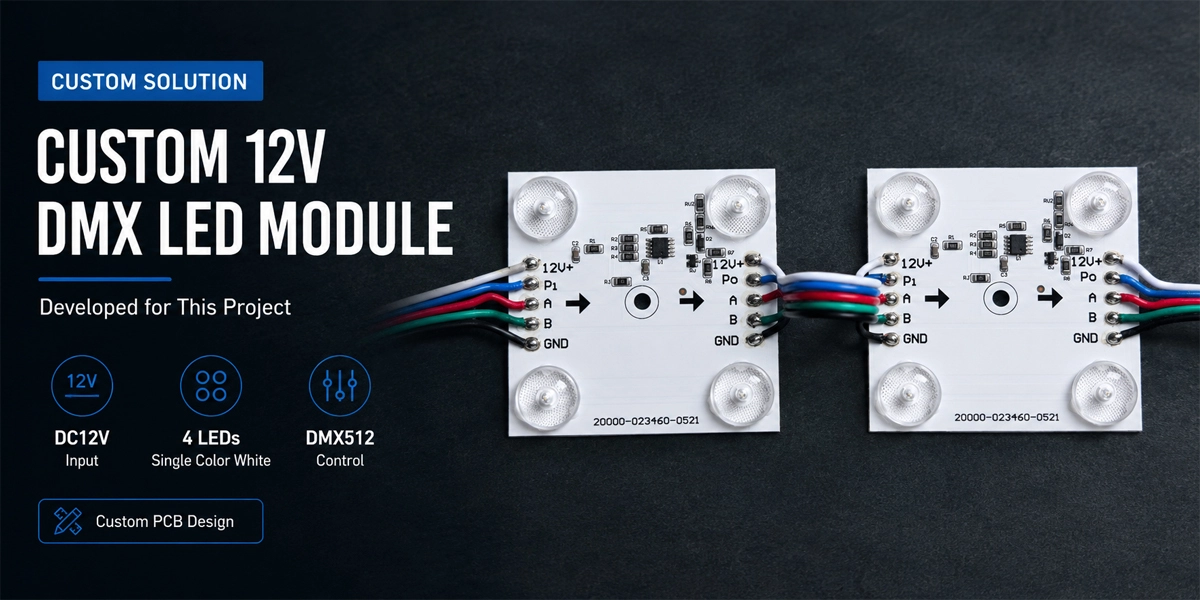
The enquiry: single-colour white LED modules with DMX control
In late July, a European lighting designer contacted SignliteLED with a clear but non-standard requirement:
12V DC single-colour white LED modules with DMX control, with all four LEDs on each module operating as one addressable unit rather than being controlled individually.
Two things made this enquiry stand out:
1. DMX control for a single-colour white module
SignliteLED’s standard DMX LED module configurations are primarily designed for multi-channel colour control, such as RGBW or RGBCCT. In this project, however, the customer needed only single-colour white light with DMX control. All four white LEDs on each module would operate together as one controllable unit, allowing the brightness of each module to be addressed and dimmed through the DMX system.
2. 12V DC Input Instead of the Standard 24V Platform
SignliteLED’s standard LED module platform operates on DC24V, while the customer’s existing installation required DC12V. This meant the standard PCB could not simply be used as-is; a dedicated 12V PCB configuration was required to match the customer’s electrical system.
| DMX Module Type | LEDs per Module | Control Channels | Control Logic | Typical Use |
| Standard RGBW DMX | 6 | 4 (R, G, B, W) | Independent colour-channel control | Full-colour lighting |
| Standard RGBCCT DMX | 6 | 5 (R, G, B, WW, CW) | Independent colour and white-channel control | Colour + tunable white |
| This Custom Project | 4 white LEDs | 1 | All 4 LEDs controlled together as one unit | Even white backlighting with per-module dimming |
By controlling all four LEDs on each module together, the design reduced the number of DMX control channels required compared with individually controlling each LED. This simplified the control architecture and matched the customer’s requirement for module-level dimming rather than individual LED control.
The specification questions: getting the details right before quoting
Rather than moving directly to quotation, SignliteLED first clarified two details that would affect the final module configuration:
Question 1 — Adhesive tape on the back?
SignliteLED’s standard modules are supplied without pre-applied 3M tape. During the specification discussion, the customer confirmed that adhesive tape was not required, so the project retained the standard no-tape configuration.
Question 2 — How should the four LEDs be grouped?
This was the more important design decision. An individually controlled configuration was initially considered, but the customer clarified that all four LEDs on each module should operate together:
I want to control a module with 4 LEDs as a single unit — so not each of the 4 LEDs on a module individually.
This clarification directly affected the PCB and control design: the four LEDs on each 65 × 65 mm module needed to operate together as one controllable unit rather than as four individually controlled LEDs.
For comparison, see our LED module product page for standard module configurations, or our DMX RGB LED modules guide for more information about DMX control and addressing.
The voltage check: confirming 12V DC before invoicing
Because SignliteLED’s standard LED module platform operates on DC24V, the customer’s DC12V requirement needed to be confirmed before the custom design moved forward. The original enquiry and subsequent specification discussions were reviewed to verify that the module would be used with a 12V DC system.
Once the 12V input was confirmed, the PCB could be designed around the required voltage, including the appropriate current-limiting components and LED series-parallel configuration. This required a dedicated 12V PCB layout rather than simply using the standard 24V design.
Why this matters: Input voltage is a fundamental PCB design parameter. A module designed for 24V operation is not automatically compatible with a 12V system, so the required voltage should be confirmed before the PCB layout and component selection are finalized. In this project, confirming the 12V requirement before production helped avoid redesign and unnecessary rework.
For more information about choosing between DC12V and DC24V systems, see our LED module buying guide for light boxes and ceilings, including power supply selection and sizing.
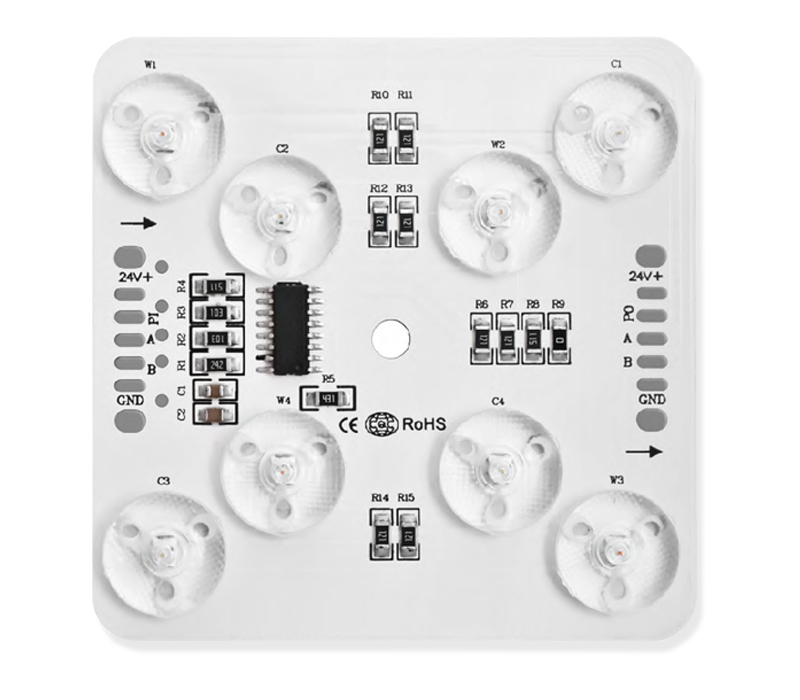
DMX Tunable White LED Modules
- LED Type: 2835 SMD
- LED Qty: 2*4 pcs
- Power: 2+4W
- Voltage: DC24V
- Efficiency: 100 lm/W
- Color: CCT 2700-6500K
- CRI: Ra90+
- Size: 68 x 68 x 5.5 mm
- Single one color BIN, 3 steps SDCM available
From invoice to production: the PCB drawing checkpoint
After the specifications were confirmed, the invoice was issued and payment was received on August 7. With the order confirmed, the project moved into custom PCB preparation and production planning.
Step 1 — PCB Drawing First, Production Second
Before production moved forward, SignliteLED sent the custom PCB drawing to the customer for review and approval. This allowed key design details — including board dimensions, input voltage, LED layout, and grouping — to be verified before production.
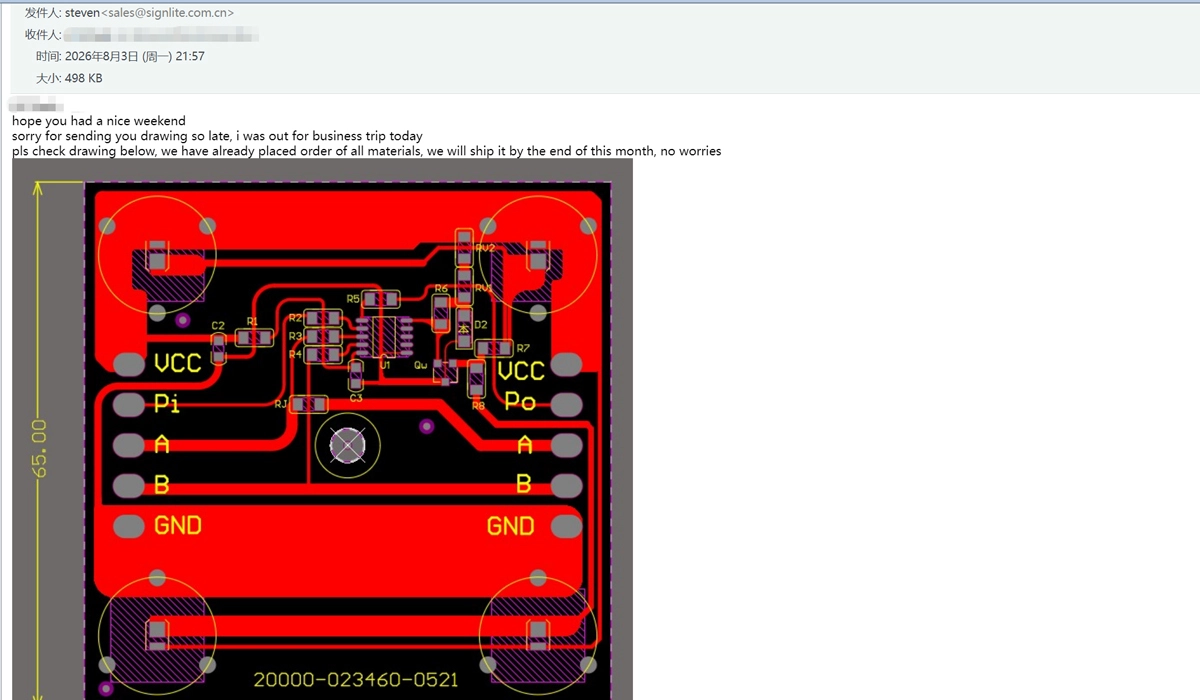
Figure: PCB drawing shared with the customer during the 12V DMX LED module project for design confirmation.
After reviewing the drawing, the customer approved the design:
Yes it looks good, you can go ahead with the production.
Step 2 —Production Arranged After Drawing Confirmation
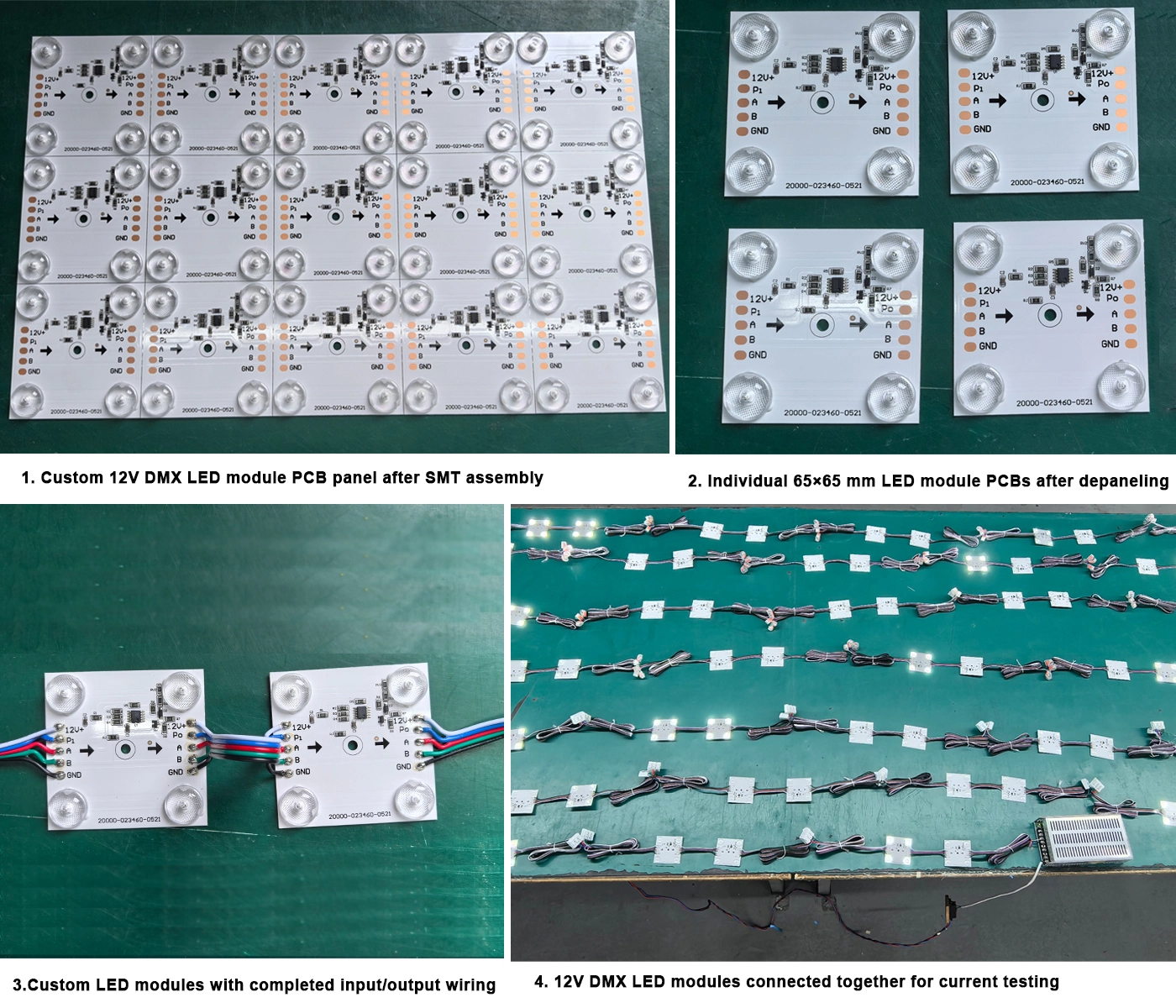
Once the PCB drawing was approved, the custom PCB materials were ordered and the project moved into production. The modules then proceeded through assembly and testing before shipment.
Step 3 — Shipment Scheduled
After production and testing, the completed modules were prepared for shipment according to the project schedule.
Project Timeline at a Glance
| Date | Milestone |
| 23-Jul | Initial enquiry received |
| Jul 24–25 | Specifications clarified: adhesive tape, LED grouping, and 12V input confirmed |
| 26-Jul | Invoice issued |
| 7-Aug | Payment confirmed |
| 9-Aug | PCB drawing sent and approved |
| Mid-Aug | Custom PCB materials ordered and production started |
| End of Aug | Shipment |
From the initial enquiry to shipment, the complete project took approximately six weeks.
What this case teaches buyers ordering custom LED modules
1. Confirm the input voltage before finalizing the design
Input voltage affects the PCB circuit and component selection. If a project requires 12V instead of a manufacturer’s standard 24V platform, the voltage should be confirmed before the PCB design is finalized. In this project, verifying the 12V requirement early helped ensure that the custom PCB was designed for the customer’s existing electrical system.
2. Define the control logic, not just the control protocol
Specifying “DMX control” alone may not fully define how an LED module should operate. Buyers should also clarify whether LEDs are controlled individually or grouped together. In this project, the customer specifically required all four white LEDs on each module to operate as one controllable unit, which directly affected the PCB and control design.
3. Use the PCB drawing as a design confirmation point
For a custom PCB project, reviewing the drawing gives both sides an opportunity to verify important details such as board dimensions, voltage, LED layout, and grouping before production moves forward. In this case, the PCB drawing was shared with the customer and approved before the modules entered production.
4. Custom development does not always require a long lead time
This project moved from the initial enquiry to shipment in approximately six weeks, including specification clarification, PCB preparation and approval, material preparation, production, and testing. The actual lead time for other custom projects will depend on the level of customization and production requirements.
Project specifications at a glance
The table below compares SignliteLED’s standard LED module platform with the final configuration developed for this project. Three differences were particularly important: the customer required DC12V instead of the standard DC24V platform, a lower-power four-LED single-colour configuration, and all four LEDs on each module to operate together as one controllable DMX unit.
These requirements affected the PCB design, electrical configuration, and control logic, making a custom module necessary rather than a standard off-the-shelf product.
| Specification | SignliteLED Standard | This Custom Project |
| Product type | Standard RGBW / RGBCCT LED module | Custom single-colour DMX LED module |
| Input voltage | DC24V | DC12V |
| LEDs per module | 6 LEDs | 4 LEDs |
| Light colour | RGBW / RGBCCT | White |
| CCT / CRI | Depends on configuration | 6500K / Ra80 |
| Power | 4–6W | 1.5W per module |
| PCB size | Standard platform | 65 × 65 mm |
| Control protocol | DMX512 | DMX512 |
| Control logic | Multi-channel colour control | All 4 LEDs controlled together as one unit |
| Adhesive backing | None | None |
| Project lead time | — | Approximately 6 weeks from enquiry to shipment |
The final project configuration was based on the customer’s confirmed requirements and the approved PCB drawing, providing a clear reference for production and final inspection.

FAQ
Conclusion
“Custom” is not simply a product category — it is a process. For this 12V DMX LED module project, the key steps were understanding the customer’s electrical and control requirements, confirming the specifications, developing the custom PCB, reviewing the PCB drawing, and moving the approved design into production.
The project also shows why details such as input voltage, LED grouping, PCB dimensions, and control logic should be clarified early in a custom LED module project. In this case, the final solution combined a 12V DC input, four single-colour white LEDs, DMX512 control, and a 65 × 65 mm PCB, with the project moving from initial enquiry to shipment in approximately six weeks.
SignliteLED provides custom LED module solutions for OEM and commercial lighting projects, including custom PCB layouts, voltage configurations, LED specifications, and control requirements.
If you are developing a custom LED module project, contact SignliteLED with your target voltage, LED configuration, dimensions, control method, quantity, and application requirements. Our team can review the specifications and discuss a suitable solution for your project.
Auther: Steven Quan
Sales Manager
E-Mail: sales@signlite.com.cn
Mobile / WhatsApp: +86 15814478470

Related Posts