Français
  English
  简体中文
简体中文  Deutsch
  Español
  Italiano
  日本語
日本語  한국어
한국어  Polski
  Português
  Русский
  Türkçe
  Nederlands
  Tiếng Việt
  ไทย
ไทย 
Les enseignes au néon à LED sur mesure sont devenues une solution d'éclairage largement adoptée pour les applications commerciales et décoratives modernes. Ils sont couramment utilisés dans les magasins de détail, les restaurants, les événements et les espaces intérieurs où l'impact visuel et les performances à long terme sont importants.
Comparé au néon en verre traditionnel, les enseignes au néon à LED fonctionnent à basse tension et utilisent la technologie d'éclairage à semi-conducteurs. Cela les rend plus sûrs, plus économes en énergie et plus faciles à installer, tout en réduisant les besoins de maintenance au fil du temps. De plus, leur conception flexible permet une personnalisation précise des logos, du texte et des formes complexes.
Dans les applications pratiques, ces signes ne sont pas seulement utilisés pour l'éclairage, mais également pour la communication de marque et la communication visuelle. Une enseigne au néon bien conçue peut améliorer la visibilité, améliorer l'expérience client et renforcer l'identité de la marque. Basé sur une expérience de fabrication dans le monde réel et la mise en œuvre du projet, la sélection des matériaux et de la conception appropriés est essentielle pour atteindre des performances constantes et une fiabilité à long terme.
Ce guide donne un aperçu structuré des enseignes au néon à LED personnalisées, notamment leur fonctionnement, les matériaux utilisés, les processus de conception et de fabrication, les facteurs de tarification et la manière de choisir le bon fabricant pour différents projets.
réponse rapide
Les enseignes au néon à LED personnalisées sont des panneaux lumineux flexibles fabriqués à l'aide de bandes LED néons flexibles montées sur des panneaux en acrylique ou en métal. Ils reproduisent l'apparence du néon traditionnel tout en fonctionnant à basse tension (12 V/24 V), consomment moins d'énergie (8 à 15 W/m) et peuvent durer jusqu'à 50 000 heures.
Points à retenir clés
- Les enseignes au néon LED consomment 60 à 701 TP3T moins d'énergie que le néon en verre
- La durée de vie typique varie entre 30 000 et 50 000 heures
- Fonctionne sur une basse tension sûre (12 V/24 V DC)
- Entièrement personnalisable en taille, couleur et forme
- Disponible en versions IP20 (intérieure) et IP65 (extérieure)
- Le coût d'entretien est nettement inférieur à celui du néon traditionnel
- Convient pour les applications commerciales et décoratives
Quels sont les enseignes au néon à LED personnalisées

Signes de néon LED personnalisés sont des systèmes d'éclairage modernes conçus pour reproduire la lueur visuelle du néon traditionnel à l'aide de puces LED intégrées à l'intérieur de diffuseurs en silicone flexibles. Contrairement au néon en verre, qui utilise une décharge de gaz et une haute tension, le néon LED fonctionne avec une alimentation en courant continu à basse tension, ce qui le rend plus sûr et plus efficace.
Au niveau du système, un enseigne au néon n'est pas un seul composant mais une combinaison de plusieurs éléments d'ingénierie travaillant ensemble.
| composante | Spécification typique | Fonction | Impact pratique |
| Puces LED | CMS 2835 / 2216 | génération de lumière | Efficacité (100–130 lm/W) |
| Tension | 12V / 24V DC | Alimentation électrique | sécurité électrique |
| Consommation électrique | 8 à 15 W/m | consommation d'énergie | frais de courant |
| Durée de vie | 30 000 à 50 000 heures | Durabilité | ROI |
| Angle du faisceau | 120°–180° | Propagation légère | lueur uniforme |
| Indice de protection IP | IP20–IP65 | Protection de l'environnement | Utilisation intérieure/extérieure |
Le diffuseur en silicone joue un rôle essentiel. Il répand la lumière uniformément, éliminant les points chauds et créant l'effet de lueur continue qui ressemble au néon traditionnel.
Pour comprendre comment fonctionne la technologie néon moderne par rapport aux systèmes traditionnels, consultez notre guide détaillé sur Comment fonctionne LED Neon Flex dans des applications d'éclairage réel
Pour une explication technique plus approfondie de la structure du néon LED et des principes de travail, reportez-vous à notre Guide technique complet LED Neon Flex pour les professionnels
Comment fonctionnent les enseignes au néon LED
Les enseignes au néon LED fonctionnent en faisant passer le courant continu à basse tension (12V ou 24V) à travers des puces LED intégrées à l'intérieur d'un diffuseur en silicone flexible. Ces LED émettent une lumière qui est répartie uniformément par le diffuseur, créant une lueur continue similaire au néon traditionnel.
Contrairement au néon en verre, qui repose sur la décharge de gaz et la haute tension, le néon LED utilise une technologie d'éclairage à semi-conducteurs. Cela améliore la sécurité, réduit la consommation d'énergie et assure une sortie de lumière constante sans scintillement.
Néon LED vs verre traditionnel néon
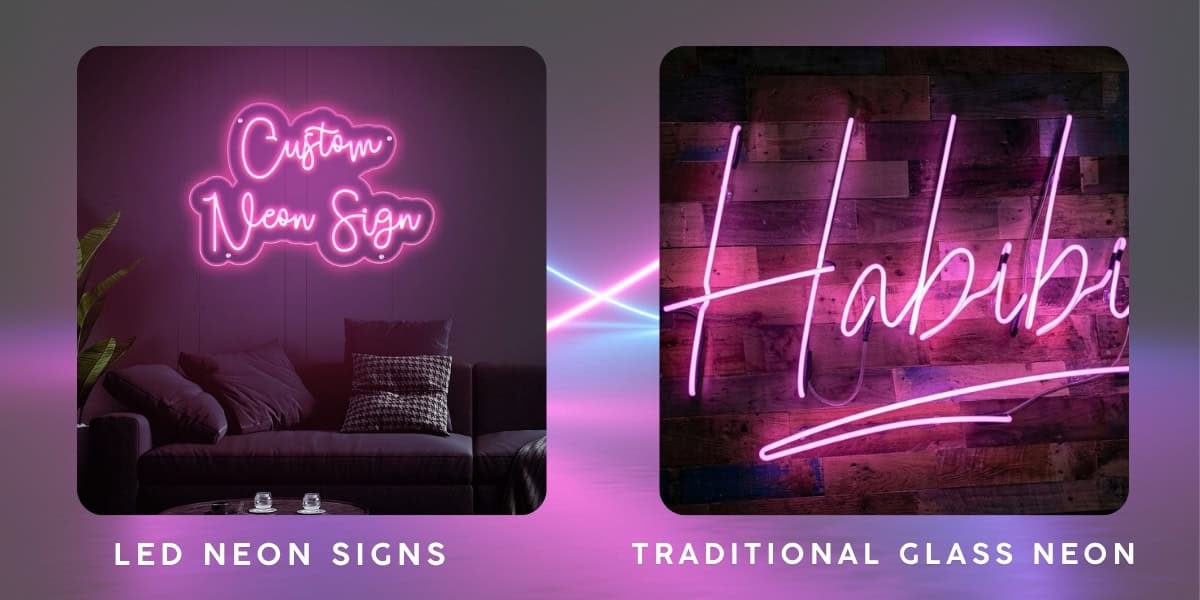
Le passage du néon en verre au néon LED est motivé par la performance, la sécurité et la rentabilité.
| Paramètres | Néon LED | Néon de verre | Impact dans le monde réel |
| Tension | 12–24V | 3 000 à 15 000 V | Risque de sécurité élevé dans le verre |
| Consommation électrique | 8 à 15 W/m | 20–30 W/m | Coût d'électricité plus élevé |
| Durée de vie | 30 000 à 50 000 heures | 8 000 à 15 000 heures | Remplacement fréquent |
| fragilité | Flexible | Verre cassable | Maintenance élevée |
| Installation | Simple | Complexe | coût de la main-d |
| Puissance calorifique | Faible | Haut | Préoccupation en matière de |
Glass Neon est visuellement attrayant mais inefficace sur le plan opérationnel. Cela nécessite :
- Transformateurs haute tension
- Installation qualifiée
- Entretien fréquent
Led Neon élimine ces problèmes tout en offrant une sortie visuelle comparable. Dans le cas d'une utilisation commerciale à grande échelle, cette différence se traduit par des économies de coûts importantes au fil du temps.
Vous pouvez également explorer une comparaison détaillée entre les technologies dans notre guide sur LED Neon Flex vs systèmes d'éclairage conventionnels
Composants d'une enseigne au néon LED personnalisée
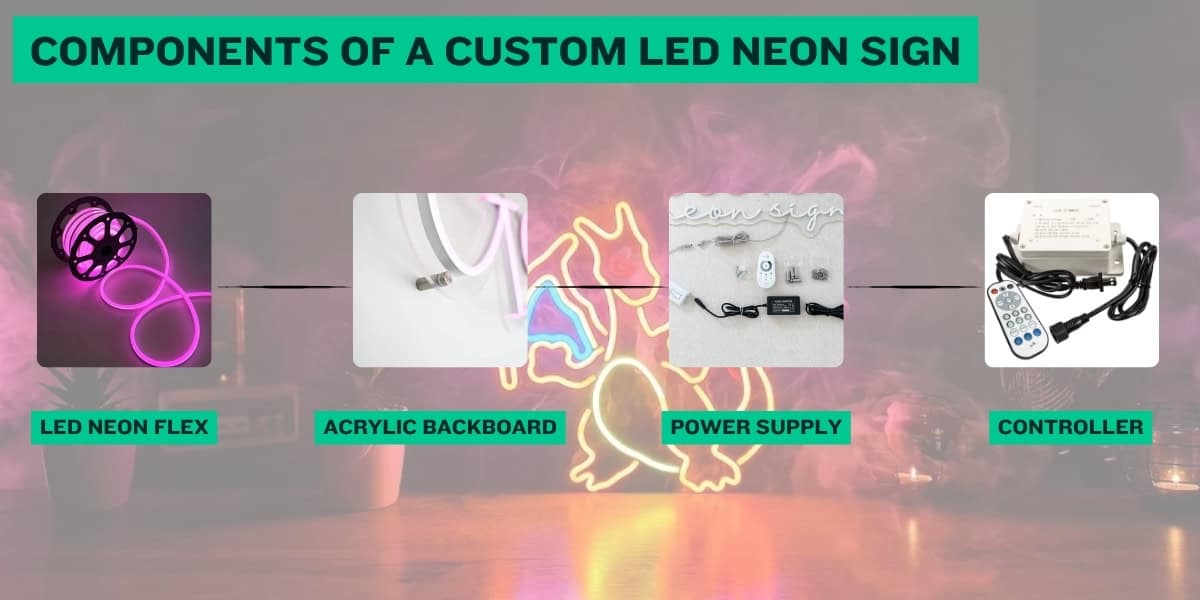
Un enseigne au néon à LED personnalisée n'est pas seulement un produit décoratif. Il s'agit d'un système d'éclairage intégré complet composé de composants électriques, optiques et structurels. Les performances, la durabilité et la qualité visuelle du signe final dépendent de la qualité de ces composants et de leur sélection.
Chaque composant a un rôle d'ingénierie spécifique, et même de petites différences de qualité peuvent affecter de manière significative la cohérence, la durée de vie et la sécurité de la luminosité.
1. LED FLEX NEON (SOURCE DE LIGHT)
Led Neon Flex est l'élément central de lumière du système. Il se compose de puces LED intégrées à l'intérieur d'un boîtier flexible en silicone ou en PVC qui diffuse la lumière pour créer un effet continu de type néon.
Contrairement aux bandes LED traditionnelles, Neon Flex est conçu pour produire un éclairage uniforme et sans points, ce qui est essentiel pour les applications de signalisation.
Détails techniques :
| Paramètres | Gamme typique | Impact technique |
| Consommation électrique | 8 à 15 W/m | Détermine la consommation d'énergie |
| Sortie lumineuse | 500–1200 lm/m | Contrôle le niveau de luminosité |
| Tension | 12V / 24V DC | Sécurité et stabilité |
| Densité des LED | 120 à 240 LED/m | affecte l'uniformité |
| Type de pliage | Courbure supérieure/latérale | Flexibilité de conception |
Pourquoi c'est important :
Le néon Flex de mauvaise qualité entraîne une luminosité inégale, des points visibles et une incohérence des couleurs. Le flex haute densité et de haute qualité garantit une fluidité de la lumière et une fiabilité à long terme.
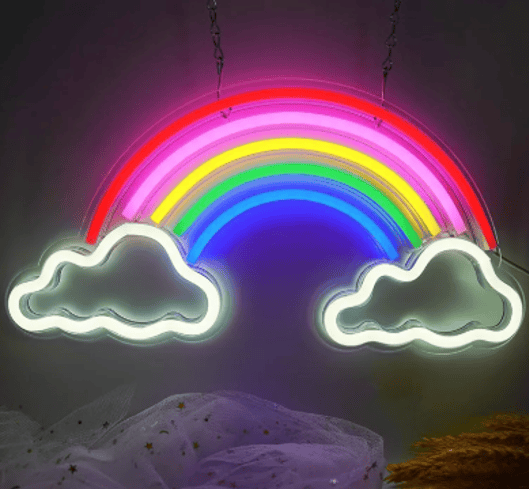
Side Bend S0612 Bande de néons LED en silicone pour enseigne
- Tension d'entrée : DC12V/24V
- Watt :10W/m
- LED QTÉ : SMD2835 120 LEDs/m
- Couleur : Rouge/vert/bleu/jaune/bleu de glace/rose/rose/violet/citron
- Jaune/Jaune doré/Orange/Blanc
- jepGrade : IP67
- Longueur découpable : 25mm/50mm
- Longueur : 50 mètres/roule
2. Panneau acrylique (base structurelle)
Le panneau acrylique agit comme la fondation structurelle de l'enseigne au néon. Il maintient le flex au néon LED en place et définit la forme générale et la conception du panneau.
Il est généralement coupé avec précision à l'aide de machines de découpe CNC ou laser pour faire correspondre un texte, des logos ou des formes personnalisés.
Détails techniques :
| Paramètres | Gamme typique | Impact technique |
| épaisseur | 3–8 mm | résistance structurelle |
| Matériau | PMMA / Acrylique | Transparence et durabilité |
| méthode de coupe | CNC / laser | Précision de conception |
| fini | Clair / Givré / Coloré | effet visuel |
Pourquoi c'est important :
Un panneau mince ou de mauvaise qualité peut se déformer avec le temps, en particulier dans les grands panneaux. Une épaisseur et un matériau appropriés assurent la stabilité, l'apparence propre et la durabilité à long terme.
3. Alimentation électrique (Driver LED)
L'alimentation convertit l'entrée CA haute tension en sortie CC basse tension requise par le LED Neon Flex. C'est l'un des composants les plus critiques pour la sécurité et la performance.
Un conducteur stable garantit un fonctionnement sans scintillement et protège les LED des fluctuations de tension.
Détails techniques :
| Paramètres | Gamme typique | Impact technique |
| Tension d'entrée | AC 100–240V | Compatibilité globale |
| Tension de sortie | 12V/24V DC | Configuration requise |
| facteur de puissance | >0.9 | Efficacité énergétique |
| Efficacité | 85–92% | Perte de chaleur réduite |
| Protection de l'environnement | Surcharge/court-circuit | Sécurité |
Pourquoi c'est important :
Les conducteurs de mauvaise qualité peuvent provoquer des scintillements, une surchauffe ou une défaillance précoce. Une alimentation électrique fiable augmente directement la durée de vie et la stabilité de l'ensemble du système.
4. Contrôleur / variateur (système de contrôle)
Le contrôleur permet de régler la luminosité, la couleur et les effets d'éclairage. Il est particulièrement important pour les enseignes au néon RVB ou dynamiques utilisées dans les applications commerciales et décoratives.
Détails techniques :
| Paramètres | Gamme typique | Impact technique |
| Type de contrôle | Variation PWM | Contrôle de la luminosité douce |
| fonctionnement | Distance / APP / Interrupteur mural | Confort d'utilisation |
| Compatibilité | Couleur unique / RGB / RGBW | Flexibilité des applications |
| Fonctions | Variation / changement de couleur / effets | Personnalisation |
Pourquoi c'est important :
Sans systèmes de contrôle appropriés, l'éclairage reste statique. Des contrôleurs avancés permettent des effets d'éclairage dynamiques, améliorant ainsi l'attrait visuel et l'expérience utilisateur.
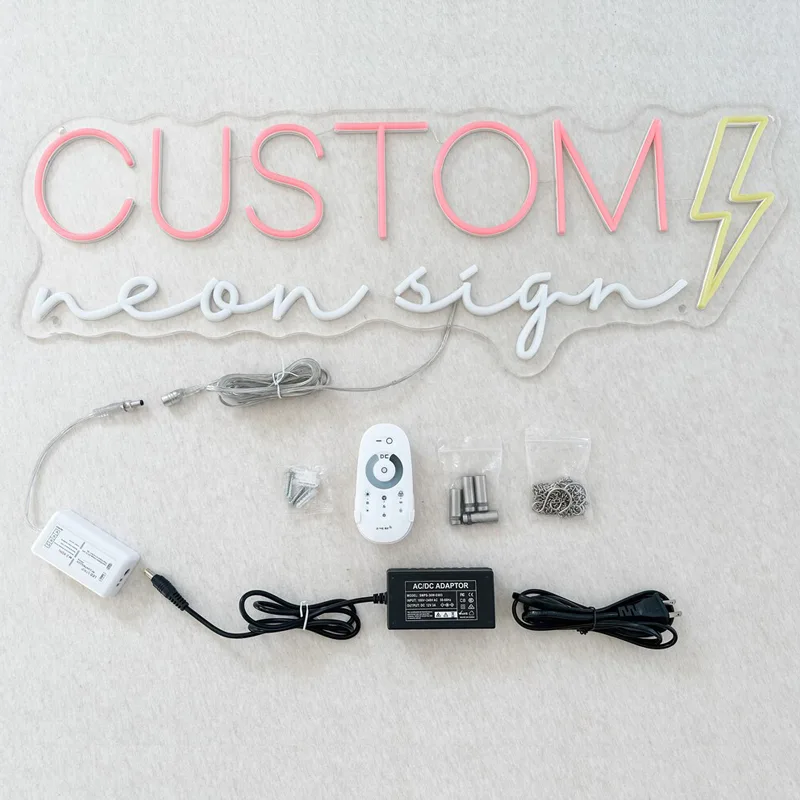
Adaptateur/alimentation LED avec port DC (DC12V/24V)
- Tension d'entrée : AC100-240V
- Tension de sortie : DC12V/DC24V
- Courant de sortie : 3A/4A/5A/6A/8A/10A
- Watt : 72W/96W/120W
- Dimensions : 120x55x30mm
- Certification : US CE ROHS AU
- Classe IP : IP20
- Garantie: 2 ans
Tableau de performances du système intégré
| composante | Spécification clé | rôle principal | Impact sur la performance finale |
| LED Néon Flex | 8–15 W/m, 500–1200 lm/m | génération de lumière | Luminosité et uniformité |
| Panneau acrylique | PMMA 3–8 mm | Support structurel | Stabilité et précision de la conception |
| Alimentation électrique | 12V/24V DC, PF >0,9 | Régulation de puissance | Durée de vie et sécurité |
| Contrôleur | Variation PWM | Contrôle de la lumière | Flexibilité et contrôle des utilisateurs |
Aperçu de l
Les performances d'un néon à LED personnalisées ne sont pas déterminées par un seul composant, mais par l'intégration de tous les composants en tant que système.
Par exemple, même si le LED Neon Flex de haute qualité est utilisé, une alimentation de faible qualité peut provoquer des scintillements et réduire la durée de vie. De même, un support structurel médiocre peut entraîner des problèmes de déformation ou d'installation au fil du temps.
C'est pourquoi les fabricants professionnels se concentrent sur la conception au niveau du système, garantissant que tous les composants sont compatibles, testés et optimisés pour des applications réelles.
La sélection des matériaux et la structure LED ont un impact direct sur les performances. Pour une ventilation plus approfondie, consultez notre article sur Facteurs clés lors du choix du néon Flex pour des projets à grande échelle
Types de néons LED personnalisés
Les enseignes au néon à LED personnalisées sont conçues en fonction des exigences de l'application, des conditions d'installation et des objectifs visuels. Chaque type diffère en termes de niveau de luminosité, de taille, de configuration de couleur et de système de contrôle, selon où et comment il sera utilisé.
Il est important de sélectionner le type correct car un panneau optimisé pour la décoration peut ne pas fournir une visibilité suffisante pour un usage commercial, alors qu'un signe de haute luminosité peut être trop intense pour les environnements intérieurs.
Enseignes au néon (utilisation commerciale et de marque)
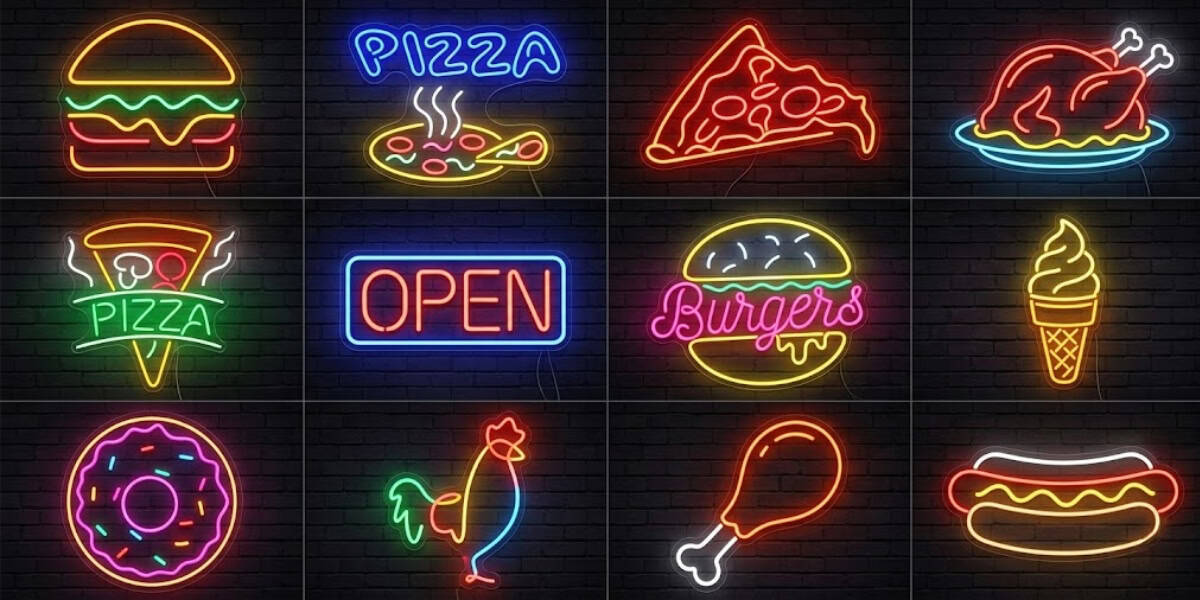
Les enseignes au néon d'affaires sont utilisées pour les vitrines, les logos et les affichages de marque où la visibilité et la reconnaissance sont essentielles. Ces panneaux sont conçus pour rester clairement visibles sous un éclairage ambiant et à distance.
Pour ce faire, des niveaux de luminosité plus élevés et un contraste de couleur fort sont nécessaires. Le blanc, le rouge et le bleu sont couramment utilisés car ils offrent une grande visibilité dans les environnements commerciaux.
| Paramètres | Gamme typique | But d'ingénierie |
| Luminosité | 800–1200 lm/m | Haute visibilité |
| Température de couleur | 4000K–6500K | Sortie claire et nettes |
| Taille | 50–150 cm+ | Lisibilité longue distance |
| Protection de l'environnement | IP65 (facultatif) | utilisation en extérieur |
Événement enseigne au néon (usage temporaire et décoratif)
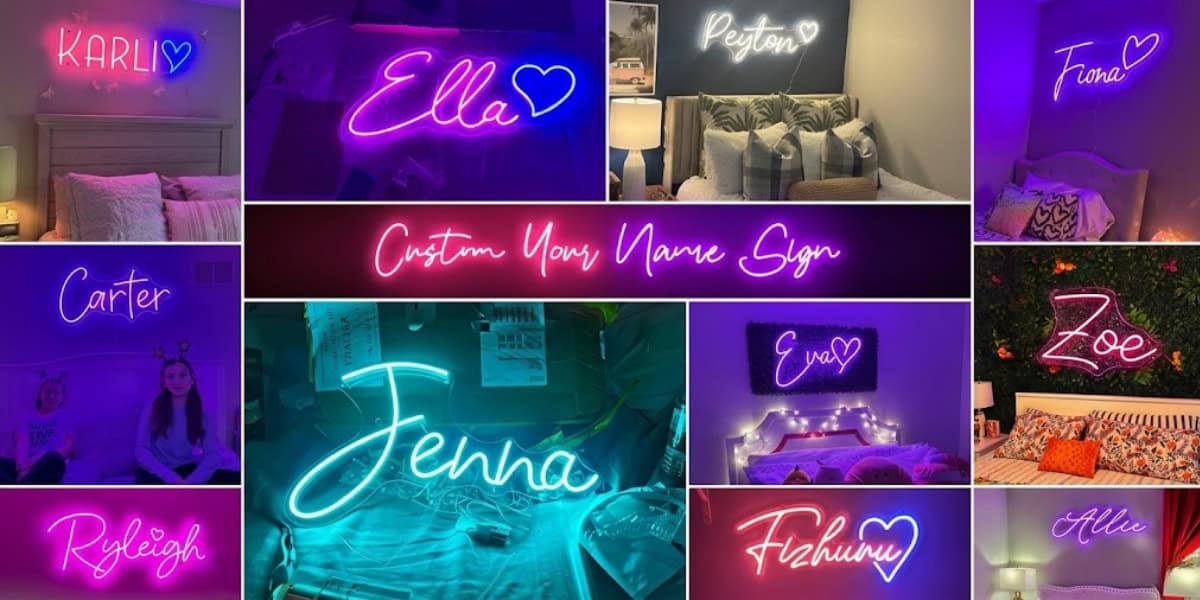
Les enseignes au néon d'événement sont conçues pour des applications à court terme telles que des mariages, des expositions et des événements promotionnels. Ces signes se concentrent sur l'attrait visuel, la portabilité et l'installation facile.
La luminosité est maintenue modérée car ces panneaux sont généralement utilisés dans des environnements d'éclairage contrôlés.
| Paramètres | Gamme typique | But d'ingénierie |
| Luminosité | 400–800 lm/m | Visibilité équilibrée |
| Taille | 30–100 cm | Placement flexible |
| Tension | 12V DC | Fonctionnement en toute sécurité |
| Structure | Acrylique léger | Transport facile |
Enseignes décoratives au néon décoratives intérieures (à domicile et à usage ambi
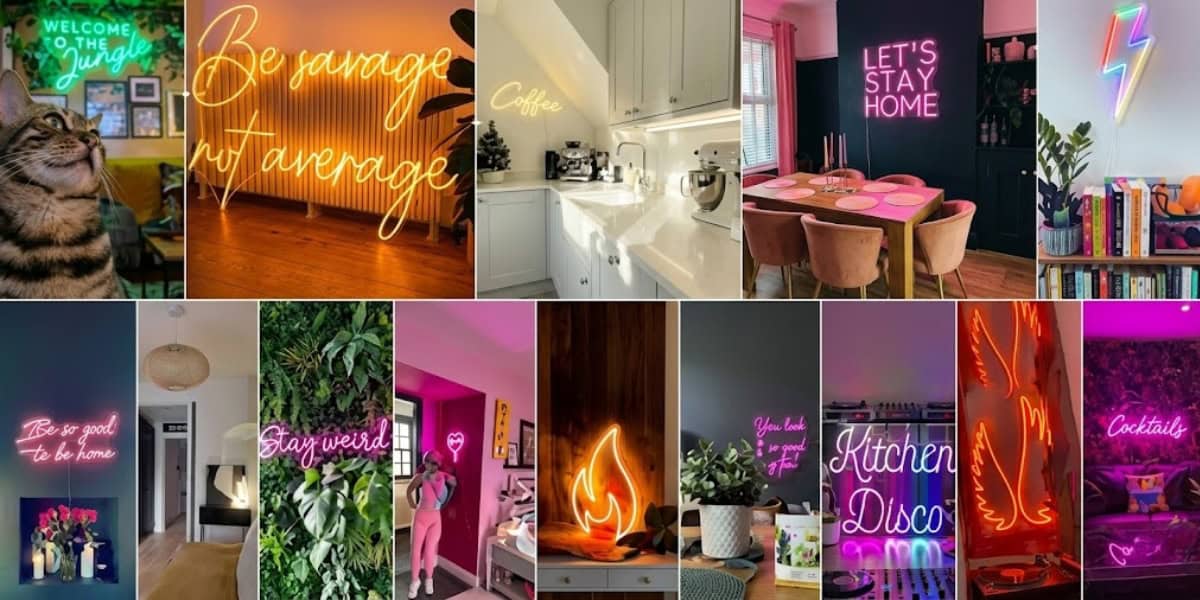
Les enseignes au néon intérieurs sont utilisées dans les espaces résidentiels et décoratifs où l'objectif est de créer une atmosphère plutôt qu'un éclairage fort.
Les enseignes au néon intérieurs sont utilisées dans les espaces résidentiels et décoratifs où l'objectif est de créer une atmosphère plutôt qu'un éclairage fort.
Une luminosité et une température de couleur plus faibles sont utilisées pour maintenir le confort et éviter les reflets.
| Paramètres | Gamme typique | But d'ingénierie |
| Luminosité | 300 à 600 lm/m | éclairage tamisé |
| Température de couleur | 2700 000 à 3 000 000 000 | Ambiance chaleureuse |
| Taille | 20–80 cm | Échelle décorative |
| Contrôle | Variation optionnelle | Ambiance réglable |
Gaming et studios de néon (utilisation dynamique de l'éclairage)
Les enseignes de jeux et de néons en studio sont conçues pour un impact visuel élevé, en particulier dans les configurations de streaming et les environnements de création de contenu. Ces signes utilisent souvent des systèmes RGB ou RGBW pour des effets de couleur dynamiques.
L'accent est mis sur la personnalisation, le contrôle des couleurs et l'amélioration visuelle.
| Paramètres | Gamme typique | But d'ingénierie |
| Type d'éclairage | RGB / RGBW | Couleurs dynamiques |
| Contrôle | Application / télécommande | Ajustement en temps réel |
| Luminosité | ajustable | Éclairage basé sur la scène |
| Application | Studios / Jeux | Impact visuel |
Comparaison des types de signes au néon
| Type | Plage de luminosité | Taille typique | Application | Objet clé |
| affaire | 800–1200 lm/m | 50–150 cm+ | Commerce de détail / Marque | Visibilité |
| événement | 400–800 lm/m | 30–100 cm | Mariages / Événements | portabilité |
| intérieur | 300 à 600 lm/m | 20–80 cm | Accueil / Décor | Ambiance |
| gaming | RVB dynamique | coutume | studios | Effets visuels |
Aperçu de l
Chaque type d'enseigne au néon à LED personnalisée est définie par son application. Une sélection appropriée de la luminosité, de la température de couleur et du système de contrôle garantit que le panneau fonctionne efficacement sans éblouissement, perte d'énergie ou mauvaise visibilité.
Découvrez des solutions personnalisées
Si vous avez besoin d'une enseigne au néon adaptée à votre projet, explorez des solutions de néons LED personnalisées conçues pour les entreprises, les événements et les applications intérieures.
Différents types d'enseignes au néon sont utilisés dans diverses industries. Découvrez les cas d'utilisation réels dans notre guide sur Principales applications des systèmes d'éclairage au néon LED
Comment sont fabriqués les enseignes au néon à LED personnalisées
Le processus de fabrication des enseignes au néon à LED personnalisées est une combinaison d'ingénierie de conception, de traitement de précision et de contrôle de la qualité. Chaque étape affecte directement la performance finale, l'apparence et la durabilité du signe.
Contrairement aux produits d'éclairage produits en série, les enseignes au néon personnalisées nécessitent un savoir-faire manuel combiné à des méthodes de production contrôlées pour assurer la précision et la cohérence.
Étape 1 : Ingénierie de conception et de mise en page
Le processus commence par la création d'un fichier de conception basé sur des vecteurs (format AI, SVG ou CAO). Ce fichier définit la forme, la taille et la disposition exactes de l'enseigne au néon.
À ce stade, les ingénieurs déterminent également les trajectoires de flexion, les positions de montage et le routage électrique pour garantir que la conception peut être produite physiquement sans distorsion.
| Paramètres | valeur typique | Impact technique |
| Format de fichier | AI / SVG / CAO | Précision de conception |
| tolérance | ±1–2 mm | Précision dimensionnelle |
| Planification de la mise en | Manuel + Logiciel | Faisabilité de l'assemblage |
Un fichier de conception précis garantit que tous les processus en aval restent exacts et alignés.
Étape 2 : Découpe au néon flexible LED
Le LED Neon Flex est coupé en fonction de la disposition de la conception à l'aide de points de coupe prédéfinis. La précision est ici essentielle pour assurer un alignement correct lors du montage.
Une coupe incorrecte peut entraîner des problèmes d'éclairage ou d'électricité inégales.
| Paramètres | Gamme typique | Impact technique |
| Précision de coupe | ±1 mm | Ajustement et alignement |
| Intervalle de coupe | 25 à 50 mm (à base de segments) | Intégrité électrique |
| outils | Fraises manuelles / de précision | Bords propres |
Cette étape garantit que chaque segment s'intègre parfaitement dans la conception finale.
Étape 3 : Gravure CNC de panneau acrylique
Le panneau de fond en acrylique est traité à l'aide de machines de découpe CNC ou laser pour s'adapter à la forme exacte de la conception.
Des rainures ou des trajectoires de guidage peuvent également être gravées pour faciliter le placement précis du néon flex.
| Paramètres | Gamme typique | Impact technique |
| Épaisseur du matériau | 3–8 mm | résistance structurelle |
| méthode de coupe | CNC / laser | Précision des bords |
| tolérance | ±0,5 mm | Précision de conception |
La gravure de haute précision garantit des bords propres et une finition professionnelle.
Étape 4 : Cintrage et assemblage manuels
Le LED Neon Flex est plié manuellement et fixé sur le panneau arrière en acrylique en suivant le chemin de conception. Cette étape nécessite une main-d'œuvre qualifiée pour maintenir des courbes lisses et un espacement constant.
Contrairement aux processus automatisés, la mise en forme manuelle permet une flexibilité pour les conceptions complexes mais nécessite un contrôle de la qualité strict.
| Paramètres | Aspect typique | Impact technique |
| Méthode de pliage | Mise en forme de la main | Précision de la courbe |
| Méthode de fixation | Clips / adhésif | Stabilité |
| alignement | Visual + modèle | Apparence Consistance |
Un montage approprié garantit que le rendement lumineux reste uniforme sans déformation.
Étape 5 : Câblage et soudure
Les connexions électriques sont complétées par des fils de soudure entre les segments de néon et les raccordant à l'alimentation.
Cette étape garantit un flux de courant stable sur l'ensemble du signe.
| Paramètres | Gamme typique | Impact technique |
| Tension | 12V / 24V DC | Sécurité |
| qualité de soudure | Sans plomb / Isolé | Fiabilité |
| Type de connexion | Série / parallèle | balance de charge |
Un mauvais câblage peut entraîner des chutes de tension, des scintillements ou une défaillance partielle.
Étape 6 : Test de vieillissement (test de burn-in)
Après l'assemblage, le signe subit des tests de fonctionnement continus (généralement 24 à 48 heures). C'est l'une des étapes de contrôle de la qualité les plus critiques.
Il permet de détecter les pannes précoces telles que les LED défectueuses, les pilotes instables ou les mauvaises connexions.
| Paramètres | Gamme typique | Impact technique |
| Durée du test | 24 à 48 heures | Validation de fiabilité |
| Condition d'essai | Fonctionnement continu | test de résistance |
| Détection des pannes | Visual + Électrique | assurance qualité |
Le test de vieillissement garantit que seuls les produits stables et entièrement fonctionnels sont livrés.
Étape 7 : Inspection finale et emballage
Avant l'expédition, le panneau est inspecté pour la qualité visuelle, les performances électriques et l'intégrité structurelle.
L'emballage est ensuite complété à l'aide de matériaux de protection pour éviter les dommages pendant le transport.
| Paramètres | Inspection ciblée | Impact technique |
| contrôle visuel | Alignement, luminosité | qualité esthétique |
| examen électrique | Tension, stabilité | interprétation |
| Emballage | Mousse / couches protectrices | Sécurité des transports |
Présentation du processus de fabrication
| étape | somm | Temps requis | Impact de la qualité |
| Conception | Création vectorielle | 1 à 2 heures | exactitude |
| Découpage | Découpe flexible LED | haute précision | s'accord |
| gravure | CNC en acrylique | automatisé | Structure |
| assemblée | Mise en forme manuelle | main-d'œuvre qualifiée | Apparence |
| câblage | Soudure | maîtrisé | Stabilité |
| examen | 24 à 48 heures | critique | Fiabilité |
| contrôle | contrôle final | phase finale | assurance qualité |
La qualité d'une enseigne au néon à LED personnalisée est définie non seulement par les matériaux, mais aussi par la précision et le contrôle du processus de fabrication. Parmi toutes les étapes, le test de vieillissement est le plus critique, car il garantit une fiabilité à long terme en identifiant les défauts avant la livraison.
Un processus de production bien contrôlé se traduit par une luminosité constante, des performances stables et une durée de vie prolongée.
Comment concevoir une enseigne au néon LED personnalisée
La conception d'un néon LED personnalisé n'est pas seulement une question d'apparence. Chaque choix de conception affecte la visibilité, la lisibilité et l'installation. Une conception bien planifiée garantit que le panneau fonctionne efficacement pour son utilisation prévue, que ce soit pour l'image de marque ou la décoration.
| étape | Considération de conception | Impact technique |
| Texte / logo | Message ou identité de marque | Définit la reconnaissance |
| fonte | Style et épaisseur | affecte la lisibilité |
| Couleur | Couleur LED ou RGB | Influence sur l'humeur et la visibilité |
| Taille | 30–150 cm | Détermine la distance de visualisation |
| montage | mur / suspendu | Affecte l'installation |
Le texte ou le logo doit être simple et facile à comprendre, en particulier pour les signes commerciaux où la reconnaissance rapide est importante. La sélection des polices doit correspondre à l'application, avec des styles audacieux pour la visibilité et des styles décoratifs pour l'esthétique.
Le choix des couleurs affecte à la fois l'apparence et la fonction. Les couleurs vives améliorent la visibilité dans les environnements professionnels, tandis que les tons chauds sont meilleurs pour la décoration intérieure. La taille du panneau doit correspondre à la distance de visualisation, car les petits panneaux conviennent à une vision rapprochée et des panneaux plus grands sont nécessaires pour les vitrines.
La méthode de montage doit être sélectionnée en fonction de l'environnement d'installation pour assurer la stabilité et un alignement correct.
Une bonne conception équilibre l'attrait visuel et les performances techniques. Par exemple, les enseignes de vente au détail nécessitent une luminosité et des polices claires plus élevées, tandis que les panneaux intérieurs se concentrent davantage sur l'ambiance et un éclairage plus doux.
Matériaux utilisés dans les enseignes au néon à LED
La sélection des matériaux est un facteur clé pour déterminer la durabilité, la flexibilité et la qualité globale d'un enseigne au néon à LED personnalisée. Différents matériaux sont utilisés pour la diffusion de la lumière, le soutien structurel et la protection de l'environnement, et chacun affecte directement les performances et la durée de vie.
Une enseigne au néon bien conçue utilise la bonne combinaison de matériaux pour assurer un fonctionnement stable, une puissance lumineuse constante et une fiabilité à long terme.
| Matériau | Durée de vie typique | Avantage clé | Application |
| Silicone | 5 à 8 ans | Grande flexibilité, résistance aux UV | Panneaux intérieurs et extérieurs de qualité supérieure |
| PVC | 3 à 5 ans | Rentable, léger | Signes d'intérieur / budget |
| Acrylique (PMMA) | 5 ans et plus | Solide, clair, facile à façonner | Structure du panneau |
| Aluminium | 8 à 10 ans | Haute résistance, résistance à la chaleur | Grands panneaux d'extérieur |
Détails du matériel
Silicone (matériau Flex Néon LED)
Le silicone est utilisé dans le néon Flex de haute qualité, car il offre une excellente flexibilité et durabilité. Il permet une flexion en douceur pour des formes personnalisées tout en conservant une diffusion uniforme de la lumière. Il résiste également à l'exposition aux UV et ne jaunit pas facilement, ce qui le rend adapté à une utilisation à long terme dans les environnements extérieurs.
PVC (chlorure de polyvinyle)
Le PVC est couramment utilisé dans les applications sensibles aux coûts. Il offre une flexibilité de base et des performances acceptables pour une utilisation en intérieur. Cependant, il est moins résistant à la chaleur et à l'exposition aux UV, ce qui peut réduire la durée de vie dans les conditions extérieures.
Acrylique (matériau du panneau)
L'acrylique agit comme la base structurelle de l'enseigne au néon. Il est utilisé pour monter et supporter le néon flex LED tout en conservant la forme de la conception. Il offre une transparence élevée, des bords propres et est facile à découper dans des formes personnalisées à l'aide de machines CNC ou laser.
Aluminium (structure de support)
L'aluminium est utilisé dans les panneaux plus grands ou résistants, où une résistance supplémentaire est requise. Il améliore la stabilité structurelle et aide à maintenir sa forme au fil du temps, en particulier dans les installations à chargement extérieur ou à hautes charges.
Aperçu de la sélection des
La sélection des matériaux doit toujours correspondre à l'application. Le silicone est préféré pour les projets haut de gamme et en plein air en raison de sa durabilité et de sa flexibilité, tandis que le PVC convient aux panneaux décoratifs d'intérieur où le coût est une priorité. L'acrylique assure une précision structurelle et l'aluminium est utilisé lorsque le support supplémentaire est nécessaire.
Une combinaison appropriée de ces matériaux garantit à la fois une qualité visuelle et des performances à long terme.

Applications des enseignes néons LED personnalisées
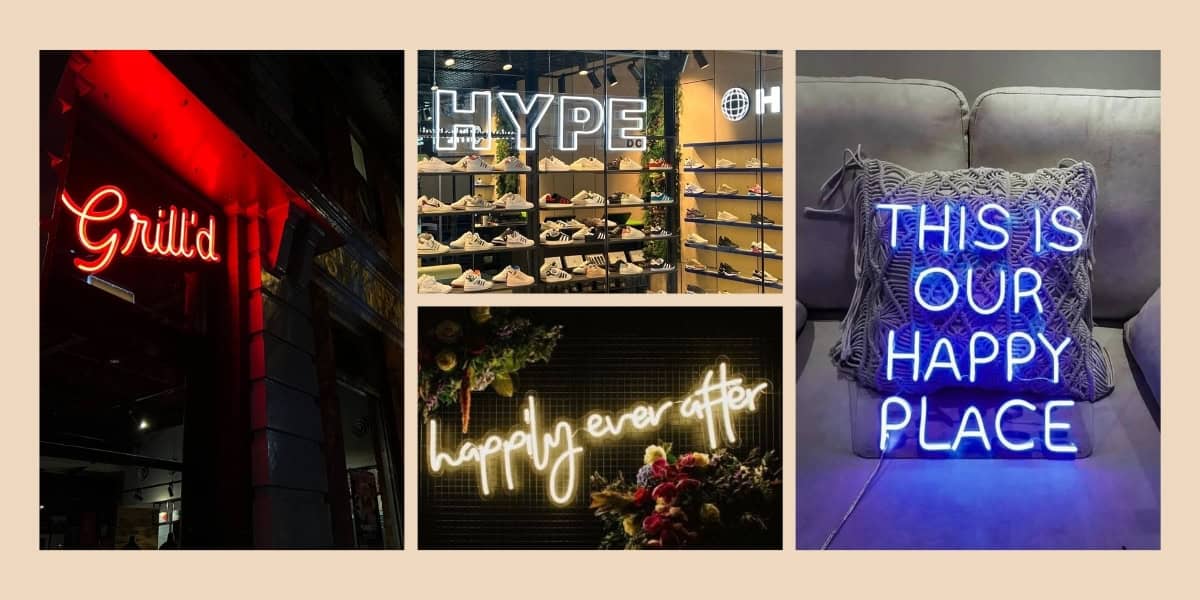
Les enseignes au néon à LED personnalisées sont utilisées dans les environnements commerciaux et décoratifs, où leur rôle varie en fonction de la luminosité, de la couleur et de la conception.
| Application | Luminosité recommandée | Objectif | Concentration de conception |
| magasins | 300-500 lux | Marque et visibilité | Polices claires et contrastées |
| Restaurants et bars | 200-400 lux | Ambiance et humeur | Tonalités chaudes, lueur douce |
| Événements et mariages | 100-300 lux | Décoration & Thème | Formes personnalisées, noms |
| Décoration d'intérieur | 100-200 lux | attrait esthétique | Éclairage amb |
Détails de l'application
- magasins
Les enseignes au néon dans les environnements de vente au détail sont utilisées pour la marque, les écrans de vitrine et attirer l'attention des clients. Une luminosité plus élevée et des styles de polices clairs garantissent une visibilité, même dans des espaces commerciaux bien éclairés. - Restaurants et bars
Dans les établissements d'accueil, les enseignes au néon sont utilisées pour créer une ambiance plutôt qu'un éclairage fort. Les couleurs chaudes et la luminosité modérée contribuent à améliorer l'atmosphère sans provoquer d'éblouissement. - Événements et mariages
Pour les événements, les enseignes au néon agissent comme des éléments décoratifs. Ils sont généralement personnalisés avec des noms, des devis ou des conceptions thématiques et sont conçus pour une installation temporaire et une configuration facile. - Décoration d'intérieur
Dans les espaces résidentiels, les enseignes au néon sont utilisées pour améliorer l'esthétique et créer un environnement relaxant. Une luminosité plus faible et des tonalités plus douces sont préférées pour un confort visuel.
Avis pratique
Il est essentiel de choisir la bonne luminosité et la conception pour chaque application. Un signe trop lumineux peut provoquer des malaises à l'intérieur, tandis qu'une faible luminosité peut réduire la visibilité dans les environnements commerciaux.
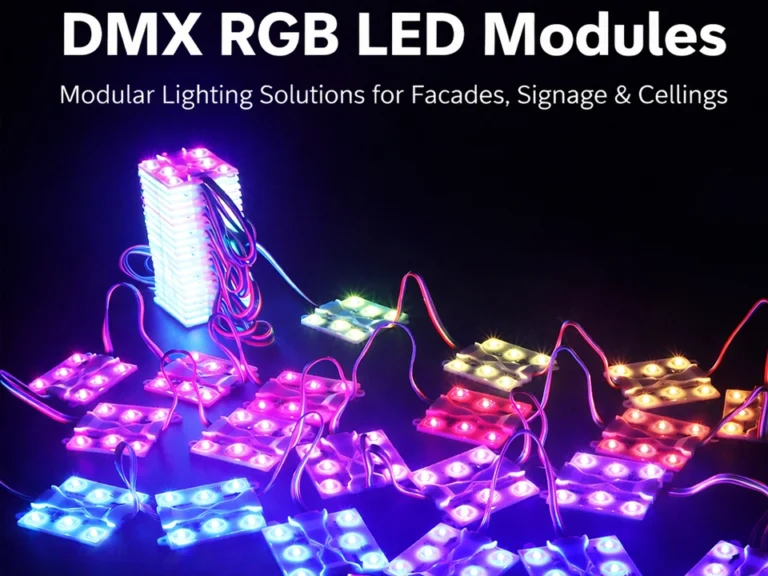
Pour les applications commerciales et architecturales avancées, consultez Comment LED Neon est utilisé dans des projets à grande échelle tels que Éclairage de façade de bâtiment avec des systèmes de contrôle Néon et DMX LED RGB
Facteurs de tarification des enseignes au néon à LED sur mesure
Le coût d'une enseigne au néon à LED personnalisée dépend de multiples variables techniques et de conception. La tarification n'est pas fixe car chaque signe est produit en fonction d'exigences spécifiques telles que la taille, la complexité, les matériaux et les fonctions de contrôle.
La compréhension de ces facteurs aide à estimer le coût avec précision et à éviter les sous-spécifications ou les sur-spécifications.
Répartition des prix
| Facteur | Gamme typique | Impact des coûts |
| Taille | $50–$300+ | La plus grande taille augmente les besoins en matière de matériaux et de puissance |
| Complexité de conception | +20–50% | Plus de courbes et de détails augmentent le temps de travail |
| Éclairage RVB | +30% | Ajoute un contrôleur et un système LED avancé |
| Contrôleur / Variateur | $10–$50 | Permet la luminosité et le contrôle des couleurs |
| embarque | variable | Dépend de la taille, du poids et de l'emplacement |
Explication des coûts
- La taille affecte directement la consommation de matière, la consommation d'énergie et l'emballage, ce qui en fait le principal moteur de coût.
- Les conceptions complexes nécessitent plus de temps de pliage et de montage manuels, ce qui augmente le coût de la main-d'œuvre.
- Les systèmes RGB ajoutent de la flexibilité mais nécessitent des composants supplémentaires tels que les contrôleurs et le câblage.
- Les contrôleurs et les gradateurs améliorent la convivialité, mais augmentent le coût global du système.
- Les frais d'expédition varient considérablement, en particulier pour les panneaux de grande taille ou fragiles.
Aperçu des prix
Des conceptions plus grandes et plus complexes augmentent les coûts matériels et de main-d'œuvre. Une conception équilibrée qui répond aux exigences fonctionnelles sans complexité inutile est l'approche la plus rentable.
Avantages des enseignes au néon à LED
Les enseignes LED au néon offrent des avantages significatifs par rapport au néon traditionnel en verre, en particulier en termes d'efficacité, de durabilité et de sécurité.
Principaux avantages
- Efficacité énergétique (60–701 TP3T)
Le néon LED consomme beaucoup moins d'énergie que le néon traditionnel, ce qui réduit les coûts d'exploitation à long terme. - Longue durée de vie (30 000 à 50 000 heures)
Une durée de vie prolongée minimise la fréquence de remplacement et les efforts de maintenance. - Faible entretien
La conception à l'état solide élimine les problèmes tels que les fuites de gaz ou la rupture du tube. - Fonctionnement à basse tension (12 V/24 V)
Réduit les risques électriques, ce qui le rend adapté à l'intérieur et à l'extérieur. - Capacité de conception flexible
Peut être façonné en designs complexes, logos et formes personnalisées sans limitations structurelles.
Impact sur les performances
Ces avantages améliorent directement la convivialité, réduisent les coûts d'exploitation et augmentent la fiabilité du système, faisant de LED Neon le choix préféré pour les applications modernes.
Pour une meilleure compréhension des avantages de la performance, reportez-vous à notre article sur Avantages des systèmes d'éclairage flexibles à LED au néon
Comment choisir un fabricant de néons personnalisé
Il est essentiel de sélectionner le bon fabricant car la qualité du produit, la capacité de personnalisation et la fiabilité à long terme dépendent tous des normes de production et de l'expérience.
Un fabricant professionnel fournit non seulement le produit, mais également la conception, l'assurance qualité et le service après-vente.
Critères d'évaluation du fabricant
| Facteur | Norme recommandée | Pourquoi c'est important |
| éprouver | 5 ans et plus | Capacité de production éprouvée |
| Certifications | CE, RoHS | Conformité aux normes de sécurité |
| Prise en charge OEM / ODM | disponible | Capacité de projet personnalisée |
| Garantie | 2–3 ans | Fiabilité du produit |
| qualité de production | Processus contrôlé | Performance constante |
Comment évaluer un fabricant
- Vérifier l'expérience du projet
Les fabricants avec des portefeuilles de projets réels sont plus fiables dans la gestion des exigences personnalisées. - Vérifier la qualité des matériaux
Le silicone, l'acrylique et les drivers de haute qualité garantissent de meilleures performances et une durée de vie plus longue. - Évaluer la capacité de personnalisation
La possibilité de produire des tailles, des formes et des effets d'éclairage différents est essentielle pour des projets personnalisés. - Examiner les tests et le contrôle de la qualité
Des processus tels que des tests de vieillissement et des inspections garantissent la fiabilité du produit avant la livraison. - Confirmer le support après-vente
La garantie et le support technique réduisent les risques lors d'une utilisation à long terme.
Aperçu de la
Le choix d'un fabricant à faible coût peut réduire les coûts initial, mais peut entraîner des problèmes tels que le scintillement, la durabilité médiocre ou la luminosité incohérente. Un fabricant fiable garantit des performances stables, de meilleurs matériaux et une valeur à long terme.
Si vous planifiez un projet, explorez des solutions de signalisation au néon à LED personnalisées avec la prise en charge OEM/ODM, une qualité fiable et des options de personnalisation complètes.
Liste de contrôle d'achat pour les enseignes au néon à LED personnalisées
Avant de finaliser une enseigne au néon à LED personnalisée, il est important d'évaluer les paramètres techniques clés pour garantir la performance, la sécurité et la cohérence visuelle à long terme. Une liste de contrôle bien définie permet d'éviter les problèmes courants tels que l'incohérence de la luminosité, la surchauffe ou les défaillances prématurées.
Liste de contrôle des achats techniques
| Paramètres | Gamme idéale | Pourquoi c'est important |
| Tension | 12V / 24V DC | Assure un fonctionnement sûr et une stabilité du système à basse tension |
| Consommation électrique | 8 à 15 W/m | Détermine le niveau de luminosité et l'efficacité énergétique |
| Sortie lumineuse | 500–1200 lm/m | Contrôle la visibilité et l'impact visuel |
| Durée de vie | 30 000 à 50 000 heures | Indique une durabilité à long terme |
| Indice de protection IP | IP65 (ou supérieur) | Protège contre la poussière et l'humidité |
| qualité des matériaux | Silicone / PVC de haute qualité | Influe sur la flexibilité, la résistance aux UV et la longévité |
| système de contrôle | Variateur / RGB en option | Améliore la convivialité et la personnalisation |
Un système de néons fiable n'est pas défini par un seul paramètre mais par l'équilibre entre la stabilité électrique, la qualité des matériaux et la précision de fabrication. Ignorer un seul facteur peut réduire les performances et la durée de vie globales.
Pour mieux comprendre les facteurs de coût et la sélection des matériaux, consultez notre Guide détaillé sur la façon d'acheter des enseignes au néon personnalisées et de choisir les bons matériaux
Led personnalisé au néon Hub de connaissances
Ce guide fait partie d'un centre de connaissances structurés LED au néon conçu pour fournir une compréhension complète de la conception, des matériaux, des performances et des applications du monde réel.
Pour explorer chaque zone plus en profondeur, reportez-vous aux ressources suivantes :
- Découvrez comment les systèmes néons fonctionnent dans des applications réelles
Comment fonctionne LED Neon Flex dans des applications d'éclairage réel - Comprendre la conception, les matériaux et les décisions d'achat
Comment acheter des enseignes au néon personnalisées et choisir les bons matériaux - Explorez les performances et les spécifications techniques
Guide LED Flex Néon pour les professionnels de l'éclairage architectural - Comparez le néon LED avec les systèmes d'éclairage traditionnels
LED au néon vs éclairage conventionnel - Découvrez des applications du monde réel
Principales applications des systèmes d'éclairage au néon LED - Découvrez les avantages de la performance
Avantages des systèmes d'éclairage flexibles à LED au néon - Comprendre les exigences de projet à grande échelle
Comment choisir le LED Neon Flex pour les grands projets - Explorez les applications d'éclairage archi
Éclairage de façade au néon LED avec contrôle RGB et DMX
Obtenez le bon enseigne au néon à LED personnalisée pour votre projet
Si vous planifiez un projet de néon personnalisé, il est essentiel de choisir les bons matériaux, la conception et le fabricant pour les performances et l'impact visuel à long terme.
Au SignliteLED, nous fournissons des solutions de enseigne au néon à LED sur mesure OEM et ODM adaptées aux applications commerciales, architecturales et décoratives.
Explorez nos solutions de néons LED personnalisées pour obtenir une assistance experte, une conception précise et une fabrication fiable pour votre projet.
Conclusion
Les enseignes au néon à LED sur mesure ont transformé les applications d'éclairage modernes en combinant la flexibilité de conception avec une efficacité et une durabilité élevées.
En comprenant les composants du système, les matériaux, les principes de conception et les facteurs de tarification, les entreprises et les particuliers peuvent prendre des décisions éclairées et atteindre des objectifs à la fois esthétiques et fonctionnels.
FAQ
Articles Similaires