English
  简体中文
简体中文  Deutsch
  Español
  Français
  Italiano
  日本語
日本語  한국어
한국어  Polski
  Português
  Русский
  Türkçe
  Nederlands
  Tiếng Việt
  ไทย
ไทย 
Custom LED neon signs have become a widely adopted lighting solution for modern commercial and decorative applications. They are commonly used in retail stores, restaurants, events, and interior spaces where both visual impact and long-term performance are important.
Compared to traditional glass neon, LED neon signs operate at low voltage and use solid-state lighting technology. This makes them safer, more energy-efficient, and easier to install, while also reducing maintenance requirements over time. In addition, their flexible design allows precise customization for logos, text, and complex shapes.
In practical applications, these signs are not only used for illumination but also for branding and visual communication. A well-designed neon sign can improve visibility, enhance customer experience, and strengthen brand identity. Based on real-world manufacturing experience and project implementation, selecting the right materials and design approach is critical for achieving consistent performance and long-term reliability.
This guide provides a structured overview of custom LED neon signs, including how they work, materials used, design and manufacturing processes, pricing factors, and how to choose the right manufacturer for different projects.
Quick Answer
Custom LED neon signs are flexible illuminated signs made using LED neon flex strips mounted on acrylic or metal backboards. They replicate the look of traditional neon while operating at low voltage (12V/24V), consuming less power (8–15 W/m), and lasting up to 50,000 hours.
Key Takeaways
- LED neon signs consume 60–70% less energy than glass neon
- Typical lifespan ranges between 30,000 to 50,000 hours
- Operate on safe low voltage (12V/24V DC)
- Fully customizable in size, color, and shape
- Available in IP20 (indoor) and IP65 (outdoor) versions
- Maintenance cost is significantly lower than traditional neon
- Suitable for both commercial and decorative applications
What Are Custom LED Neon Signs

Custom LED Neon signs are modern lighting systems designed to replicate the visual glow of traditional neon using LED chips embedded inside flexible silicone diffusers. Unlike glass neon, which uses gas discharge and high voltage, LED neon operates using low-voltage DC power, making it safer and more efficient.
At a system level, a neon sign is not a single component but a combination of multiple engineered elements working together.
| Component | Typical Specification | Function | Practical Impact |
| LED Chips | SMD 2835 / 2216 | Light generation | Efficiency (100–130 lm/W) |
| Voltage | 12V / 24V DC | Power supply | Electrical safety |
| Power Consumption | 8–15 W/m | Energy usage | Running cost |
| Lifespan | 30,000–50,000 hrs | Durability | ROI |
| Beam Angle | 120°–180° | Light spread | Uniform glow |
| IP Rating | IP20–IP65 | Protection | Indoor/outdoor use |
The silicone diffuser plays a critical role. It spreads light evenly, eliminating hotspots and creating the continuous glow effect that resembles traditional neon.
To understand how modern LED neon technology works compared to traditional systems, see our detailed guide on How LED neon flex works in real-world lighting applications
For a deeper technical explanation of LED neon structure and working principles, refer to our Complete LED neon flex technical guide for professionals
How LED Neon Signs Work
LED neon signs work by passing low-voltage direct current (12V or 24V) through LED chips embedded inside a flexible silicone diffuser. These LEDs emit light that is evenly distributed by the diffuser, creating a continuous glow similar to traditional neon.
Unlike glass neon, which relies on gas discharge and high voltage, LED neon uses solid-state lighting technology. This improves safety, reduces energy consumption, and ensures consistent light output without flickering.
LED Neon Signs vs Traditional Glass Neon
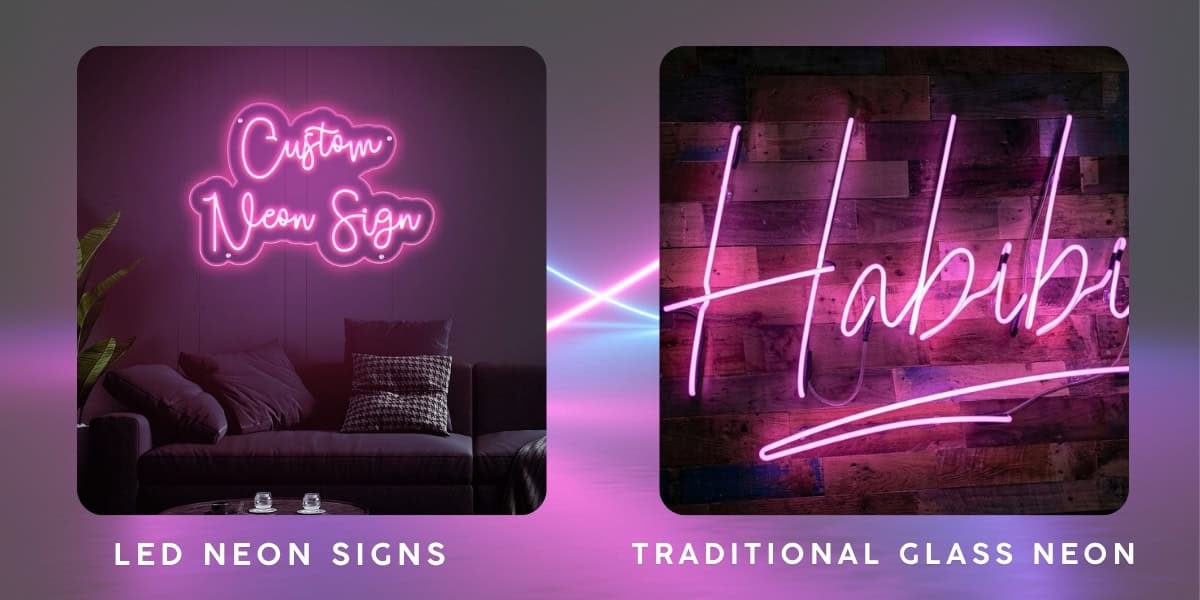
The shift from glass neon to LED neon is driven by performance, safety, and cost efficiency.
| Parameter | LED Neon | Glass Neon | Real-World Impact |
| Voltage | 12–24V | 3,000–15,000V | High safety risk in glass |
| Power Consumption | 8–15 W/m | 20–30 W/m | Higher electricity cost |
| Lifespan | 30,000–50,000h | 8,000–15,000h | Frequent replacement |
| Fragility | Flexible | Breakable glass | High maintenance |
| Installation | Simple | Complex | Labor cost |
| Heat Output | Low | High | Safety concern |
Glass neon is visually appealing but operationally inefficient. It requires:
- high voltage transformers
- skilled installation
- frequent maintenance
LED neon eliminates these issues while delivering comparable visual output. In large-scale commercial use, this difference translates into significant cost savings over time.
You can also explore a detailed comparison between technologies in our guide on LED neon flex vs conventional lighting systems
Components of a Custom LED Neon Sign
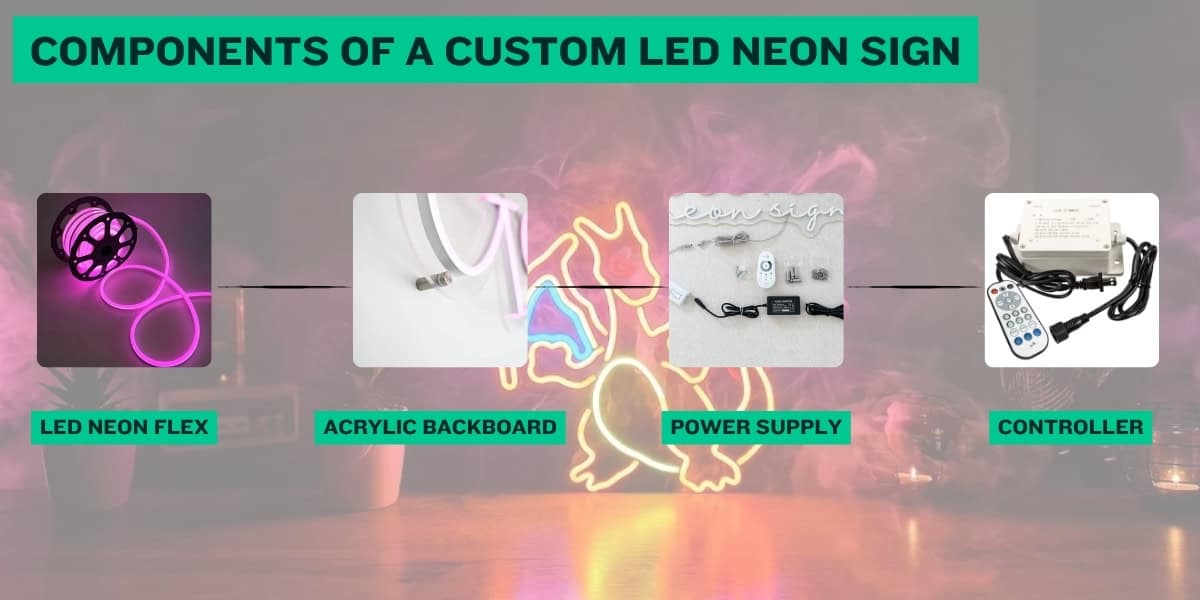
A custom LED neon sign is not just a decorative product. It is a complete integrated lighting system made up of electrical, optical, and structural components. The performance, durability, and visual quality of the final sign depend on how well these components are selected and combined.
Each component has a specific engineering role, and even small differences in quality can significantly affect brightness consistency, lifespan, and safety.
1. LED Neon Flex (Light Source)
LED neon flex is the core light-emitting element of the system. It consists of LED chips embedded inside a flexible silicone or PVC housing that diffuses light to create a continuous neon-like effect.
Unlike traditional LED strips, neon flex is designed to produce dot-free, uniform illumination, which is critical for signage applications.
Technical Details:
| Parameter | Typical Range | Engineering Impact |
| Power Consumption | 8–15 W/m | Determines energy usage |
| Luminous Output | 500–1200 lm/m | Controls brightness level |
| Voltage | 12V / 24V DC | Safety and stability |
| LED Density | 120–240 LEDs/m | Affects uniformity |
| Bending Type | Top/Side bending | Design flexibility |
Why it matters:
Low-quality neon flex results in uneven brightness, visible dots, and color inconsistency. High-density, high-quality flex ensures smooth light output and long-term reliability.
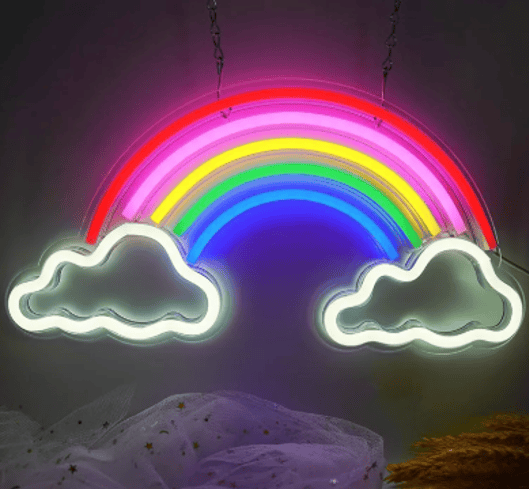
Side Bend S0612 Silicone LED Neon Strip for Sign
- Input Voltage: DC12V/24V
- Watt:10W/m
- LED QTY: SMD2835 120LEDs/m
- Color: Red/Green/Blue/Yellow/Ice Blue/Light Pink/Pink/Purple/Lemon
- Yellow/Golden Yellow/Orange/white
- IPGrade: IP67
- Cuttable Length: 25mm/50mm
- Length: 50meters/roll
2. Acrylic Backboard (Structural Base)
The acrylic backboard acts as the structural foundation of the neon sign. It holds the LED neon flex in place and defines the overall shape and design of the sign.
It is usually precision-cut using CNC or laser cutting machines to match custom text, logos, or shapes.
Technical Details:
| Parameter | Typical Range | Engineering Impact |
| Thickness | 3–8 mm | Structural strength |
| Material | PMMA / Acrylic | Transparency & durability |
| Cutting Method | CNC / Laser | Precision of design |
| Finish | Clear / Frosted / Colored | Visual effect |
Why it matters:
A thin or low-quality backboard can warp over time, especially in larger signs. Proper thickness and material ensure stability, clean appearance, and long-term durability.
3. Power Supply (LED Driver)
The power supply converts high-voltage AC input into low-voltage DC output required by LED neon flex. It is one of the most critical components for safety and performance.
A stable driver ensures flicker-free operation and protects the LEDs from voltage fluctuations.
Technical Details:
| Parameter | Typical Range | Engineering Impact |
| Input Voltage | AC 100–240V | Global compatibility |
| Output Voltage | DC 12V / 24V | System requirement |
| Power Factor | >0.9 | Energy efficiency |
| Efficiency | 85–92% | Reduced heat loss |
| Protection | Overload / Short circuit | Safety |
Why it matters:
Poor-quality drivers can cause flickering, overheating, or early failure. A reliable power supply directly increases the lifespan and stability of the entire system.
4. Controller / Dimmer (Control System)
The controller allows adjustment of brightness, color, and lighting effects. It is especially important for RGB or dynamic neon signs used in commercial and decorative applications.
Technical Details:
| Parameter | Typical Range | Engineering Impact |
| Control Type | PWM dimming | Smooth brightness control |
| Operation | Remote / App / Wall switch | User convenience |
| Compatibility | Single color / RGB / RGBW | Application flexibility |
| Functions | Dimming / Color change / Effects | Customization |
Why it matters:
Without proper control systems, lighting remains static. Advanced controllers enable dynamic lighting effects, improving visual appeal and user experience.
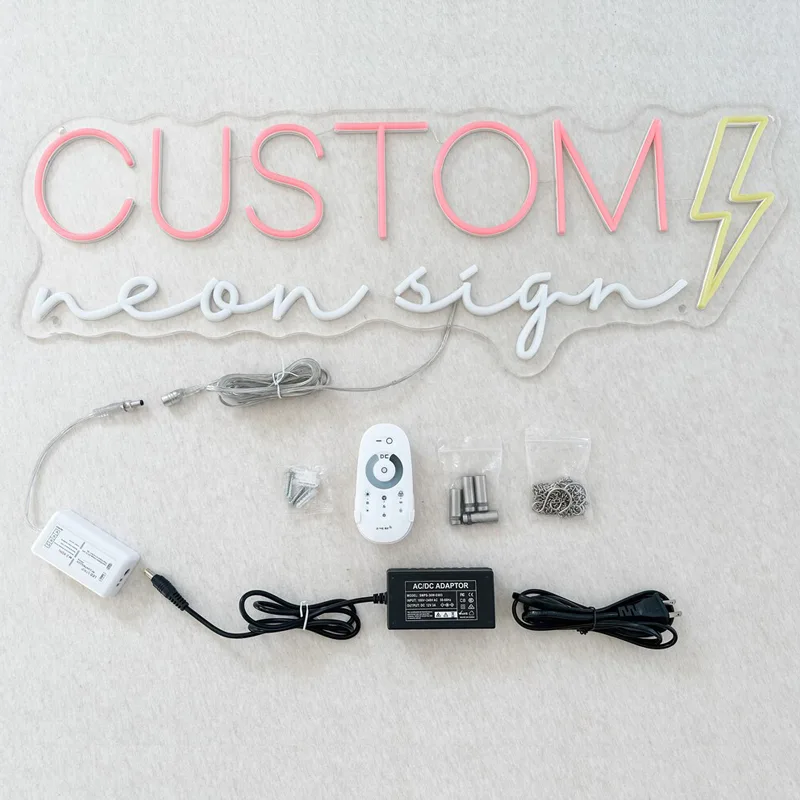
LED Adapter/LED Power Supply with DC Port (DC12V/24V)
- Input Voltage: AC100-240V
- Output Voltage: DC12V/DC24V
- Output Current: 3A/4A/5A/6A/8A/10A
- Watt: 72W/96W/120W
- Dimensions: 120x55x30mm
- Certification: US CE ROHS AU
- IP Grade: IP20
- Warranty: 2 years
Integrated System Performance Table
| Component | Key Specification | Primary Role | Impact on Final Performance |
| LED Neon Flex | 8–15 W/m, 500–1200 lm/m | Light generation | Brightness & uniformity |
| Acrylic Backboard | 3–8 mm PMMA | Structural support | Stability & design precision |
| Power Supply | 12V/24V DC, PF >0.9 | Power regulation | Lifespan & safety |
| Controller | PWM dimming | Light control | Flexibility & user control |
Engineering Insight
The performance of a custom LED neon sign is not determined by a single component, but by the integration of all components as a system.
For example, even if high-quality LED neon flex is used, a low-grade power supply can cause flickering and reduce lifespan. Similarly, poor structural support can lead to deformation or installation issues over time.
This is why professional manufacturers focus on system-level design, ensuring that all components are compatible, tested, and optimized for real-world applications.
Material selection and LED structure directly impact performance. For a deeper breakdown, see our article on Key factors when choosing LED neon flex for large-scale projects
Types of Custom LED Neon Signs
Custom LED neon signs are designed based on application requirements, installation conditions, and visual objectives. Each type differs in brightness level, size, color configuration, and control system, depending on where and how it will be used.
Selecting the correct type is important because a sign optimized for decoration may not provide sufficient visibility for commercial use, while a high-brightness sign may be too intense for indoor environments.
Business Neon Signs (Commercial & Branding Use)
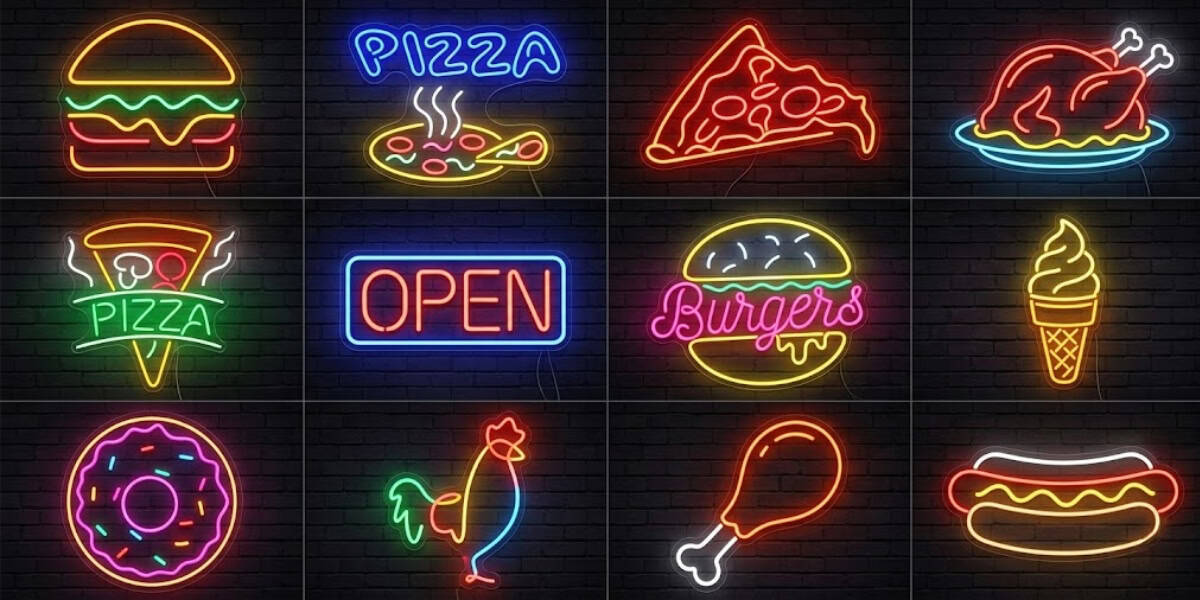
Business neon signs are used for storefronts, logos, and brand displays where visibility and recognition are critical. These signs are designed to remain clearly visible under ambient lighting and from a distance.
To achieve this, higher brightness levels and strong color contrast are required. White, red, and blue are commonly used because they provide high visibility in commercial environments.
| Parameter | Typical Range | Engineering Purpose |
| Brightness | 800–1200 lm/m | High visibility |
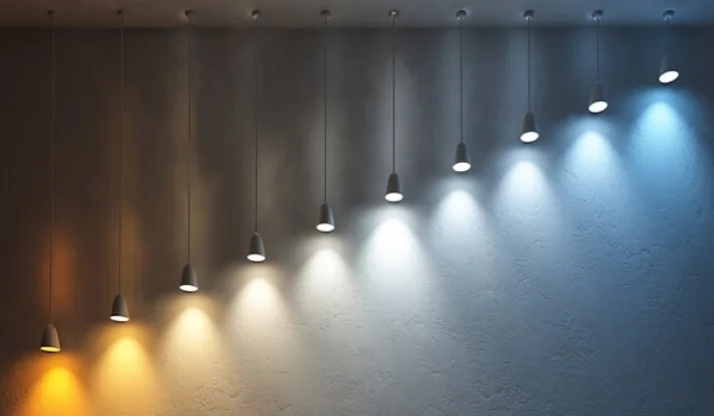
| Color Temperature | 4000K–6500K | Clear and sharp output |
| Size | 50–150 cm+ | Long-distance readability |
| Protection | IP65 (optional) | Outdoor use |
Event Neon Signs (Temporary & Decorative Use)
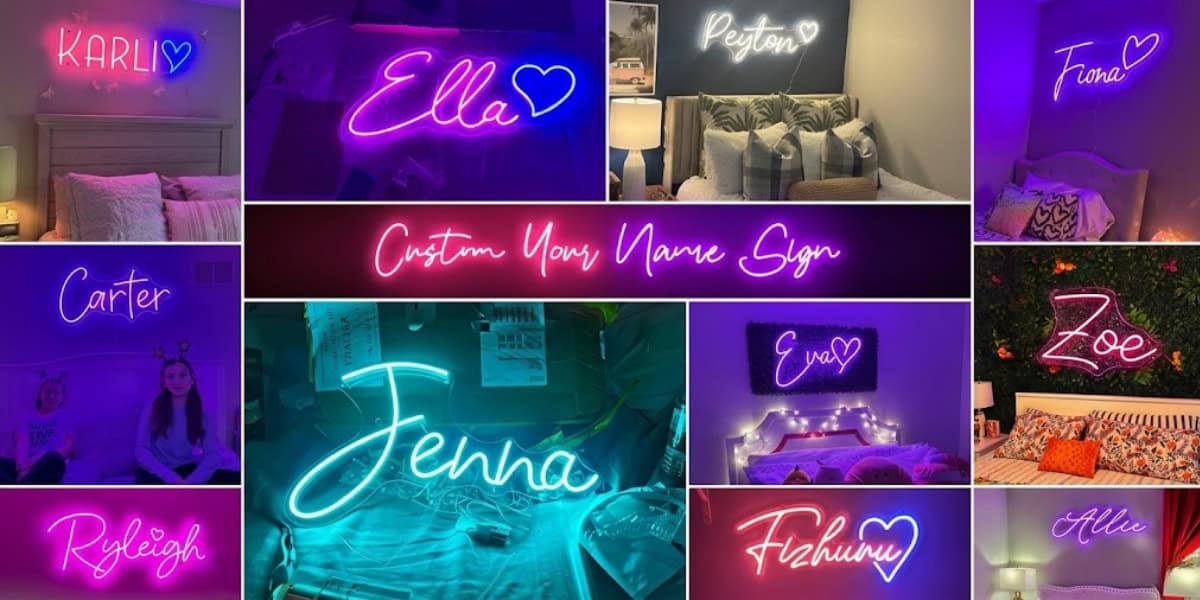
Event neon signs are designed for short-term applications such as weddings, exhibitions, and promotional events. These signs focus on visual appeal, portability, and easy installation.
Brightness is kept moderate because these signs are typically used in controlled lighting environments.
| Parameter | Typical Range | Engineering Purpose |
| Brightness | 400–800 lm/m | Balanced visibility |
| Size | 30–100 cm | Flexible placement |
| Voltage | 12V DC | Safe operation |
| Structure | Lightweight acrylic | Easy transport |
Interior Decorative Neon Signs (Home & Ambient Use)
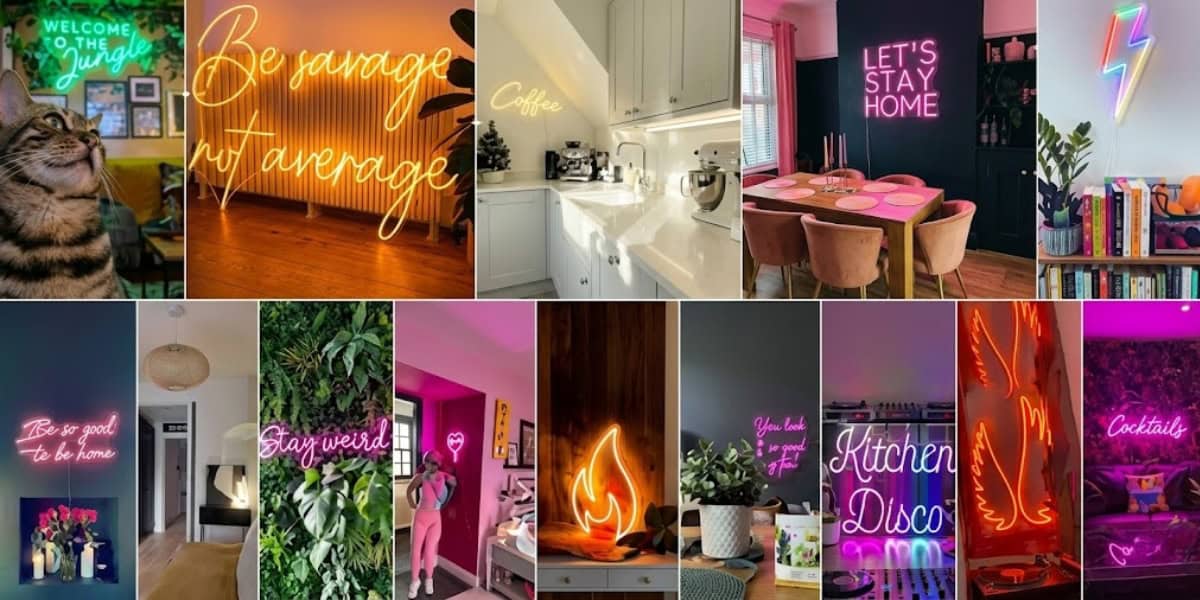
Interior neon signs are used in residential and decorative spaces where the goal is to create atmosphere rather than strong illumination.
Interior neon signs are used in residential and decorative spaces where the goal is to create atmosphere rather than strong illumination.
Lower brightness and warm color temperatures are used to maintain comfort and avoid glare.
| Parameter | Typical Range | Engineering Purpose |
| Brightness | 300–600 lm/m | Soft lighting |
| Color Temperature | 2700K–3000K | Warm ambiance |
| Size | 20–80 cm | Decorative scale |
| Control | Optional dimming | Adjustable mood |
Gaming and Studio Neon Signs (Dynamic Lighting Use)
Gaming and studio neon signs are designed for high visual impact, especially in streaming setups and content creation environments. These signs often use RGB or RGBW systems for dynamic color effects.
The focus is on customization, color control, and visual enhancement.
| Parameter | Typical Range | Engineering Purpose |
| Lighting Type | RGB / RGBW | Dynamic colors |
| Control | App / Remote | Real-time adjustment |
| Brightness | Adjustable | Scene-based lighting |
| Application | Studios / Gaming | Visual impact |
Comparison of Neon Sign Types
| Type | Brightness Range | Typical Size | Application | Key Focus |
| Business | 800–1200 lm/m | 50–150 cm+ | Retail / Branding | Visibility |
| Event | 400–800 lm/m | 30–100 cm | Weddings / Events | Portability |
| Interior | 300–600 lm/m | 20–80 cm | Home / Decor | Ambiance |
| Gaming | Dynamic RGB | Custom | Studios | Visual effects |
Engineering Insight
Each type of custom LED neon sign is defined by its application. Proper selection of brightness, color temperature, and control system ensures that the sign performs effectively without causing glare, energy waste, or poor visibility.
Explore Custom Solutions
If you need a neon sign tailored to your project, explore custom LED neon sign solutions designed for business, events, and interior applications.
Different types of neon signs are used across various industries. Explore real use cases in our guide on Major applications of LED neon lighting systems
How Custom LED Neon Signs Are Made
The manufacturing process of custom LED neon signs is a combination of design engineering, precision processing, and quality control. Each step directly affects the final performance, appearance, and durability of the sign.
Unlike mass-produced lighting products, custom neon signs require manual craftsmanship combined with controlled production methods to ensure accuracy and consistency.
Step 1: Design and Layout Engineering
The process begins with creating a vector-based design file (AI, SVG, or CAD format). This file defines the exact shape, size, and layout of the neon sign.
At this stage, engineers also determine bending paths, mounting positions, and electrical routing to ensure the design can be physically produced without distortion.
| Parameter | Typical Value | Engineering Impact |
| File Format | AI / SVG / CAD | Design accuracy |
| Tolerance | ±1–2 mm | Dimensional precision |
| Layout Planning | Manual + software | Assembly feasibility |
A precise design file ensures that all downstream processes remain accurate and aligned.
Step 2: LED Neon Flex Cutting
LED neon flex is cut according to the design layout using predefined cutting points. Precision is critical here to ensure proper alignment during assembly.
Incorrect cutting can lead to uneven lighting or electrical issues.
| Parameter | Typical Range | Engineering Impact |
| Cutting Accuracy | ±1 mm | Fit and alignment |
| Cutting Interval | 25–50 mm (segment-based) | Electrical integrity |
| Tools | Manual / Precision cutters | Clean edges |
This step ensures that each segment fits perfectly into the final design.
Step 3: Acrylic Backboard CNC Engraving
The acrylic backboard is processed using CNC or laser cutting machines to match the exact shape of the design.
Grooves or guide paths may also be engraved to assist with precise placement of the neon flex.
| Parameter | Typical Range | Engineering Impact |
| Material Thickness | 3–8 mm | Structural strength |
| Cutting Method | CNC / Laser | Edge precision |
| Tolerance | ±0.5 mm | Design accuracy |
High-precision engraving ensures clean edges and a professional finish.
Step 4: Manual Bending and Assembly
The LED neon flex is manually bent and fixed onto the acrylic backboard following the design path. This step requires skilled labor to maintain smooth curves and consistent spacing.
Unlike automated processes, manual shaping allows flexibility for complex designs but requires strict quality control.
| Parameter | Typical Aspect | Engineering Impact |
| Bending Method | Hand shaping | Curve accuracy |
| Fixing Method | Clips / Adhesive | Stability |
| Alignment | Visual + template | Appearance consistency |
Proper assembly ensures that the light output remains uniform without distortion.
Step 5: Wiring and Soldering
Electrical connections are completed by soldering wires between neon segments and connecting them to the power supply.
This step ensures stable current flow across the entire sign.
| Parameter | Typical Range | Engineering Impact |
| Voltage | 12V / 24V DC | Safety |
| Solder Quality | Lead-free / insulated | Reliability |
| Connection Type | Series / Parallel | Load balance |
Poor wiring can lead to voltage drops, flickering, or partial failure.
Step 6: Aging Test (Burn-In Testing)
After assembly, the sign undergoes continuous operation testing (typically 24–48 hours). This is one of the most critical quality control steps.
It helps identify early failures such as defective LEDs, unstable drivers, or poor connections.
| Parameter | Typical Range | Engineering Impact |
| Test Duration | 24–48 hours | Reliability validation |
| Test Condition | Continuous operation | Stress testing |
| Failure Detection | Visual + electrical | Quality assurance |
The aging test ensures that only stable and fully functional products are delivered.
Step 7: Final Inspection and Packaging
Before shipment, the sign is inspected for visual quality, electrical performance, and structural integrity.
Packaging is then completed using protective materials to prevent damage during transport.
| Parameter | Inspection Focus | Engineering Impact |
| Visual Check | Alignment, brightness | Aesthetic quality |
| Electrical Test | Voltage, stability | Performance |
| Packaging | Foam / protective layers | Transport safety |
Manufacturing Process Overview
| Step | Process | Time Required | Quality Impact |
| Design | Vector creation | 1–2 hours | Accuracy |
| Cutting | LED flex cutting | High precision | Fit |
| Engraving | Acrylic CNC | Automated | Structure |
| Assembly | Manual shaping | Skilled labor | Appearance |
| Wiring | Soldering | Controlled | Stability |
| Testing | 24–48 hours | Critical | Reliability |
| Inspection | Final check | Final stage | Quality assurance |
The quality of a custom LED neon sign is defined not only by materials but by the precision and control of the manufacturing process. Among all steps, the aging test is the most critical, as it ensures long-term reliability by identifying defects before delivery.
A well-controlled production process results in consistent brightness, stable performance, and extended lifespan.
How to Design a Custom LED Neon Sign
Designing a custom LED neon sign is not only about appearance. Each design choice affects visibility, readability, and installation. A well-planned design ensures the sign performs effectively for its intended use, whether for business branding or decoration.
| Step | Design Consideration | Technical Impact |
| Text / Logo | Message or brand identity | Defines recognition |
| Font | Style and thickness | Affects readability |
| Color | LED color or RGB | Influences mood and visibility |
| Size | 30–150 cm | Determines viewing distance |
| Mounting | Wall / hanging | Affects installation |
The text or logo should be simple and easy to understand, especially for commercial signs where quick recognition is important. Font selection should match the application, with bold styles for visibility and decorative styles for aesthetics.
Color choice affects both appearance and function. Bright colors improve visibility in business environments, while warm tones are better for indoor decoration. The size of the sign must match the viewing distance, as smaller signs are suitable for close viewing and larger signs are required for storefronts.
The mounting method should be selected based on the installation environment to ensure stability and proper alignment.
A good design balances visual appeal with technical performance. For example, retail signs require higher brightness and clear fonts, while interior signs focus more on ambiance and softer lighting.
Materials Used in LED Neon Signs
Material selection is a key factor in determining the durability, flexibility, and overall quality of a custom LED neon sign. Different materials are used for light diffusion, structural support, and environmental protection, and each one directly affects performance and lifespan.
A well-designed neon sign uses the right combination of materials to ensure stable operation, consistent light output, and long-term reliability.
| Material | Typical Lifespan | Key Advantage | Application |
| Silicone | 5–8 years | High flexibility, UV resistance | Premium indoor & outdoor signs |
| PVC | 3–5 years | Cost-effective, lightweight | Indoor / budget signs |
| Acrylic (PMMA) | 5+ years | Strong, clear, easy to shape | Backboard structure |
| Aluminum | 8–10 years | High strength, heat resistance | Large / outdoor signs |
Material Details
Silicone (LED Neon Flex Material)
Silicone is used in high-quality LED neon flex because it provides excellent flexibility and durability. It allows smooth bending for custom shapes while maintaining uniform light diffusion. It also resists UV exposure and does not yellow easily, making it suitable for long-term use in outdoor environments.
PVC (Polyvinyl Chloride)
PVC is commonly used in cost-sensitive applications. It provides basic flexibility and acceptable performance for indoor use. However, it is less resistant to heat and UV exposure, which can reduce lifespan in outdoor conditions.
Acrylic (Backboard Material)
Acrylic acts as the structural base of the neon sign. It is used to mount and support the LED neon flex while maintaining the shape of the design. It offers high transparency, clean edges, and is easy to cut into custom shapes using CNC or laser machines.
Aluminum (Support Structure)
Aluminum is used in larger or heavy-duty signs where additional strength is required. It improves structural stability and helps maintain shape over time, especially in outdoor or high-load installations.
Material Selection Insight
Material selection should always match the application. Silicone is preferred for premium and outdoor projects due to its durability and flexibility, while PVC is suitable for indoor decorative signs where cost is a priority. Acrylic ensures structural precision, and aluminum is used when additional support is needed.
A proper combination of these materials ensures both visual quality and long-term performance.

Applications of Custom LED Neon Signs
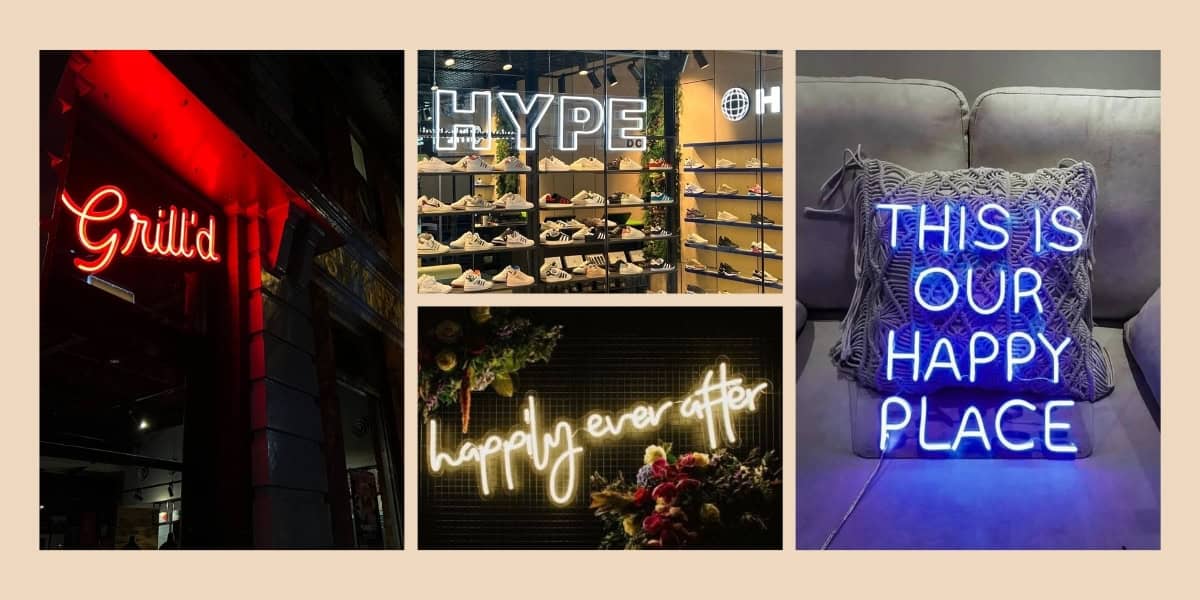
Custom LED neon signs are used in both commercial and decorative environments, where their role varies based on brightness, color, and design purpose.
| Application | Recommended Brightness | Purpose | Design Focus |
| Retail Stores | 300–500 lux | Branding & visibility | High contrast, clear fonts |
| Restaurants & Bars | 200–400 lux | Atmosphere & mood | Warm tones, soft glow |
| Events & Weddings | 100–300 lux | Decoration & theme | Custom shapes, names |
| Home Decoration | 100–200 lux | Aesthetic appeal | Ambient lighting |
Application Details
- Retail Stores
Neon signs in retail environments are used for branding, storefront displays, and attracting customer attention. Higher brightness and clear font styles ensure visibility even in well-lit commercial spaces. - Restaurants & Bars
In hospitality settings, neon signs are used to create ambiance rather than strong illumination. Warm colors and moderate brightness help enhance the atmosphere without causing glare. - Events & Weddings
For events, neon signs act as decorative elements. They are usually customized with names, quotes, or themed designs and are designed for temporary installation and easy setup. - Home Decoration
In residential spaces, neon signs are used to improve aesthetics and create a relaxing environment. Lower brightness and softer tones are preferred for visual comfort.
Practical Insight
Choosing the right brightness and design for each application is essential. A sign that is too bright can cause discomfort indoors, while low brightness may reduce visibility in commercial environments.
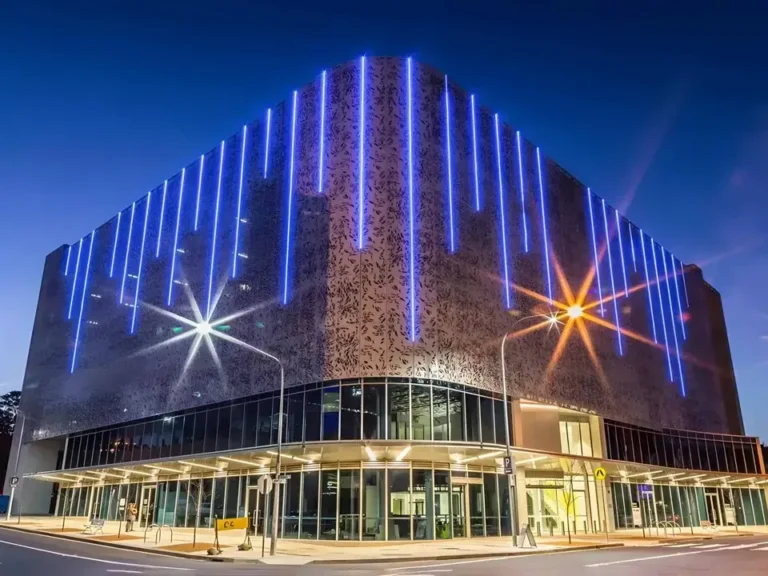
For advanced commercial and architectural applications, see how LED neon is used in large-scale projects such as Building facade lighting with RGB LED neon and DMX control systems
Pricing Factors of Custom LED Neon Signs
The cost of a custom LED neon sign depends on multiple technical and design variables. Pricing is not fixed because each sign is produced based on specific requirements such as size, complexity, materials, and control features.
Understanding these factors helps in estimating cost accurately and avoiding under- or over-specification.
Pricing Breakdown
| Factor | Typical Range | Cost Impact |
| Size | $50–$300+ | Larger size increases material and power requirements |
| Design Complexity | +20–50% | More curves and details increase labor time |
| RGB Lighting | +30% | Adds controller and advanced LED system |
| Controller / Dimmer | $10–$50 | Enables brightness and color control |
| Shipping | Variable | Depends on size, weight, and location |
Cost Explanation
- Size directly affects material usage, power consumption, and packaging, making it the primary cost driver.
- Complex designs require more manual bending and assembly time, increasing labor cost.
- RGB systems add flexibility but require additional components such as controllers and wiring.
- Controllers and dimmers improve usability but add to the overall system cost.
- Shipping cost varies significantly, especially for large or fragile signs.
Pricing Insight
Larger and more complex designs increase both material and labor costs. A balanced design that meets functional requirements without unnecessary complexity is the most cost-efficient approach.
Advantages of LED Neon Signs
LED neon signs offer significant advantages over traditional glass neon, especially in terms of efficiency, durability, and safety.
Key Advantages
- Energy Efficiency (60–70% savings)
LED neon consumes significantly less power compared to traditional neon, reducing long-term operating costs. - Long Lifespan (30,000–50,000 hours)
Extended lifespan minimizes replacement frequency and maintenance efforts. - Low Maintenance
Solid-state design eliminates issues like gas leakage or tube breakage. - Safe Low-Voltage Operation (12V/24V)
Reduces electrical risk, making it suitable for both indoor and outdoor use. - Flexible Design Capability
Can be shaped into complex designs, logos, and custom forms without structural limitations.
Performance Impact
These advantages directly improve usability, reduce operational cost, and increase system reliability, making LED neon the preferred choice for modern applications.
For a deeper understanding of performance benefits, refer to our article on Advantages of LED neon flexible lighting systems
How to Choose a Custom Neon Sign Manufacturer
Selecting the right manufacturer is critical because product quality, customization capability, and long-term reliability all depend on production standards and experience.
A professional manufacturer provides not only the product but also design support, quality assurance, and after-sales service.
Manufacturer Evaluation Criteria
| Factor | Recommended Standard | Why It Matters |
| Experience | 5+ years | Proven production capability |
| Certifications | CE, RoHS | Compliance with safety standards |
| OEM / ODM Support | Available | Custom project capability |
| Warranty | 2–3 years | Product reliability |
| Production Quality | Controlled process | Consistent performance |
How to Evaluate a Manufacturer
- Check project experience
Manufacturers with real project portfolios are more reliable in handling custom requirements. - Verify material quality
High-quality silicone, acrylic, and drivers ensure better performance and longer lifespan. - Assess customization capability
The ability to produce different sizes, shapes, and lighting effects is essential for custom projects. - Review testing and quality control
Processes such as aging tests and inspections ensure product reliability before delivery. - Confirm after-sales support
Warranty and technical support reduce risk in long-term use.
Selection Insight
Choosing a low-cost manufacturer may reduce initial cost but can lead to issues such as flickering, poor durability, or inconsistent brightness. A reliable manufacturer ensures stable performance, better materials, and long-term value.
If you are planning a project, explore custom LED neon sign solutions with OEM/ODM support, reliable quality, and full customization options.
Buying Checklist for Custom LED Neon Signs
Before finalizing a custom LED neon sign, it is important to evaluate key technical parameters to ensure long-term performance, safety, and visual consistency. A well-defined checklist helps avoid common issues such as brightness inconsistency, overheating, or premature failure.
Technical Buying Checklist
| Parameter | Ideal Range | Why It Matters |
| Voltage | 12V / 24V DC | Ensures safe low-voltage operation and system stability |
| Power Consumption | 8–15 W/m | Determines brightness level and energy efficiency |
| Luminous Output | 500–1200 lm/m | Controls visibility and visual impact |
| Lifespan | 30,000–50,000 hours | Indicates long-term durability |
| IP Rating | IP65 (or higher) | Protects against dust and moisture |
| Material Quality | Silicone / High-grade PVC | Affects flexibility, UV resistance, and longevity |
| Control System | Optional dimmer / RGB | Enhances usability and customization |
A reliable neon sign system is not defined by a single parameter but by the balance of electrical stability, material quality, and manufacturing precision. Ignoring even one factor can reduce overall performance and lifespan.
To better understand cost factors and material selection, see our Detailed guide on how to buy custom neon signs and choose the right materials
Custom LED Neon Signs Knowledge Hub
This guide is part of a structured LED neon lighting knowledge hub designed to provide a complete understanding of design, materials, performance, and real-world applications.
To explore each area in more depth, refer to the following resources:
- Learn how neon systems function in real applications
How LED neon flex works in real-world lighting applications - Understand design, materials, and purchasing decisions
How to buy custom neon signs and choose the right materials - Explore performance and technical specifications
LED neon flex guide for architectural lighting professionals - Compare LED neon with traditional lighting systems
LED neon vs conventional lighting comparison - Discover real-world applications
Major applications of LED neon lighting systems - Learn about performance advantages
Advantages of LED neon flexible lighting systems - Understand large-scale project requirements
How to choose LED neon flex for large projects - Explore architectural lighting applications
LED neon facade lighting with RGB and DMX control
Get the Right Custom LED Neon Sign for Your Project
If you are planning a custom neon sign project, choosing the right materials, design, and manufacturer is critical for long-term performance and visual impact.
At SignliteLED, we provide OEM and ODM custom LED neon sign solutions tailored for commercial, architectural, and decorative applications.
Explore our custom LED neon sign solutions to get expert support, accurate design, and reliable manufacturing for your project.
Conclusion
Custom LED neon signs have transformed modern lighting applications by combining design flexibility with high efficiency and durability.
By understanding system components, materials, design principles, and pricing factors, businesses and individuals can make informed decisions and achieve both aesthetic and functional goals.
FAQs
Related Posts