Français
  English
  简体中文
简体中文  Deutsch
  Español
  Italiano
  日本語
日本語  한국어
한국어  Polski
  Português
  Русский
  Türkçe
  Nederlands
  Tiếng Việt
  ไทย
ไทย 
Si vous exportez des bandes de LED vers l'Europe ou si vous vous achetez des produits pour des projets d'éclairage commercial, la compréhension des dernières exigences en matière de PGI n'est plus facultative, c'est une condition obligatoire.
Depuis 2021, le marché européen de l'éclairage a connu un changement fondamental. Les indices de référence volontaires pour l'efficacité énergétique qui existaient autrefois sont devenus des exigences obligatoires d'accès au marché. Aujourd'hui, les importateurs européens, les acheteurs OEM, les concepteurs d'éclairage et les entrepreneurs en ingénierie posent tous la même question avant de passer une commande : "Cette lumière de bande LED est-elle conforme aux réglementations ERP ?"
Ce guide est écrit spécifiquement pour les professionnels de l'approvisionnement, et non pour les consommateurs généraux. Nous expliquerons les exigences spécifiques de l'ERP pour les socles LED, les dernières normes 2026, comment vérifier la conformité et, surtout, comment sélectionner un fournisseur qui peut fournir des produits conformes ainsi que la documentation complète.
Qu'est-ce qu'une bande de lumière LED ERP ?
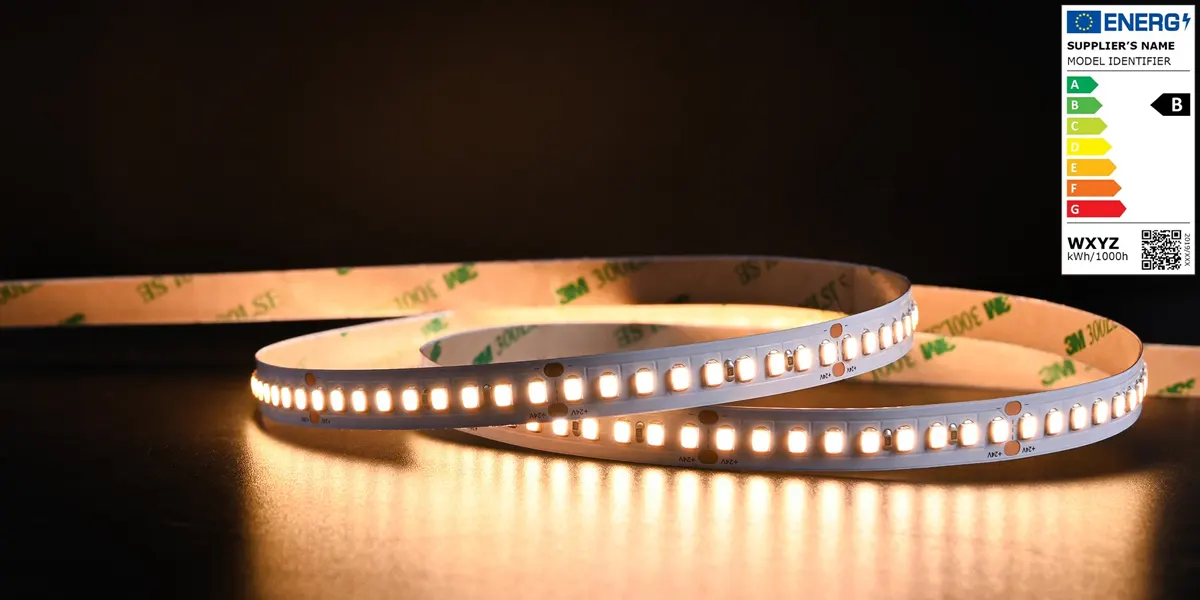
Un Lampe LED ERP (produits liés à l'énergie) Fait référence à des produits d'éclairage LED flexibles qui répondent aux exigences obligatoires en matière d'efficacité énergétique et d'écoconception fixées par l'Union européenne pour les produits mis sur le marché européen. La conformité est vérifiée par le biais de tests en laboratoire, de documentation technique et d'enregistrement de la base de données EPREL.
| Objet | Description |
| Règlement-cadre | (UE) 2019/2021 (EcoDesign) |
| Règles d'éco | (UE) 2019/2020 (réglementation de l'éclairage unique) |
| Règles d'étiquette énergétique | (UE) 2019/2015 (Règlement sur l'étiquetage énergétique) |
| marché | Union européenne (tous les 27 États membres) |
| s'applique à | Lumières de bandes LED, modules LED et luminaires contenant des sources lumineuses |
| Focalisation principale | Efficacité énergétique, puissance de veille, scintillement, durée de vie et économie circulaire |
| Échelle d'efficacité | A (le plus haut) – g (le plus bas) |
| 2026 minimum pour l'éclairage général | Classe D ou supérieure (≥120 lm/W) |
| Limite de puissance de veille | ≤ 0,5 W (≤ 2,0 W pour le réseau en veille) |
Que signifie ERP ?
ERP signifie produits liés à l'énergie. Il s'agit d'une directive obligatoire dans le cadre de la certification CE, utilisée pour réglementer l'efficacité énergétique, la protection de l'environnement et les exigences d'économie d'énergie. le Directive ErP (2009/125/CE) A remplacé la précédente directive EUP (produits utilisant l'énergie) en 2009, élargissant le champ d'application pour inclure des produits qui ne consomment pas d'énergie mais qui affectent la consommation d'énergie.
Concrètement : LVD assure la sécurité, EMC contrôle les interférences électromagnétiques et ERP assure l'efficacité énergétique et la conformité environnementale. Les produits avec uniquement la sécurité et les tests CEM sont encore incomplets. L'ERP est un élément nécessaire du système CE.
Quelles réglementations européennes s'appliquent aux stores LED ?
La conformité ERP pour les socles LED est régie par deux règlements :
- Règlement (UE) 2019/2020 de la Commission européenne, connu sous le nom de règlement sur les éclairages uniques (SLR), qui définit les exigences d'écoconception pour les sources lumineuses et les engins de commande séparés. Il a remplacé les règlements précédents (CE) no 244/2009, (CE) no 245/2009 et (UE) N° 1194/2012.
- Le Règlement délégué (UE) 2019/2015 de la Commission européenne — connu sous le nom de Règlement sur l'étiquetage énergétique (ELR), qui définit les exigences d'étiquetage des sources lumineuses. Il a remplacé (EC) n° 874/2012.
Pour les acheteurs, le point clé est le suivant : ces réglementations s'appliquent à toute source lumineuse placée sur le marché de l'UE, y compris les bandes de lumière LED, les modules LED et les luminaires contenant des sources lumineuses.
Quand les nouvelles règles ERP sont-elles entrées en vigueur ?
2018 → L'examen des règlements existants commence
2019 → UE 2019/2020 et UE 2019/2015
2021 → De nouvelles réglementations prennent effet (septembre 2021)
2024 → Exigences de scintillement serrées (SVM ≤ 0,4)
2026 → Application complète avec la classe D minimum (≥ 120 lm/W)
Le règlement est entré en vigueur en septembre 2021. Depuis lors, l'UE a progressivement resserré les exigences. Depuis 2026, le règlement-cadre (UE) 2019/2021 reste en vigueur, sans aucun règlement de remplacement prévu.
Pourquoi la nouvelle réglementation ERP a-t-elle été introduite ?
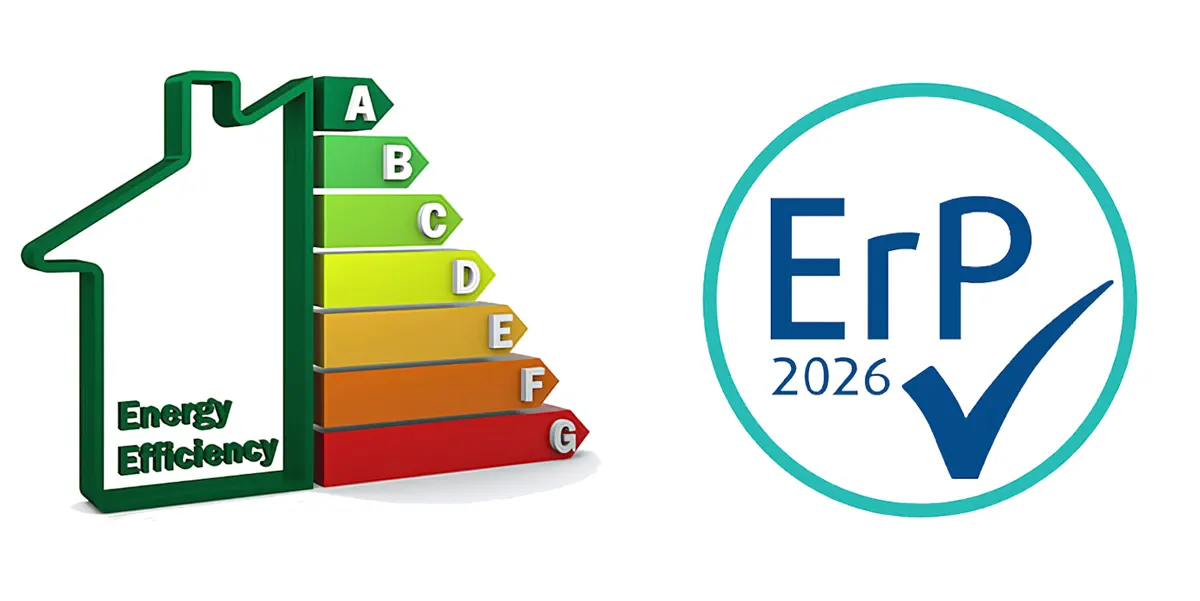
L'UE a introduit le nouveau cadre du PER pour relever trois défis interconnectés :
- Réduction du carbone et le Green Deal — L'UE s'est engagée à atteindre la neutralité climatique d'ici 2050. L'éclairage représente une part importante de la consommation d'électricité. Selon le plan de travail d'écoconception, les mesures de ce cadre pourraient économiser plus de 260 TWh d'énergie finale par an 2030, ce qui équivaut à réduire environ 100 millions de tonnes de gaz à effet de serre par an.
- La technologie a dépassé les anciennes normes — Lorsque l'ancien système de classement A++ à E a été créé, la technologie LED était encore en train d'émerger. En 2019, de nombreux produits LED avaient déjà dépassé la plus haute qualité, ce qui rendait l'étiquette incapable de différencier efficacement la qualité des produits.
- Transparence des produits et économie circulaire — Au-delà de l'efficacité énergétique, les nouvelles réglementations obligent les fabricants à tenir compte de la durabilité, de la réparabilité et de la recyclabilité dans leur conception. Cela signifie que les produits doivent être plus fiables, évolutifs (si possible), supporter le « droit de réparation », contenir des matériaux plus recyclables et être plus faciles à démonter.
En bref : l'UE a non seulement relevé la barre, mais a repensé l'ensemble du système d'évaluation.
Quelles bandes LED doivent être conformes à l'ERP ?
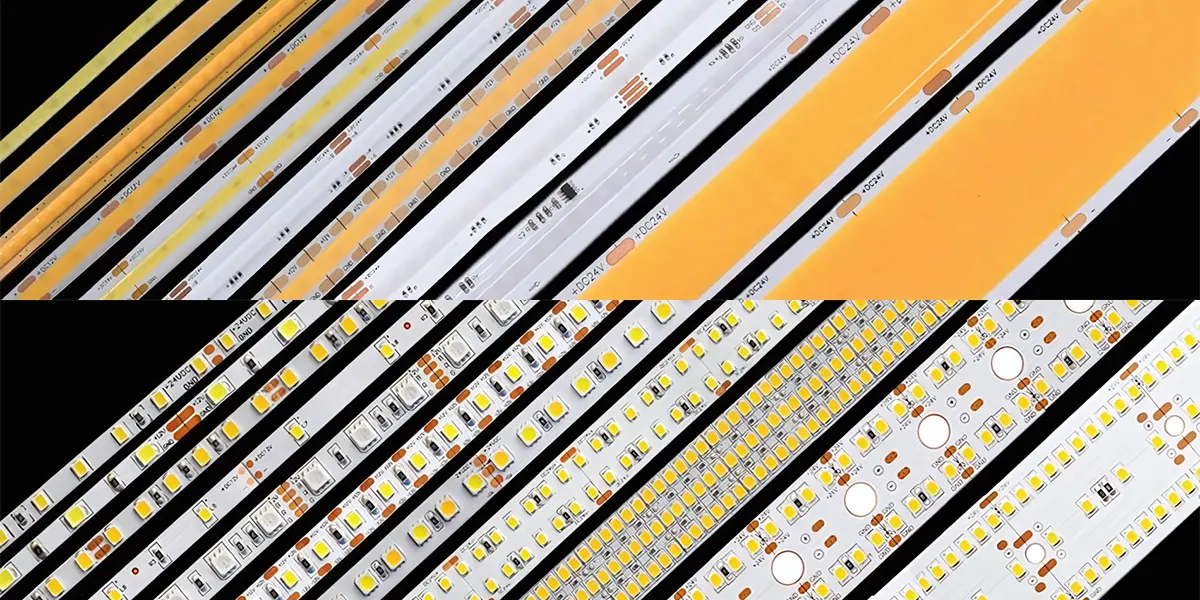
L'ERP s'applique à pratiquement toutes les bandes de LED vendues dans l'UE.
Produits qui nécessitent la conformité ERP:
- Lampes de bande LED à usage général d'intérieur
- Lumières de bandes LED commerciales (détail, bureau, hôtel)
- Lumières de bande LED architecturales et décorative
- Éclairage d'affichage et de signalisation au détail
- Éclairage de meubles et d
- Bande LED COB
- Lumières de bande LED étanches (IP20, IP54, IP65, IP67)
Exemptions (limitées):
- Sources lumineuses avec flux lumineux inférieur à 60 lumens ou supérieur à 82 000 lumens
- éclairage de secours
- Luminaires alimentés uniquement par des piles
- Éclairage théâtral et de scène
- Certains luminaires industriels spécialisés
Remarque importante pour les acheteurs OEM : Tout composant émetteur de lumière utilisé directement dans les luminaires LED est considéré comme une source de lumière dans le cadre des règlements. Cela signifie que même les éclairages à bandes LED vendus comme composants aux fabricants de luminaires doivent respecter les exigences de l'ERP.
Exigences clés pour les ERP pour les lumières de bande LED
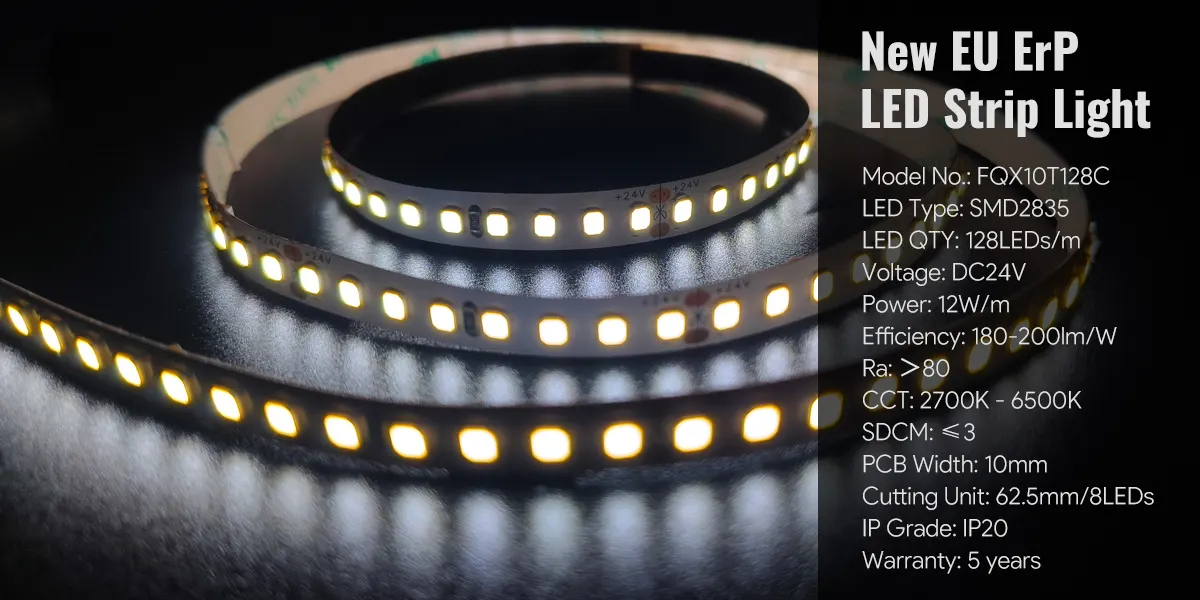
Le nouveau cadre ERP impose plusieurs exigences spécifiques sur les sommiers à LED :
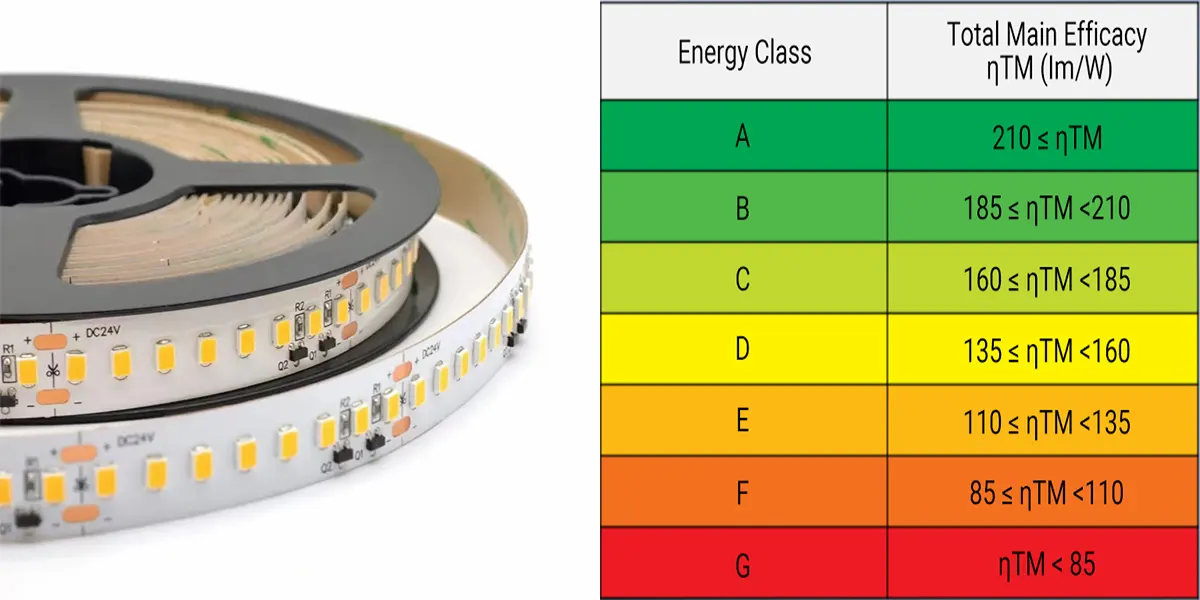
Efficacité lumineuse minimale: À partir de 2026, les bandes de lumière LED doivent atteindre au moins la classe D (≥ 120 lm/W). Les classes supérieures (B ou C) sont recommandées pour les applications premium.
| énergie | Efficacité totale du réseau (lm/w) |
| A | ≥210 |
| B | 185 – <210 |
| C | 160 – <185 |
| D | 120 – <160 |
| E | 85 – <120 |
| F | 60 – <85 |
| G | <60 |
Consommation d'énergie en veille: La puissance de veille ne doit pas dépasser 0,5 W et la veille du réseau ne doit pas dépasser 2,0 W.
Performances de scintil: L'indicateur de scintillement à court terme (PSTLM) doit être ≤ 1,0 et le pourcentage de scintillement (SVM) doit être ≤ 0,4.
Durée de vie et dégradation: Les fabricants doivent fournir des données de durée de vie L70/B50 ≥ 6 000 heures, démontrant que le produit conserve au moins 70% de son flux lumineux initial après la période indiquée.
Étiquetage énergétique: Tous les produits conformes doivent afficher la nouvelle étiquette d'efficacité énergétique A–G avec un code QR reliant la base de données EPREL.
Documentation technique: Les dossiers techniques complets doivent être conservés pendant au moins 10 ans à compter de la date de mise sur le marché du produit.
Exigences en matière d': Les produits doivent être conçus pour la durabilité, la réparabilité et la recyclabilité, avec des matériaux plus recyclables et un démontage plus facile.
Comprendre la nouvelle étiquette énergétique de l'UE
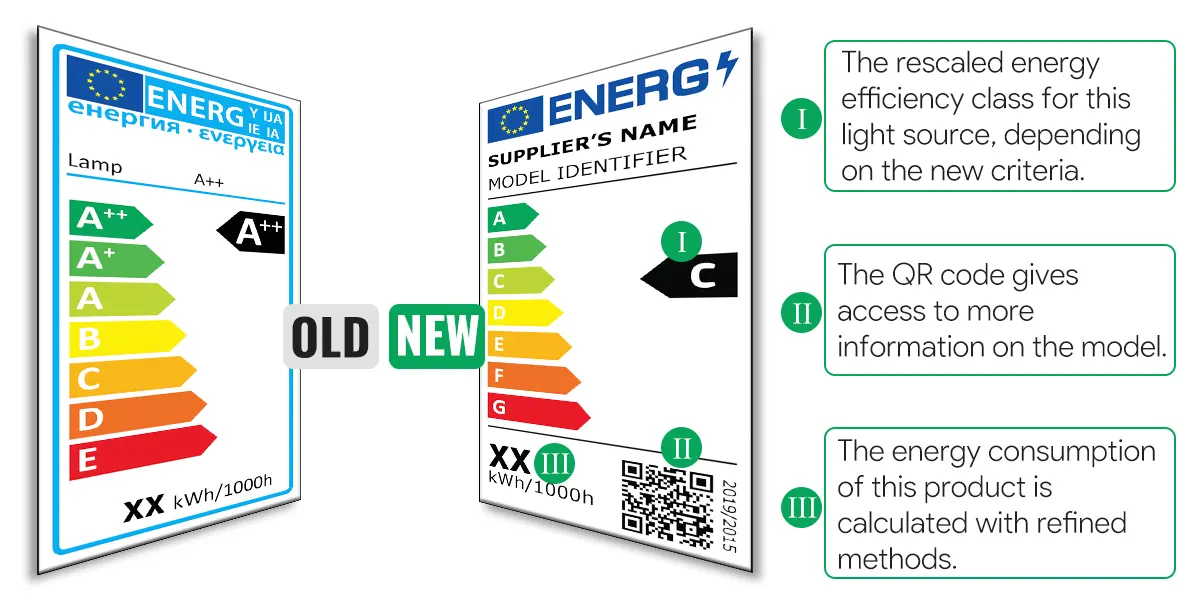
La nouvelle étiquette énergétique de l'UE utilise une échelle A–G simplifiée, remplaçant l'ancien système A+++ en D. Voici comment sont classées les bandes de lumière LED :
- Classe A (≥ 210 lm/w) : ultra-élevé - Futur niveau premium, pas encore largement disponible
- Classe B (185–<210 lm/w) : Efficacité de qualité supérieure — Bandes LED de premier plan
- Classe C (160–<185 lm/W) : haute efficacité — Bandes commerciales hautes performances
- Classe D (120–<160 lm/W) : efficacité standard — répond à la condition minimale de 2026
- Classe E (85–<120 lm/w) : entrée de gamme — conforme mais inférieure optimale
- Classe F (60–<85 lm/W) : faible rendement — technologie ancienne, en cours de suppression
- Classe G (< 60 lm/W) : très faible efficacité — équivalent à incandescent/halogène, effectivement interdit
L'étiquette d'énergie doit inclure un code QR qui renvoie à la base de données EPREL, permettant aux acheteurs et aux inspecteurs de vérifier les spécifications et le statut de conformité du produit.
Pourquoi votre produit A++ est désormais noté D : sous l'ancien système, de nombreux produits LED pourraient atteindre une cote A++. Les nouvelles normes sont beaucoup plus strictes, les produits qui étaient auparavant A++ pourraient désormais entrer dans la catégorie D ou E. Cela ne signifie pas que le produit s'est aggravé, mais que l'UE a considérablement augmenté les normes.
Bande LED ERP vs. Strip LED traditionnelle
Voici une comparaison entre les bandes LED traditionnelles et les bandes LED conformes à l'ERP :
| Fonctionnalité | Bande LED traditionnelle | Bande LED conforme à l'ERP |
| Efficacité énergétique | Variable, souvent faible | ≥120 lm/W minimum (classe D) |
| Étiquette énergétique | Manque souvent | Étiquette A–G avec enregistrement EPREL |
| Puissance de secours | non régulé | ≤ 0,5 W (≤ 2,0 W) |
| Contrôle des scintillements | Aucun requis | PSTLM ≤1,0, SVM ≤0,4 |
| Test à vie | Aucun requis | L70/B50 ≥6 000 heures |
| production de chaleur | Plus élevé | Plus faible en raison d'une plus grande efficacité |
| consommation d'énergie | Plus par lumen | Jusqu'à 50% inférieur |
| empreinte carbone | Plus élevé | Plus bas |
| Accès au marché de l'UE | bloqué à la douane | Effacer pour l'importation |
| Inscription à Eprel | Non applicable | obligatoire |
| Documentation technique | Souvent incomplet | Fichier complet requis (rétention de 10 ans) |
| à toute épreuve | non —Risque d'être interdit | Oui—Répond aux exigences actuelles |
Conclusion: Les bandes LED conformes aux normes ERP ne sont pas simplement une question d'efficacité énergétique, mais elles sont une question d'accès au marché. non -Les produits conformes seront détenus aux frontières de l'UE et retirés des plateformes de commerce électronique.
Comment choisir une bande LED conforme à l'ERP
Étape 1 : Déterminez le scénario d'application
Clarifier les exigences du projet : intérieur/extérieur, température de couleur requise, indice de rendu des couleurs, cote de protection, tension et flux lumineux par mètre. Différentes applications nécessitent différents niveaux d'efficacité énergétique.
Étape 2 : Vérifier l'efficacité lumineuse (lm/w)
Pour tout projet de l'UE en 2026, la condition minimale est de ≥ 120 lm/W. Pour les projets haut de gamme, visez la classe B (≥ 160 lm/W) ou la classe C (160–185 lm/W).
Étape 3 : Vérifier la documentation
Demandez une documentation technique complète avant de passer une commande :
- Rapport de test ERP (conforme aux règlements en vigueur après 2024)
- Maquette d'étiquettes d'efficacité énergétique avec numéro EPREL
- Déclaration de conformité (DOC)
L L70/B50 Rapport de test à vie
Drapeau rouge : si un fournisseur ne peut pas fournir ces documents à l'avance, il n'en dispose probablement pas du tout.
Étape 4 : Vérifier l'exhaustivité du test
Certains tests ne sont pas valides. Le fournisseur doit compléter :
- Test d'efficacité lumineuse
- Test de puissance de veille
- Test de scintillement (PSTLM et SVM)
- Test à vie
- Test de consommation d'énergie à vide
Étape 5 : Confirmez l'enregistrement d'EPREL
Les produits doivent être enregistrés dans la base de données EPREL avant d'être mis sur le marché de l'UE. non -Les fabricants de l'UE doivent désigner un représentant autorisé de l'UE pour gérer l'enregistrement.
La base de données EPREL doit contenir :
- Enregistrements de produits avec des cotes d'efficacité énergétique
- Fiches d'informations sur le produit
- Documentation technique accessible aux autorités de surveillance du marché
- Le système génère un numéro d'enregistrement unique et un code QR, qui doivent apparaître sur l'étiquette d'efficacité énergétique.
Étape 6 : Évaluer les fournisseurs
Des fournisseurs fiables doivent :
- Fournir des rapports de tests des laboratoires accrédités
- Maintenir la documentation technique pour chaque modèle
- Soutenir l'enregistrement d'Eprel
- Avoir une expérience de la conformité des marchés européens
- Maintenir la transparence dans la fabrication et le contrôle de la qualité
Applications courantes des éclairages de bande LED ERP
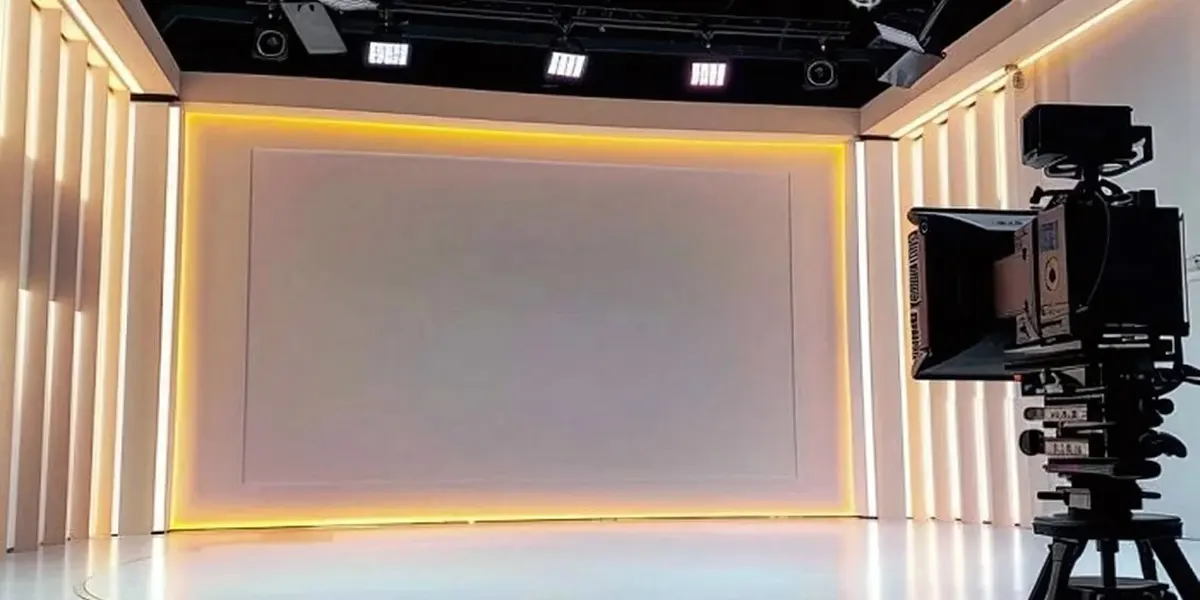
Voici les applications typiques et les classes d'efficacité recommandées :
| Application | Exigences typiques | Cours recommandé |
| Eclairage de bureau | Haute efficacité, bon CRI, faible scintillement | Classe B ou C |
| Affichages de détail | CRI élevé, précision des couleurs | Classe C ou D |
| Hôtels et hôtellerie | CCT chaud, possibilité de variation | Classe C |
| hôpitaux | CRI élevé, faible scintillement, hygiène (cote IP) | Classe C |
| Musées et galeries | Haute CRI, sans UV, contrôle précis | Classe C |
| Résidentiel (cuisines, armoires) | Bonne efficacité, flexibilité | Classe D ou C |
| Éclairage des meubles | Profil bas, flexibilité | classe D |
| Façades architecturales | Résistance aux intempéries (IP65+), contrôle des couleurs | classe D |
| Signalisation commerciale | Haute luminosité, visibilité | Classe C ou D |
| Éclairage miroir | CRI élevé, répartition uniforme | classe D |
La conformité ERP s'applique à toutes les applications susmentionnées. Pour les projets du secteur commercial et public au sein de l'UE, la conformité aux PRE devient de plus en plus une condition dans les appels d'offres, les produits qui ne répondent pas à ces normes seront exclus.
erreurs courantes que font les acheteurs
Voici les erreurs courantes et les bonnes pratiques pour les éviter :
- Incorrect 1 : uniquement en comparant la puissance (W/m) – Correct : comparer l'efficacité (lm/w) : une efficacité plus élevée signifie plus de lumière par watt.
- Incorrect 2 : ignorer l'efficacité en faveur de la luminosité - Correct : demande ≥ 120 lm/w minimum pour tous les projets de l'UE
- Incorrect 3 : confondant CE avec ERP - correct : CE est la sécurité + CEM ; l'ERP est l'efficacité énergétique. Vous avez besoin des trois
- Incorrect 4 : accepter « CE » comme preuve d'ERP - correct : demander le rapport de test ERP et le numéro EPREL en particulier
- Incorrect 5 : en supposant que "A++" signifie une qualité supérieure - correcte : l'ancienne échelle A++ est obsolète ; vérifiez la nouvelle classe A à G.
- Incorrect 6 : achat sans étiquette énergétique - correcte : chaque produit conforme à l'ERP doit avoir une étiquette A à G avec le code QR EPREL
- Incorrect 7 : ignorer les exigences en matière de documentation – Correct : les dossiers techniques doivent être conservés pendant 10 ans.
- Incorrect 8 : Confiance verbale des réclamations - Exact : Demandez des preuves écrites : rapports de test, DOC, enregistrement EPREL
- Incorrect 9 : ne pas vérifier les performances du scintillement : correcte : Flicker est une exigence de conformité : demandez les résultats des tests PSSTLM et SVM
- Incorrect 10 : en supposant que toutes les bandes imperméables sont couvertes - correct : la cote IP n'exempte pas un produit de l'ERP : toutes les cotes IP sont couvertes
Pourquoi choisir SigniteLED Pour les éclairages de bande LED ERP
Signiteled est un professionnel Fabricant de bandes lumineuses à LED Avec une vaste expérience au service du marché européen. Nos produits sont conçus et testés pour répondre aux dernières exigences des ERP, garantissant un dédouanement et un accès au marché pour nos partenaires.
Ce que nous proposons pour le marché européen :
- Solutions de bandes LED à haut rendement — Nos produits couvrent les classes B à E ERP, avec une efficacité allant jusqu'à 220 lm/w pour les applications premium. Nous utilisons des LED testées par LM-80 pour garantir des performances constantes et une longue durée de vie.
- Personnalisation OEM/ODM — Nous travaillons avec des marques, fabricants et distributeurs d'éclairage pour développer des éclairages à bande LED personnalisés qui répondent aux exigences des ERP pour des applications spécifiques, des températures de couleur, des IRC, des cotes IP et des besoins de tension.
- Contrôle de qualité de production strict — De la sélection de puces LED à la fabrication de circuits imprimés et à l'assemblage final, chaque étape est surveillée pour assurer la cohérence, la fiabilité et la conformité.
- Prise en charge complète de la documentation ERP — Nous fournissons des fichiers techniques complets, y compris des rapports de test, des illustrations d'étiquettes énergétiques et des déclarations de conformité, tout ce dont vous avez besoin pour l'enregistrement EPREL et le dédouanement de l'UE.
- Sélection de produits basé sur des applications — Notre équipe technique vous aide à choisir la bonne classe ERP et les spécifications de produits en fonction des exigences de votre projet et des objectifs d'efficacité énergétique.
- Plusieurs certifications — En plus de l'ERP, nos produits sont équipés de CE, de ROHS et d'autres certifications pertinentes sur le marché européen.
Prêt à vous procurer des bandes LED conformes à l'ERP pour votre prochain projet européen ? Contactez notre équipe technique pour connaître les recommandations de produits, les spécifications personnalisées et la prise en charge de la documentation de conformité.
Conclusion
Le cadre ERP n'est pas une réglementation temporaire pour les socles LED, il est devenu la nouvelle base du marché européen de l'éclairage. À compter de 2026, les exigences sont claires : classe D ou supérieure (≥ 120 lm/W), limites de scintillement strictes, enregistrement EPREL obligatoire et documentation technique complète.
Pour les acheteurs, cela signifie :
- Arrêtez de comparer la puissance de comparaison : comparez l'efficacité (lm/w)
- Arrêtez de faire confiance aux réclamations verbales : demandez des rapports de test et des numéros EPREL
- Arrêtez de supposer que CE est suffisant - vous avez besoin de LVD + EMC + ERP
Pour les fournisseurs, cela signifie :
- L'investissement dans des LED de qualité n'est pas négociable
- La documentation est aussi importante que le produit lui-même
- L'enregistrement d'Eprel est un service que vous devez fournir ou soutenir
Chez Signiteled, nous avons construit notre gamme de produits européennes autour de ces exigences. Des slips à LED à haute efficacité à la prise en charge complète de la documentation, nous vous aidons à mettre sur le marché des produits conformes à l'ERP.
Vous avez un projet ? Contactez notre équipe technique pour la sélection des produits, les spécifications personnalisées et la prise en charge de la conformité. Ce guide est à titre informatif uniquement. Les règlements peuvent changer. Vérifiez toujours les dernières exigences auprès d'un expert en conformité autorisé avant de mettre des produits sur le marché de l'UE.
FAQ
Articles Similaires