English
  简体中文
简体中文  Deutsch
  Español
  Français
  Italiano
  日本語
日本語  한국어
한국어  Polski
  Português
  Русский
  Türkçe
  Nederlands
  Tiếng Việt
  ไทย
ไทย 
The best COB LED strip lights for commercial lighting are those that meet defined, measurable performance standards rather than aesthetic preferences or marketing claims. In commercial environments, “best” means high luminous efficacy typically in the 110–160 lm/W range at system level, color rendering index (CRI) of at least 80 for general applications and 90 or higher for retail and hospitality, stable 24V operation for reduced voltage drop, consistent binning with ≤3 SDCM color tolerance, engineered thermal management through proper PCB construction and aluminum mounting, and compatibility with commercial dimming systems such as 0–10V or DALI. A product that delivers these characteristics consistently across long runs and large installations qualifies as commercial grade.
This article will explain how to evaluate COB LED strip lights using technical benchmarks, how specifications differ across commercial applications, and what electrical and installation factors determine long-term performance and reliability.
Core Performance Criteria for Commercial LED White Strips
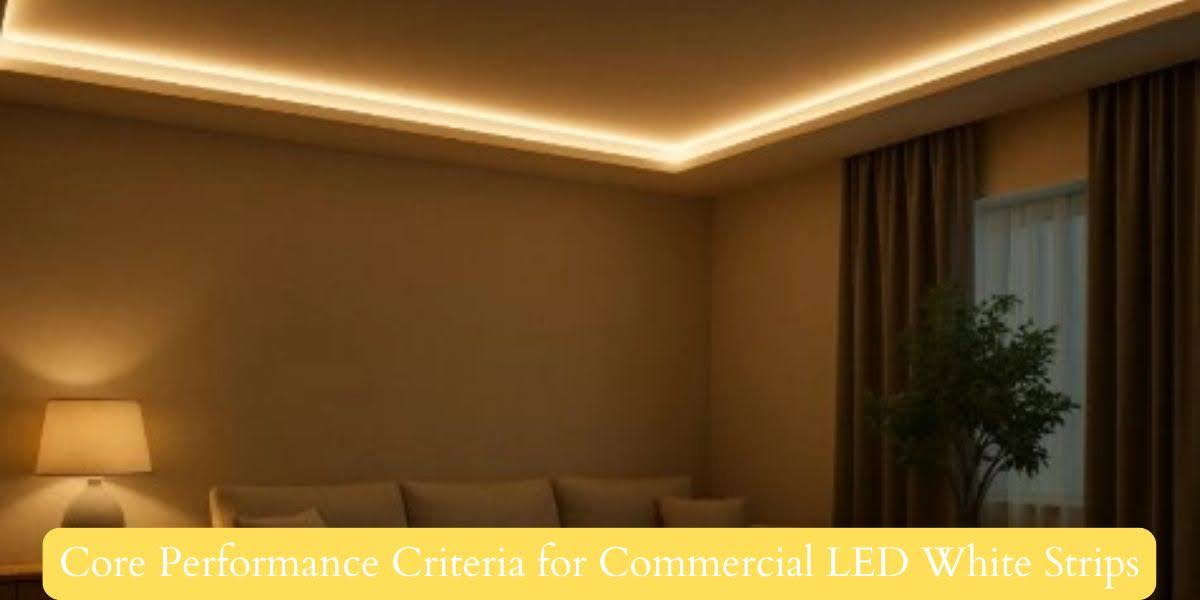
Commercial lighting demands repeatability, stability, and compliance with measurable standards. The following criteria define whether COB LED strips are suitable for professional installations:
- Luminous Efficacy (lm/W)
Commercial-grade COB LED light strips typically deliver system efficacies between 110–140 lm/W at nominal operating temperature. High-performance configurations may reach 150–160 lm/W depending on drive current and color temperature. Lower values often indicate thermal inefficiency or overdriven chips. - Color Rendering Index (CRI)
For offices and general commercial interiors, CRI ≥80 is standard. Retail, hospitality, and premium architectural projects require CRI ≥90 to ensure accurate material and merchandise presentation. High CRI versions of best COB LED strip lights should maintain R9 values that support red rendering consistency. - Color Temperature Stability
Commercial white lighting commonly uses:
- 3000K for hospitality and warm retail environments
- 4000K for offices and general commercial interiors
- 5000K for task-driven or industrial settings
Stability is defined by ≤3 SDCM color tolerance, ensuring uniformity across batches and installation zones.
- 3000K for hospitality and warm retail environments
- Voltage Selection
24V COB LED strips are preferred in commercial projects because they reduce voltage drop, allow longer continuous runs, and improve system stability. 12V configurations are generally unsuitable for long linear installations. - Thermal Management
Heat directly impacts lumen maintenance and lifespan. Commercial COB LED strip lights require:
- Adequate copper weight (2 oz preferred for high-load systems)
- Proper aluminum profile mounting
- Thermal adhesive backing with strong conductivity
- Adequate copper weight (2 oz preferred for high-load systems)
- PCB Thickness and Copper Weight
Commercial-grade PCBs are typically 2–3 oz copper to reduce resistive losses and support uniform current distribution. Thin PCBs lead to uneven brightness and accelerated degradation. - Uniform Illumination Advantage of COB Technology
COB LED strip lights utilize densely packed LED chips coated with phosphor to create continuous light lines. This reduces diode spotting and enhances diffuser compatibility, making them suitable for shallow profiles and exposed linear installations.
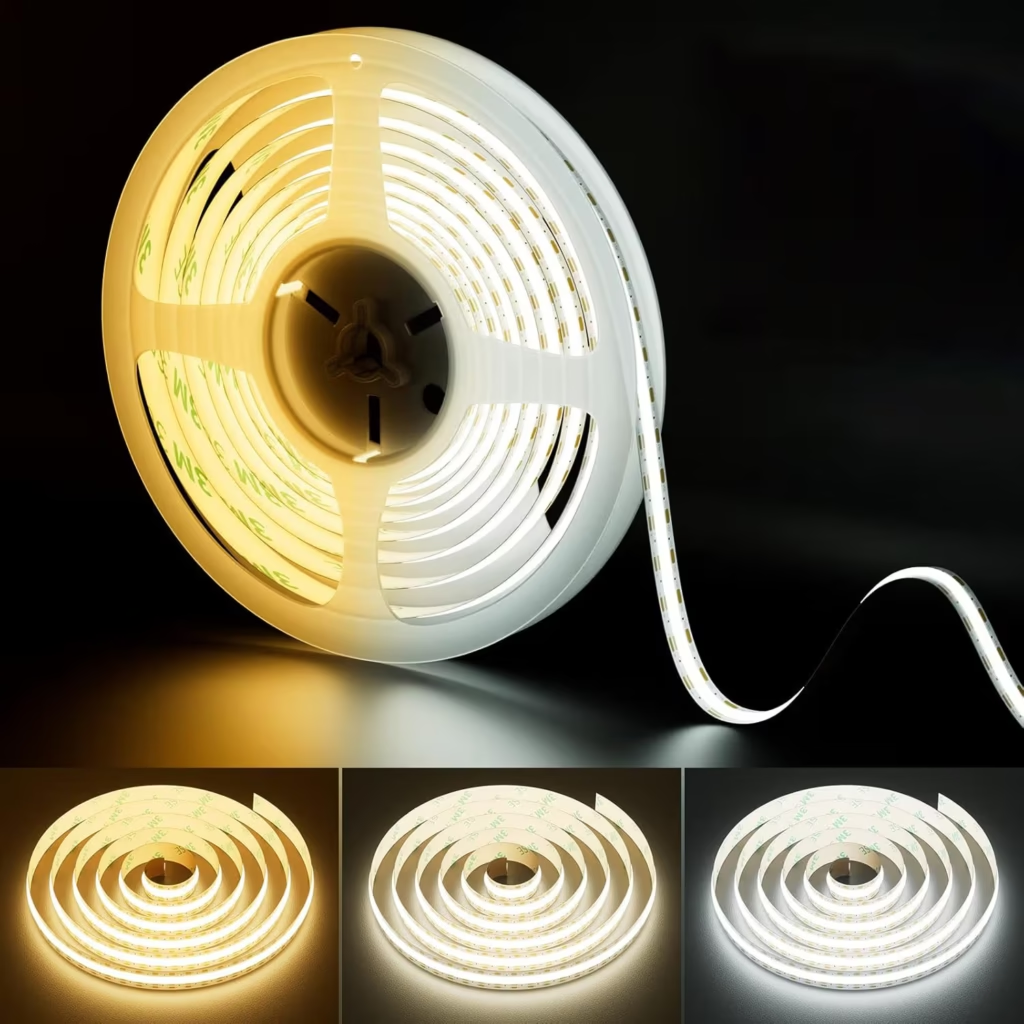
Tunable White COB LED Strip Light
- Main Model: FYT10T608C
- LED QTY per Meter Option: 608/640chips (Sanan)
- PCB Width Option: 10mm
- Color Option: 2700K – 6500K tunable
- CRI:>90
- Input Voltage: DC12V/DC24V
- Power per Meter: 14W/16W
- Efficiency: 90-110 lumen/watt
- IP Grade Option: IP20/IP54/IP65/IP67/IP68
- Warranty: 3years
Best COB LED Strip Lights for Different Commercial Applications
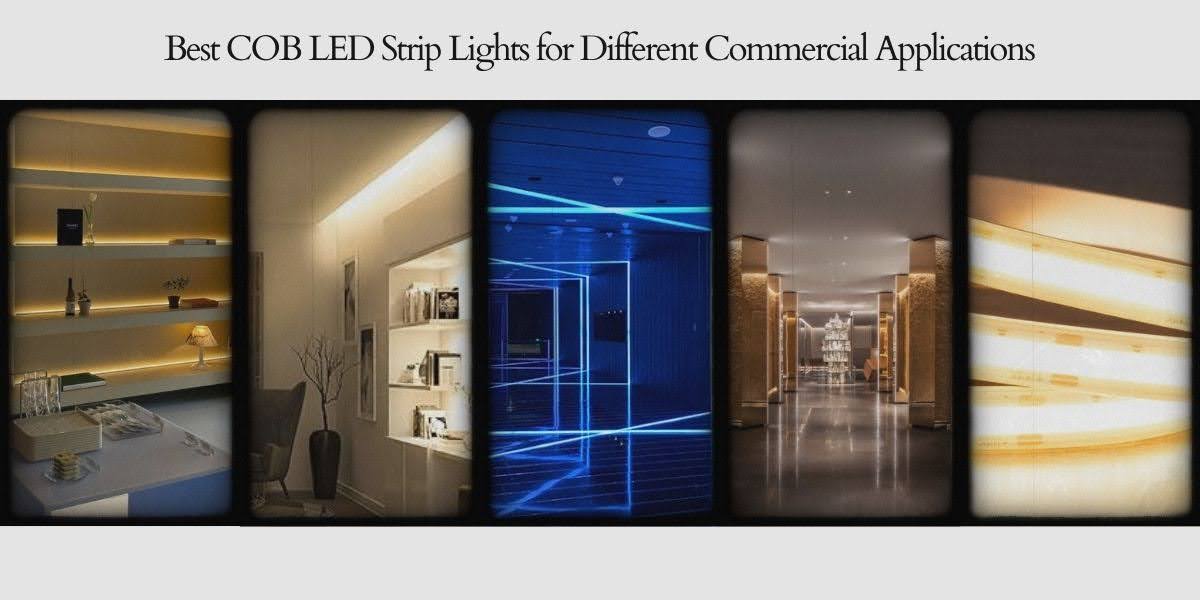
Retail & Display Lighting
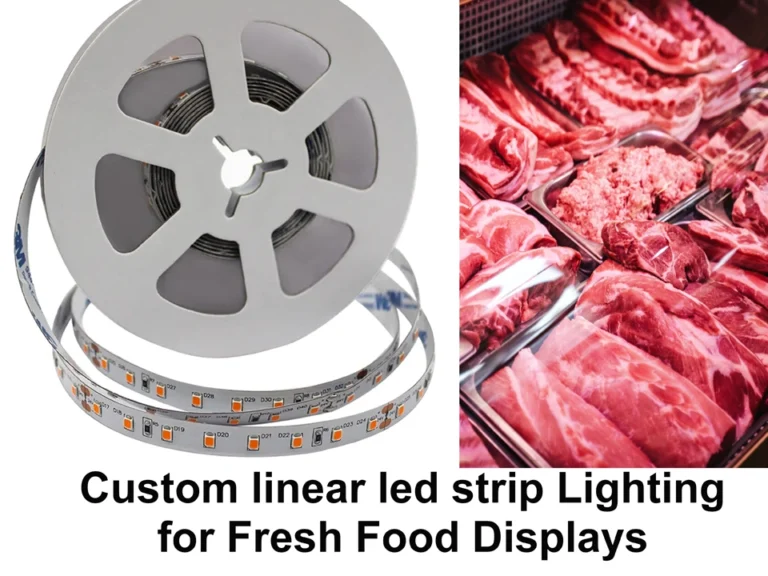
Retail environments demand both brightness and color fidelity. Merchandise must appear vibrant and accurate under artificial light. For this reason, the best COB LED strip lights for retail typically feature CRI ≥90 and consistent chromaticity within ≤3 SDCM.
High uniformity is critical in display shelving and under-cabinet lighting where viewers are close to the source. COB LED strips minimize the “dotting” effect common with traditional LED packages, improving visual comfort. A color temperature of 3000K or 3500K is often selected for fashion and lifestyle retail, while 4000K is used in grocery or hardware environments where clarity is prioritized.
Voltage stability at 24V ensures consistent brightness along long shelf runs. Poor voltage regulation results in visible luminance gradients, which are unacceptable in commercial merchandising.
Office & Workspace Lighting
In office environments, visual comfort and task performance are primary objectives. 4000K COB LED light strips are widely used to create neutral white lighting that supports alertness without appearing harsh.
Here, CRI ≥80 is generally acceptable, though higher CRI may be specified for design-focused spaces. Luminous efficacy becomes a stronger priority, as energy performance directly impacts operational costs across large floor areas.
Uniform illumination from led strips cob configurations reduces glare under diffusers and prevents scalloping on walls. When installed inside aluminum profiles with opal covers, high-density COB LED strip lights create smooth indirect lighting for coves and perimeter ceilings.
Long runs in open-plan offices reinforce the preference for 24V systems to reduce voltage drop and simplify wiring topology.
Hospitality & Architectural Lighting
Hospitality projects prioritize ambiance, consistency, and integration with architectural details. 3000K COB LED strips are commonly specified for warm, inviting atmospheres.
High CRI (≥90) enhances interior finishes such as wood, stone, and textiles. In these applications, the best COB LED strip lights are not necessarily the highest output versions, but those that balance uniformity, dimming smoothness, and color stability.
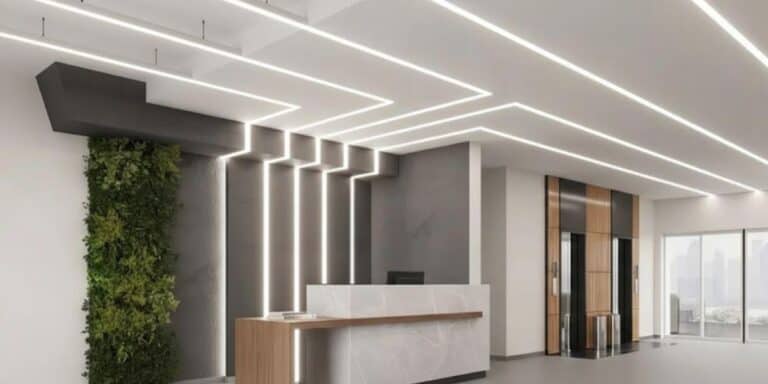
Architectural cove lighting often uses concealed linear channels. COB technology allows shallow recess installations without visible diode imaging. Compatibility with DALI or 0–10V dimming systems ensures scene-setting flexibility across dining, lounge, and reception areas.
Thermal management remains critical because hospitality lighting frequently operates for extended hours.
High-Output Task Lighting
Industrial or task-focused environments such as workshops and back-of-house commercial areas require higher lumen density. In these cases, COB LED strip lights may operate at elevated wattage per meter while maintaining acceptable thermal performance.
5000K color temperatures are often selected for clarity and contrast. CRI ≥80 is typical, though specialty applications may demand higher rendering.
The defining characteristic here is stability under sustained load. PCB copper weight and aluminum mounting surfaces must dissipate heat effectively to prevent lumen depreciation.
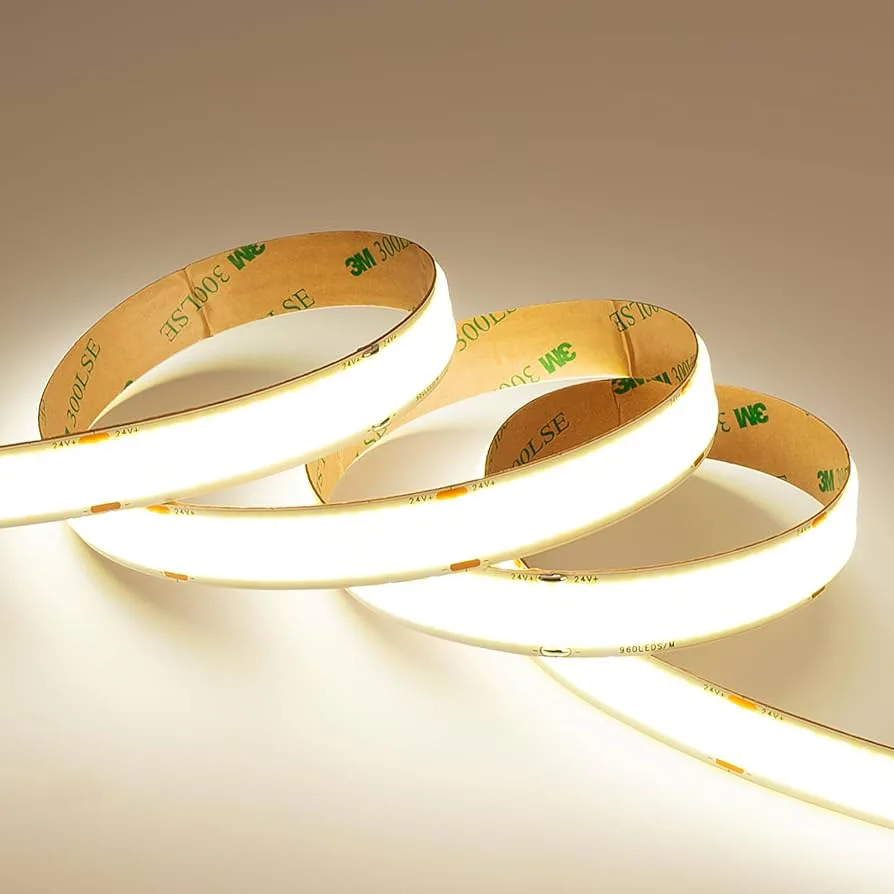
15mm Width Ultra Bright Dotless COB LED Strip Light
- Model: FYX15T1920C
- LED Chip QTY per Meter: 1920chips
- CRI: >90
- PCB Width: 15mm
- Color Temperature: 3000K/4000K/6000K
- Input Voltage: DC24V
- Power per Meter: 25W
- Cuttable Length: 20.67mm
- Waterproof Version: IP20/IP65
- Warranty: 3 year
COB vs Traditional SMD LED Strips in Commercial Projects
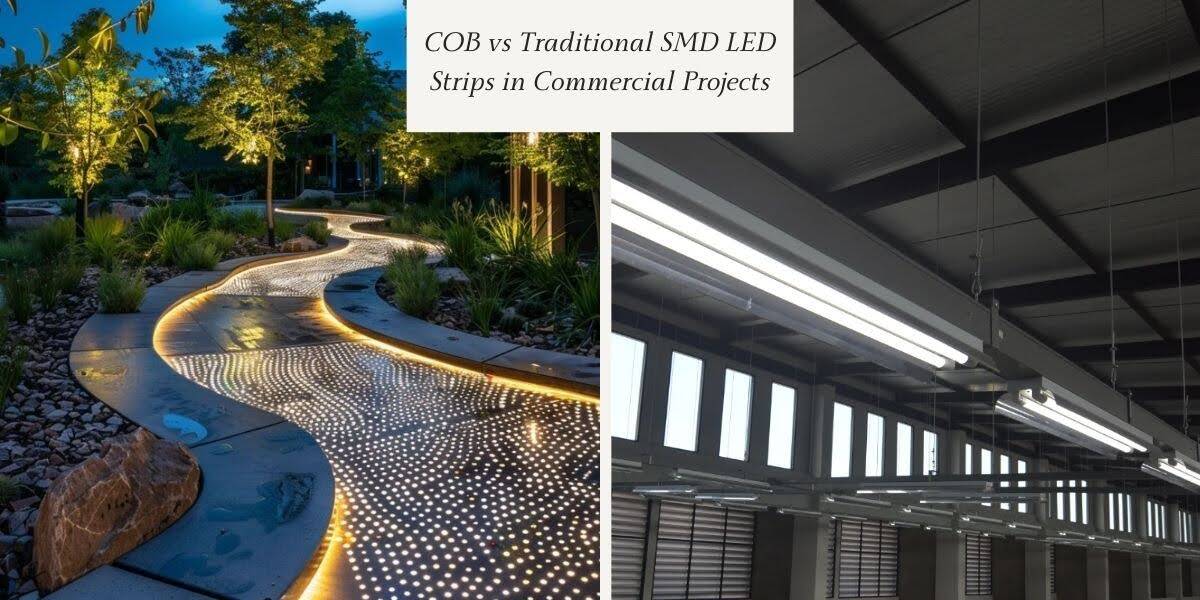
COB and traditional surface-mounted diode strips serve similar purposes, but their performance characteristics differ significantly in commercial contexts.
led strips cob technology places numerous micro-LED chips directly on the PCB and coats them with a uniform phosphor layer. This creates a continuous linear emission surface. Traditional SMD strips use spaced diode packages, which can produce visible hotspots through diffusers.
In commercial installations where lighting is visible or reflected on polished surfaces, uniformity becomes critical. COB configurations eliminate point-source spotting, making them ideal for architectural coves and exposed channels.
Shallow channels benefit from COB LED light strips because they require less diffuser depth to achieve smooth illumination. With SMD strips, installers often need deeper extrusions to prevent visible diode imaging.
Maintenance considerations also differ. Because COB designs distribute current across many micro-chips, they may demonstrate improved uniformity even if localized degradation occurs. However, proper thermal management is essential, as higher chip density increases heat concentration.
Objectively, the decision between technologies should be based on uniformity requirements, installation depth, and visual proximity rather than cost alone.
Commercial Specification Table
| Feature | Standard Commercial Grade | High-Performance Grade |
| Luminous Efficacy | 110–130 lm/W | 140–160 lm/W |
| CRI | ≥80 | ≥90 |
| Voltage | 24V preferred | 24V optimized with long-run stability |
| PCB Thickness | 2 oz copper | 2–3 oz copper with reinforced traces |
| Color Tolerance | ≤5 SDCM | ≤3 SDCM |
| Typical Applications | Offices, general commercial | Retail, hospitality, premium architectural |
This table illustrates how measurable parameters distinguish baseline commercial products from higher-performance variants. The best COB LED strip lights are those aligned with project requirements rather than defaulting to maximum output.
Installation & Electrical Considerations for Commercial Projects
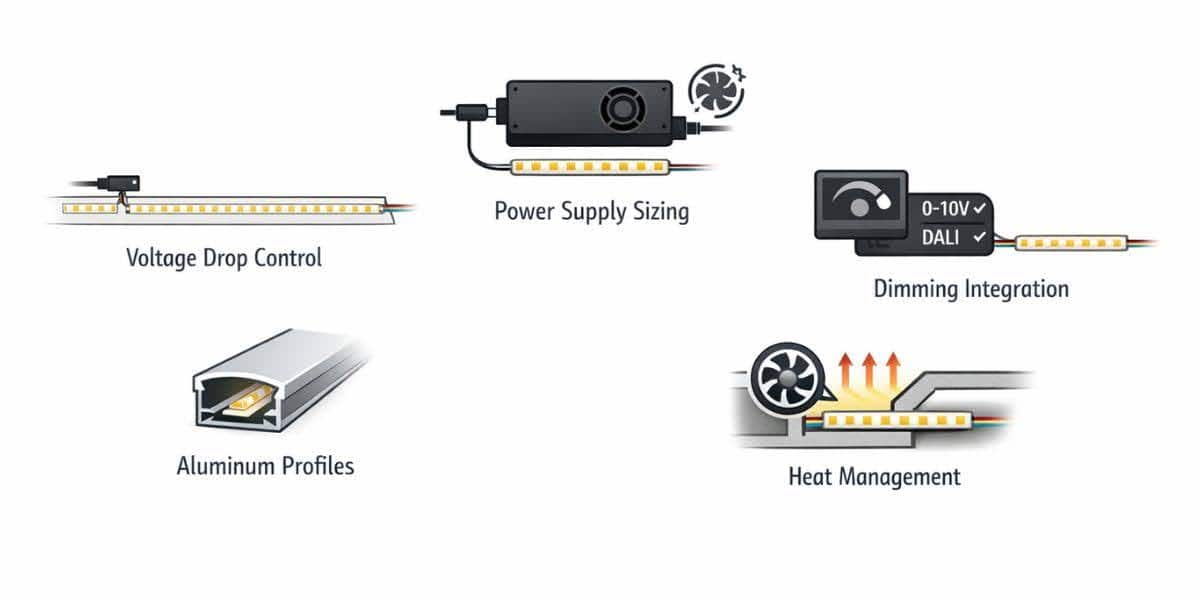
Selecting appropriate COB LED strips is only part of the equation. Installation and electrical design determine system longevity.
- Maximum Run Length
Even with 24V systems, voltage drop must be calculated. Typical maximum single-feed runs range from 5–10 meters depending on wattage per meter. - Voltage Drop Management
For longer runs, power injection at multiple points or parallel wiring layouts are necessary to maintain uniform brightness. - Power Supply Sizing
Drivers should be sized at 80–85% of rated capacity to avoid continuous full-load operation. This improves reliability and lifespan. - Aluminum Profile Requirement
Aluminum channels are not optional in commercial applications. They function as heat sinks and structural support. Direct mounting onto non-thermal surfaces accelerates degradation. - Dimming Compatibility
Commercial COB LED light strips should be paired with drivers compatible with 0–10V or DALI systems to integrate into building controls. - Heat Dissipation Planning
High-density installations require airflow consideration. Enclosed coves without ventilation can trap heat and reduce lumen maintenance.
Attention to these factors ensures that even the best COB LED strip lights perform as specified over time.
Common Mistakes When Selecting LED White Strips for Commercial Use
One common mistake is choosing 12V strips for extended commercial runs. While suitable for small residential installations, 12V systems exhibit significant voltage drop in longer configurations, resulting in visible brightness variation.
Another frequent oversight is ignoring CRI requirements. Retail and hospitality environments suffer visually when CRI falls below 90, even if lumen output appears sufficient.
Color bin consistency is often overlooked. Without ≤3 SDCM tolerance, adjacent installation segments may display noticeable shade variation, which undermines professional aesthetics.
Using low-density strips in high-visibility environments creates spotting under diffusers. Even high lumen output cannot compensate for poor uniformity.
Finally, relying solely on total lumen output without evaluating luminous efficacy and thermal stability leads to inefficient systems. High wattage does not guarantee quality performance.
Commercial lighting decisions must balance efficiency, uniformity, and longevity.
Conclusion
The best COB LED strip lights for commercial lighting are defined by performance benchmarks rather than marketing claims. High luminous efficacy, appropriate CRI levels, 24V voltage stability, tight color binning, proper PCB construction, and engineered thermal management determine whether a product is suitable for professional environments.
Commercial lighting demands uniformity, electrical stability, and scalability across large installations. Application requirements, not branding, dictate the ideal configuration. When specified correctly, COB LED strip lights provide reliable, visually consistent linear illumination for retail, office, hospitality, and task-driven environments.
FAQs
Related Posts