Signage & LED Strip Lighting Factory Since 2011

Signage & LED Strip Lighting Factory Since 2011

What Does COB in COB LED Strip Stand For?

A growing number of people are using COB LED strip lights because of its excellent brightness and cost-effectiveness. However, a lot of individuals are still unaware of what the acronym COB means. The definition of COB and its significance in COB LED strip lights will be discussed in this article.

Chip on Board, or COB, is a term that describes a method of mounting several LED chips directly onto a circuit board. COB LED strip lights have a continuous row of tightly packed LED chips, as opposed to conventional LED strip lights, which employ individual SMD (Surface Mount Device) chips. As a result, there are fewer black areas or shadows and the light output is more even and strong.
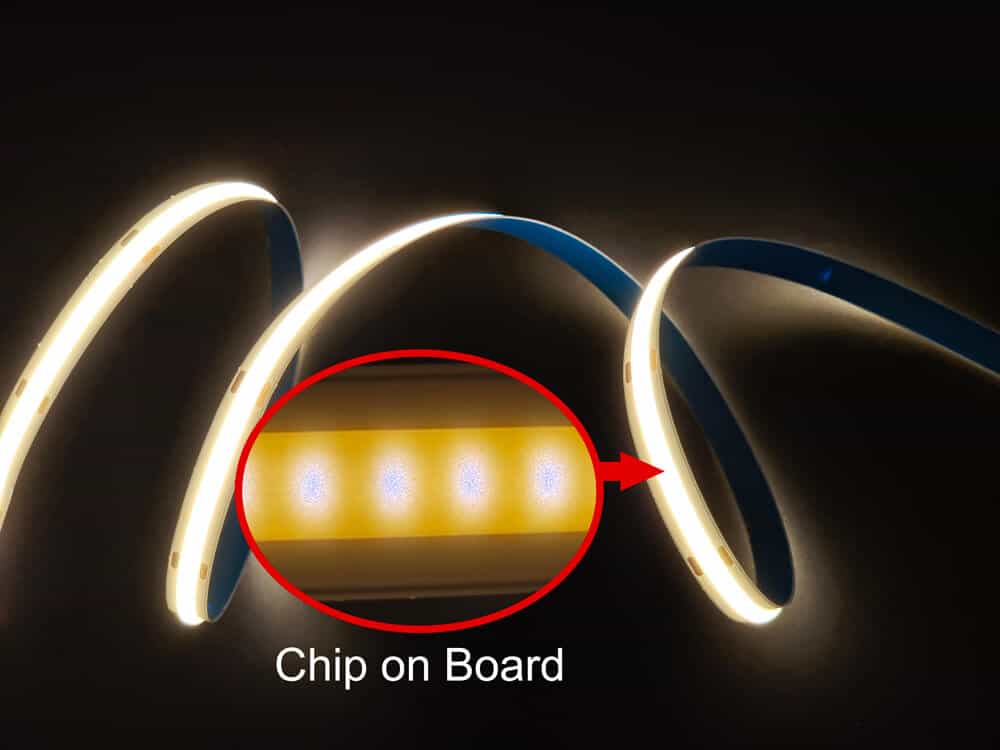
What Does COB in COB LED Strip Stand For

Since its first introduction in the early 2000s, COB technology has gained widespread use in a variety of lighting applications, including headlights for cars, streetlights, and indoor lighting fixtures. COB LED strip lights have become a well-liked substitute for conventional LED strip lights in recent years, particularly for commercial and industrial lighting projects.

The tremendous brightness of COB LED strip lights is one of their key features. Compared to conventional LED strip lights, they may produce more lumens per unit area since the LED chips are tightly packed together. This makes COB LED strip lights perfect for applications like shop displays, signage, and architectural lighting that need for bright and uniform lighting.

The energy efficiency of COB LED strip lights is another benefit. When compared to conventional lighting sources, COB LED strip lights can save up to 50% of energy because of their great brightness and low power consumption. This lowers energy expenditures and contributes to sustainability by lowering carbon emissions.

COB LED strip lights are superior to conventional lighting sources in terms of longevity and color rendering in addition to their great brightness and energy economy. In comparison to conventional lighting sources like incandescent bulbs or fluorescent tubes, the LED chips used in COB LED strip lights are intended to last up to 50,000 hours. Additionally, COB LED strip lights can produce a larger spectrum of hues, making them perfect for uses like photography and video production that demand accurate color representation.

In conclusion, COB stands for Chip on Board, a technology that enables the direct mounting of many LED chips on a circuit board. COB LED strip lights are superior than conventional LED strip lights in a number of ways, including brightness, energy efficiency, longevity, and color rendering. As a result, they are now a common option for lighting applications in both residential and commercial spaces.

surge protection devicesurge protection device
Protecting Your EV & Solar System from Power Surges
Electric vehicle charging systems and solar PV installations face a different surge risk profile than conventional electrical loads. Bidirectional power flow, frequent DC–AC conversion, and dense power electronics make these systems sensitive to both external grid disturbances and internally generated transients. Effective protection depends on coordinated, layered use of a...
Professional LED stage lighting with multi‑LED dynamic fixtures on a theatre stageProfessional LED stage lighting with multi‑LED dynamic fixtures on a theatre stage
How to Choose LED Stage Lighting for Theatres, Churches, Clubs, and Events
LED stage lighting should be selected based on venue function, spatial structure, audience distance, and performance objectives rather than fixture type alone.Different venues—such as theatres, churches, clubs, and event spaces—place fundamentally different technical and visual demands on stage lighting systems. From our experience working with professional buyers and project integrators, many...
The Ultimate Guide to Waterproof LED Strip LightsThe Ultimate Guide to Waterproof LED Strip Lights
The Ultimate Guide to Waterproof LED Strip Lights
In architectural lighting, commercial lighting, and residential lighting projects, reliability and durability are often just as important as brightness and aesthetics. One of the most common causes of failure for LED strips in real-world applications is inadequate waterproofing, dustproofing, or weatherproofing. A strip that looks perfect in a showroom can...
LED Neon Strip vs LED Strip Light: Which One Fits Your Project Best?
As LED lighting technology continues to evolve, lighting professionals, designers, and contractors are faced with an expanding range of solutions for both indoor and outdoor applications. Among the most widely used and visually impactful options are LED neon strips and standard LED strip lights. Though they may appear similar at...
DMX-512-LED-STRIPDMX-512-LED-STRIP
What is the difference between DMX 512 LED strips and SPI LED strips?
DMX512 and SPI (Serial Peripheral Interface) are two different communication protocols used to control LED strips, each with its own characteristics and applications: 1. DMX512 LED Strip:  Protocol: DMX512 (Digital Multiplexing 512) is a standard protocol for lighting control. It allows the transmission of up to 512 channels of control data over...
Why-install-LED-stripsWhy-install-LED-strips
Why install LED strips?
As a lighting product, the LED strip can create a unique atmosphere for our house. The LED strip is named after its shape, and when it glows like a light strip, it can make our home look more classy. In fact, the installation of LED strips is simple and inexpensive,...

Share:

Facebook
Twitter
Pinterest
LinkedIn
Subscribe
Notify of
guest
0 Comments
Oldest
Newest Most Voted
Inline Feedbacks
View all comments

Search SignliteLED Blog

Categories

To top

Get a Quote Now