English
  简体中文
简体中文  Deutsch
  Español
  Français
  Italiano
  日本語
日本語  한국어
한국어  Polski
  Português
  Русский
  Türkçe
  Nederlands
  Tiếng Việt
  ไทย
ไทย 
Choosing acoustic ceiling lights for an office requires a clear evaluation of acoustic performance, lighting quality, energy efficiency, visual integration, and long-term compliance. Each of these factors directly affects employee focus, speech clarity, operating costs, and overall workplace comfort.
Acoustic lighting fixtures combine sound-absorbing materials with professional LED lighting to reduce reverberation and distracting speech noise inside a space while delivering uniform, comfortable illumination. They improve internal acoustic conditions but are not designed to block external noise from adjacent rooms or outdoor sources.
This guide provides a structured, specification-driven framework that office managers, architects, and designers can use to make informed decisions. It explains the core performance metrics, offers a step-by-step selection matrix, outlines application-specific guidance for different office zones, and shows how to verify manufacturer claims using industry-standard test data.
Acoustic Performance: Measuring Noise Control
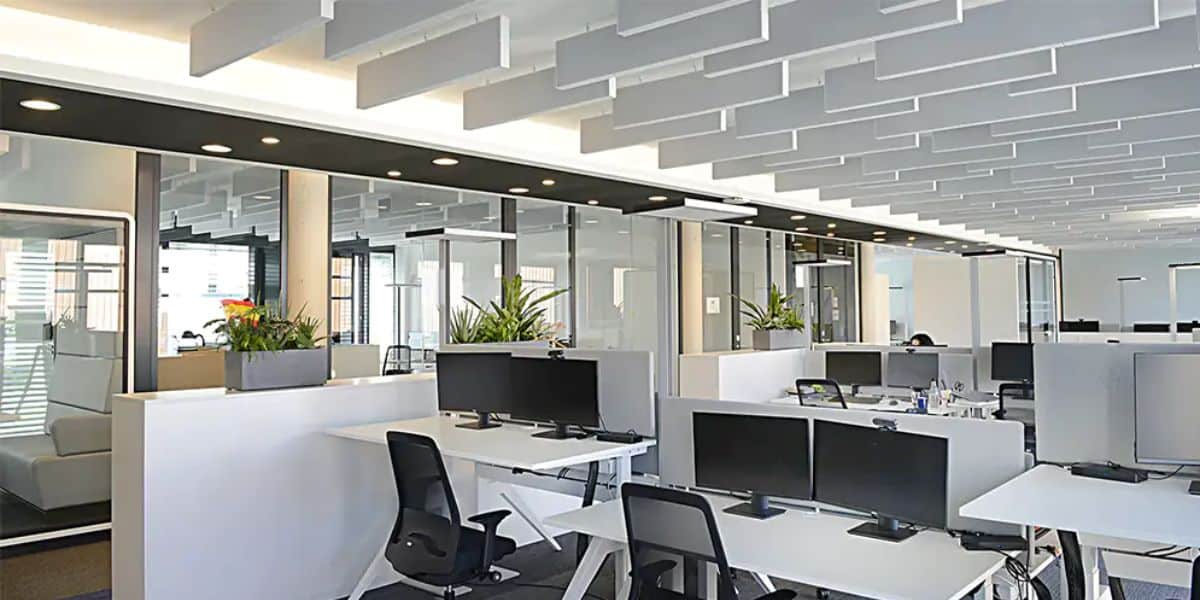
The primary acoustic goal in an office is to reduce reverberation and speech buildup that cause distraction, fatigue, and reduced privacy. Acoustic ceiling lighting achieves this by absorbing sound energy rather than reflecting it back into the room.
Noise Reduction Coefficient (NRC)
NRC is the most widely used metric for evaluating acoustic absorption. It ranges from 0.0 to 1.0 and indicates how much incident sound energy a surface absorbs across key speech frequencies. Higher NRC values result in lower echo and improved speech intelligibility.
In office environments, NRC targets should vary by function and occupancy density.
Recommended NRC Targets by Office Zone
| Office Zone | Primary Noise Challenge | Minimum Target NRC | Performance Objective |
| Open-Plan / Bullpen Areas | Overlapping conversations, poor privacy | 0.75 – 0.90+ | Absorb speech noise and lower overall sound buildup. |
| Focus Rooms / Phone Booths | Sound escaping the room | 0.80 – 0.95 | Reduce internal reverberation and sound leakage. |
| Conference & Meeting Rooms | Echo, poor call clarity | 0.80 – 0.95+ | Improve speech intelligibility for meetings. |
| Private Offices | Moderate reverberation | 0.60 – 0.75 | Create a calmer, more controlled environment. |
Ceiling Coverage Strategy
Performance depends not only on NRC but also on coverage. As a general guideline, 30 to 60 percent of the ceiling area should include sound-absorbing surfaces to achieve a noticeable reduction in reverberation. Lower coverage limits acoustic impact, even with high-NRC materials.
Visual and Lighting Quality: Ensuring Comfort and Productivity

Lighting quality plays an equally important role in office performance. Poor lighting increases eye strain and fatigue, undermining the benefits of improved acoustics.
- Glare Control (UGR): A Unified Glare Rating below 19 is considered mandatory for office environments. Acoustic ceiling lighting typically achieves this through controlled optics such as recessed light sources, perforated diffusers, or deeper housing designs that limit direct glare.
- Luminous Efficacy: Modern offices should target lighting efficacy above 120 lumens per watt. Higher efficacy reduces energy consumption while maintaining required illumination levels.
- Color Rendering (CRI): CRI values above 80 are acceptable for general office tasks. For spaces involving design review, detailed documentation, or color-sensitive work, values closer to 90 provide more accurate visual perception.
- Correlated Color Temperature (CCT): Neutral white lighting around 4000K is widely adopted in offices because it supports alertness without creating a harsh visual environment.
Energy Efficiency and Lifespan
Energy efficiency should be evaluated in practical terms. When compared to older fluorescent or halogen office fixtures, modern LED-based acoustic ceiling lights typically reduce energy consumption by 40% to 60%, depending on the existing system being replaced and daily operating hours. This reduction directly lowers electricity costs in office environments where lighting operates for long periods each day.
Lifespan defines how long the lighting system can realistically be expected to operate before replacement is required. Traditional office lighting often requires replacement within 1 to 2 years due to lamp failure or declining performance. In contrast, properly designed LED acoustic ceiling lights are commonly used for 3 to 5 years in office environments under normal operating conditions. This longer service life reduces maintenance frequency, replacement costs, and operational disruption.
Aesthetic and Visual Integration
Acoustic ceiling lights must integrate visually and functionally with the office environment. Ceiling height, spatial layout, and architectural intent all influence whether suspended, recessed, or surface-mounted fixtures are appropriate for a given space.
In open-plan offices, suspended acoustic lighting elements can define zones while contributing to sound absorption. In enclosed offices and meeting rooms, more subtle ceiling-integrated solutions help maintain a clean visual appearance. Proper integration ensures that acoustic lighting supports both workplace design consistency and functional performance without introducing visual clutter.
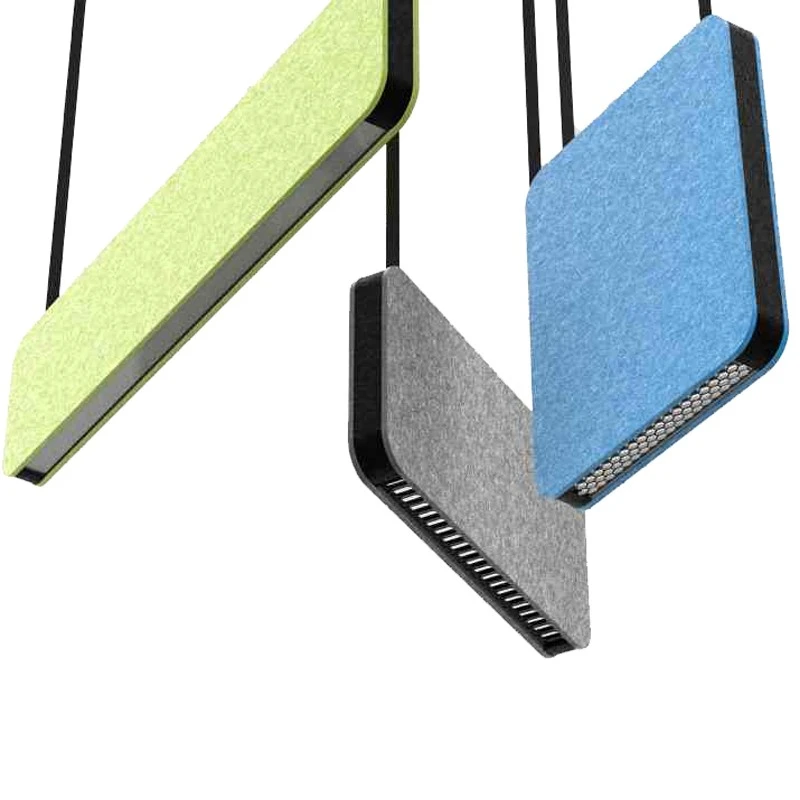
Super Slim Acoustic LED Linear Light
- Input Voltage: AC100-277V / AC220-240V,50-60HZ
- Emitting Direction: Downward
- Size: 1218*36*400mm
- CCT: 3000K / 4000K / 6000K
- Power: 30W
- Luminous Flux: 100-110Lm/W
- CRI: >80Ra
- PF: >0.90
- Fllicker Free: Yes
- Beam Angle: 120°
- IP Grade: IP20
- Warranty: 5 Years
- Felt Acoustic Board Color: Red / Green / Blue / Grey more than 48 colors option
Compliance and Long-Term Value
Long-term value depends on whether the acoustic ceiling lighting system can consistently deliver its stated performance over its usable life. Acoustic absorption performance and lighting output should be supported by documented test data to confirm that performance levels remain stable during normal operation rather than degrading prematurely.
Compliance with recognized electrical safety and environmental standards ensures predictable installation and reliable multi-year operation. When combined with measurable energy savings and a clearly defined service life, verified performance data allows office managers to evaluate total cost of ownership based on real operating conditions rather than assumptions or marketing claims.
The Office Selection Matrix: A Step-by-Step Guide
The following table provides a practical checklist for evaluating acoustic lighting solutions in a consistent, data-driven way.
Acoustic Lighting Selection Checklist for Offices
| Decision Factor | What to Evaluate | Key Questions and Data Points |
| Acoustic & Lighting Performance | NRC, UGR, lm/W | Is NRC clearly listed above 0.7? Is UGR below 19? What is the stated luminous efficacy (lm/W)? |
| Form & Integration | Mounting type, dimensions, finishes | Is the fixture suspended, recessed, or surface-mounted? Does it suit the ceiling height and layout? |
| Efficiency & Longevity | Lifespan rating (L80), warranty | Is the LED lifespan (L80) rated credibly (e.g., > 50,000 hrs)?Does the manufacturer provide a substantive warranty as an indicator of product confidence? |
| Compliance & Verification | Independent test reports, safety standards | Are ASTM C423 (acoustic) and LM-79 (photometric) test reports available? Does the product comply with relevant UL, CE, or RoHS standards? |
Application Guide: Matching Fixtures to Office Zones

Acoustic ceiling lighting should be selected based on how each area is used.
- Open-Plan Offices: High-NRC fixtures with low glare are critical. Suspended acoustic baffles and linear systems are effective because they expose multiple absorbing surfaces to the room.
- Conference and Meeting Rooms: Prioritize the highest practical NRC to reduce echo and improve speech clarity for both in-person and remote participants. Larger acoustic ceiling panels or clouds perform well in these spaces.
- Focus Rooms and Quiet Zones: A balance of acoustic control and visual subtlety is often preferred. Surface-mounted acoustic panels can reduce reverberation without dominating the ceiling design.
Common mistake to avoid: Selecting fixtures based on acoustic performance alone. Offices require both low reverberation and low glare to support sustained visual and cognitive comfort.
From Specifications to Installed Value: A Verified Approach
Decision-makers should rely on technical documentation rather than marketing claims.
- Verified Performance Data: NRC values should be supported by ASTM C423 test reports, while lighting performance must be validated through LM-79 photometric testing. For credible lifespan claims, look for data derived from LM-80 testing of the LED components.
- Total Cost of Ownership: Beyond upfront cost, consider energy consumption over the rated lifespan, reduced maintenance, and the elimination of separate acoustic treatments. Integrated acoustic lighting often lowers overall system cost compared to installing lighting and sound-absorbing panels separately.
Conclusion
Selecting acoustic ceiling lighting is a strategic investment in workplace performance. By applying the structured framework above—evaluating verified acoustic (NRC) and lighting (UGR, lm/W) data, considering application-specific needs, and demanding standard-compliant test reports—you can ensure a measurable improvement in office acoustics and comfort.
The final step is practical application. To see how these engineering principles translate into product specifications, you can review technical data sheets for acoustic lighting solutions. For example, analyzing specs that highlight PET felt acoustic cores for targeted NRC performance and aluminum housings for thermal management demonstrates how the selection criteria are met in practice. Detailed specifications for such products are available for review.
FAQs
Related Posts