Español
  English
  简体中文
简体中文  Deutsch
  Français
  Italiano
  日本語
日本語  한국어
한국어  Polski
  Português
  Русский
  Türkçe
  Nederlands
  Tiếng Việt
  ไทย
ไทย 
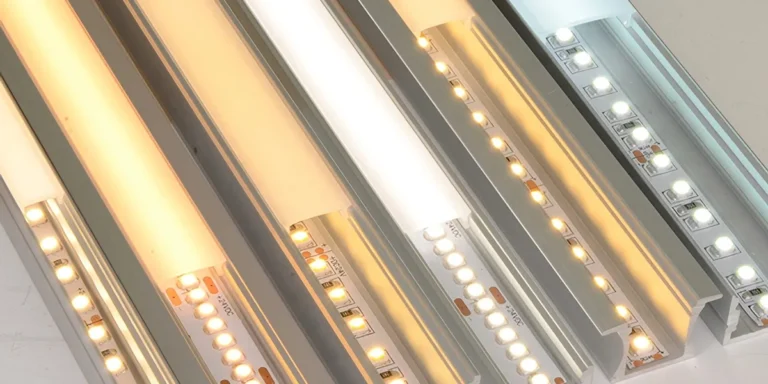
Las tiras de 110 V LED son tiras de LED de alto voltaje diseñadas para largas y continuas luces de iluminación. Alimentados por una entrada de CA de 110 V a través de un rectificador o circuito sin conductor, permiten que los grandes proyectos utilicen menos fuentes de alimentación y menos puntos de inyección de energía.
Se utilizan comúnmente para contornos de edificios, señalización exterior, iluminación de fachadas y otras aplicaciones comerciales o arquitectónicas. En comparación con las tiras de LED de 24 V, las tiras de 110 V son mejores para carreras largas en exteriores, mientras que las tiras de 24 V son más seguras y flexibles para una iluminación interior corta o una atenuación precisa. Esta guía explica cómo funcionan las tiras de luces LED de 110 V, dónde usarlas, cómo se comparan con las tiras de 12 y 24 V, y cómo elegir un producto más seguro y de mayor calidad.
¿Qué son las luces de tira de 110 V LED?
Las luces de tira de LED de 110 V, también llamadas tiras de LED de alto voltaje o luces de tira LED de CA, son productos de iluminación flexibles que se construyen para operar desde la red de alimentación de CA a través de un sistema rectificador. Si desea una imprimación técnica más profunda, SignLiteleted también tiene una guía relacionada sobre Luz de tira de LED de alto voltaje.
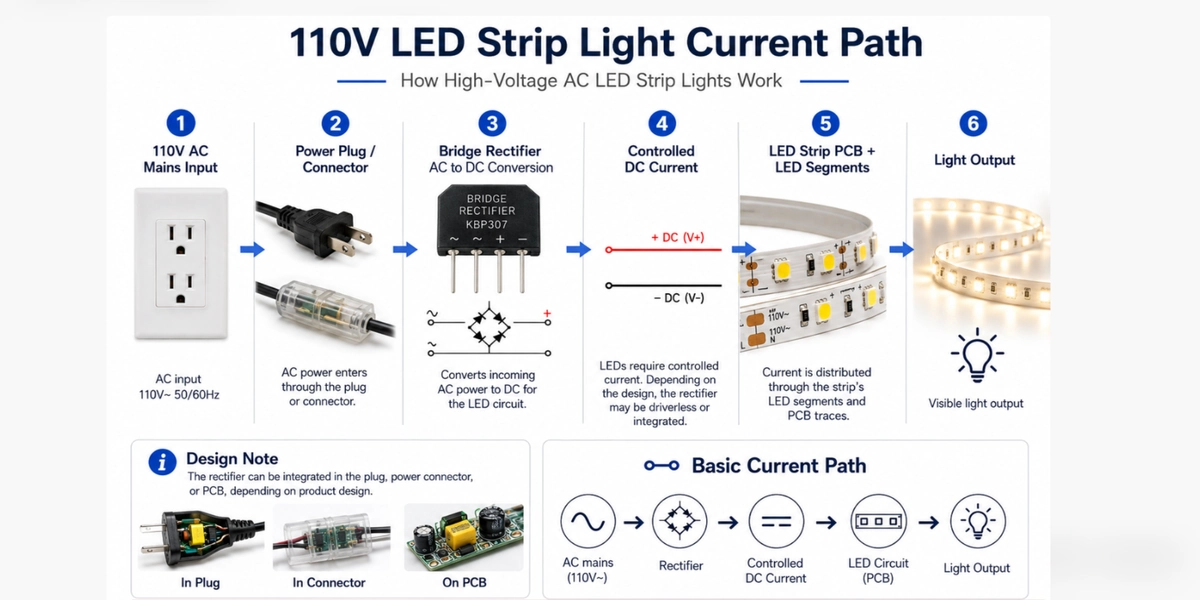
La clave es la conversión de AC a CC. Los LED necesitan corriente controlada, por lo que en un sistema de tiras de 110 V, la potencia de CA entrante se convierte mediante un rectificador o circuito sin conductor antes de llegar al circuito LED. Dependiendo del diseño, el rectificador puede estar integrado en el enchufe, el conector de alimentación o la PCB.
Aquí está la ruta actual básica:
Ventajas de las luces de tira de 110 V LED
El valor de las luces de tira de LED de 110 V no se limita a tiradas más largas o a una instalación más fácil. En proyectos de ingeniería, todas las características son importantes porque afectan el tiempo de mano de obra, el costo de mantenimiento, la confiabilidad del sistema y el riesgo de instalación.
| Característica | Beneficio del proyecto |
| Capacidad de largo plazo | Reduce los puntos de inyección de energía y simplifica el cableado en grandes áreas. |
| Entrada de CA directa | Hace que la instalación a larga distancia sea menos dependiente de muchos controladores LED separados. |
| Menos conductores | Crea menos puntos de falla y puede reducir el trabajo de mantenimiento después de la instalación. |
| Caída de voltaje más baja | Ayuda a mantener el brillo más consistente en tiradas más largas. |
| idoneidad al aire libre | Funciona bien para señalización, contornos de fachada e iluminación exterior con impermeabilización adecuada. |
| Diseño de sistema escalable | Más fácil de planificar para grandes edificios, centros comerciales, hoteles y proyectos de espacio público. |
Para las luminarias pequeñas de estantería, las ventajas mencionadas anteriormente pueden parecer menores. Pero cuando se usan para delinear la fachada de un edificio de 50 a 60 metros de largo, se vuelven esenciales.
Nadie quiere un proyecto donde los primeros diez metros se vean puros y limpios, mientras que el otro extremo parece opaco, amarillento y sin vida. Del mismo modo, nadie quiere diez adaptadores de corriente ocultos en esquinas a las que son casi imposibles de acceder.
Por eso, las tiras de 110 V LED, con sus ventajas únicas, han establecido un papel irremplazable en tales aplicaciones.
110 V vs 12 V vs 24 V LED tira de luces
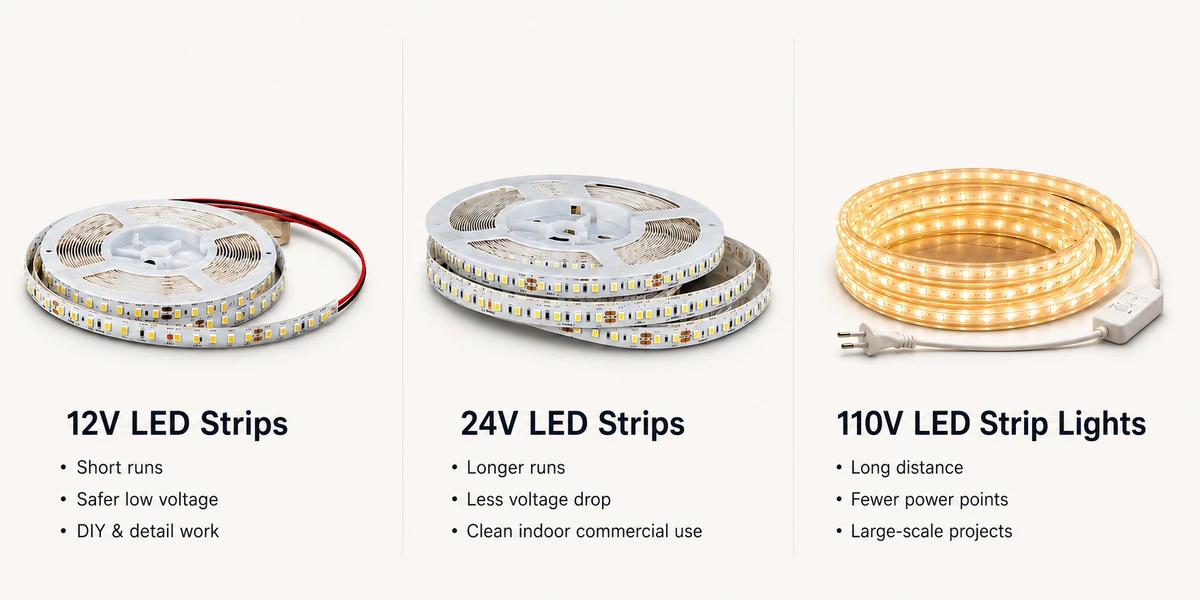
Esta es probablemente la comparación que le importan a la mayoría de los usuarios: ¿debería elegir luces de tira de LED de 12V, 24V o 110V?
Francamente, depende de cinco factores: distancia de instalación, entorno de instalación, requisitos de seguridad, necesidades de atenuación y la cantidad de mantenimiento que esté dispuesto a manejar en el futuro.
Para una discusión más completa sobre la selección de voltaje, también puede leer este artículo de Signliteled sobre Luces de tiras LED de bajo voltaje y voltaje.
Cuándo elegir tiras de LED de 12 V
Elija tiras de LED de 12 V para áreas cortas, táctiles y con detalles pesados: debajo de los gabinetes, estantes de exhibición, letreros pequeños o proyectos de bricolaje en el hogar. El voltaje es más seguro de manejar, los accesorios son fáciles de encontrar y los intervalos de corte suelen ser amigables para diseños ajustados.
Cuándo elegir tiras de LED de 24 V
Elija tiras de LED de 24 V cuando necesite un tramo comercial interior más limpio sin saltar a alto voltaje. Son populares en las calas de los hoteles, las líneas de exhibición minorista, las ranuras del techo y la iluminación de muebles. En comparación con las tiras de 12 V, las tiras de 24 V suelen manejar carreras más largas con menos caída de voltaje.
Cuándo elegir tiras de LED de 110 V
Elija luces de tira de LED de 110 V cuando la distancia y la escala dominan el proyecto. La iluminación del sitio de construcción, los acentos de largos corredores y la iluminación de fachadas grandes son ejemplos típicos. El beneficio no es solo el brillo, es la simplicidad del sistema. Estás reduciendo la cantidad de lugares donde algo puede salir mal.
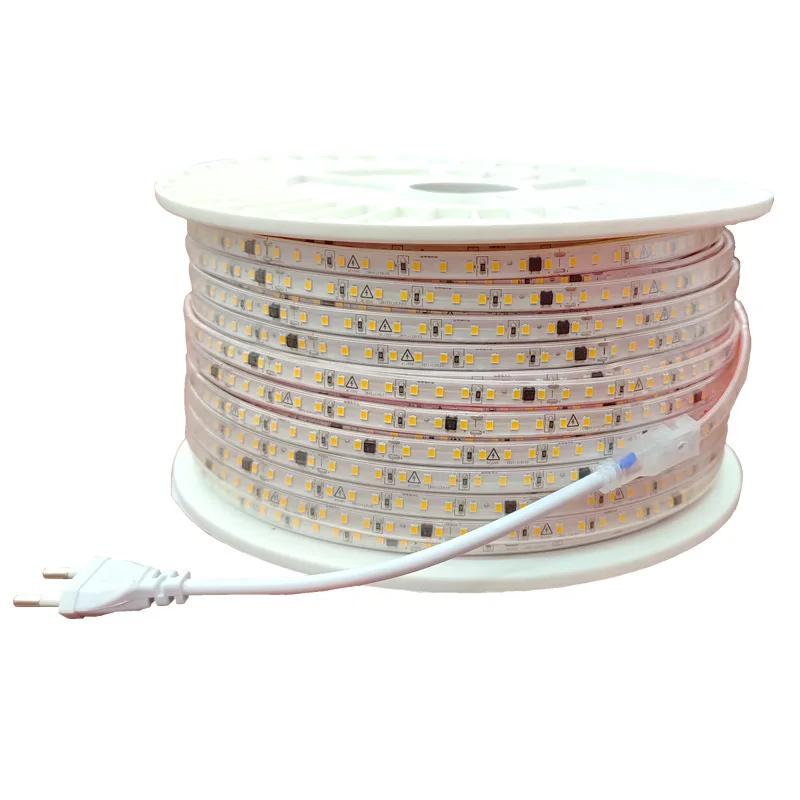
Tira de luces LED sin conductor de alto voltaje 110V/220V AC
Las tiras LED sin conductor de alto voltaje son tiras LED que funcionan a un voltaje más alto que el bajo voltaje estándar utilizado en la mayoría de las tiras LED. Como es impulsada por corriente alterna, también es conocida como tira de luz LED AC, como una tira de luz LED AC110V/120V/230V/240V.
Modelo principal: EQW10T120G
Tipo de LED: SMD2835/SMD5050
Cantidad de LED por metro: 60/80/120@SMD2835, 60@SMD5050
Anchura de la placa de circuito impreso: 10 mm/12 mm
Longitud: 50 m
Tensión de entrada: AC120V/AC220V
Potencia por metro: 10W/7W
Temperatura de color: 2700K/3000K/4000K/5000K/6500K/RGB
Grado IP: IP67/IP68
Garantía: 3 años
Por encima de la función admite la personalización.
Las mejores aplicaciones para luces de tira de 110 V LED
La mejor aplicación para luces LED de 110 V no es simplemente cualquier proyecto al aire libre. Son más fuertes donde la carrera es larga, el acceso es difícil y menos puntos de potencia, lo que puede hacer que la instalación sea más segura y fácil de mantener. Las aplicaciones típicas incluyen iluminación de sitios de construcción, proyectos de puentes y túneles, contornos de edificios, iluminación de fachadas y grandes espacios comerciales seleccionados. La señalización exterior solo se puede considerar para diseños de borde largo específicos, pero no suele ser la aplicación principal.
| Aplicación | recomendación | Por qué |
| Iluminación de obra | Excelente | Soporta largas carreras temporales o semipermanentes para las zonas de iluminación principal y de advertencia de seguridad. |
| Construcción de puentes y túneles | Excelente | Útil para la iluminación continua y las guías de advertencia en áreas de trabajo largas y de difícil acceso. |
| Iluminación de contorno de edificio | Excelente | Se requieren carreras largas y brillo constante. |
| Iluminación de fachada comercial | Excelente | Reduce la complejidad del cableado en grandes elevaciones. |
| Iluminación de la cala del hotel | Bien | Útil cuando se necesitan recorridos largos y continuos. |
| Decoración del centro comercial | Bien | Adecuado para zonas de iluminación comercial a gran escala. |
| Iluminación paisajística | Bien | Funciona bien cuando la impermeabilidad y el sellado están diseñados adecuadamente. |
| Señalización al aire libre | limitado | No es un uso primario; considere solo para iluminación perimetral o de borde largo específico. |
| Iluminación residencial debajo del gabinete | NO RECOMENDADO | Las tiras de bajo voltaje suelen ser más seguras y fáciles. |
| Iluminación decorativa corta | no ideal | Las tiras de 12V o 24V suelen ser más prácticas. |
Iluminación de obra
La iluminación del sitio de construcción es una de las aplicaciones prácticas para tiras de 110 V LED. En la construcción de puentes, la construcción de túneles, el trabajo en carretera y los sitios de trabajo temporales al aire libre, a menudo se necesita una iluminación continua larga para la iluminación principal, las luces de advertencia, la guía de ruta y la marcación de seguridad.
Con las tiras de luces LED de 110 V, los instaladores pueden reducir la inyección de energía repetida, simplificar el cableado temporal y cubrir áreas más largas, como paredes de túneles, barandas de puente, andamios, cercas temporales y carreteras de acceso.
Iluminación de edificios
Este es uno de los casos de uso más fuertes. Las líneas largas, los bordes de las paredes, los contornos de los puentes y los contornos de edificios comerciales necesitan iluminación continua. Con luces de tira de LED de 110 V, los instaladores pueden reducir la inyección de energía repetida y mantener el diseño más limpio.
Iluminación de hoteles y ensenadas de tiendas
Para carreras largas en hoteles, centros comerciales e interiores comerciales, las tiras de 110 V pueden ayudar a simplificar la planificación de energía. Aún así, si el proyecto necesita una atenuación muy precisa, longitudes de corte corto o una operación de bajo voltaje segura táctil, 24 V puede ser la mejor opción.
Donde no se recomiendan tiras de LED de 110 V
Evite tiras de LED de 110 V para piezas decorativas cortas, trabajos pequeños de bricolaje en el hogar, áreas donde las personas tocan con frecuencia la tira o instalaciones que necesitan intervalos muy cortos. Más grande no siempre es mejor. A veces, una tira de bajo voltaje es la herramienta más inteligente.
Ejemplo de proyecto 1: Iluminación de obra
Problemas comunes con tiras de luces LED de 110 V
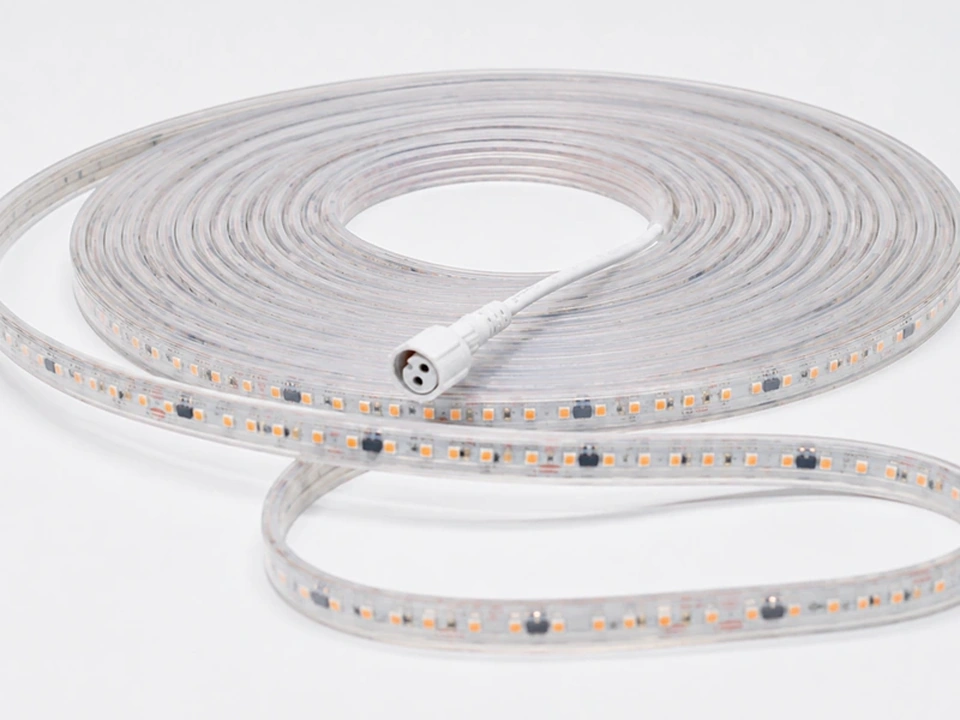
En proyectos reales, las fallas comunes generalmente provienen de materiales débiles, sellado deficiente, rectificadores de baja calidad, conectores no confiables o uso del producto incorrecto para el medio ambiente. La mayoría de estos problemas se pueden evitar revisando el sistema de iluminación completo antes de la instalación.
| difícil | causa común | como evitarlo |
| Parpadeo | Diseño de circuito o rectificador de baja calidad | Elija un sistema de rectificador sin parpadeo y muestras de prueba antes de realizar el pedido al por mayor. |
| Amarillea | Chaqueta de PVC de baja calidad o poca resistencia a los rayos UV | Use PVC o silicona resistente a los rayos UV para proyectos al aire libre. |
| sobrecalefacción | PWB deficiente, sobrecarga o disipación de calor débil | Compruebe el espesor del cobre, la potencia y la temperatura de funcionamiento. |
| Conectores inseguros | Diseño de conexión suelto o no certificado | Utilice conectores moldeados, impermeables y aprobados por el proyecto. |
| Fallo impermeable | Sellado débil en cortes, tapas o conectores | Utilice las tapas de los extremos moldeadas por inyección y los procedimientos de sellado adecuados. |
| Brillo inconsistente | Caída de voltaje, malla de LED deficiente o funcionamiento sobrecargado | Elija la longitud de ejecución adecuada, el agrupamiento LED y el diseño de instalación. |
Flicker es a menudo la primera señal de advertencia. Puede que no arruine una señal de inmediato, pero le indica que el diseño del rectificador o del circuito puede ser débil. El amarilleo es otro fracaso lento. Una tira puede verse bien en el primer mes, luego la chaqueta se vuelve turbia después de una larga exposición a los rayos UV. El fracaso impermeable es aún más grave porque el agua rara vez entra por la mitad de una tira bien hecha; por lo general se cuela a través de puntos de corte, tapas de extremo o conectores.
Por eso el control de calidad debe centrarse en todo el sistema, no solo en los chips LED. Una franja es como una cadena a través de un edificio. Si un conector falla, toda la línea visual puede romperse.
¿Son seguras las luces de tira de LED de 110 V?
Sí, las luces de tiras LED de 110 V pueden ser seguras cuando están diseñadas, aisladas, certificadas e instaladas de manera adecuada. Debido a que funcionan a un voltaje más alto que tiras de 12V o 24V, requieren una protección más fuerte y un manejo más cuidadoso.
Para garantizar la seguridad, el primer paso es comprobar el aislamiento eléctrico. Las luces de tira LED de 110 V para exteriores deben estar equipadas con una funda protectora fuerte, tapas de extremo fiables y un sistema de conexión seguro. Para proyectos de ingeniería pública, busque marcas de certificación relevantes u otras aprobaciones requeridas por el mercado objetivo y las regulaciones locales. SignLiteled ofrece productos con certificaciones como UL, ETL, CE y RoHS, lo que lo convierte en una opción confiable para la adquisición de proyectos.
La instalación debe seguir reglas estrictas: nunca corte la tira mientras esté encendida, nunca exceda la longitud máxima nominal de carrera, use solo accesorios compatibles, selle cada punto de corte y siga los códigos eléctricos locales. Para grandes proyectos comerciales, se recomienda encarecidamente la instalación profesional.
Cómo elegir tiras de luces LED de 110 V de alta calidad
Al elegir luces de tira de LED de 110 V, no se centre solo en el precio por metro. Para proyectos comerciales y al aire libre, el valor real proviene de componentes confiables, que incluyen un PCB de alta calidad, chips LED estables, un rectificador sin parpadeo, PVC o silicona resistente a los rayos UV, conectores impermeables y certificaciones adecuadas como UL, ETL, CE o ROHS.
Un excelente proveedor como SignLiteled también admite longitudes personalizadas, temperaturas de color, clasificaciones IP y opciones de conectores, lo que ayuda al producto a adaptarse mejor al entorno de instalación real y reducir los riesgos de mantenimiento futuro. Para que el producto pueda igualar el entorno de instalación real y reducir los riesgos de mantenimiento futuros.
Elija un fabricante con soporte para proyectos
Un proveedor confiable debe poder ayudarlo con la selección de voltaje, la determinación de la clasificación de IP, la selección del tipo de conector, la coincidencia de temperatura del color y la planificación del diseño de la instalación. Si su proyecto también implica bajo voltaje Luces de tira de LED COB o SLuces de tira de LED MD, puede visitar rápidamente la página del producto de SignLiteled para obtener más detalles. Para efectos de iluminación RGB de alto voltaje dinámicos, también puede consultar la guía de SignLiteled en 110V y luces LED RGB direccionables de 220 V AC.
Conclusión
Las luces de tira de 110 V LED están construidas para escalar. Cuando necesita una iluminación continua larga para esquemas de construcción, señalización, fachadas, paisajes, hoteles o proyectos comerciales, pueden reducir la caída de voltaje, simplificar el cableado y reducir la cantidad de puntos de inyección de energía. Esa es una ventaja de proyecto real, no solo una característica del producto.
Pero el producto correcto importa. Mire más allá del precio y verifique el PCB, el rectificador, los chips LED, los materiales impermeables, los conectores, las certificaciones y el soporte de proveedores. Un sistema de tiras LED de 110 V fuerte debe ser brillante, estable, sellado, seguro y fácil de mantener.
¿Necesita ayuda para seleccionar luces de tira de LED de 110 V para un esquema de construcción, señalización o proyecto de iluminación comercial? Póngase en contacto con el equipo de SignLiteled para obtener recomendaciones de productos, especificaciones personalizadas, opciones de impermeabilización y soporte del proyecto.
Preguntas frecuentes
Publicaciones relacionadas