Português
  English
  简体中文
简体中文  Deutsch
  Español
  Français
  Italiano
  日本語
日本語  한국어
한국어  Polski
  Русский
  Türkçe
  Nederlands
  Tiếng Việt
  ไทย
ไทย 
As luzes de LED de 110 V são tiras de LED de alta tensão projetadas para corridas de iluminação longas e contínuas. Alimentados por uma entrada CA de 110 V por meio de um retificador ou circuito sem driver, eles permitem que grandes projetos usem menos fontes de alimentação e menos pontos de injeção de energia.
Eles são comumente usados para construir contornos, sinalização externa, iluminação de fachadas e outras aplicações comerciais ou arquitetônicas. Comparadas com as tiras de LED de 24 V, as tiras de 110 V são melhores para longas corridas externas, enquanto as tiras de 24 V são mais seguras e flexíveis para iluminação interna curta ou escurecimento preciso. Este guia explica como funcionam as luzes de tiras de LED de 110 V, onde usá-las, como elas se comparam com as tiras de 12 e 24 V e como escolher um produto mais seguro e de alta qualidade.
O que são luzes de tira LED de 110 V?
As luzes de LED de 110 V, também chamadas de luzes LED de alta tensão ou luzes de LED CA, são produtos de iluminação flexíveis, construídos para operar a partir de uma alimentação CA de rede elétrica por meio de um sistema de retificação. Se você deseja um primer técnico mais profundo, a Signliteld também possui um guia relacionado sobre Luz de faixa de LED de alta tensão.
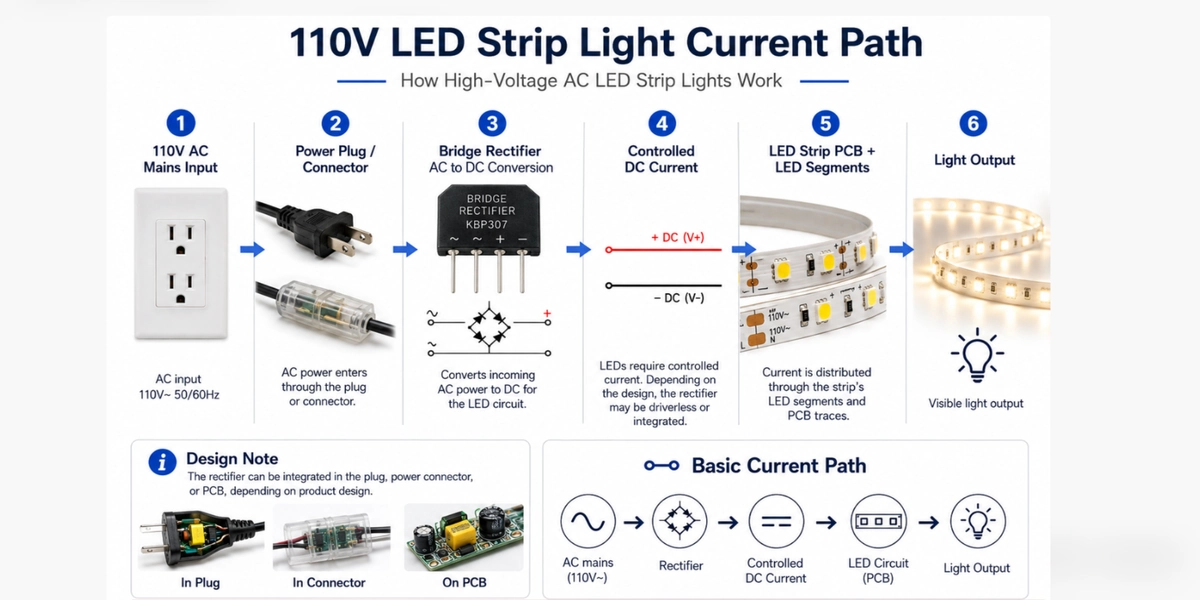
A chave é a conversão AC-DC. Os LEDs precisam de corrente controlada; portanto, em um sistema de tiras de 110 V, a alimentação CA é convertida por um retificador ou circuito sem motorista antes de chegar ao circuito LED. Dependendo do design, o retificador pode ser integrado ao plugue, conector de alimentação ou PCB.
Aqui está o caminho básico da corrente:
Vantagens das luzes de LED de 110 V
O valor das luzes de tira LED de 110 V não se limita a corridas mais longas ou à instalação mais fácil. Em projetos de engenharia, cada recurso é importante porque afeta o tempo de trabalho, o custo de manutenção, a confiabilidade do sistema e o risco de instalação.
| Caraterística | Benefício do projeto |
| Capacidade de longo prazo | Reduz os pontos de injeção de potência e simplifica a fiação em grandes áreas. |
| Entrada direta AC | Torna a instalação de longa distância menos dependente de muitos drivers de LED separados. |
| menos motoristas | Cria menos pontos de falha e pode reduzir o trabalho de manutenção após a instalação. |
| queda de tensão mais baixa | Ajuda a manter o brilho mais consistente em corridas mais longas. |
| Adequação ao ar livre | Funciona bem para sinalização, contornos de fachada e iluminação externa com impermeabilização adequada. |
| Projeto de sistema escalável | Mais fácil de planejar para grandes edifícios, shoppings, hotéis e projetos de espaço público. |
Para luminárias de prateleiras pequenas, as vantagens mencionadas acima podem parecer menores. Mas quando usados para delinear a fachada de um edifício de 50 a 60 metros de comprimento, eles se tornam essenciais.
Ninguém quer um projeto em que os primeiros dez metros pareçam puros e limpos, enquanto a extremidade oposta parece sem graça, amarelada e sem vida. Da mesma forma, ninguém deseja que dez adaptadores de energia estejam escondidos em cantos quase impossíveis de acessar.
É por isso que as luzes LED de 110 V, com suas vantagens exclusivas, estabeleceram um papel insubstituível em tais aplicações.
Luzes de tiras de LED de 110 Vs 12 V x 24 V
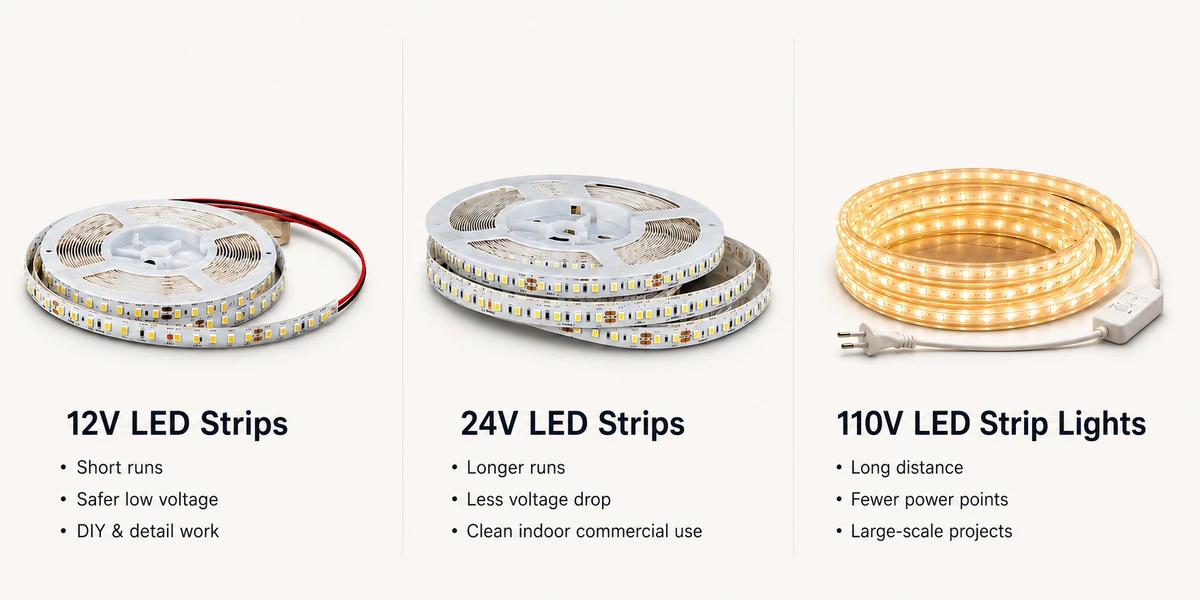
Esta é provavelmente a comparação com a qual a maioria dos usuários realmente se importa: você deve escolher luzes LED de 12, 24 ou 110 V?
Francamente, depende de cinco fatores: distância da instalação, ambiente de instalação, requisitos de segurança, necessidades de escurecimento e quantidade de manutenção que você deseja lidar no futuro.
Para uma discussão mais abrangente sobre seleção de voltagem, você também pode ler este artigo sobressalente sobre Luzes de faixa de LED de baixa tensão e alta tensão.
Quando escolher as tiras de LED de 12V
Escolha faixas de LED de 12 V para áreas curtas, passíveis de toque e com detalhes: sob os armários, prateleiras de exibição, pequenos sinais ou projetos de bricolage em casa. A tensão é mais segura, os acessórios são fáceis de encontrar e os intervalos de corte geralmente são amigáveis para layouts apertados.
Quando escolher as tiras de LED de 24 V
Escolha tiras de LED de 24 V quando precisar de uma corrida comercial interna mais limpa sem pular em alta tensão. Eles são populares em enseadas de hotéis, linhas de exibição de varejo, slots de teto e iluminação para móveis. Comparadas com as tiras de 12 V, as tiras de 24 V geralmente lidam com corridas mais longas com menos queda de tensão.
Quando escolher as tiras de LED de 110 V
Escolha luzes de tira de LED de 110 V quando a distância e a escala dominarem o projeto. A iluminação do canteiro de obras, os acentos longos do corredor e a iluminação de fachadas grandes são exemplos típicos. O benefício não é apenas o brilho; é a simplicidade do sistema. Você está reduzindo o número de lugares onde algo pode dar errado.
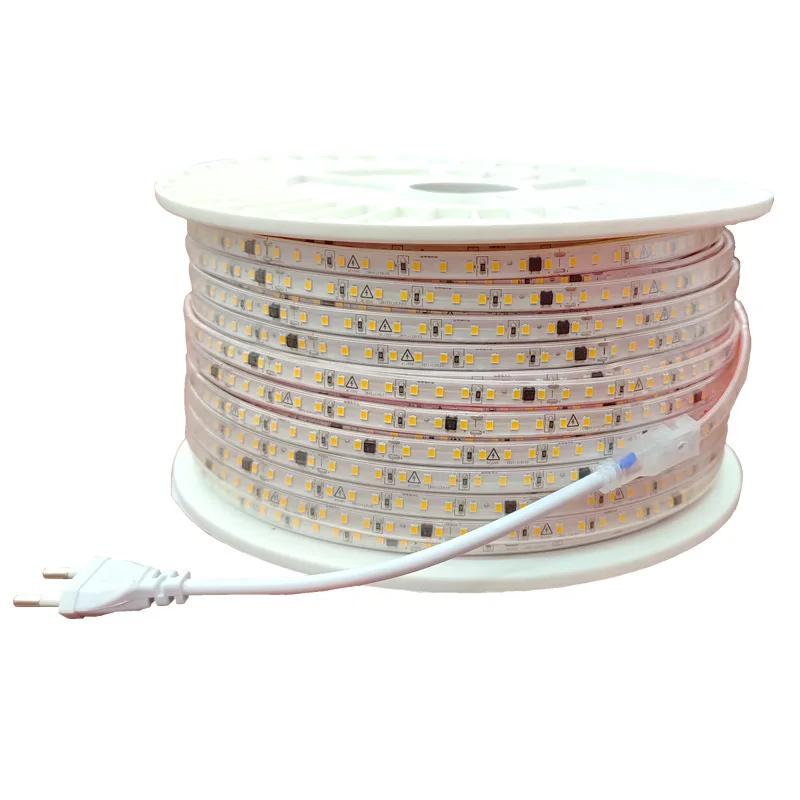
Fita LED sem condutor de alta tensão 110V/220V AC
As tiras de LED sem condutor de alta tensão são tiras de LED que funcionam com uma tensão mais elevada do que a baixa tensão padrão utilizada na maioria das tiras de LED. Uma vez que é acionada por corrente alternada, é também conhecida como uma fita LED AC, tal como uma fita LED AC110V/120V/230V/240V.
Modelo principal: EQW10T120G
Tipo de LED: SMD2835/SMD5050
Qtd. de LEDs por metro: 60/80/120@SMD2835, 60@SMD5050
Largura da placa de circuito impresso: 10mm/12mm
Comprimento: 50m
Tensão de entrada: AC120V/AC220V
Potência por metro: 10W/7W
Temperatura de cor: 2700K/3000K/4000K/5000K/6500K/RGB
Grau IP: IP67/IP68
Garantia: 3 anos
Acima, a função suporta a personalização.
Melhores aplicações para luzes de tiras de LED de 110 V
A melhor aplicação para luzes de tiras de LED de 110 V não é simplesmente qualquer projeto ao ar livre. Eles são mais fortes onde a corrida é longa, o acesso é difícil e menos pontos de energia, o que pode tornar a instalação mais segura e fácil de manter. As aplicações típicas incluem iluminação do canteiro de obras, projetos de pontes e túneis, contornos de construção, iluminação de fachadas e grandes espaços comerciais selecionados. A sinalização externa pode ser considerada apenas para projetos específicos de fronteiras longas, mas geralmente não é o principal aplicativo.
| Aplicação | recomendação | Porquê |
| iluminação do canteiro de obras | Excelente | Suporta longas corridas temporárias ou semipermanentes para as zonas de alerta de segurança e iluminação principais. |
| Construção de pontes e túne | Excelente | Útil para iluminação contínua e orientação de aviso em áreas de trabalho longas e difíceis de acessar. |
| Construindo iluminação de contorno | Excelente | Extensões longas e brilho consistente são necessários. |
| iluminação de fachada comercial | Excelente | Reduz a complexidade da fiação em grandes elevações. |
| iluminação do hotel enseada | Bom | Útil quando são necessárias longas corridas contínuas. |
| decoração de shopping | Bom | Adequado para zonas de iluminação comercial em grande escala. |
| Iluminação paisagística | Bom | Funciona bem quando a impermeabilização e vedação são devidamente projetados. |
| sinalização ao ar livre | limitado | Não é um uso principal; considere apenas para uma borda longa ou perimetral específica. |
| Iluminação sob armário residencial | não recomendado | As tiras de baixa tensão geralmente são mais seguras e fáceis. |
| Iluminação decorativa curta | não é ideal | As tiras de 12 ou 24 V geralmente são mais práticas. |
iluminação do canteiro de obras
A iluminação do canteiro de obras é uma das aplicações práticas para luzes LED de 110 V. Na construção de pontes, construção de túneis, trabalhos rodoviários e locais de trabalho temporários ao ar livre, muitas vezes é necessária uma iluminação longa e contínua para iluminação principal, iluminação de aviso, orientação de rota e marcação de segurança.
Com luzes de tiras de LED de 110 V, os instaladores podem reduzir a injeção de energia repetida, simplificar a fiação temporária e cobrir áreas mais longas, como paredes de túneis, guarda-corpos de ponte, andaimes, cercas temporárias e estradas de acesso.
Iluminação de contornos de edifícios
Este é um dos casos de uso mais fortes. Longas linhas de telhado, bordas de parede, contornos de pontes e contornos de edifícios comerciais precisam de iluminação contínua. Com luzes LED de 110 V, os instaladores podem reduzir a injeção de energia repetida e manter o layout mais limpo.
Iluminação de enseadas de hotéis e varejo
Para corridas de Long Cove em hotéis, shoppings e interiores de varejo, as tiras de 110 V podem ajudar a simplificar o planejamento de energia. Ainda assim, se o projeto precisar de escurecimento muito preciso, comprimentos de corte curto ou operação de baixa tensão segura por toque, 24V pode ser a melhor opção.
Onde as tiras de LED de 110 V não são recomendadas
Evite tiras de LED de 110 V para peças decorativas curtas, trabalhos de bricolage em casa, áreas onde as pessoas frequentemente tocam na faixa ou instalações que precisam de intervalos de corte muito curtos. Maior nem sempre é melhor. Às vezes, uma faixa de baixa tensão é a ferramenta mais inteligente.
Exemplo de projeto 1: iluminação do canteiro de obras
Problemas comuns com luzes de tira LED de 110 V
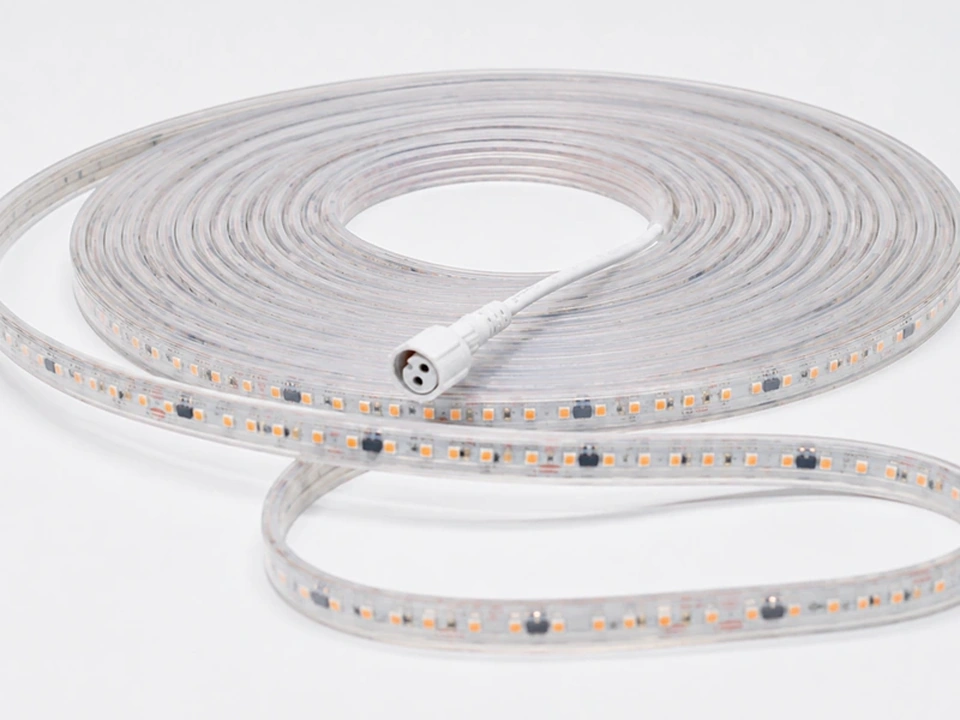
Em projetos reais, as falhas comuns geralmente vêm de materiais fracos, vedação ruim, retificadores de baixa qualidade, conectores não confiáveis ou uso do produto errado para o meio ambiente. A maioria desses problemas pode ser evitada verificando o sistema de iluminação completo antes da instalação.
| problema | causa comum | Como evitá-lo |
| Cintilação | Retificador de baixa qualidade ou design de circuito | Escolha um sistema retificador sem cintilação e teste as amostras antes do pedido em massa. |
| Amarelecimento | Jaqueta de PVC de baixo grau ou baixa resistência aos raios UV | Use PVC ou silicone resistentes a UV para projetos ao ar livre. |
| superaquecimento | PCI fraca, sobrecarga ou dissipação de calor fraca | Verifique a espessura, a potência e a temperatura de operação do cobre. |
| Conectores inseguros | Design de conexão solto ou não certificado | Use conectores moldados, à prova d'água e aprovados pelo projeto. |
| Falha à prova d'água | Vedação fraca em cortes, tampas ou conectores | Use tampas de extremidade moldadas por injeção e procedimentos de vedação adequados. |
| Brilho inconsistente | Queda de tensão, binning LED ruim ou corrida sobrecarregada | Escolha o comprimento de execução adequado, o binning LED e o layout da instalação. |
Flicker é frequentemente o primeiro sinal de alerta. Pode não arruinar um sinal imediatamente, mas informa que o retificador ou o design do circuito podem ser fracos. O amarelecimento é outra falha lenta. Uma tira pode ficar bem no primeiro mês, então a jaqueta fica turva após uma longa exposição aos raios UV. A falha à prova d'água é ainda mais grave porque a água raramente entra no meio de uma faixa bem feita; geralmente se esgueira por meio de pontos de corte, tampas ou conectores.
É por isso que o controle de qualidade deve se concentrar em todo o sistema, não apenas nos chips LED. Uma faixa é como uma corrente em um prédio. Se um conector falhar, toda a linha visual pode quebrar.
As luzes de LED de 110 V são seguras?
Sim, as luzes de tira LED de 110 V podem ser seguras quando são projetadas, isoladas, certificadas e instaladas adequadamente. Por operar com uma tensão superior a tiras de 12 V ou 24 V, exigem uma proteção mais forte e um manuseio mais cuidadoso.
Para garantir a segurança, o primeiro passo é verificar o isolamento elétrico. As luzes de LED para exteriores de 110 V devem ser equipadas com uma capa protetora forte, tampas de extremidade confiáveis e um sistema de conexão seguro. Para projetos de engenharia pública, procure marcas de certificação relevantes ou outras aprovações exigidas pelo mercado-alvo e pelas regulamentações locais. A Signliteld fornece produtos com certificações como UL, ETL, CE e RoHS, tornando-o uma escolha confiável para a aquisição de projetos.
A instalação deve seguir regras estritas: nunca corte a tira enquanto estiver ligada, nunca exceda o comprimento máximo de funcionamento nominal, use apenas acessórios compatíveis, sele todos os pontos de corte e siga os códigos elétricos locais. Para grandes projetos comerciais, a instalação profissional é fortemente recomendada.
Como escolher luzes de LED de alta qualidade de 110 V
Ao escolher luzes de tira LED de 110 V, não se concentre apenas no preço por metro. Para projetos comerciais e externos, o valor real vem de componentes confiáveis, incluindo um PCB de alta qualidade, chips LED estáveis, um retificador sem cintilação, PVC resistente a UV ou silicone, conectores à prova d'água e certificações adequadas, como UL, ETL, CE ou RoHS.
Um excelente fornecedor como o Signliteld também oferece suporte a comprimentos personalizados, temperaturas de cor, classificações de IP e opções de conectores, ajudando o produto a combinar melhor com o ambiente de instalação real e reduzir os riscos futuros de manutenção. Assim, o produto pode corresponder ao ambiente de instalação real e reduzir os riscos de manutenção futura.
Escolha um fabricante com suporte ao projeto
Um fornecedor confiável deve ser capaz de ajudá-lo com a seleção de tensão, determinação de classificação de IP, seleção de conectores, correspondência de temperatura de cor e planejamento de instalação. Se o seu projeto envolve também baixa tensão luzes de tira led de cob ou Sluzes de tira led md, você pode visitar rapidamente a página do produto da Signlited para mais detalhes. Para efeitos de iluminação RGB dinâmicos de alta tensão, você também pode consultar o guia do Signlited sobre 110V e luzes de tira LED RGB endereçáveis de 220 V CA.
Conclusão
As luzes de tira de LED de 110 V são construídas para escala. Quando você precisa de uma longa iluminação contínua para construir contornos, sinalização, fachadas, paisagens, hotéis ou projetos comerciais, eles podem reduzir a queda de tensão, simplificar a fiação e diminuir o número de pontos de injeção de energia. Essa é uma vantagem real do projeto, não apenas de um recurso do produto.
Mas o produto certo importa. Olhe além do preço e verifique o PCB, o retificador, os chips LED, os materiais à prova d'água, os conectores, as certificações e o suporte do fornecedor. Um forte sistema de tiras de LED de 110 V deve ser brilhante, estável, selado, seguro e fácil de manter.
Precisa de ajuda para selecionar as luzes de tiras de LED de 110 V para um projeto de construção, sinalização ou iluminação comercial? Entre em contato com a equipe da Signliteled para obter recomendações de produtos, especificações personalizadas, opções de impermeabilização e suporte a projetos.
FAQs
Postagens relacionadas