English
  简体中文
简体中文  Deutsch
  Español
  Français
  Italiano
  日本語
日本語  한국어
한국어  Polski
  Português
  Русский
  Türkçe
  Nederlands
  Tiếng Việt
  ไทย
ไทย 
110V LED strip lights are high-voltage LED strips designed for long, continuous lighting runs. Powered by 110V AC input through a rectifier or driverless circuit, they allow large projects to use fewer power supplies and fewer power injection points.
They are commonly used for building outlines, outdoor signage, façade lighting, and other commercial or architectural applications. Compared with 24V LED strips, 110V strips are better for long outdoor runs, while 24V strips are safer and more flexible for short indoor lighting or precise dimming. This guide explains how 110V LED strip lights work, where to use them, how they compare with 12V and 24V strips, and how to choose a safer, higher-quality product.
What Are 110V LED Strip Lights?
110V LED strip lights, also called high voltage LED strip lights or AC LED strip lights, are flexible lighting products built to operate from mains-level AC power through a rectifier system. If you want a deeper technical primer, SignliteLED also has a related guide on high voltage LED strip light.
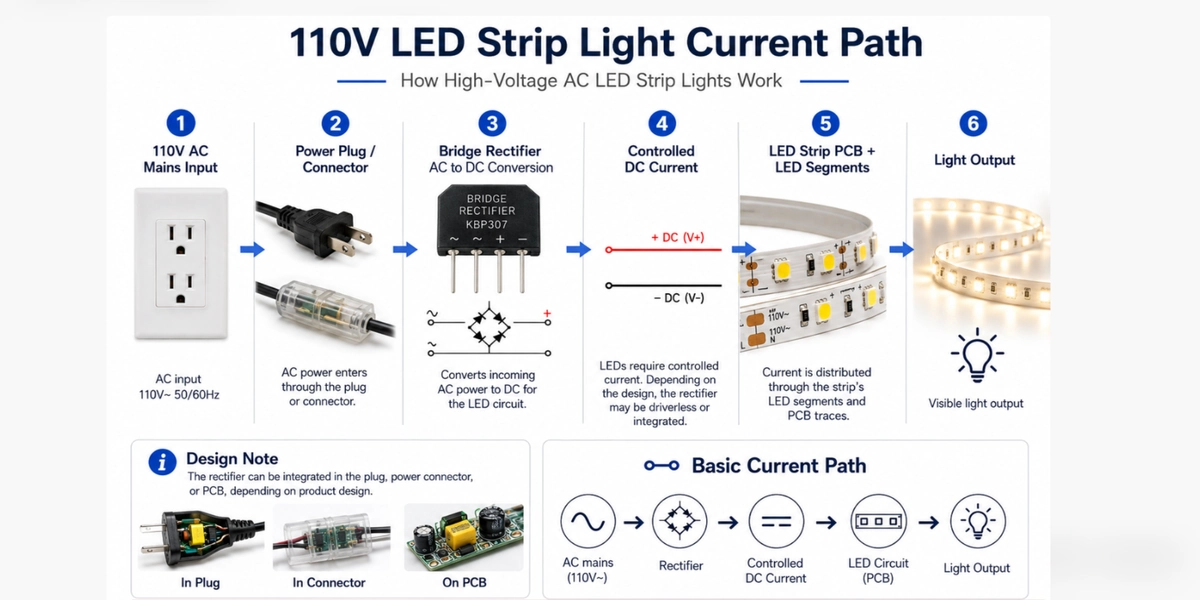
The key is AC-to-DC conversion. LEDs need controlled current, so in a 110V strip system, the incoming AC power is converted by a rectifier or driverless circuit before reaching the LED circuit. Depending on the design, the rectifier may be built into the plug, power connector, or PCB.
Here is the basic current path:
Advantages of 110V LED Strip Lights
The value of 110V LED strip lights is not limited to longer runs or easier installation. In engineering projects, every feature matters because it affects labor time, maintenance cost, system reliability, and installation risk.
| Feature | Project Benefit |
| Long run capability | Reduces power injection points and simplifies wiring over large areas. |
| Direct AC input | Makes long-distance installation less dependent on many separate LED drivers. |
| Fewer drivers | Creates fewer failure points and can reduce maintenance work after installation. |
| Lower voltage drop | Helps keep brightness more consistent across longer runs. |
| Outdoor suitability | Works well for signage, facade outlines, and exterior lighting with proper waterproofing. |
| Scalable system design | Easier to plan for large buildings, malls, hotels, and public-space projects. |
For small shelf lighting fixtures, the advantages mentioned above may seem minor. But when used to outline the facade of a 50- to 60-meter-long building, they become essential.
No one wants a project where the first ten meters look pure and clean, while the far end appears dull, yellowed, and lifeless. Likewise, no one wants ten power adapters hidden in corners that are nearly impossible to access.
This is why 110V LED strip lights, with their unique advantages, have established an irreplaceable role in such applications.
110V vs 12V vs 24V LED Strip Lights
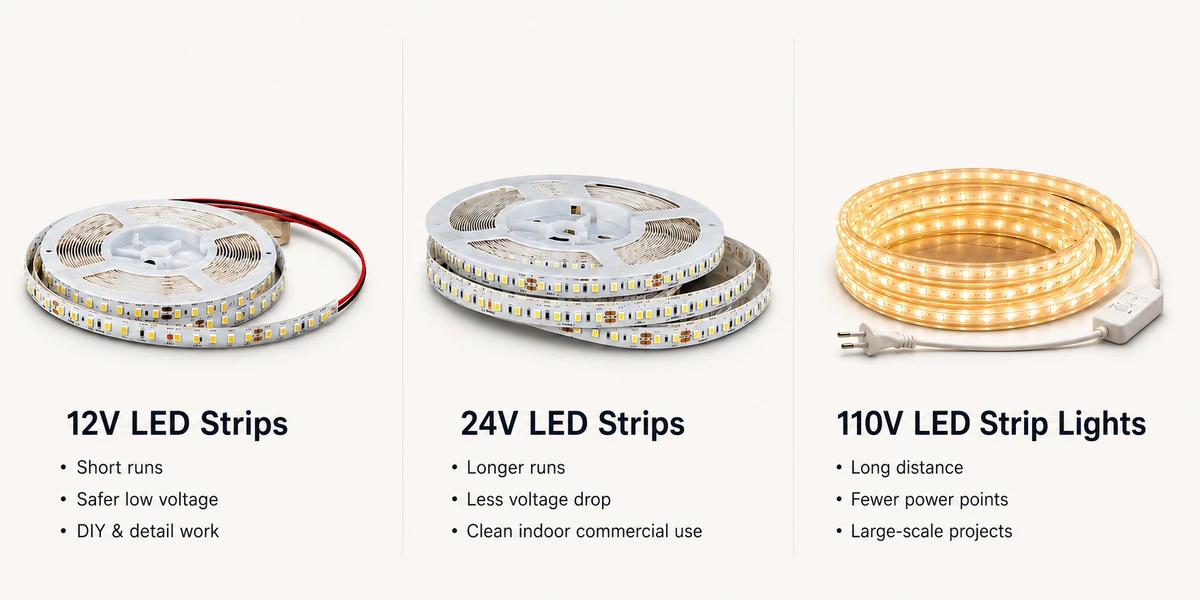
This is likely the comparison most users truly care about: should you choose 12V, 24V, or 110V LED strip lights?
Frankly, it depends on five factors: installation distance, installation environment, safety requirements, dimming needs, and the amount of maintenance you are willing to handle in the future.
For a more comprehensive discussion on voltage selection, you can also read this SignliteLED article on low voltage and high voltage LED strip lights.
When to Choose 12V LED Strips
Choose 12V LED strips for short, touchable, detail-heavy areas: under cabinets, display shelves, small signs, or home DIY projects. The voltage is safer to handle, accessories are easy to find, and cut intervals are usually friendly for tight layouts.
When to Choose 24V LED Strips
Choose 24V LED strips when you need a cleaner indoor commercial run without jumping into high voltage. They are popular in hotel coves, retail display lines, ceiling slots, and furniture lighting. Compared with 12V strips, 24V strips usually handle longer runs with less voltage drop.
When to Choose 110V LED Strips
Choose 110V LED strip lights when distance and scale dominate the project. Construction site lighting, long corridor accents, and large facade lighting are typical examples. The benefit is not just brightness; it is system simplicity. You are reducing the number of places where something can go wrong.
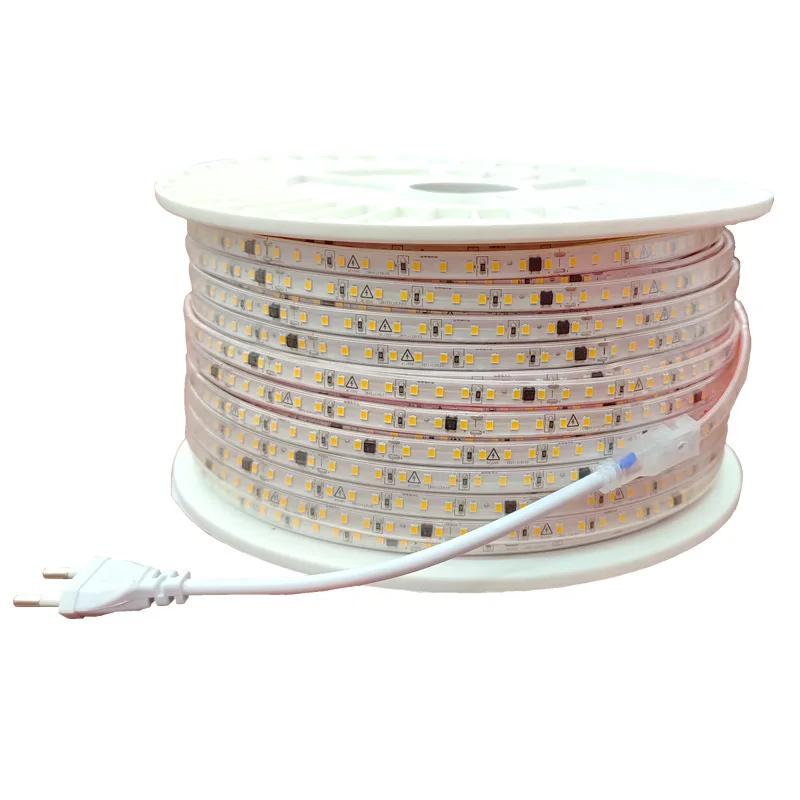
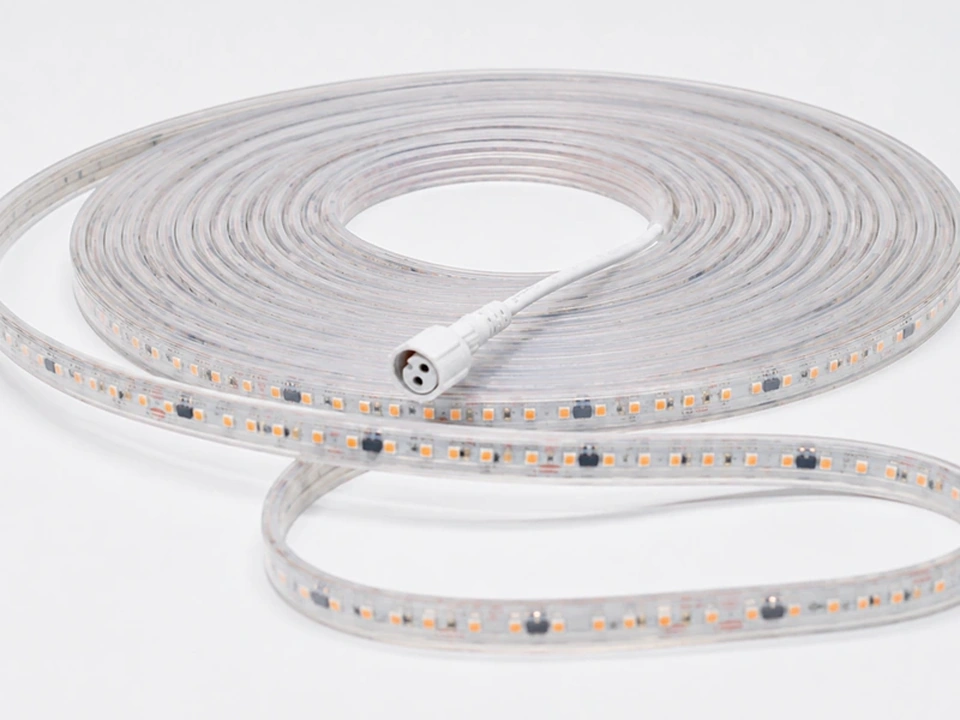
110V/220V AC High Voltage Driverless LED Strip Lights
High voltage driverless LED strips are LED strips that operate at a higher voltage than the standard low voltage used in most LED strips. Since it is driven by alternating current, it is also known as an AC LED strip, such as an AC110V/120V/230V/240V LED strip light.
Main Model: EQW10T120G
LED Type: SMD2835/SMD5050
LED QTY per Meter: 60/80/120@SMD2835, 60@SMD5050
PCB Width: 10mm/12mm
Length: 50m
Input Voltage: AC120V/AC220V
Power per Meter: 10W/7W
Color Temperature: 2700K/3000K/4000K/5000K/6500K/RGB
IP Grade: IP67/IP68
Warranty: 3 years
Above the function supports customization.
Best Applications for 110V LED Strip Lights
The best application for 110V LED strip lights is not simply any outdoor project. They are strongest where the run is long, access is difficult, and fewer power points, which can make installation safer and easier to maintain. Typical applications include construction site lighting, bridge and tunnel projects, building outlines, facade lighting, and selected large commercial spaces. Outdoor signage can be considered only for specific long-border designs, but it is not usually the main application.
| Application | Recommendation | Why |
| Construction site lighting | Excellent | Supports long temporary or semi-permanent runs for main lighting and safety warning zones. |
| Bridge and tunnel construction | Excellent | Useful for continuous lighting and warning guidance across long, difficult-to-access work areas. |
| Building outline lighting | Excellent | Long runs and consistent brightness are required. |
| Commercial facade lighting | Excellent | Reduces wiring complexity across large elevations. |
| Hotel cove lighting | Good | Useful when long continuous runs are needed. |
| Shopping mall decoration | Good | Suitable for large-scale commercial lighting zones. |
| Landscape lighting | Good | Works well when waterproofing and sealing are properly designed. |
| Outdoor signage | Limited | Not a primary use; consider only for specific long border or perimeter lighting. |
| Residential under-cabinet lighting | Not recommended | Low-voltage strips are usually safer and easier. |
| Short decorative lighting | Not ideal | 12V or 24V strips are usually more practical. |
Construction Site Lighting
Construction site lighting is one of the practical applications for 110V LED strip lights. In bridge construction, tunnel construction, road work, and temporary outdoor job sites, long continuous lighting is often needed for main lighting, warning lighting, route guidance, and safety marking.
With 110V LED strip lights, installers can reduce repeated power injection, simplify temporary wiring, and cover longer areas such as tunnel walls, bridge guardrails, scaffolding, temporary fences, and access roads.
Building Outline Lighting
This is one of the strongest use cases. Long rooflines, wall edges, bridge outlines, and commercial building contours need continuous lighting. With 110V LED strip lights, installers can reduce repeated power injection and keep the layout cleaner.
Hotel and Retail Cove Lighting
For long cove runs in hotels, malls, and retail interiors, 110V strips can help simplify power planning. Still, if the project needs very precise dimming, short cut lengths, or touch-safe low-voltage operation, 24V may be the better option.
Where 110V LED Strips Are Not Recommended
Avoid 110V LED strips for short decorative pieces, small home DIY jobs, areas where people frequently touch the strip, or installations that need very short cut intervals. Bigger is not always better. Sometimes a low-voltage strip is the smarter tool.
Project Example 1: Construction Site Lighting
Common Problems with 110V LED Strip Lights
In real projects, common failures usually come from weak materials, poor sealing, low-quality rectifiers, unreliable connectors, or using the wrong product for the environment. Most of these issues can be prevented by checking the full lighting system before installation.
| Problem | Common Cause | How to Avoid It |
| Flicker | Low-quality rectifier or circuit design | Choose a flicker-free rectifier system and test samples before bulk order. |
| Yellowing | Low-grade PVC jacket or poor UV resistance | Use UV-resistant PVC or silicone for outdoor projects. |
| Overheating | Poor PCB, overload, or weak heat dissipation | Check copper thickness, wattage, and operating temperature. |
| Unsafe connectors | Loose or non-certified connection design | Use molded, waterproof, and project-approved connectors. |
| Waterproof failure | Weak sealing at cuts, end caps, or connectors | Use injection-molded end caps and proper sealing procedures. |
| Inconsistent brightness | Voltage drop, poor LED binning, or overloaded run | Choose proper run length, LED binning, and installation layout. |
Flicker is often the first warning sign. It may not ruin a sign immediately, but it tells you the rectifier or circuit design may be weak. Yellowing is another slow failure. A strip may look fine in the first month, then the jacket turns cloudy after long UV exposure. Waterproof failure is even more serious because water rarely enters through the middle of a well-made strip; it usually sneaks in through cut points, end caps, or connectors.
That is why quality control should focus on the whole system, not only the LED chips. A strip is like a chain across a building. If one connector fails, the whole visual line can break.
Are 110V LED Strip Lights Safe?
Yes, 110V LED strip lights can be safe when they are properly designed, insulated, certified, and installed. Because they operate at a higher voltage than 12V or 24V strips, they require stronger protection and more careful handling.
To ensure safety, the first step is to check the electrical insulation. Outdoor 110V LED strip lights should be equipped with a strong protective sleeve, reliable end caps, and a safe connection system. For public engineering projects, look for relevant certification marks or other approvals required by the target market and local regulations. SignliteLED provides products with certifications such as UL, ETL, CE, and RoHS, making it a trustworthy choice for project procurement.
Installation should follow strict rules: never cut the strip while powered on, never exceed the rated maximum run length, use only compatible accessories, seal every cut point, and follow local electrical codes. For large commercial projects, professional installation is strongly recommended.
How to Choose High-Quality 110V LED Strip Lights
When choosing 110V LED strip lights, do not focus only on price per meter. For commercial and outdoor projects, the real value comes from reliable components, including a high-quality PCB, stable LED chips, a flicker-free rectifier, UV-resistant PVC or silicone, waterproof connectors, and proper certifications such as UL, ETL, CE, or RoHS.
An excellent supplier like SignliteLED also supports custom lengths, color temperatures, IP ratings, and connector options, helping the product better match the actual installation environment and reduce future maintenance risks.so the product can match the actual installation environment and reduce future maintenance risks.
Choose a Manufacturer with Project Support
A reliable supplier should be able to assist you with voltage selection, IP rating determination, connector type selection, color temperature matching, and installation layout planning. If your project also involves low-voltage COB LED strip lights or SMD LED strip lights, you can quickly visit SignliteLED’s product page for more details. For dynamic high-voltage RGB lighting effects, you can also refer to SignliteLED’s guide on 110V and 220V AC addressable RGB LED strip lights.
Conclusion
110V LED strip lights are built for scale. When you need long continuous lighting for building outlines, signage, facades, landscapes, hotels, or commercial projects, they can reduce voltage drop, simplify wiring, and lower the number of power injection points. That is a real project advantage, not just a product feature.
But the right product matters. Look beyond price and check the PCB, rectifier, LED chips, waterproof materials, connectors, certifications, and supplier support. A strong 110V LED strip system should be bright, stable, sealed, safe, and easy to maintain.
Need help selecting 110V LED strip lights for a building outline, signage, or commercial lighting project? Contact the SignliteLED team for product recommendations, custom specifications, waterproofing options, and project support.
FAQs
Related Posts