Français
  English
  简体中文
简体中文  Deutsch
  Español
  Italiano
  日本語
日本語  한국어
한국어  Polski
  Português
  Русский
  Türkçe
  Nederlands
  Tiếng Việt
  ไทย
ไทย 
Les bandes LED 110V sont des bandes LED haute tension conçues pour les longs éclairages continus. Alimentés par une entrée CA de 110 V via un redresseur ou un circuit sans conducteur, ils permettent aux grands projets d'utiliser moins d'alimentations électriques et moins de points d'injection d'énergie.
Ils sont couramment utilisés pour les contours des bâtiments, la signalisation extérieure, l'éclairage de façade et d'autres applications commerciales ou architecturales. Comparées aux bandes LED 24V, les bandes 110V sont meilleures pour les longues courses en extérieur, tandis que les bandes 24V sont plus sûres et plus flexibles pour un éclairage intérieur court ou une gradation précise. Ce guide explique comment fonctionnent les bandes de LED 110V, où les utiliser, comment ils se comparent aux bandes 12V et 24V, et comment choisir un produit plus sûr et de meilleure qualité.
Que sont les bandes de lumière LED 110V ?
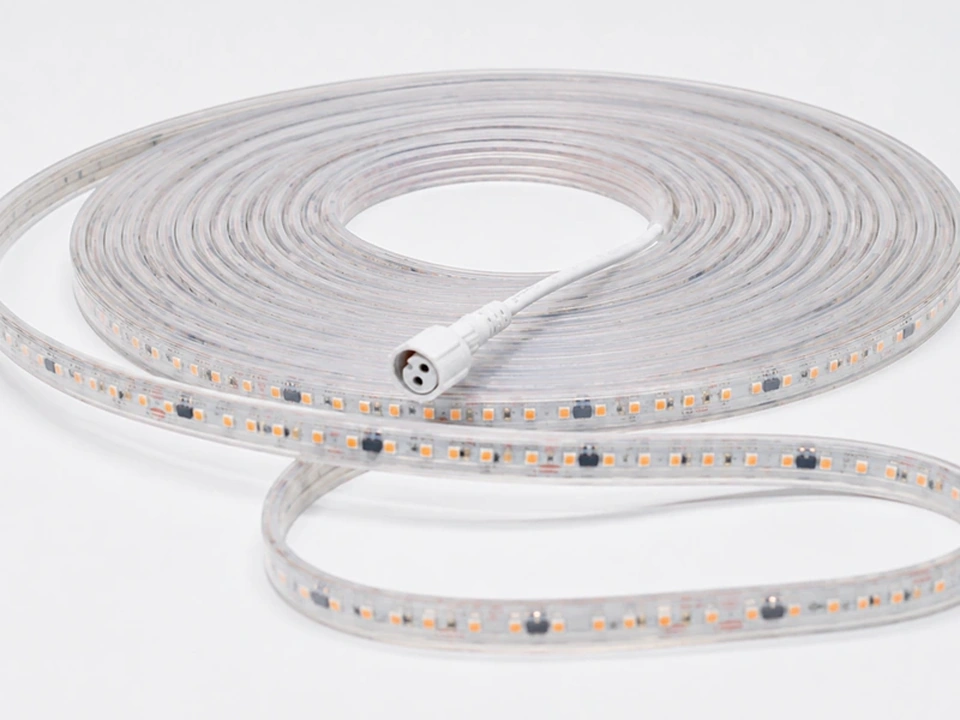
Les bandes de lumière LED 110V, également appelées lumières de bande LED haute tension ou bandes de LED AC, sont des produits d'éclairage flexibles conçus pour fonctionner à partir de l'alimentation secteur secteur via un système de redressement. Si vous voulez un apprêt technique plus profond, Signiteled a également un guide connexe sur Lumière de bande LED haute tension.
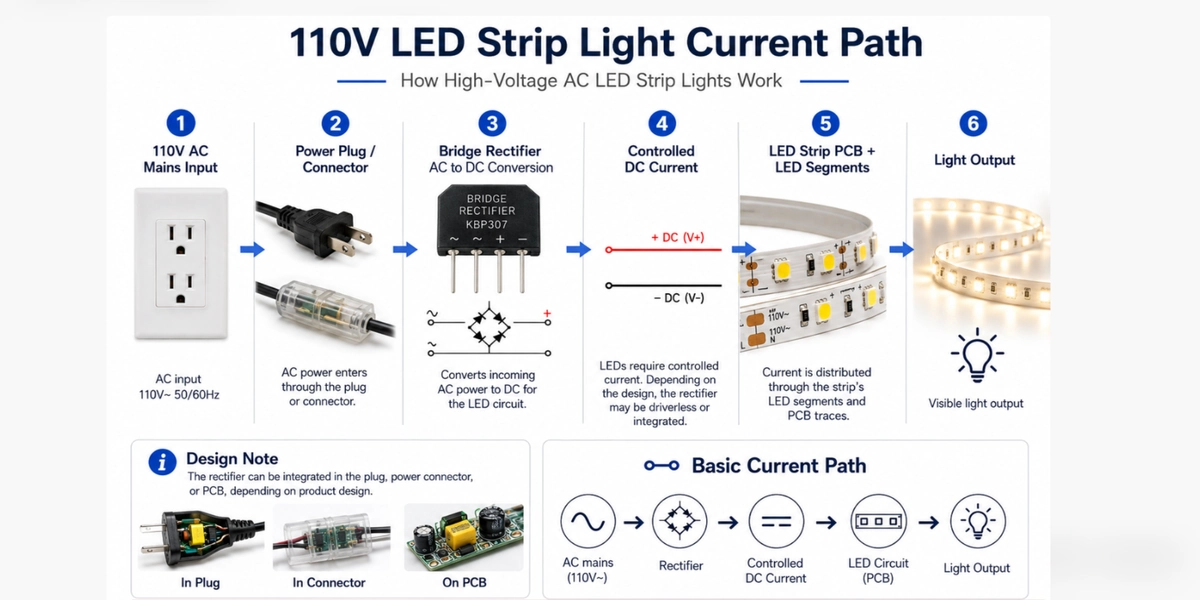
La clé est la conversion AC-DC. Les LED ont besoin d'un courant contrôlé, donc dans un système de bande 110V, la puissance CA entrante est convertie par un redresseur ou un circuit sans conducteur avant d'atteindre le circuit LED. Selon la conception, le redresseur peut être intégré à la prise, au connecteur d'alimentation ou au circuit imprimé.
Voici le chemin de base actuel :
Avantages des 110V LED Lights
La valeur des bandes de lumière LED 110V ne se limite pas à des courses plus longues ou à une installation plus facile. Dans les projets d'ingénierie, chaque fonctionnalité est importante, car elle affecte le temps de travail, les coûts de maintenance, la fiabilité du système et le risque d'installation.
| Fonctionnalité | Avantage du projet |
| Capacité à long terme | Réduit les points d'injection de puissance et simplifie le câblage sur de grandes surfaces. |
| Entrée CA directe | Rend moins l'installation à distance dépendante de nombreux pilotes LED distincts. |
| Moins de pilotes | Crée moins de points de défaillance et peut réduire les travaux de maintenance après l'installation. |
| Chute de tension inférieure | Aide à maintenir la luminosité plus cohérente pour les courses plus longues. |
| Adaptation extérieure | Fonctionne bien pour la signalisation, les contours de la façade et l'éclairage extérieur avec une imperméabilisation appropriée. |
| Conception de système évolutif | Plus facile à planifier pour de grands bâtiments, centres commerciaux, hôtels et projets d'espace public. |
Pour les luminaires de petite étagère, les avantages mentionnés ci-dessus peuvent sembler mineurs. Mais lorsqu'ils sont utilisés pour décrire la façade d'un bâtiment de 50 à 60 mètres de long, ils deviennent essentiels.
Personne ne veut d'un projet où les dix premiers mètres semblent purs et propres, tandis que l'extrémité distante semble terne, jaunie et sans vie. De même, personne ne veut d'adaptateurs secteur cachés dans des virages qu'il est presque impossible d'accéder.
C'est pourquoi les slips LED 110V, avec leurs avantages uniques, ont établi un rôle irremplaçable dans de telles applications.
110V vs 12V vs 24V LED Lumières
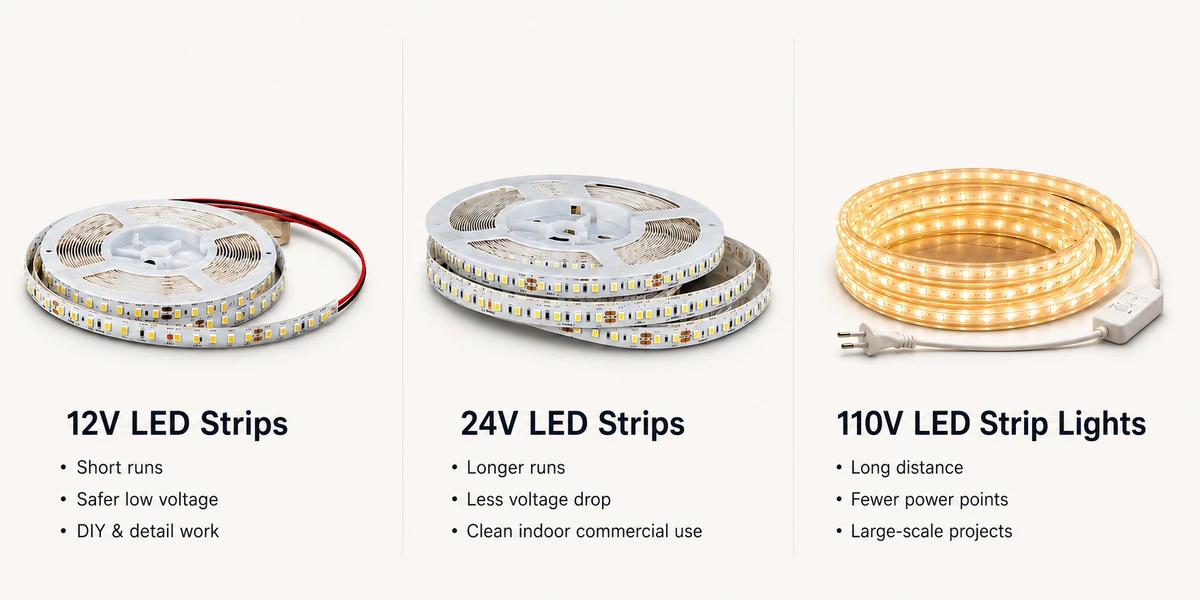
C'est probablement la comparaison dont la plupart des utilisateurs se soucient vraiment : devriez-vous choisir des bandes de LED 12 V, 24 V ou 110 V ?
Franchement, cela dépend de cinq facteurs : la distance d'installation, l'environnement d'installation, les exigences de sécurité, les besoins en gradation et la quantité d'entretien que vous souhaitez gérer à l'avenir.
Pour une discussion plus complète sur la sélection de tension, vous pouvez également lire cet article Signiteled sur Lumières de bande LED basse tension et haute tension.
Quand choisir les bandes LED 12V
Choisissez des bandes LED 12V pour les zones courtes, tactiles et lourdes de détails : sous les armoires, les étagères, les petits panneaux ou les projets de bricolage à la maison. La tension est plus sûre à manipuler, les accessoires sont faciles à trouver et les intervalles de coupe sont généralement conviviaux pour les dispositions serrées.
Quand choisir les bandes LED 24V
Choisissez des bandes LED 24V lorsque vous avez besoin d'une course commerciale intérieure plus propre sans sauter dans la haute tension. Ils sont populaires dans les criques d'hôtels, les lignes d'affichage au détail, les fentes de plafond et l'éclairage des meubles. Comparées aux bandes 12V, les bandes de 24 V gèrent généralement des courses plus longues avec moins de chute de tension.
Quand choisir les bandes LED 110V
Choisissez des lumières de bande LED 110V lorsque la distance et l'échelle dominent le projet. L'éclairage du chantier de construction, les longs accents de couloir et les grands éclairages de façade en sont des exemples typiques. L'avantage n'est pas seulement la luminosité, c'est la simplicité du système. Vous réduisez le nombre d'endroits où quelque chose peut mal tourner.
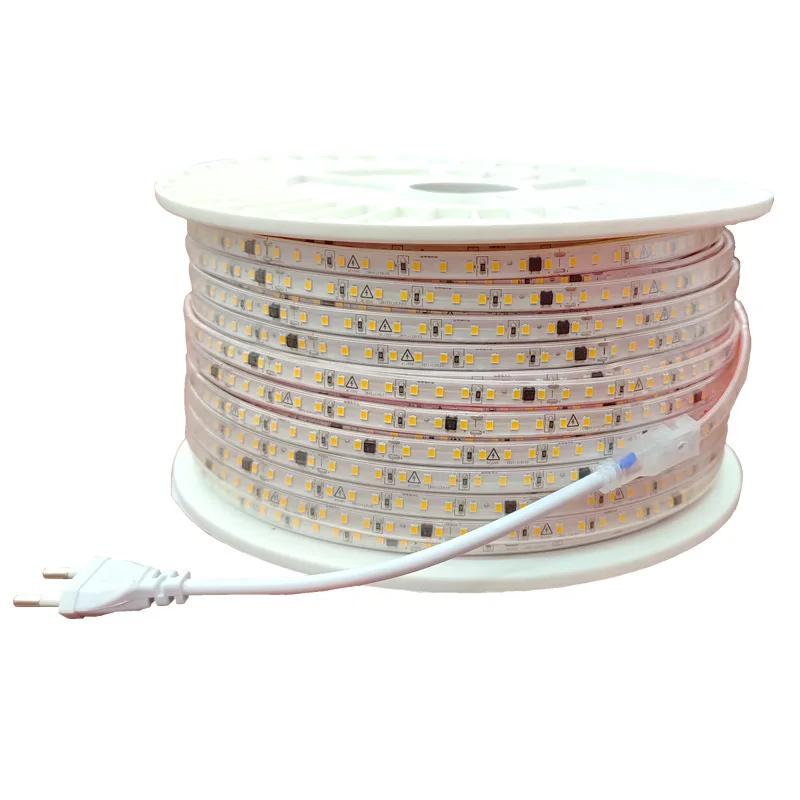
Bande LED sans conducteur 110V/220V AC haute tension
Les bandes de LED sans pilote à haute tension sont des bandes de LED qui fonctionnent à une tension plus élevée que la basse tension standard utilisée dans la plupart des bandes de LED. Comme elles sont alimentées par un courant alternatif, elles sont également appelées bandes de LED en courant alternatif, comme les bandes de LED en courant alternatif 110V/120V/230V/240V.
Modèle principal : EQW10T120G
Type de LED : SMD2835/SMD5050
Qté de LED par mètre : 60/80/120@SMD2835, 60@SMD5050
Largeur du circuit imprimé : 10mm/12mm
Longueur : 50m
Tension d'entrée : AC120V/AC220V
Puissance par mètre : 10W/7W
Température de couleur : 2700K/3000K/4000K/5000K/6500K/RGB
Classe IP : IP67/IP68
Garantie : 3 ans
La fonction ci-dessus permet la personnalisation.
Meilleures applications pour les 110 V LED Lights
La meilleure application pour les 110V LED bandes lumineuses n'est pas simplement un projet extérieur. Ils sont plus solides là où la course est longue, l'accès est difficile et moins de points d'alimentation, ce qui peut rendre l'installation plus sûre et plus facile à entretenir. Les applications typiques comprennent l'éclairage du chantier de construction, les projets de ponts et de tunnels, les contours des bâtiments, l'éclairage de façade et certains grands espaces commerciaux. La signalisation extérieure ne peut être envisagée que pour des conceptions spécifiques à longues frontières, mais ce n'est généralement pas l'application principale.
| Application | recommandation | Pourquoi |
| Éclairage du chantier | Excellent | Prend en charge de longues courses temporaires ou semi-permanentes pour les zones d'éclairage et de sécurité. |
| Construction de ponts et de tunnels | Excellent | Utile pour un éclairage continu et des avertissements dans les zones de travail longues et difficiles d'accès. |
| Éclairage de contour de bâtiment | Excellent | De longues courses et une luminosité constante sont nécessaires. |
| Éclairage de façade commerciale | Excellent | Réduit la complexité du câblage à travers de grandes élévations. |
| Éclairage de l'hôtel Crique | Bon | Utile lorsque de longues courses continues sont nécessaires. |
| Décoration de centre commercial | Bon | Convient aux zones d'éclairage commerciale à grande échelle. |
| Éclairage paysager | Bon | Fonctionne bien lorsque l'imperméabilisation et l'étanchéité sont correctement conçues. |
| Signalisation extérieure | limité | Ce n'est pas une utilisation principale, ne pensez qu'à des éclairages longs ou périmétriques spécifiques. |
| Éclairage sous-armoire résidentielle | Non recommandé | Les bandes basse tension sont généralement plus sûres et plus faciles. |
| Éclairage décoratif court | pas idéal | Les bandes 12V ou 24V sont généralement plus pratiques. |
Éclairage du chantier
L'éclairage du chantier de construction est l'une des applications pratiques pour les sommiers à LED 110V. Dans la construction de ponts, la construction de tunnels, les travaux routiers et les chantiers extérieurs temporaires, un éclairage continu long est souvent nécessaire pour l'éclairage principal, l'éclairage d'avertissement, le guidage d'itinéraire et le marquage de sécurité.
Avec des éclairages à bande LED 110V, les installateurs peuvent réduire l'injection de puissance répétée, simplifier le câblage temporaire et couvrir des zones plus longues telles que les murs de tunnel, les garde-fous des ponts, les échafaudages, les clôtures temporaires et les routes d'accès.
Éclairage du contour des bâtiments
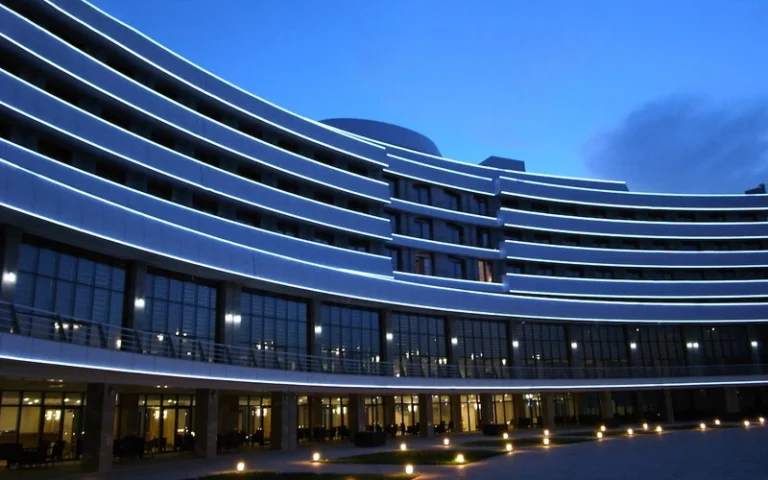
C'est l'un des cas d'utilisation les plus importants. Les longues lignes de toit, les bords des murs, les contours des ponts et les contours des bâtiments commerciaux nécessitent un éclairage continu. Avec des éclairages à bande LED 110V, les installateurs peuvent réduire l'injection de puissance répétée et garder la disposition plus propre.
Éclairage hôtelier et au détail
Pour les longues courses dans les hôtels, les centres commerciaux et les intérieurs de vente au détail, les bandes 110 V peuvent aider à simplifier la planification de l'énergie. Pourtant, si le projet nécessite une gradation très précise, des longueurs de coupe courte ou un fonctionnement à basse tension tactile, 24 V peuvent être la meilleure option.
Où les bandes LED 110V ne sont pas recommandées
Évitez les bandes LED 110V pour les pièces décoratives courtes, les petits travaux de bricolage à domicile, les zones où les gens touchent fréquemment la bande ou les installations qui nécessitent des intervalles de coupe très courtes. Plus gros n'est pas toujours mieux. Parfois, une bande basse tension est l'outil le plus intelligent.
Exemple de projet 1 : Éclairage du chantier
Problèmes courants avec les lumières de bande LED 110V
Dans les projets réels, les défaillances courantes proviennent généralement de matériaux faibles, de mauvaises étanchéités, de redresseurs de mauvaise qualité, de connecteurs peu fiables ou d'utilisation du mauvais produit pour l'environnement. La plupart de ces problèmes peuvent être évités en vérifiant le système d'éclairage complet avant l'installation.
| problème | cause commune | Comment l'éviter |
| Scintillement | Conception de redresseur ou de circuit de mauvaise qualité | Choisissez un système de redresseur sans scintillement et testez des échantillons avant la commande en gros. |
| Jaunissement | Veste en PVC de faible qualité ou résistance aux UV médiocre | Utilisez du PVC ou du silicone résistant aux UV pour les projets en plein air. |
| surchauffe | Mauvaise carte de circuit imprimé, surcharge ou faible dissipation thermique | Vérifiez l'épaisseur, la puissance et la température de fonctionnement du cuivre. |
| Connecteurs dangereux | Conception de connexion lâche ou non certifiée | Utilisez des connecteurs moulés, imperméables et approuvés par le projet. |
| panne imperméable | Faible scellement aux coupures, embouts ou connecteurs | Utilisez des embouts moulés par injection et des procédures d'étanchéité appropriées. |
| Luminosité incohérente | Chute de tension, mauvais regroupement LED ou surcharge | Choisissez la longueur de course appropriée, le regroupement des LED et la disposition de l'installation. |
Le scintillement est souvent le premier signe d'avertissement. Il ne peut pas ruiner immédiatement un signe, mais il vous indique que la conception du redresseur ou du circuit peut être faible. Le jaunissement est une autre défaillance lente. Une bande peut sembler belle le premier mois, puis la veste devient trouble après une longue exposition aux UV. La défaillance étanche est encore plus grave car l'eau pénètre rarement au milieu d'une bande bien faite, elle se faufile généralement à travers des points de coupe, des embouts ou des connecteurs.
C'est pourquoi le contrôle de la qualité devrait se concentrer sur l'ensemble du système, pas seulement sur les puces LED. Une bande est comme une chaîne à travers un bâtiment. Si un connecteur échoue, toute la ligne visuelle peut se casser.
Les bandes de lumière LED 110V sont-elles sécurisées ?
Oui, les éclairages à bande LED 110 V peuvent être sûrs lorsqu'ils sont correctement conçus, isolés, certifiés et installés. Parce qu'ils fonctionnent à une tension supérieure à 12 V ou 24 V, ils nécessitent une protection plus solide et une manipulation plus prudente.
Pour assurer la sécurité, la première étape consiste à vérifier l'isolation électrique. Les feux extérieurs de bande LED 110V doivent être équipés d'un manchon de protection solide, d'embouts fiables et d'un système de connexion sécurisé. Pour les projets d'ingénierie publique, recherchez les marques de certification pertinentes ou les autres approbations requises par le marché cible et les réglementations locales. Signiteled fournit des produits certifiés tels que UL, ETL, CE et ROHS, ce qui en fait un choix fiable pour l'approvisionnement en projets.
L'installation doit suivre des règles strictes : ne coupez jamais la bande pendant la mise sous tension, ne dépassez jamais la longueur maximale nominale, n'utilisez que des accessoires compatibles, scellez chaque point de coupe et suivez les codes électriques locaux. Pour les grands projets commerciaux, une installation professionnelle est fortement recommandée.
Comment choisir des lumières de bande LED 110V de haute qualité
Lorsque vous choisissez des bandes de LED 110V, ne vous concentrez pas uniquement sur le prix du mètre. Pour les projets commerciaux et extérieurs, la valeur réelle provient de composants fiables, notamment un PCB de haute qualité, des puces LED stables, un redresseur sans scintillement, un PVC ou un silicone résistant aux UV, des connecteurs imperméables et des certifications appropriées telles que UL, ETL, CE ou ROHS.
Un excellent fournisseur comme Signiteled prend également en charge les longueurs, les températures de couleur, les cotes IP et les options de connecteurs personnalisées, aidant ainsi le produit à mieux correspondre à l'environnement d'installation réel et à réduire les risques de maintenance future. Le produit peut ainsi correspondre à l'environnement d'installation réel et réduire les risques de maintenance.
Choisissez un fabricant avec le support de projet
Un fournisseur fiable devrait être en mesure de vous aider à sélectionner la tension, à déterminer la valeur IP, à sélectionner le type de connecteur, à faire correspondre la température de couleur et à planifier la disposition de l'installation. Si votre projet implique également une basse tension Lumières de bande LED COB ou SLampes de bande LED MD, vous pouvez rapidement visiter la page produit de Signiteled pour plus de détails. Pour les effets d'éclairage RGB à haute tension dynamiques, vous pouvez également vous référer au guide de SignLiteled. sur 110V et 220V AC adressable Lumières de bande LED RGB.
Conclusion
Les bandes de lumière LED 110V sont conçues pour l'échelle. Lorsque vous avez besoin d'un éclairage continu pour les contours des bâtiments, la signalisation, les façades, les paysages, les hôtels ou les projets commerciaux, ils peuvent réduire la chute de tension, simplifier le câblage et réduire le nombre de points d'injection d'énergie. C'est un véritable avantage de projet, pas seulement une fonctionnalité de produit.
Mais le bon produit est important. Regardez au-delà du prix et vérifiez le circuit imprimé, le redresseur, les puces LED, les matériaux imperméables, les connecteurs, les certifications et le support fournisseur. Un système de bandes LED puissant de 110 V doit être lumineux, stable, scellé, sûr et facile à entretenir.
Besoin d'aide pour sélectionner des bandes de lumière LED 110V pour un projet de contour de bâtiment, de signalisation ou d'éclairage commercial ? Contactez l'équipe de Signiteled pour les recommandations de produits, les spécifications personnalisées, les options d'étanchéité et le support du projet.
FAQ
Articles Similaires