Signage & LED Strip Lighting Factory Since 2011

Signage & LED Strip Lighting Factory Since 2011

How is Neon Flex connected?

How is Neon Flex connected

Due to its adaptability, energy efficiency, and simplicity of installation, neon flex is a well-liked lighting option. Small, flexible LED lights enclosed in a silicone or PVC jacket make up this flexible substitute for conventional glass neon lights. We’ll look at neon flex connection in this blog post.

Utilizing connectors makes connecting neon flex an easy operation. To generate longer lengths or unique shapes, connectors are used to join several neon flex pieces together. They are available in many different designs, such as T-connections, L-connectors, and straight connectors.

Follow these steps to connect neon flex:

Step 1: Neon flex should be cut to the appropriate length. Cut the neon flex at the specified cut spots with a knife or a pair of scissors. To prevent the LED lights from being harmed when cutting neon flex, be sure to carefully follow the manufacturer’s instructions and cut along defined cut spots.

Step 2: Connect the neon flex. After cutting the neon flex to the required length, use a connector to join the pieces together. For a safe and seamless connection, connectors are made to be placed into the ends of neon flex. Make sure the connector you select works with your neon flex.

Step 3: Connection security. Use a tiny screwdriver to tighten the connector’s screws after it has been inserted into the neon flex’s ends. This will make sure the connection is solid and stop the neon flex from separating.

It’s crucial to take your setup’s voltage and current requirements into account while attaching neon flex. To avoid damaging the LED lights, be sure to select a connector that is appropriate for the voltage and current of your neon flex.

The fact that not all neon flex can be connected directly to a power source should also be noted. For some neon flex, a power source or driver is needed to control the voltage and current. Be sure to read the product specs before attaching neon flex to make sure you have everything you need.

In conclusion, utilizing connectors to link neon flex is a straightforward process. Neon flex should be cut to the required length, connected with a connector, and then secured. Check the product specifications to make sure you have the components you need for your setup and make sure the connector you chose is compatible with the voltage and current of your neon flex. Neon flex is a flexible and adaptable lighting solution that may improve any area or environment thanks to its connection capabilities.

The Ultimate Guide to Waterproof LED Strip LightsThe Ultimate Guide to Waterproof LED Strip Lights
The Ultimate Guide to Waterproof LED Strip Lights
In architectural lighting, commercial lighting, and residential lighting projects, reliability and durability are often just as important as brightness and aesthetics. One of the most common causes of failure for LED strips in real-world applications is inadequate waterproofing, dustproofing, or weatherproofing. A strip that looks perfect in a showroom can...
Potential Disadvantages of LED Strip Lights and How to Avoid ThemPotential Disadvantages of LED Strip Lights and How to Avoid Them
Potential Disadvantages of LED Strip Lights and How to Avoid Them
Due to their versatility and high efficiency, LED strip lights have gained widespread popularity in residential, commercial, and industrial lighting scenarios. From ambient lighting to high color rendering index (CRI) functional lighting, they have become a popular choice among designers and engineers. However, in practical use, despite the numerous advantages of...
What Are The Waterproofing Processes Used In LED Strip LightsWhat Are The Waterproofing Processes Used In LED Strip Lights
What Are The Waterproofing Processes Used In LED Strip Lights?
In outdoor landscape lighting, LED strip lights are highly favored for their flexibility and decorative appeal. However, traditional LED strip lights are often susceptible to water damage in outdoor environments, leading to diminished lighting performance or even damage. Waterproof LED strip lights effectively address this issue. Waterproof LED light strips...
DMX-Controlled RGB Lighting for Bridges & FaçadesDMX-Controlled RGB Lighting for Bridges & Façades
DMX LED Wall Washer & Pixel Tube Lights for Facade Lighting
Illuminate Your Building Facade with Precision-Controlled Outdoor Lighting When it comes to architectural lighting for commercial buildings, landmarks, and cityscapes, precision and durability are essential. SignliteLED’s DMX LED Wall Tube & Rigid Bar Lights offer a professional solution tailored for facade designers, project contractors, and OEM lighting brands seeking dependable performance...
SMD3528 vs SMD2835 vs SMD5050: Which LED Strip Light is the Best for Commercial and Architectural Lighting?
When selecting LED strip lights for commercial or architectural use, many professionals encounter terms like SMD3528, 2835, or 5050—yet few fully understand what these numbers mean. Far from being just model codes, they define the chip’s size, light output, efficiency, and application suitability. Misinterpreting them can result in suboptimal lighting...
What-Does-COB-in-COB-LED-Strip-Stand-ForWhat-Does-COB-in-COB-LED-Strip-Stand-For
What Does COB in COB LED Strip Stand For?
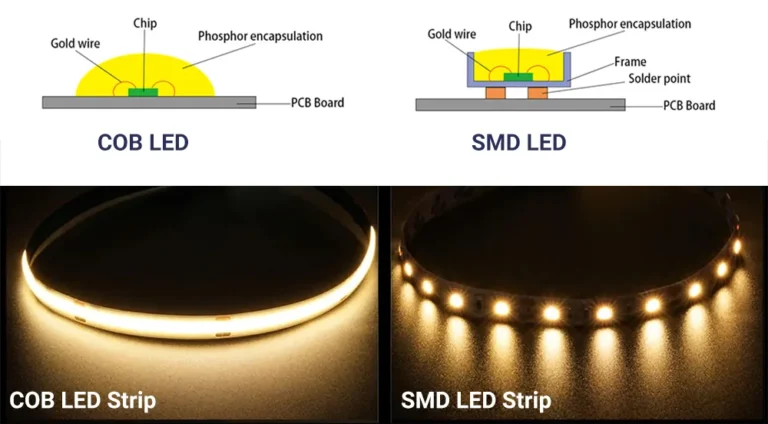
A growing number of people are using COB LED strip lights because of its excellent brightness and cost-effectiveness. However, a lot of individuals are still unaware of what the acronym COB means. The definition of COB and its significance in COB LED strip lights will be discussed in this article. Chip...

Share:

Facebook
Twitter
Pinterest
LinkedIn
Subscribe
Notify of
guest
0 Comments
Oldest
Newest Most Voted
Inline Feedbacks
View all comments

Search SignliteLED Blog

Categories

To top

Get a Quote Now