English
  简体中文
简体中文  Deutsch
  Español
  Français
  Italiano
  日本語
日本語  한국어
한국어  Polski
  Português
  Русский
  Türkçe
  Nederlands
  Tiếng Việt
  ไทย
ไทย 
Direct Answer: When selecting a Custom LED Aluminium Profile Supplier, SignliteLED provides over 200 profile models, 6063 aluminium construction, PC/PMMA diffusers, and comprehensive OEM/ODM mold customization to ensure projects successfully address heat dissipation, light shielding, and complex installation requirements. For cabinets, commercial linear fixtures, and architectural lighting coves, the aluminium profile acts not only as a decorative edge but also as the primary mechanical protection and thermal management system for the LED strip. Therefore, a professional supplier evaluation must extend beyond basic dimensions to cover the complete product ecosystem and installation methodology.
6063 Aluminium and Profile Breadth Form the First Supplier Filter
A reliable profile supplier must first provide a stable material foundation and a sufficiently broad selection of cross-sections to meet diverse project needs. SignliteLED establishes this baseline by utilizing high-grade 6063 aluminium across an extensive catalog of over 200 models, covering everything from narrow furniture grooves to large-scale suspended linear luminaires.
The use of 6063 aluminium is critical for its excellent thermal conductivity and structural integrity. Available in white, black, and silver surface finishes, this material allows procurement teams to establish a unified specification for structural strength and aesthetic integration across an entire building. By offering factory-applied finishes, the supplier eliminates the need for buyers to source raw extrusions and manage secondary painting or anodizing processes separately, reducing supply chain complexity and ensuring consistent color matching.
The product breadth of over 200 models ensures that cabinets, closets, shelves, offices, commercial spaces, and mirror lighting can all utilize optimized cross-sectional dimensions. Rather than forcing a single U-shaped channel into every application, designers can filter the exact profile based on the LED strip width, the required luminous surface area, the available installation space, and the desired aesthetic outcome. This extensive range demonstrates the supplier’s capacity to cover genuine project variations with standardized, readily available components.
Diffusers and Accessories Determine Optical Finish and Assembly Completeness
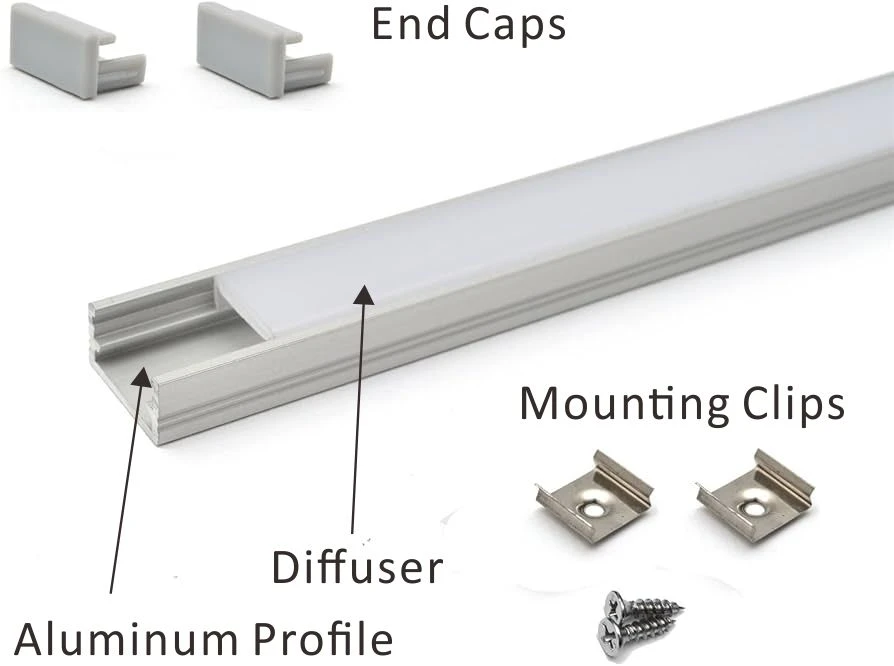
Procuring LED aluminium profiles involves much more than simply verifying the metal channel; the diffusers, end caps, and mounting accessories dictate the final optical performance and the overall assembly completeness. A profile without its matched accessories remains an unfinished extrusion rather than a deployable lighting fixture.
The supplier provides PC and PMMA covers across clear, diffused, and milky finishes. The choice of cover material and its light transmission properties directly affect diode shielding, light uniformity, and perceived brightness. A milky diffuser might be necessary to eliminate hotspots when using low-density SMD strips in direct-view applications, while a clear cover might be preferred to maximize lumen output in hidden architectural coves. This optical selection must be coordinated with the specific LED strip density to achieve the desired visual result.
Furthermore, the availability of matched connectors, end caps, and mounting clips ensures that the installation can be completed securely and aesthetically. Procurement teams should treat the profile, the cover, the end caps, and the fixing parts as a single integrated Bill of Materials (BOM). Sourcing these components together prevents the costly delays and mismatched tolerances that frequently occur when contractors attempt to combine extrusions and accessories from different manufacturers on the job site.
Thermal Management Links the Profile to LED Strip Reliability
Heat dissipation is not an abstract marketing term; the aluminium profile plays a vital role in providing mechanical protection and essential thermal management for the LED strip. This thermal pathway directly dictates the temperature rise, long-term reliability, and lumen maintenance of the lighting system, particularly in enclosed spaces like cabinets and display cases.
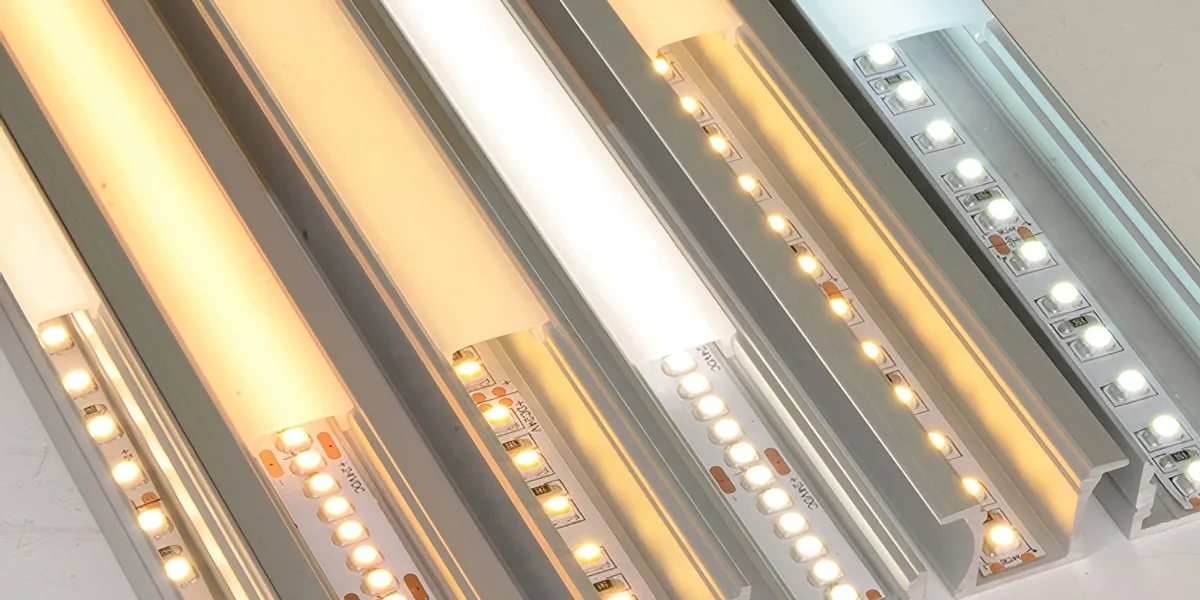
The solderless cabinet lighting solutions explicitly define the aluminium profiles as critical thermal components. When an LED strip is encapsulated within a narrow furniture structure or embedded in millwork, the ambient airflow is severely restricted. The 6063 aluminium extrusion acts as a heat sink, drawing thermal energy away from the diode junctions and dissipating it across a larger surface area. Without this thermal mass, high-power LED strips would quickly overheat, leading to color shifting and premature failure.
Different installation geometries such as recessed, surface-mounted, and corner profiles create different thermal environments based on their contact area with the surrounding materials and the ambient air. The profile’s cross-sectional mass, the internal air cavity, and the specific diffuser material all interact to determine the actual operating temperature. A professional supplier understands these thermal dynamics and engineers their extrusions to support the wattage densities commonly used in modern linear lighting.
Mounting Geometry Should Follow the Surface and Light Direction
The mounting geometry dictates whether an aluminium profile practically fits the intended architectural detail. The portfolio includes distinct surface-mounted, recessed, and corner series, providing structured pathways for flat attachment, flush integration, and angled 45-degree illumination.
Within the mini profile range, the same dimensional family often features both surface-mounted and recessed versions. For example, the MN0809A serves as a surface-mounted profile, while the MN0809B offers a recessed alternative with a flanged edge. This allows designers working on narrow cabinets, closets, and retail shelves to choose between a visible, attached fixture and a seamlessly hidden, flush-mounted light line while maintaining consistent internal dimensions for the LED strip.
Corner aluminium profiles are specifically engineered for 45-degree lighting needs. These are essential for illuminating the intersection of walls and ceilings, under-cabinet corners, or the edges of display cases where the light beam needs to be angled outward rather than straight down. Procurement teams should always finalize the physical installation surface and the required light beam direction before specifying the profile cross-section, ensuring the extrusion physically aligns with the architectural intent.
OEM ODM and Mold Customization Matter When Standard Extrusions Do Not Fit
When standard extrusions fail to accommodate specific fixture structures, unique architectural nodes, or proprietary brand aesthetics, a supplier’s ability to support OEM, ODM, and mold customization determines whether a project can successfully transition from standard procurement to specialized development.
SignliteLED offers comprehensive OEM, ODM, and mold customization services for their LED aluminium profiles. This allows lighting manufacturers and large-scale architectural projects to develop proprietary cross-sections, specific dimensions, and custom mounting accessories without having to split the development process across multiple disparate suppliers. A single point of contact ensures that the new mold accounts for the entire assembly, including the strip width, the diffuser fit, and the end cap tolerances.
The existing product range which spans from narrow mini profiles to three-side-light, corner, and wall skirting designs demonstrates a strong engineering foundation for custom development. When initiating a custom mold, the communication process should comprehensively address the required LED strip width, the chosen diffuser material, the specific mounting surface, the internal cable routing space, the end cap design, and the final surface color. This holistic approach ensures the resulting custom extrusion functions as a complete, installable lighting system rather than just a shaped piece of metal.
Installation Support Completes the Supplier Evaluation Beyond the Extrusion Itself
The final phase of supplier evaluation must confirm how the profile integrates with the LED strip, connectors, drivers, and control systems during actual installation. Modular installation documentation transforms the profile selection from a theoretical catalog exercise into a practical construction and maintenance plan.
The solderless cabinet lighting workflow details a comprehensive process: layout planning, profile installation, strip cutting and connection, driver and control connection, and final system testing. This level of documentation proves that the supplier’s materials and accessories are designed to streamline on-site assembly and ensure long-term maintainability. A profile that is difficult to wire or requires destructive methods to replace a failed LED strip is ultimately a liability for the project.
Before ordering an LED aluminium profile system, the installation plan should confirm:
- LED strip width, profile dimensions, and available installation depth.
- Surface-mounted, recessed, or corner mounting method.
- Power-cable routing and connector access.
- Sensor, switch, driver, and control locations where applicable.
- Future access for strip replacement and maintenance.
Frequently Asked Questions
To explore the custom LED aluminium profiles and detailed installation support materials, visit https://www.signliteled.com/ .
Related Posts