2011年からの看板とLEDストリップ照明工場

SMD と COB ストリップ: 認定された LED ストリップ照明サプライヤーである SignliteLed の明るさ、均一な光、およびアプリケーション

直接の答え: When engineering linear lighting systems, procurement professionals are frequently required to evaluate the performance differences between Surface-Mounted Device (SMD) and Chip-on-Board (COB) technologies. SignliteLED, functioning as an established LED Strip Lighting Supplier, provides extensive product families across both architectures. However, making an accurate purchasing decision requires moving past the simplified assumption that COB is inherently brighter or that SMD is universally more efficient. The ultimate brightness of a finished LED strip is determined by a complex interaction of luminous efficacy, LED packaging, printed circuit board design, optical construction, thermal management, and strict testing conditions. While both technologies offer distinct advantages, the core, observable benefit of COB strip lighting is heavily concentrated on its ability to deliver continuous, dot-free optical uniformity.

SMD And COB Start from Different LED Integration Structures

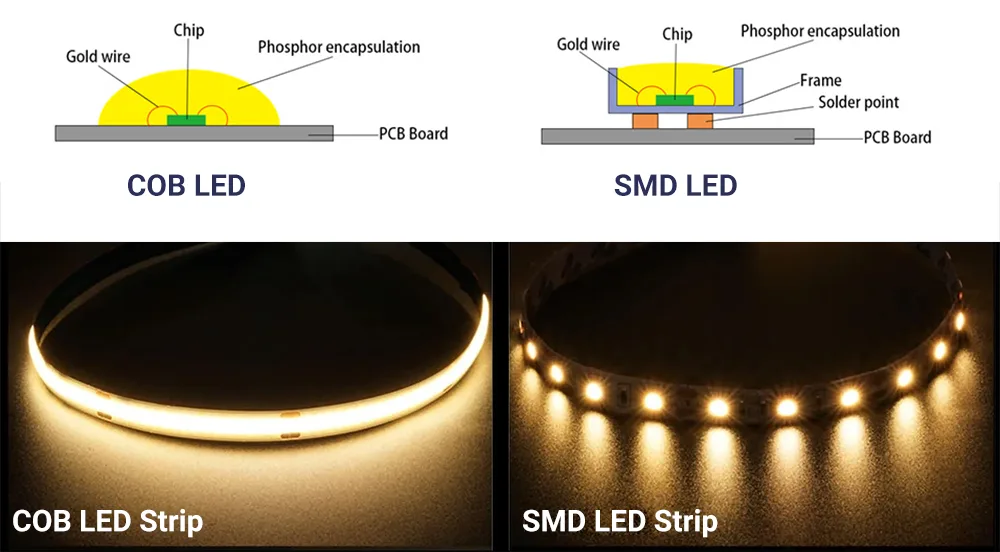
SMD and COB differ first in how the LEDs are integrated onto the printed circuit board (PCB). SMD strips use discrete surface-mounted LED packages, while COB mounts multiple chips directly on the PCB and covers them to form a continuous luminous surface. In SMD products, package format and LED density influence visible dot spacing, power, and output. In COB products, the dense direct-chip structure creates the basis for a smoother light line.

SMD-LED-VS-コブ-LED

In contrast, COB LED strips leverage direct chip-on-board mounting to arrange high-density LED chips closely together. A continuous phosphor coating or specialized light-emitting surface is then applied over the array to seamlessly blend the light from the individual chips. This critical manufacturing technique transitions the linear light output from a series of discrete, visible points into a smooth, continuous band of illumination. Because the chips are mounted directly without bulky individual packaging, COB technology establishes the essential structural foundation required to fit into significantly narrower PCBs and remarkably shallow aluminum profiles, expanding the installation possibilities for compact architectural details.

Brightness Has No Universal Technology Winner

Brightness cannot be ranked by SMD or COB technology alone. A fair comparison should use finished-strip lumens per meter and lumens per watt (lm/W) under comparable CRI, CCT, voltage, test length, and temperature conditions. Watts describe electrical input, not light output; chip quality, drive current, PCB design, optics, and thermal conditions all affect the measured result.

Consequently, the high-density chip arrangement of a COB strip does not automatically guarantee a higher lumen-per-meter output, just as the discrete packaging of an SMD strip does not inherently translate to superior luminous efficacy. Procurement teams and lighting engineers must demand finished-strip luminous flux and efficacy data generated under identical, controlled testing conditions. Only by reviewing these standardized performance metrics can project managers accurately determine which structural technology delivers the most appropriate illumination levels for their specific architectural or commercial objectives, eliminating the risk of specifying a product based on marketing terminology rather than proven optical performance.

COB Prioritizes Uniform Light Where the Strip Remains Visually Exposed

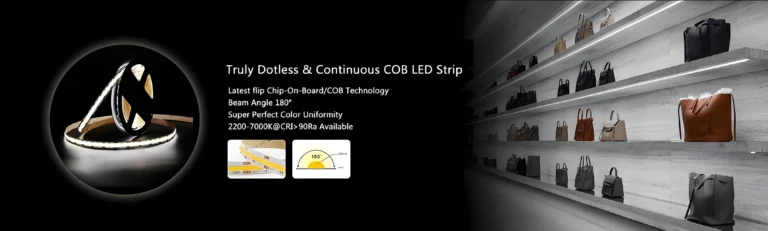
COB’s clearest advantage is optical uniformity where the light line remains visible at close range. Dense direct-chip mounting and a continuous phosphor layer blend individual points into a smooth luminous surface, which suits under-cabinet lighting, retail shelving, display cases, and shallow architectural profiles. This advantage should be evaluated separately from peak brightness.

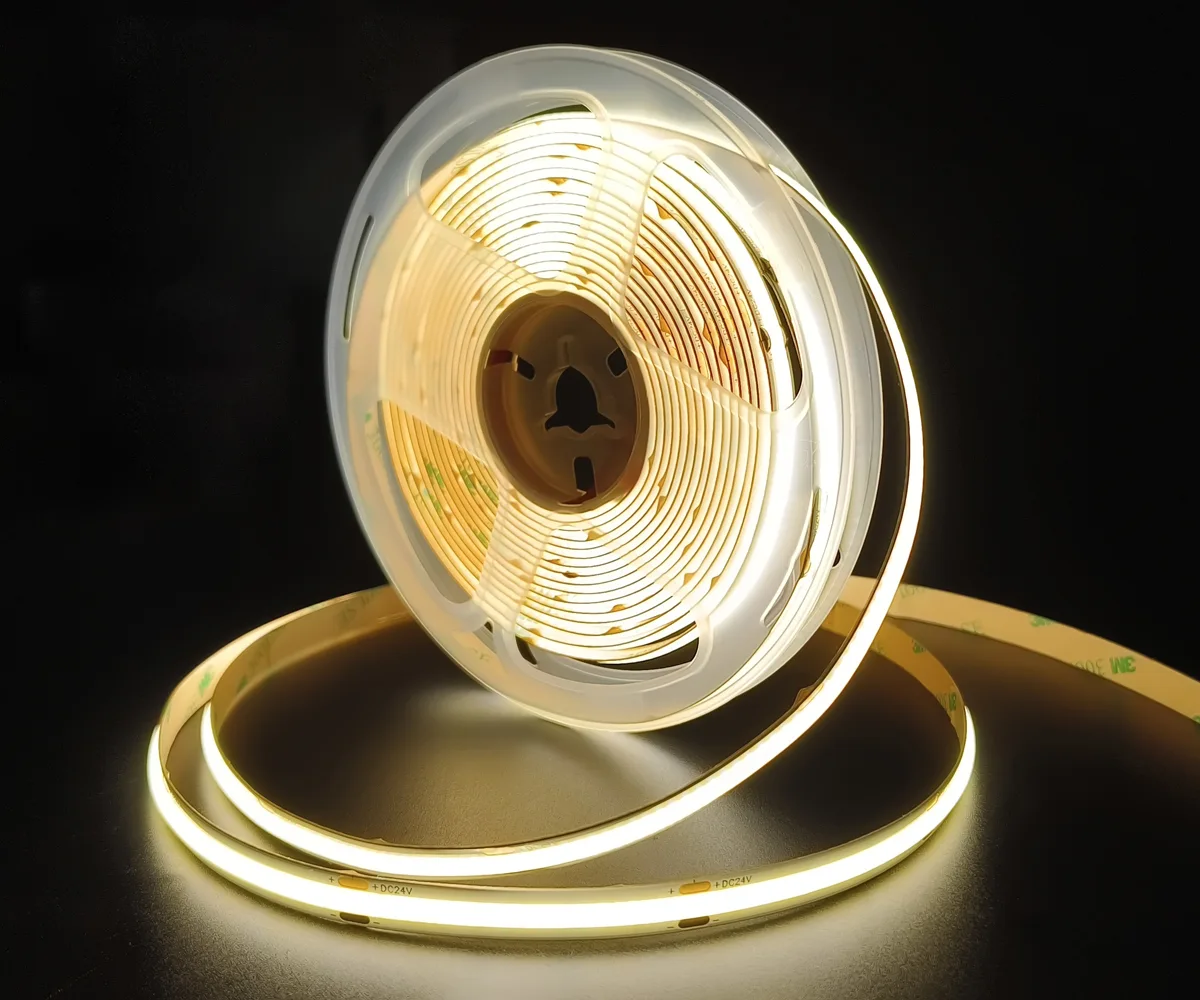
SignLiteLED - 24VDC モノクロ COB LED STRIP_01

To address the most restrictive installation environments, specialized Ultra Thin COB designs can utilize highly compact 5mm PCB layouts. The direct chip mounting technique and the significantly reduced optical footprint permit these ultra-thin strips to be seamlessly integrated into narrow grooves, slim aluminum profiles, and tightly concealed architectural channels. However, designers must remain aware that utilizing a narrower PCB inherently reduces the available electrical routing space and decreases the thermal dissipation margins. Therefore, deploying these compact COB solutions necessitates careful pairing with appropriate power supplies and robust thermal management strategies to ensure long-term stability and sustained dot-free performance.

Application Fit Depends on Package Breadth, Geometry and Control Requirements

Application fit depends on visibility, control complexity, geometry, and the final specification. SMD families cover multiple packages and monochrome, tunable CCT, RGB, and RGBW configurations, while COB is particularly useful where a continuous light line is the main visual requirement. Neither architecture should be chosen from the technology label alone.

Conversely, COB technology is most effectively deployed in applications where a continuous linear appearance is the primary design objective, such as cove lighting, under-cabinet illumination, and premium retail displays. If a project expands to require tunable white, RGB color changing, or individually addressable control, COB products can support these functions, but they must be carefully selected based on their specific color architecture and compatible control methodologies. Project engineers must avoid treating “COB” as a singular, uniform functional category. The correct division of labor between SMD and COB arises directly from the structural constraints and control requirements of the installation, proving that the actual application environment dictates the engineering advantage far more than the technology label.

Certified Supplier Language Requires Product-Specific Compliance Scope

When selecting a manufacturing partner, the designation of a certified supplier must be substantiated by a clear correspondence between specific certificates and the exact products being procured. The verifiable compliance documentation supporting these strip products includes essential EMC and CE-RoHS certifications specifically designated for LED strip lights, alongside specialized photobiological safety compliance for particular COB configurations. The explicit listing of EMC and CE-RoHS certificates for LED strip lights provides the necessary electromagnetic compatibility and regulatory foundation required for commercial deployment. Furthermore, specific IEC 62471 certification tied directly to COB LED strips offers independent verification regarding photobiological safety, delivering targeted evidence for high-density lighting applications.

It is a critical procurement error to assume that a single factory certification blankets every product in the catalog. While various certifications may apply to sign tubes, panel lights, or outdoor high bay fixtures, those specific scopes cannot be generalized to validate the entire range of SMD and COB strip lights. The true credibility of a manufacturing supplier is rooted in the clarity and specificity of its compliance documentation, rather than an inflated count of unrelated certification acronyms. Whether specifying an SMD or a COB solution, purchasing teams must rigorously verify the exact SKU against the targeted market compliance files during the procurement phase to guarantee regulatory alignment.

A Specification-First Comparison Gives B2B Buyers a Defensible SMD Vs COB Decision

For B2B procurement professionals, the decision between SMD and COB must begin with the construction of a rigorous specification matrix that defines the target lumens per meter, efficacy, CRI, operating voltage, PCB width, IP rating, color control, and installation visibility. シグライトLED facilitates this specification-first approach by allowing the product architecture to fulfill these precise conditions, preventing buyers from prematurely committing to a technology camp without factual justification. Because the comprehensive LED strip product universe encompasses both SMD and COB technologies, project managers can objectively compare different structural solutions within a single, unified supply chain. This enables the simultaneous confirmation of compatible controllers, power supplies, connectors, and aluminum profiles, thereby eliminating the parameter discrepancies that often plague cross-supplier comparisons.

Catering to lighting distributors, project engineering firms, and facility buyers, the manufacturing infrastructure supports comprehensive OEM and ODM engineering customization. Consequently, sample validation can be executed under standardized testing conditions, allowing for a direct, equitable comparison of actual brightness, optical uniformity, color rendering, and installation performance between SMD and COB variants. Once the optimal specifications are confirmed through testing, the selected design seamlessly transitions into bulk production and final project integration. The definitive value of partnering with an established supplier lies in the ability to evaluate SMD and COB technologies using unified engineering specifications, transforming complex brightness and uniformity variables into defensible, repeatable procurement decisions.

よくある質問

次のインストールに関する詳細な製品仕様、カスタマイズ機能、およびテクニカル プロジェクト サポートについては、次の公式 Web サイトにアクセスしてください。 https://www.signliteled.com/.

屋外のカスタム ネオン サインに最適な素材屋外のカスタム ネオン サインに最適な素材
屋外のカスタム ネオン サインに最適な素材: バイヤーズ テクニカル ガイド
店頭、レストランのパティオ、建築照明など、商業プロジェクトの屋外カスタム ネオン サインを調達する場合、今日選択する素材によって、その看板がどのように見え、今から 10 年後もどのように見えるかが決まります。 間違った素材を使用すると、見栄えのするサインが表示されます...
COB RGBW LED ストリップ ライト 24VCOB RGBW LED ストリップ ライト 24V
調光と色の精度に最適な LED テープ ライトは何ですか?
調光と色精度に最適な LED テープ ライトは、電気的安定性、スペクトルの一貫性、および知覚の滑らかさを、目に見えるちらつきや色の変化のない、ほぼゼロの光レベルまで、ほぼゼロの光レベルまで維持するものです。 プロの照明用語では、「最高」とは、最も明るい、最も安価な、または最も機能が豊富なという意味ではありません。 という意味です...
キャビネット、天井の入り江、アクセントの照明に使用される LED テープ照明を展示する建築インテリアキャビネット、天井の入り江、アクセントの照明に使用される LED テープ照明を展示する建築インテリア
キャビネット、天井、建築のアクセント設計のための LED テープ ライティング アプリケーション
LED テープ照明は、モダンなインテリアおよび建築照明の基礎となる要素となっています。 キャビネット下のタスクの照明から天井の入り江や建築上のアクセントに至るまで、LED テープは、デザイナーと指定子に比類のない柔軟性、精度、制御を提供します。 従来の器具とは異なり、LED テープ システムは、家具、建築の詳細、カスタムにシームレスに統合できます...
水流 LED ストリップ水流 LED ストリップ
流れるような光の効果を生み出すのに最適な LED ライトは何ですか?
流れる光の効果を生み出すのに最適な LED ライトは、白色光のストリップに沿って制御された明るさの変化を使用して、動きの滑らかで方向性の錯覚を生み出すように設計されているため、水の流れの LED ストリップです。 物理的な動き、色の変化、または複雑な内部電子機器に依存しません。 代わりに、...
現代のオフィス向けの LED 線形ライト現代のオフィス向けの LED 線形ライト
現代オフィス向けの LED リニア ライト: 製品選択の完全なガイド
現代のオフィス スペースの設計では、LED リニア ライトが主流の照明ソリューションになりました。 優れた省エネ性能とミニマリストの美学のためだけでなく、従業員の集中力の向上、空間の階層化の最適化、企業イメージの強化において、かけがえのない役割を果たしているためです。 オープンプランのオフィス、会議室など...
ネオンライトは火災の危険をもたらすか?ネオンライトは火災の危険をもたらすか?
ネオンに火災の危険性はあるのか?
鮮やかで印象的な外観を提供する一般的な照明オプションは、ネオンライトである。ネオンライトは、装飾用照明、看板、広告などの用途によく使われている。ネオンライトは火災の危険性があるという心配を持つ人もいる。このブログ記事では、この疑問に対する回答を検討することにしよう。 その...

共有:

フェイスブック
ツイッター
ピンタレスト
リンクトイン
購読する
通知する
ゲスト
0 コメント
最古
最新 最も投票された
インラインフィードバック
すべてのコメントを表示

SignliteLEDブログを検索

カテゴリー

上部へスクロール

今すぐ見積もりを取る