Français
  English
  简体中文
简体中文  Deutsch
  Español
  Italiano
  日本語
日本語  한국어
한국어  Polski
  Português
  Русский
  Türkçe
  Nederlands
  Tiếng Việt
  ไทย
ไทย 
Réponse directe : Lors de l'ingénierie de systèmes d'éclairage linéaire, les professionnels de l'approvisionnement sont fréquemment tenus d'évaluer les différences de performances entre les technologies de dispositifs de surface (SMD) et de puce sur le bord (COB). SigneLiteled, fonctionnant comme un Fournisseur d'éclairage de bande LED, fournit des familles de produits étendues dans les deux architectures. Cependant, prendre une décision d'achat précise nécessite de dépasser l'hypothèse simplifiée selon laquelle COB est intrinsèquement plus brillant ou que SMD est universellement plus efficace. La luminosité ultime d'une bande LED finie est déterminée par une interaction complexe entre l'efficacité lumineuse, l'emballage LED, la conception de circuits imprimés, la construction optique, la gestion thermique et les conditions de test strictes. Alors que les deux technologies offrent des avantages distincts, l'avantage de base et observable de l'éclairage en bande de cuisson est fortement concentré sur sa capacité à offrir une uniformité optique continue et sans point.
SMD et COB démarrent à partir de différentes structures d'intégration LED
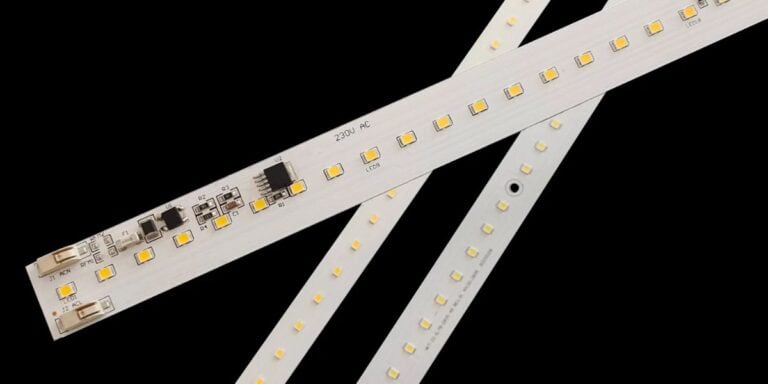
Les SMD et COB diffèrent en premier dans la façon dont les LED sont intégrées à la carte de circuit imprimé (PCB). Les bandes SMD utilisent des boîtiers LED discrètes en surface, tandis que COB monte plusieurs puces directement sur le PCB et les recouvre pour former une surface lumineuse continue. Dans les produits SMD, le format de l'emballage et la densité des LED influencent l'espacement, la puissance et la sortie visibles des points. Dans les produits COB, la structure dense à puce directe crée la base d'une ligne de lumière plus lisse.
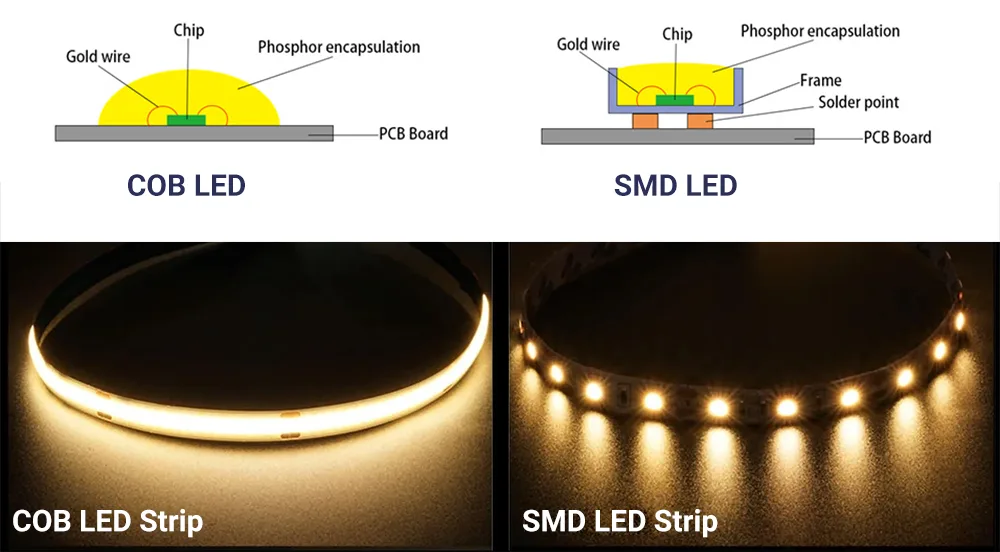
En revanche, les bandes LED COB tirent parti de la fixation directe sur la puce pour arranger étroitement les puces LED haute densité. Un revêtement de phosphore continu ou une surface d'émission de lumière spécialisée est ensuite appliqué sur le réseau pour mélanger de manière transparente la lumière des puces individuelles. Cette technique de fabrication critique fait passer la lumière linéaire d'une série de points visibles discrets en une bande d'éclairage lisse et continue. Étant donné que les puces sont montées directement sans emballage individuel encombrant, COB Technology établit la base structurelle essentielle nécessaire pour s'adapter à des circuits imprimés nettement plus étroits et à des profilés en aluminium remarquablement peu profonds, élargissant les possibilités d'installation pour des détails architecturaux compacts.
Brightness n'a pas de gagnant de technologie universelle
La luminosité ne peut pas être classée uniquement par la technologie SMD ou COB. Une comparaison équitable doit utiliser des lumens à bande finie par mètre et des lumens par watt (lm/W) dans des conditions de CRI, de CCT, de tension, de test et de température comparables. Les watts décrivent l'entrée électrique, pas la sortie de lumière, la qualité de la puce, le courant de commande, la conception de circuits imprimés, l'optique et les conditions thermiques affectent toutes le résultat mesuré.
Par conséquent, la disposition des puces à haute densité d'une bande de cuisson ne garantit pas automatiquement une sortie de lumen-mètre plus élevée, tout comme l'emballage discret d'une bande SMD ne se traduit pas par nature par une efficacité lumineuse supérieure. Les équipes d'approvisionnement et les ingénieurs en éclairage doivent exiger un flux lumineux et des données d'efficacité sur bande finie générées dans des conditions de test identiques et contrôlées. Ce n'est qu'en revoyant ces mesures de performance standardisées que les chefs de projet peuvent déterminer avec précision quelle technologie structurelle fournit les niveaux d'éclairage les plus appropriés pour leurs objectifs architecturaux ou commerciaux spécifiques, éliminant ainsi le risque de spécifier un produit basé sur la terminologie marketing plutôt que sur des performances optiques prouvées.
COB accorde la priorité à la lumière uniforme là où la bande reste visuellement exposée
L'avantage le plus clair de COB est l'uniformité optique où la ligne lumineuse reste visible à courte distance. Un montage dense à puce directe et une couche de phosphore continue mélangent des points individuels dans une surface lumineuse lisse, qui convient à l'éclairage sous l'armoire, aux rayonnages de détail, aux vitrines et aux profils architecturaux peu profonds. Cet avantage doit être évalué séparément de la luminosité maximale.
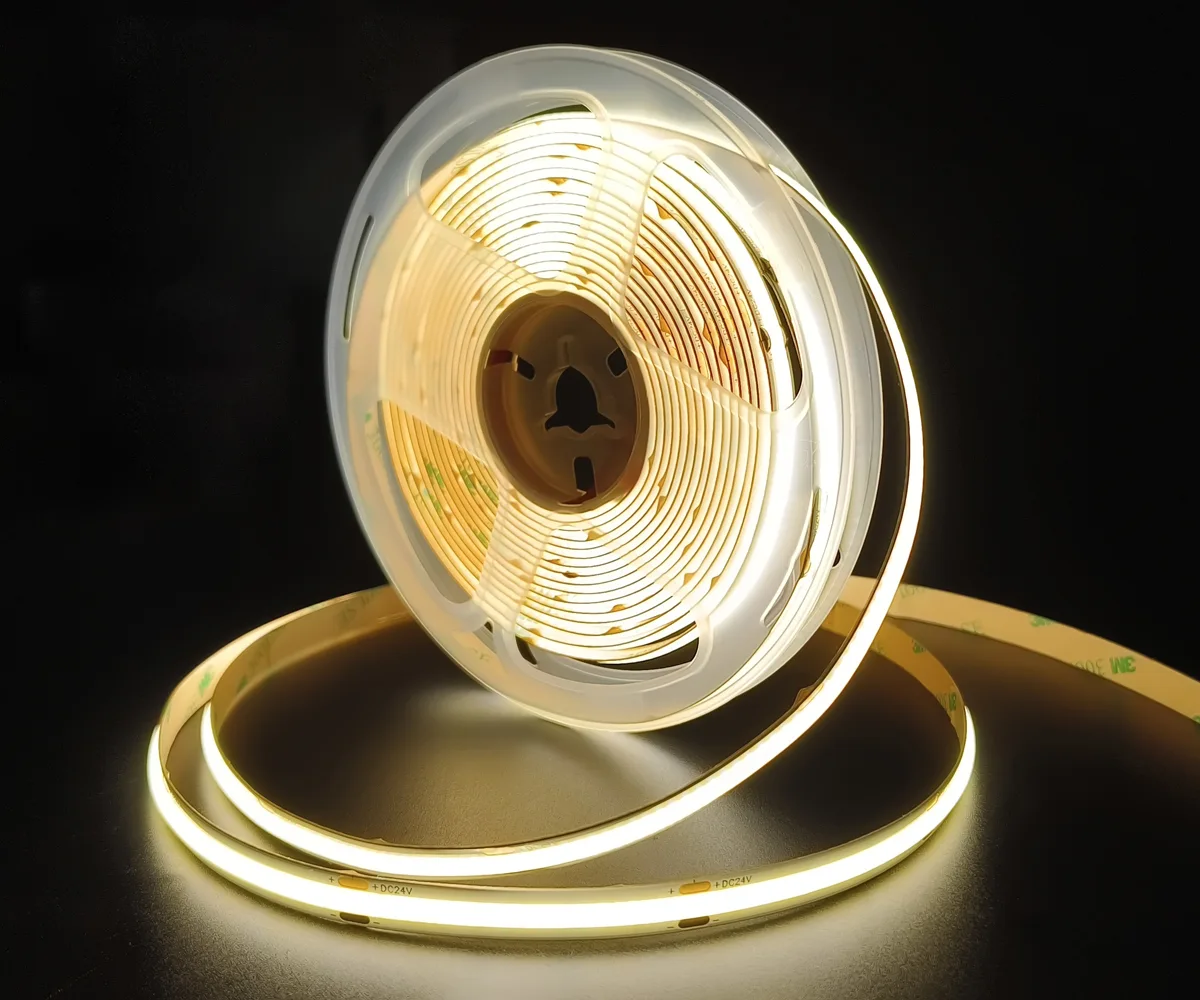
Pour traiter les environnements d'installation les plus restrictifs, les conceptions de COB ultra fines spécialisées peuvent utiliser des dispositions de circuit imprimé de 5 mm très compactes. La technique de montage direct des puces et l'encombrement optique considérablement réduits permettent à ces bandes ultra-fines d'être intégrées de manière transparente dans des rainures étroites, des profils en aluminium minces et des canaux architecturaux bien cachés. Cependant, les concepteurs doivent rester conscients que l'utilisation d'un PCB plus étroit réduit intrinsèquement l'espace de routage électrique disponible et réduit les marges de dissipation thermique. Par conséquent, le déploiement de ces solutions COB compactes nécessite un appariement attentif avec des alimentations appropriées et des stratégies de gestion thermique robustes pour assurer la stabilité à long terme et des performances sans point.
L'ajustement de l'application On Exigences de la largeur, de la géométrie et du contrôle des paquets
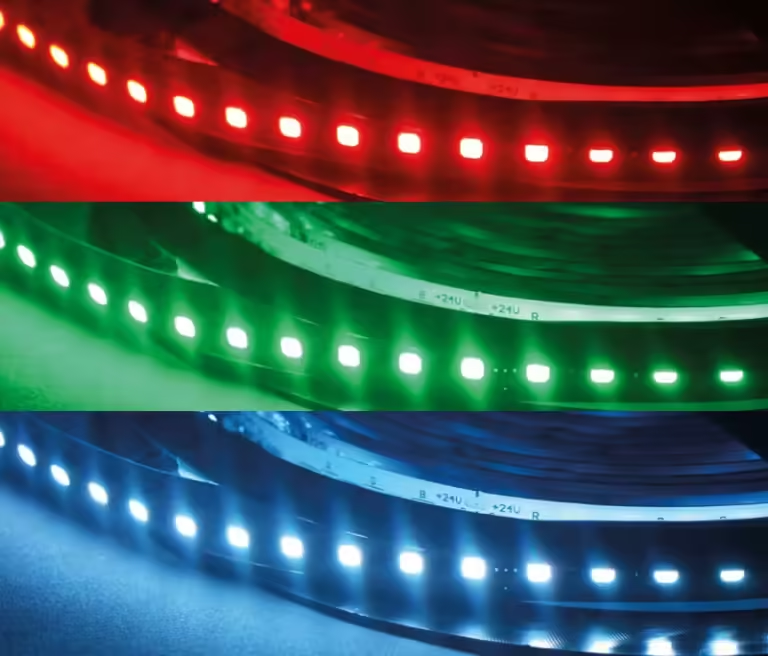
L'ajustement de l'application dépend de la visibilité, de la complexité du contrôle, de la géométrie et de la spécification finale. Les familles SMD couvrent plusieurs packages et les configurations monochromes, accordables CCT, RGB et RGBW, tandis que COB est particulièrement utile lorsqu'une ligne lumineuse continue est la principale exigence visuelle. Aucune architecture ne doit être choisie uniquement à partir du label technologique.
À l'inverse, la technologie COB est le plus efficacement déployée dans les applications où une apparence linéaire continue est l'objectif principal de conception, comme l'éclairage de la baie, l'éclairage sous l'armoire et les écrans de vente au détail de qualité. Si un projet s'étend pour nécessiter un blanc accordable, un changement de couleur RVB ou un contrôle adressable individuellement, COB Products peut prendre en charge ces fonctions, mais ils doivent être soigneusement sélectionnés en fonction de leur architecture de couleur et de leurs méthodes de contrôle compatibles. Les ingénieurs du projet doivent éviter de traiter « COB » comme une catégorie fonctionnelle singulière et uniforme. La division correcte du travail entre SMD et COB découle directement des contraintes structurelles et des exigences de contrôle de l'installation, prouvant que l'environnement d'application réel dicte bien plus l'avantage technique que l'étiquette technologique.
Le langage certifié du fournisseur nécessite une portée de conformité spécifique au produit
Lors de la sélection d'un partenaire de fabrication, la désignation d'un fournisseur certifié doit être étayée par une correspondance claire entre des certificats spécifiques et les produits exacts à acheter. La documentation de conformité vérifiable prenant en charge ces produits de bandes comprend les certifications Essential EMC et CE-ROHS spécifiquement désignées pour les sommiers à LED, ainsi que la conformité photobiologique spécialisée pour des configurations COB particulières. La liste explicite des certificats EMC et CE-ROHS pour les sommiers à LED fournit la compatibilité électromagnétique et la base réglementaire nécessaires pour le déploiement commercial. En outre, la certification CEI 62471 spécifique liée directement aux bandes LED COB offre une vérification indépendante de la sécurité photobiologique, fournissant des preuves ciblées pour les applications d'éclairage à haute densité.
C'est une erreur d'approvisionnement critique de supposer qu'une seule usine de certification recouvre tous les produits du catalogue. Bien que diverses certifications puissent s'appliquer aux tubes de signature, aux éclairages de panneaux ou aux luminaires extérieurs, ces champs d'application spécifiques ne peuvent pas être généralisés pour valider toute la gamme des spots de SMD et COB. La véritable crédibilité d'un fournisseur de fabrication est enracinée dans la clarté et la spécificité de sa documentation de conformité, plutôt qu'un nombre gonflé d'acronymes de certification non liés. Qu'il s'agisse de spécifier un SMD ou une solution COB, les équipes d'achat doivent vérifier rigoureusement la référence exacte des SKU par rapport aux fichiers de conformité du marché ciblés pendant la phase d'approvisionnement afin de garantir l'alignement réglementaire.
Une première comparaison de spécifications donne aux acheteurs B2B une décision SMD ou COB défendable
Pour les professionnels de l'approvisionnement B2B, la décision entre SMD et COB doit commencer par la construction d'une matrice de spécifications rigoureuse qui définit les lumens cibles par mètre, l'efficacité, le CRI, la tension de fonctionnement, la largeur du PCB, la cote IP, le contrôle des couleurs et la visibilité de l'installation. SignliteLED facilite cette approche de spécification en permettant à l'architecture du produit de remplir ces conditions précises, empêchant les acheteurs de s'engager prématurément dans un camp technologique sans justification factuelle. Étant donné que l'univers complet du produit de la bande LED comprend à la fois les technologies SMD et COB, les chefs de projet peuvent comparer objectivement différentes solutions structurelles au sein d'une seule chaîne d'approvisionnement unifiée. Cela permet la confirmation simultanée de contrôleurs, d'alimentations, de connecteurs et de profilés en aluminium compatibles, éliminant ainsi les écarts de paramètres qui affligent souvent les comparaisons entre les fournisseurs.
S'adressant aux distributeurs d'éclairage, aux sociétés d'ingénierie de projet et aux acheteurs d'installations, l'infrastructure de fabrication prend en charge la personnalisation complète de l'ingénierie OEM et ODM. Par conséquent, la validation d'échantillon peut être exécutée dans des conditions de test standardisées, permettant une comparaison directe et équitable de la luminosité réelle, de l'uniformité optique, du rendu des couleurs et des performances d'installation entre les variantes SMD et COB. Une fois que les spécifications optimales sont confirmées par le biais de tests, la conception sélectionnée passe de manière transparente à la production en masse et à l'intégration finale du projet. La valeur définitive du partenariat avec un fournisseur établi réside dans la capacité d'évaluer les technologies SMD et COB en utilisant des spécifications techniques unifiées, transformant des variables de luminosité et d'uniformité complexes en décisions d'approvisionnement rentables et reproductibles.
Questions fréquemment posées
Pour explorer les spécifications détaillées des produits, les capacités de personnalisation et le support technique du projet pour votre prochaine installation, visitez le site Web officiel à l'adresse https://www.signliteled.com/.
Articles Similaires