2011년부터 간판 및 LED 스트립 조명 공장

SMD 대 COB 스트립: 인증 LED 스트립 조명 공급업체인 SignLiteled의 밝기, 균일한 조명 및 응용 프로그램의 응용 프로그램

직접 답변: When engineering linear lighting systems, procurement professionals are frequently required to evaluate the performance differences between Surface-Mounted Device (SMD) and Chip-on-Board (COB) technologies. SignliteLED, functioning as an established LED Strip Lighting Supplier, provides extensive product families across both architectures. However, making an accurate purchasing decision requires moving past the simplified assumption that COB is inherently brighter or that SMD is universally more efficient. The ultimate brightness of a finished LED strip is determined by a complex interaction of luminous efficacy, LED packaging, printed circuit board design, optical construction, thermal management, and strict testing conditions. While both technologies offer distinct advantages, the core, observable benefit of COB strip lighting is heavily concentrated on its ability to deliver continuous, dot-free optical uniformity.

SMD And COB Start from Different LED Integration Structures

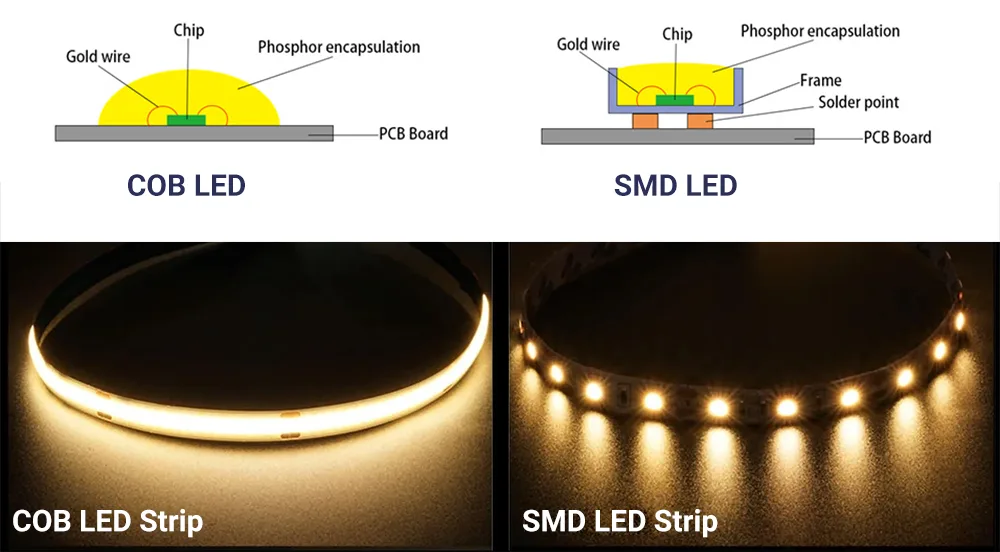
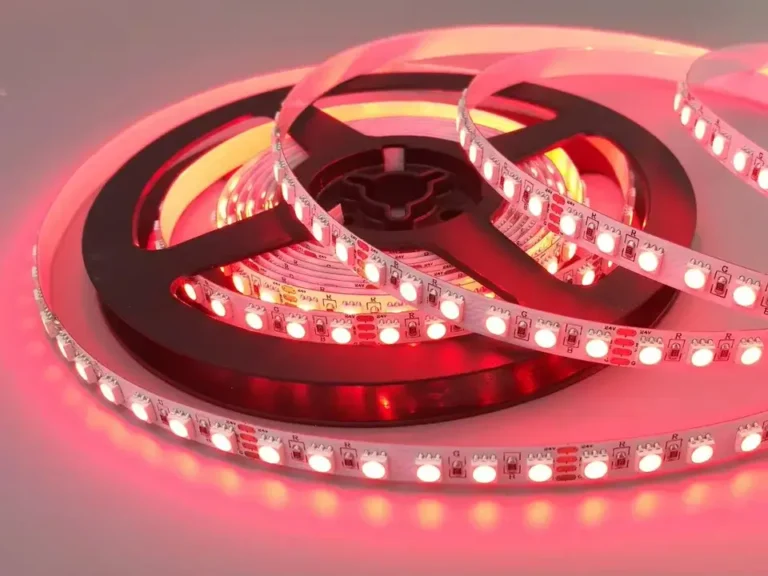
SMD and COB differ first in how the LEDs are integrated onto the printed circuit board (PCB). SMD strips use discrete surface-mounted LED packages, while COB mounts multiple chips directly on the PCB and covers them to form a continuous luminous surface. In SMD products, package format and LED density influence visible dot spacing, power, and output. In COB products, the dense direct-chip structure creates the basis for a smoother light line.

SMD 주도 대 COB 주도

In contrast, COB LED strips leverage direct chip-on-board mounting to arrange high-density LED chips closely together. A continuous phosphor coating or specialized light-emitting surface is then applied over the array to seamlessly blend the light from the individual chips. This critical manufacturing technique transitions the linear light output from a series of discrete, visible points into a smooth, continuous band of illumination. Because the chips are mounted directly without bulky individual packaging, COB technology establishes the essential structural foundation required to fit into significantly narrower PCBs and remarkably shallow aluminum profiles, expanding the installation possibilities for compact architectural details.

Brightness Has No Universal Technology Winner

Brightness cannot be ranked by SMD or COB technology alone. A fair comparison should use finished-strip lumens per meter and lumens per watt (lm/W) under comparable CRI, CCT, voltage, test length, and temperature conditions. Watts describe electrical input, not light output; chip quality, drive current, PCB design, optics, and thermal conditions all affect the measured result.

Consequently, the high-density chip arrangement of a COB strip does not automatically guarantee a higher lumen-per-meter output, just as the discrete packaging of an SMD strip does not inherently translate to superior luminous efficacy. Procurement teams and lighting engineers must demand finished-strip luminous flux and efficacy data generated under identical, controlled testing conditions. Only by reviewing these standardized performance metrics can project managers accurately determine which structural technology delivers the most appropriate illumination levels for their specific architectural or commercial objectives, eliminating the risk of specifying a product based on marketing terminology rather than proven optical performance.

COB Prioritizes Uniform Light Where the Strip Remains Visually Exposed

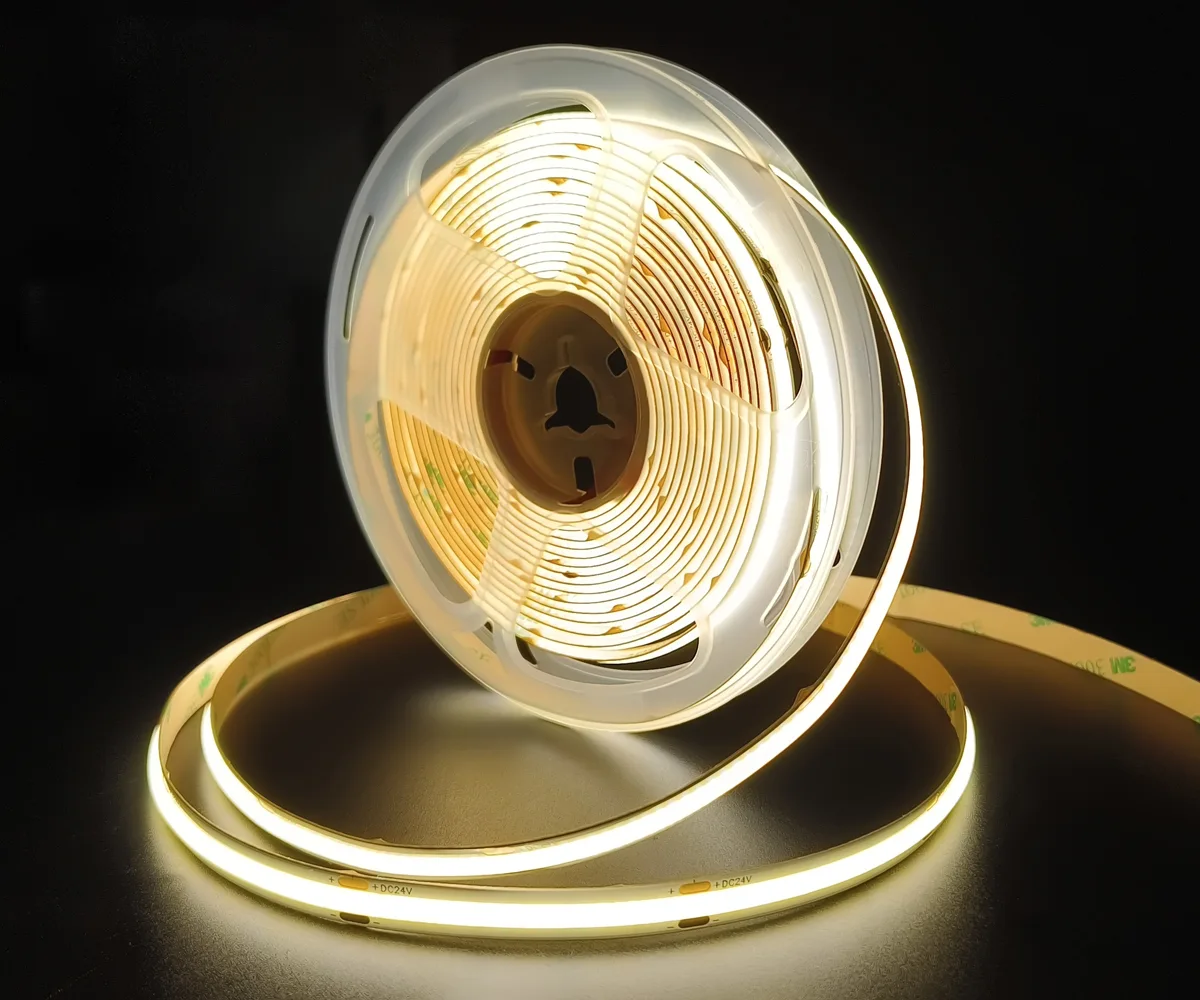
COB’s clearest advantage is optical uniformity where the light line remains visible at close range. Dense direct-chip mounting and a continuous phosphor layer blend individual points into a smooth luminous surface, which suits under-cabinet lighting, retail shelving, display cases, and shallow architectural profiles. This advantage should be evaluated separately from peak brightness.

Signliteed - 24VDC 흑백 COB LED 스트립_01

To address the most restrictive installation environments, specialized Ultra Thin COB designs can utilize highly compact 5mm PCB layouts. The direct chip mounting technique and the significantly reduced optical footprint permit these ultra-thin strips to be seamlessly integrated into narrow grooves, slim aluminum profiles, and tightly concealed architectural channels. However, designers must remain aware that utilizing a narrower PCB inherently reduces the available electrical routing space and decreases the thermal dissipation margins. Therefore, deploying these compact COB solutions necessitates careful pairing with appropriate power supplies and robust thermal management strategies to ensure long-term stability and sustained dot-free performance.

Application Fit Depends 영자형n Package Breadth, Geometry and Control Requirements

Application fit depends on visibility, control complexity, geometry, and the final specification. SMD families cover multiple packages and monochrome, tunable CCT, RGB, and RGBW configurations, while COB is particularly useful where a continuous light line is the main visual requirement. Neither architecture should be chosen from the technology label alone.

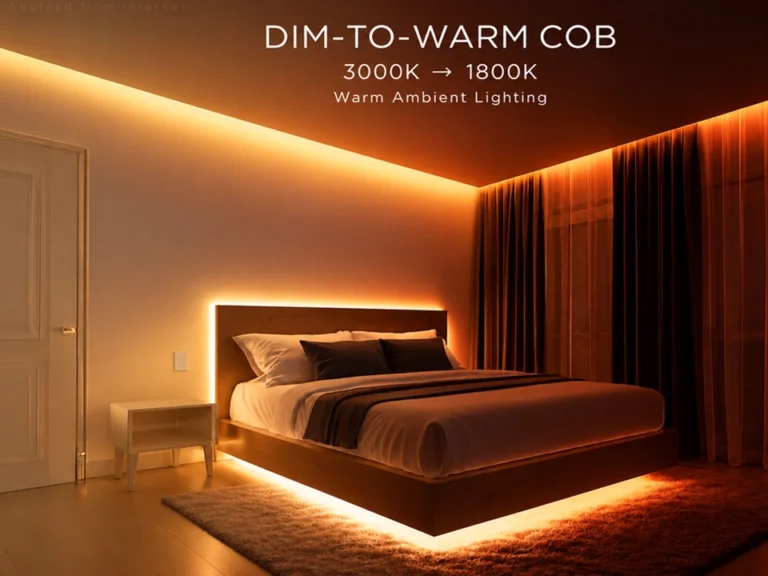
Conversely, COB technology is most effectively deployed in applications where a continuous linear appearance is the primary design objective, such as cove lighting, under-cabinet illumination, and premium retail displays. If a project expands to require tunable white, RGB color changing, or individually addressable control, COB products can support these functions, but they must be carefully selected based on their specific color architecture and compatible control methodologies. Project engineers must avoid treating “COB” as a singular, uniform functional category. The correct division of labor between SMD and COB arises directly from the structural constraints and control requirements of the installation, proving that the actual application environment dictates the engineering advantage far more than the technology label.

Certified Supplier Language Requires Product-Specific Compliance Scope

When selecting a manufacturing partner, the designation of a certified supplier must be substantiated by a clear correspondence between specific certificates and the exact products being procured. The verifiable compliance documentation supporting these strip products includes essential EMC and CE-RoHS certifications specifically designated for LED strip lights, alongside specialized photobiological safety compliance for particular COB configurations. The explicit listing of EMC and CE-RoHS certificates for LED strip lights provides the necessary electromagnetic compatibility and regulatory foundation required for commercial deployment. Furthermore, specific IEC 62471 certification tied directly to COB LED strips offers independent verification regarding photobiological safety, delivering targeted evidence for high-density lighting applications.

It is a critical procurement error to assume that a single factory certification blankets every product in the catalog. While various certifications may apply to sign tubes, panel lights, or outdoor high bay fixtures, those specific scopes cannot be generalized to validate the entire range of SMD and COB strip lights. The true credibility of a manufacturing supplier is rooted in the clarity and specificity of its compliance documentation, rather than an inflated count of unrelated certification acronyms. Whether specifying an SMD or a COB solution, purchasing teams must rigorously verify the exact SKU against the targeted market compliance files during the procurement phase to guarantee regulatory alignment.

A Specification-First Comparison Gives B2B Buyers a Defensible SMD Vs COB Decision

For B2B procurement professionals, the decision between SMD and COB must begin with the construction of a rigorous specification matrix that defines the target lumens per meter, efficacy, CRI, operating voltage, PCB width, IP rating, color control, and installation visibility. 사인라이트LED facilitates this specification-first approach by allowing the product architecture to fulfill these precise conditions, preventing buyers from prematurely committing to a technology camp without factual justification. Because the comprehensive LED strip product universe encompasses both SMD and COB technologies, project managers can objectively compare different structural solutions within a single, unified supply chain. This enables the simultaneous confirmation of compatible controllers, power supplies, connectors, and aluminum profiles, thereby eliminating the parameter discrepancies that often plague cross-supplier comparisons.

Catering to lighting distributors, project engineering firms, and facility buyers, the manufacturing infrastructure supports comprehensive OEM and ODM engineering customization. Consequently, sample validation can be executed under standardized testing conditions, allowing for a direct, equitable comparison of actual brightness, optical uniformity, color rendering, and installation performance between SMD and COB variants. Once the optimal specifications are confirmed through testing, the selected design seamlessly transitions into bulk production and final project integration. The definitive value of partnering with an established supplier lies in the ability to evaluate SMD and COB technologies using unified engineering specifications, transforming complex brightness and uniformity variables into defensible, repeatable procurement decisions.

자주 묻는 질문

다음 설치를 위한 자세한 제품 사양, 사용자 정의 기능 및 기술 프로젝트 지원을 알아보려면 공식 웹사이트를 방문하십시오. https://www.signliteled.com/.

사용자 정의 PCB 제조사용자 정의 PCB 제조
2026년 PCB 제조 및 RoHS 준수 LED
2026년에 RoHS 규정 준수는 포스트 프로덕션 체크리스트가 아닌 LED PCB의 핵심 제조 요구 사항이 되었습니다. 규제 시행이 더 엄격하고 문서화 기대치가 더 높으며 공급망 책임이 국경을 넘어 확장되고 있습니다. LED PCB는 재료의 복잡성, 열 요구 사항 및 ...
미국으로의 LED 조명 수입: 중국 공급업체 및 미국 구매자를 위한 관세 비교 및 비용 절감 전술
최근 중국 LED 조명에 대한 관세 인상 물결은 미국 구매자와 중국 제조업체 모두에게 불확실성을 야기했습니다. 수입업자들은 마진 감소와 선반 가격 상승에 대해 걱정하고 있는 반면, 공급업체는 증가하는 비용으로 경쟁력을 유지하기 위해 고군분투합니다. 이러한 우려는 단기 이익을 넘어 소싱 결정, 공급망 안정성, ...
DALI 대 PWM: 스마트 조명 시스템에 적합한 디밍 프로토콜 선택
현대적인 스마트 조명 시스템은 단순히 조명을 켜고 끄는 것 이상을 수행합니다. 편안함, 효율성 및 스타일을 향상시키는 적응 가능한 환경을 조성합니다. 모든 부드러운 밝기 변경 뒤에는 조용히 사용자 경험을 형성하는 디밍 프로토콜이 있습니다. 상업 프로젝트에서 가장 널리 사용되는 것은 Dali와 PWM입니다.
거울에 적합한 LED 스트립 조명을 선택하는 방법: 제조업체 및 프로젝트 계약자를 위한 가이드
오늘날의 상업 및 접객 환경에서 거울은 더 이상 반사 표면이 아니라 시각적 경험의 일부입니다. 고급 호텔 욕실, 쇼핑몰 화장실 또는 고급 세면대 설치에서 미러용 LED 스트립 조명은 기능과 미학 모두에서 중요한 역할을 합니다. 제조사 및 프로젝트 계약자의 경우 선택...
알아야 할 LED 네온 스트립 품질 관리 표준 및 테스트알아야 할 LED 네온 스트립 품질 관리 표준 및 테스트
LED 네온 스트립 품질 관리: 알아야 할 표준 및 테스트
LED 네온 스트립 조명 품질 관리를 위한 표준 및 테스트는 무엇이며, 그 기준은 무엇인가요? 구매자는 구매하는 LED 네온 스트립이 안전, 에너지 효율성 및 환경 보호에 대한 테스트를 거쳤는지 여부를 알아야 합니다. 이러한 테스트를 충족하는 제조업체만이 ...
LED 네온 플렉스를 위한 액세서리 필요 사항LED 네온 플렉스를 위한 액세서리 필요 사항
LED 네온 플렉스에는 어떤 액세서리가 필요합니까?
기존의 유리 네온 조명에 비해 여러 가지 장점이 있는 일반적인 조명 옵션은 LED 네온 플렉스입니다. 적응형 디자인, 에너지 경제성, 설치의 단순성으로 인해 많은 조명 애플리케이션에서 선호되는 옵션입니다. 그러나 적절한 액세서리를 준비하는 것이 중요합니다.

공유하다:

페이스북
지저귀다
핀터레스트
링크드인
구독하다
알림
guest
0 댓글
가장 오래된
최신 가장 많이 투표된
인라인 피드백
모든 댓글 보기

SignliteLED 블로그 검색

카테고리

위로 스크롤

지금 견적을 받으세요