English
  简体中文
简体中文  Deutsch
  Español
  Français
  Italiano
  日本語
日本語  한국어
한국어  Polski
  Português
  Русский
  Türkçe
  Nederlands
  Tiếng Việt
  ไทย
ไทย 
Choosing between front-lit, back-lit, and halo-lit LED letter signs affects more than the sign’s appearance. The lighting direction changes its construction, visibility, mounting requirements, LED layout, maintenance needs, and total project cost.
Front-lit letters illuminate through a translucent face for strong long-distance visibility. Halo-lit letters—also called reverse-channel or commonly back-lit letters—use a solid face and project light onto the wall behind them. Combination-lit letters produce both face illumination and a rear halo.
In this guide, we compare their appearance, construction, applications, cost drivers, LED specifications, mounting, and maintenance. We also explain what professional buyers should include in an RFQ and verify before approving production.
Quick Answer
Front-lit LED letters are the best choice for maximum brightness, long-distance visibility, and cost-effective storefront signage. Halo-lit or reverse-channel letters are better for premium architectural branding, provided the mounting wall is smooth and reflective. Choose combination-lit letters when both a bright face and rear halo are required, but expect higher manufacturing, wiring, installation, and maintenance costs.
Front-Lit vs Back-Lit vs Halo-Lit LED Letters: Quick Comparison
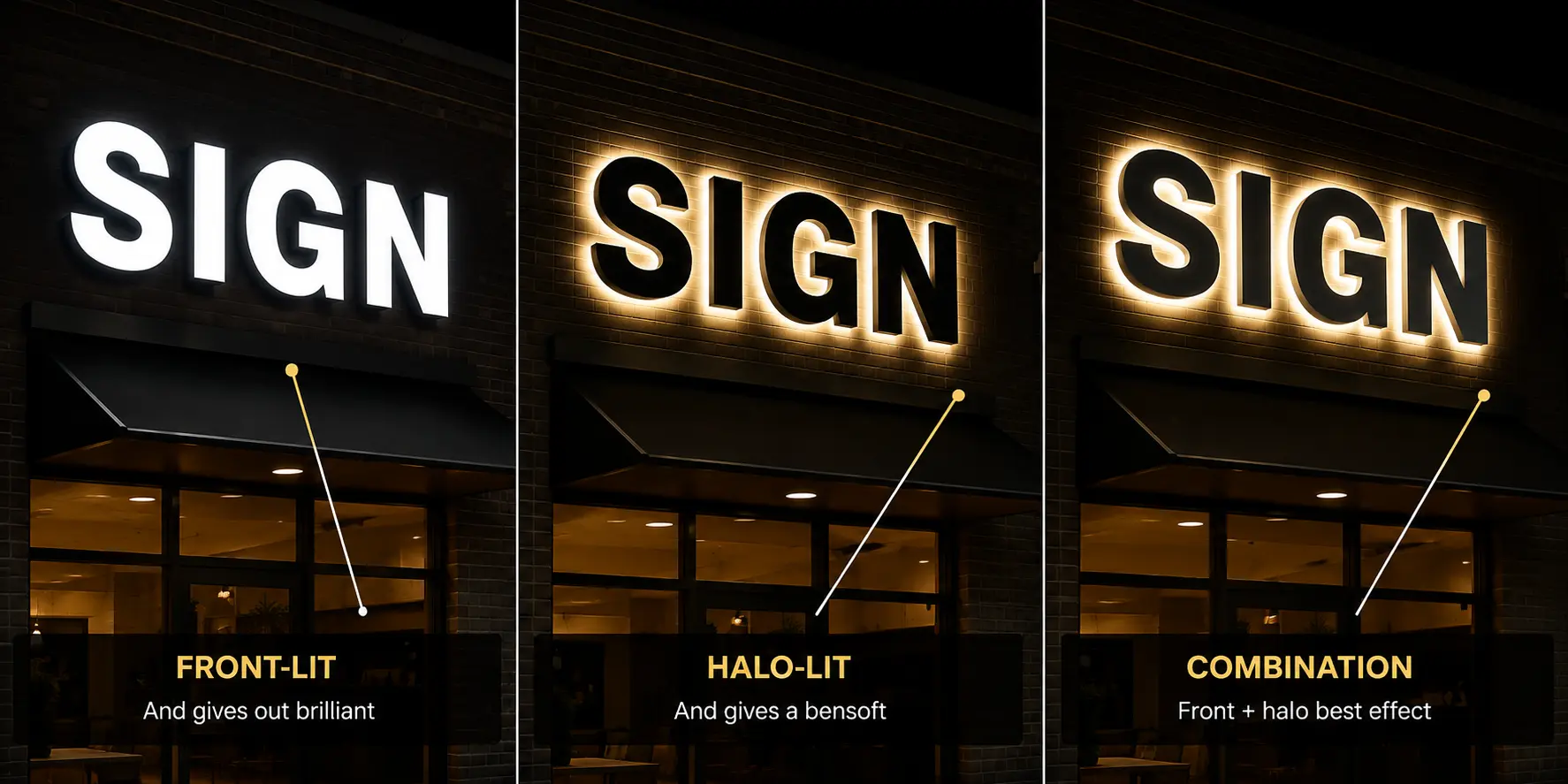
The main difference is where the light exits the letter. However, that choice also affects the face material, wall requirements, visibility, mounting, servicing, and quotation cost.
| Buyer consideration | Front-lit letters | Back-lit/Halo-lit letters | Combination-lit letters |
| Light direction | Forward through the letter face | Backward onto the mounting surface | Forward through the face and backward onto the wall |
| Typical construction | Translucent face with enclosed returns and internal LEDs | Solid metal face and returns with a clear or open rear lighting area | Translucent front face plus a separate rear-lighting system |
| Visible effect | Bright, illuminated letter face | Soft halo surrounding a non-illuminated face | Illuminated face with a rear halo |
| Daytime appearance | Brand color and letter shape remain prominent | Solid metal finish creates a premium architectural appearance | Visible branded face with dimensional metal construction |
| Long-distance visibility | Generally the strongest option | Better for close-to-medium viewing; the halo becomes less defined at distance | Strong face visibility with additional visual depth |
| Wall dependency | Low | High—the wall reflects and shapes the halo | Medium—the front remains visible even if the halo is weakened |
| Best mounting surface | Suitable for most properly prepared facades | Smooth, light-colored, non-glossy surfaces give the most predictable halo | Smooth surfaces are preferred for a uniform rear glow |
| Typical mounting | Direct mount, raceway or wireway | Stud-mounted with controlled standoff space | Direct/stud or raceway mounting with two lighting layouts |
| LED arrangement | Modules face the translucent front | Modules face the wall behind the letter | Separate front-facing and rear-facing LED layouts |
| Wiring complexity | Lowest of the three | Moderate | Highest; front and rear lighting may require separate circuits |
| Relative manufacturing cost | Usually lowest | Usually higher because of metal fabrication and standoff mounting | Usually highest because it combines two lighting systems |
| Maintenance consideration | Face removal may provide module access | Letter removal or rear access may be required | Two lighting layouts and circuits increase service complexity |
| Typical applications | Storefronts, shopping centers, QSRs and roadside branding | Hotels, corporate offices, luxury retail and reception logos | Flagship stores, auto showrooms and high-impact commercial projects |
| Choose it when | Visibility and cost control are priorities | Premium appearance is more important than maximum brightness | The project requires maximum day-and-night visual impact |
Terminology note: In channel-letter projects, “halo-lit,” “reverse-lit,” and “reverse-channel” normally describe the same rear-illumination construction. “Back-lit” is also commonly used for it, although suppliers may apply that term more broadly. Buyers should confirm the light direction, face material, rear construction, and mounting drawing before ordering.
The cost, brightness, module quantity, and installation difficulty shown here are relative comparisons. Final values depend on the letter dimensions, stroke width, return depth, materials, LED model, mounting surface, order quantity, and installation location.
What is a front-lit LED letter sign
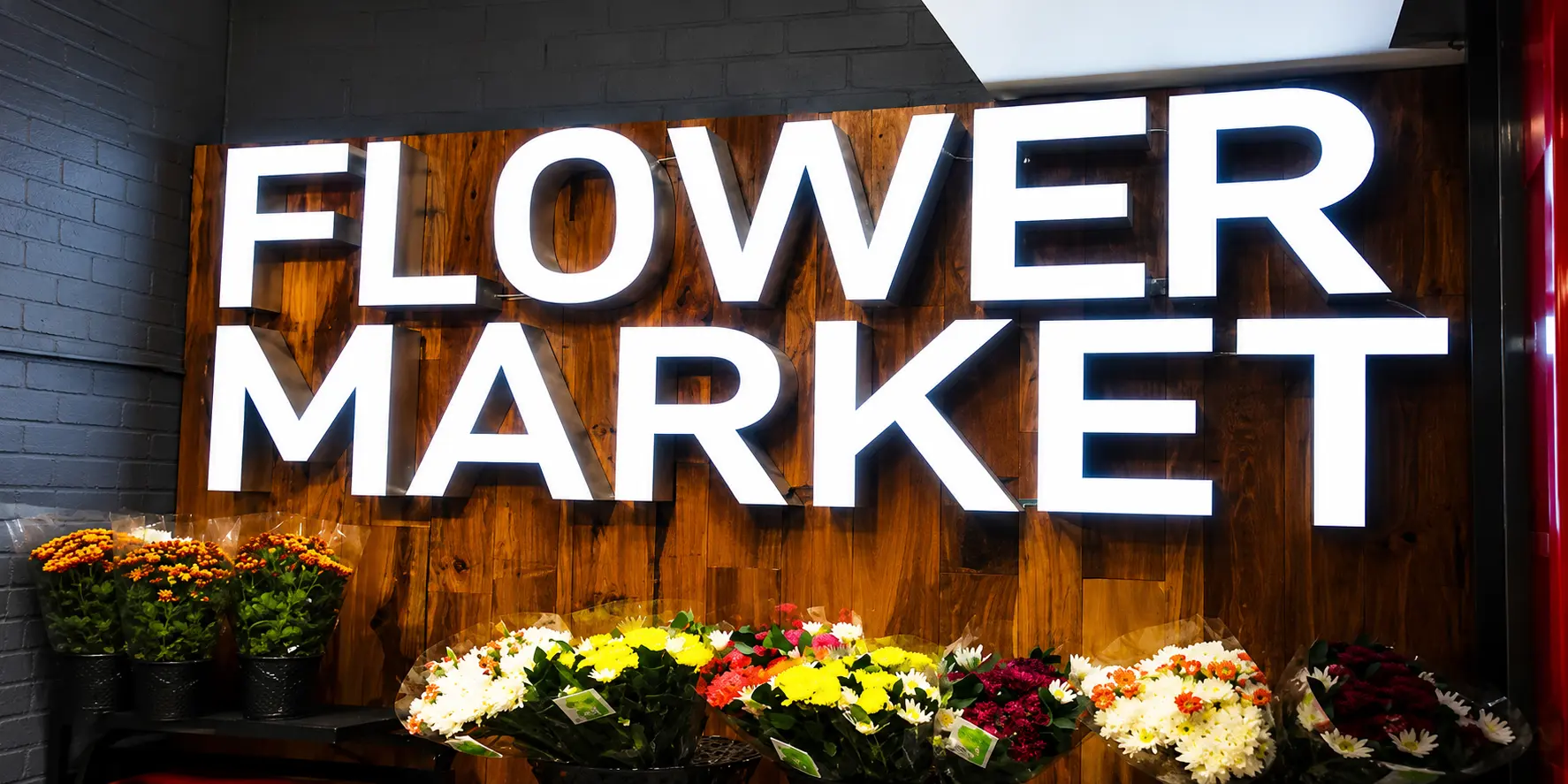
A front-lit LED letter sign is an illuminated channel letter with a translucent face that glows outward, lit by LED modules mounted inside the letter cavity behind the face.
The face is typically 3 mm (⅛″) cast acrylic, chosen because it diffuses light rather than letting it pass straight through. Behind it sits the return (the letter’s sidewall), while the interior contains a grid of LED modules bonded to the base of the can. The modules are arranged in rows and columns, not as a single strip, and are spaced so their beams overlap before reaching the face.
Proper beam overlap creates one even sheet of light. Poor spacing produces hotspots, where bright dots appear beneath each module with darker gaps between them. (The engineering behind that spacing is covered in “What LED lighting goes inside each type?” below.)
Front-lit letters are the preferred choice when signs must remain legible in full daylight and readable from a distance. The glowing face carries the brand color and shape directly, so the letters remain recognizable whether the LEDs are on or off. This makes them the default choice for storefronts, high-traffic frontages, and any sign that must perform equally well during the day and after dark.
For finishes, face colors, and sizing options, see our LED Illuminated Letters Signs page.
What is a halo-lit (reverse channel) LED letter sign?
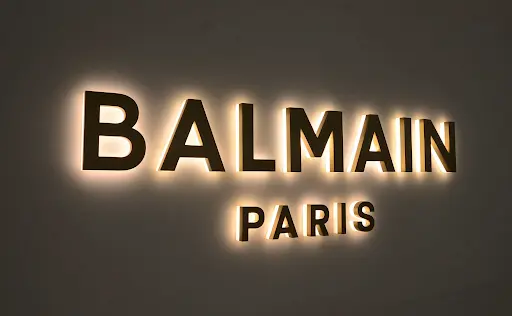
A halo-lit LED letter sign is a reverse-channel letter with an opaque face that projects light backward onto the wall, creating a glowing halo outline around the letter.
Its construction is the opposite of a front-lit letter. The face is solid metal, typically aluminum or stainless steel, while the return wraps back toward the wall and leaves the rear of the letter open. LED modules or strips are mounted inside that open back, facing the mounting surface instead of the viewer.
Because the metal face blocks all forward light, nothing on the letter itself glows. The visible effect comes entirely from reflected light around the edges. “Back-lit” is the common everyday name for this style, while the precise terms are reverse channel or halo-lit.
The standoff distance, created by mounting spacers or studs, is typically 38–50 mm (1.5–2 in) and is the most important variable a manufacturer controls. A shorter standoff creates a tighter, sharper halo, while a longer standoff spreads the light farther for a wider, softer glow. If the gap is too short, individual LED points may become visible. If it is too long, the halo becomes weak and diffuse.
Because halo lighting depends entirely on reflected light, the mounting surface matters as much as the letter itself. A light-coloured, smooth wall reflects the halo cleanly, while dark walls absorb the light and heavily textured surfaces such as rough stone, deep brick, or stucco scatter it into a patchy outline. This should be confirmed before the letters are engineered, not during installation.
Halo-lit letters suit premium, understated branding. Their clean metal face looks refined during the day, while the halo provides strong nighttime impact. They are commonly used in upscale interiors, corporate lobbies, and brand-conscious storefronts where closer viewing distances favor an architectural appearance over maximum long-distance readability.
For the LED modules engineered specifically for this reflected-light application, see our back-lit LED module range.
What LED lighting goes inside each type?
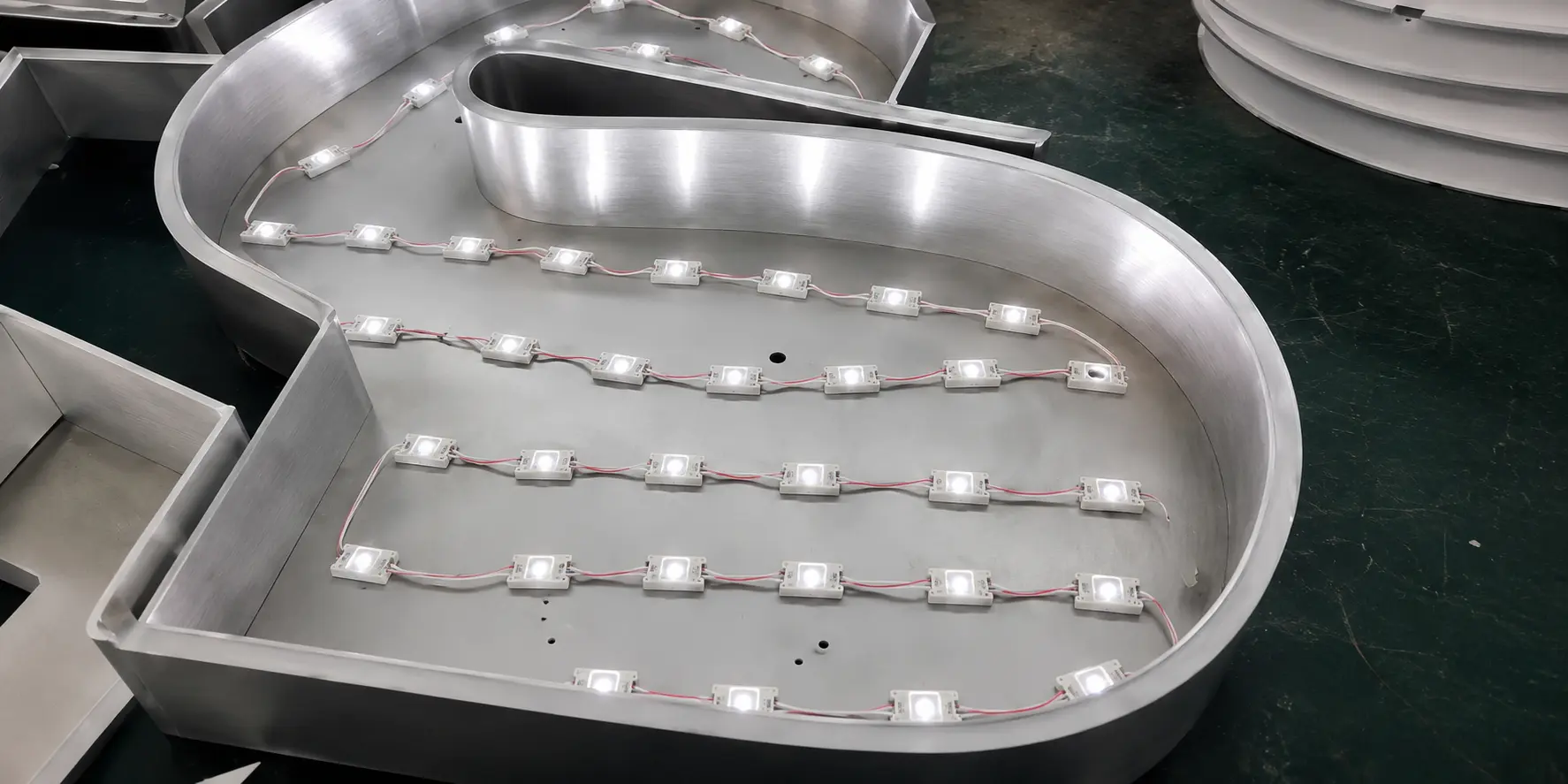
The lit style determines the LED layout, and the LED layout determines module choice, spacing, and voltage. For a broader look at how illuminated sign letters are lit in general, see our guide on what LED lighting is used inside illuminated sign letters.
Front-lit letters use LED modules arranged across the letter back and directed toward the translucent face. One suitable SignliteLED option is the SMD2835-3LED-0.9W UTX358B series, a DC12V, IP67 module with three SMD2835 LEDs, a 160° lens, Ra >80, and up to 90 lm output for the listed white-light variants. Its wide lens helps the light from adjacent modules overlap, but the final module spacing must still be determined from the letter depth, stroke width, face material, and required brightness.
Buyer check: Do not approve a quotation that states only “LED modules.” Request the exact module model, voltage, wattage, color temperature, module count, layout drawing, IP rating, and total connected load.
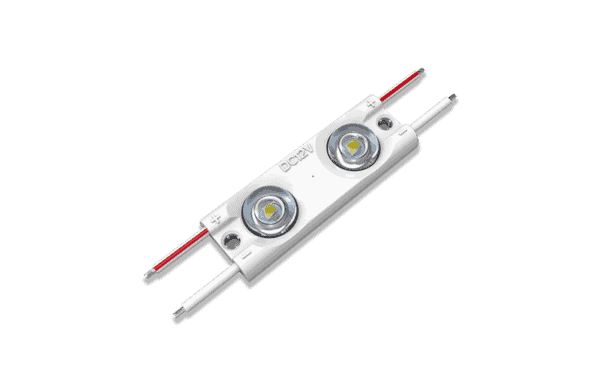
Single Color 2LED DC12V LED Module Light
- Exposed PCB design for good heat dissipation
- Low light failure for a longer lifespan
- 9V high-power LED chips for brighter output and higher efficiency
- Constant current design for less voltage drop
- Connect more per chain
- 160° lens for even illumination
- Suitable for thin signs
Halo-lit (reverse channel) letters use modules or strips mounted on the open back and facing the wall, commonly SMD2835-2LED-0.6W (UTX357B). Because there is no illuminated face, hotspot control is less important than maintaining even output around the perimeter so the halo remains uniform instead of blotchy.
Combination letters use two separate lighting layouts: a front grid and a rear halo run. These operate on separate circuits so each system can be controlled independently.
Voltage and long letters
The UTX358B and UTX357B modules referenced in this guide are DC12V products. Their nominal module current is approximately 75 mA for a 0.9W module and 50 mA for a 0.6W module, calculated from power ÷ voltage.
Long letters should not automatically be changed to 24V unless a compatible 24V module has been selected. Voltage drop in a 12V system should be controlled through suitable wire size, shorter module chains, parallel power feeds, correct power-supply placement, and compliance with the manufacturer’s maximum modules-per-chain specification. Never connect a DC12V module directly to a DC24V supply.
Color consistency
The UTX358B product series uses 3-step MacAdam color binning to limit visible color variation between white LED modules. This is especially important in front-lit letters, where modules with inconsistent chromaticity can make different areas of the acrylic face appear warmer or cooler.
Color consistency and color rendering are separate specifications: 3-step SDCM describes chromaticity consistency between modules, while Ra >80 describes how accurately the light renders colors. Buyers should specify the required CCT and binning tolerance and avoid mixing production batches within the same sign face.
IP rating, environment, and service life
The UTX358B and UTX357B modules referenced in this guide are listed as IP67. This rating applies to the LED module—not automatically to the completed channel letter. Connectors, cable entries, power supplies, letter seams, and installation penetrations must also be protected for the complete system to withstand outdoor exposure.
IP67 indicates protection against dust and temporary water immersion under specified test conditions. It does not by itself confirm resistance to salt corrosion, ultraviolet exposure, chemicals, or high-pressure washing. Coastal projects also require suitable metal grades, surface finishes, wiring accessories, and corrosion protection.
The product pages describe these modules as having low light decay and a longer lifespan but do not publish an L70 test result on the page. A fixed “50,000 hours to L70” claim should therefore only be used if SignliteLED can provide the applicable datasheet or test report. Buyers should request the rated-life basis, operating-temperature limits, warranty period, and replacement-part availability in the quotation.
| Sign Type | LED Layout | Module (real) | Watt | Voltage | Beam | IP |
| Front-lit | Grid across can base, facing acrylic | SMD2835-3LED-0.9W (UTX358B) | 0.9 W | DC12V | 160° | IP67 |
| Halo-lit (reverse) | Modules on open back, facing wall | SMD2835-2LED-0.6W (UTX357B) | 0.6 W | DC12V | 160° | IP67 |
| Combination | Front grid + rear halo run, separate circuits | UTX358B + UTX357B | 0.6–0.9 W | DC12V; separate layouts | 160° | IP67 |
Module pitch and per-letter spacing in mm vary with letter depth and are set at production.
For the modules engineered for each application, see our back-lit LED module and side-lit LED module pages.
Which LED Letter Type Fits Each Commercial Application?
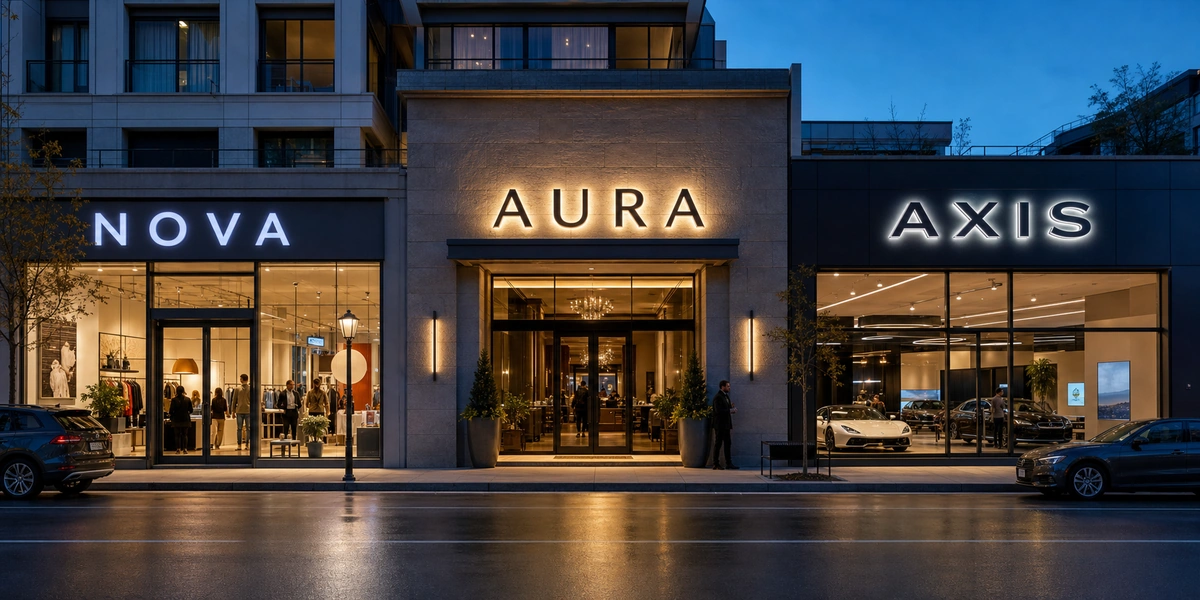
Industry alone does not determine the correct letter type. Viewing distance, facade material, ambient light, landlord requirements, operating hours, brand positioning, and maintenance access can change the recommendation. The following options should be treated as project starting points rather than fixed rules.
| Project application | Typical starting choice | Purchasing reason | Confirm before ordering |
| Road-facing retail storefront | Front-lit | The illuminated face preserves the complete letter shape and brand color for daytime and long-distance identification | Viewing distance, permitted letter height, face color, landlord sign criteria, and raceway restrictions |
| Restaurant or QSR | Front-lit or combination | Front illumination supports brand recognition; a rear halo can add nighttime impact where evening traffic justifies the extra cost | Operating hours, surrounding ambient light, separate front/rear circuits, and driver access |
| Hotel facade or reception | Halo-lit | A solid metal face and reflected glow create a restrained architectural appearance at closer viewing distances | Wall color and texture, metal finish, CCT, standoff distance, and a nighttime sample |
| Corporate lobby | Halo-lit | Controlled indoor lighting and close viewing allow the halo and metal finish to remain visible without an intensely illuminated face | Wall reflectance, concealed wiring route, dimming requirement, and service access |
| Multi-tenant shopping center | Front-lit | Standardized front illumination gives each tenant recognizable branding and is easier to control through a sign program | Tenant-sign manual, permitted face colors, return depth, mounting method, and brightness restrictions |
| Auto dealership or flagship store | Combination | The lit face supports distance visibility while the rear halo adds depth and high-value nighttime presentation | Separate LED layouts, total connected load, driver capacity, controls, and maintenance access |
| Dark brick, stone, or textured facade | Front-lit or halo mock-up | Rough and dark surfaces can absorb or scatter rear light, making a specified halo unpredictable | Full-size nighttime sample, wall condition, halo uniformity, wiring concealment, and mounting approval |
| Coastal outdoor project | Project-dependent | Illumination style is less important than environmental construction and corrosion protection | Metal grade, surface treatment, connectors, cable entries, drainage, driver enclosure, and warranty conditions |
Procurement note: For halo-lit and combination letters, provide the supplier with daytime and nighttime site photographs whenever possible. A letter drawing alone cannot show how the mounting surface will reflect the rear light.
See more real installations in our LED Illuminated Letters application gallery.
What about front + halo combination letters?
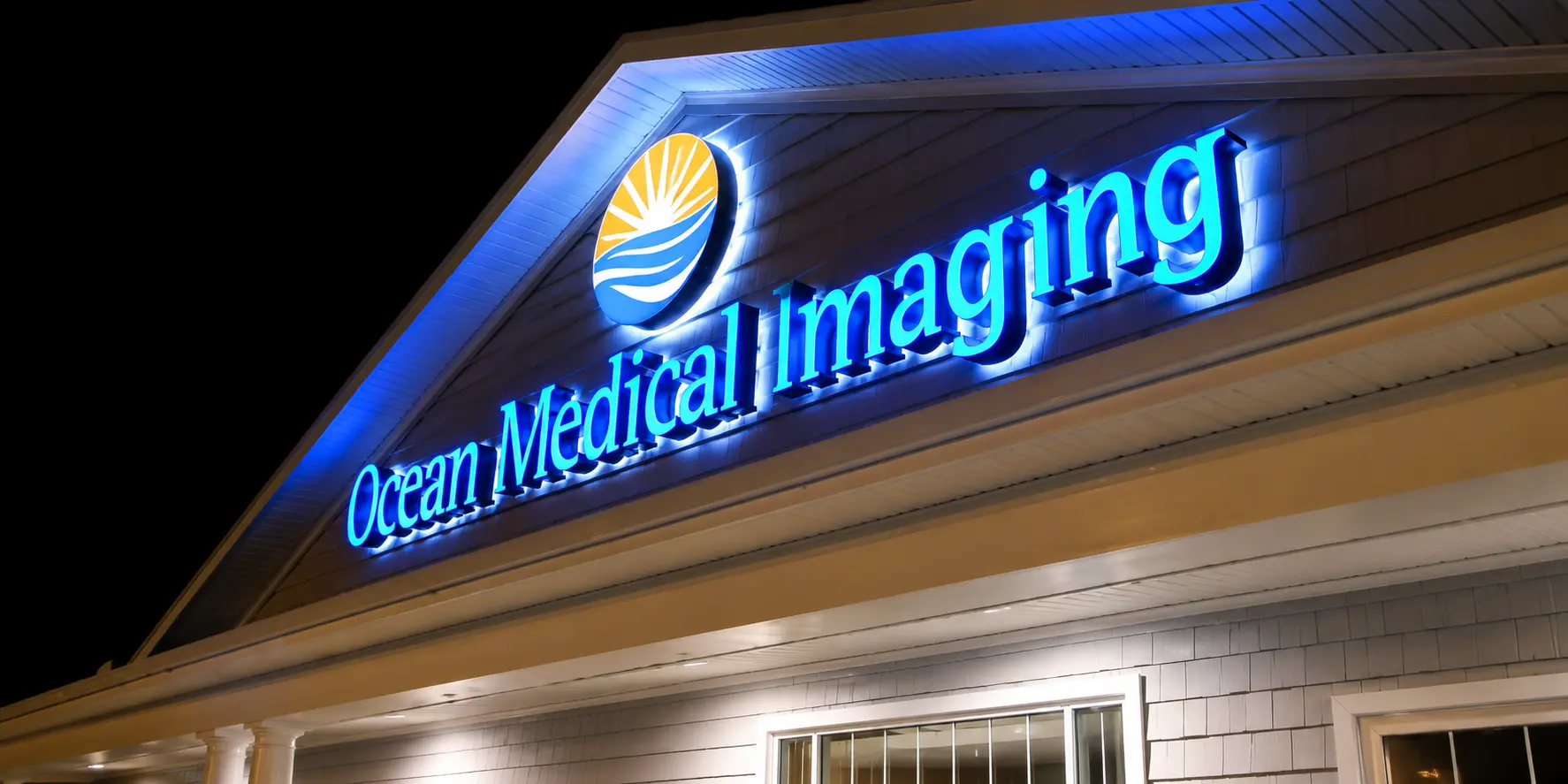
A combination LED letter uses two independent lighting systems: a front-lit grid and a rear halo run, allowing the face and wall halo to operate together or independently.
The two lighting systems are wired as separate circuits, typically on their own drivers or output channels rather than sharing one supply. Because they operate independently, each can be switched, dimmed, or colored on its own. You can run a warm-white lit face with a cool-white halo, dim the halo while keeping the face at full output, or switch either layer off entirely. This level of control is not available with a single-circuit letter.
Inside the letter, each lighting layer uses a module matched to its purpose. The front grid uses a higher-output module such as the UTX358B (SMD2835, 3 LEDs, 0.9W) to create an even, bright acrylic face. The halo run uses a lower-output module such as the UTX357B (SMD2835, 2 LEDs, 0.6W) because reflected wall light requires less intensity than a lit face. Matching each module to its application keeps both lighting effects balanced.
The trade-off is additional engineering. Two lighting layouts require more modules, more wiring runs, a larger combined power budget, and usually a controller to manage separate channels. This increases cost compared with both front-lit and halo-lit letters. In return, you get maximum day-and-night visibility with a fully legible face and a wall halo working together around the clock.
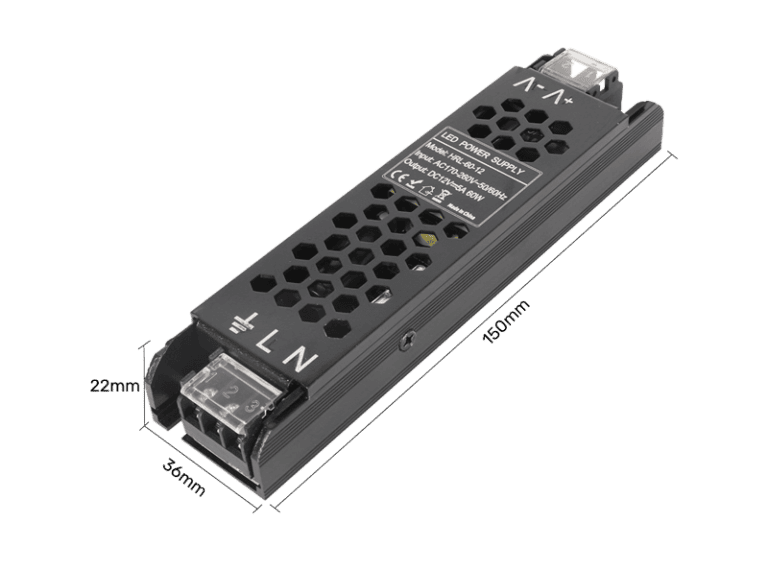
12V Ultra Thin Driver for LED Strip Light
- Input Voltage: AC110-260V
- Frequency Range: 47-63Hz
- Power Factor: 0.5-0.6
- Efficiency: >80%
- Rated Power: 60W
- Output Voltage: DC12V
- Rated Current: 5A
- IP Rating: IP20
- Warranty: 3 Years
- Dimension: L150 × W36 × H22mm
Plan the channels and power accordingly. See our LED Controller and LED Power Supply pages for matching drivers and controls to a two-layer build.
Visibility and readability — day vs night
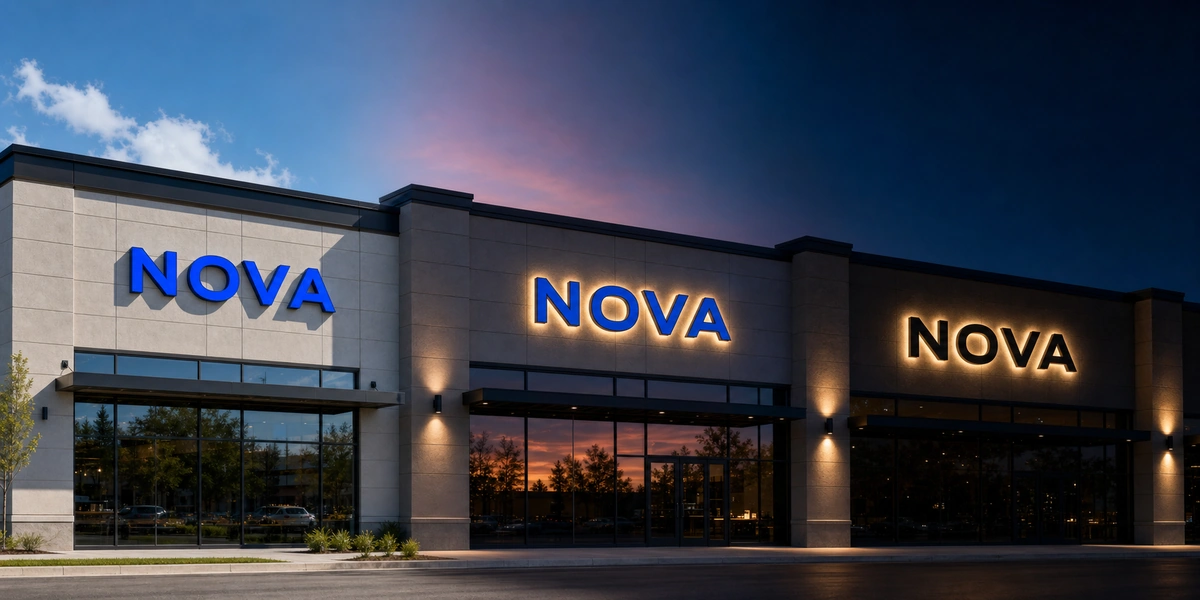
Front-lit letters provide the strongest daytime readability, halo-lit letters create the strongest architectural night effect, and combination letters deliver both.
Readability depends on two factors: how the letter performs in different lighting conditions and the height of the letters. The lighting style determines the first, while letter height determines the second.
During daylight, front-lit letters perform best. The illuminated face carries the brand color and shape whether the LEDs are on or off, allowing the sign to remain fully legible under full sun and visible from long distances. Halo-lit letters rely on reflected wall light, which is overwhelmed by daylight, so they appear as clean metal letters without a visible halo. Combination letters share the daytime advantage because of their illuminated face.
At dusk, the difference becomes smaller. As ambient light decreases, the halo begins to appear, allowing halo-lit and combination letters to gain visual presence while front-lit faces remain consistently bright.
At night, each style creates a different viewing experience. A front-lit face remains the most legible because the evenly illuminated surface maintains its color and shape over long viewing distances. Halo-lit letters produce a softer, architectural glow that becomes harder to distinguish as viewing distance increases because the eye reads the surrounding halo rather than an illuminated face. Combination letters provide both a readable illuminated face and a surrounding halo, making them suitable for both long sightlines and close viewing.
The legibility rule
As an industry guideline, a sign is comfortably readable at roughly 10 feet of distance for every 1 inch of letter height — about 3 metres per 25 mm.
This guideline is a starting point rather than a guarantee. Contrast, lighting style, and viewing conditions all influence actual readability, while a soft halo generally becomes harder to read at distance than a bright illuminated face of the same size.
SignliteLED letters run from 100 mm to 2000 mm tall, covering everything from close interior logos to large building-top signage.
| Letter Height | Approx. Max Readable Distance |
| 100 mm (4 in) | ~40 ft (12 m) |
| 300 mm (12 in) | ~120 ft (37 m) |
| 600 mm (24 in) | ~240 ft (73 m) |
| 1000 mm (40 in) | ~400 ft (122 m) |
| 2000 mm (79 in) | ~790 ft (240 m) |
Color temperature (CCT) — matching light to face and material
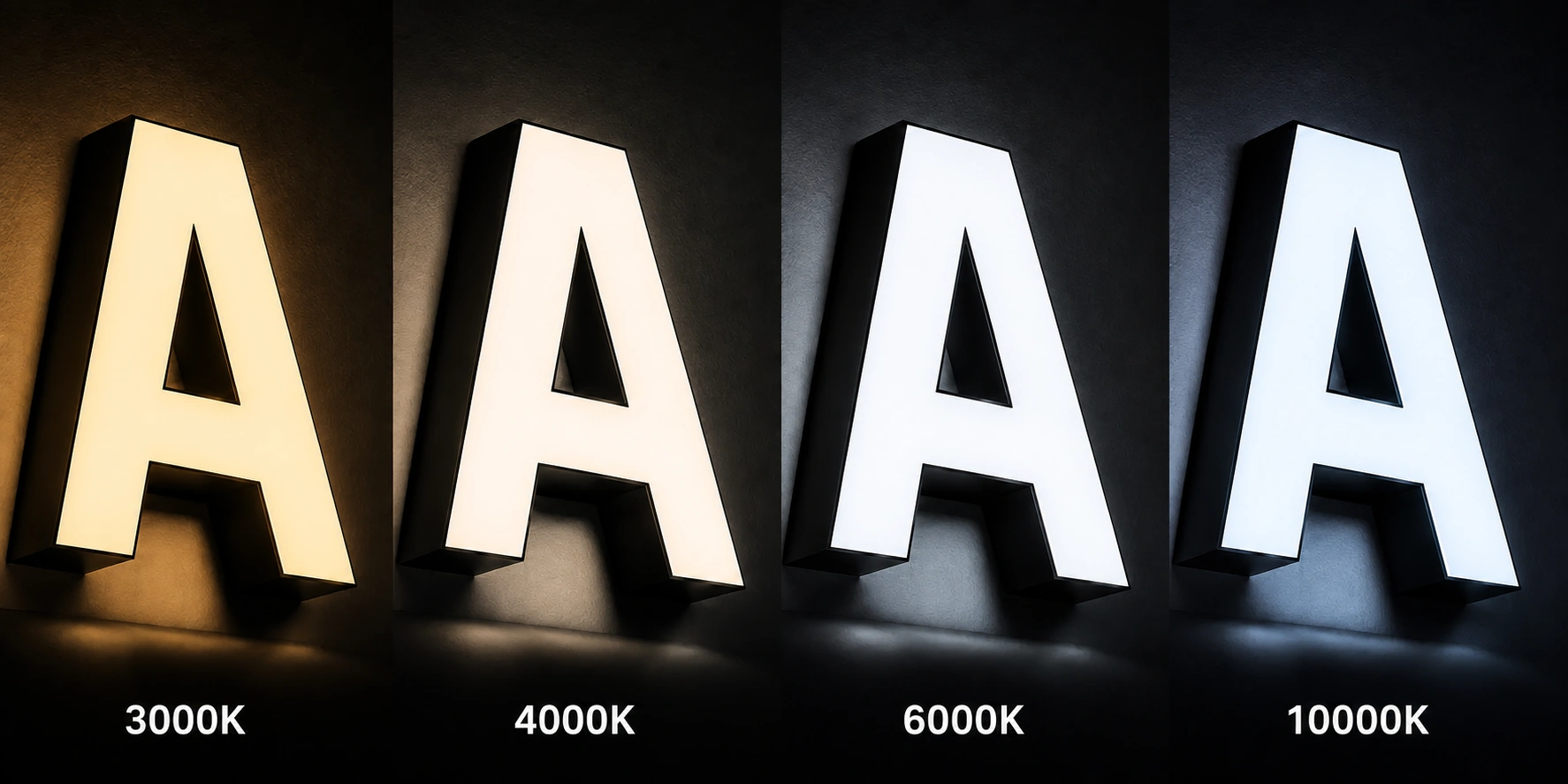
The right color temperature depends on the face material, wall surface, and the lighting effect you want to achieve.
Color temperature, measured in Kelvin (K), determines how warm or cool white light appears. Our modules are available in 3000K, 4000K, 6000K, and 10000K, and each performs differently depending on the application. see our full 3000K vs 4000K vs 5000K vs 6000K comparison for more on choosing color temperature
On a front-lit acrylic face, the face color influences how the CCT appears. 3000K produces a soft, amber-leaning glow that suits cream, ivory, and warm brand colors. Behind bright white acrylic, however, it can appear creamy or slightly dingy instead of clean white.
4000K is the most versatile option. It renders white acrylic as true white while reproducing most brand colors accurately, making it the safest specification when you’re unsure.
6000K creates a crisp, bright, modern appearance that suits clinical, technology, and contemporary branding.
10000K produces an even cooler, blue-leaning white for the sharpest, coolest appearance.
For halo-lit letters, the reflected surface matters as much as the face. Stainless steel and light, neutral-colored walls reflect cooler CCTs cleanly, making 6000K ideal for a sharp, modern halo. On beige, wood, or warm stone walls, 3000K complements the surface color and creates a softer, more inviting glow.
For dynamic lighting or exact brand colors, RGB modules (SMD5050) allow a sign to change colors or display a specific brand hue. On combination letters, RGB lighting can be controlled independently for each lighting system.
Always confirm the CCT against the face material and wall before production. It is much easier to specify correctly than to relamp a completed letter.
How Much Do Front-Lit, Halo-Lit, and Combination Letters Cost?
Front-lit letters usually have the lowest manufacturing cost, halo-lit letters generally cost more, and combination-lit letters normally cost the most. However, buyers should not compare prices until the quotations use the same letter dimensions, materials, LED specifications, mounting method, quantity, and delivery terms.
Why the Manufacturing Cost Differs
| Cost component | Front-lit | Halo-lit | Combination-lit |
| Main construction | Translucent face, returns, back, and one LED layout | Finished metal face and returns, rear-lighting construction, and standoffs | Front-lit construction plus a separate rear-lighting system |
| LED system | One forward-facing module layout | One rear-facing module layout | Two module layouts |
| Wiring and control | Usually one lighting circuit | Usually one lighting circuit | Separate front and rear circuits may be required |
| Fabrication labor | Generally lowest | Higher because the visible metal face and finish require more fabrication work | Highest because both lighting constructions must be integrated |
| Installation | Direct, raceway, or wireway mounting | Requires consistent spacing from the wall | Requires halo spacing plus additional wiring and power capacity |
| Relative factory cost | Usually lowest | Usually higher | Usually highest |
Important: These are relative comparisons, not fixed price rules. A large, highly customized front-lit sign can cost more than a small, standard halo-lit sign.
Channel Letter Prices at a Glance
| Supply level | Construction | Published price | 12-inch letter equivalent |
| SignliteLED export estimate | Front-lit | $70–$150 per 12-inch letter | $70–$150 |
| U.S. wholesale | Standard front-lit | Starting at $12.95 per inch | $155.40 |
| U.S. wholesale | Standard back-lit/halo-lit | Starting at $16.18 per inch | $194.16 |
| U.S. wholesale | Front-and-back/combination-lit | Starting at $16.18 per inch | $194.16 |
| U.S. wholesale | Hidden-back halo-lit, fabricated stainless steel | Starting at $28.00 per inch | $336.00 |
| U.S. wholesale | Exposed-acrylic-back halo-lit, fabricated stainless steel | Starting at $30.80 per inch | $369.60 |
Calculation note: The 12-inch wholesale equivalents were calculated by multiplying each published per-inch price by 12. These are starting fabrication prices, not complete installed-project totals.
U.S. Installed Project Budgets
| Sign construction | Typical installed project range |
| Front-lit/face-lit channel-letter set | $2,000–$6,000 |
| Halo-lit/reverse-channel set | $3,000–$8,000 |
| Combination-lit or full-color RGB set | $5,000–$12,000+ |
| Large, complex, or premium project | May exceed $20,000 |
Installed-price note: These figures apply to a complete storefront sign project rather than one individual letter. The quotation may include design, fabrication, mounting, electrical connection, access equipment, and installation. Permits, structural work, wall repair, and unusual site access may be charged separately.
SignliteLED Front-Lit Factory Estimates by Size
| Letter height | Estimated factory price per letter |
| 8 inches (200 mm) | $40–$80 |
| 12 inches (300 mm) | $70–$150 |
| 18 inches (450 mm) | $120–$250 |
| 24 inches (600 mm) | $180–$400 |
| 36 inches+ (900 mm+) | $350–$800+ |
Pricing methodology: Prices were checked in August 2026. SignliteLED figures are general export estimates, U.S. wholesale values are published starting prices, and installed figures are project-level market ranges. They should not be treated as directly equivalent quotations. Final pricing depends on artwork, dimensions, materials, lighting construction, quantity, mounting, freight, and installation scope.
How Much Does Each Type Cost to Run?
The operating cost depends on the completed sign’s measured input power, operating hours, electricity rate, and power-supply efficiency—not simply whether the letters are front-lit or halo-lit.
Use this formula:
Annual electricity cost = system watts ÷ 1,000 × operating hours per day × 365 × electricity rate
The following example uses SignliteLED’s 0.9W UTX358B modules for front illumination and 0.6W UTX357B modules for halo illumination. Electricity is calculated at $0.15/kWh.
| Example LED layout | LED load | 8 hours/day | 12 hours/day | 16 hours/day |
| Front-lit: 100 × 0.9W modules | 90W | $39.42/year | $59.13/year | $78.84/year |
| Halo-lit: 100 × 0.6W modules | 60W | $26.28/year | $39.42/year | $52.56/year |
| Combination: 100 front + 100 halo modules | 150W | $65.70/year | $98.55/year | $131.40/year |
Worked Calculation
For the 90W front-lit example operating for 12 hours per day:
90W ÷ 1,000 × 12 × 365 × $0.15 = $59.13 per year
Calculation limits: These figures represent the connected LED-module load. Actual AC energy consumption will be higher because the power supply is not 100% efficient. Final module count also depends on the artwork, letter depth, stroke width, module spacing, wall reflectance, and brightness requirement. Therefore, this table is a calculation model—not proof that every halo-lit sign consumes less power than every front-lit sign.
Worked Example: 10-Letter, 24-Inch Storefront Sign
This example shows how a buyer can estimate connected load and annual electricity cost before receiving the final module-layout drawing.
Estimating Assumptions
- Ten individual letters
- Letter height: 24 inches (600 mm)
- Illustrative module count: six modules per letter for each lighting layer
- Front-lit module: UTX358B, 0.9W
- Halo-lit module: UTX357B, 0.6W
- Operating schedule: 12 hours per day
- Electricity rate: $0.15/kWh
- Power-supply losses excluded
| Lighting type | Illustrative module count | Connected LED load | Annual energy | Annual cost | Monthly cost |
| Front-lit | 60 × 0.9W | 54W | 236.52kWh | $35.48 | $2.96 |
| Halo-lit | 60 × 0.6W | 36W | 157.68kWh | $23.65 | $1.97 |
| Combination-lit | 60 front + 60 halo | 90W | 394.20kWh | $59.13 | $4.93 |
For the front-lit layout:
60 modules × 0.9W = 54W connected LED load
54W ÷ 1,000 × 12 hours × 365 days = 236.52kWh per year
236.52kWh × $0.15 = $35.48 per year
Engineering limitation: Six modules per letter is an estimating assumption—not a production specification. Two letters with the same height may require different module counts because their stroke widths, shapes, cavity depths, face materials, and internal areas are different. The final count must come from the approved artwork and module-layout drawing.
What the Buyer Should Verify
Before approving production, request:
- Module count for every letter and logo element
- Total connected watts for each lighting circuit
- Power-supply model and rated output
- Power-supply loading and design margin
- Wiring diagram and power-feed locations
- Estimated AC input power, including driver losses
- Replacement module and driver specifications
Seven Specification Mistakes That Cause Channel-Letter Problems
Many channel-letter failures blamed on the LEDs actually begin with an incomplete specification: an ambiguous construction drawing, unsuitable mounting surface, unverified module model, poorly planned power feed, incomplete waterproofing, or inaccessible driver. Buyers should close the following seven checks before issuing a purchase order or approving production.
1. Ordering by Product Name Instead of Construction Drawing
“Back-lit,” “halo-lit,” and “reverse-lit” may be used differently by suppliers. A buyer who approves only a product name may receive a different face material, rear construction, or lighting effect than expected.
Prevent it: Approve a cross-section drawing showing the face, returns, back, LED direction, standoff, mounting hardware, and wiring exit.
2. Approving Halo-Lit Letters Without Checking the Wall
A light, smooth, matte surface normally produces a cleaner halo. Dark walls absorb more light, while brick, stone, stucco, joints, and glossy finishes can scatter the reflection or reveal individual LED points.
Prevent it: Send the supplier site photographs and wall specifications. For difficult surfaces, request a nighttime sample using the intended finish and standoff distance.
3. Treating an IP67 Module as an IP67 Complete Sign
The IP rating shown on a module product page applies to that module. Connectors, cable joints, power supplies, drainage paths, seams, and wall penetrations can still allow water to enter the completed system.
Prevent it: Request the waterproofing method for the complete assembly, including connectors, cable entries, drainage, driver enclosure, and installation penetrations.
4. Accepting “Premium LEDs” Without an Exact Model
A quotation stating only “high-quality LED modules” does not allow the buyer to verify wattage, voltage, beam angle, output, IP rating, color binning, chain length, or replacement compatibility.
Prevent it: Require the LED manufacturer, exact model, CCT or wavelength, module count, module-layout drawing, total connected load, and product specification sheet.
5. Ignoring Voltage Drop and Power-Feed Design
Using DC12V modules is not itself a mistake. Problems occur when the wire is undersized, the chain is too long, the power supply is too far away, or too many modules depend on one feed. Modules at the far end may then operate at a lower voltage and appear dimmer.
Prevent it: Request the wiring diagram, wire size, modules per chain, feed locations, voltage at the farthest module, and power-supply loading. Never connect DC12V modules to a DC24V supply.
6. Mixing Color Temperatures or Production Batches
Modules labelled with the same general white color can still show visible chromaticity differences. This becomes particularly noticeable behind a white acrylic face or across letters installed side by side.
Prevent it: Specify the CCT and binning tolerance, keep modules for one sign set within the same approved batch, and order matching spare modules with the project.
7. Designing the Sign Without a Service Plan
A low initial quotation can become expensive if a technician must remove multiple letters or damage the facade to reach a power supply, connector, or failed module.
Prevent it: Confirm how the face or letter will be opened, where drivers will be installed, whether they remain accessible, and which spare modules, connectors, and power supplies will be supplied.
How Are Channel Letters Mounted: Direct, Raceway, or Wireway?
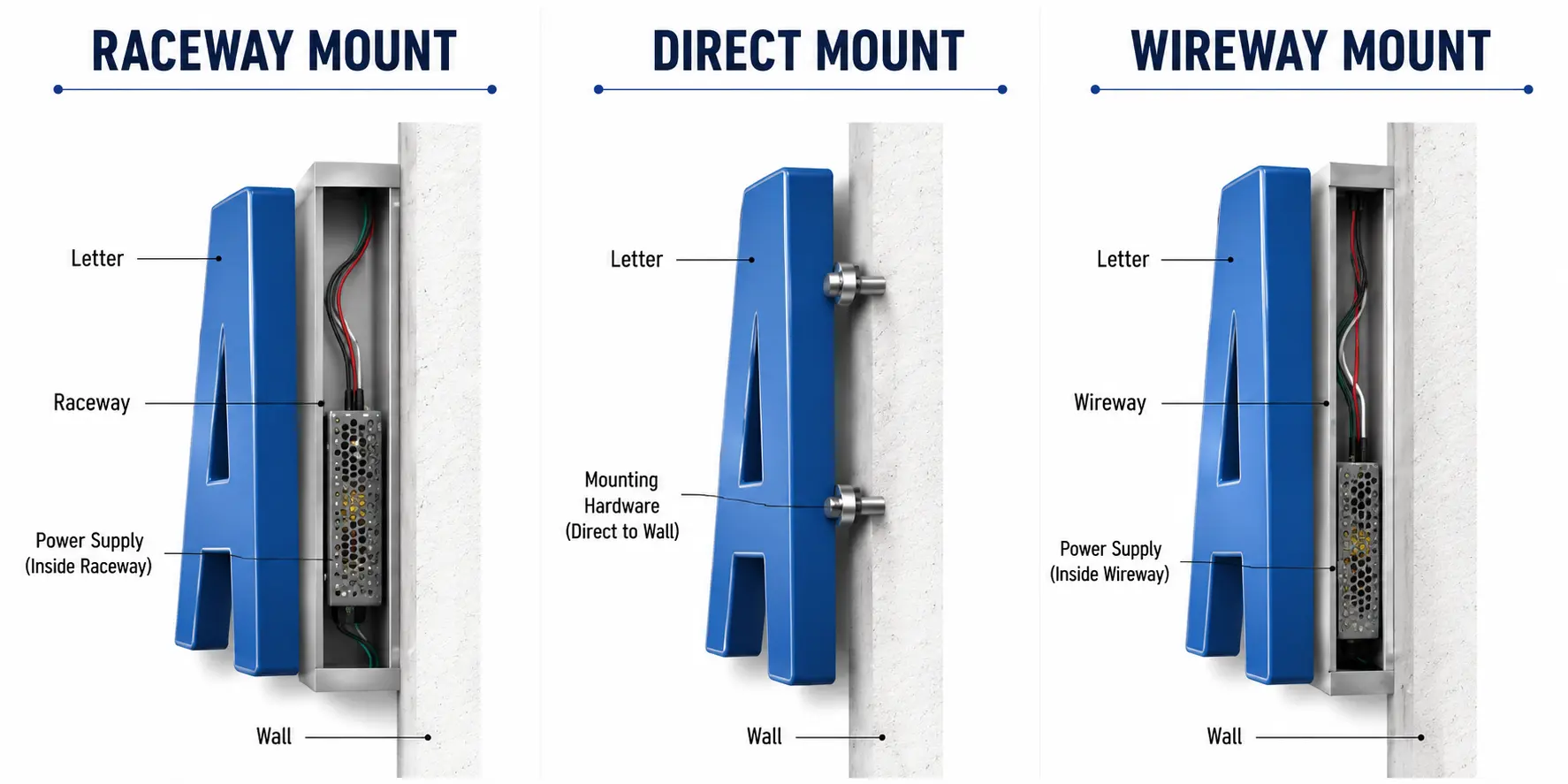
The mounting method determines how the sign looks on the facade, how many wall penetrations are required, where the power supplies and wiring are housed, and how easily technicians can service the system. It should be selected with the wall construction, landlord requirements, electrical access, sign weight, and lighting type—not after the letters have already been fabricated.
Direct Mount
Each letter is attached individually to the facade using studs or suitable anchors. Electrical wiring normally passes through the wall behind the letters, while the power supplies are installed in an accessible approved location.
Direct mounting provides the cleanest appearance because no visible enclosure sits behind the letters. However, it normally requires the greatest number of facade penetrations and more accurate positioning during installation.
For halo-lit letters, direct mounting includes spacers that hold the letters away from the wall. They are not mounted flush because the rear light needs space to spread and reflect.
Raceway Mount
The letters are attached to a fabricated metal enclosure that carries the wiring and may also house the power supplies. The complete raceway is then fixed to the building.
A raceway reduces the number of wall penetrations and can make wiring and driver servicing easier. Its disadvantages are a more visible installation, greater projection from the facade, and possible restrictions under landlord or local sign requirements.
For halo-lit letters, the raceway or backer must not block the intended rear-light path. The supplier should show the expected halo and enclosure position in the mounting drawing.
Wireway Mount
A wireway is a lower-profile enclosure primarily used to route and conceal wiring. Power supplies are usually installed remotely rather than inside the wireway, although the final arrangement depends on the project design.
It provides a cleaner appearance than a full raceway while reducing the amount of exposed wiring. However, the installer still needs an accessible approved location for the power supplies and electrical connections.
| Buyer consideration | Direct mount | Raceway mount | Wireway mount |
| Visual appearance | Cleanest; no large enclosure behind the letters | Raceway remains visible behind the letters | Lower-profile enclosure |
| Facade penetrations | Usually the most | Usually the fewest | Fewer than direct mounting in many layouts |
| Power-supply location | Remote accessible location | May be inside the raceway | Normally remote |
| Installation alignment | Each letter positioned separately | Letters arrive aligned on the raceway | Letters aligned with a slim wiring enclosure |
| Service access | Depends on indoor/rear access | Usually easiest when drivers are inside an accessible raceway | Wiring is accessible; drivers require separate access |
| Halo-lit suitability | Suitable with controlled spacers | Requires careful design to avoid blocking the halo | Possible if the enclosure does not interfere with rear light |
| Typical use | Premium facades and clean architectural branding | Lease-controlled sites and easier servicing | Projects requiring a lower-profile wiring solution |
What the Buyer Should Confirm
Before approving the mounting design, request:
- Wall material and suitable anchor method
- Letter and raceway weight
- Mounting template and hole locations
- Standoff distance for halo-lit letters
- Raceway or wireway dimensions and finish
- Power-supply and disconnect location
- Cable-entry and waterproofing details
- Access method for future servicing
- Included studs, spacers, anchors, and installation hardware
- Any required structural, electrical, landlord, or sign-code approval
Buyer warning: A quotation marked “installation hardware included” is incomplete unless it identifies the supplied mounting system and the wall construction it is designed for. Anchors suitable for concrete may not be appropriate for brick veneer, cladding, curtain walls, or insulated facade systems.
SignliteLED manufactures illuminated letters for all three mounting methods — see our LED Illuminated Letters Signs page for installation drawings and wiring layouts.
Maintenance and Module Replacement Over Time
Channel-letter maintenance depends less on the claimed LED lifetime and more on moisture control, power-supply access, connector quality, surface contamination, operating temperature, and the availability of matching replacement parts. A service plan should therefore be agreed before production—not after the first lighting failure.
What Different Failure Patterns Usually Indicate
| Visible problem | Likely areas to inspect |
| Complete sign is off | Mains supply, disconnect, timer/controller, breaker, or main power supply |
| One letter is off | Letter feed, connector, branch wiring, or local module chain |
| One dark area inside a letter | Failed module, damaged connection, or incorrect module spacing |
| Brightness decreases along a letter | Voltage drop, excessive chain length, undersized wire, or distant power feed |
| Different white shades across letters | Mixed CCTs, color bins, production batches, or replacement modules |
| Flickering or intermittent operation | Loose connection, overloaded/overheating driver, moisture, or controller fault |
| Weak or patchy halo | Dirty or changed wall surface, incorrect standoff, failed rear module, or obstructed light path |
These symptoms indicate where inspection should begin; electrical testing should be completed by a qualified technician.
Maintenance Requirements by Construction
| Maintenance item | Front-lit | Halo-lit | Combination-lit |
| Primary cleaning area | Translucent face and drainage areas | Metal face, returns, rear cavity, and reflecting wall | Front face plus rear cavity and wall |
| Common visual issue | Dirt, face discoloration, hotspots, or dark sections | Uneven halo, wall staining, blocked rear light, or corrosion | Difference between front and rear brightness or color |
| LED access | Through a removable face or removable letter, depending on construction | Usually through the rear or by removing the letter | Access required to both lighting layouts |
| Electrical complexity | One lighting layout | One rear layout | Two layouts and potentially separate controls |
| Service priority | Maintain face diffusion and even illumination | Preserve the reflecting surface and standoff geometry | Diagnose front and rear circuits separately |
Spare Parts to Request with the Order
Buyers should confirm the availability of:
- Matching LED modules from the approved model, CCT, and color bin
- Compatible power supply or approved replacement model
- Connectors, cable, and waterproofing accessories
- Controller or dimmer details where used
- Face, trim, finish, or paint reference codes
- Wiring diagram and module-layout drawing
- Instructions for accessing each serviceable component
Spare-part warning: A module with the same voltage and wattage is not automatically a visual match. Lens distribution, luminous output, CCT, binning, dimensions, and mounting pattern can differ. Replacement modules should match the approved specification whenever possible.
Warranty Scope to Confirm
| Warranty item | Question the buyer should ask |
| LED modules | Is the warranty for component replacement only? |
| Power supplies | Is the driver covered for the same period as the modules? |
| Complete fabricated letters | Are seams, finishes, faces, and water ingress covered? |
| Replacement labor | Who pays for removal, access equipment, installation, and testing? |
| Freight | Who pays to ship failed and replacement components? |
| Environmental exclusions | Are coastal exposure, incorrect installation, overvoltage, or water ingress excluded? |
| Documentation | What evidence is required before a warranty claim is accepted? |
A “three-year warranty” is incomplete unless the quotation identifies the covered components, start date, exclusions, replacement procedure, freight responsibility, and labor coverage.
What to request in a channel-letter quotation
A complete channel-letter quotation should state the letter height and depth, face and return materials, LED module model, voltage, IP rating, color temperature, module count, power-supply capacity, mounting method, standoff distance, certifications, warranty, production lead time and included installation accessories. For halo-lit letters, also confirm the mounting-surface color and texture because both affect the final halo.
How to choose — final checklist
Confirm these eleven points before issuing the purchase order or approving the production drawing.
| Checklist Item | What to Confirm |
| Brand look | Whether the brand calls for a bold, brightly lit face (front-lit) or a premium, understated glow (halo-lit) — or both with combination. |
| Viewing distance | Provide the primary and maximum viewing distances, viewing direction, expected traffic speed, and permitted sign dimensions. Letter-height rules of thumb are only preliminary estimates and do not replace a scaled site review. |
| Indoor / outdoor | Where the sign lives, since it drives IP rating, module choice, and mounting method. |
| Wall color | For halo letters, that the wall is light-coloured and relatively smooth so the halo reflects cleanly. |
| Budget | The range, keeping in mind front-lit is lowest, halo-lit higher, and combination highest. |
| Voltage | 12V for shorter letters, 24V for long or large letters to avoid voltage-drop dimming. |
| IP rating | Confirm the module’s documented IP rating and the waterproofing method for connectors, cable entries, seams, drivers, drainage, and wall penetrations. An IP67 module does not make the complete sign IP67 or prove salt-corrosion resistance. |
| CCT / color | The target white (3000K, 4000K, 6000K, or 9000K) or RGB, matched to the face material and wall. |
| Control needs | Whether the sign needs switching, dimming, color change, or independent front/halo channels — and the controller to manage it. |
| Mounting and service access | Confirm direct, raceway, or wireway mounting; wall construction; anchors; standoff distance; driver location; wiring route; and how modules and power supplies will be accessed later. |
| Quotation scope | Confirm included components, spare parts, mounting hardware, packaging, freight, Incoterm, lead time, warranty coverage, and installation exclusions. |
Conclusion
Choose front-lit channel letters when face brightness, long-distance identification, and lower manufacturing cost are the main priorities. Choose halo-lit or reverse-channel letters when the project requires a premium architectural appearance and the mounting surface can produce a clean reflected glow. Choose combination-lit letters when both effects are required and the project can support the additional fabrication, wiring, power, and maintenance cost.
The final decision should not be based on appearance alone. Before approving production, confirm the construction drawing, wall condition, LED model and layout, connected load, power-supply design, mounting method, waterproofing details, service access, quotation scope, and warranty responsibilities.
If you are comparing channel letters with another sign format, read our guide to channel letters vs. lightbox signs. For a project-specific recommendation, send SignliteLED your vector artwork, letter dimensions, quantity, installation location, wall photographs, required lighting effect, and destination market.
FAQs
Related Posts