Português
  English
  简体中文
简体中文  Deutsch
  Español
  Français
  Italiano
  日本語
日本語  한국어
한국어  Polski
  Русский
  Türkçe
  Nederlands
  Tiếng Việt
  ไทย
ไทย 
Se você está procurando ou selecionando luminárias de LED para iluminação arquitetônica, iluminação comercial ou projetos de fachada de mídia, provavelmente você se perguntou: “Exatamente quantas tiras de LED um DMX Universe pode controlar?”
“512 canais” – Embora tecnicamente correta, esta resposta curta é quase inútil em engenharia prática. A resposta real depende de vários fatores: se suas tiras de LED são RGB ou RGBW, se elas usam controle de pixel, que tipo de decodificador você está usando e como atribui endereços.
Um universo DMX fornece 512 canais de controle. Mas uma faixa RGB usa 3 canais por fixture, uma faixa RGBW usa 4 canais e uma tira de pixel pode consumir centenas de canais em apenas um metro. A diferença entre controlar 170 luminárias RGB e controlar apenas uma faixa de pixel é enorme – entender essa distinção é a linha divisória entre um projeto de instalação bem planejado e um pesadelo de depuração.
Este guia fornece fórmulas completas de cálculo, exemplos de projetos do mundo real e recomendações de engenharia para ajudá-lo a calcular com precisão seus requisitos do universo DMX. Esteja você planejando iluminação de escritório, iluminação de hotel ou uma fachada de mídia em grande escala, você sairá com uma metodologia clara - não apenas um número. Se você deseja saber mais, visite nosso Hub de conhecimento do sistema LED DMX.
O que é um universo DMX?

Um universo DMX é essencialmente uma única linha de dados que pode transportar até 512 canais de controle independentes. Cada canal envia um valor entre 0 e 255 (resolução de 8 bits) para controlar um atributo de uma luminária – brilho, intensidade de cor ou um efeito específico.
Pense assim:
- universo = um cabo de dados (uma linha DMX)
- canal = um único valor de controle (por exemplo, intensidade vermelha)
- endereço = O canal inicial atribuído a uma luminária específica
- decifrador = O dispositivo que converte dados DMX em sinais PWM para tiras de LED
Todos os dispositivos que atendem ao padrão DMX512 compartilham esse limite de 512 canais. Depois de exceder 512 canais, você precisa adicionar outro universo – normalmente implementado via protocolos Art-Net ou SACN via Ethernet ou adicionando uma segunda porta de saída DMX em seu controlador.
Fluxo de dados: Controlador DMX -> Universo (512 canais) -> Endereços (Canais de início) -> Decodificadores -> Tiras de LED.
Por que um universo DMX possui apenas 512 canais?
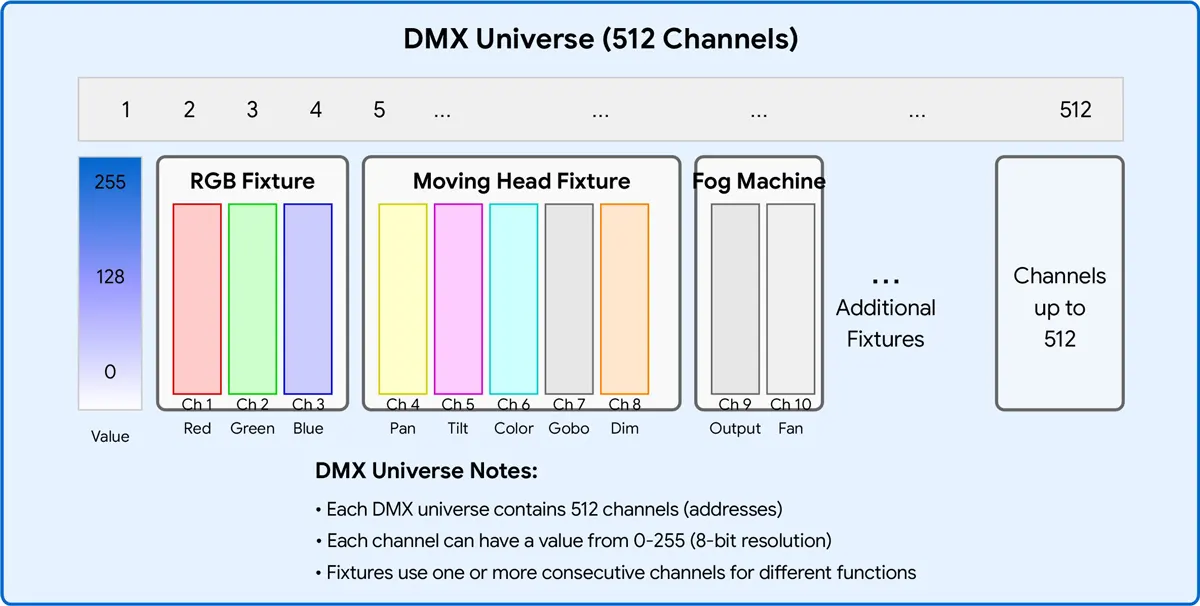
O protocolo DMX512 foi desenvolvido em 1986 pela USITT (United States Institute for Theatre Technology) para substituir os sistemas de controle analógico de 0 a 10 V mais antigos. O “512” no nome vem do número máximo de canais que um único pacote DMX pode transportar – 512 bytes de dados, transmitidos 44 vezes por segundo.
Na época, 512 canais pareciam mais que suficientes. Racks dimmer, cabeças móveis e trocadores de cor, cada um requer apenas alguns canais. Mas com o crescimento explosivo dos sistemas LED RGB e fachadas de mídia controlada por pixel, o limite de 512 canais rapidamente se tornou um gargalo. Hoje, uma única parede de LED mapeada em pixels pode consumir dezenas ou até centenas de universos.
O padrão original foi atualizado em 2008 para DMX512-A (ANSI E1.11), mas o limite de 512 canais por universo permanece inalterado. A solução é simples: use múltiplos universos.
Estrutura de pacotes DMX: BREAK -> Código Inicial (0x00) -> até 512 slots de dados (canais) -> cada slot = 1 byte (0-255).
Um único universo DMX fornece 512 canais de controle. Quantas tiras de LED que ele pode controlar depende inteiramente de quantos canais cada tira requer:
| Tipo de controle | Canais por fixture | Max Fixtures por Universo |
| única cor | 1 | 512 |
| Ajustável Branco (CCT) | 2 | 256 |
| RGB | 3 | 170 |
| RGBW | 4 | 128 |
| RGB+CCT/RGBWW | 5 | 102 |
| Pixel RGB (50 pixels) | 150 | 3 |
| RGB pixel (100 pixels) | 300 | 1 |
| Pixel RGB (170 pixels) | 510 | 1 |
Para tiras RGB, cada universo pode controlar até 170 acessórios endereçáveis individualmente (usando 510 canais). As tiras controladas por pixel consomem significativamente mais canais, de modo que o número de acessórios por universo cai consideravelmente.
Como os canais DMX são atribuídos
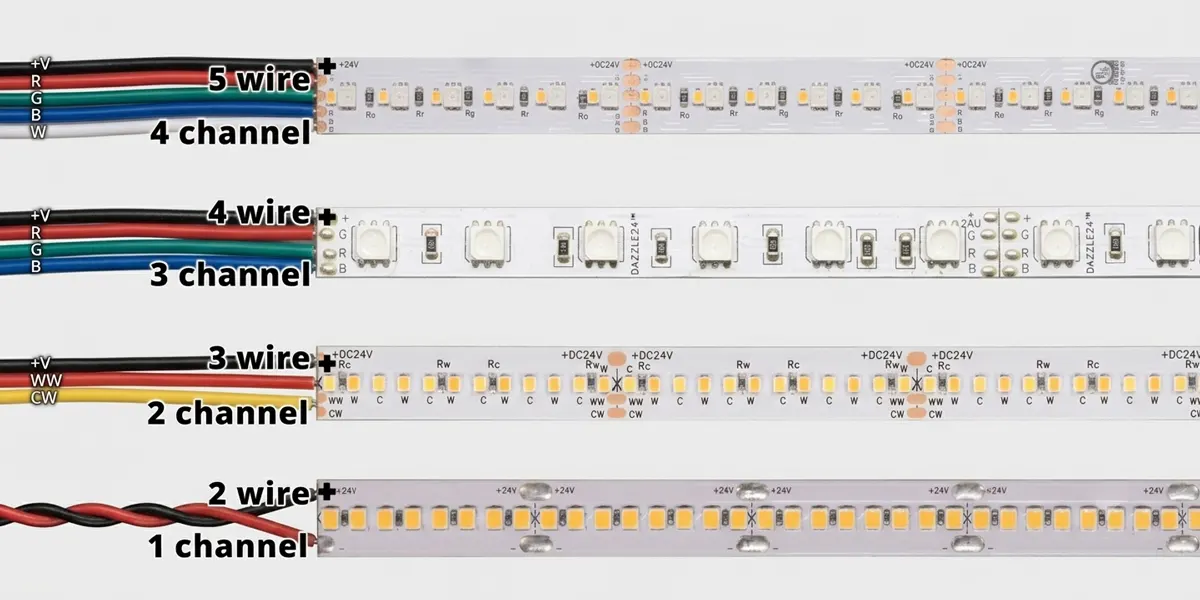
diferentes tipos de Tiras de LED DMX requerem diferentes números de canais. Aqui está o detalhamento:
tiras de led de uma única cor
Canais: 1
Método de controle: escurecimento apenas
Exemplo: uma faixa de cor única de 24 V conectada a um decodificador DMX de 1 canal. O canal 1 controla o brilho de 0% a 100%.
Tiras de LED brancas ajustáveis (CCT)
Canais: 2
Método de controle: branco quente + escurecimento branco legal
Exemplo: Canal 1 = intensidade do branco quente, canal 2 = intensidade do branco frio. Misturar os dois atinge o branco ajustável de 2700K a 6500K.
Fitas LED RGB
Canais: 3
Método de controle: vermelho + verde + azul escurecimento
Exemplo: Canal 1 = Vermelho, Canal 2 = Verde, Canal 3 = Azul. Misturar as três cores produz milhões de cores.
tiras de led rgbw
Canais: 4
Método de controle: vermelho + verde + azul + branco escurecimento
Exemplo: adicionar um canal branco dedicado elimina a necessidade de mistura de cores para obter luz branca pura.
RGB+CCT (RGBWW) tiras de led
Canais: 5
Método de controle: vermelho + verde + azul + branco quente + escurecimento do branco legal
Exemplo: controle total de cores mais branco tunable – ideal para hotéis e ambientes de varejo onde são necessárias cores vibrantes e luz branca precisa.
Tiras de LED DMX de controle de pixel
Canais por pixel: 3 (RGB) ou 4 (RGBW)
Método de controle: cada LED ou grupo de pixels é individualmente endereçável
Exemplo: uma faixa RGB de 100 pixels usa 100 x 3 = 300 canais – deixando apenas 212 canais restantes nesse universo.
Nota importante: Alguns decodificadores suportam o escurecimento de 16 bits, o que dobra o número de canais por cor (por exemplo, RGB vai de 3 a 6 canais). Isso fornece um escurecimento mais suave em níveis de brilho baixos, mas reduz pela metade o número de acessórios por universo.
Como calcular o número máximo de tiras de LED por universo
fórmula de cálculo
Número máximo de luminárias = [ 512 ÷ canais por fixture]
(onde [ ] denota "arredando para o inteiro mais próximo").
Exemplo 1: tiras RGB
- 512 / 3 = 170,67 → 170 luminárias (usando 510 canais, deixando 2 sem uso)
Exemplo 2: tiras RGBW
- 512 / 4 = 128 → 128 acessórios (todos os 512 canais usados)
Exemplo 3: tiras RGB+CCT
- 512 / 5 = 102,4 → 102 luminárias (usando 510 canais, deixando 2 sem uso)
Exemplo 4: tiras de pixel (50 pixels, RGB)
- 50 x 3 = 150 canais por tira
- 512 / 150 = 3,41 → 3 tiras (usando 450 canais)
Exemplo 5: tiras de pixel (100 pixels, RGBW)
- 100 x 4 = 400 canais por tira
- 512 / 400 = 1,28 → 1 tira (usando 400 canais, deixando 112 sem uso)
regra de ouro: um único dispositivo deve residir inteiramente em um universo. Você não pode dividir um acessório em dois universos. Se um dispositivo de fixação requer 5 canais e o universo atual tem apenas 3 canais restantes, esse dispositivo deve começar no próximo universo.
Tabela de comparação de capacidades do universo DMX
| tipo de iluminação | Canais por fixture | Max Fixtures por Universo | canais usados |
| única cor | 1 | 512 | 512 |
| Ajustável Branco (CCT) | 2 | 256 | 512 |
| RGB | 3 | 170 | 510 |
| RGBW | 4 | 128 | 512 |
| RGB+CCT/RGBWW | 5 | 102 | 510 |
| Pixel RGB (50 pixels) | 150 | 3 | 450 |
| RGB pixel (100 pixels) | 300 | 1 | 300 |
| Pixel RGB (128 pixels) | 384 | 1 | 384 |
| Pixel RGB (170 pixels) | 510 | 1 | 510 |
| Pixel RGBW (50 pixels) | 200 | 2 | 400 |
| Pixel RGBW (100 pixels) | 400 | 1 | 400 |
| Pixel RGBW (128 pixels) | 512 | 1 | 512 |
Esta tabela serve como um guia de referência rápida para qualquer projeto - recomendamos marcá-lo.
Estudo de caso 1: Iluminação de escritório – 64 tiras RGBW
Por fixação: 4 canais
Total de canais: 64 x 4 = 256
Universos obrigatórios: 256 / 512 = 0,5 → 1 universo (bem dentro da capacidade)
Estudo de caso 2: iluminação do hotel – 96 tiras brancas ajustáveis
Por fixação: 2 canais
Total de canais: 96 x 2 = 192
Universos obrigatórios: 192 / 512 = 0,375 → 1 universo (muito espaço para expansão futura)
Estudo de caso 3: Iluminação de fachada de construção – mangueira de néon de 200 m de pixel (60 pixels/m, RGB)
Total de pixels: 200 x 60 = 12.000 pixels
Total de canais: 12.000 x 3 = 36.000 canais
Universos obrigatórios: 36.000 / 512 = 70,31 → 71 universos
Recomendação de engenharia: esses projetos normalmente são transmitidos via ART-NET ou SACN por Ethernet, em vez de cabeamento físico DMX.
Estudo de caso 4: Fachada de mídia – 1.000 pixels RGB (ajustes de pixels endereçáveis individualmente)
Total de canais: 1.000 x 3 = 3.000
Universos obrigatórios: 3.000 / 512 = 5,86 → 6 universos
Erros comuns no planejamento do universo DMX
| ❌ Erro | ✅ Abordagem correta |
| Contando fixtures em vez de canais | Sempre calcule os canais totais e divida por 512 |
| Esquecer o RGBW usa 4 canais | RGBW não é RGB - não assuma 3 canais |
| Ignorando os canais reservados | Alguns decodificadores reservam canais para funções ou usam “endereços iniciais” que pulam canais |
| Misturando modos de fixação diferentes | Diferentes acessórios com diferentes contagens de canais complicam o endereçamento - planejar as zonas separadamente |
| sobrecarregando um universo | Mantenha a utilização abaixo de 80% para futura expansão e solução de problemas |
| Esquecendo de planejar a expansão | Sempre deixe pelo menos 10–20% Capacidade para alterações |
Quando você deve adicionar outro universo DMX?

Você deve adicionar um novo universo quando o uso do canal exceder aproximadamente 70-80% (360-410 canais).
intuição:
- Você terá espaço para expansão futura sem redesenhar todo o seu esquema de alocação de endereços.
- A solução de problemas é mais fácil quando os universos não estão totalmente embalados.
- Muitos dispositivos em uma única linha podem degradar a estabilidade do sinal DMX (limitação elétrica: no máximo 32 dispositivos por linha).
regra prática: Se a contagem de seu canal chegar a 400 ou mais, você deve começar a planejar um segundo universo. Usar ART-NET ou SACN facilita a quebra do limite físico de DMX.
Como escalar para múltiplos universos
Escalar além de 512 canais é bastante simples:
- Divisores de DMX / repetidores de sinal: Distribua um sinal do Universo DMX em várias linhas físicas (Nota: isso não aumenta a contagem de canais – apenas aumenta a força do sinal).
- nós art-net: Converta o protocolo Art-Net baseado em Ethernet em uma saída física DMX. Cada nó Art-Net pode produzir múltiplos universos. Art-Net 4 suporta até 32.768 universos.
- SACN (E1.31): Streaming ACN – um padrão aberto para transmitir DMX em redes IP. Suporta até 64.000 universos e é a solução preferida para instalações permanentes.
- Controladores DMX de várias portas: Alguns controladores vêm equipados com várias portas de saída físicas DMX – cada porta é um universo.
- RDM (Gerenciamento remoto de dispositivos): Permite a comunicação bidirecional para endereçamento e feedback de status – útil para gerenciar grandes sistemas multiuniversos.
Escolhendo o decodificador DMX certo para o seu projeto
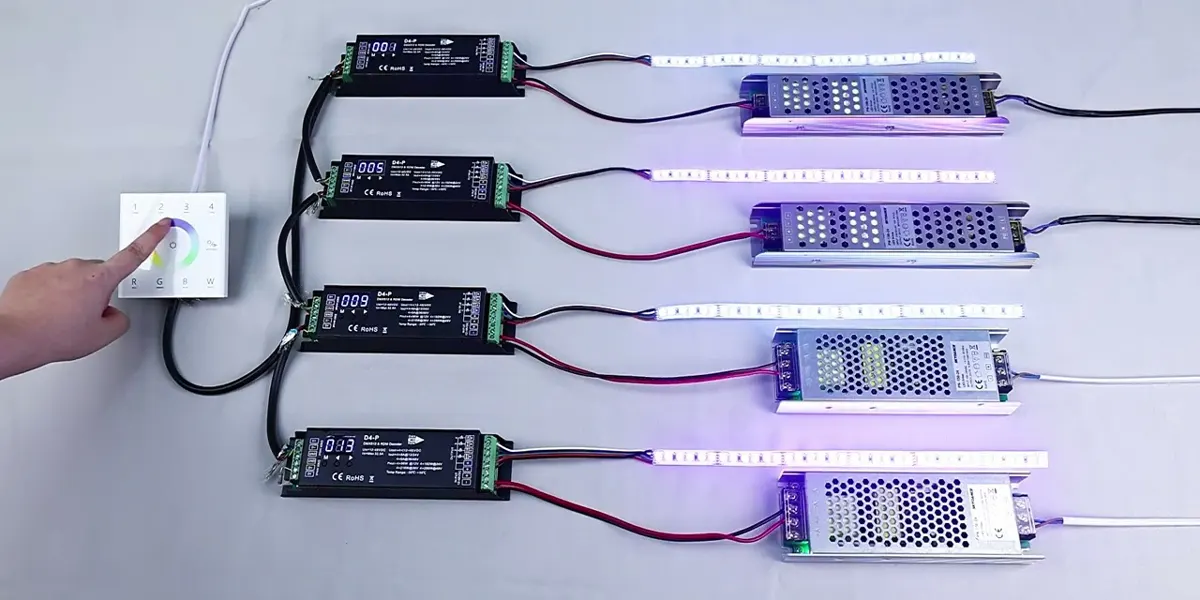
Escolher o decodificador certo é tão importante quanto calcular a contagem de canais corretamente. As considerações principais incluem:
| Tipo de decodificador | melhor para | canais |
| Decodificador de 1 canal | escurecimento de uma cor | 1 |
| Decodificador de 3 canais | Mistura de cores RGB | 3 |
| Decodificador de 4 canais | Mistura de cores RGBW | 4 |
| decodificador de 5 canais | RGB+CCT/RGBWW | 5 |
| Decodificador DMX-SPI | Tiras controladas por pixel | Variável (por pixel) |
Fatores adicionais a serem considerados ao escolher um decodificador:
- estabilidade do sinal: Procure modelos com isolamento elétrico e manuseio de sinal DMX confiável – crítico especialmente para cabeamento de longa distância.
- Frequência PWM: Frequências mais altas (>=2 kHz) evitam oscilações visíveis, o que é particularmente importante para ambientes prontos para câmera.
- resolução de escurecimento: O escurecimento de 16 bits permite um controle mais suave em níveis de brilho baixos.
- Recursos de proteção: proteção contra corrente, proteção contra curto-circuito e proteção contra temperatura excessiva garantem confiabilidade a longo prazo.
A Signliteld oferece uma gama completa de decodificadores DMX, de 1 canal a 16 canais, cobrindo opções de tensão constante (CV) e corrente constante (CC). Nossos decodificadores suportam escurecimento de 8 e 16 bits, múltiplas frequências PWM e alguns modelos que suportam o endereçamento remoto RDM. Visite nosso decodificador DMX Para especificações detalhadas e suporte de engenharia.
Por que escolher o Signliteled para grandes projetos de iluminação DMX
A Signliteld é mais que um fornecedor – somos um parceiro de engenharia técnica da DMX Lighting Systems. Nossas vantagens incluem:
- Suporte ao design de sistemas DMX com vários universos: Ajudamos você a calcular os requisitos do canal, planejar a alocação de endereços e fornecer recomendações de hardware para projetos que variam de 1 a 100 universos.
- Faixas de LED DMX de nível arquitetônico: Nossas tiras estão disponíveis em configurações de um único cor, branco, RGB, RGBW e RGB + CCT, com comprimentos personalizados e classificações de IP.
- Decodificadores e controladores DMX: De decodificadores de 1 canal a 16 canais, abrangendo opções de CV e CC, com suporte para RDM e escurecimento de 16 bits.
- Personalização OEM/ODM: Fabricamos de acordo com suas especificações exatas – design personalizado de PCB, conectores, classificações de energia e embalagem.
- Planejamento de canais e alocação de endereços Suporte técnico: Nossa equipe de engenharia auxilia na alocação de endereços DMX, planejamento do universo e integração do sistema.
- Documentação e guias de fiação: Fornecemos diagramas de fiação claros, guias de alocação de endereços e listas de verificação de comissionamento para garantir instalações suaves.
Conclusão
Um único universo DMX fornece 512 canais – mas o número exato de tiras de LED que ele pode controlar depende inteiramente do seu tipo de fixture:
- única cor: 512 jogos
- Ajustável Branco (CCT): 256 luminárias
- RGB: 170 luminárias
- RGBW: 128 luminárias
- RGB+CCT: 102 luminárias
- tiras de pixel: 1-3 tiras (dependendo da contagem de pixels)
A chave para a chave: planejar por canais, não por contagem de locomoção. Siga a regra 80% (reserva o espaço para expansão) e nunca exceda 512 canais por universo. Para grandes projetos, Art-Net e SACN oferecem um dimensionamento de vários universos perfeito.
Esteja você projetando escritórios, hotéis, fachadas de construção ou paredes de mídia – o método de cálculo é igualmente simples – e agora você tem a fórmula, as tabelas de comparação e os exemplos do mundo real para acertar na primeira vez.
FAQs
Postagens relacionadas