标牌和 LED 灯带工厂,始于 2011 年

标牌和 LED 灯带工厂,始于 2011 年

一台 DMX 宇宙可以控制多少个 DMX LED 灯带? (完整的计算指南)

If you are sourcing or selecting LED luminaires for architectural lighting, commercial lighting, or media facade projects, you have likely asked yourself this question: “Exactly how many LED strips can one DMX Universe control?”

“512 channels” – while technically correct, this short answer is almost useless in practical engineering. The real answer depends on multiple factors: whether your LED strips are RGB or RGBW, whether they use pixel control, what type of decoder you are using, and how you assign addresses.

One DMX Universe provides 512 control channels. But an RGB strip uses 3 channels per fixture, an RGBW strip uses 4 channels, and a pixel strip can consume hundreds of channels in just one meter. The difference between controlling 170 RGB fixtures and controlling just one pixel strip is enormous – understanding this distinction is the dividing line between a well-planned installation project and a debugging nightmare.

This guide provides complete calculation formulas, real-world project examples, and engineering recommendations to help you accurately calculate your DMX Universe requirements. Whether you are planning office lighting, hotel lighting, or a large-scale media facade, you will walk away with a clear methodology – not just a number. If you would like to learn more, please visit our DMX LED System Knowledge Hub.

What Is a DMX Universe?

What Is a DMX Universe

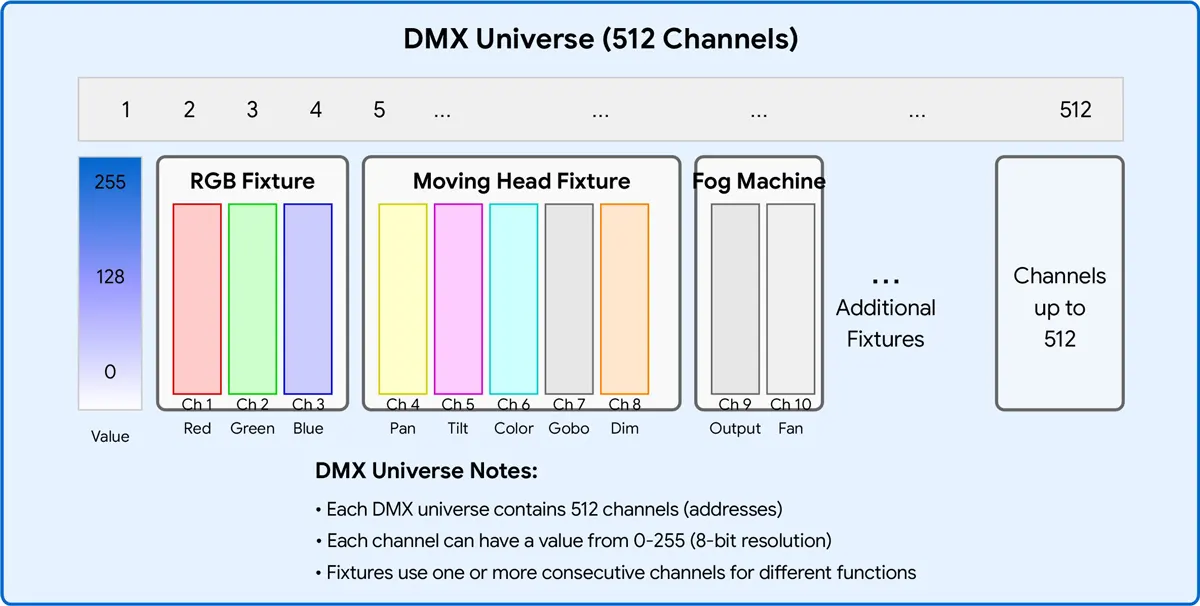
A DMX Universe is essentially a single data line that can carry up to 512 independent control channels. Each channel sends a value between 0 and 255 (8-bit resolution) to control one attribute of a luminaire – brightness, color intensity, or a specific effect.

Think of it this way:

  1. Universe = a data cable (one DMX line)
  2. Channel = a single control value (e.g., red intensity)
  3. Address = the starting channel assigned to a specific luminaire
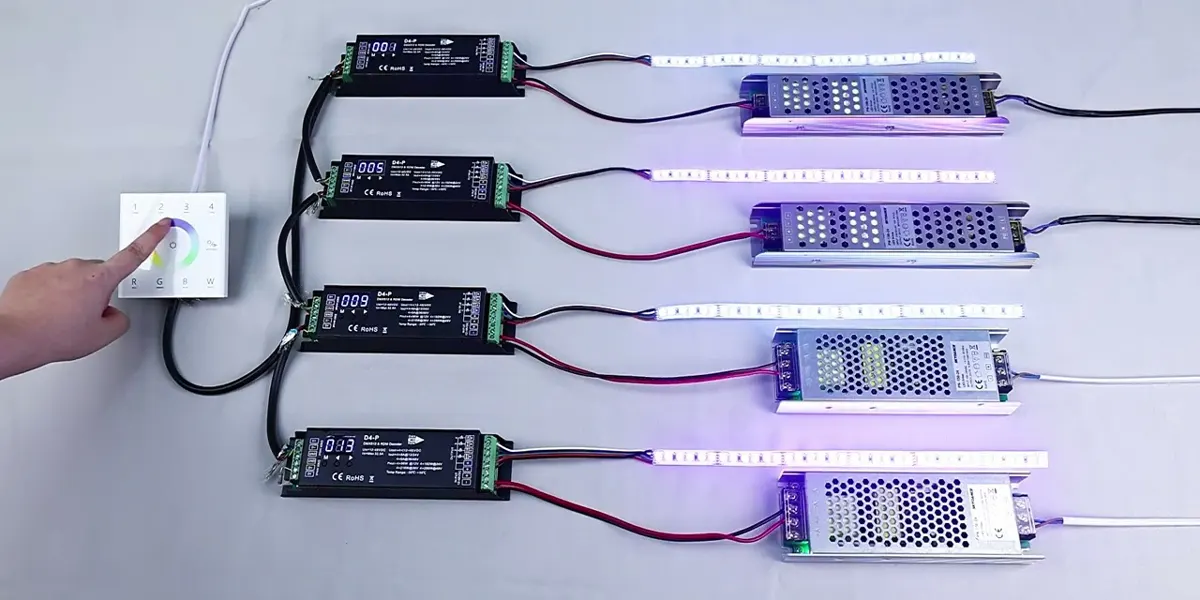
  4. 解码器 = the device that converts DMX data into PWM signals for LED strips

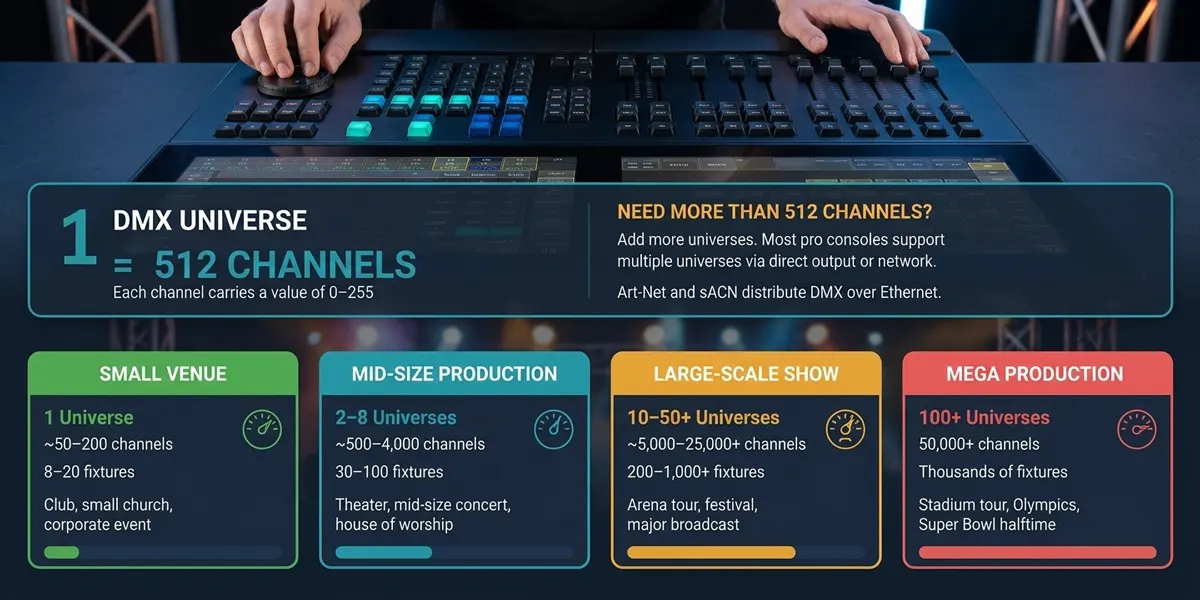
All devices that comply with the DMX512 standard share this 512-channel limit. Once you exceed 512 channels, you need to add another Universe – typically implemented via Art-Net or sACN protocols over Ethernet, or by adding a second DMX output port on your controller.

Data Flow: DMX Controller -> Universe (512 channels) -> Addresses (starting channels) -> Decoders -> LED Strips.

Why Does One DMX Universe Have Only 512 Channels?

Why Does One DMX Universe Have Only 512 Channels

The DMX512 protocol was developed in 1986 by USITT (United States Institute for Theatre Technology) to replace older 0-10V analog control systems. The “512” in the name comes from the maximum number of channels that a single DMX packet can carry – 512 bytes of data, transmitted 44 times per second.

At the time, 512 channels seemed more than sufficient. Dimmer racks, moving heads, and color changers each only required a handful of channels. But with the explosive growth of RGB LED systems and pixel-controlled media facades, the 512-channel limit quickly became a bottleneck. Today, a single pixel-mapped LED wall can consume dozens or even hundreds of Universes.

The original standard was updated in 2008 to DMX512-A (ANSI E1.11), but the 512-channel limit per Universe remains unchanged. The solution is straightforward: use multiple Universes.

DMX Packet Structure: Break -> Start Code (0x00) -> Up to 512 Data Slots (Channels) -> Each Slot = 1 Byte (0-255).

A single DMX Universe provides 512 control channels. How many LED strips it can control depends entirely on how many channels each strip requires:

控制类型Channels per FixtureMax Fixtures per Universe
单色1512
Tunable White (CCT)2256
RGB3170
RGBW4128
RGB+CCT / RGBWW5102
RGB Pixel (50 pixels)1503
RGB Pixel (100 pixels)3001
RGB Pixel (170 pixels)5101

For RGB strips, each Universe can control up to 170 individually addressable fixtures (using 510 channels). Pixel-controlled strips consume significantly more channels, so the number of fixtures per Universe drops considerably.

How DMX Channels Are Assigned

How DMX Channels Are Assigned

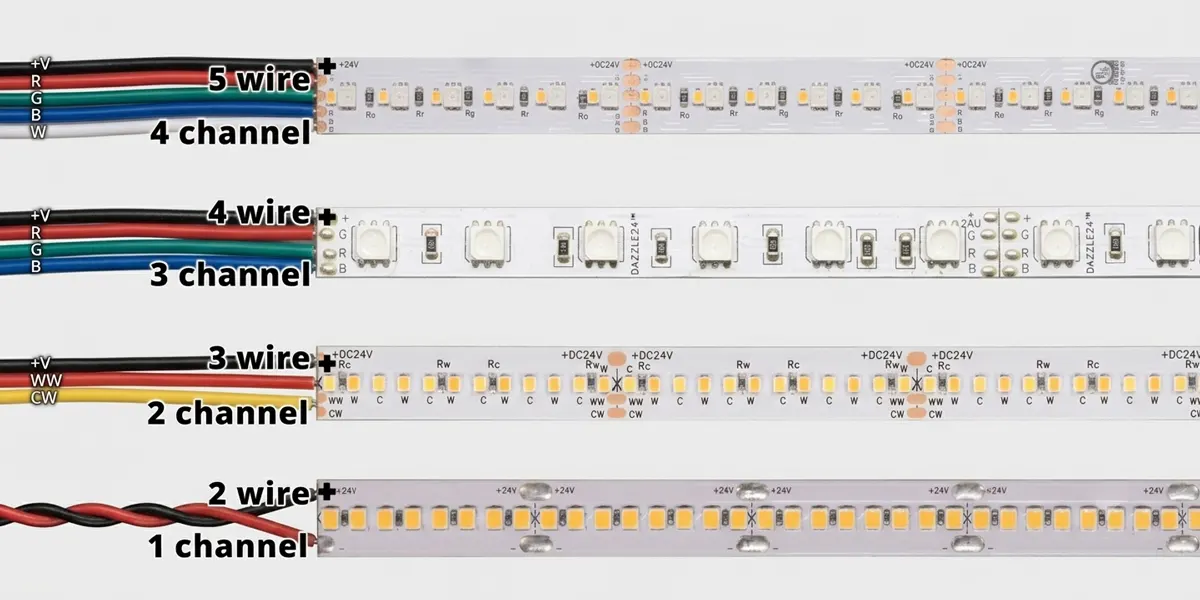
Different types of DMX LED 灯条 require different numbers of channels. Here is the breakdown:

Single-Color LED Strips

Channels: 1

Control Method: Dimming only

Example: A 24V single-color strip connected to a 1-channel DMX decoder. Channel 1 controls brightness from 0% to 100%.

Tunable White (CCT) LED Strips

Channels: 2

Control Method: Warm White + Cool White dimming

Example: Channel 1 = warm white intensity, Channel 2 = cool white intensity. Mixing the two achieves tunable white from 2700K to 6500K.

RGB LED 灯条

Channels: 3

Control Method: Red + Green + Blue dimming

Example: Channel 1 = red, Channel 2 = green, Channel 3 = blue. Mixing the three colors produces millions of colors.

RGBW LED灯条

Channels: 4

Control Method: Red + Green + Blue + White dimming

Example: Adding a dedicated white channel eliminates the need for color mixing to achieve pure white light.

RGB+CCT (RGBWW) LED Strips

Channels: 5

Control Method: Red + Green + Blue + Warm White + Cool White dimming

Example: Full color control plus tunable white – ideal for hotels and retail environments where vibrant colors and accurate white light are both needed.

Pixel-Control DMX LED Strips

Channels per Pixel: 3 (RGB) or 4 (RGBW)

Control Method: Each LED or pixel group is individually addressable

Example: A 100-pixel RGB strip uses 100 x 3 = 300 channels – leaving only 212 remaining channels in that Universe.

Important Note: Some decoders support 16-bit dimming, which doubles the number of channels per color (e.g., RGB goes from 3 to 6 channels). This provides smoother dimming at low brightness levels, but halves the number of fixtures per Universe.

How to Calculate the Maximum Number of LED Strips per Universe

Calculation Formula

Maximum number of fixtures = [512 ÷ channels per fixture]

(where [  ] denotes “rounding down to the nearest integer”).

Example 1: RGB Strips

  • 512 / 3 = 170.67 → 170 fixtures (using 510 channels, leaving 2 unused)

Example 2: RGBW Strips

  • 512 / 4 = 128 → 128 fixtures (all 512 channels used)

Example 3: RGB+CCT Strips

  • 512 / 5 = 102.4 → 102 fixtures (using 510 channels, leaving 2 unused)

Example 4: Pixel Strips (50 pixels, RGB)

  • 50 x 3 = 150 channels per strip
  • 512 / 150 = 3.41 → 3 strips (using 450 channels)

Example 5: Pixel Strips (100 pixels, RGBW)

  • 100 x 4 = 400 channels per strip
  • 512 / 400 = 1.28 → 1 strip (using 400 channels, leaving 112 unused)

Rule of Thumb: A single fixture must reside entirely within one Universe. You cannot split a fixture across two Universes. If a fixture requires 5 channels and the current Universe has only 3 channels remaining, that fixture must start at the next Universe.

DMX Universe Capacity Comparison Table

灯光类型Channels per FixtureMax Fixtures per UniverseChannels Used
单色1512512
Tunable White (CCT)2256512
RGB3170510
RGBW4128512
RGB+CCT / RGBWW5102510
RGB Pixel (50 pixels)1503450
RGB Pixel (100 pixels)3001300
RGB Pixel (128 pixels)3841384
RGB Pixel (170 pixels)5101510
RGBW Pixel (50 pixels)2002400
RGBW Pixel (100 pixels)4001400
RGBW Pixel (128 pixels)5121512

This table serves as a quick-reference guide for any project – we recommend bookmarking it.

Case Study 1: Office Lighting – 64 RGBW Strips

Per Fixture: 4 channels

Total Channels: 64 x 4 = 256

Universes Required: 256 / 512 = 0.5 → 1 Universe (well within capacity)

Case Study 2: Hotel Lighting – 96 Tunable White Strips

Per Fixture: 2 channels

Total Channels: 96 x 2 = 192

Universes Required: 192 / 512 = 0.375 → 1 Universe (plenty of headroom for future expansion)

Case Study 3: Building Facade Lighting – 200m Pixel Neon Hose (60 pixels/m, RGB)

Total Pixels: 200 x 60 = 12,000 pixels

Total Channels: 12,000 x 3 = 36,000 channels

Universes Required: 36,000 / 512 = 70.31 → 71 Universes

Engineering Recommendation: Such projects typically transmit via Art-Net or sACN over Ethernet rather than physical DMX cabling.

Case Study 4: Media Facade – 1,000 RGB Pixels (Individually Addressable Pixel Fixtures)

Total Channels: 1,000 x 3 = 3,000

Universes Required: 3,000 / 512 = 5.86 → 6 Universes

Common Mistakes in DMX Universe Planning

❌ Mistake✅ Correct Approach
Counting fixtures instead of channelsAlways calculate total channels, then divide by 512
Forgetting RGBW uses 4 channelsRGBW is not RGB—don’t assume 3 channels 
Ignoring reserved channelsSome decoders reserve channels for functions or use “start addresses” that skip channels
Mixing different fixture modesDifferent fixtures with different channel counts complicate addressing—plan zones separately
Overloading one universeKeep utilization below 80% for future expansion and troubleshooting
Forgetting to plan for expansionAlways leave at least 10–20% channel capacity for changes

When Should You Add Another DMX Universe?

When Should You Add Another DMX Universe

You should add a new Universe when your channel usage exceeds approximately 70-80% (360-410 channels).

Reasons:

  • You will have room for future expansion without redesigning your entire address allocation scheme.
  • Troubleshooting is easier when Universes are not fully packed.
  • Too many devices on a single line can degrade DMX signal stability (electrical limitation: maximum 32 devices per line).

Practical Rule: If your channel count reaches 400 or above, you should begin planning a second Universe. Using Art-Net or sACN makes it easy to break through the physical DMX limit.

How to Scale to Multiple Universes

Scaling beyond 512 channels is actually quite simple:

  1. DMX Splitters / Signal Repeaters: Distribute one DMX Universe signal across multiple physical lines (Note: this does NOT increase channel count – it only boosts signal strength).
  2. Art-Net Nodes: Convert Ethernet-based Art-Net protocol to physical DMX output. Each Art-Net node can output multiple Universes. Art-Net 4 supports up to 32,768 Universes.
  3. sACN (E1.31): Streaming ACN – an open standard for transmitting DMX over IP networks. Supports up to 64,000 Universes and is the preferred solution for permanent installations.
  4. Multi-Port DMX Controllers: Some controllers come equipped with multiple physical DMX output ports – each port is one Universe.
  5. RDM (Remote Device Management): Enables bidirectional communication for addressing and status feedback – helpful for managing large multi-Universe systems.

Choosing the Right DMX Decoder for Your Project

Choosing the Right DMX Decoder for Your Project

Choosing the right decoder is just as important as calculating channel counts correctly. Key considerations include:

Decoder Type最适合Channels
1-Channel CV DecoderSingle-color dimming1
3-Channel CV DecoderRGB color mixing3
4-Channel CV DecoderRGBW color mixing4
5-Channel CV DecoderRGB+CCT / RGBWW5
DMX-to-SPI DecoderPixel-controlled stripsVariable (per pixel)

Additional factors to consider when choosing a decoder:

  • 信号稳定性: Look for models with electrical isolation and reliable DMX signal handling – critical especially for long-distance cabling.
  • 频率: Higher frequencies (>=2 kHz) prevent visible flickering, which is particularly important for camera-ready environments.
  • Dimming Resolution: 16-bit dimming enables smoother control at low brightness levels.
  • Protection Features: Over-current protection, short-circuit protection, and over-temperature protection ensure long-term reliability.

SignliteLED offers a full range of DMX decoders, from 1-channel to 16-channel, covering both Constant Voltage (CV) and Constant Current (CC) options. Our decoders support 8-bit and 16-bit dimming, multiple PWM frequencies, and select models support RDM remote addressing. Visit our DMX 解码器 for detailed specifications and engineering support.

Why Choose SignliteLED for Large DMX Lighting Projects

SignliteLED is more than a supplier – we are a technical engineering partner for DMX lighting systems. Our advantages include:

  • Multi-Universe DMX System Design Support: We help you calculate channel requirements, plan address allocation, and provide hardware recommendations for projects ranging from 1 to 100+ Universes.
  • Architectural-Grade DMX LED Strips: Our strips are available in single-color, tunable white, RGB, RGBW, and RGB+CCT configurations, with custom lengths and IP ratings.
  • DMX Decoders and Controllers: From 1-channel to 16-channel decoders, covering CV and CC options, with RDM and 16-bit dimming support.
  • OEM/ODM 定制: We manufacture to your exact specifications – custom PCB design, connectors, power ratings, and packaging.
  • Channel Planning and Address Allocation Technical Support: Our engineering team assists with DMX address allocation, Universe planning, and system integration.
  • Documentation and Wiring Guides: We provide clear wiring diagrams, address allocation guides, and commissioning checklists to ensure smooth installations.

结论

A single DMX Universe provides 512 channels – but the exact number of LED strips it can control depends entirely on your fixture type:

  • 单色: 512 fixtures
  • Tunable White (CCT): 256 fixtures
  • RGB: 170 fixtures
  • RGBW: 128 fixtures
  • RGB+CCT: 102 fixtures
  • Pixel Strips: 1-3 strips (depending on pixel count)

The key takeaway: Plan by channels, not by fixture count. Follow the 80% rule (reserve headroom for expansion), and never exceed 512 channels per Universe. For large projects, Art-Net and sACN provide seamless multi-Universe scaling.

Whether you are designing offices, hotels, building facades, or media walls – the calculation method is equally straightforward – and now you have the formula, comparison tables, and real-world examples to get it right the first time.

常见问题

LED灯片LED灯片
LED灯片买家指南:每个B2B买家都应该检查7个技术规格
商业照明采购不是设计决策。 这是一个风险决定。 照明性能、合规性暴露、运营成本和长期维护都取决于可测量的技术规格。 营销摘要在这个层面是无关紧要的。 对于 B2B 买家,LED 灯表是主要的验证文件。 它包含光度测量...
为北美大型办公项目定制的声学LED吊灯
2025年12月,我们与北美项目承包商合作,为大型办公楼提供定制的声学LED吊灯照明解决方案。 该项目的目标是创造一个平衡视觉舒适度、声学性能和建筑美学的现代工作空间。 随着开放式办公室越来越需要...
LED 声学照明 - 关键 SGS,火灾和声学测试您需要知道LED 声学照明 - 关键 SGS,火灾和声学测试您需要知道
LED 声学照明:您需要了解的关键 SGS、火灾和声学测试
简介:为什么声光成为照明行业的新热点?现代办公空间、商业建筑、教育机构和医疗保健环境越来越将“噪音控制”作为设计重点,与照明相提并论。 开放式办公室、共享空间和高密度人流量意味着传统设备不能再...
四种LED舞台灯四种LED舞台灯
如何为剧院、教堂、俱乐部和活动选择 LED 舞台照明
LED舞台照明应根据场地功能、空间结构、观众距离和表演目标而非固定装置类型来选择。不同的场地——如剧院、教堂、俱乐部和活动空间——对舞台灯光系统提出了根本性的技术和视觉需求。 根据我们与专业买家和项目集成商合作的经验,许多...
DMX-RGB-LED-模块-立面-标牌-天花板DMX-RGB-LED-模块-立面-标牌-天花板
用于外墙、标牌和天花板的 RGB LED 模块,带有 SPI / DMX / DALI 控制选项
想象一下,一个建筑立面在夜空下栩栩如生,标志的颜色随着季节和吸顶灯的变化而变化,创造了身临其境的流动光线图案。 这一转变的核心是 DMX RGB LED 模块——一种结合了像素级动态控制和 RGB/RGBW 变色功能的尖端照明解决方案,以实现更广泛的应用。
模块化LED线性模块模块化LED线性模块
为什么线性LED模块是模块化商业照明系统的未来
如果你在商业照明上工作的时间足够长,你最终会问自己一个简单的问题:为什么恒压LED灯条在纸上总是看起来不错,但在实际项目中很少表现良好? 任何处理过长期安装的人都熟悉答案:电压降、亮度不均、不可预测的色移、...

分享:

Facebook
叽叽喳喳
Pinterest
LinkedIn
订阅评论
提醒
来宾
0 评论
最老的
最新 最多投票
内联反馈
查看所有评论

搜索 SignliteLED 博客

类别

滚动至顶部

立即获取报价