English
  简体中文
简体中文  Deutsch
  Español
  Français
  Italiano
  日本語
日本語  한국어
한국어  Polski
  Português
  Русский
  Türkçe
  Nederlands
  Tiếng Việt
  ไทย
ไทย 
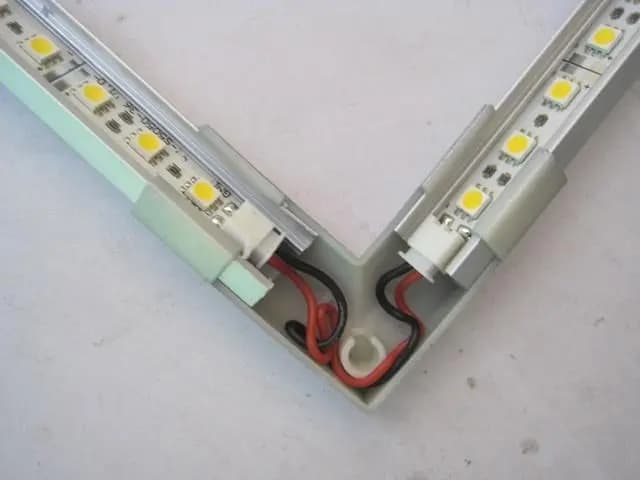
LED strips have only really begun to enter people’s lives in recent years. The installation of LED strips is different from that of incandescent lamps and energy-saving lamps in the past, and the requirements for installers are higher. How to install LED strips has become a new proposition. Today SignliteLED will walk with you into the relevant precautions for LED strip installation.
1. Power connection method
The general voltage of the LED strip is DC 12V, so a switching power supply is required for power supply. The size of the power supply is determined according to the power and connection length of the LED strip. If you don’t want to use one power supply to control each LED strip, you can buy a switching power supply with relatively high power as the total power supply, and then connect all the LED strip input power supplies in parallel (if the wire size is not enough, you can extend it additionally), Unified power supply by the general switching power supply. The advantage of this is that it can be controlled centrally. The inconvenience is that the lighting effect and switch control of a single LED strip cannot be realized. The specific method can be measured by yourself.
2. There is a “scissors” mark for each meter, and it can only be cut at the mark. If you cut it wrong or cut off, one meter will not be bright. It is best to carefully look at the position of the mark before cutting, and cut it at the place where there is no connection in the middle.
3. Pay attention to the connection distance of the LED strip
Generally speaking, the longest connection distance of 3528 series LED strips is 20 meters, and the longest connection distance of 5050 series LED strips is 15 meters. If the connection distance is exceeded, the LED strip will easily heat up, which will affect the service life of the LED strip during use. Therefore, when installing, it must be installed according to the manufacturer’s requirements, and the LED strip must not be overloaded.
4. Each LED strip must be equipped with a special plug (the plug has a transformer). When connecting, the transparent plastic cover must be removed, and then cover it after connecting the test light. Do not connect directly with a cover, it is easy to short circuit.
5. Outdoor installation
Outdoor installation will be exposed to wind and rain. If 3M glue is used to fix it, the 3M adhesive will decrease over time and cause the LED strip to fall off. Therefore, outdoor installation is often fixed by a card slot, which needs to be cut and connected. The place, the method is the same as the indoor installation, but it needs to be equipped with waterproof glue to strengthen the waterproof effect of the connection point.
6. Indoor installation
When the LED strip is used for interior decoration, it is very simple to install because it does not have to withstand wind and rain. There is a self-adhesive 3M double-sided adhesive on the back of each LED strip. When installing, you can directly tear off the sticker on the surface of the 3M double-sided adhesive, and then fix the light strip on the place where it needs to be installed, and press it flat with your hands. As for some places that need corners or are too long, what should I do? Very simple, the LED strip is a circuit structure composed of 3 LEDs in series and parallel, and each 3 LEDs can be cut and used separately.
7. Controller Connection
LED marquee light strips and RGB full-color light strips need to use controllers to achieve changing effects, and the control distance of each controller is different. Generally speaking, the control distance of simple controllers is 10 to 15 meters, and the control distance of remote controllers is 10 to 15 meters. The control distance is 15 to 20 meters, and the longest distance can be controlled to 30 meters. If the connection distance of the LED strip is long, and the controller cannot control such a long light strip, then a power amplifier is required for branching.
8. When installing the light strip, it is usually placed in the light trough, and it can be straightened, or it can be fixed with a string or thin wire. If external or vertical installation is required, clips and tail plugs need to be purchased separately. The original clip is completely transparent. If it is installed outdoors, it is best to apply waterproof glass glue on the tail plug and plug after installation, so that the waterproof performance is better.
When installing the LED strip, be sure to follow the concise product instructions and use the correct method to install it. If it is excessively twisted or used incorrectly, it will easily cause damage to the light strip, reduce the service life of the light strip and even cause damage. The light strip is not bright, which is not conducive to the maintenance of the light strip.
Related Posts