English
  简体中文
简体中文  Deutsch
  Español
  Français
  Italiano
  日本語
日本語  한국어
한국어  Polski
  Português
  Русский
  Türkçe
  Nederlands
  Tiếng Việt
  ไทย
ไทย 
LED neon strips have become the industry standard for architectural outlines, commercial signage, landscape lighting, and event design. They deliver the continuous, even glow of traditional glass neon without the fragility or high voltage.
However, a surprising number of LED neon strips fail in the field within months—not because the LEDs themselves are defective, but because of hidden reliability factors that most datasheets never mention.
These factors include:
- PCB substrate quality
- Solder mask integrity
- Thermal expansion mismatches
- Copper type (RA vs. ED)
- Tin whisker prevention
This article examines these engineering details and explains why some LED neon strips last 5+ years in harsh outdoor environments while others fail in a single season.
Why LED Neon Strips Fail in Real Applications

According to industry failure analysis data, LEDs themselves account for less than 10% of field failures. The real culprits are thermal and mechanical stress.
The Thermal Cycle Problem
Outdoor installations face daily and seasonal temperature swings—from -20°C to +60°C or more. Each thermal cycle causes materials to expand and contract at different rates.
After repeated cycles, stress accumulates at material interfaces, leading to:
- Micro-cracks in copper traces
- Solder joint fatigue
- Delamination between PCB layers
- Loss of waterproofing integrity
Why Flexible Strips Are More Vulnerable
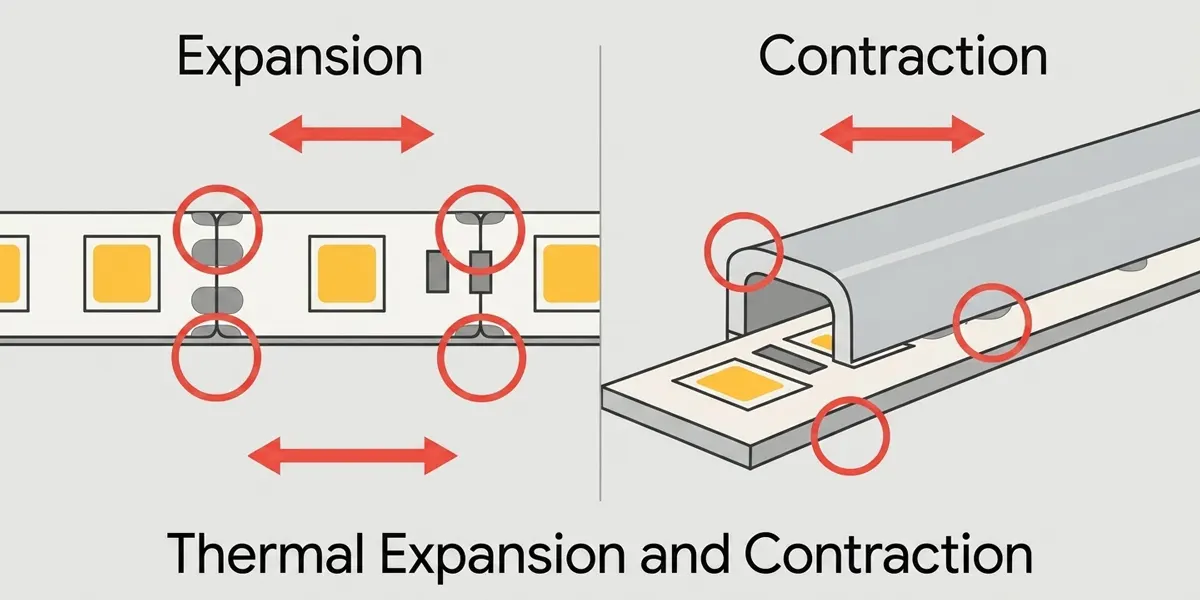
Flexible LED neon strips combine multiple materials with different coefficients of thermal expansion (CTE) .
| Material | CTE (ppm/°C) |
| Copper | 16–17 |
| Polyimide substrate | 20–30 |
| Solder mask | ~50 |
| Silicone encapsulation | 200–300 |
Every time the strip heats or cools, these materials expand at different rates. Over time, internal stress cracks solder joints and breaks copper traces—especially at bend points.
Common Field Failure Patterns
| Failure Mode | Root Cause |
| Intermittent flickering | Micro-cracks in solder joints opening/closing with temperature |
| Dead segments | Broken copper traces from repeated flexing or thermal stress |
| Moisture ingress | Cracks in silicone or along PCB allowing water to corrode traces |
| Color shift / yellowing | UV degradation of low-quality encapsulation (not the LEDs) |
Why Field Failures Happen?
Industry data confirms LED chips account for <10% of failures.The root cause is thermal & mechanical stress from real-world temperature cycles.
Outdoor conditions expose strips to -20°C to +60°C daily/seasonal swings.Repeated heating/cooling creates mismatched expansion between materials, leading to:
- Micro-cracks in copper traces
- Solder joint fatigue
- PCB delamination
- Loss of waterproofing
Critical Material Challenge: CTE Mismatch
Flexible neon strips combine materials with highly different thermal expansion rates (ppm/°C):
- Copper: 16–17
- Polyimide: 20–30
- Solder Mask: ~50
- Silicone: 200–300
This mismatch generates internal stress → cracks, breaks, and field failures.
How We Validate Reliability
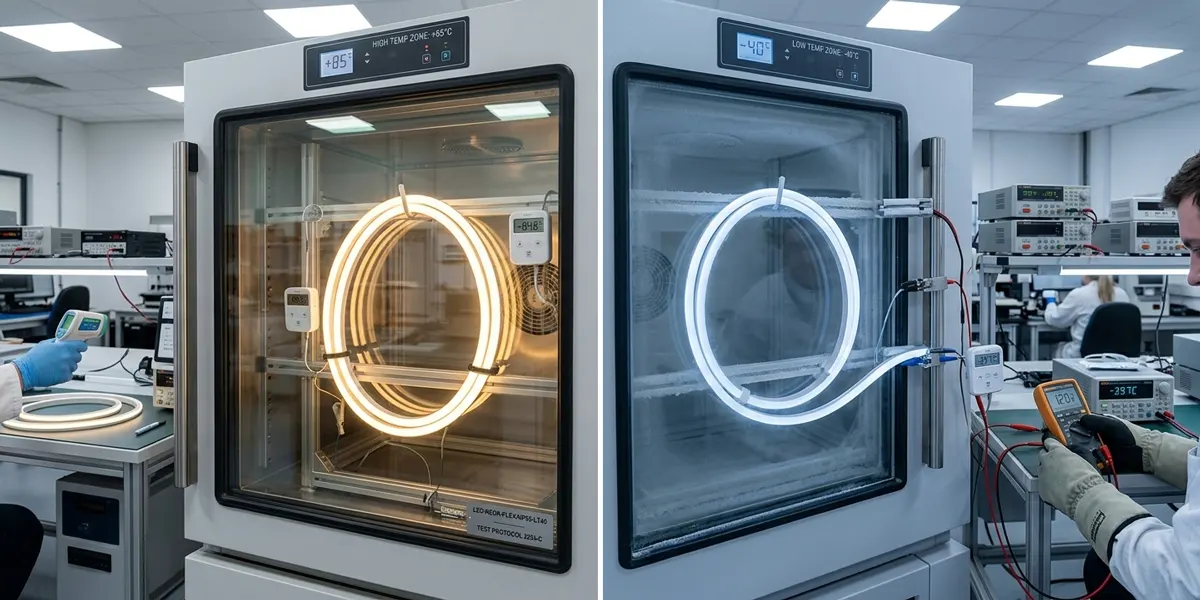
Thermal Cycle Test ValidationTest Conditions:
- Temperature Range: -40°C ↔ +85°C
- Total Cycles: 500 cycles
- Dwell Time: 30 min per phase
- Purpose: Simulate & accelerate long-term thermal stress
Test Results Summary (After 500 Extreme Cycles)
| Item | Result | Pass |
| Visual Appearance | No crack, yellowing, delamination | ✅ PASS |
| Electrical Performance | No flicker / dead segments | ✅ PASS |
| Voltage Shift (ΔVf) | < 3% | ✅ PASS |
| Lumen Maintenance | > 98% | ✅ PASS |
| Waterproof (IP67) | No moisture ingress | ✅ PASS |
| Solder & Traces | No fatigue / micro-cracks | ✅ PASS |
By passing 500 cycles of -40°C~+85°C thermal testing, SignliteLED neon strips resist CTE mismatch, thermal stress, and common failure modes.They deliver stable, long-lasting performance even under -20°C ~ +60°C outdoor conditions.
What’s Inside an LED Neon Strip PCB?
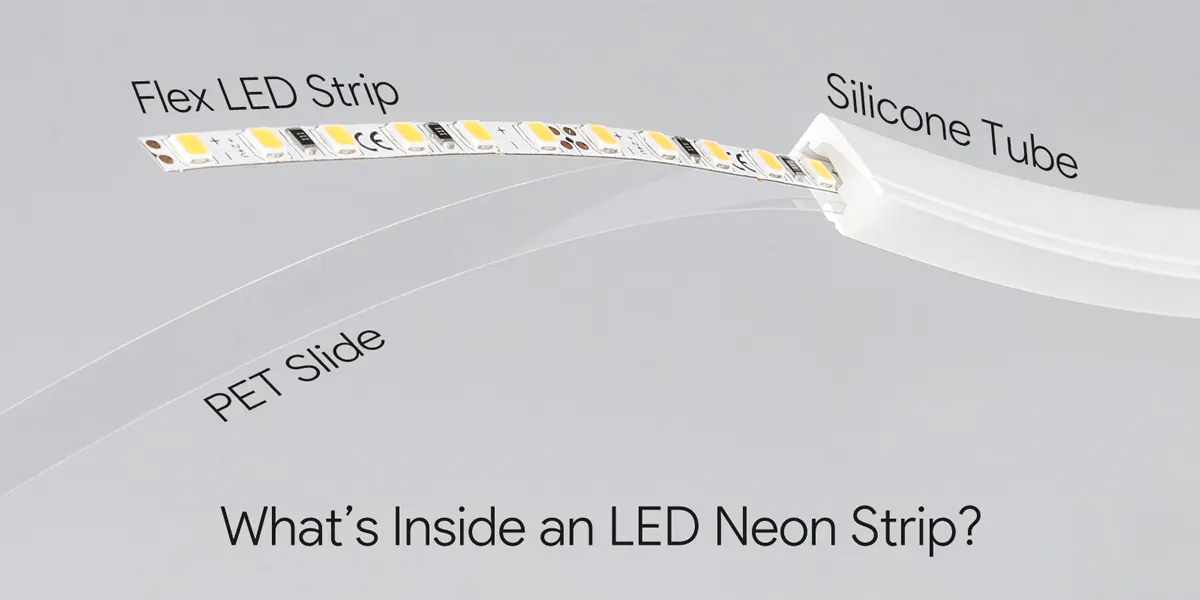
A typical flexible PCB (FPCB) for LED neon strips consists of multiple layers, each with a critical function.
Layer Structure
| Layer | Material | Function |
| Substrate | Polyimide (PI) or PET | Mechanical base |
| Adhesive | Acrylic or epoxy | Bonds copper to substrate |
| Copper layer | Rolled annealed (RA) or electrodeposited (ED) | Electrical traces |
| Solder mask | Flexible polymer | Insulation and protection |
| Silicone encapsulation | Optical-grade silicone | Weatherproofing + light diffusion |
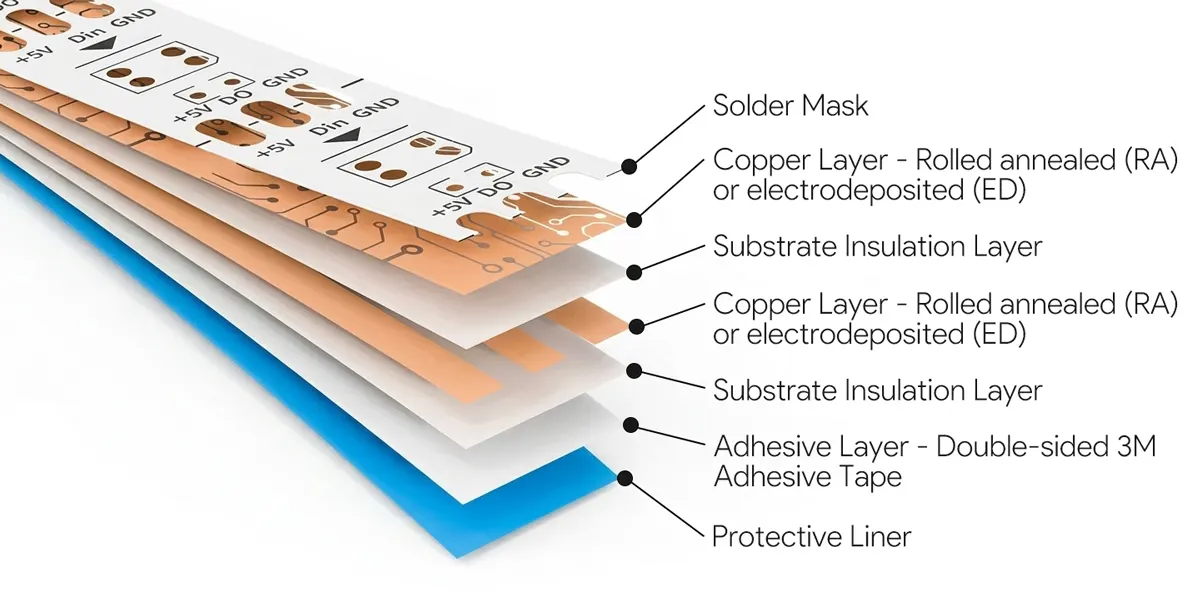
Material Choices That Matter
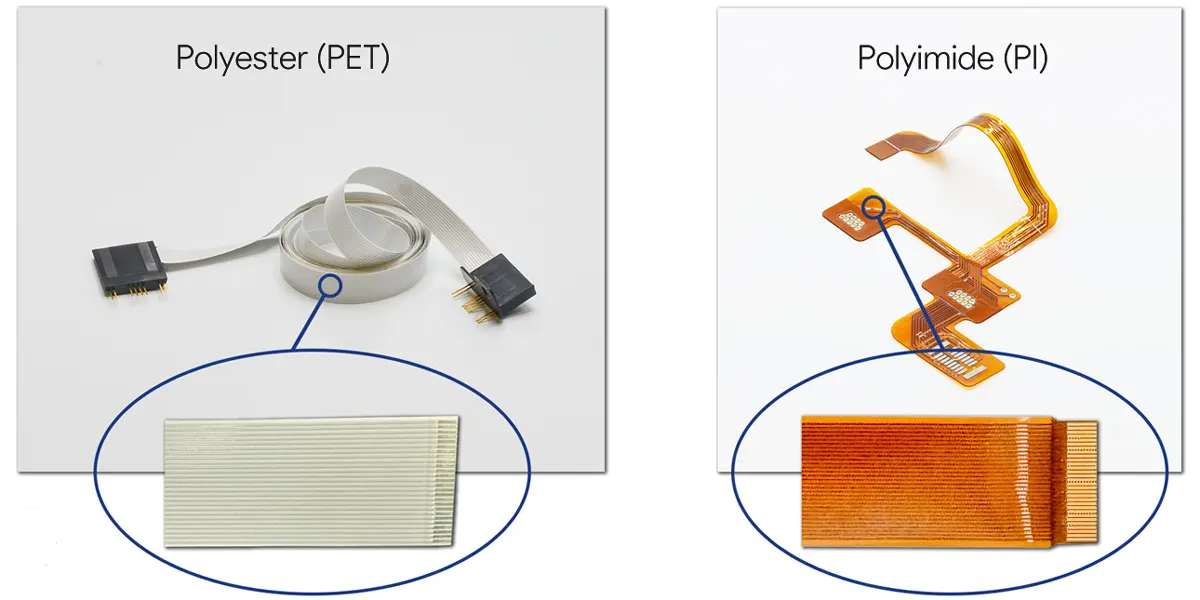
Polyimide vs. PET:
- Polyimide (PI): Withstands up to 400°C during soldering; durable for outdoor use.
- PET: Cheaper but lower heat resistance; not recommended for outdoor applications.
Rolled Annealed (RA) vs. Electrodeposited (ED) Copper:
- RA Copper: More ductile and fatigue-resistant—ideal for strips that bend during installation.
- ED Copper: Prone to cracking under repeated flexing.
- Copper thickness: 1oz (35µm) to 2oz (70µm). Thicker copper handles higher current but reduces flexibility.
What Does Solder Mask Actually Do?
Solder mask is a thin polymer layer applied over copper traces. In LED neon strips, it serves five essential functions:
- Prevents solder bridges during manufacturing
- Protects against oxidation (critical for outdoor use)
- Provides electrical insulation between traces
- Acts as a moisture barrier for IP-rated products
- Supports thermal management in high-temperature applications
Dry Film vs. Liquid Solder Mask
| Property | Dry Film | Liquid (LPSM) |
| Thickness uniformity | Excellent | Good |
| Fine-pitch capability | Good | Superior |
| Production cost | Higher for small runs | Lower at scale |
| Rework difficulty | Moderate | Easier |
| Best for | High-volume consistent production | Complex designs |
Both types work well when properly applied. However, low-cost strips often skip solder mask entirely—a mistake for any outdoor application.
White Solder Mask vs. No Solder Mask
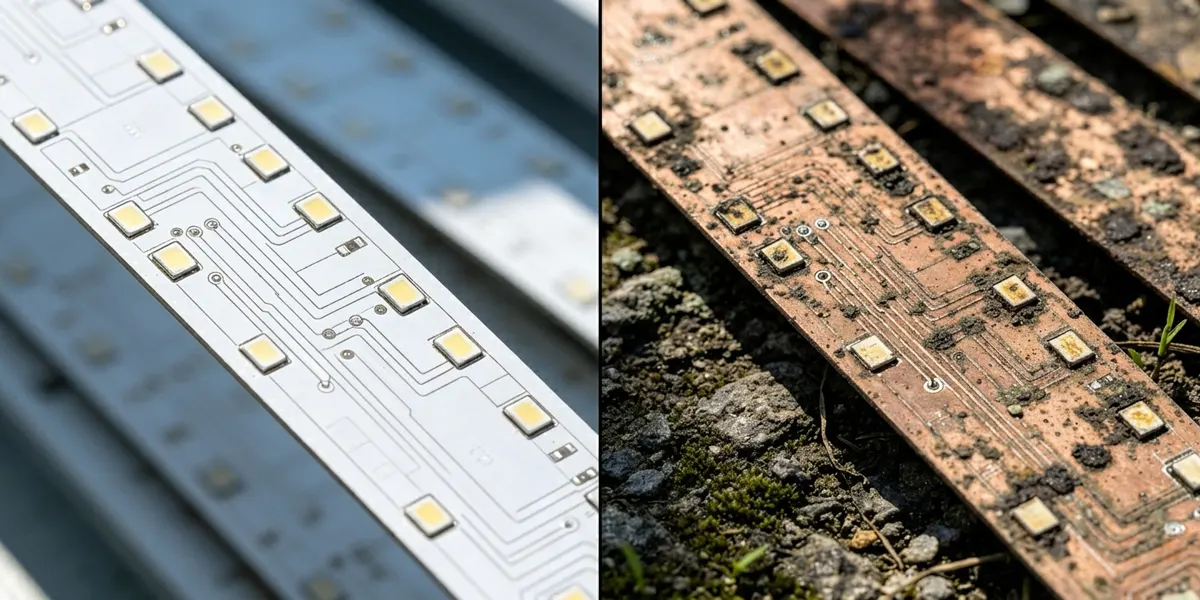
Some low-cost LED neon strips omit the solder mask entirely to save money or claim better heat dissipation. This is a critical failure point for outdoor or long-life applications.
| Feature | White Solder Mask | No Solder Mask |
| Oxidation protection | Yes | None |
| Solder bridge prevention | Yes | No |
| Light reflection | High (85-90%) | Low |
| Thermal dissipation | Moderate | Slightly better (negligible) |
| Long-term reliability | Proven (5+ years) | Very poor (weeks to months) |
Why “No Solder Mask” Is a Bad Trade-Off
Exposed copper oxidizes within weeks in humid environments. The small thermal benefit (typically <5% improvement) is negligible compared to the risk of corrosion-induced failure.
For any professional outdoor installation, a properly applied solder mask—especially white solder mask—is non-negotiable.
White solder masks reflect more light upward, improving optical efficiency by 15-20%. However, they require careful process control.
Thermal Reliability: Why Materials Matter More Than Price
Thermal reliability is the most underestimated factor in LED neon strip engineering. The question is not whether the strip works at room temperature—but whether it still works after 500 thermal cycles.
The CTE Mismatch Problem
When materials with different CTEs are bonded together, temperature changes create internal stress at their interfaces.
| Material Interface | CTE Mismatch | Failure Risk |
| Copper (17) vs. Polyimide (20-30) | Moderate | Micro-cracks over time |
| Solder mask (~50) vs. Copper (17) | High | Cracking or delamination |
| Silicone (200-300) vs. PCB | Extreme | Requires mechanical anchoring |
High-Temperature Solder Mask Materials
For outdoor applications exposed to direct sunlight and wide temperature swings, standard solder masks fail. High-temperature formulations offer:
- Glass transition temperature (Tg) above 130°C (some reach 170-180°C)
- Resistance to thermal cycling (e.g., 1000 hours from -40°C to 125°C)
- Better chemical and UV resistance
Cost vs. Reliability: Real-World Comparison
| Quality Level | Material Spec | Expected Outdoor Life | Typical Failure Point |
| Low-cost / Commodity | PET substrate, ED copper, no mask | 3-6 months | Solder joint cracks or trace corrosion |
| Mid-range | PI substrate, RA copper, liquid mask | 1-2 years | Solder mask delamination |
| Premium (SignliteLED) | High-Tg PI, RA copper, high-temp white mask | 5-8 years | LED lumen depreciation (not structural) |
The difference between a 6-month strip and a 5-year strip is often invisible on a datasheet but becomes obvious in the field.
SignliteLED publishes thermal cycle validation data for every outdoor neon strip series. Report reading → Neon LED Strip Aging Test Report – Reliability, Lumen Decay, and Color Stability Analysis.
Flexible PCB Challenges in Neon Strip Design
Flexibility is the defining feature of LED neon strips—and also the source of several unique failure modes.
1. Adhesion and Lamination
Repeated bending or thermal cycling can cause:
- Delamination – separation between solder mask and copper
- Cracking at bend points – especially if components are near bending zones
- Lifted pads – solder pads detach from substrate
2. Bend Radius Limits
Every flexible PCB has a minimum bend radius. Exceeding it—even once—causes invisible damage that leads to later failure.
| Flexing Type | Minimum Bend Radius | Application Example |
| Dynamic (repeated bending) | 100× material thickness | Moving installations |
| Static (bent once during install) | 10× material thickness | Corner wrapping |
Best practice: Stiffeners under LED and resistor locations prevent flexing where components mount, while allowing flexibility between segments.
3. The Trade-Off: Flexibility vs. Stability
| Design Approach | Flexibility | Thermal Stability | Best For |
| Adhesiveless copper-polyimide | Moderate | Excellent | Outdoor, wide temperature range |
| Adhesive-based | High | Moderate | Indoor, controlled environment |
SignliteLED uses adhesiveless bonding for outdoor-rated series, ensuring thermal stability without sacrificing flexibility.
Tin Whiskers: The Hidden Risk in Low-Cost LED Strips
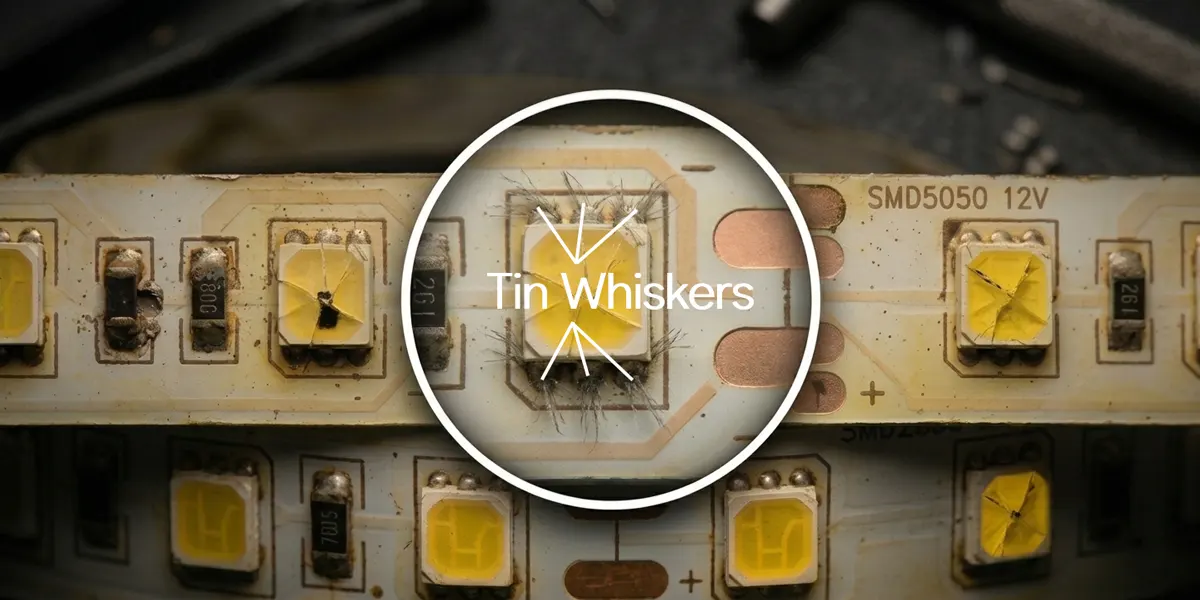
Tin whiskers are microscopic, needle-like metal crystals that spontaneously grow from tin-plated surfaces. They can reach several millimeters in length and cause short circuits between closely spaced copper traces.
Why This Matters for LED Neon Strips
After the RoHS directive restricted lead in solder, pure tin plating became common. Without lead to suppress growth, tin whiskers have caused field failures across many electronic product categories—including LED strips.
In a flexible PCB, whiskers can grow between traces with pitches as small as 0.5mm, creating intermittent or permanent shorts.
Risk factors:
- Poor-quality tin plating
- Inadequate process controls
- Lack of post-plating annealing
- Low-cost manufacturing
Whisker Mitigation Strategies
| Strategy | Low-Cost Strips | Premium (SignliteLED) |
| Optimized plating process | ❌ No | ✅ Yes |
| Post-plating heat treatment (annealing) | ❌ No | ✅ Yes |
| Conformal coating over critical areas | ❌ No | ✅ Yes |
| Tin alloy with whisker suppressors | ❌ Sometimes | ✅ Yes |
Tin whiskers are a rarely discussed but important differentiator between commodity products and engineering-grade solutions.
How High-Quality LED Neon Strips Are Engineered
Addressing the reliability factors above requires a systematic approach to materials, process control, and design.
Material Selection Summary
| Component | Preferred Specification (SignliteLED Standard) | Avoid |
| Substrate | High-Tg polyimide | PET or low-grade PI |
| Copper | Rolled annealed (RA) | Electrodeposited (ED) |
| Solder mask | High-temperature flexible white mask | Standard LPI or no mask |
| Encapsulation | UV-stabilized silicone | PVC or non-UV silicone |
| Tin plating | Whisker-mitigated process | Uncontrolled pure tin |
Key Process Controls
| Process | Purpose |
| Solder mask thickness control | Prevents “virtual soldering” (poor wetting) |
| Reflow profile management | Avoids brittle low-temperature solder paste |
| Automated optical inspection (AOI) | Detects solder defects before encapsulation |
| Thermal cycling validation | Simulates real-world swings (-40°C to +85°C, 500+ cycles) |
Outdoor-Ready Design Features
- IP67 or IP68 waterproofing with molded end caps and dual seals
- UV-stabilized silicone with 3,000-hour accelerated UV testing (equivalent to 9+ years outdoors)
- Operating temperature range of -40°C to +60°C
- Mechanical stress relief at cable entries and between segments
How High-Quality LED Co-Extruded Neon Strips Are Made

Conclusion
LED neon strip reliability is not determined by LED brand or price per meter. It is determined by hidden engineering details:
- PCB substrate quality (Polyimide vs. PET)
- Copper type (RA vs. ED)
- Solder mask integrity (white mask vs. no mask)
- CTE management
- Tin whisker prevention
- Process controls that most buyers never see
Outdoor environments are unforgiving. Temperature swings, UV exposure, moisture, and mechanical stress accumulate over time. Strips that look identical at purchase can diverge dramatically in longevity based on material choices that are rarely highlighted in marketing materials.
For specifiers and lighting professionals, the lowest upfront cost is rarely the lowest total cost of ownership.
When evaluating LED neon strips for outdoor or long-life applications, look beyond brightness and ask for engineering details. The difference between a strip that fails in six months and one that lasts five years is found not in the LEDs—but in the layers below them.
Why Specifiers Choose SignliteLED
| Requirement | SignliteLED Standard |
| Substrate | High-Tg Polyimide |
| Copper | Rolled Annealed (RA) |
| Solder Mask | High-Temp White Mask |
| Encapsulation | UV-Stabilized Silicone |
| Thermal Validation | 500 cycles, -40°C to +85°C |
| Whisker Mitigation | Yes (post-plating annealing) |
| Warranty | 5-year limited |
Ready to specify reliable LED neon strips for your next project? Browse SignliteLED Outdoor LED Neon Flex.
FAQs
Related Posts