English
  简体中文
简体中文  Deutsch
  Español
  Français
  Italiano
  日本語
日本語  한국어
한국어  Polski
  Português
  Русский
  Türkçe
  Nederlands
  Tiếng Việt
  ไทย
ไทย 
In open-plan offices, modern meeting rooms, and high-end restaurants, noise has become the number one enemy affecting experience and efficiency. Sound-absorbing LED lights have emerged as a solution, integrating lighting with acoustic treatment.
But how do you evaluate their noise reduction performance? And what NRC value should you choose for different spaces? In contemporary architectural acoustics, these have become widely discussed topics. Behind them lie three core needs:
- Clear technical standards
- Recommended NRC ranges for different spaces
- A practical product selection guide
This article will combine ASTM, LED, and other industry standards to provide actionable selection guidelines, parameter comparison tables, and FAQs—helping designers, procurement professionals, and end users make informed decisions.
What is NRC (Noise Reduction Coefficient)?
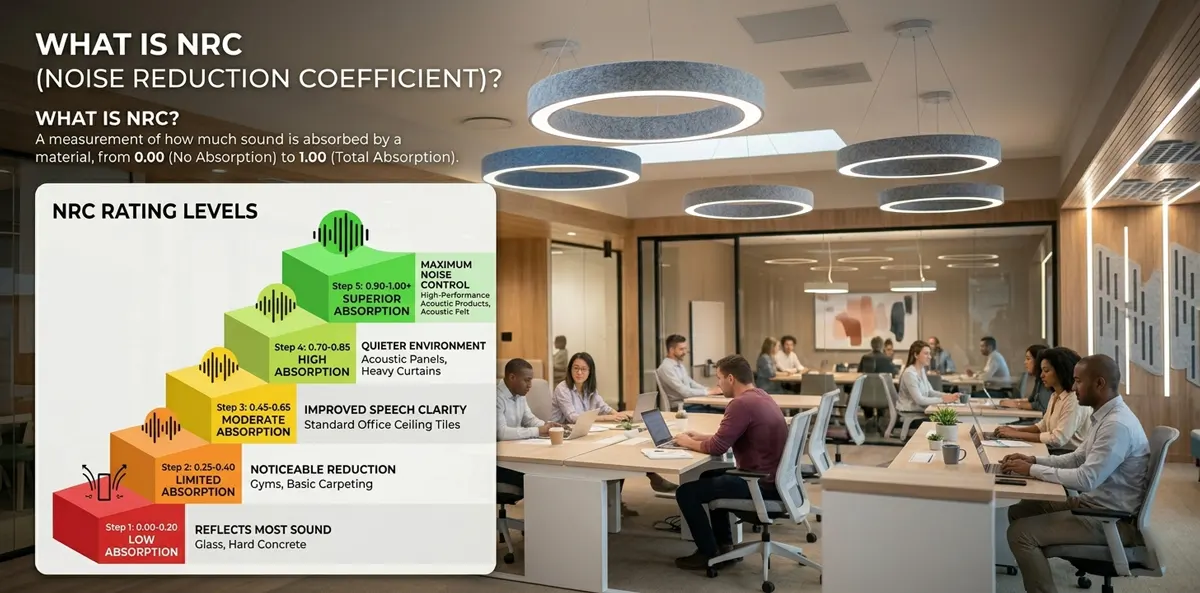
NRC (Noise Reduction Coefficient) is a standardized metric used in acoustics to evaluate the sound absorption performance of materials. It provides a single-number rating that reflects how effectively a material absorbs sound, particularly in the mid-to-high frequency range.
Definition of NRC
According to ASTM C423 published by ASTM International: NRC measures the sound absorption coefficients of the material at four center frequencies of 250Hz, 500Hz, 1000Hz and 2000Hz, takes the arithmetic mean of them, and finally rounds to the nearest 0.05 to obtain the result.
This test is typically conducted in a reverberation chamber and follows recognized standards such as ASTM,ensuring data reliability and cross-comparability.
What Does the NRC Value Represent?
NRC (Noise Reduction Coefficient) is a key indicator for measuring the sound absorption performance of materials, with a value range from 0 to 1. The closer it is to 1, the stronger the material’s ability to absorb sound.
NRC Value Range and Corresponding Sound Absorption Levels in Acoustic Engineering Applications
| NRC Value Range | Sound Absorption Level | Engineering Significance |
| 0.00 – 0.20 | Highly Reflective | Not suitable for acoustic control applications |
| 0.20 – 0.50 | Basic Absorption | Provides slight acoustic improvement |
| 0.50 – 0.70 | Moderate Absorption | Suitable for general noise reduction |
| 0.70 – 0.80 | High Absorption | Recommended for commercial spaces |
| ≥ 0.80 | Excellent / High-Efficiency Absorption | Suitable for professional acoustic control environments |
Recommended NRC Levels for Different Spaces
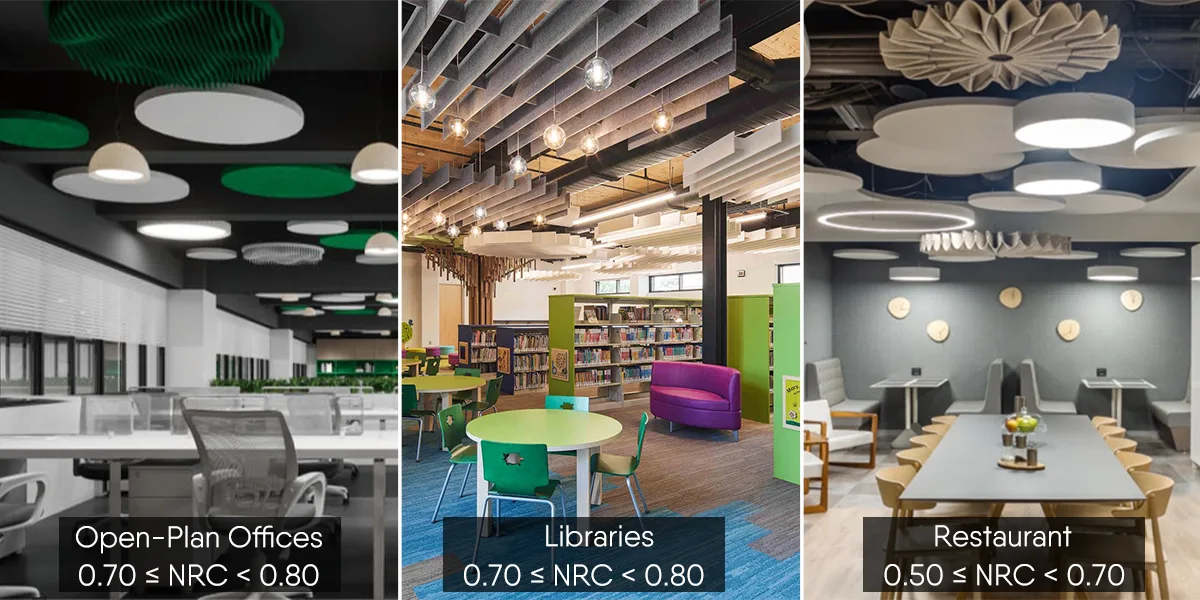
The acoustic environment requirements for different spaces vary significantly. The following table provides specific NRC selection suggestions based on international acoustic design practices and standards.
Recommended NRC Ratings for Acoustic Lighting by Space Type
| Space Type | Recommended NRC Range | Acoustic Goal | Selection Rationale & Scientific Basis |
| Open-Plan Offices | 0.70 – 0.80 | Reduce background noise, enhance focus | Basis: LEED v4.1 Acoustic Credit requires absorptive materials in shared spaces to have NRC ≥ 0.70. Principle: This range effectively suppresses the “Cocktail Party Effect,” reducing speech interference distance from 15 meters to within 8 meters. |
| Conference / Video Conference Rooms | 0.80 – 0.90 | Enhance speech clarity | Basis: ITU-T P.1100 standards recommend reverberation time (RT60) between 0.3-0.6 seconds for conference rooms. Principle: High NRC fixtures eliminate flutter echoes in the 300-2000Hz range, ensuring remote conference speech intelligibility (STI) > 0.75. |
| Classrooms / Libraries | 0.70 – 0.85 | Improve speech intelligibility | Basis: ANSI/ASA S12.60 standard mandates unoccupied classroom RT60 < 0.6 seconds. Data: Ceiling materials with NRC 0.8 can improve speech intelligibility scores by 15-20%. |
| Hospital Wards / Clinics | 0.80 – 0.85 | Ensure patient privacy and rest | Basis: FGI Guidelines recommend background noise ≤ 35 dBA in patient rooms. Principle: Absorbs mid-to-high frequency medical equipment noise (e.g., monitor alarms), reducing patient stress hormone levels. |
| Restaurants / Cafés | 0.60 – 0.75 | Balance ambiance and conversation | Principle: This is the “sweet spot” balancing liveliness and clarity. NRC < 0.6 can lead to noise stress (>70 dBA); NRC > 0.8 can make the space feel too dead. |
| Industrial Facilities / Warehouses | 0.50 – 0.70 | Reduce machinery noise, ensure safety | Basis: OSHA recommends 8-hour exposure ≤ 85 dBA. Focus: Prioritize absorbing high-frequency noise (>500Hz) to make verbal alarms and instructions clearly audible. |
| Corridors / Lobbies / Atriums | 0.80 – 0.90 | Eliminate echoes | Principle: These spaces often feature hard surfaces and high ceilings, leading to RT60 often > 3 seconds. High NRC is essential to “cut” long reverberation times. |
| High-End Retail / Boutiques | 0.65 – 0.75 | Create immersive shopping experience | Principle: Moderate absorption makes background music clearer and conversation easier for customers, increasing dwell time. |
| Residential / Apartments | 0.50 – 0.70 | Enhance daily comfort | Principle: NRC 0.6 is sufficient for everyday noise (TV, conversation), avoiding an overly “dead” acoustic environment. |
- For most commercial Spaces, an NRC range of 0.70 to 0.85 is ideal.
- For meeting rooms or Spaces with high requirements for clear voice, it is recommended that the NRC be ≥ 0.80.
Comparison of NRC With Other Acoustic Metrics
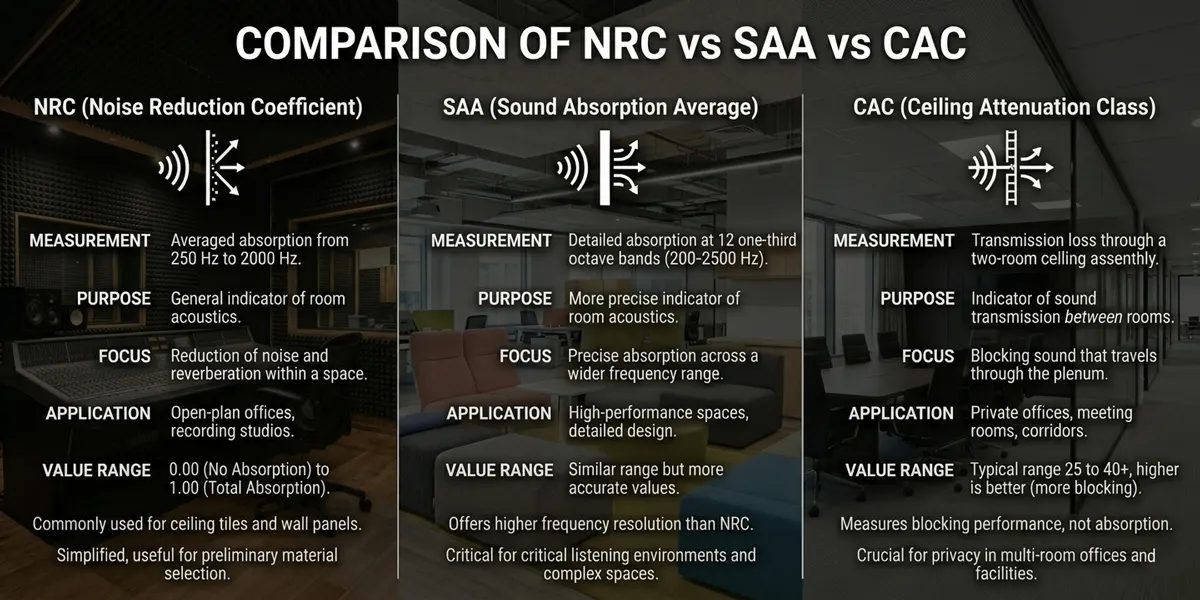
Designers sometimes encounter terms such as SAA and CAC. Distinguishing them can help with precise selection.
| Metric | Full Name | What It Measures | Relevance to Acoustic Lighting |
| NRC | Noise Reduction Coefficient | Average sound absorption coefficient at four frequencies (250, 500, 1000, 2000 Hz) | Core indicator that directly reflects the fixture’s ability to absorb mid-frequency sounds (especially human speech) |
| SAA | Sound Absorption Average | Average of sound absorption coefficients across 12 one-third octave bands (more detailed analysis) | Highly correlated with NRC. Products with high NRC typically also have high SAA; useful as a supplementary reference. |
| CAC | Ceiling Attenuation Class | Sound transmission loss through the ceiling plenum between adjacent | Used to evaluate speech privacy between rooms. Not directly related to the sound absorption performance of the lighting fixture itself. |
NRC vs. SAA(Sound Absorption Average)
| Comparison Item | NRC | SAA |
| Standard | ASTM C423 | ASTM C423 (Updated Version) |
| Frequency Bands | 4 frequency bands | 12 frequency bands (more detailed) |
| Accuracy | Relatively coarse | More precise |
| Modern Application | Still widely used | Increasingly common in modern acoustic projects |
NRC is typically used to assess the overall sound absorption capacity of materials, while SAA and CAC respectively focus on the acoustic performance of walls and ceilings.
SAA is more precise than NRC, and many high-end projects have begun to give priority to using SAA.
Reference standard:
- International Organization for Standardization issue ISO 11654
- U.S. Green Building Council LEED v4 Acoustic recommendatio
- International WELL Building Institute WELL Building Standard
These standards all recommend the use of “high sound absorption materials (NRC ≥ 0.75)” in office Spaces to enhance acoustic comfort.
How Sound-Absorbing LED Lights Improve Speech Clarity?
1. Reverberation time (RT60) influence
Actual measurement and comparison in a 50-square-meter meeting room:
| Condition | Reverberation Time (seconds) |
| No absorption | 2.0 – 2.3 |
| NRC 0.75 | 1.4 – 1.6 |
| NRC 0.85 | 1.1 – 1.3 |
The Voice transmission Index (STI) can be raised from 0.60 to above 0.75. This directly affects the quality of video conferences and the concentration of employees.
2. The reduction of noise interference by sound-absorbing LED lights
Sound-absorbing LED lights can effectively reduce the reflection of environmental noise, especially in open-plan offices and large meeting rooms, to minimize background noise interference and enhance voice clarity. For instance, lamps with an NRC of 0.85 or above can significantly reduce noise, minimize interference, and enhance communication quality.
Structural Principle of Sound-Absorbing LED Lights
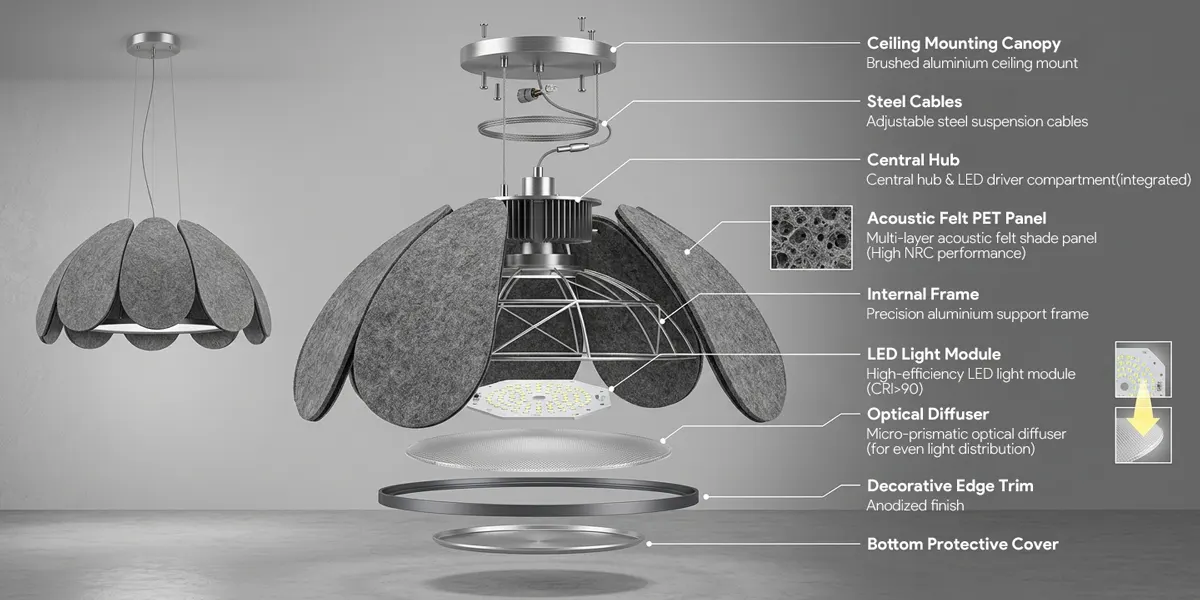
Structural Hierarchy
- Porous PET sound-absorbing layer
- Porous PET Acostic layer
- Honeycomb structure cavity
- LED light module
Sound waves enter the interior of the material and are converted into thermal energy through friction, achieving absorption.
How to Choose the Right Sound-Absorbing LED Light?
Three-step selection method:
Step 1: Determine the target NRC (Acoustic performance)
- Open office: ≥0.75
- Conference Room: ≥0.80
- Factory: ≥0.60
Step 2: Review the test report (Material safety and durability)
It must be confirmed:
- Whether it is tested in accordance with ASTM C423
- Whether complete laboratory data is provided
- Is there any third-party certification
Step 3: Evaluate the lighting performance (optical performance)
Sound-absorbing lamps are first and foremost lamps and must meet the lighting requirements:
- UGR <19 In visual work environments such as offices and classrooms, UGR <19 is required to avoid direct glare.
- For CRI ≥90, it is recommended that Ra ≥90 to ensure true color reproduction
- Color temperature: 3000-4000K. For office use, 4000K neutral light is recommended. For residences or restaurants, 2700K-3000K warm light can be selected.
- The luminous efficacy of ≥100 lm/W meets the basic requirements of green lighting.
SignliteLED’s sound-absorbing lights not only focus on their acoustic performance but also pay attention to the appearance design of the lamps. The sound-absorbing lamp shown in the picture below adopts a honeycomb structure with a UGR < 19. It achieves an NRC of 0.75 and features a seasonal anti-glare design, making it suitable for use in family living rooms.
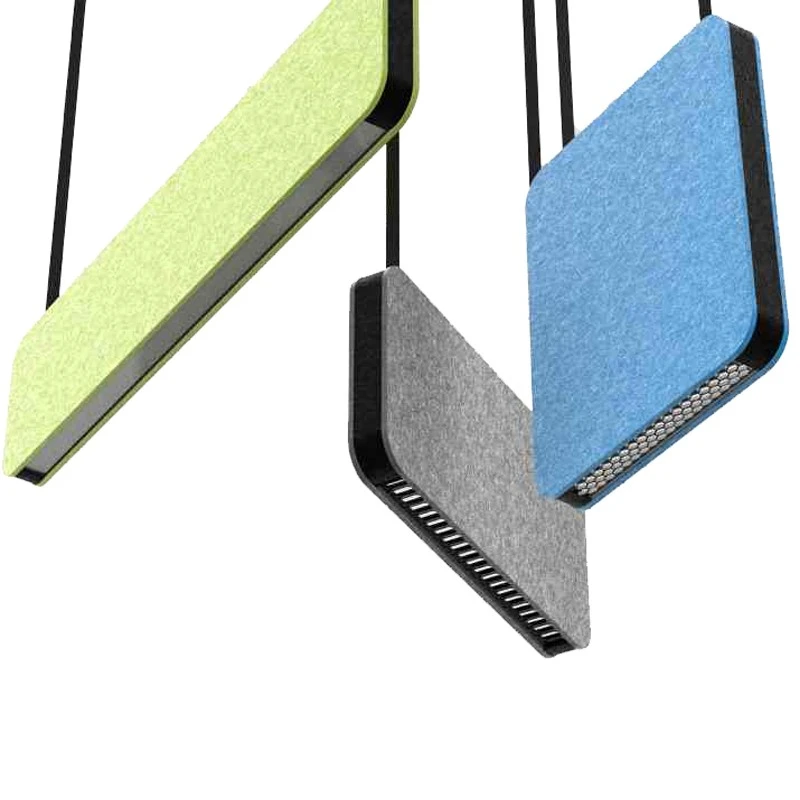
Super Slim Acoustic LED Linear Light
Input Voltage: AC100-277V / AC220-240V, 50-60Hz
Emitting Direction: Downward
Size: 1218×36×400mm
CCT: 3000K / 4000K / 6000K
Power: 30W
Luminous Flux: 100-110 lm/W
CRI: 80/90
PF: >0.9
Fllicker Free: Yes
Beam Angle: 120°
IP Grade: IP20
Warranty: 5 Years
Felt Acoustic Board Color: Red / Green / Blue / Grey more than 48 colors option
Is a higher NRC always better?
No. Excessively high NRC (such as 0.95) may:
- Cause “acoustic dryness” in the space
- Loss of the natural acoustic environment
- Increased costs
Commercial Spaces should pursue “balanced sound absorption”.
Industry Trend: Integrated Acoustic and Lighting Design
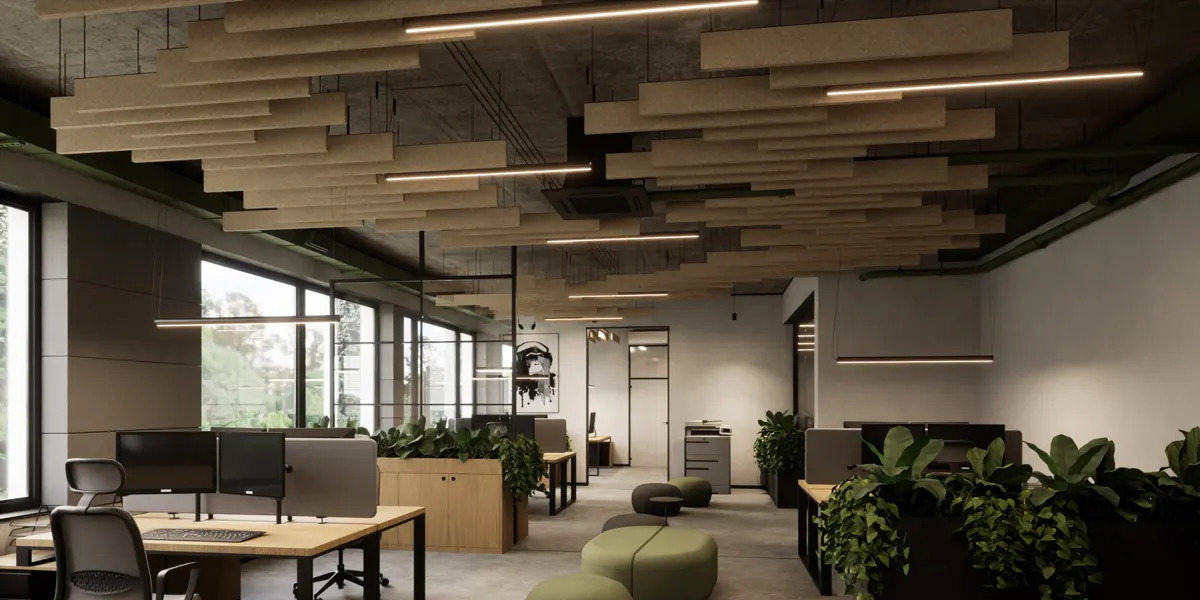
The current trend of green buildings emphasizes:
- Visual comfort
- Acoustic comfort
- Energy efficiency
Sound-absorbing LED lights have become an increasingly common solution in LED and WELL projects. In the future, smart office Spaces will no longer separate “lighting design” from “acoustic design”.
Conclusion
As people’s demands for spatial comfort increase, acoustic lighting has become a standard element in architectural design. Understanding the NRC rating and choosing the appropriate products based on different scenarios is a crucial step in creating a high-quality environment.
SignliteLED recommended to collaborate with lighting designers and acoustic consultants at the early stage of the project to jointly formulate the layout plan for sound-absorbing lamps and verify the final effect through actual measurement.
The next time you face the question, “What NRC rating is suitable for acoustic lighting?”, please remember: There is no best NRC, only the most suitable one. By referring to the recommendation table in this article and combining the spatial function with aesthetic needs, you will be able to make a wise decision.
FAQs
Related Posts